twi-ny recommended events

THE NAP

(photo by Joan Marcus)

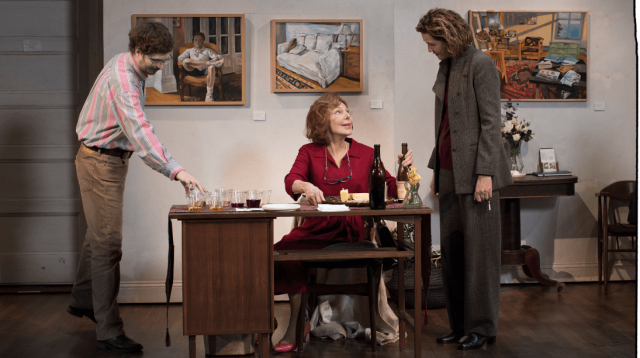
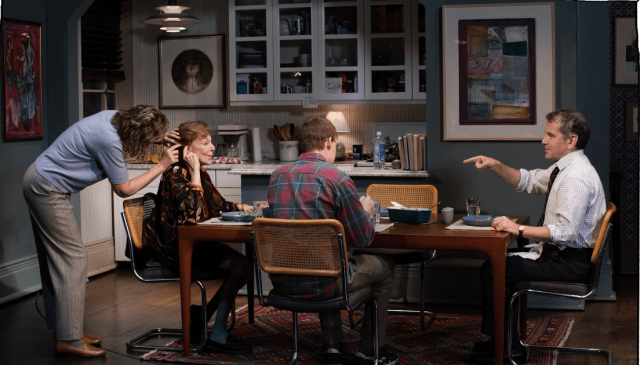
Dylan Spokes (Ben Schnetzer) is none too happy with what his mother (Johanna Day) has gotten him into in The Nap (photo by Joan Marcus)

Manhattan Theatre Club at the Samuel J. Friedman Theatre
261 West 47th St. between Broadway & Eighth Aves.
Tuesday – Sunday through November 11, $79-$199
thenapbroadway.com

You don’t have to know the slightest bit about snooker to have a jolly good time at The Nap, the rousing London transfer making its American premiere at Manhattan Theatre Club’s Samuel J. Friedman Theatre through November 11. Written by Olivier Award nominee Richard Bean, who wrote the uproarious hit One Man, Two Guvnors, which exploded the career of a young James Corden, The Nap is a tense and very funny crime thriller built around the highly contested world of snooker, the nineteenth-century cue sport similar to pocket billiards and pool. Twenty-three-year-old Dylan Spokes (Ben Schnetzer) is on the rise, preparing for a big-time match. He’s practicing in the British Legion basement in Sheffield with his grumpy, not-too-bright father, the numbers-challenged and ersatz snooker historian Bobby (John Ellison Conlee). Dylan is an easygoing fellow who believes in self-actualization. “It’s the highest possible state of human happiness, when your mind and body come together in, like, a beautiful symphony,” he tells his father, a former amateur snooker player who doesn’t get it at all, responding, “Do you want an orange? Got a bag full.” They are unexpectedly visited by Mohammad Butt (Bhavesh Patel), who identifies himself as an integrity officer for the International Centre for Sport Security, and Eleanor Lavery (Heather Lind), of the National Crime Agency.

(photo by Joan Marcus)

Dylan Spokes (Ben Schnetzer) gets a little too cozy with crime investigator Eleanor Lavery (Heather Lind) in Richard Bean’s The Nap (photo by Joan Marcus)

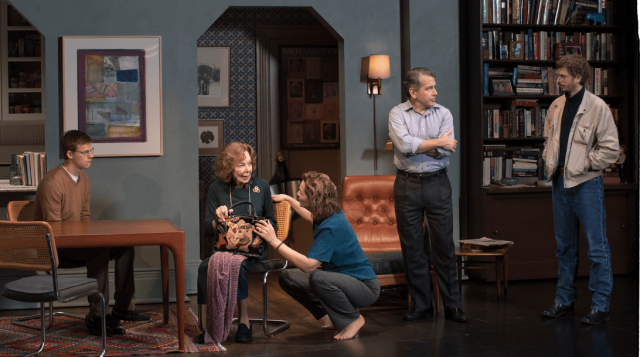
They claim that Dylan is involved in match fixing and global illegal betting, a charge he adamantly denies. “I am not vulnerable. I honour my game,” he declares. “Snooker is the result of a century of human negotiation. A celebration of cooperation and civilisation. It doesn’t exist other than in the hearts of players and fans.” After Mo and Eleanor leave, Dylan and Bobby are first joined by Dylan’s oh-so-stylish, fast-talking manager, Tony DanLino (Max Gordon Moore), then by Dylan’s wacky mother, Stella (Johanna Day), and her new boyfriend, Danny Killeen (Thomas Jay Ryan), a boring driving instructor. It turns out that Stella, Bobby’s ex, needs money, and she wants Dylan to get it for her — by going against his principles and throwing a frame. It turns out that Dylan has financial issues he wasn’t aware of; he’s in deeper than he ever realized, and the only way out is to listen to transgender gangster Waxy Bush (Alexandra Billings), who has a way with words. “Dylan, let me give you some advice,” she says. “Life, for us vertebrates, is a series of disappointments and appointments. The key to happiness is to forget your disappointments and remember your appointments; in fact, write them down, preferably in a dairy.” As Dylan’s matches with Abdul Fattah and Baghawi Quereshi (both played by former snooker champion Ahmed Aly Elsayed) approach, he has to decide where his loyalties lie and what he is willing to risk, and for whom.

(photo by Joan Marcus)

The Nap features a pair of very tense, live snooker matches with champion Ahmed Aly Elsayed (photo by Joan Marcus)

The title of the show is a snooker term referring to the smoothness of the table, which Dylan explains to Eleanor early on. “Playing with the nap, the ball will run straight with the natural line,” he says. “Playing against the nap, the ball can deviate and drift off line. I play straight. I honour the god of snooker, and he, or let’s be fair, she, looks after me.” Bean (The Heretic, Harvest) and Tony-winning director Daniel Sullivan (The Little Foxes, Proof) honour the god of the stage in this triumphant comedy while not being afraid to deviate and drift off line. Snooker might be an individual sport, but theater requires significant collaboration, and The Nap demonstrates that in all facets. The ensemble, which also includes Ethan Hova as Seth and a snooker referee, is terrific, with a particular shout-out to American actor Ryan (Dance Nation, The Amateurs), one of the city’s most underrated and understated treasures. David Rockwell’s sets rotate from the dank legion basement to a historic hotel room, from a country hideout to a championship snooker match, complete with riotously funny voice-over commentary that is partially improvised. The snooker matches themselves are tense and exciting, occurring live onstage. But once again, it doesn’t matter what you think about sports and gambling, as Bean has plenty to say about dysfunctional families, straight and LGBTQ romance, the criminal element, and vegetarianism. The Nap is a champion on all counts, clearing the table, knocking every ball into the right pocket.

TICKET GIVEAWAY — KENNEDY: BOBBY’S LAST CRUSADE

David Arrow plays Bobby Kennedy in one-man show he also wrote (photo by Russ Rowland)

David Arrow plays Bobby Kennedy in one-man show he also wrote (photo by Russ Rowland)

KENNEDY: BOBBY’S LAST CRUSADE
Theatre at St. Clement’s
423 West 46th St. between Ninth & Tenth Aves.
Wednesday – Sunday through December 9, $55-$85 (use code KNDYGEN for discount)
866-811-4111
www.kennedybobbyslastcrusade.com
www.stclementsnyc.org

On June 6, 1968, Robert F. Kennedy was assassinated by Sirhan Sirhan at the Ambassador Hotel in Los Angeles during a presidential campaign stop. This month Bobby, the former US attorney general and, at the time of his death, New York senator, would have turned ninety-three. The new one-man show Kennedy: Bobby’s Last Crusade honors the legacy of the man known as RFK upon the fiftieth anniversary of his murder. The world premiere at the Theatre at St. Clement’s was written by and stars David Arrow as Kennedy; “The Kennedys are a political dynasty and have had a lasting effect on America, and fifty years later the words of Bobby Kennedy need to be repeated so that we as Americans can remember that politics used to be about ideas and ideals, not about us versus them,” Arrow notes in a statement. The story focuses on Kennedy’s 1968 presidential campaign and is drawn from his public speeches and lesser-known private events; Arrow previously portrayed Kennedy in Jack Holmes’s solo show RFK, winning the San Francisco Bay Area Theatre Critics Circle Award for his performance, topping Anna Deavere Smith, Steven Abbott, and Geoff Sobelle. The play is directed by Eric Nightengale, with set design by Jim Morgan and lighting by Miriam Crowe.

TICKET GIVEAWAY: Kennedy: Bobby’s Last Crusade runs through December 9 (with a November 8 opening) at the Theatre at St. Clement’s, and twi-ny has three pairs of tickets to give away for free. Just send your name, daytime phone number, and favorite play involving a real-life politician to contest@twi-ny.com by Wednesday, November 7, at 3:00 pm to be eligible. All entrants must be twenty-one years of age or older; three winners will be selected at random.

SCIENCE ON SCREEN — RHINOCEROS: THE DECLINE OF CIVILIZATION

Zero Mostel and Gene Wilder

Zero Mostel and Gene Wilder can only do so much to battle fascism and conformity in Rhinoceros

RHINOCEROS (Tom O’Horgan, 1974)
Museum of the Moving Image, Redstone Theater
35th Ave. at 36th St., Astoria
Sunday, November 4, $15, 6:30
718-777-6800
www.movingimage.us

Seven years after striking comedy gold in Mel Brooks’s The Producers, Zero Mostel and Gene Wilder teamed up again in the misguided, misbegotten Rhinoceros, Tom O’Horgan’s completely mishandled cinematic adaptation of Eugène Ionesco’s 1959 Theatre of the Absurd classic. Mostel reprises the role of bon vivant John (Jean), which earned him a Tony, while Wilder is his downstairs neighbor Stanley (Bérenger), a schlemiel of an accountant. Stanley is in love with his coworker Daisy (Karen Black), which coincidentally is the same name as the sheep Wilder’s character falls hard for in Woody Allen’s 1972 Everything You Always Wanted to Know About Sex *But Were Afraid to Ask. But this time the animal problem involves the rhinoceros, some species of which in the twenty-first century are endangered because they are illegally hunted for their horns and by big-gamers filling their trophy cases. The plot deals with individuality and fascism as humanity threatens to become extinct as the strong-skinned rhino starts taking over the streets, even though we never see them. Meta and metaphors abound in the wacky, way-too-over-the-top slapstick farce, which never gains traction; even the 1970s score is utterly absurd, and not in a good way. I’ve seen a terrific production of the play in French and a disappointing one in Yiddish, but the movie is in its own oddball category.

Rhinoceros is screening November 4 at 6:30 at the Museum of the Moving Image as part of the “Science on Screen” series, with political scientist Ester Fuchs, author of Mayors and Money: Fiscal Policy in New York and Chicago and director of WhosOnTheBallot.org, and Theresa Rebeck, writer of such current shows as Bernhardt/Hamlet and Downstairs — and who wrote her own adaptation of Rhinoceros in 1996 — attempting to examine the film within the context of the decline of civilization today, particularly under President Donald Trump, whose sons are trophy hunters themselves.

JORGE PALACIOS: LINK

Palacios’s (photo by twi-ny/mdr)

Jorge Palacios’s “Link” stands in the shadow of the Flatiron Building (photo by twi-ny/mdr)

Flatiron Plaza North
Intersection of Broadway, Fifth Ave., and 23rd St.
Through November 6, free
www.noguchi.org
link slideshow

“Jorge Palacios at the Noguchi Museum” continues through January 20 at the Long Island City institution, the museum that opened in 1985 by sculptor Isamu Noguchi, who was born in Los Angeles, raised in Japan, and lived and worked in New York for much of his career. In conjunction with the exhibition, which features nine pieces by Spanish sculptor Jorge Palacios that were inspired by Noguchi’s experimental style, Palacios’s monumental “Link” is on view through November 6 on Flatiron Plaza North. The smooth sculpture, a tribute to Noguchi’s work in public spaces that involved scale and civic engagement — for example, “Red Cube” in the Financial District — stands thirteen feet high and ten feet wide, consisting of narrow, rectangular pieces of Accoya wood that effortlessly wrap around to form an abstract shape that resembles an alien figure, a human rear end, or even a Humpty Dumpy-like character, with a small hole in the bottom. A collaboration between the New York City Department of Transportation’s Art Program, the Flatiron/23rd Street Partnership Business Improvement District, and the Noguchi Museum, “Link” is fun distraction in a crowded area, whether seen up close or from afar, the Flatiron Building rising behind it.

DISTANT CONSTELLATION

Selma in Distant Constellation

Selma tells the heartbreaking story of her family during the Armenian genocide in Distant Constellation

DISTANT CONSTELLATION (Shevaun Mizrahi, 2018)
Metrograph
7 Ludlow St. between Canal & Hester Sts.
Opens Friday, November 2
212-660-0312
metrograph.com
grasshopperfilm.com

Shevaun Mizrahi’s debut feature, Distant Constellation, is a lovely, intimate portrait of a group of residents at an old age home in Istanbul who just go about their business or share deeply personal stories while major construction outside tears down the past to build a future the senior citizens will not be a part of. Two men spend much of their day going up and down in the elevator, making fun of each other, talking about aliens, and not wanting to be bothered by anyone else. A man is delighted to bring in halvah. A photographer who now can barely see repeats words and phrases as he tries to fix his flash. A man sleeps in a coffinlike bed, coughing, gasping, and singing as the wind whistles through the window. A woman tells the heart-wrenching tale of what she and her family went through during the Armenian genocide of 1915. And another man talks about his unending passion for sex and eroticism, reading passages from Vladimir Nabokov’s Lolita. There’s a lot of napping and sitting, staring into nothingness and watching television. Snow falls lightly from the sky. A flock of birds fly near giant cranes.

Life goes on at Turkish retirement home, inside and outside, in Distant Constellation

Life goes on at Turkish retirement home, inside and outside, in Distant Constellation

A still photographer who studied filmmaking at NYU and apprenticed with Oscar-nominated cinematographer Ed Lachman (Far from Heaven, Carol), Mizrahi regularly travels to Turkey to visit her father. (Her mother is an American.) Back in 2009, she started spending time at a retirement home for the elderly in her father’s hometown and, using a basic DSLR camera, began filming the very old men and women. Encouraged by film-school friends Shelly Grizim and Deniz Buga and inspired by Chris Marker’s Sans Soleil, Pedro Costa’s Colossal Youth, and Wallace Stevens’s “Final Soliloquy of the Interior Paramour,” Mizrahi decided to make a full-length film. She focuses her camera, which almost never moves, directly on her subjects, many of whom speak in their bedrooms, the construction often visible outside. Mizrahi shoots Selma, the genocide survivor, in extreme close-up, every moment of her life seemingly right there on her face. The people are not identified in the film by their full names, there is no voiceover narration, no doctors or nurses are interviewed, and no ages or background information is supplied other than what they choose to tell Mizrahi.

At one point Mizrahi, who served as director, cinematographer, editor, and sound designer — Grizim and Buga ultimately became her producers and worked with her on the sound, with Grizim also contributing to the editing and visual effects — shows two old alarm clocks side-by-side, with slightly different times, a wry comment on time itself, something that the residents do not experience the same as the construction workers, who expect to be part of the future they are building. Mizrahi even humanizes them, not casting them as villains eliminating the past. It’s quite a group of elderly characters she’s assembled, members of minorities who speak in Turkish, English, Armenian, French, Greek, and Kurdish. “Light the first light of evening, as in a room / In which we rest and, for small reason, think / The world imagined is the ultimate good,” Stevens wrote in “Final Soliloquy of the Interior Paramour.” But as someone says in Distant Constellation, “So is life.” The genuinely poetic film opens November 2 at Metrograph, with Mizrahi appearing at Q&As at the 7:00 show Friday, moderated by Eric Hynes, and at the 7:45 show on Saturday.

SOUL OF A NATION: ART IN THE AGE OF BLACK POWER

Faith Ringgold, “United States of Attica,” offset lithograph on paper, © 2018 courtesy ACA Galleries, © 2018 Faith Ringgold

Faith Ringgold, “United States of Attica,” offset lithograph on paper, © 2018 courtesy ACA Galleries, © 2018 Faith Ringgold

FIRST SATURDAYS
Brooklyn Museum
200 Eastern Parkway at Washington St.
Saturday, November 3, free (some events require advance tickets), 5:00 – 11:00
212-864-5400
www.brooklynmuseum.org

The Brooklyn Museum explores art and Black Power in the November edition of its free First Saturday program. There will be live performances by Antoine Drye, Shelley Nicole’s blaKbüshe, and the Brooklyn Dance Festival; an Art & Dialogue discussion with curators Valerie Cassel Oliver and Catherine Morris; a hands-on workshop in which participants can create miniature paintings inspired by jazz and the work of Alma Thomas, William T. Williams, and others; a curator tour of “Soul of a Nation: Art in the Age of Black Power” with Ashley James; original poetry and music by Jaime Lee Lewis, Jennifer Falu, Joekenneth Museau, Asante Amin, Frank Malloy, and Terry Lovette in addition to excerpts from the 1968 collection Black Fire: An Anthology of Afro-American Writing; pop-up poetry with Sean DesVignes, Joel Dias-Porter, and Omotara James of Cave Canem; an “Archives as Raw History” tour with archivist Molly Seegers; and the community talk “Black Art Futures Fund.” In addition, the galleries will be open late so you can check out “Soul of a Nation: Art in the Age of Black Power,” “Syria, Then and Now: Stories from Refugees a Century Apart,” “One: Do Ho Suh,” “Half the Picture: A Feminist Look at the Collection,” “Something to Say: Brooklyn Hi-Art! Machine, Deborah Kass, Kameelah Janan Rasheed, and Hank Willis Thomas,” “Cecilia Vicuña: Disappeared Quipu,” “Rob Wynne: FLOAT,” “Infinite Blue,” “A Woman’s Afterlife: Gender Transformation in Ancient Egypt,” and more.

WHITE LIGHT FESTIVAL: WAITING FOR GODOT

(photo by Matthew Thompson)

Druid’s Waiting for Godot shows up at Lincoln Center November 2-13 (photo by Matthew Thompson)

WAITING FOR GODOT
Gerald W. Lynch Theater at John Jay College
November 2-13, $55-$95
www.lincolncenter.org
www.druid.ie

In his delightful one-man show On Beckett at the Irish Rep, Bill Irwin spends a significant portion of time discussing Samuel Beckett’s most famous play, Waiting for Godot, including delving into the correct pronunciation of “Godot.” In addition to GOD-oh and guh-DOH, Irwin brings up a third version, suggested to him by Irish Rep producing director Ciaran O’Reilly: godjo. From November 2 to 13, you can see how Ireland’s Druid theater company says the name when its widely hailed slapstick version of Waiting for Godot is presented at the Gerald W. Lynch Theater at John Jay College as part of Lincoln Center’s annual White Light Festival. (The Druid was last at Lincoln Center with DruidShakespeare in 2015, an epic work that brings together Richard II, both parts of Henry IV, and Henry V.) The comic reimagining features Garrett Lombard as Lucky, Aaron Monaghan as Estragon, Rory Nolan as Pozzo, and Marty Rea as Vladimir, with Nathan Reid and Jaden Pace alternating as the boy.

The play is helmed by Druid artistic director Garry Hynes, who won a Tony in 1998 for The Beauty Queen of Leenane, with sets and costumes by Francis O’Connor, lighting by James F. Ingalls, sound by Greg Clarke, and movement by Nick Winston. The 7:30 show on November 3 will be preceded by a 6:15 talk with Hynes and opera and theater producer, essayist, and consultant Robert Marx. The multidisciplinary White Light Festival continues through November 18 with such other productions as The Distant Light with the Latvian Radio Choir, conducted by Sigvards Kļava at the Church of St. Mary the Virgin, The Creation with Les Arts Florissants, conducted by William Christie at Alice Tully Hall, and Only the Sound Remains, composed by Kaija Saariaho and directed by Peter Sellars at the Rose Theater.