The Professional Bull Riders will Unleash the Beast in New York City for annual season kickoff at the Garden (photo by Andy Watson/BullStock Media)
PROFESSIONAL BULL RIDERS MONSTER ENERGY BUCK OFF AT THE GARDEN
Madison Square Garden
31st – 33rd Sts. between Seventh & Eighth Aves.
January 4-6, $28-$226 ($551 for PBR Elite Seats) www.pbr.com www.msg.com
There are a lot of traditions in New York City tied to the New Year, and one of the most exciting is the Professional Bull Riders opening its season at the World’s Most Famous Arena the first weekend of January. The sport’s twenty-sixth season, dubbed Unleash the Beast, gets under way January 4-6 with the Monster Energy Buck Off at the Garden, as thirty-five riders attempt to hold on to hard-battling bulls for eight damn-tough seconds. Among the anticipated competitors are PBR legend and two-time world champion J. B. Mauney, a three-time MSG winner and all-around badass cowboy; 2016 world champ Cooper Davis, who we introduced you to three years ago; and 2017 Garden victor and world champion Jess Lockwood. Due to injuries — bull riding is one of the most dangerous sports on the planet — 2018 world champion Kaique Pacheco and 2018 MSG winner Gage Gay will have to sit out the contest.
PBR riders and bulls first invaded New York City in 2007, and the event keeps getting bigger and better, with pyrotechnics, cowboy hats worn the wrong way by Brooklyn hipsters, and a barrel of laughs from PBR “Exclusive Entertainer” Flint Rasumussen, who we interviewed in 2017. In addition to the competition, PBR will be hosting a Cowboy Brunch on January 5 at the Renaissance Hotel ($75, 10:00 am), with Rasmussen, such riders as Stetson Lawrence, and other special guests; you can also join PBR and Boot Barn as it rings the morning bell at the New York Stock Exchange on January 4 at 8:00 ($225), including a continental breakfast and photo ops with PBR CEO Sean Gleason and Canadian superstar Tanner Byrne, who we profiled with his brother Jesse two years ago. (Yes, we kind of have a thing for this crazy event at the home of the Knicks and Rangers.)
Professional Bull Riders are all fired up for the Monster Energy Buck Off at the Garden January 4-6 (photo by Andy Watson/BullStock Media)
TICKET GIVEAWAY: PBR Unleash the Beast bursts through the gates of Madison Square Garden January 4-6, with such participants as Ryan Dirteater, Chase Outlaw, Dakota Buttar, Stetson Lawrence, and Keyshawn Whitehorse, which are their real, given names, and twi-ny has a pair of tickets to give away for free for Sunday afternoon’s finale. Just send your name and what your cowboy alias would be if you were insane enough to get on a one-ton bucking bull to contest@twi-ny.com by Monday, December 17, at 3:00 pm to be eligible. All entrants must be twenty-one years of age or older; one winner will be selected at random.
Theatre for a New Audience, Polonsky Shakespeare Center
262 Ashland Pl. between Lafayette Ave. & Fulton St.
Tuesday – Sunday through December 16, $90-$115
866-811-4111 www.tfana.org
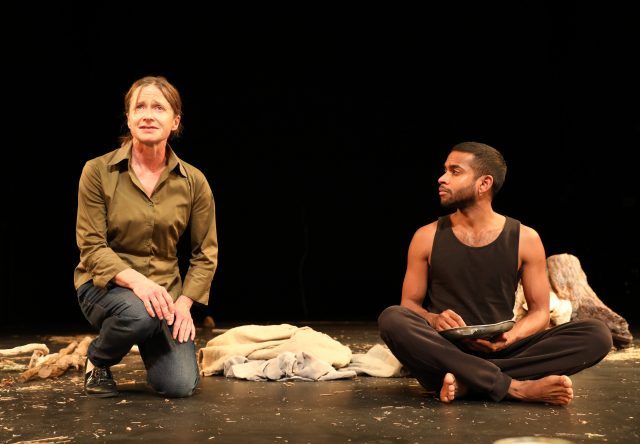
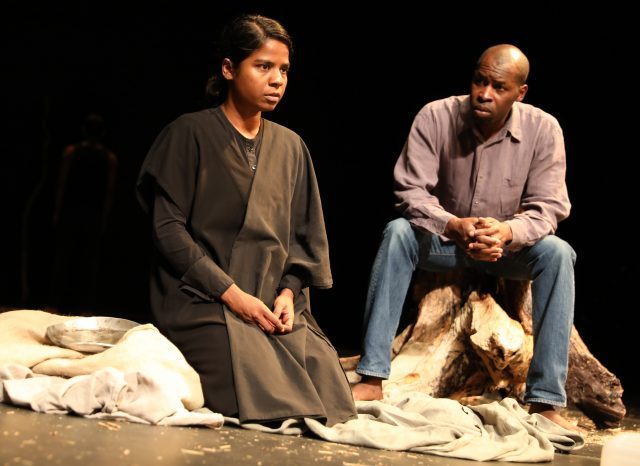
Peter Brook and Marie-Hélène Estienne and their C.I.C.T. — Théâtre des Bouffes du Nord return to Theatre for a New Audience’s Polonsky Shakespeare Center with the existential parable The Prisoner, a meditative, minimalist adult fable about crime and punishment, forgiveness and forgetting. Inspired by an experience Brook had in Afghanistan more than sixty years ago, the seventy-minute piece is set in an unnamed land, on a mostly bare set (by David Violi) save for a tree stump and some scattered twigs and branches. Mavuso (Hiran Abeysekera) has committed an “unspeakable act,” and his sister, Nadia (Kalieaswari Srinivasan), and uncle, Ezekiel (Hervé Goffings), prepare his punishment, according to both ancient laws and the court system. He is ultimately sentenced to twenty years on a hill by himself, facing a prison, with no guards watching him, no barriers to walking away except those in his own mind. “There are no cells, no bars, and you will always have the temptation to leave,” Ezekiel instructs him. He also tells Mavuso that whenever someone asks him why he is there, he must answer, “I am here to repair.” Over the years, he is visited by a woman traveler (Hayley Carmichael), a man from a nearby village (Omar Silva), his uncle, and a few drunk guards. “You are disturbing the system!” one of them declares, but nothing can change Mavuso’s intention to carry out his sentence.
The story includes bits of magic and such philosophical statements as “Everything is in the past” and “We want to possess everything without seeing that we have nothing,” but there is no moralizing. There is also no score but instead long silences. The passage of time is indicated by Philippe Vialatte’s lighting softly going down, then coming back up. Brook never found out what crime the man in Afghanistan had committed to receive such a fate, but Mavuso’s misdeed is named, and it serves to further complicate his sentence. The time period and place are also left ambiguous, made more so by a cast of diverse actors with different accents and heritages, leaving plenty of space for each audience member’s individual imagination. Only the traveling woman wears shoes; everyone else is barefoot, walking over the wood (and hopefully avoiding splinters). Written and directed by Tony, Emmy, and Obie winner Brook and Estienne (Samuel Beckett’s Fragments, The Valley of the Astonishment, Can Themba’s The Suit), The Prisoner raises issues of tolerance and hate, love and judgment, birth and rebirth, fathers and sons, and the prisons that we all build for ourselves. When Mavuso — who wanted to be judged for his actions, since he judged the actions of others — sits quietly and stares out at the jail, he is looking over the audience, almost as if we are all in a prison as well and need to repair something in our lives as we sit still, looking back at him. Seeing such beautifully engaging and thoughtful works as The Prisoner is not a bad place to start that reparation process.
William Kentridge’s massive spectacle The Head & the Load continues at Park Avenue Armory through December 15 (photo by Stephanie Berger)
Park Avenue Armory, Wade Thompson Drill Hall
643 Park Ave. at 67th St.
December 4-15, $40-$90, 2:00/7:00/8:00
212-933-5812 armoryonpark.org www.theheadandtheload.com
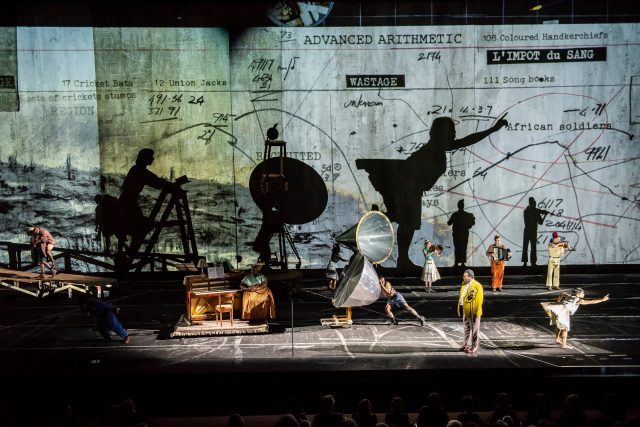
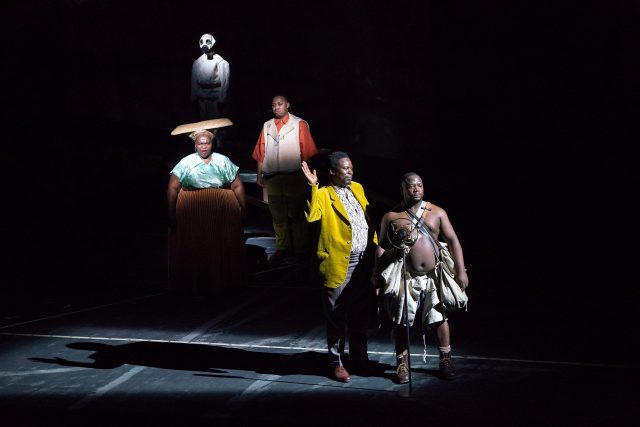
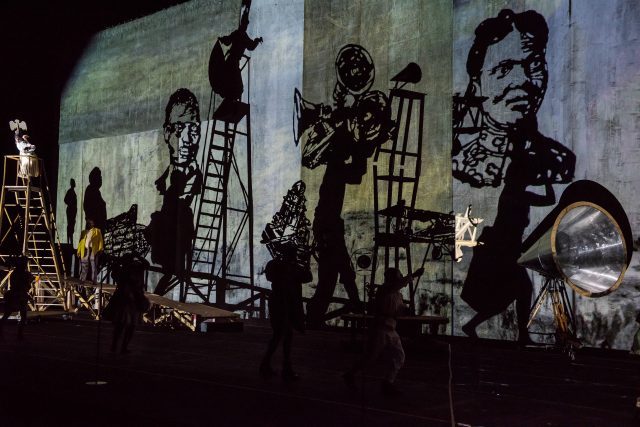
In 2012, MoMA hosted “Five Themes,” a major, wide-ranging retrospective of the work of South African artist William Kentridge. Virtually everything Kentridge has done since then — the public procession Triumph and Laments: A Project for Rome, the multimedia chamber opera Refuse the Hour, adaptations of Berg’s Lulu and Shostakovich’s The Nose at the Met, “The Refusal of Time” installation at the Metropolitan Museum of Art, the gallery exhibition “Second-Hand Reading” at Marian Goodman, and a performance of Kurt Schwitters’s Ursonate at Harlem Parish — has merely been a prelude to The Head & the Load, a massive multidisciplinary spectacle that could only be put on in New York City in the Park Avenue Armory’s Wade Thompson Drill Hall. Taking place on a stage nearly two hundred feet long, the presentation employs a jagged, abstract narrative to explore the fate of hundreds of thousands of black Africans forced into service by colonialist European countries, primarily Germany, France, Belgium, and Britain, as porters and carriers during World War I. Kentridge uses live music, choreographed movement, video projections, and dialogue in multiple languages to relate the tragic tale. A trio of military men (Hamilton Dlamini, Nhlanhla Mahlangu, and associate director Luc De Wit) speak in nonsense words from Ursonate. Ann Masina delivers gorgeous arias with objects on her head. Joanna Dudley, wearing an eagle on a Nazi helmet, is pushed across the stage on a ramshackle cart, pronouncing edicts. Sipho Seroto stands atop a tower, wearing an evil-looking gas mask. The Knights play in a surprise confined space. Mncedisi Shabangu, in a bright yellow jacket, serves as narrator, guiding us through the complex story. A procession of men and women parades across the length of the stage, many wearing or carrying stencil cutouts of human faces and animals that show up as silhouetted shadows on the back wall, mixing with previously photographed video.
Ann Masina sings as four men look on in The Head & the Load (photo by Stephanie Berger)
In a program note, Kentridge asks, “Can one find the truth in the fragmented and incomplete? Can one think about history as collage, rather than as narrative?” Commissioned by 14-18 NOW and the armory along with Ruhrtriennale and MASS MoCA as part of the centenary of the end of WWI, The Head & the Load is a thrilling eighty-five-minute cacophony of sound, images, and movement, a performance collage that reveals little-known facts about African involvement in the war. The title comes from the Ghanaian proverb “The head and the load are the troubles of the neck,” representing the physical and psychological burdens thrust onto Africans. The production is divided into three acts, “Manifestos,” “Paradox,” and “War,” with such scenes as “Morsecode / Swahili Phrasebook,” “Orders & Commands,” “Troubles of the Body,” “Playing Against History,” “Kaiser Waltz,” and “Coda & Deathlist.” Composers Philip Miller and Thuthuka Sibisi’s score was inspired by Maurice Ravel, Erik Satie, Paul Hindemuthy, Arnold Schoenberg, and Fritz Kreisler, while Kentridge incorporates text, either spoken or projected onscreen, from Frantz Fanon, Tristan Tzara, Wilfred Owen, Aimé Césaire, the conference of Berlin, phrases from a handbook of military drills, Setswana proverbs from Sol Plaatje’s 1920 collection, and a letter from John Chilembwe.
The Head & the Load is highlighted by a multimedia procession across a two-hundred-foot-long stage (photo by Stephanie Berger)
The choreographer is Gregory Maqoma, with cinematography by Duško Marović, costumes by Greta Goiris, sets by Sabine Theunissen, lighting by Urs Schönebaum, and sound by Mark Grey, all coming together in exciting ways. Although Kentridge himself does not appear, his hands are evident throughout, particularly when cutting up maps and other documents on filmed segments, evoking the feel of the entire piece, which is really more of an experience than a show. When the audience enters the drill hall, they pass by several lights that project their shadows onto the back wall of the stage, a sly way of making everyone complicit in this colonialist world of war, ethnocentricity, and cultural suppression. It’s a critical message for the modern era, sent by an extraordinary artist and his marvelous team.
Who: The New York City Master Chorale, Megan Abbott, Scott Adsit, Mike Albo, Jami Attenberg, Sandra Bauleo, Tara Isabella Burton, Alexander Chee, Vinson Cunningham, Maria Dahvana Headley, Marcy Dermansky, Jo Firestone, Angela Flournoy, Alice Gregory, Jill Hennessy, Suki Kim, Maris Kreizman, Victor LaValle, Min Jin Lee, Lisa Lucas, Noreen Malone, Leon Neyfakh, Max Read, Rosie Schaap, Elissa Schappell, Rob Spillman, J. Courtney Sullivan, Sarah Weinman, and more What:“What the Dickens?” Where: Housing Works Bookstore Cafe, 126 Crosby St., 212-334-3324 When: Saturday, December 15, free with advance RSVP, 12 noon – 4:30 pm Why: On December 15, Housing Works will present its ninth annual marathon reading of Charles Dickens’s 1843 holiday classic, a ghost story about a poor family and a wealthy miser. “Marley was dead: to begin with. There is no doubt whatever about that,” the novel begins. “The register of his burial was signed by the clergyman, the clerk, the undertaker, and the chief mourner. Scrooge signed it: and Scrooge’s name was good upon ’Change, for anything he chose to put his hand to. Old Marley was as dead as a door-nail.” The event kicks off at 12 noon with Christmas carols sung by the New York City Master Chorale, followed by dozens of performers reading passages from the book. Seasonal treats will be available for purchase, and everything in the store will be ten percent off. Admission is free and you can come and go as you please, but advance RSVP is recommended.
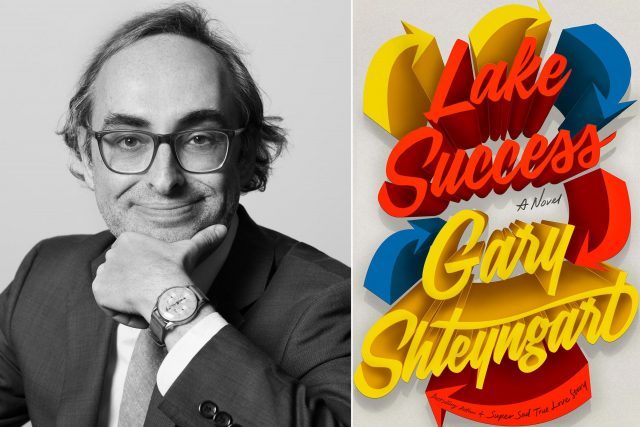
Gary Shteyngart will present his latest book at the JCC on December 12 (photo by Brigitte Lacombe)
Who:Gary Shteyngart What:Arts + Ideas — Conversations Where: Marlene Meyerson JCC Manhattan, 334 Amsterdam Ave. at 76th St., 646-505-4444 When: Wednesday, December 12, $20, 8:00 Why: Leningrad-born author Gary Shteyngart will be at the Marlene Meyerson JCC Manhattan on December 12 for the latest “Person Place Thing” event, being held in conjunction with the publication of his most recent book, Lake Success (Random House, September 2018, $28). Shteyngart, whose previous novels include Super Sad True Love Story and Absurdistan, will discuss the book and sign copies; there will also be live klezmer music by Brooklyn-based new traditionalists Tsibele. “Barry Cohen, a man with 2.4 billion dollars of assets under management, staggered into the Port Authority Bus Terminal. He was visibly drunk and bleeding. There was a clean slice above his left brow where the nanny’s fingernail had gouged him and, from his wife, a teardrop scratch below his eye. It was 3:20 a.m.” So begins Lake Success, the first chapter of which is titled “Destination America.”
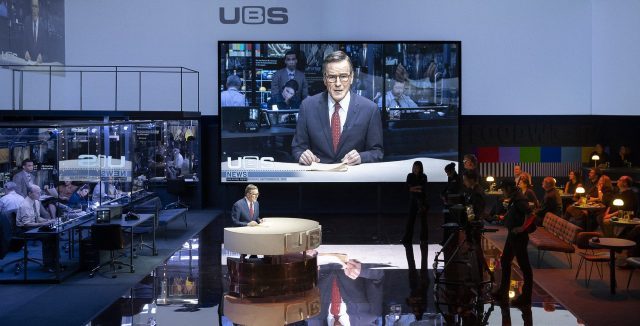
Bryan Cranston takes on iconic role of madman Howard Beale in stage version of Network (photo by Jan Versweyveld, 2018)
Belasco Theatre
111 West 44th St. between Sixth & Seventh Aves.
Tuesday – Saturday through March 17, $49 – $399 networkbroadway.com
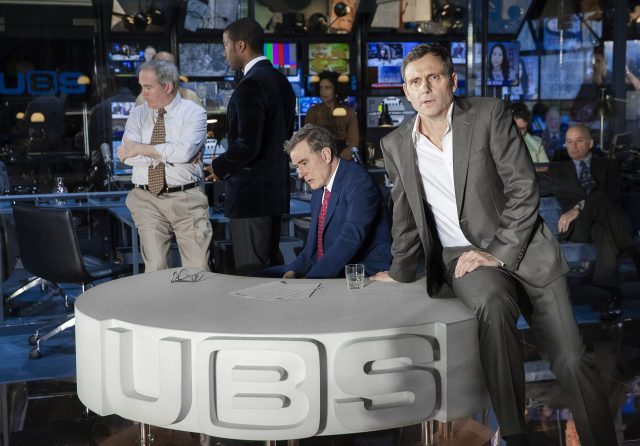
When it was released in 1976, Sidney Lumet’s Network instantly shocked audiences as it unmasked the approaching intersection of the corporatization of entertainment and news in the media, featuring a brilliant, prescient script by Bronx native Paddy Chayefsky that skewered the television industry and Americans’ obsession with “the tube.” It revealed a world dominated by ratings-hungry white men in suits, with two exceptional white female characters boldly asserting their own personal and professional power and independence at the height of the women’s liberation movement. Four decades later, the story is as relevant and shocking as ever in Ivo van Hove’s riveting yet dizzying stage production, which opened last night at the Belasco.
The film was nominated for ten Oscars, winning acting awards for the late Peter Finch, Faye Dunaway, and Beatrice Straight and Best Original Screenplay for Chayefsky, who wrote such other gems as Marty, The Hospital, The Americanization of Emily, and Altered States before passing away in 1981 at the age of fifty-eight. Despite Bryan Cranston’s mesmerizing lead performance and all of van Hove’s live-streaming technical wizardry — which can be breathtaking and exhilarating as well as overwhelming, distracting, anachronistic, and confusing — it’s Chayefsky’s words that steal the show, adapted here by Lee Hall like they are gospel, which in many ways they are. In the published version of the play, which debuted at London’s National Theatre in November 2017, Hall describes his adaptation as “keyhole surgery,” writing, “Hopefully my interventions are invisible to the untrained eye.” The only significant changes involve the treatment of terrorists by the media, which Hall and van Hove tone down here, and the addition of a coda following the climactic finale. (Hall was given access to Chayefsky’s archives, so he has noted that any and all changes were based on or inspired by the author’s notes, letters, drafts, etc.)
Howard Beale (Bryan Cranston) is downtrodden as Max Schumacher (Tony Goldwyn) looks distraught in Ivo van Hove’s high-tech Broadway version of Network (photo by Jan Versweyveld, 2018)
Olivier, Emmy, and Tony winner Cranston (Breaking Bad, All the Way) takes on the iconic role of Howard Beale, portrayed so memorably by Finch in the film. Cranston immerses himself in the role with a careful abandon; he pays tribute to Finch while making the part his own, much as Hall and van Hove treat the movie. After twenty-five years with Union Broadcasting Systems, Beale is being put out to pasture because of low ratings. But he surprises everyone when he announces during a broadcast that he is going to commit suicide live on television the next week. His best friend and longtime colleague, news division president Max Schumacher (Tony Goldwyn), puts him back on the air quickly so he can apologize and restore his dignity, but Beale instead calls “bullshit” on the state of the world, sending everyone into a tizzy — except ruthlessly ambitious programming head Diana Christensen (Tatiana Maslany), who jumps on the unique opportunity and soon convinces executive producer Harry Hunter (Julian Elijah Martinez), network executive Nelson Chaney (Frank Wood), and network head Frank Hackett (Joshua Boone) to give Beale his own show, making him a kind of angry prophet of the airwaves, speaking for and to the common person. The contemporary of industry legends Walter Cronkite, Eric Sevareid, and Edward R. Murrow becomes a ranting and raving populist hero, although Schumacher believes Beale is being turned into a fool, but there’s little he can to do stop the momentum, which eventually falls apart all by itself.
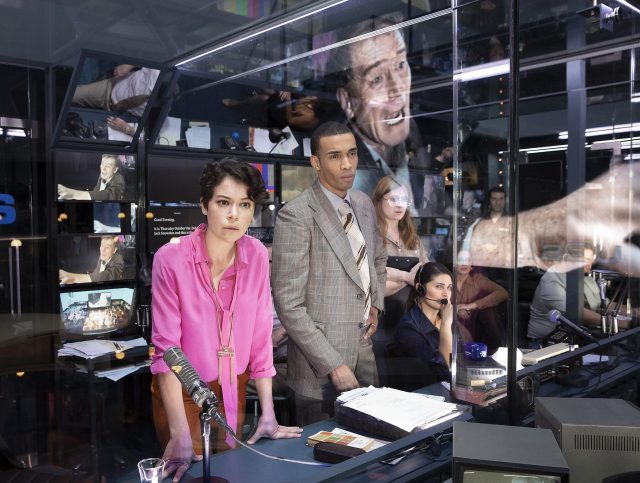
The use of live video, something van Hove has done in such previous productions as The Damned at Park Avenue Armory and A View from the Bridge and The Crucible.) Depending on where you are sitting, the cameras, operated by technicians Gina Daniels, Nicholas Guest, Jeena Yi, and Joe Paulik, may also occasionally block your view. The footage is projected onto a large screen at the back, often turning Beale into a giant, his image repeating into the distance. Period news reports about Patty Hearst and old commercials — with Roy Scheider in a Folgers ad and Cranston himself pitching Preparation H — fly by on a wall of screens on one side, but don’t get too caught up in them or you’ll miss the magnificent dialogue. The set, by van Hove’s partner, Jan Versweyveld, includes a bar and nightclub-like tables and couches at stage left (where audience members who pay $299 to $399 enjoy dinner and drinks curated by former White House pastry chef Bill Yosses while watching the show and even interacting with the characters) and the glassed-in control room at stage right, where various executives, some of the tech crew, and the announcer (Henry Stram) can always be seen, as if everyone is both under surveillance and doing the surveilling.
Diana Christensen (Tatiana Maslany) and Harry Hunter (Julian Elijah Martinez) can’t believe what they’re seeing in Network (photo by Jan Versweyveld, 2018)
When Beale implores his television audience to open their windows and scream, “I’m mad as hell, and I’m not going to take this anymore,” van Hove shows numerous people doing only the latter; instead of photographing men and women yelling out their windows, a procession of YouTube-like selfie videos follow, seeming out of time and place. The live video even extends outdoors when Max and Diana go for a stroll, but the scene takes you out of the play as passersby gawk at Goldwyn (Scandal, Ghost) and Emmy winner Maslany (Orphan Black, Mary Page Marlowe), who never quite catch the fire and passion of William Holden and Dunaway in the film, a critical relationship that literally puts the news and entertainment divisions in bed together. Goldwyn is otherwise solidly effective as Beale’s determined protector, and the pivotal showdown between Max and his wife, Louise (Alyssa Bresnahan), hits the right notes; however, Bresnahan looks so much like Dunaway that you can’t help but wonder if she should have played Diana. (Coincidentally, Dunaway just announced she will be returning to Broadway next year, portraying Katharine Hepburn in Tea at Five.) In a fine casting touch, Barzin Akhavan plays both Jack Snowden, the young anchor in line to replace Beale, and the warm-up guy for Beale’s circuslike show, a newsman transformed into carnival barker.
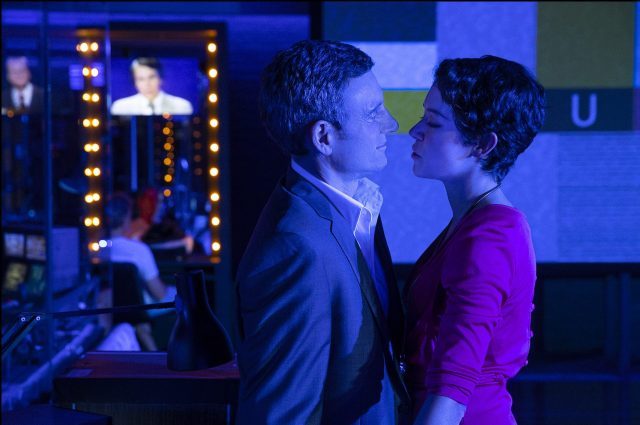
News division president Max Schumacher (Tony Goldwyn) and programming head Diana Christensen (Tatiana Maslany) bring their work home with them in Network) (photo by Jan Versweyveld, 2018)
But it’s Chayefsky’s sparkling language that reigns supreme all these years later; Beale’s pronouncements ring as true now as they did in 1976. Take this speech, for example: “I don’t have to tell you things are bad. Everybody knows things are bad. Everybody’s out of work or scared of losing their job, the dollar buys a nickel’s worth, banks are going bust, shopkeepers keep a gun under the counter, punks are running wild in the streets, and there’s nobody anywhere who seems to know what to do and there’s no end to it. We know the air’s unfit to breathe and our food is unfit to eat and we sit and watch our teevees while some local newscaster tells us today we had fifteen homicides and sixty-three violent crimes, as if that’s the way it’s supposed to be. We all know things are bad. Worse than bad. They’re crazy. It’s like everything’s going crazy. So we don’t go out anymore. We sit in the house and slowly the world we live in gets smaller and all we ask is, please, at least leave us alone in our own living rooms. Let me have my toaster and my teevee and my hair dryer and my steel belted radials, and I won’t say anything, just leave us alone. Well, I’m not going to leave you alone. I want you to get mad.” When he mentions Russia, the audience laughs, but Hall isn’t making a cheap joke about current events; the reference is in the film.
In another Beale rant, it’s as if Chayefsky saw the coming of smartphones, the internet, and social media: “Because less than three percent of you people read books. Because less than fifteen percent read newspapers. Because the only truth you know is what you get on your television. There is a whole and entire generation right now who never knew anything that didn’t come out of this tube. This tube is gospel. This tube is the ultimate revelation. This tube can make or break presidents, popes, and prime ministers. This tube is the most awesome goddam force in the whole godless world! And woe is us if it ever falls into the hands of the wrong people.”
When Jensen makes his remarkably foresighted proclamation to Beale about power, international commerce, and “the primal forces of nature,” devilishly delivered by Wyman (Catch Me If You Can, A Tale of Two Cities), van Hove puts Jensen above everyone else on a heavenly platform, as if he’s a godlike figure who is the only one who understands what is really happening in the world — in 1976 as well as in 2018. Be sure to get to the Belasco early, as the actors are already traversing the stage, preparing for the evening news, as the audience enters the theater, and stay in your seats after the curtain call, as there’s a bonus that brings the visionary satire right up to the present moment, although that point has already frighteningly shone through over and over again.
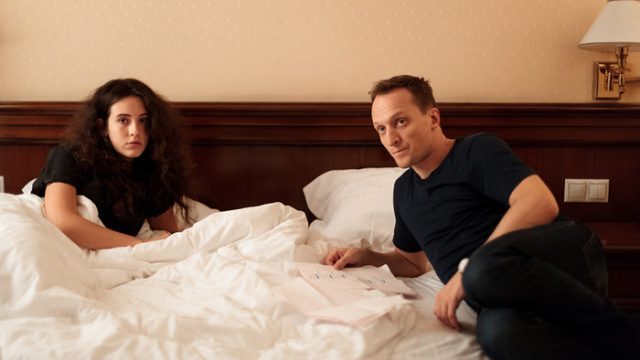
Masha (Sonya Gershevich) and Dmitry (Vladimir Mishukov) develop an unusual relationship in Elephants Can Play Football
ELEPHANTS CAN PLAY FOOTBALL (слоны могут играть в футбол) (Mikhail Segal, 2018)
SVA Theatre, Beatrice
333 West Twenty-Third St. between Eighth & Ninth Aves.
Wednesday, December 12, 8:00pm – Elephants Can Play Football – Drama. Directed by Mikhail Segal
Festival runs December 8-14 cherryorchardfestival.org
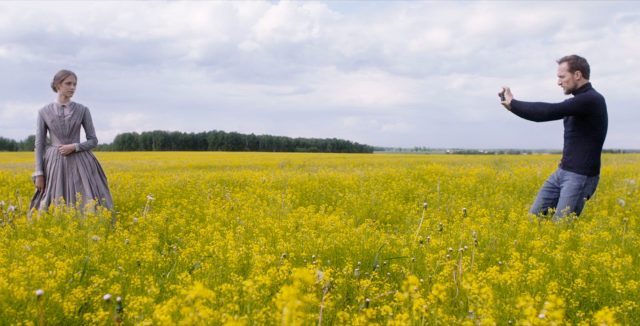
Held in conjunction with the multidisciplinary Cherry Orchard Festival, Russian Film Week takes place December 8-14 at the SVA Theatre, consisting of fourteen new works as well as a fifteenth anniversary screening of Alexey Uchitel’s award-winning The Stroll, presented by the director in person. On December 12 at 8:00, Mikhail Segal’s (Franz+Polina, Film about Alekseev) fourth feature, Elephants Can Play Football, will be shown, an offbeat and unpredictable black comedy that follows the trials and tribulations of lonely and successful fortysomething businessman Dmitry (Vladimir Mishukov), who has a thing for much younger women, although not necessarily in ways one might expect. Over the course of the film, Dmitry, aka Dima, develops unique relationships with Masha (Sonya Gershevich), the seventeen-year-old daughter of his college friend (Segal, who also composed the score) and his wife (Alla Nesterova); the younger Sveta (Varya Pakhomova), whose parents (Yuriy Bykov and Nadezhada Gorelova) travel a lot; and twenty-year-old Lika (Sasha Bystrzhitskaya), whose roommate, Vera (Elena Korotkova), is battling severe depression, which actually leads to several outrageously funny scenes. Dmitry either lies about the relationships or hides them from his best friend, Sergey (Sergey Mamotov), and his wife (Irina Pakhomova) as he fastidiously insinuates himself into the young women’s lives.
Lika (Sasha Bystrzhitskaya) and Dmitry (Vladimir Mishukov) frolic through a field in Elephants Can Play Football
Elephants Can Play Football has creepy, uncomfortable moments, and not all of it makes sense, but Mishukov is compelling as the strange Dmitriy, and Eduard Moshkovich’s camera adores Gershevich and Bystrzhitskaya. The film is very much about time — actually, a fear of death — and being an active participant in a life outside oneself. Dmitry is obsessed with youth; when he talks to his parents on the computer, their heads are cut off, as if he doesn’t want to see their elderly faces. Meanwhile, he regularly says that he’ll just look out the window, as if what’s happening out there is better than what is going on inside him. At one point he rails against a man who is three minutes late to a meeting, but to Dmitry, three minutes could be a lifetime, particularly after an incident that nearly kills him. Elephants Can Play Football is often head-scratchingly confusing, and the sexual dynamics can be disturbing, but then a twist onscreen will bring you right back into its narrative grip. Among the other works being shown during Russian Film Week are Avdotya Smirnova’s The Story of One Appointment, Karen Shakhnazarov’s Anna Karenina: Vronsky’s Story, Sarik Andreasyan’s Unforgiven, and Konstantin Khabensky’s Sobibor, with many screenings followed by Q&As with members of the cast and/or crew.



 Held in conjunction with the multidisciplinary Cherry Orchard Festival, Russian Film Week takes place December 8-14 at the SVA Theatre, consisting of fourteen new works as well as a fifteenth anniversary screening of Alexey Uchitel’s award-winning The Stroll, presented by the director in person. On December 12 at 8:00, Mikhail Segal’s (Franz+Polina, Film about Alekseev) fourth feature, Elephants Can Play Football, will be shown, an offbeat and unpredictable black comedy that follows the trials and tribulations of lonely and successful fortysomething businessman Dmitry (Vladimir Mishukov), who has a thing for much younger women, although not necessarily in ways one might expect. Over the course of the film, Dmitry, aka Dima, develops unique relationships with Masha (Sonya Gershevich), the seventeen-year-old daughter of his college friend (Segal, who also composed the score) and his wife (Alla Nesterova); the younger Sveta (Varya Pakhomova), whose parents (Yuriy Bykov and Nadezhada Gorelova) travel a lot; and twenty-year-old Lika (Sasha Bystrzhitskaya), whose roommate, Vera (Elena Korotkova), is battling severe depression, which actually leads to several outrageously funny scenes. Dmitry either lies about the relationships or hides them from his best friend, Sergey (Sergey Mamotov), and his wife (Irina Pakhomova) as he fastidiously insinuates himself into the young women’s lives.