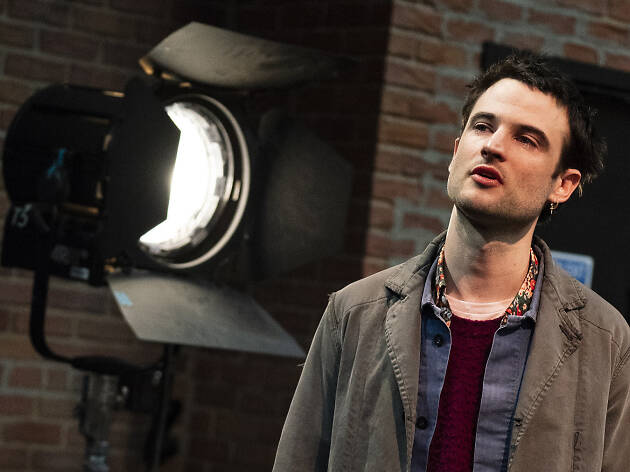
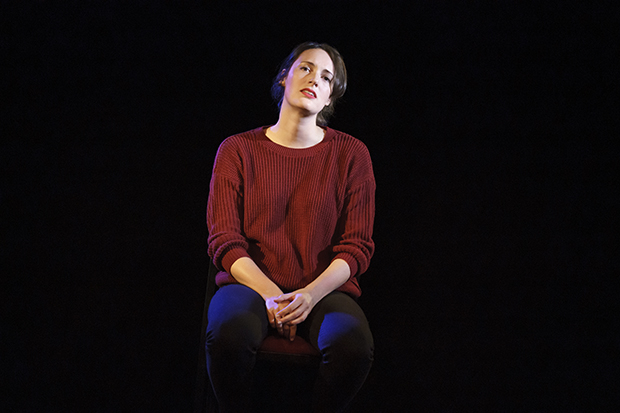
Tom Sturridge stars in Simon Stephens’s Sea Wall at the Public (photo by Joan Marcus)
The Public Theater, Newman Theater
425 Lafayette St. by Astor Pl.
Tuesday – Sunday through March 31
212-967-7555
www.publictheater.org
The Public Theater’s pairing of two one-act solo plays, Simon Stephens’s Sea Wall and Nick Payne’s A Life, is no mere combination of works by star British playwrights performed by a Tony nominee and an Oscar nominee, respectively. Instead, it’s a powerhouse double header of intimate explorations of loss and love, of what it means to be a husband, a father, and a son, that will leave you emotionally exhausted and exhilarated. American actor Jake Gyllenhaal and English actor Tom Sturridge wanted to work together, and they ultimately decided to share an evening of one-man shows written by playwrights they felt a kinship with; Gyllenhaal was previously in Payne’s If There Is I Haven’t Found It Yet and Constellations, while Sturridge was in Stephens’s Punk Rock and Wastwater.
As the audience is entering the Newman Theater, Sturridge walks onstage, looking more like a member of the crew. He grabs a beer from a small desk, adjusts a light, and sits at the top of a ladder, having a drink and checking his cell phone. When the audience realizes it’s the star and instantly hushes, he says, “That’s all right; you don’t have to be quiet yet.” It’s a line that might not be in the script but establishes him as just one of us. A few minutes later, he turns off the lights himself and becomes Alex, starting a riveting monologue about his daughter, Lucy, his wife, Helen, and his father-in-law, a proud soldier. He wanders slowly all over Laura Jellinek’s strikingly bare set, which features a piano to one side and a large brick landing in the back. Talking about photography, he advises that “if you possibly can, then take [a picture] from below the subject. It renders the subject actually oddly, what it does is it renders them not more heroic, not more god-like, oddly it renders them more human.” Having been so instructed, we understand that when he climbs the ladder and walks along the higher part of the stage in the back, he’s just another person, no different from anyone else. He talks about Lucy’s birth, going diving with his father-in-law, the existence of God, and the surging strength of the ocean. Forty-five minutes after he begins, he turns out the lights, and intermission offers a brief chance to recover from the affecting drama we have all experienced.
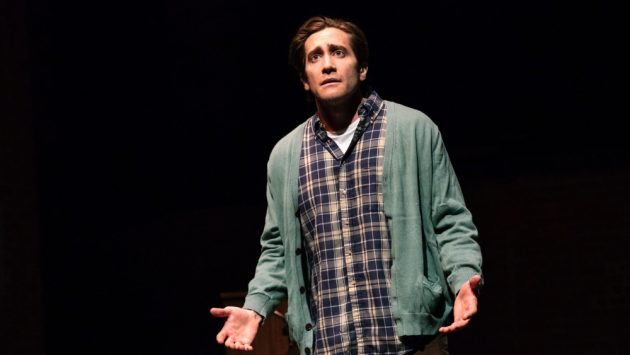
Jake Gyllenhaal plays a man dealing head-on with life and death in Nick Payne’s A Life (photo by Joan Marcus)
Next Gyllenhaal takes the stage and turns out the lights, standing in one spotlight for nearly his entire fifty-five-minute monologue, which also deals with family. (The actual lighting designer is Peter Kaczorowski.) A Life was originally Payne’s deeply personal memory about his father’s illness, but he has expanded it by adding the story of the birth of his daughter, so it fits extraordinarily well with Stephens’s Sea Wall. As Abe, Gyllenhaal quickly goes back and forth between his character taking care of his ailing father and getting ready for his wife to give birth to their first child. It all happens so fast that it’s sometimes hard to follow the transitions, but it adds to the excitement as the tale plays out like a procedural. Payne avoids most of the traps of a clichéd life-death exchange as each part heads toward its gripping conclusion, with graphic details that will make you squirm in your seat. Like with Sturridge’s Alex, Gyllenhaal’s Abe is so honest and forthright, capturing every key moment, that you’ll think you’re seeing the events they’re describing with vivid clarity, watching his father’s decline and his wife’s tense pregnancy as they collide toward a bittersweet ending.
There are numerous similarities between the two shows, several of which are purely coincidental; both include lines about aging, skin cracking, the television show ER, three generations of family, and holes in the body, real and metaphorical. Director Carrie Cracknell (A Doll’s House, The Deep Blue Sea) skillfully allows them to intertwine ever so subtly with deft touches that pack a terrific one-two punch. Early in A Life, Gyllenhaal says something that zeroes in on many aspects of each play: “I remember reading somewhere or maybe someone telling me about this idea that there are three kinds of deaths. . . . The first is when the body ceases to function. The second is when we bury the body, or I guess set it on fire. And the third is the moment, sometime way in the future, when our names are said, spoken aloud, for the very last time. I’m thinking to myself but I don’t say it, I wonder who’s gonna say our child’s name for the last time?” Gyllenhaal (Sunday in the Park with George, Brokeback Mountain) and Sturridge (Orphans, 1984) might not be acting face-to-face onstage, but the characters and the actors’ individual performances relate organically to each other; they rehearsed together to make it all feel cohesive and tried out many variations in previews, and the actors still make minor adjustments every night depending on audience reaction. Sea Wall flows beautifully into A Life, as if Stephens (Heisenberg, The Curious Incident of the Dog in the Night-Time) and Payne (Elegy, Incognito) had collaborated extensively from start to finish, which is not the case, but Cracknell, Sturridge, and Gyllenhaal transform them into one interconnected piece that deals with some very difficult yet compelling topics.
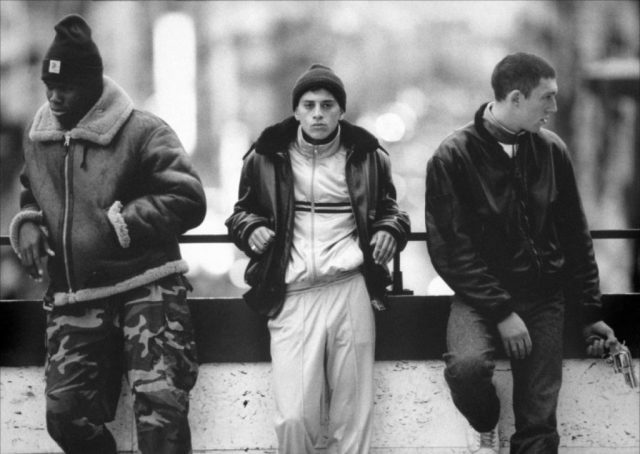
 BAM and Triple Canopy, the New York–based online magazine, have teamed up to present the provocative film series “On Resentment,” which kicks off March 20 at 7:30 with Mathieu Kassovitz’s incendiary 1995 stunner, La haine, inspired by the real-life stories of Makome M’Bowole and Malik Oussekine, two young men who were killed by police in 1993 and 1986, respectively. Kassovitz’s second feature film (following Métisse), La haine, which means “hate,” is set in the immediate aftermath of Paris riots as three friends —the Jewish Vinz (Vincent Cassel), the Afro-French Hubert (Hubert Koundé), and the Arab Saïd (Saïd Taghmaoui) — spend about twenty hours wandering the mean streets of their banlieue (suburban projects) and Paris, causing minor mayhem as they encounter skinheads, stop off for some wine at an art opening, try to get into a hot club, and, over and over, become embroiled with the police.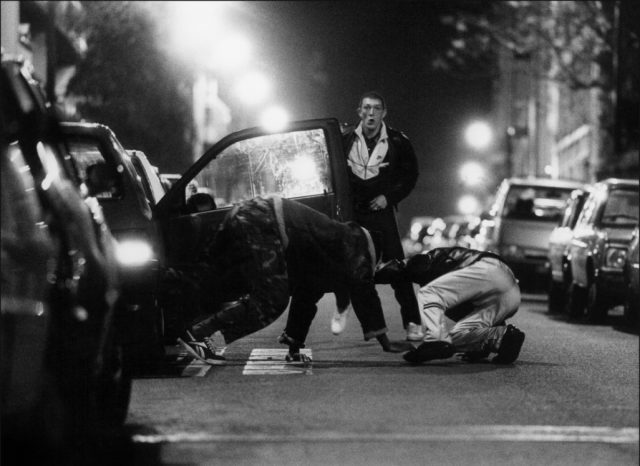

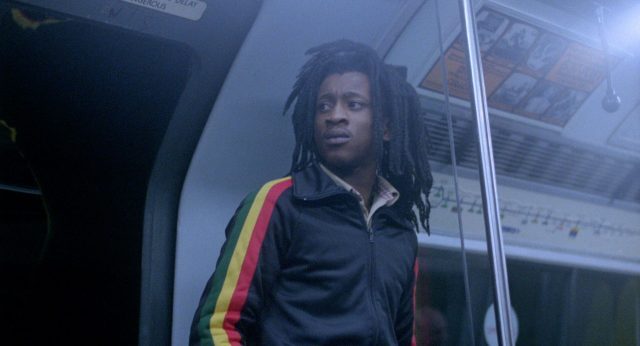
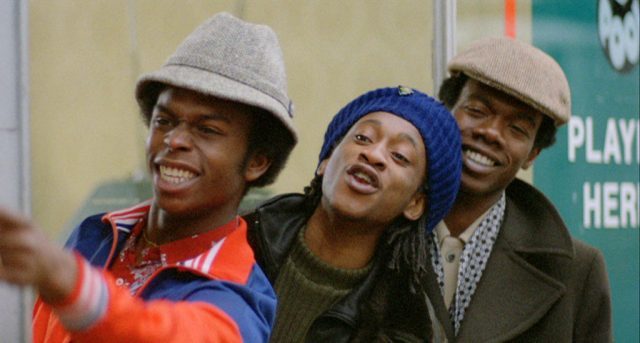
 One of the best, and most important, British films of the last forty years took the long route to reach America, but it’s finally here, and it’s a knockout. In 1973-74, Franco Rosso and Martin Stellman wrote Babylon, a somewhat semiautobiographical story of prejudice and bigotry set around Jamaican sound system culture during the Thatcher era in South London. The BBC rejected it, and after several production companies passed on it as well, it was finally picked up by Mamoun Hassan of the National Film Finance Corporation. The movie was shot in six weeks on location in Deptford and Brixton and received an X rating, despite having limited violence and no sex. It screened at Cannes but was turned down by the New York Film Festival, which considered the subject matter too controversial. The film was restored in 2008, but an old print was shown at BAM in 2012, the only time the film was officially shown in the United States. That is, until now; the scorching tale at last got its American theatrical release March 8 at BAM and has now opened as well at IFC Center, Kew Gardens Cinemas, Nitehawk, and the Magic Johnson Harlem 9. Babylon is a don’t-miss work that is still frighteningly relevant today, even though it was ripped from the headlines of the 1970s.