twi-ny recommended events

WORKING WOMAN

Working Woman

Liron Ben Shlush is powerful as a married mother of three reentering the job market and facing sexual harassment in Working Woman

WORKING WOMAN (ISHA OVEDET) (אשה עובדת) (Michal Aviad, 2018)
IFC Center
323 Sixth Ave. at West Third St.
Opens Wednesday, March 27
212-924-7771
zeitgeistfilms.com
www.ifccenter.com

Liron Ben Shlush gives a heart-wrenching performance as a mother reentering the work force in Israeli feminist director Michal Aviad’s second fiction film, Working Woman. Ben Shlush is Orna, who has three young children and gets a job to help support the family while her husband, Ofer (Oshri Cohen), gets his struggling new restaurant off the ground. She takes a position with her former army commander, Benny (Menashe Noy), a high-powered real estate developer. Despite her lack of experience, Orna is an instant success as a savvy salesperson, pushing exclusive new beachfront luxury property. Orna is dismayed when Benny unexpectedly kisses her against her wishes, but when he continues his advances even as she shoves him away, she finds herself in an old, all-too-common situation, forced to decide whether she controls her body or her boss does; since her body is basically a commodity in this society, her decision is financial as well, as it will affect both her career and her family.

Working Woman

Orna (Liron Ben Shlush) has to keep looking over her shoulder, watching out for her predatory boss, Benny (Menashe Noy), in Michal Aviad’s second fiction film

Written before the #MeToo movement began by longtime documentarian Aviad (Jenny & Jenny, Invisible) with Sharon Azulay Eyal and Michal Vinik, Working Woman tells a familiar story but provides unique perspective. Although Orna does nothing to encourage Benny, she begins questioning whether his creepy attraction to her is her fault regardless, that she is not doing enough to keep him away from her. She is surrounded by wealth — Benny is a rich man, living in a large, fancy home with his wife, Sari (Dorit Lev-Ari), and Orna spends her days trying to sell luxury apartments to the one percent, including the Benayouns (Gilles Ben-David and Corinne Hayat), a French couple who might bring a small community with them — but she and Ofer, a proud man who wants no help, were having financial difficulties prior to her job. If she were to quit, her family would suffer, something she will not allow to happen even as she considers the cost. Aviad handles the conflict with a profound sensitivity and deep understanding, providing no easy answers when it comes to sexual harassment. Cinematographer Daniel Miller composes long shots that follow Ben Shlush’s (Next to Her, Road 40 South) yearning, expressive eyes as she searches for a way out, a place where she can be a wife and a mother with a good full-time job. Key scenes feature subtleties that emphasize the power a male boss can hold over a female employee in so many ways that go beyond forcible contact. Working Woman opens at IFC on March 27; Aviad will be at the Greenwich Village theater for Q&As at the 7:45 screenings on March 27 and 30.
VENEZUELA

(photo by Asca)

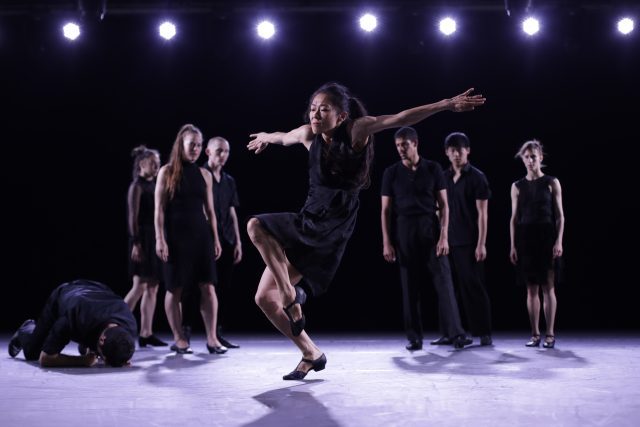
Batsheva’s Venezuela dances into BAM this week (photo by Asca)

BAM Howard Gilman Opera House
Peter Jay Sharp Building
230 Lafayette Ave.
March 27-30, 7:30
718-636-4100
www.bam.org
batsheva.co.il/en

Superstar Israeli troupe Batsheva Dance Company is back at BAM this week with Ohad Naharin’s Venezuela, running March 27-30 at the Howard Gilman Opera House. The evening-length work consists of two forty-minute sections that mirror each other movement-wise but change the score, which ranges from Gregorian chants to songs by Rage Against the Machine, Olafur Arnalds, the Notorious B.I.G., and Vox. Under Naharin’s leadership, Batsheva has been presenting dance at BAM for many years, including The Last Work, Hora, and Sadeh21; this will be the main troupe’s first visit since former company dancer Gili Navot took over as artistic director, with Naharin remaining as house choreographer to develop new pieces and continue his research into his unique Gaga language. Venezuela, which addresses freedom of choice and has been percolating in Naharin for decades, is performed by Etay Axelroad, Billy Barry, Yael Ben Ezer, Matan Cohen, Ben Green, Chiaki Horita, Chunwoong Kim, Rani Lebzelter, Hugo Marmelada, Eri Nakamura, Nitzan Ressler, Kyle Scheurich, Maayan Sheinfeld, Yoni (Yonatan) Simon, Hani Sirkis, Amalia Smith, Imre van Opstal, and Erez Zohar, with lighting by Avi Yona Bueno (Bambi), soundtrack design and edit by Maxim Waratt, and costumes by Nakamura. On March 29 at 10:30 am at the Mark Morris Dance Center, a Batsheva company member will lead a Gaga and Repertory master class for professionals ($25).

KISS ME, KATE

(photo by Joan Marcus 2019)

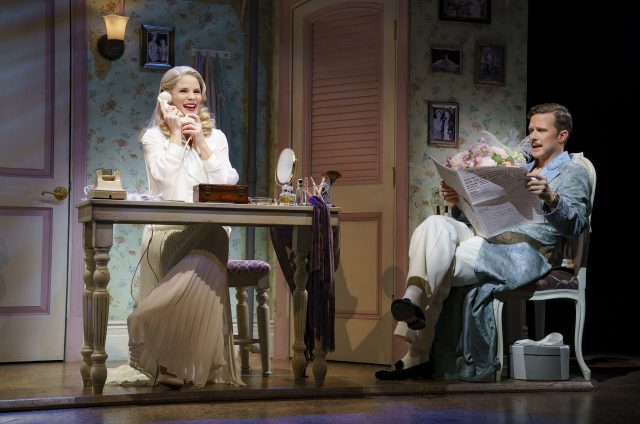
Kelli O’Hara and Will Chase star as a divorced couple making a musical version of The Taming of the Shrew in Kiss Me, Kate (photo by Joan Marcus 2019)

Studio 54
254 West 54th St.
Through June 30, $59-$352
212-719-1300
www.roundabouttheatre.org

The #MeToo makeover of golden age Broadway musicals continues with Roundabout’s Kiss Me, Kate, which opened March 14 at Studio 54. In the last year, major or minor changes have been made to My Fair Lady, Carousel, and Oklahoma! in order to deal with their troublesome presentations of sexism, misogyny, domestic violence, and gender inequality. Tony nominee Amanda Green (Hands on a Hardbody, Bring It On), who tweaked Roundabout’s 2015 revival of On the 20th Century, now does the same with Kiss Me, Kate, implementing small fixes that most audience members won’t notice in director Scott Ellis’s exuberant adaptation of one of Cole Porter’s most beloved shows, which in 1949 won the first-ever Tony for Best Musical and in 2000 won for Best Revival of a Musical. The book by Sam and Bella Spewack (Boy Meets Girl, My Favorite Wife), inspired by the real-life relationship of legendary actors Alfred Lunt and Lynn Fontanne during their 1935 revival of William Shakespeare’s The Taming of the Shrew at the Guild Theatre (now known as the August Wilson), also won a 1949 Tony.

The tale is set in the summer of 1948, as a company prepares for opening night of a musical version of Shrew at Baltimore’s Ford Theatre, hoping for an eventual Broadway run. The show is produced and directed by Fred Graham (Will Chase), who also plays Petruchio, opposite his ex-wife, movie star Lilli Vanessi (Kelli O’Hara), who is returning to the stage as Katharine (Kate), the character who supposedly needs taming. The backstage shenanigans mimic Shakespeare’s plot with an extra dollop of Hollywood screwball comedy as Petruchio woos Kate for her father’s (Mel Johnson Jr., who also plays stage manager Harry Trevor) money despite her resistance, for she wants no part of any man, while Fred and Lilli become enmeshed in a battle of the sexes over fame, fortune, and love. Fred is fooling around with the sweet but not-so-innocent ingénue Lois Lane (Stephanie Styles), who is dating Bill Calhoun (Corbin Bleu), a cad with a $10,000 gambling debt he has surreptitiously signed over to Fred. In the musical within the musical, Lois is Bianca, Kate’s younger sister, who has a trio of suitors, Gremio (Will Burton), Hortensio (Rick Faugno), and Lucentio, the last played by Bill. Lilli has just gotten engaged to General Harrison Howell (Terence Archie), a rigid military man who is not as devoted to his fiancée as he is to his country or other women. Meanwhile, Fred is being closely watched by two gangsters (John Pankow and Lance Coadie Williams) who are sticking around to collect their boss’s ten grand and who even take roles in the show to make sure Fred doesn’t go anywhere.

(photo by Joan Marcus 2019)

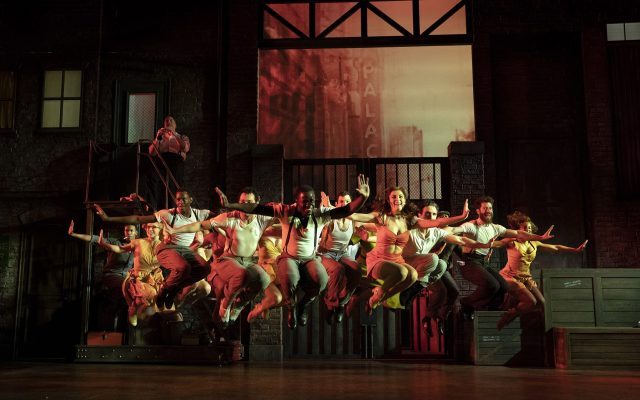
“Too Darn Hot” is a highlight of Roundabout revival of Kiss Me, Kate (photo by Joan Marcus 2019)

Ellis’s revival takes a while to get going, building too slowly. It isn’t until the second act opener, the sizzling “Too Darn Hot,” led by James T. Lane as Paul, Fred’s assistant, that the show starts hitting its mark. The chemistry between Tony nominee Chase (The Mystery of Edwin Drood, Nashville) and Tony winner O’Hara (The King and I, South Pacific) is just not there at the beginning; Fred is too unsympathetic, and Lilli is not shrewish enough, especially as compared to Petruchio and Kate. You just don’t want them to fall back in love. In her Broadway debut, Styles (Kingdom Come, Roman Holiday) is a delight as Lois/Bianca, and Pankow (Twelve Angry Men, The Iceman Cometh) and Williams (Sweat, Bootycandy) have fun as the gangsters, although “Brush Up Your Shakespeare” goes on too long. Paul Gemignani’s orchestrations of such Porter tunes as “Another Op’nin’, Another Show,” “Wunderbar,” “Why Can’t You Behave,” and “Where Is the Life That Late I Led?,” performed by a band positioned in the audience boxes on either side of the stage, go from syrupy to extravagant, with O’Hara cutting it loose with her operatic voice and making Lilli’s point exceedingly clear in “I Hate Men” (“I hate men. / Though roosters they, I will not play the hen. / If you espouse an older man through girlish optimism, / He’ll always stay at home at night and make no criticism, / Though you may call it love the doctors called it / Rheumatism. / Oh, I hate men.”).

The choreography by Tony winner Warren Carlyle (After Midnight; Hello, Dolly!) is highlighted by “Too Darn Hot,” which includes tap and lots of heat, and “Tom, Dick or Harry,” as Gremio, Hortensio, and Lucentio make their case to Bianca through dazzling moves. David Rockwell’s sets change to a choreography all their own. But even as Lilli strikes back at Fred, literally and figuratively, her ultimate choice does not feel as liberating as one might wish. “Come, come you wasp; i’ faith, you are too angry,” Petruchio tells Kate, who replies, “If I be waspish, best beware my sting.” Eight-time Tony nominee Ellis’s (Curtains, 1776) Shrew lacks the necessary sting, but it does have bite.

AN EVENING WITH LYNN GOLDSMITH: KISS 1977-1980

kiss book

Who: Lynn Goldsmith
What: Book talk, Q&A, and signing
Where: Morrison Hotel Gallery, 116 Prince St., second floor, 212-941-8770
When: Tuesday, March 26, free, 6:00 – 8:00
Why: From 1977 to 1980, photographer Lynn Goldsmith chronicled the rise of KISS, the hard rock group consisting of lead singer and bassist Gene Simmons, lead guitarist Ace Frehley, rhythm guitarist and vocalist Paul Stanley, and drummer Peter Criss. On March 27, the band, which now features Simmons, Stanley, lead guitarist Tommy Thayer, and drummer Eric Singer, will play Madison Square Garden for the last time as it makes its way around the world on its farewell tour. The night before, on March 26 at 6:00, Goldsmith will be at the Morrison Hotel Gallery on Prince St. to present her 2017 gift to the loyal KISS Army, KISS: 1977-1980, an illustrated book that collects more than 250 shots of the band along with text contributions from Simmons and Stanley. “I have to admit appreciating singer-songwriters like Bob Dylan, Leonard Cohen, or Paul Simon a great deal more than the music of KISS, but who would I rather photograph or pay to see in concert? No contest: KISS,” Goldsmith writes in the introduction. Goldsmith will talk about working with KISS, participate in a Q&A, and sign copies of the book; in addition, prints will be on display. If you’re wondering where KISS is that night, it’s the third of three off-days prior to the MSG show.

THE BITCH SEAT — 5th ANNIVERSARY SHOW

bitch seat

Q.E.D. Astoria
27-16 23rd Ave.
Sunday, March 24, $8-$10, 8:30
347-451-3873
qedastoria.com
www.lyssamandel.com

The Bitch Seat, which bills itself as “therapy for your misspent youth,” is celebrating its fifth anniversary with a special show March 24 at Q.E.D. Astoria. Host, producer, and “neurotic hippie” Lyssa Mandel and her cohost and boyfriend, Phil Casale, will be joined by comedians and storytellers Jeff Simmermon, Oscar Collazos, and Angel Yau, with music by Rebecca Vigil and a guest appearance by Myq Kaplan. The live talk show delves into the pain we all experience during adolescence, looking back at it with both horror and humor. Tickets are $8 in advance and $10 day of show.

CROSS TRANSIT

Japanese dancer and choreographer Akiko Kitamura and Cambodian photographer Kim Hak collaborate on the multimedia Cross Transit at Japan Society (photo © Ayumi Sakamoto)

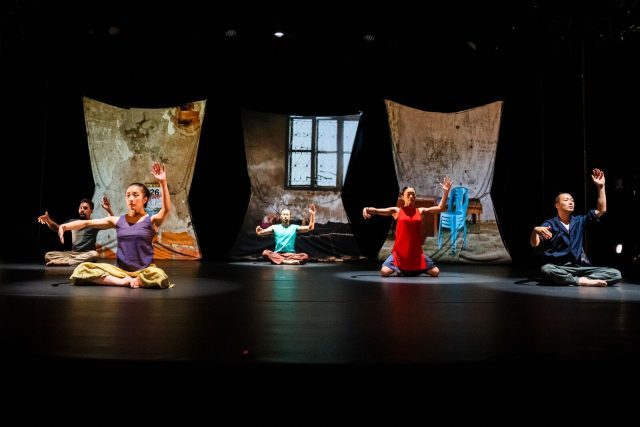
Japanese dancer and choreographer Akiko Kitamura and Cambodian photographer Kim Hak collaborate on the multimedia Cross Transit at Japan Society (photo © Ayumi Sakamoto)

Japan Society
333 East 47th St. at First Ave.
Friday, March 22, and Saturday, March 23, $30, 7:30
212-715-1258
www.japansociety.org
www.akikokitamura.com

“These are the memories of human beings,” Cambodia photographer Kim Hak says in Cross Transit, an engrossing collaboration with Japanese dancer and choreographer Akiko Kitamura and Amrita Performing Arts Center of Phnom Penh. There’s one night left — March 23 — to see the show at Japan Society. With the seventy-five-minute multimedia piece, Kitamura continues her exploration of the future of Asia, following To Belong, on which she worked with Indonesian artists on such topics as diversity and inclusion. Cross Transit is Kitamura and Hak’s attempt to recapture a past that has gone missing because of the violent reign of the Khmer Rouge from 1975 to 1979; in a way, the work is a dance about photography and architecture. In voiceover Cambodian narration that is translated by an English speaker, Hak explains that many families, including his own, had to either destroy or bury personal photos to protect themselves from the oppressive regime, hiding their identities to avoid being arrested, tortured, and killed.

While recovered family photos and new pictures taken by Hak of abandoned buildings are projected behind them on three stretched canvases, Kitamura, Ippei Shiba, Yuka Seike, Yuki Nishiyama, Llon Kawai, and Chy Ratana move about the otherwise dark stage like lost souls or ghosts, reaching out with their hands and arms, trying to make connections in awkward, aggressive ways. They dance in haunting silence, to Hak’s words, narration by Paul Dargan, electronic noise, a Cambodian pop song, percussive sounds evoking gunshots and the snap of a camera, original music by Hiroaki Yokoyama, and vocalizations by Yoshie Abe; Akihiko Kaneko designed the set and the projected films, with dramatic lighting by Yuji Sekiguchi and naturalistic costumes by Tomoko Inamura. The motion of the dancers is initially slow and individual but eventually moves more closely in unison, with several impressive lifts and carries and rolls along the floor. In one section the dancers call out words in English, Japanese, and Cambodian, including “Here,” “Home,” “Now,” and “What are you talking about?” (The non-English words are not translated.) The Cross Transit project, which began in 2014, continues with “vox soil,” a collaboration between Cambodian, Indonesian, Indian, and Japanese artists. Kitamura (Enact Frames of Pleasure, Ghostly Round) and Hak will participate in a Q&A following the March 23 performance at Japan Society.

BAM AND TRIPLE CANOPY — ON RESENTMENT: HUNGER

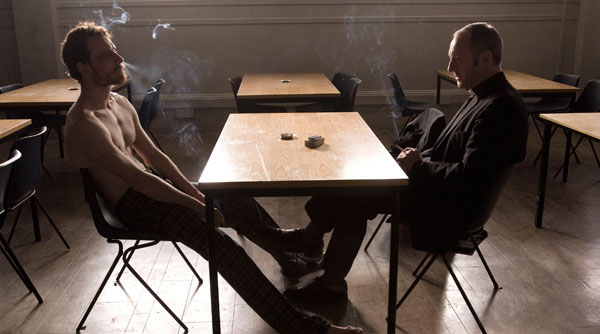
Bobby Sands (Michael Fassbender) and Father Dominic Moran (Liam Cunningham) are caught amid the Troubles in Steve McQueen’s Hunger

HUNGER (Steve McQueen, 2008)
BAMfilm, BAM Rose Cinemas
30 Lafayette Ave. between Ashland Pl. & St. Felix St.
Monday, March 25, 4:00 & 9:30
Series runs March 20-28
718-636-4100
www.bam.org
www.ifcfilms.com

In 2004, we saw Steve McQueen’s fascinating video installation of three short works at Wellesley’s Davis Museum. As entertaining and intriguing as that show was, it never could have prepared us for Hunger, the British-born Turner Prize winner’s brutal and harrowing feature-length debut, let alone his follow-up, 12 Years a Slave. Winner of the Camera d’Or at Cannes, Hunger is set amid the Troubles in Northern Island, as IRA members are locked up in the Maze prison. Seeking special category status, the prisoners are on a Blanket and No Wash protest, refusing to wear official garb or clean up after themselves. They wipe their feces all over their cell walls and let their maggot-infested garbage pile up in corners. Meanwhile, the guards, who live in their own kind of daily fear, never miss a chance to beat the prisoners mercilessly. McQueen (Shame, Widows) introduces the audience to the infamous prison through the eyes of one of the high-ranking guards, Raymond Lohan (Stuart Graham), and new prisoner Davey Gillen (Brian Milligan). Cinematographer Sean Bobbitt often lets his camera linger on a scene, with little or no dialogue, composing them as if individual works of art; one particularly gorgeous shot features Lohan having a cigarette outside the prison as snow falls. About halfway through, the film radically changes focus as Father Dominic Moran (Liam Cunningham) visits H Block leader Bobby Sands (Michael Fassbender), leading to sixteen minutes of uninterrupted dialogue, the camera never moving, as the two men discuss Sands’s planned hunger strike. Written with Enda Walsh (Disco Pigs, The Walworth Farce), McQueen’s film is a visually stunning, emotionally powerful story that will leave you ragged.

Prison guard Raymond Lohan (Stuart Graham) stops for a smoke in powerful Hunger

Prison guard Raymond Lohan (Stuart Graham) stops for a smoke in powerful Hunger

Hunger is screening March 25 in the BAM / Triple Canopy series “On Resentment,” which asks such questions as “How can resentment be reclaimed by those who are used to fits of anger and bitterness being called unproductive, petty, selfish, even pathological?” and “Can — and must — resentment be useful?” The series continues through March 28 with such other films as Liang Zhao’s Petition, Lucretia Martel’s Zama, Lino Brocka’s Manila in the Claws of Light, Brett Story’s The Prison in Twelve Landscapes, and Christine Choy and Renee Tajima-Peña’s Who Killed Vincent Chin?