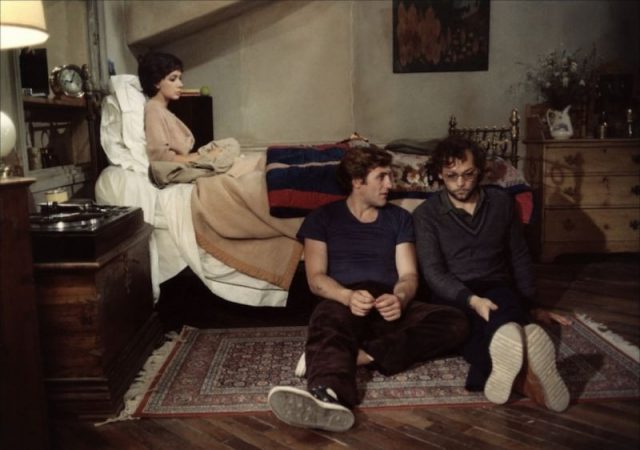
Solange (Carole Laure), Raoul (Gérard Depardieu), and Stéphane (Patrick Dewaere) form a unique kind of family in Bertrand Blier’s Get Out Your Handkerchiefs
GET OUR YOUR HANDKERCHIEFS (PRÉPAREZ VOS MOUCHOIRS) (Bertrand Blier, 1978)
Quad Cinema
34 West 13th St. between Fifth & Sixth Aves.
March 15-21
212-255-2243
quadcinema.com
 French writer-director Bertrand Blier’s Oscar-winning Get Out Your Handkerchiefs is no weepy melodrama. If you need hankies while watching, they’ll be for the tears rolling down your face from laughter. A fortieth-anniversary 2K restoration is screening March 15-21 in the Quad series “Amour or Less: A Blier Buffet,” a nine-film celebration of the five-decade career of the controversial auteur, who has been regularly labeled a misogynist. Get Out Your Handkerchiefs has stirred up its share of naysayers through the years, so it’s fascinating to watch it now, in the midst of the #MeToo movement. The film opens in a restaurant where the brutish, doting Raoul (Gérard Depardieu) is eating with his bored, disinterested wife, Solange (Carole Laure). Suspecting that she is stealing glances at a man seated at a table behind him, Raoul approaches him, a schoolteacher named Stéphane (Patrick Dewaere), and practically begs him to sleep with his wife. Raoul, a driving instructor, loves Solange so much that he is willing to go to great lengths to make her happy, even if it means sharing her bed with another man.
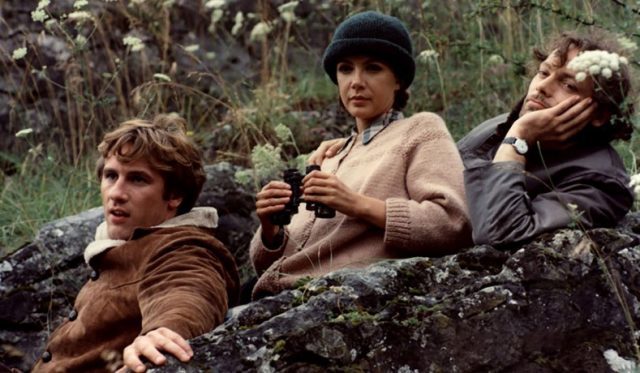
Adolescence hits Christian Belœil (Riton Liebman) hard in Oscar-winning romantic comedy
Of course, she has something to say about it and ultimately decides, without much excitement, that the plan is fine with her; she desperately wants to have a baby but has been unable to conceive with her husband. The men begin having quite the bromance themselves as they talk about Mozart while Solange knits, and knits, and knits. (The first scene Blier wrote was when the two men have a less-than-intelligent discussion on Mozart; Blier then built the film around that.) Their green-grocer neighbor (Michel Serrault) starts hanging around as well, concerned about Solange’s search for contentment. Solange, Raoul, and Stéphane spend a summer working together at a camp, where they meet Christian Belœil (Riton Liebman), a thirteen-year-old rich kid who gets bullied by the other boys but takes a liking to Solange as his hormones rage out of control. The film gets more absurdist, and funnier and funnier, as it heads into territory destined to offend politically correct watchdogs everywhere.
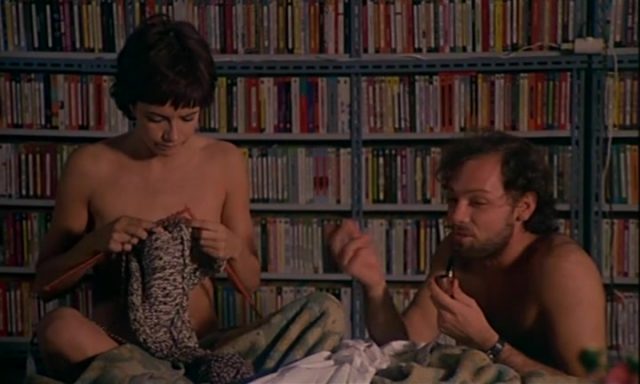
A fortieth-anniversary 2K restoration of Get Out Your Handkerchiefs opens at the Quad on March 15
Named Best Picture by the National Society of Film Critics in addition to nabbing the Academy Award for Best Foreign Language Film, Get Out Your Handkerchiefs is a delightful farce that turns traditional family and societal relationships inside out and upside down, whether it be parents and children, mothers and sons, husbands and wives, teachers and students, or just a couple of dudes. Depardieu and Dewaere, who previously teamed up in Blier’s Going Places, are a comic force as a couple of ordinary guys caught up in a crazy riff on Jules et Jim, Raoul a driving instructor who doesn’t know where he’s going, Stéphane a man obsessed with Pocket Books. Laure (Sweet Movie, La Tête de Normande St-Onge) charmingly underplays the enigmatic Solange: Raoul and Stéphane think she might be a simpleton, but is she? The scenes of her knitting are hilariously deadpan, and the matching sweaters she produces eventually show up on nearly everyone, their prosaic patterns sometimes echoed in the walls, floors furniture, and other elements. Meanwhile, the comedy turns poignant as Christian, who can’t stand his parents (Eléonore Hirt and Jean Rougerie) or the other kids, spends more time with his new adult friends, especially Solange. At one point Christian is in bed reading Ralph Dennis’s super-noir On bricole, the cover showing a man torn in half, as if Raoul and Stéphane are two parts of the same human being (or referencing Christian’s growth from boy to man). And Stéphane is reading Vladimir Nabokov’s Ada, a novel about a rather unusual family. Through it all is a wonderfully evocative score by Georges Delerue. “Amour or Less: A Blier Buffet” continues through March 21 with such other Blier works as Beau-père, Merci la vie, Ménage (Tenue de soirée), and Going Places.

 Jia Zhang-Ke reaches into his recent past, and China’s, in his elegiac Ash Is Purest White. In the film, which opens today at the Quad and Lincoln Center, the Sixth Generation writer-director’s wife and muse, Zhao Tao, stars as Qiao, a combination of the characters she played in Jia’s 2002 Unknown Pleasures and 2006