twi-ny recommended events

THE LIGHT

(photo by Joan Marcus)

Genesis (Mandi Masden) and Rashad (McKinley Belcher III) are ready for a special night in Loy A. Webb’s The Light (photo by Joan Marcus)

Susan & Ronald Frankel Theater, the Robert W. Wilson MCC Theater Space
511 West 52nd St. between Tenth & Eleventh Aves.
Tuesday – Sunday through March 17
www.mcctheater.org

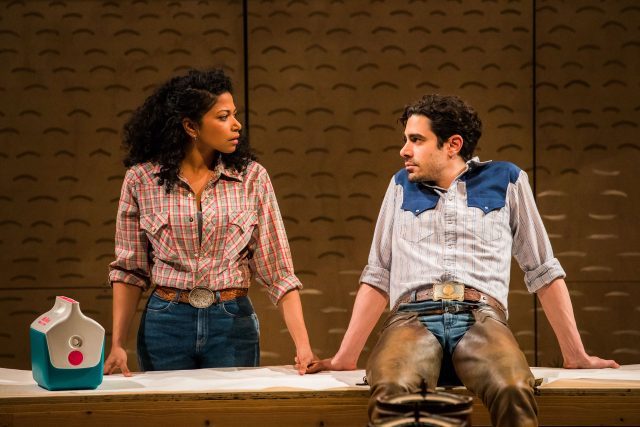
MCC inaugurates its cozy new one-hundred-seat Susan & Ronald Frankel Theater at the Robert W. Wilson MCC Theater Space on West Fifty-Second St. with the New York premiere of Loy A. Webb’s The Light, a slow-building incendiary drama that opened last night and continues through March 17. Rashad (McKinley Belcher III) and Genesis (Mandi Masden) are celebrating a special evening, exchanging gifts and getting frisky in her beautiful Hyde Park condo, which features two skylights, a long marble kitchen island, a large window looking out on a small garden, and several paintings and photographs by African American artists, including one from Carrie Mae Weems’s highly influential Kitchen Table series. (The impressive set, surrounded on three sides by the audience, is by Kimie Nishikawa.) Rashad is a hunk of a fireman with a young daughter; Genesis is a teacher at an all-black charter school. “You’ve been a tremendous blessing in both our lives, baby,” Rashad says to Genesis, who is curious at his sudden honesty and eloquence. He adds, “Specially mine. It used to get me down thinking about all the failed relationships I had before you. But I realized that wasn’t nothing but life pruning me. Just as it would a tree. Cutting out all the old, damaged, and diseased branches that didn’t belong. Making room for the one that did . . . you.” She laughs, and he responds, “Really? I’m trying to have a serious moment and you laugh?” To which she replies, “This is so suspect, Shad. You were one Drake lyric away from singing.” What starts out as a romantic occasion becomes something very different when he presents her with a surprise gift that dredges up painful memories.

(photo by Joan Marcus)

Mandi Masden and McKinley Belcher III heat up the stage in inaugural production at new Susan & Ronald Frankel Theater at the Robert W. Wilson MCC Theater Space (photo by Joan Marcus)

Webb’s full-length debut is a potent look at the fragility of love in a #MeToo, #BlackLivesMatter world fraught with ever-evolving complications as people walk tenderly around matters of race, sexuality, abuse, and power exemplified by such controversial public cases as the Brett Kavanaugh confirmation hearings and the accusations against such celebrities as R. Kelly and Chris Brown. Over the course of seventy-five minutes, Rashad and Genesis’s relationship, so inspired at the beginning, goes through a series of challenges that tests their future as each one opens up their heart, moving through joy, pain, and redemption. “Please, don’t nobody want you. And the only reason I do is because my biological clock is ticking and I’m desperate,” she teases him, but when she sees he is hurt, she says, “I’m joking, baby.” Drama Desk Award winner Belcher III (The Royale, Ozark) and Masden (Saint Joan, Our Lady of Kibeho) are a formidable duo, each one balancing strength with vulnerability as some deep truths emerge. Webb and director Logan Vaughn (The Agitators) focus on the actors’ electric chemistry, which only intensifies as the friction increases; Ben Stanton’s lighting design keeps the full space partially illuminated so we can see our fellow attendees while also feeling implicated in the characters’ actions, wondering how we would react to the questions Rashad and Genesis ask each other. The play falters somewhat as the end approaches and Webb throws in too many late twists, but the finale hits the mark. Originally developed at the New Colony in Chicago (with Jeffery Owen Freelon Jr. and Tiffany Oglesby, directed by Toma Langston), The Light will leave you gasping for breath — and examining your own meaningful relationships, trying to stay away from the darkness.

THE FUTURE OF FILM IS FEMALE, PART 2: BLAME / HAPPY BIRTHDAY, MARSHA!

Quinn Shepard Blame

Quinn Shepard is a sextuple threat in sexy, hard-hitting teen drama Blame

BLAME (Quinn Shephard, 2017)
MoMA Film, Museum of Modern Art
11 West 53rd St. between Fifth & Sixth Aves.
Thursday, February 14, 4:00
Series runs February 14-21
212-708-9400
www.moma.org
www.samuelgoldwynfilms.com/blame

Last summer, MoMA presented “The Future Is Female,” a week of independent features and shorts written, directed, and starring women, dealing with important issues of inclusivity and gender. The series is back for its second iteration, running February 14-21 and beginning with a recent head spinner. Twenty-two-year-old Quinn Shephard proves herself to be a sextuple threat in the daring, sexy teen thriller Blame. The New Jersey native wrote, directed, edited, produced, and stars in the film, in addition to writing the lyrics for several songs performed by Peter Henry Phillips. Her mother, Laurie Shephard, also produced and cast the movie, which takes place in a New Jersey high school where Abigail Grey (Shephard) has returned after a mysterious psychotic incident. She is immediately targeted by mean-girl leader Melissa Bowman (Nadia Alexander) and her trusted bestie, Sophie Grant (Sarah Mezzanotte), while the third member of the clique, Ellie Redgrave (Tessa Albertson), might be on the outs for showing sympathy for Abigail. Melissa sics her boyfriend, T.J. (Owen Campbell), and Sophie’s beau, Eric (Luke Slattery), on Abigail, taunting and teasing her, calling her Sybil, after the book and movie about a woman with multiple personalities. When Jeremy Woods (Chris Messina) takes over their drama class, he switches the play they’re presenting from Tennessee Williams’s The Glass Menagerie to Arthur Miller’s The Crucible, casting Abigail as protagonist Abigail Williams, who might be involved with witchcraft, and Eric as John Proctor, a married man she might be having an affair with. Melissa, who wanted the lead role, is furious when she is named Abigail’s understudy. When Eric doesn’t take things seriously, Jeremy steps in to play John, angering Melissa further as Abigail gets to spend more time with the rather attractive teacher, especially as she watches Abigail and Jeremy grow very close. And Melissa doesn’t like to lose.

Quinn Shepard

Quinn Shepard, wrote, directed, produced, edited, stars in, and composed lyrics for for her feature-film debut, Blame

Blame is a carefully crafted, intimate tale of lust, jealousy, and obsession, capturing the complicated zeitgeist of high school life, the fear and trepidation along with the experimentation and confusion. In shifting from The Glass Menagerie to The Crucible, Shephard equates mental illness with witchcraft as seen through a feminist lens as her story parallels Miller’s, much as Amy Heckerling’s Clueless follows Jane Austen’s Emma (only without the laughs) and Roger Kumble’s Cruel Intentions is based on Pierre Choderlos de Laclos’s Les Liaisons dangereuses. The scenes between Shephard (Hostages, The Miseducation of Cameron Post) and Messina (The Mindy Project, Damages) are sizzling hot as teacher and student teeter on the edge of a major taboo. Shephard, who appeared in a high school production of The Crucible, also gets to show off her fab eyebrows, which are a character unto themselves. She is one talented filmmaker deserving of attention in an industry that must do a much better job cultivating, acknowledging, celebrating, and rewarding films by and about women. Blame is screening February 14 at 4:00 with Tourmaline and Sasha Wortzel’s fourteen-minute Happy Birthday, Marsha!, about trans artist and activist Marsha P. Johnson, followed by a Q&A with the filmmakers. “The Future Is Female, Part 2” continues with such other pairings as Nia DaCosta’s Little Woods and Crystal Kayiza’s Edgecombe, Kate Novack’s The Gospel According to André and Catherine Lee’s 9at38, and Josephine Decker’s Madeline’s Madeline and Eleanor Wilson’s Low Road, all followed by discussions.

BILL CHATS

Oskar Eustis and Bill T. Jones will talk about their roles as artistic directors on February 11 at NYLA

Oskar Eustis and Bill T. Jones will talk about their roles as artistic directors on February 11 at NYLA

Who: Bill T. Jones and Oskar Eustis
What: Bill Chats
Where: New York Live Arts, 219 West 19th St. between Seventh & Eighth Aves., 212-924-0077
When: Monday, February 11, $8-$10, 7:00
Why: New York Live Arts artistic director Bill T. Jones sits down with Public Theater artistic director Oskar Eustis for the next edition of his “Bill Chats” series, taking place February 11 at 7:00. Jones, an award-winning choreographer — among his many prizes are the Tony, the Obie, the 2013 National Medal of Arts, the 2010 Kennedy Center Honors, and the 1994 MacArthur Genius Award — and Eustis, who directed the controversial 2017 Shakespeare in the Park production of Julius Caesar that turned the Roman leader into Donald Trump, will discuss the current sociopolitical climate and how it impacts their decisions as artistic directors.

PLS. REPLY BOOK LAUNCH

(courtesy Ugly Duckling Presse)

Rochelle Feinstein will celebrate the publication of her new book with a celebration at the Block Gallery (courtesy Ugly Duckling Presse)

Who: Rochelle Feinstein and Didier William
What: Book launch and discussion
Where: AIM: Artist in the Marketplace, the Block Gallery, 80 White St., second floor
When: Monday, February 11, free with advance RSVP, 6:00
Why: Bronx native Rochelle Feinstein will celebrate the launch of her new book, Pls. Reply (Ugly Duckling Presse / Bronx Museum of the Arts / Stellar Projects, March 1, $22), with a special event at AIM’s new space in the Block Gallery on February 11. The trade paperback is a collection of her writings along with sixteen full-color book plates, edited by Antonio Sergio Bessa, and comes out in conjunction with her current exhibition at the Bronx Museum of the Arts, “Rochelle Feinstein: Image of an Image,” which continues through March 3 and was curated by Bessa. At the Block Gallery, the seventy-one-year-old Feinstein, a tenured Yale professor, will talk with Haitian visual artist and AIM alumnus Didier William; beer and wine will be served, and Pls. Reply will be available at a discount.

CHOIR BOY

(photo © Matthew Murphy, 2018)

Pharus Jonathan Young (Jeremy Pope) pursues his singing dreams in Choir Boy (photo © Matthew Murphy, 2018)

Manhattan Theatre Club at the Samuel J. Friedman Theatre
261 West 47th St. between Broadway & Eighth Aves.
Tuesday – Sunday through February 24, $79-$169
choirboybroadway.com
www.manhattantheatreclub.com

Oscar-winning screenwriter Tarell Alvin McCraney’s Broadway debut, Choir Boy, offers a new twist on a classic dramatic trope: life at an all-male boarding school. But Charles R. Drew Prep School is not quite like the schools depicted in such well-regarded films as Rushmore, Dead Poets Society, Tom Brown’s School Days, Heaven Help Us, or If… The students and the teachers at Drew are all men of color. “My daddy say they used to let you get away with a lil bit because they know how hard it is to be a black man out there,” student Bobby Marrow (J. Quinton Johnson) tells fellow student David Heard (Caleb Eberhardt). “Now, everything got to be watched, gotta be careful, gotta be cordial. Don’t say nothing, don’t say that word, don’t look like that, this shit Pandemic.” Bobby, whose uncle is Headmaster Marrow (Chuck Cooper), is one of several young men in the school’s prestigious choir, along with Pharus Jonathan Young (Jeremy Pope), Junior Davis (Nicholas L. Ashe), Anthony Justin “AJ” James (John Clay III), and David. The show opens with Pharus singing the school song, a much-coveted opportunity, but he takes an unfortunate pause when he is secretly harassed by Bobby, who questions Pharus’s sexual orientation. Afterward, in explaining why he stopped but without snitching on Bobby, Pharus asks the headmaster, “Would you rather be feared or respected?” which becomes an underlying theme of the play as the boys deal with issues of race, gender, homophobia, family, class, and education.

(photo © Matthew Murphy, 2018)

Bobby Marrow (J. Quinton Johnson) and Pharus Jonathan Young (Jeremy Pope) are at odds in boarding-school drama (photo © Matthew Murphy, 2018)

The play suffers dramatically upon the arrival of Mr. Pendleton, a former teacher at the school who has been brought back by the headmaster for inexplicable reasons, unless it is merely to force racial conflict, as Pendleton is white and, oddly, played by the ubiquitous Austin Pendleton, blurring the line between theater and real life in an obtrusive way. The scenes with Mr. Pendleton, who uses racist cracks to supposedly educate the kids, bring the show to a screeching halt and are best forgotten as the story proceeds. Fortunately, there is much to enjoy in the rest of the Manhattan Theater Club production, which has been extended at the Samuel J. Friedman Theatre through February 24.

Pope (Ain’t Too Proud, Invisible Thread) makes a dazzling Broadway debut as Pharus, a proud, flawed, young gay man who refuses to muzzle himself while often disregarding the feelings of others; it’s an electrifying performance of a role given complex subtleties by McCraney, who cowrote the Oscar-winning Moonlight with Barry Jenkins. The supporting cast portraying the other teens are terrific as well, including Clay III (Encores’ Grand Hotel) as AJ, Pharus’s roommate, who is sensitive to his friend’s situation; Johnson (Hamilton) as the troubled Bobby, who is dealing with his mother’s death; Eberhardt (Is God Is) as David, who is hiding his own secrets; and Ashe (Kill Floor) as Junior, a follower who makes questionable decisions. They might have their share of disagreements, but when they sing such spirituals as “Keep Your Eyes on the Prize” and “Rockin in Jerusalem” they show just what they can accomplish together. (Alas, “There’s a Rainbow ’round My Shoulder” feels a bit too obvious and heavy-handed.) Tony winner Cooper (The Life) is splendidly august as the headmaster, who only gets involved when truly necessary, understanding that the students grow when they figure things out for themselves, even if that’s sometimes painful. Thoughtfully directed by Trip Cullman (Lobby Hero, Six Degrees of Separation), Choir Boy is ultimately about tolerance, about the basic human dignity everyone deserves, while for the most part steering clear of grand statements and politically correct sentimentality.

MoMA PRESENTS YERVANT AND ANGELA RICCI LUCCHI’S ANGELA’S DIARIES

Angela

Yervant Gianikian and Angela Ricci Lucchi’s final collaboration is making its US premiere at MoMA

I DIARI DI ANGELA (ANGELA’S DIARIES) (Yervant Gianikian & Angela Ricci Lucchi, 2018)
MoMA Film, Museum of Modern Art
11 West 53rd St. between Fifth & Sixth Aves.
February 7–13
212-708-9400
www.moma.org

In February 2009, MoMA hosted a retrospective of the work of Italian visual artists Yervant Gianikian and Angela Ricci Lucchi. Ten years later, MoMA is presenting the US premiere of their final film, I Diari di Angela (“Angela’s Diaries”), which Gianikian completed following the death of his longtime partner; Lucchi died in February 2018 at the age of seventy-six. The film, running through February 13, is an homage to both their private and professional life together, incorporating archival footage with scenes they shot during their travels to Moscow, Armenia, Bosnia and Herzegovina, and other locales, often tied to recent war and political and climate turmoil, in addition to home movies of Lucchi cooking and gardening. Throughout the film, Gianikian reads random pages from Lucchi’s extensive diaries, his aged fingers turning the pages filled with her attractive handwriting and drawings. “This is my memory of Angela, of our life. I reread these notebooks and discover others I didn’t know about,” Gianikian explains in his director’s statement. “Reexamining all the notebooks of Angela’s infinite Diary and the backward look of our private films, which accompanied our research. My desperate attempt to bring her back to my side, to bring her back to life, the continuation of our work as goal, as mission, through her notebooks and drawings, a sort of map for action in the present, containing its guiding principles and envisaging its continuation. Angela and I have prepared new and important projects to carry out. The promise, the oath, to continue the work.”

Angela

Angela Ricci Lucchi and Yervant Gianikian show off their Golden Lion at the Venice Biennale

It is often difficult to tell which footage is old and which is new, as the pair hand-tinted much of the archival material and eschewed the latest high-def technology for the newer shots, layering together the look of the past and the present. Early on, Lucchi describes one of their canvases, which includes watercolor images and handwritten text: “I want to use my work to express my indignation, our indignation. This is like our manifesto. It took shape during a period of great despair for today’s world, with so much upheaval. So, I wrote that our world is not political, is not aesthetic, is not pedagogical, is not progressive, is not cooperative, is not ethical, is not consistent. Above all, it’s the contemporary world, it’s contemporaneity. And I think many artists, nowadays, focus more on getting into the market and making money. We began, and go on, working out of passion. And I say that if other artists focused a bit more on these things, then maybe the world would be less wretched.” Despite such dire pronouncements, the film is a soft, touching, poetic work, told in their trademark avant-garde narrative style. Men dangerously saw wood. Gianikian and Lucchi (Dal Polo all’Equatore; Oh! uomo; Pays barbare) visit a friend’s studio. They go through canisters of old, decaying film. They tell a serious story about a terrible accident Gianikian suffered. But through it all, even with the slow pace, they display a passion for life, for justice, for love. It’s a one-of-a-kind documentary, a work that eventually sweeps you up into its welcoming atmosphere, a fitting finale for a one-of-a-kind team.

RACE, SEX & CINEMA — THE WORLD OF MARLON RIGGS: MOONLIGHT / AFFIRMATIONS

MOONLIGHT

Chiron (Alex Hibbert) looks out at a hard future in Barry Jenkins’s Oscar-winning Moonlight

MOONLIGHT (Barry Jenkins, 2016)
BAMcinématek, BAM Rose Cinemas
30 Lafayette Ave. between Ashland Pl. & St. Felix St.
Saturday, February 9, 7:00
Series runs February 6-14
718-636-4100
www.bam.org
moonlight-movie.com

BAM is paying tribute to controversial and innovative Texas-born filmmaker Marlon Riggs in conjunction with the twenty-fifth anniversary of his death with “Race, Sex & Cinema: The World of Marlon Riggs.” Riggs, who was gay and black, died in April 1994 at the age of thirty-seven from AIDS complications, leaving behind an important legacy of films, poetry, and essays. Many of his works had major impacts on the next generation of African American writers and directors, as evidenced by this program. On February 9, the series pairs Barry Jenkins’s Moonlight, which was nominated for eight Oscars and won three (Best Picture, Best Supporting Actor for Mahershala Ali, and Best Adapted Screenplay for Jenkins and Tarell Alvin McCraney), with Riggs’s ten-minute 1990 short, Affirmations, about the dreams and desires of gay black men. In Moonlight, Jenkins tells the powerful and moving story of Chiron, a shy, troubled boy growing up in Liberty City, Florida, in three chapters as Chiron goes from a young boy (Little, played by Alex Hibbert) to a teenager (Chiron, played by Ashton Sanders) to a twenty-seven-year-old man (Black, played by Trevante Rhodes). The semiautobiographical film is based on playwright and actor McCraney’s In Moonlight Black Boys Look Blue and Jenkins’s own experiences; both men are from Liberty City but did not know each other there. In the first section, Little is chased by bullies and runs into an abandoned building, where he is found by Juan (Ali), a drug dealer who brings him home to his girlfriend, Teresa (Janelle Monáe). They become a kind of surrogate family, as Little’s mother, Paula (Naomie Harris), is a crack addict who will do just about anything for her next score. Little also finds solace in his friendship with Kevin (Jaden Piner, later played by Jharrel Jerome and André Holland). In the second chapter, Chiron is taunted and bullied by Terrel (Patrick Decile) while trying to come to terms with his sexual orientation. In the third section, the passage of time reveals how much has changed, although the film turns overly melodramatic at the end.

Marlon Riggs

Karen Everett’s I Shall Not Be Removed: The Life of Marlon Riggs is part of Riggs tribute at BAM

Taking its inspiration from the source material, Moonlight is beautifully photographed by James Laxton, who has previously shot Medicine for Melancholy and Jenkins’s 2003 shorts, My Josephine and Little Brown Boy, and 2011 “Remigration” episode of Futurestates, bathing the film in lush blues. Jenkins’s subtly paced style is accompanied by a gorgeous classical-inspired score by Nicholas Britell (The Big Short). Moonlight is anchored by superb performances by Emmy nominee Ali (House of Cards, Hidden Figures) as the cool and caring Juan; Harris (Mandela: Long Walk to Freedom, 28 Days Later) as the drug-addicted Paula, who has lost control of her life; Monáe (Hidden Figures, The Electric Lady) as the sweet and understanding Teresa; and Sanders (The Retrieval) as the in-between Chiron, who feels overwhelmed by all the maelstrom swirling around him. Moonlight and Affirmations are screening at BAM February 9 at 7:00; “Race, Sex & Cinema: The World of Marlon Riggs” runs February 6-14 and includes such other evenings as Riggs’s Tongues Untied and Anthem with Isaac Julien’s The Attendant; a fifteenth-anniversary screening of Rodney Evans’s Brother to Brother, followed by a Q&A with Evans; Su Friedrich’s Hide and Seek and Cheryl Dunye’s Janine; and Lynn Hershman Leeson’s The Complete Electronic Diaries, Peter Rose’s The Man Who Could Not See Far Enough, and Jeanne C. Finley’s I Saw Jesus in a Tortilla.