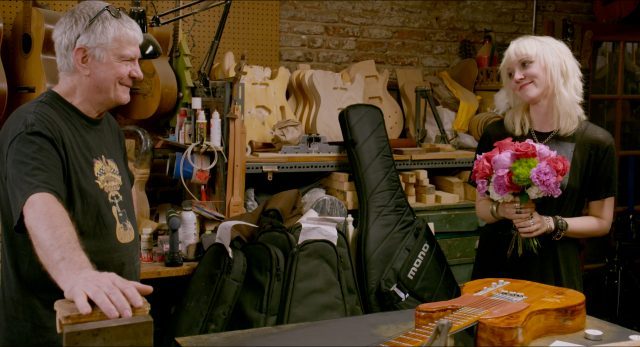
In the second half of Ron Mann’s utterly delightful and unique documentary Carmine Street Guitars, a well-dressed, well-groomed young man enters the title store in Greenwich Village and identifies himself as Adam Shalom, a Realtor who is selling the building next door. Shalom tries to talk about square footage, but Carmine Street Guitars founder and owner Rick Kelly barely looks up as he continues cleaning a fret. It’s a critical, uncomfortable moment in an otherwise intimate and inviting film; throughout the rest of the eighty-minute documentary, the soft-spoken Kelly talks guitars and craftsmanship with a stream of very cool musicians and his punk-looking young apprentice, Cindy Hulej. But Shalom’s arrival hearkens to one of the main reasons why Mann made the movie: to capture one of the last remaining old-time shops in a changing neighborhood, a former bohemian paradise that has been taken over by hipsters and corporate culture, by upscale stores and restaurants and luxury apartments. You’ll actually cheer that Kelly gives Shalom such short shrift, but you’ll also realize that Shalom and others might be knocking again at that door all too soon.
Rick Kelly welcomes “instigator” Jim Jarmusch to his Greenwich Village shop in Carmine Street Guitars
The rest of the film is an absolute treat. Mann follows five days in the life of Carmine Street Guitars; each day begins with a static shot of the store from across the street, emphasizing it as part of a community as people walk by or Kelly, who was born in Bay Shore, arrives with a piece of wood he’s scavenged. The camera then moves indoors to show Kelly and Hulej making guitars by hand, using old, outdated tools and wood primarily from local buildings that date back to the nineteenth century. Kelly doesn’t do computers and doesn’t own a cell phone; he leaves all that to Hulej, who posts pictures of new six-strings on Instagram. Meanwhile, Kelly’s ninetysomething mother, Dorothy, works in the back of the crazily cluttered store, taking care of the books with an ancient adding machine. Over the course of the week, they are visited by such musicians as Dallas and Travis Good of the Sadies (who composed the film’s soundtrack), “Captain” Kirk Douglas of the Roots, Eleanor Friedberger, Dave Hill of Valley Lodge, Jamie Hince of the Kills, Nels Cline of Wilco, Christine Bougie of Bahamas, Marc Ribot, and Charlie Sexton. Bill Frisell plays an impromptu surf-guitar instrumental version of the Beach Boys’ “Surfer Girl.” Stewart Hurwood, Lou Reed’s longtime guitar tech, talks about using Reed’s guitars for the ongoing “DRONES” live installation. “It’s like playing a piece of New York,” Lenny Kaye says about the guitars made from local wood while also referring to the shop as part of the “real village.”
Mann, the Canadian director of such previous nonfiction films as Grass, Know Your Mushrooms, and Comic Book Confidential, was inspired to make the movie at the suggestion of his friend Jarmusch, who in addition to directing such works as Stranger Than Paradise (which featured Balint), Down by Law, and 2016 NYFF selection Paterson is in the New York band Sqürl. Plus, it was Jarmusch who first got Kelly interested in crafting his guitars with wood from buildings, “the bones of old New York,” resulting in Telecaster-based six-strings infused with the history of Chumley’s, McSorley’s, the Chelsea Hotel, and other city landmarks. Carmine Street Guitars, which is far more than just mere guitar porn, opens April 24 at Film Forum, with Mann, Kelly, and Hulej participating in Q&As following the 7:45 show on Wednesday night, joined by Jarmusch, and after the 6:00 screening on Friday and 4:10 show on Saturday.
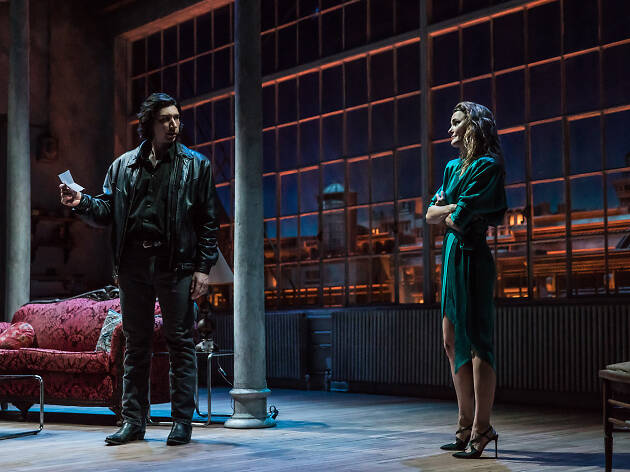
Adam Driver and Keri Russell star in Broadway revival of Lanford Wilson’s Burn This (photo by Matthew Murphy)
Hudson Theatre
139-141 West 44th St. between Sixth & Seventh Aves.
Tuesday – Sunday through July 14, $59 – $315
855-801-5876 www.thehudsonbroadway.com
Adam Driver is scorching hot and Keri Russell sizzles in Michael Mayer’s otherwise surprisingly lukewarm revival of Lanford Wilson’s Burn This, which opened last week at the Hudson Theatre. Oscar and Emmy nominee Driver is deserving of a Tony nod for his ferociously physical, incendiary performance as Pale, a Jersey restaurant manager unable to deal with the tragic death of his younger brother Robbie, a gay dancer who was killed in a boating accident with his lover, Dom. The play is set in 1987 and takes place in a huge industrial loft apartment in Lower Manhattan where Robbie lived with fellow dancer Anna (Russell), a straight woman in a relationship with successful screenwriter Burton (Tony nominee David Furr), and Larry (Tony nominee Brandon Uranowitz), a wisecracking gay man who works in advertising. One night Pale shows up drunk, loudly complaining about New York City, parking, phone messages, new shoes, social politeness, and anything else that comes to mind, rattling on without a filter. He constantly uses words about heat when talking about himself and his life, declaring that his “feet are in boiling water,” he has a toaster oven for a stomach, his normal temperature is about 110, and it’s hot enough in the apartment for them to “bake pizza.” He says he’s “a roving fireman. Very healthy occupation. I’m puttin’ out somebody’s else’s fire. I’m puttin’ out my own. . . . Or sometimes you just let it burn.”
Despite her better judgment, Anna, who is branching out as a choreographer, is strangely attracted to Pale, who is a stark contrast to the more self-contained Burton, who lives in Canada and is always talking about the cold, including snow and “glacier activity”; the only time he brings up heat is when he tells Anna about her upcoming dance, “Make it as personal as you can. Believe me, you can’t imagine a feeling everyone hasn’t had. Make it personal, tell the truth, and then write ‘Burn this’ on it.” Here Wilson is describing his own process in writing the play; it was indeed personal, inspired partly by the death of a friend’s brother, as well as the AIDS epidemic claiming the lives of so many New York artists. He wrote “Burn this” at the top of every page until he realized it should be the title of the play.
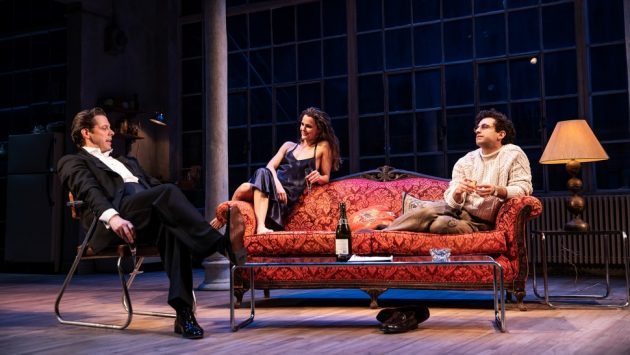
Burton (David Furr), Anna (Keri Russell), and Larry (Brandon Uranowitz) have a brief moment to cool down in Burn This at the Hudson Theatre (photo by Matthew Murphy)
Despite the strong cast, led by Lortel Award winner Driver (BlacKkKlansman, Look Back in Anger), whose body commands the stage with an intense, dangerous fury, and Golden Globe winner and Emmy nominee Russell (The Americans, Fat Pig), who has a sweet tenderness as Anna, the play never catches fire. Derek McLane’s set is lovely, with large back windows that look out on the city, an outside world that the characters can’t reach yet, and Clint Ramos’s costumes are sexy and alluring, from Pale’s sharp suits to Anna’s slinky dresses and hapi coat. The unending references to hot and cold, fire and ice grow tiresome, including the leitmotif of Bruce Springsteen’s “I’m on Fire”; would Larry really sing that? Pulitzer Prize winner Wilson (Talley’s Folly, Angels Fall) and Tony winner Mayer (Spring Awakening, Hedwig and the Angry Inch) also incorporated Springsteen songs into a 1984 revival of 1965’s Balm in Gilead. The play made its Broadway debut in 1987, running for more than a year at the Plymouth Theatre, with John Malkovich as Pale and a Tony-winning Joan Allen as Anna. A 2002 revival at the Signature paired Edward Norton and Catherine Keener. In order for the play to work, it has to have the fire and passion at least reminiscent of A Streetcar Named Desire, but this production, even with its powerful moments and strong performances, too often simmers when it needs to blister and blaze.
Clint Eastwood introduces the Man with No Name in Sergio Leone’s A Fistful of Dollars (photo courtesy MGM / Cineteca di Bologna / Park Circus)
A FISTFUL OF DOLLARS (PER UN PUGNO DI DOLLARI) (Sergio Leone, 1964)
Film Forum
209 West Houston St.
Saturday, April 20, 4:30, and Monday, April 22, 4:40
Series runs April 19 – May 16
212-727-8110 filmforum.org
Clint Eastwood made a name for himself on the big screen playing the Man with No Name in Sergio Leone’s 1964 spaghetti Western, A Fistful of Dollars, which is being shown April 20-23 at Film Forum as part of its awesome Trilogies series. In his first lead movie role, Eastwood, the costar of the television series Rawhide, is a gunslinger draped in a poncho and smoking a small cigar who rides on a mule into San Miguel, a tiny town in the middle of nowhere, home to an ongoing feud between the gun-running Baxters and the liquor-dealing Rojos. The stranger decides to play both sides against the middle, caring only that he earns lots of cash. “Never saw a town as dead as this one,” the stranger tells saloon owner Silvanito (Jose Calvo), who explains, “The place is only widows. Here you can only get respect by killing other men, so nobody works anymore.” The stranger hears the sound of banging outside and says, “Somebody doesn’t share your opinion.” Silvanito opens the window to reveal old man Piripero (Joe Edger) making coffins. “You’ll be a customer,” Silvanito tells the stranger with assurance. The stranger goes back and forth between the Baxters, led by the sheriff (W. Lukschy), and the Rojos, who follow the dangerous, unpredictable Ramón (Gian Maria Volontè). Also caught up in the Hatfield-McCoy battle are the sheriff’s wife, Consuelo (Margherita Lozano), and brother, Antonio (Bruno Carotenuto), along with Rojo brothers Benito (Antonio Prieto) and Esteban (S. Rupp) and their enforcer, Chico (Richard Stuyvesant). Ramón, meanwhile, has his eyes set on Marisol (Marianne Koch), who is married to Julio (Daniel Martín), who does not want to get involved in any fighting. Carefully watching it all is Juan de Díos (Raf Baldassarre), who rings the church bell at every death.
The Italian-German-Spanish production is a remake of Akira Kurosawa’s Yojimbo, which led to legal entanglements when the Japanese auteur demanded, well, a fistful of dollars in financial compensation. According to Christopher Frayling’s Sergio Leone — Something to Do with Death, Leone received a note from Kurosawa that read, “Signor Leone — I have just had the chance to see your film. It is a very fine film, but it is my film. Since Japan is a signatory of the Berne Convention on international copyright, you must pay me.” Frayling also suggests that Leone was influenced by Dashiell Hammett’s Red Harvest and Carlo Goldoni’s Servant of Two Masters and did not feel he was stealing only from Kurosawa. In The BFI Companion to the Western, Frayling quotes Leone as saying, “Kurosawa’s Yojimbo was inspired by an American novel of the serie-noire so I was really taking the story back home again.” (For a montage of similarities between the two films, check out this video.). Regardless, A Fistful of Dollars, made for about two hundred grand, set the standard for the new genre, and Eastwood was its antihero. He and Leone would team up again on the sequel, For a Few Dollars More, which is not a direct remake of Kurosawa’s Yojimbo follow-up, Sanjuro, as well as The Good, the Bad, and the Ugly, the best of the Dollars Trilogy.
Clint Eastwood watches his back in first of the Dollars Trilogy (photo courtesy MGM / Cineteca di Bologna / Park Circus)
Fistful is steeped in violence and death, from Iginio Lardani’s rad title sequence of silhouettes in black, white, and blood red to an early shot of the stranger riding under a noose and giving it a long look. Whereas Toshirô Mifune played the bodyguard in Yojimbo with a devilish glee, Eastwood — in a role that had been previously offered to Henry Fonda, Charles Bronson, James Coburn, and others — is much more serious as the Man with No Name, who would become more sympathetic in future outings. The extremely poor dubbing only adds to the film’s magnificence. To enhance its foreign appeal to American audiences, several members of the cast and crew appear under pseudonyms in the credits, including Leone (Bob Robertson), cinematographer Massimo Dallamano (Jack Dalmas), actor Gian Maria Volontè (John Wells), and composer Ennio Morricone (Leo Nichols or Dan Savio). There is no mention of Kurosawa or Yojimbo anywhere.
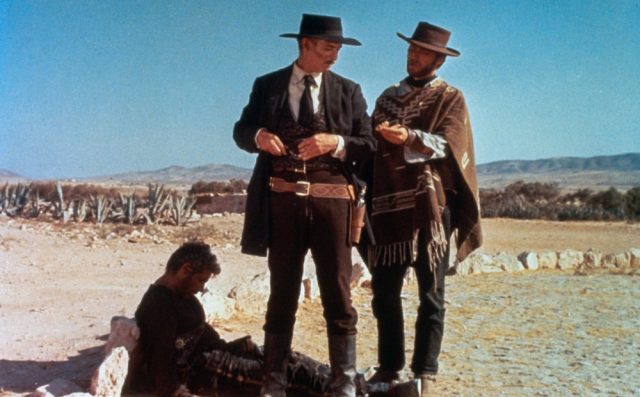
Rival bounty killers colonel Douglas Mortimer (Lee Van Cleef) and Manco (Clint Eastwood) join forces in Sergio Leone’s For a Few Dollars More
FOR A FEW DOLLARS MORE (PER QUALCHE DOLLARO IN PIÙ) (Sergio Leone, 1965)
Saturday, April 20, 4:30, and Tuesday, April 23, 4:40 filmforum.org
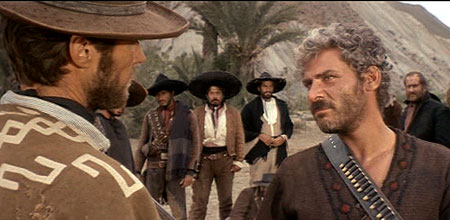
Determined to capitalize on the immediate success of A Fistful of Dollars, director and cowriter Sergio Leone and stars Clint Eastwood and Gian Maria Volonté quickly got back in the saddle to make the initially underrated, now celebrated follow-up, For a Few Dollars More. In the 1965 spaghetti Western, filmed in Almería, Spain, and at Rome’s Cinecittà Studios — and featuring a town doubling as El Paso built by production designer Carlo Simi that still stands today, part of the MiniHollywood theme park in Tabernas — Eastwood is a bounty killer that some call Manco, but he is essentially the Man with No Name again. He travels from wretched place to wretched place with his horse, poncho, cigar, squinty eyes, and guns, shooting criminals and collecting rewards. When he encounters a rival, former Confederate colonel Douglas Mortimer (Lee Van Cleef), they are initially at odds, going after the same trophies, but they ultimately decide to join forces to capture and kill El Indio (Volonté), a murderous psychopath who likes to use a pocket watch that plays a gentle tune when opened when he is getting ready to shoot someone, an element from his past (involving a mystery woman played by Rosemary Dexter) that haunts him. Manco embeds himself with Indio’s mangy gang, which includes Groggy (Luigi Pistilli), Niño (Mario Brega), Cuchillo (Aldo Sambrell), Tomaso (Lorenzo Robledo), Sancho Perez (Panos Papadopulos), Slim (Werner Abrolat), Blackie (Frank Braña), Chico (José Canalejas), Frisco (Antonio Molino Rojo), Hughie (Benito Stefanelli, who was in all three Dollars films), and Wild (the one and only Klaus Kinski). As Indio prepares to rob a bank in El Paso, a series of double crosses and personal vengeance lead to a memorable ending.
Manco (Clint Eastwood) becomes part of Indio’s (Gian Maria Volonté) gang in For a Few Dollars More
Written by Leone and Luciano Vincenzoni with added dialogue by Sergio Donati, For a Few Dollars More fits right in between A Fistful of Dollars and The Good, the Bad, and the Ugly, from its overall look and mood to Ennio Morricone’s stupendous score and Massimo Dallamano’s beautiful cinematography, both veterans of Fistful. Eastwood further established his ability to carry a film as a compelling antihero, Van Cleef (How the West Was Won, Escape from New York) earned one of the three title roles in Ugly, and Volonté, who would go on to make such classics as A Bullet for the General, Investigation of a Citizen Above Suspicion, and Christ Stopped at Eboli, is superbly grimy as a brutal villain hiding a soft spot. Genre tropes abound, highlighted by Leone’s love of close-ups of his characters’ eyes, shifting from one side to the other as they face their destinies.
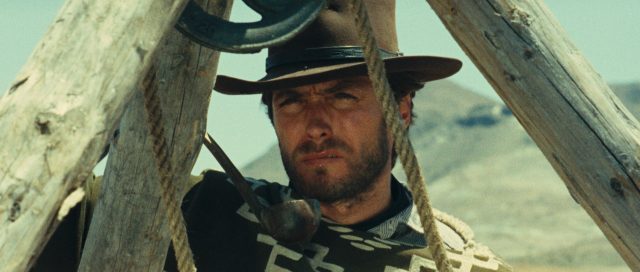
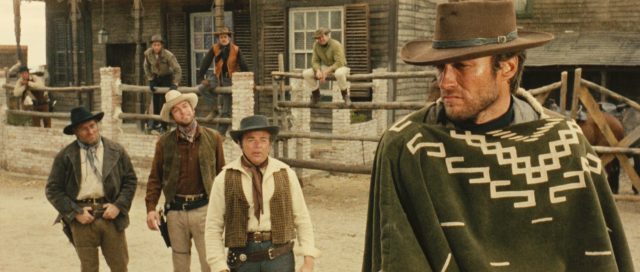
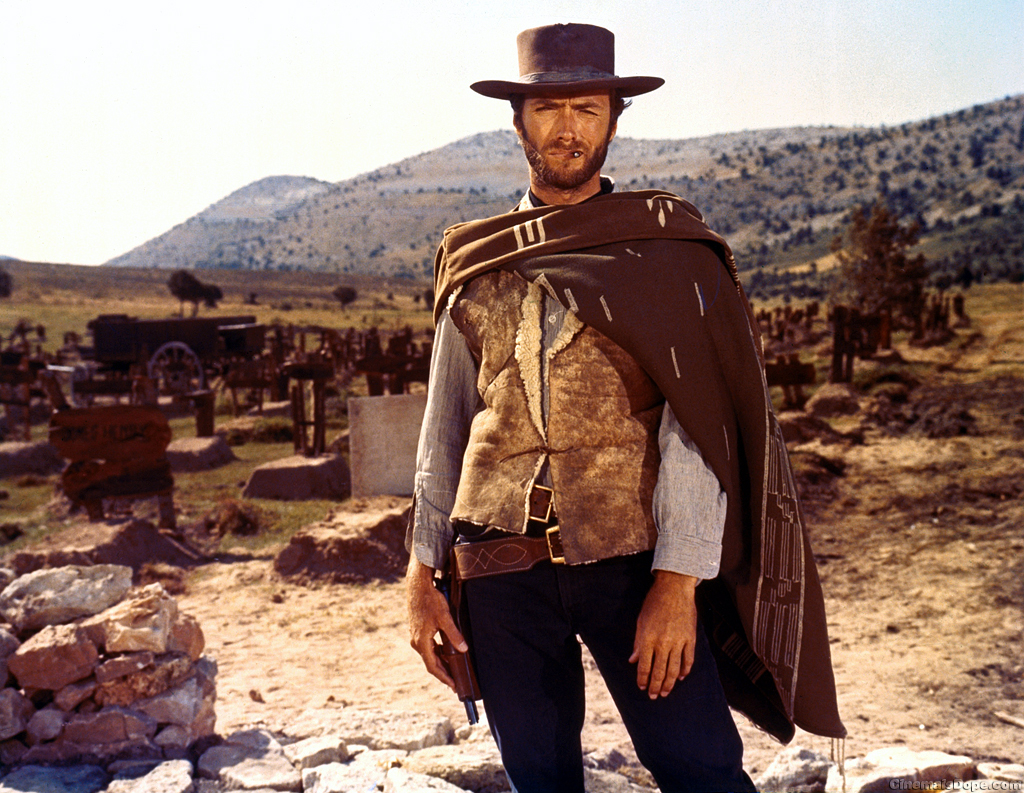
Clint Eastwood is the Good in classic Sergio Leone operatic oater
THE GOOD, THE BAD AND THE UGLY (Sergio Leone, 1966)
Saturday, April 20, 9:00, and Sunday, April 21, 4:40 filmforum.org
One of the all-time-great spaghetti Westerns, Sergio Leone’s dusty three-hour operatic oater stars Clint Eastwood as the Good (Blondie), Lee Van Cleef as the Bad (Angel Eyes), and Eli Wallach as the Ugly (Tuco Benedicto Pacifico Juan Maria Ramirez, whose list of criminal offenses is a riot), three unique individuals after $200,000 in Confederate gold buried in a cemetery in the middle of nowhere. Nearly twenty minutes of never-before-seen footage was added to the film several years ago, with Wallach and Eastwood overdubbing brand-new dialogue, so if you haven’t seen it in a while, it might just be time to catch it again. Ennio Morricone’s unforgettable score and Torino delli Colli’s gorgeous widescreen cinematography were also marvelously enhanced; their work in the scene when Tuco first comes upon the graveyard will make you dizzy with delight. And then comes one of the greatest finales in cinema history. The Film Forum trilogy series continues through May 16 with official and unofficial hat tricks by Fritz Lang, Wim Wenders, Carol Reed, Whit Stillman, Lucretia Martel, Michelangelo Antonioni, Rainer Werner Fassbinder, and many others.
THE HUMAN CONDITION (Masaki Kobayashi, 1959-61)
Film Forum
209 West Houston St.
April 20-29
Series runs April 19 – May 16
212-727-8110 filmforum.org
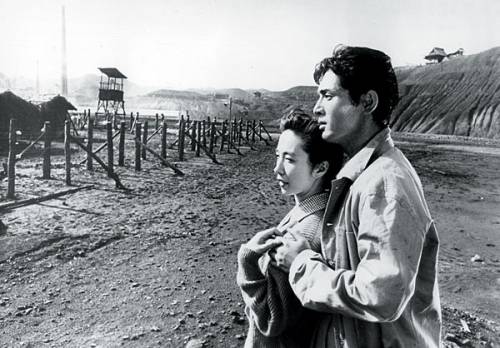
Some stories are just too big to be told in one film, let alone two, so from April 19 to May 16, Film Forum is showing well-known and under-the-radar official and unofficial trilogies, including three-packs from Francis Ford Coppola, Sergio Leone, Lucas Belvaux, Andrzej Wajda, Jean Cocteau, Ingmar Bergman, Nicolas Winding Refn, and Satyajit Ray, among others. (Note: There is separate admission to each film.) Masako Kobayashi’s ten-hour epic, The Human Condition, based on a popular novel by Jumpei Gomikawa, is one of the most stunning achievements ever captured on film. Shot over the course of three years, the film follows one man’s harrowing struggle to never give up his humanity as he is dragged deeper and deeper into the morass of WWII. Tatsuya Nakadai is remarkable as Kaji, a man who believes in common decency, personal discipline, and, above all else, that humanity will always triumph. In the first part, No Greater Love, the steadfastly practical Kaji is hesitant to marry his sweetheart, Michiko (Michiyo Aratama), for fear that he will be called to serve in the Japanese army and might not come back to her alive. But when his detailed plan to treat workers fairly is accepted by the government, he is made labor supervisor of a mine in far-off Southern Manchuria, where hundreds of Chinese prisoners are brought in as well — and regularly starved, beaten, and, on occasion, brutally killed in cold blood. Kaji’s methods, which have close ties to communism, leading many to refer to him as a “Red,” anger both sides — the Japanese want to treat the workers like animals, and the Chinese prisoners don’t trust that he has their welfare in mind. A series of escape attempts threatens the stability of the labor camp and comes between Kaji and Michiko, whose undying love is echoed in the yearning, unfulfilled desire between a Korean prisoner and a Japanese prostitute. Broken promises, lies, and betrayal reach a tense conclusion that sets the stage for the second part of Kobayashi’s masterpiece.
SPOILER ALERT: Skip the next paragraph if you don’t want to know what happens in parts II & III!
In Road to Eternity, Kaji has been drafted into the Kwantung Army, going through basic training in preparation for battle. Kaji hopes to find some semblance of humanity in the army, but the superiors are constantly slapping and hitting the recruits, punishing them in brutal ways. When Michiko suddenly shows up, Kaji suffers harassment as it is being decided whether he will be allowed to spend the night with her. With the Soviets on the march, a firefight beckons, but the Japanese troops are woefully short on weapons and ammunition — and confidence, with rumors of Japan’s demise rampant. The epic concludes with the powerful, emotional A Soldier’s Prayer. Kaji is determined to make it back to Michiko, even if it means desertion, but a long, treacherous trip awaits him and he is dangerously low on supplies. He is trying desperately to hang on to his dignity and humanity, but it becomes more and more difficult as the weather worsens, hopelessly lost people join him through the forest, and food is nowhere in sight.
The Human Condition, which has had a profound influence on such filmmakers as Stanley Kubrick, Steven Spielberg, Andrei Tarkovsky, and so many others, might take place during WWII, with Japan fighting for the Axis powers while also immersed in the Second Sino-Japanese War, but its story about man’s inhumanity to man is timeless. At its core, it’s not about Fascism, socialism, democracy, and ethnocentricity but humankind’s need for love and truth. Kaji and Michiko represent everyman and everywoman, separated by a cruel, cold world. Kobayashi provides no answers — the future he envisions is bleak indeed. At Film Forum a few years back for a tribute to his career, Nakadai talked about how brutal the making of The Human Condition was — it is also brutal to sit through, but it is a landmark work that must be seen.
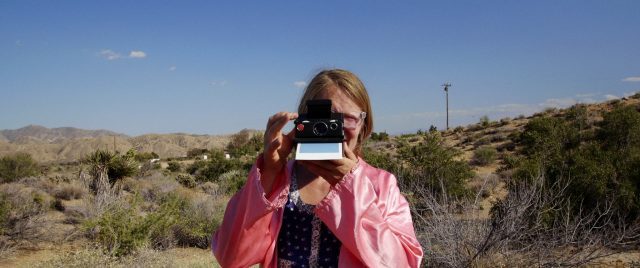
German artist Stefanie Schneider takes Polaroids with expired stock in Instant Dreams
INSTANT DREAMS (Willem Baptist, 2017)
Cinema Village
22 East 12th St. between University Pl. & Fifth Ave.
Opens Friday, April 19
212-529-6799 instantdreamsmovie.com www.cinemavillage.com
There’s an eye-opening “wow” moment in Willem Baptist’s documentary Instant Dreams in which Polaroid camera inventor Edwin H. Land, in a short 1970 promotional film, The Long Walk, reaches into his pocket, pulls out a black wallet that resembles an iPhone, and refers to it as a “camera that would be, oh, like the telephone, something that you use all day long, a long-awaited ultimate camera that is a part of the evolving human being.” The shot is shocking and eerie; how did this visionary see the future so clearly? In Instant Dreams, Dutch filmmaker Baptist (Wild Boar, I’m Never Afraid) follows four people obsessed with the Polaroid camera, which was invented by Land in 1948 so we could “press a button and have a picture”; the company stopped making its iconic white-bordered film for the cameras in 2008, but that has not stopped enthusiasts from continuing their passion. One of the four is Christopher Bonanos, a New York magazine editor and author of the book Instant: The Story of Polaroid; in the movie, he shares some of the history of Land and Polaroid and takes pictures of friends and family, especially his young son, who he says will be among the last to experience the feel and smell of a developing Polaroid photo, which can take between one and three minutes to finish. He also talks about Land’s prescience about the next era of photography, pointing out that “the idea would be that you would just shoot pictures, all day long, a future in which one would document one’s life all the time.”
Dr. Stephen Henchen is a research scientist formerly with Polaroid who explains, “My mission is to reinvent the instant film and keep this analog experience alive into the digital age.” As part of the Impossible Project, which aims to make Polaroid film available again, he spends time in labs experimenting and writing down formulas, trying to re-create Land’s patented process, but he notes that “the molecular design of the instant film is very, very complicated. Analog instant film is the world’s most chemically complex, completely man-made product ever.” German artist Stefanie Schneider uses her limited amount of expired Polaroid stock on photo shoots where she photographs models and her longtime partner in scenes depicting memories, desires, and fantasies, embracing the film’s unpredictability and imperfections. (Baptist also includes clips of Schneider’s 2013 short Heather’s Dream, starring Heather Megan Christie and Udo Kier.) And Ayana JJ, a young Japanese woman, represents the younger generation, shooting photos in a bustling Tokyo — until Baptist reveals a surprise near the end, complete with the commanding voice of Werner Herzog.
Author and editor Christopher Bonanos takes Polaroid photos of his son nearly every day
Baptist supplements the film with colorful, kaleidoscopic animation representing the chemical reactions involved in the Polaroid process, evoking the resolutely analog psychedelic imagery of the Joshua Light Show. He also provides numerous close-ups of people’s eyes as they look at the world — and then try to capture it on film. It’s fascinating to see how the bulky Polaroid cameras were the progenitors of the smartphone and the digital age of social media; at one point, Bonanos attends a birthday party and takes a seat on a couch, where many of the attendees sit for their portrait. This social interaction, which would not have taken place without the camera, brings Bonanos together with people he might not otherwise have spoken to, and they spend at least several minutes with each other, first posing for the photo, then waiting for it to develop. It’s a clear metaphor for today’s Facebook, Snapchat, and Instagram, lacking only the internet’s instant face-to-face sharing over distance. The film points out that in March 1974, Land wrote, “We could not have known, and have only just learned, that a new kind of relationship between people and groups is brought into being by instant film when the members of a group are photographing and being photographed and sharing the photographs.” With Polaroids, it occurs in different elements of time and space, the cameras supported by devoted fans unwilling to let their memories disappear amid technology run amok.
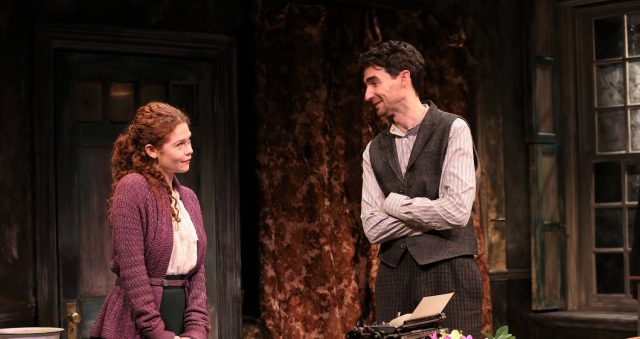
Minnie Powell (Meg Hennessy) and Donal Davoren (James Russell) flirt in Irish Rep revival of Sean O’Casey’s The Shadow of a Gunman (photo by Carol Rosegg)
Irish Repertory Theatre, Francis J. Greenburger Mainstage
132 West 22nd St. between Sixth & Seventh Aves.
Through May 25, $50-$70
212-727-2737 irishrep.org
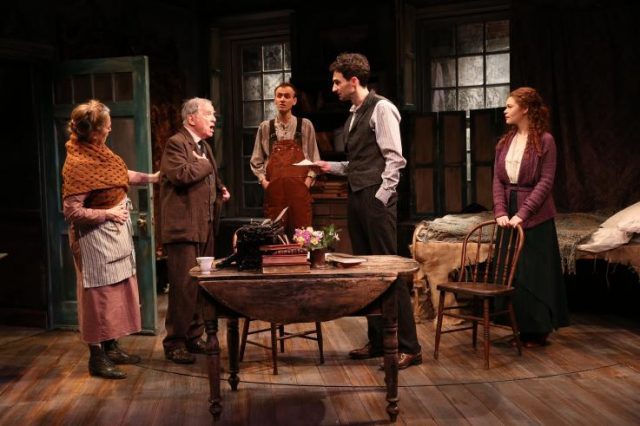
The Irish Rep’s thirtieth anniversary season, “The O’Casey Cycle,” features Sean O’Casey’s exceptional Dublin Trilogy. Last week I highly recommended Juno and the Paycock the 1924 play set during the Irish Civil War of 1922-23; 1925’s The Plough and the Stars, which takes place around the 1916 Easter Rising, was the first show Irish Rep ever put on, back in 1988, and will begin performances April 20. O’Casey’s first produced play was The Shadow of a Gunman, which premiered at the Abbey Theatre in 1923 and established the laborer as a new force on the scene. The play is set in May 1920, during the Irish War of Independence, in a tenement in Hilljoy Square in Dublin. Small-time peddler Seumas Shields (Michael Mellamphy) is sleeping late, something he appears to do often; while he waits for his colleague Mr. Maguire (Rory Duffy) to go out to sell their wares, a slew of other classic characters from Irish lore, from drunks and ne’er-do-wells to layabouts and overburdened women, come barging in.
Poet Donal Davoren (James Russell) is staying with him, which doesn’t make the landlord, Mr. Mulligan (Harry Smith), very happy, since the rent is overdue. The lovely young Minnie Powell (Meg Hennessy) develops a crush on Donal, believing him to be a heroic IRA gunman preparing for his next hit. “Maybe I am, and maybe I’m not,” he teases, taking advantage of the romantic attention. The blustery Tommy Owens (Ed Malone) stops by to let everyone know that he supports the IRA and will fight if called on. Mrs. Henderson (Una Clancy), who lives in a neighboring tenement, comes over with James Gallagher (Robert Langdon Lloyd), who reads a persnickety letter he wrote asking the IRA for help. And Mrs. Grigson (Terry Donnelly) is worried about her alcoholic husband, Adolphus (John Keating), who talks about himself in the third person. Maguire eventually shows up but is in a hurry, leaving a mysterious black bag with Seumas. Through all the mayhem and madness, the fear that the Black and Tans could show up at any minute hangs over the proceedings with so much dread.
James Gallagher (Robert Langdon Lloyd) seeks help from the IRA in The Shadow of a Gunman (photo by Carol Rosegg)
In the 105-minute two-act play, O’Casey avoids glorifying the lower class. “Upon my soul! I’m beginnin’ to believe that the Irish people are still in the stone age,” Seumas says, adding later, “Oh, this is a hopeless country!” Donal complains, “The people! Damn the people! They live in the abyss, the poet lives on the mountaintop . . . The poet ever strives to save the people; the people ever strive to destroy the poet. The people view life through creeds, through customs, and through necessities; the poet views creeds, customs, and necessities through life.” However, The Shadow of a Gunman is a slighter play than Juno and the Paycock, a less-layered tale lacking the same nuance and muscle. Charlie Corcoran’s fabulous tenement set, which runs throughout the theater, is only slightly altered from Paycock’s. Directed by Ciarán O’Reilly, who plays Capt. Boyle in Paycock,Gunman features many of the same actors, with Hennessy standing out as the coquettish Minnie and Donnelly reprising her role from the company’s 1999 production. In many ways, O’Casey’s vision of the country is personified by Seumas, who doesn’t want to get out of bed in the morning and does not want to go to work. “A land mine exploding under the bed is the only thing that would lift you out of it,” Donal says. It’s a funny line, but one more than tinged with seriousness.
As part of Onassis Festival 2019: Democracy Is Coming, Greek sculptor Kostis Velonis has installed Life without Tragedy on the South Plaza of Astor Place, near Tony Rosenthal’s movable black cube called Alamo. Developed by Velonis and Christian Kotzamanis, the work consists of a trio of dark gray wood steps that evoke Greek amphitheaters that would stage tragedies by Aeschylus, Sophocles, and Euripides and served as places for sociopolitical discourse. Presented in conjunction with DOT Art, the Village Alliance, and the Public Theater, which is hosting most of the events during the festival, including Tim Blake Nelson’s Socrates, the sculpture has narrow steps that are not easy for adults or children to climb, a striking comment on the state of political discussion today in the United States, Greece, and around the world as real-life tragedies wreak havoc and fascism is on the rise.
 In the second half of Ron Mann’s utterly delightful and unique documentary Carmine Street Guitars, a well-dressed, well-groomed young man enters the title store in Greenwich Village and identifies himself as Adam Shalom, a Realtor who is selling the building next door. Shalom tries to talk about square footage, but Carmine Street Guitars founder and owner Rick Kelly barely looks up as he continues cleaning a fret. It’s a critical, uncomfortable moment in an otherwise intimate and inviting film; throughout the rest of the eighty-minute documentary, the soft-spoken Kelly talks guitars and craftsmanship with a stream of very cool musicians and his punk-looking young apprentice, Cindy Hulej. But Shalom’s arrival hearkens to one of the main reasons why Mann made the movie: to capture one of the last remaining old-time shops in a changing neighborhood, a former bohemian paradise that has been taken over by hipsters and corporate culture, by upscale stores and restaurants and luxury apartments. You’ll actually cheer that Kelly gives Shalom such short shrift, but you’ll also realize that Shalom and others might be knocking again at that door all too soon.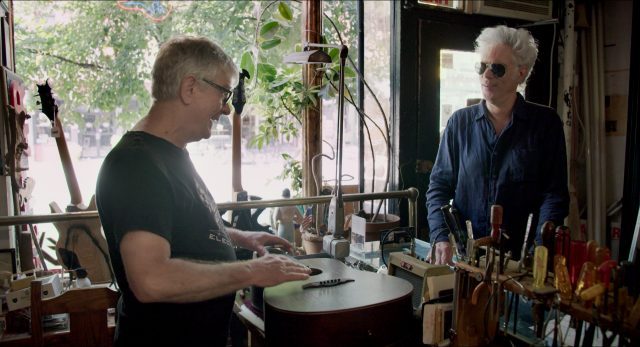
 One of the all-time-great spaghetti Westerns, Sergio Leone’s dusty three-hour operatic oater stars Clint Eastwood as the Good (Blondie), Lee Van Cleef as the Bad (Angel Eyes), and Eli Wallach as the Ugly (Tuco Benedicto Pacifico Juan Maria Ramirez, whose list of criminal offenses is a riot), three unique individuals after $200,000 in Confederate gold buried in a cemetery in the middle of nowhere. Nearly twenty minutes of never-before-seen footage was added to the film several years ago, with Wallach and Eastwood overdubbing brand-new dialogue, so if you haven’t seen it in a while, it might just be time to catch it again. Ennio Morricone’s unforgettable score and Torino delli Colli’s gorgeous widescreen cinematography were also marvelously enhanced; their work in the scene when Tuco first comes upon the graveyard will make you dizzy with delight. And then comes one of the greatest finales in cinema history. The Film Forum trilogy series continues through May 16 with official and unofficial hat tricks by Fritz Lang, Wim Wenders, Carol Reed, Whit Stillman, Lucretia Martel, Michelangelo Antonioni, Rainer Werner Fassbinder, and many others.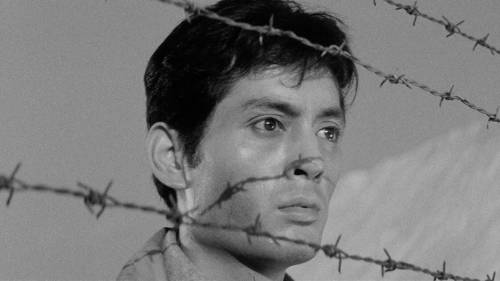
 There’s an eye-opening “wow” moment in Willem Baptist’s documentary Instant Dreams in which Polaroid camera inventor Edwin H. Land, in a short 1970 promotional film, The Long Walk, reaches into his pocket, pulls out a black wallet that resembles an iPhone, and refers to it as a “camera that would be, oh, like the telephone, something that you use all day long, a long-awaited ultimate camera that is a part of the evolving human being.” The shot is shocking and eerie; how did this visionary see the future so clearly? In Instant Dreams, Dutch filmmaker Baptist (Wild Boar, I’m Never Afraid) follows four people obsessed with the Polaroid camera, which was invented by Land in 1948 so we could “press a button and have a picture”; the company stopped making its iconic white-bordered film for the cameras in 2008, but that has not stopped enthusiasts from continuing their passion. One of the four is Christopher Bonanos, a New York magazine editor and author of the book Instant: The Story of Polaroid; in the movie, he shares some of the history of Land and Polaroid and takes pictures of friends and family, especially his young son, who he says will be among the last to experience the feel and smell of a developing Polaroid photo, which can take between one and three minutes to finish. He also talks about Land’s prescience about the next era of photography, pointing out that “the idea would be that you would just shoot pictures, all day long, a future in which one would document one’s life all the time.”