twi-ny recommended events

HACHIOJI KURUMA NINGYO PUPPET THEATER

Hachioji Kuruma Ningyo Puppet Theater

Hachioji Kuruma Ningyo Puppet Theater presents two programs at Japan Society this week

Japan Society
333 East 47th St. at First Ave.
February 28 – March 2, $40, 7:30
212-715-1258
www.japansociety.org

Hachioji Kuruma Ningyo Puppet Theater rolls into Japan Society this week with its unique brand of storytelling, led by fifth grand master Koryu Nishikawa V. Moving large puppets on a three-wheeled dolly, the company will present two female-centric programs, one consisting of Yugao, Date Musume Koi Higanoko, and Tsuri On’na, the other Yugao, Date Musume Koi Higanoko, and Kuzunoha; Yugao is a new work by Nishikawa V based on a story from The Tale of Genji. Each show will be preceded by a lecture by Dr. Claudia Orenstein of Hunter College; opening night will be followed by a reception with the artists. The works will be performed by Ryuji Nishikawa V, Ryusha Nishikawa, Ryuki Nishikawa, Ryukei Nishikawa, and Yoshiteru Nishikawa, led by Nishikawa V, with gidayu chanter Koshiko Takemoto and live shamisen music by Sansuzu Tsuruzawa and Yaya Tsuruzawa. In addition, there will be a “Hachioji Kuruma Ningyo Performance and Workshop” for students on Friday and a “Master Class on Kuruma Ningyo Puppetry” on Saturday and Sunday. And on March 10, Nishikawa V will be at the Metropolitan Museum of Art for Family Afternoon — Pens & Poems for children ages twelve and under with an adult.

MARTHA ROSLER: IRRESPECTIVE

(photo by twi-ny/mdr)

Martha Rosler’s A Gourmet Experience and Objects with No Titles are part of Jewish Museum retrospective (photo by twi-ny/mdr)

The Jewish Museum
1109 Fifth Ave. at 92nd St.
Through March 3, $8-$18, pay-what-you-wish Thursday from 5:00 – 8:00, free Saturday
212-423-3200
thejewishmuseum.org
www.martharosler.net

In November 2012, I tried to buy a mahjongg case from renowned artist Martha Rosler as part of her MoMA atrium presentation “Meta-Monumental Garage Sale,” but alas, we couldn’t agree on a price. However, I’ve completely bought into the Brooklyn-born artist and activist’s latest show, “Irrespective,” an involving survey exhibition continuing at the Jewish Museum through March 3. “We need to be out there, but we also need to be in here, because otherwise the art world will go on doing the things it’s done in the way it’s done it, and that is not really the best that art can be,” Rosler explains on the audioguide. “It’s hard for me to look at my own life as other than just keeping on with doing what I was doing, which was a tripartite thing: making work, writing about ways of thinking about the world and about the production of art, and teaching.” That perspective shines through in the exhibit, which includes photography, sculpture, video, text, and installation going back five decades, taking on war, advertising, mass media, political leaders, the education system, modes of travel, and more from a decidedly feminist angle.

(photo by twi-ny/mdr)

Martha Rosler, Prototype (Freedom Is Not Free), resin, composite, metal, paint, and printed transfers, 2006 (photo by twi-ny/mdr)

Curators Darsie Alexander and Shira Backer and designers New Affiliates, in close collaboration with Rosler, have reconfigured the museum space, which is laid out almost like a maze as visitors go from gallery to gallery in whichever order they choose, following no specific pattern as they encounter Rosler’s oeuvre uniquely, on their own path, echoing the range of her subject matter and media. (However, it is loosely chronological if you go counterclockwise.) As you enter, to your left is Prototype (Freedom Is Not Free), a giant mechanical leg that threatens to kick you; it relates to the prosthetics soldiers need after losing a limb to an IED, while the inclusion of images of stiletto heels invokes women warriors as well as wives, mothers, girlfriends, and sisters who care for men when they come home from battle seriously wounded. Rosler has revisited her “House Beautiful” series, in which she takes magazine and newspaper ads promoting domesticity, featuring suburban women doing what was considered women’s work, and places war images over specific parts. A Gourmet Experience consists of a long table set for a banquet and audio and video dealing with cooking, serving, and eating; nearby is a new iteration of Rosler’s 1970s installation Objects with No Titles, a collection of soft sculptures made with women’s undergarments, coming in all shapes and sizes.

In her most influential and well known video, Semiotics of the Kitchen, Rosler creates a new kind of verbal and physical language using standard utensils and her body. Food, labor, and power structures are highlighted in such photographic series as “Air Fare,” “North American Waitress, Coffee-Shop Variety (Know Your Servant Series, No. 1),” and “A Budding gourmet: food novel 1.” On the audioguide she notes, “Who doesn’t like food, especially if you’re Jewish? Our entire domestic life is centered on the question of reproduction and maintenance; maintenance involves, aside from cleaning the house and doing the laundry, making sure everyone is fed three times a day. And you’re supposed to be good at it.” In the video Born to Be Sold: Martha Rosler Reads the Strange Case of Baby $/M, Rosler defends Mary Beth Whitehead, a surrogate mother who decided to keep the baby she was carrying for adoptive parents, while in Unknown Secrets (The Secret of the Rosenbergs) she employs a handout, photographs, a stenciled towel, and a package of Jell-O to detail how Ethel Rosenberg might have been framed.

Martha Rosler

Martha Rosler wields a sharp knife in Semiotics of the Kitchen (black-and-white video with sound, Jewish Museum, New York)

Reading Hannah Arendt (Politically, for an Artist in the 21st Century) comprises mylar panels hanging from the ceiling, printed with quotes from the German Jewish theorist’s 1951 book, The Origins of Totalitarianism, including this paraphrasing of Noam Chomsky: “‘Detachment and equanimity’ in view of ‘unbearable tragedy’ can indeed be ‘terrifying.’” Photos of airports are accompanied by such phrases as “haunted trajectories,” “interpenetration of terrors,” and “vagina or birth canal?” In The Bowery in two inadequate descriptive systems, Rosler snaps photos along the Bowery but without any people in them; instead, she adds various words associated with drunkenness, but the absence of the denizens of Skid Row is palpable. In “Greenpoint Project,” she documents the gentrification of the neighborhood where she’s lived for nearly forty years. And in “Rights of Passage,” she traces her commute using a toy panoramic camera.

While some of the work is repetitive thematically, Rosler argues on the audioguide that “when people say, ‘Wait, you did that already,” I would say: ‘That’s right, I did that already, and so did we. And how is what we’re doing now different from what we did then?’” The Jewish Museum show might go back fifty years, but it doesn’t feel old in the least, as so much of what Rosler stands for and has been exploring throughout her career is still on the line, from war to gender inequality, from corrupt politicians to reproductive rights. That she does so with a wickedly wry sense of humor — she has referred to herself as a “standup comic” — only makes it all the more accessible, using laughter as a decoy. “The Monumental Garage Sale is a decoy,” she tells Molly Nesbit in a catalog interview. “Cooking and its customs and material objects are decoys: they provide an entry into daily life — roles and procedures that have become naturalized or normalized.” Thus, I might not have purchased that mahjongg case at MoMA, but that was just a decoy as well.

TRUE WEST

(photo by Joan Marcus)

Ethan Hawke and Paul Dano star in Roundabout revival of Sam Shepard’s True West on Broadway (photo by Joan Marcus)

American Airlines Theatre
227 West 42nd St. between Broadway & Eighth Ave.
Tuesday – Sunday through March 17, $59-$352
212-719-1300
www.roundabouttheatre.org

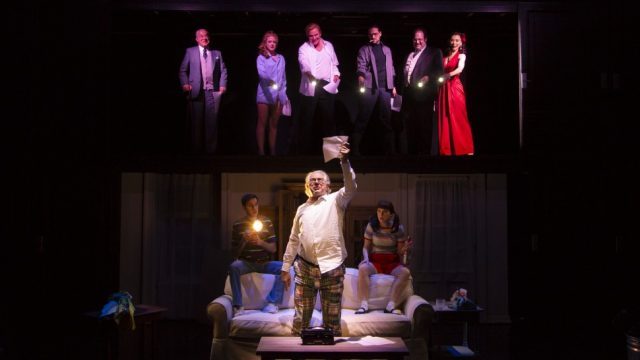
Sam Shepard’s Pulitzer-nominated True West is an oft-produced star-driven 1980 vehicle that offers an epic sibling rivalry with a few parental complications as it deconstructs the American dream and the creation of film and theater itself. The two brothers, the younger Austin, a screenwriter with a wife and kids, and the older Lee, a ne’er-do-well thief and transient, have been played by such duos as Tommy Lee Jones and Peter Boyle, Gary Sinise and John Malkovich, Dennis Quaid and Randy Quaid, Kit Harington and Johnny Flynn, Bruce Willis and Chad Smith, Bob Hoskins and Antony Sher, and, in its Broadway debut in 2000, Philip Seymour Hoffman and John C. Reilly, who occasionally switched roles. The black comedy is now back on Broadway at the American Airlines Theatre in a ferociously funny Roundabout revival, directed by James Macdonald, with Paul Dano as Austin and Ethan Hawke as Lee. This new production benefits from close ties with Shepard, who died in 2017 at the age of seventy-three: Macdonald previously helmed such Shepard works as Fool for Love and Simpatico and directed Shepard in Caryl Churchill’s A Number, while Hawke has directed Shepard’s A Lie of the Mind and starred with Shepard in Michael Almereyda’s 2000 Hamlet, which featured Hawke as the title character and Shepard as the ghost of his father. Hawke also directed Dano in the New Group’s Things We Want in 2007.

(photo by Joan Marcus)

Siblings Lee (Ethan Hawke) and Austin (Paul Dano) go at each other in Sam Shepard revival at American Airlines Theatre (photo by Joan Marcus)

A quiet, focused man, Austin is house-sitting their mother’s (Marylouise Burke) suburban home in Southern California. She is off in Alaska — essentially the polar opposite of Cali — and he is taking care of her plants while writing a screenplay that independent producer Saul Kimmer (Gary Wilmes) is interested in. The gruff, uncouth Lee shows up unexpectedly, claiming to have spent years in the desert and visiting with their father. Austin does not want Lee around for an upcoming meeting with Saul, but Lee not only interferes but is soon pitching his own film project, a contemporary Western based on his adventures on the road, pitting the two brothers against one another while they also consider working together. Macdonald, Hawke, and Dano play up the physical slapstick in this raucous version. “You probably think that I’m not fully able to comprehend somethin’ like that, huh?” the less-educated Lee asks. “Like what?” Austin responds. “That stuff yer doin’. That art. You know. Whatever you call it,” Lee replies, as Shepard, who represented manliness and masculine achievement during his lifetime as an actor, writer, and rancher, questions the very notion of storytelling. When they’re trying to outline the narrative, which Austin thinks is bad, Lee says, “What? It’s too what? It’s too real! That what ya’ mean, isn’t it? It’s too much like real life!” Austin answers, “It’s not like real life! It’s not enough like real life. Things don’t happen like that.”

In the second half of the play, the brothers basically switch places in a riotous swap of psyches and body movement. Even Mimi Lien’s long horizontal set, meant to evoke a widescreen movie, is divided in two, one side a kitchen, the other an alcove with plants and a table with a typewriter. The pairs of cherries on the wallpaper are a particularly deft touch, evoking testicles as well as how brothers are naturally stuck with each other. “I always wondered what’d be like to be you,” Lee admits, to which Austin explains, “And I used to say to myself, ‘Lee’s got the right idea. He’s out there in the world and here I am. What am I doing?” In True West, Shepard, who had the public persona of a rugged man’s man, a shining example of the American male, delves into the dual nature of identity and art, separating who we are from who we want to be, what’s real from what’s fantasy. California is home to Hollywood, the ultimate myth maker, as well as the empty desert and vast landscapes where cowboys roam the land. While Austin writes about romance, we never learn anything about his relationship with his family; the only things that exist for him are written on pages. Lee is living a rough-and-tumble life but suddenly wants to slow down and set it down on paper. It is as if they are enacting the two sides of Shepard himself. All hell breaks loose at the conclusion, which is as hysterical as it is horrifying, leaving you both exhausted and exhilarated, exploring the mythology of your own identity and family bonds.

BOESMAN AND LENA

(photo by Joan Marcus)

Boesman (Sahr Ngaujah) and Lena (Zainab Jah) arrive in the middle of nowhere in stark Fugard revival at the Signature (photo by Joan Marcus)

The Pershing Square Signature Center
The Alice Griffin Jewel Box Theatre
480 West 42nd St. between between Ninth & Tenth Aves.
Tuesday – Sunday through March 17, $35
www.signaturetheatre.org

For its fiftieth anniversary, South African playwright and director Yaël Farber reimagines Athol Fugard’s 1969 Boesman and Lena as an anti-Apartheid Waiting for Godot at the Signature, where it opens tonight and continues through March 17. Coincidentally, Farber’s fierce adaptation of Mies Julie, which transports August Strindberg’s Miss Julie to South Africa in 2012, is being performed at Classic Stage through March 10. At the Signature, the audience enters the Alice Griffin Jewel Box, where a large translucent plastic tarp flutters across the front of the stage like a sad, empty flag, blocking most of the set from view, except for the people in the center of the first row, who have to go under it to sit down. Boesman (Sahr Ngaujah) and Lena (Zainab Jah) come in through the aisles, laden with heavy bags that look like garbage, carrying their physical and metaphorical burdens with them. They are homeless, looking for a place to rest their weary, worn-out bodies. Boesman tears down the tarp, revealing a barren landscape in the middle of nowhere, the mud flats of the Swartkops River, save for one bare tree, echoing Samuel Beckett’s Godot. Susan Hilferty’s dark, drab set creates just the right atmosphere of dread; Hilferty also designed the appropriately ratty costumes for the play, which was inspired by an actual incident that Fugard experienced in 1965.

“Why did you walk so hard? In a hurry to get here? Jesus, Boesman! What’s here?” Lena asks as Boesman sets up a makeshift camp in the liminal space. “Look at us! Boesman and Lena with the sky for a roof again. What you waiting for?” While he tries to set up a place for them to sleep using the tarp and the tree, she rambles on about the sad circumstances of their life, which annoys him to no end. “‘When she puts down her bundle, she’ll start her rubbish.’ You did,” he says. “Rubbish?” she asks. “That long turd of nonsense that comes out when you open your mouth!” he replies. They bicker like George and Martha in Who’s Afraid of Virginia Woolf?, although she does most of the complaining. Lena: “This is a lonely place. Just us two. Talk to me.” Boesman: “I’ve got nothing left to say to you. Talk to yourself.” Lena: “I’ll go mad.” Boesman: “What do you mean ‘go’ mad?” But behind it all is the unspoken state of the nation, a South Africa mired in racism, where the white minority brutally rules over the dispossessed black majority.

(photo by Joan Marcus)

Boesman (Sahr Ngaujah) mock-threatens Lena (Zainab Jah) as the Old African (Thomas Silcott) sits quietly in Boesman and Lena (photo by Joan Marcus)

A third person arrives, a slow-moving, raggedy Old African (Thomas Silcott) who mumbles in his tribal Xhosa language, which neither Boesman nor Lena understands. (The script translates his dialogue; he essentially explains that he is looking for his relatives but got lost.) Boesman is not about to share what little they have with the old man, or Outa, as Boesman calls him (he also refers to him with the offensive slang term “kaffir”), but Lena has sympathy for his situation. “To hell! He doesn’t belong to us,” Boesman cries out. “There was plenty of times his sort gave us water on the road,” Lena says. The couple keep up their war of words, arguing about happiness, geography, names, and dogs as they soldier on with what little they have. Lena also shows the Old African the bruises she has from where Boesman hits her. “And now? What’s going to happen now?” Boesman asks. “Is something going to happen now?” Lena responds. It’s both a pure Beckett moment as well as a commentary on how their miserable lives, and the lives of all the black and brown people of South Africa, are not about to change for the better any time soon.

(photo by Joan Marcus)

Three lost souls try to escape the darkness of their world in Signature revival (photo by Joan Marcus)

Ngaujah (Mlima’s Tale, Fugard’s The Painted Rocks at Revolver Creek at the Signature) and Jah (School Girls; or, the African Mean Girls Play, Eclipsed) fully embody the desperation of their characters, a pair of lost souls with nowhere to go. The roles have previously been played onstage by Keith David and Lynne Thigpen in 1992 at City Center, on film by Danny Glover and Angela Bassett in 2000, and, in the original 1969 South African theatrical production, by Fugard and Yvonne Bryceland, both of whom are white; Glynn Day, who is also white, portrayed the Old African, reportedly in blackface. Silcott (Fugard’s Coming Home; Bring in ’Da Noise, Bring in ’Da Funk) is unrecognizable as the old man, beaten down to the point where he is practically invisible, fading into the darkness.

By having the characters wander through the aisles several times, Farber (Salomé, Amajuba: Like Doves We Rise) is implicating each one of us in their futility, as if Boesman and Lena are homeless and searching for a warm bed in an overcrowded New York City or refugees seeking a new life in an America that no longer welcomes them with open arms. Boesman treats the Old African much the same way. While there is hope and optimism in Godot, which has more than its fair share of comedic moments, the future is bleak for Boesman and Lena. “Now’s the time to laugh. This is also funny. Look at us!” Lena says, but their meager existence is no joke. This is the sixth Fugard play the Signature has produced as part of his ongoing residency since the company moved to its current building in 2012, including Blood Knot, The Train Driver, and Master Harold . . . and the Boys, and all those involved, from the cast and crew to the audience, have clearly benefited from so much time spent with Fugard.

ESCHER: THE EXHIBITION & EXPERIENCE

M. C. Escher, Day and Night, woodcut. Private Collection, USA. All M.C. Escher works © The M. C. Escher Company. All right reserved. www.mcescher.com

M. C. Escher, Day and Night, woodcut (© 2018 The M. C. Escher Company. All rights reserved)

Industry City, Building 6
34 Thirty-Fourth St., Brooklyn
Through March 31, $15-$35
www.eschernyc.com
industrycity.com

Finding “Escher: The Exhibition & Experience” amid the repurposed buildings of Industry City is like making your way through one of the Dutch artist’s architectural paradoxes and impossibilities. Once you finally get to the right location, you’ll encounter a fun retrospective, albeit more Instagram friendly than art-historically thorough. The winding galleries feature many of the finest pieces by left-handed, mathematically inclined artist Maurits Cornelis Escher, better known as M. C. Escher, who was born in 1898 and died in 1972, leaving behind a legacy of influential and popular op-art drawings, woodcuts, etchings, watercolors, lithographs, and engravings. His singular genius birthed works that became a pop-culture phenomenon, appearing on T-shirts and album covers, in advertisements and unauthorized black-light posters. He concentrated on spatial deformations, repeated geometric imagery known as tessellations, and cross-hatching techniques to create mind-blowing works that uniquely altered perception — and were embraced by the hippie counterculture of the 1960s.

M. C. Escher Drawing Hands Lithograph Private Collection, Usa All M.C. Escher Works @ 2018 The M.C. Escher Company. All rights reserved www.mcescher.com

M. C. Escher, Drawing Hands, lithograph (© 2018 The M. C. Escher Company. All rights reserved)

Curated by Mark Veldhuysen and Federico Giudiceandrea, the show comprises more than two hundred works, including such familiar classics as Hand with Reflecting Sphere (Self-Portrait in Spherical Mirror), Band of Union, Day and Night, Drawing Hands, and Relativity, the last one described in the catalog as “a clever perspective game based on three different vanishing points [that] allows you to bring together three completely different worlds.” Escher drew reptiles, birds, fish, insects, horses, human figures, and other creatures morphing into one another and emerging into and from physical objects. There are numerous dazzling works that most people won’t be as familiar with, such as Belvedere, Rind, Depth, and Eye. The exquisite, expansive Metamorphosis II journeys through geometric patterns, various living beings, a chess set, and Italian architecture before turning back on itself.

M. C. Escher Relativity Lithograph Private Collection, Usa All M.C. Escher Works @ 2018 The M.C. Escher Company. All rights reserved www.mcescher.com

M. C. Escher, Relativity, lithograph (© 2018 The M. C. Escher Company. All rights reserved)

Among the Escher quotes on the walls are “We adore chaos because we love to produce order,” “He who wonders discovers that this in itself is wonder,” and “I don’t grow up. In me is the small child of my early days,” which is how his oeuvre makes even the oldest visitors feel. The show employs rather silly concessions to this era of social media with several installations that encourage people to photograph themselves either within an Escher work or an Escher-inspired environment. However, one of them, H. W. Lenstra’s reexamination of Escher’s Print Gallery, which involves the Droste effect, is utterly fascinating. The exhibition concludes with greeting cards, stamps, magazine covers, and other items designed by Escher, as well as articles about him and examples of his continuing influence. “His aim is to depict dreams, ideas, or problems in such a way that other people can observe and consider them,” Escher said of graphic artists. The show at Industry City might not be definitive, but it has plenty to observe and consider, and enjoy.

TICKET GIVEAWAY: ACTUALLY, WE’RE F**KED

actually

ACTUALLY, WE’RE F**CKED
Cherry Lane Mainstage Theatre
38 Commerce St.
Tuesday – Sunday through April 7, $55-$95
212-989-2020
www.cherrylanetheatre.org

If you’ve been paying attention at all to what’s going on around the globe these days, you might very well think that the world has finally, truly gone to hell in a handbasket. That’s the theory behind Actually, We’re F**ked, debuting at the Cherry Lane this week. Mairin Lee, Keren Lugo, Ben Rappaport, and Gabriel Sloyer star as millennials who want to do something about it — until a surprise changes their future. The play is written by Emmy nominee Matt Williams (Bruce Lee Is Dead and I’m Not Feeling Too Good Either, Jason and the Nun) and directed by Obie winner John Pasquin (Moonchildren, Landscape of the Body); the two men have previously collaborated on the Tim Allen television series Home Improvement, with Williams one of the creators and Pasquin a producer and director on the first two seasons. Williams was also the creator of Roseanne and a writer and producer for The Cosby Show, while Pasquin’s working relationship with Allen continued on the movies The Santa Clause and Jungle 2 Jungle and the current series Last Man Standing. Williams is the secretary of the Cherry Lane, which is owned by his wife, artistic director Angelina Fiordellisi. The set is by Robin Vest, with costumes by Theresa Squire, lighting by Paul Miller, sound by ML Dogg/MuTTT, and projections by Brad Peterson.

TICKET GIVEAWAY: Actually, We’re F**ked runs February 26 through April 7 (with a March 7 opening) at the Cherry Lane, and twi-ny has three pairs of tickets to give away for free. Just send your name, phone number, and favorite play or movie with a curse in the title to contest@twi-ny.com by Thursday, February 28, at 3:00 pm to be eligible. All entrants must be twenty-one years of age or older; three winners will be selected at random.

LOVE IN TIMES SQUARE: X

(photo by twi-ny/mdr)

X welcomes lovers of all kinds to Times Square through the end of February (photo by twi-ny/mdr)

Father Duffy Square, Times Square
Broadway between 46th & 47th Sts.
Through February 28, free
arts.timessquarenyc.org
x slideshow

For eleven years, Times Square has celebrated the romantic month of February with the winner of the Times Square Valentine Heart Design Competition. The 2019 runners-up were Agency Agency’s Heart Warmer, Büro Koray Duman Architects’s Times Crossing, Isometric Studio’s HOPE Sculpture, Pavilions Pavilions — Whole Hearts’ N H D M, Love Labyrinth’s Only If —, and Splice Design Architecture DPC’s Human Heartedness,, but it’s Reddymade and AIA New York’s X that has been standing in Duffy Square since February 1. Illuminating the Crossroads of the World, the Times Square Arts project is made of a pair of large rectangular aluminum planes that intersect each other through circular holes that form hearts when viewed from certain angles. In the center is the repeated phrase “Into difference add equality find love,” while the periphery advises, “Caution: Don’t forget the flowers.” Suchi Reddy, the founding principal of Reddymade and an Indian immigrant, said in a statement, “Exploring the idea of communities as spaces of intersection led me to the tectonic expression of the ‘X,’ which fits the context of Times Square, one of the most thriving intersections of people, place, and culture, and its XXX history. X is for love.” Previous Love in Times Square winners include Aranda\Lasch + Marcelo Coelho’s Window to the Heart, the Office for Creative Research’s We Were Strangers Once Too, and Collective-LOK’s Heart of Hearts.