Park Avenue Armory, Wade Thompson Drill Hall
643 Park Ave. at 67th St.
June 3-9, $40-$95
212-933-5812 armoryonpark.org
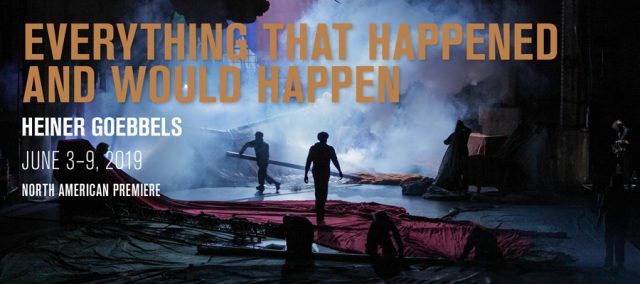
In 2009, German composer and artist Heiner Goebbels brought Stifter’s Dinge to Park Avenue Armory, a work for five pianos, sans performers, an architectural, musical, kinetic collage with the voices of William S Burroughs, Malcolm X, and Claude Lévi-Strauss. In 2016, his multidisciplinary De Materie featured a lighted zeppelin and a flock of sheep. His latest spectacle to come to the Wade Thompson Drill Hall is Everything that happened and would happen, running June 3-9. Originally staged in a former railway station in Manchester, the 160-minute intermissionless piece, reconfigured for the armory, combines unedited footage from Euronews’s No Comment, music from John Cage’s “Europeras 1&2,” and text based on Patrik Ouředník’s Europeana: A Brief History of the Twentieth Century. “Heiner Goebbels is an artist who defies classification. Composer, visual artist, theatrical pioneer, philosopher, and poet of the stage, he has for decades created compelling productions using a wide variety of performers,” armory artistic director Pierre Audi said in a statement. “The Drill Hall thrives on art forms flirting with each other, teasing us, provoking us, challenging us. Goebbels is the ring master par excellence who offers us a production especially inspired by the armory space. The result is an immersive experience that leaves each of us, the spectators, with our own experience and interpretation.”
The work, which was co-commissioned by Park Avenue Armory, 14—18 Now, Artangel, and Ruhrtriennale and explores a century of world history, is conceived and directed by Goebbels, with lighting by Goebbels and John Brown, sound by Willi Bopp, and video by Rene Liebert, with five musicians (Camille Emaille, Gianni Gebbia, Cécile Lartigau, Léo Maurel, Nicolas Perrin) and twelve performers and dancers (Juan Felipe Amaya Gonzalez, Sandhya Daemgen, Antoine Effroy, Ismeni Espejel, Montserrat Gardó Castillo, Freddy Houndekindo, Tuan Ly, Thanh Nguyễn Duy, John Rowley, Annegret Schalke, Ildikó Tóth, Tyra Wigg). On June 6 at 5:30, Goebbels will take part in an artist talk with Gelsey Bell.
Humiliatrix Ceara Lynch and filmmaker Julian Shaw play fictionalized versions of themselves in Use Me
USE ME (Julian Shaw, 2019)
Sunday, June 2, Wythe Hotel, 80 Wythe Ave. at North Eleventh St., 7:00
Monday, June 3, Windmill Studios, 300 Kingsland Ave., 8:30
Festival runs May 31 – June 9 www.brooklynfilmfestival.org
Fiction and reality collide in kinky ways in Julian Shaw’s thriller Use Me, making its world premiere at the twenty-second annual Brooklyn Film Festival. New Zealand-born director Shaw initially set out to make a documentary about Ceara Lynch, a professional humiliatrix who welcomes people to her website by proclaiming, “Here you will find a wide array of fetish and femdom POV videos specially designed to exacerbate your inexplicable urge to have a pretty girl ruin your life.” Ultimately, he decided to create a fictionalized tale in which it is often difficult to tell what is real and what is not. Lynch makes her living by humiliating men, who pay for the privilege; the film’s original title was Ruin Me. Shaw and Lynch, and various other characters, play themselves as he delves into her salacious business of sexual obsession. She has a clear set of guidelines, but when they breach a few key ground rules, Shaw finds himself trapped in a dangerous nightmare involving Lynch, her client Luke Adore (Joseph Reitman), and her protégée Princess Cassie (Jazlyn Yoder).
Shaw (Darling! The Pieter-Dirk Uys Story, Cup of Dreams) keeps the viewer off balance all the way, both through the use of shaky handheld cameras and his appropriately uncomfortable performance; he has noted in interviews that even he sometimes didn’t realize what scenes were completely made up and what was more real. The twists pile up, leading to a surprising conclusion as Shaw examines various forms of addiction, including the director’s need to film everything; he never turns the camera off, no matter what commitments he’s made to himself or others. Use Me is screening June 2 at 7:00 at the Wythe Hotel and June 3 at 8:30 at Windmill Studios, followed by Q&As with Shaw and others. The Brooklyn Film Festival continues through June 9 with such other works as Dustin Feneley’s Stray, Kristian Gianfreda’s Only Good Things, and Zhang Zhonghua’s The Home in the Tree.
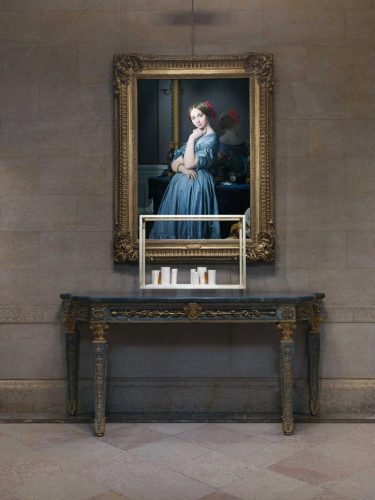
Edmund de Waal, that pause of space, porcelain, gold, alabaster, aluminum, and plexiglass, on view in the North Hall (photo by Christopher Burke)
The Frick Collection
1 East 70th St. at Fifth Ave.
Moroni through June 2, de Waal through November 17, $12-$22
212-288-0700 www.frick.org
The brief confluence of two shows at the Frick, “Elective Affinities: Edmund de Waal at the Frick Collection,” which opened May 30, and “Moroni: The Riches of Renaissance Portraiture,” which closes June 2, offers an unexpected, unanticipated bonus. For “Elective Affinities,” author and ceramicist Edmund de Waal has created site-specific vitrines of objects made of porcelain, steel, gold, alabaster, and aluminum and placed them throughout the museum, interacting with individual paintings, sculptures, and furniture, resulting in intriguing dialogues involving form, shape, color, balance, and space while exploring such concepts as wealth, power, elegance, and industry. The Moroni show focuses on the Italian painter’s portraits, many of which are accompanied by vitrines of objects relating to elements found in the work. De Waal’s an alchemy is embedded in the bottom of a table on which resides André-Charles Boulle’s “Barometer Clock,” John C. Johansen’s portrait of Henry Clay Frick looming in the background; below Jean-Auguste-Dominique Ingres’s Comtesse d’Haussonville is sub silentio, which dramatically interacts with the painting’s composition; and the temptation of Christ on the mountain echoes the architectural structures in Duccio di Buoninsegna’s tempera on poplar panel depiction of Satan attempting to entice Jesus to the dark side. A mid-sixteenth century rapier stands by Moroni’s Gabriel de la Cueva, a sword on the subject’s left side; sixteenth-century shears hover by The Tailor, in which a man is cutting fabric; and a bejeweled “Marten’s Head” resembles one of the precious accessories adorning the portrait of Isotta Brembati. Each of the exhibitions is worth seeing on its own merits, but for a few days, they can be experienced together in an unintended yet fascinating way, in lovely dialogue with each other.
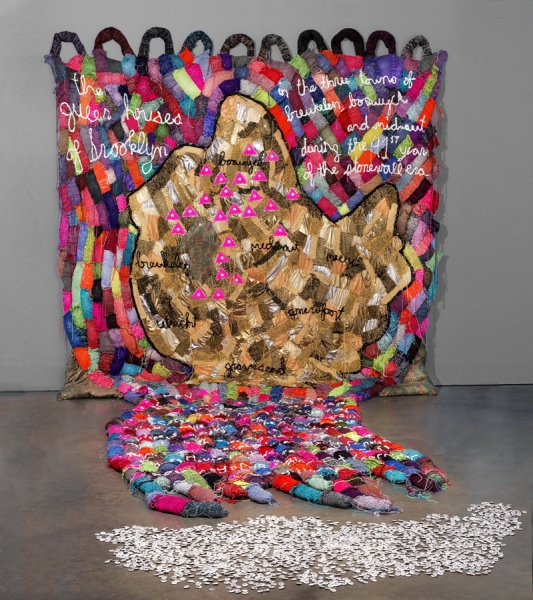
LJ Roberts, The Queer Houses of Brooklyn and the Three Towns of Boswyck, Breukelen and Midwout during the 41st Year of the Stonewall Era (based on the drawing by Daniel Rosza Lang/Levitsky and with illustrations by Buzz Slutzky), crank-knit yarn, fabric, thread, sequins, poly-fil, 1″ pins (free to the public and replenished endlessly), 2011 (photo courtesy of the artist)
Brooklyn Museum
200 Eastern Parkway at Washington St.
Saturday, June 1, free (some events require advance tickets), 5:00 – 11:00
212-864-5400 www.brooklynmuseum.org
The Brooklyn Museum honors Gay Pride and the fiftieth anniversary of the Stonewall riots in the June edition of its free First Saturday program. There will be live performances by New York City Gay Men’s Chorus, Linda LaBeija, Amber Valentine, and Madame Gandhi as well as teen staff members presenting an intersextions variety show inspired by “Nobody Promised You Tomorrow: Art 50 Years After Stonewall” and artists Morgan Bassichis, TM Davy, DonChristian Jones, Michi Osato, Una Osato, and special guests celebrating the updated edition of The Faggots & Their Friends Between Revolutions; a book club talk with Jodie Patterson discussing her latest, The Bold World, with Elaine Welteroth; a curator tour of “Nobody Promised You Tomorrow” led by Lindsay C. Harris and Carmen Hermo; a hands-on workshop in which participants can design buttons based on LJ Roberts’s The Queer Houses of Brooklyn in the Three Towns of Boswyck, Breukelen, and Midwout during the 41st Year of the Stonewall Era; a community talk on radical queer histories with Audre Lorde Project; and an “Archives as Raw History” tour focusing on the museum’s LGBTQ+ histories. In addition, the galleries will be open late so you can check out “Garry Winogrand: Color,” “Nobody Promised You Tomorrow: Art 50 Years After Stonewall,” “Eric N. Mack: Lemme walk across the room,” “Liz Johnson Artur: Dusha,” “One: Egúngún,” “Something to Say: Brooklyn Hi-Art! Machine, Deborah Kass, Kameelah Janan Rasheed, and Hank Willis Thomas,” “Infinite Blue,” “A Woman’s Afterlife: Gender Transformation in Ancient Egypt,” “Kwang Young Chun: Aggregations,” and more.
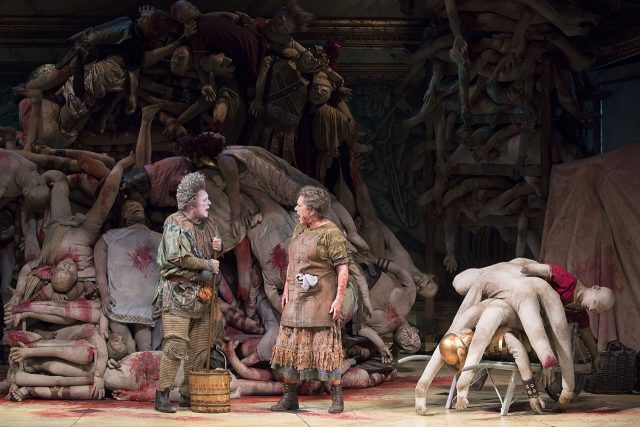
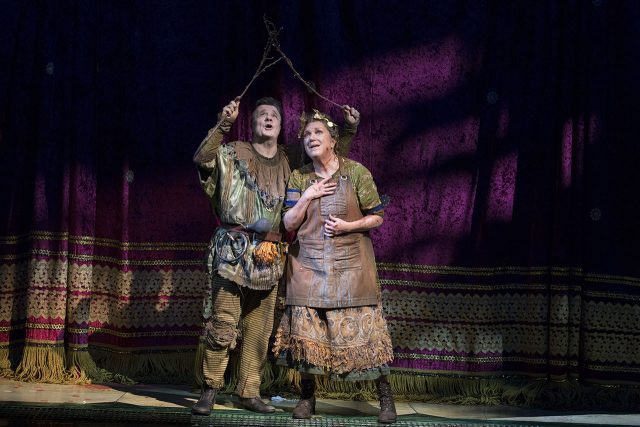
Gary (Nathan Lane) and Janice (Kristine Nielsen) have got quite a cleaning job ahead of them in Taylor Mac’s Gary: A Sequel to Titus Andronicus (photo by Julieta Cervantes)
Booth Theatre
222 West 45th St. between Broadway & Eighth Ave.
Tuesday – Sunday through June 16, $39 – $169 shubert.nyc/theatres/booth
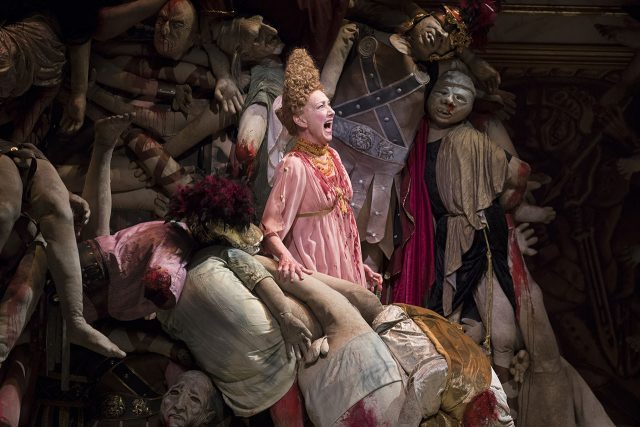
Downtown fave Taylor Mac makes quite an impression with his Broadway debut, the eminently strange and hysterically funny Gary: A Sequel to Titus Andronicus. The play is set just after the bloodbath that concludes Shakespeare’s violent tragedy and is prefaced by a monologue by a midwife named Carol (Julie White), who self-referentially explains directly to the audience, “Like God, a sequel hides inside an ending: / When time is up you pray that it’s extending. / For life, to the cultured, and to the philistine / Once felt, is craved ’til thrills become routine. / But once routine the thrills, to thrill, must grow. / And if they don’t, an outrage starts to show. / So double up on savagery and war: / To satisfy you multiply the gore.” She introduces not only the rhythmic nature of the dialogue and the British accents all three characters will speak in but also the Monty Python-like comedy of spurting blood in which anything goes and no joke is too high or low. The Clown (named Gary by Mac and portrayed with extra relish by Nathan Lane), who had delivered a letter to Saturninus in the original Bard play, has avoided execution by agreeing to become a maid. Little does he know that he will have to work with the stern, humorless Janice (Kristine Nielsen) to clean up more than a thousand ragged bodies piled high in the royal banquet room, a fate perhaps worse than death.
Carol (Julie White) find herself in an icky predicament in Gary: A Sequel to Titus Andronicus (photo by Julieta Cervantes)
“I always was a clown who hated clowns,” Gary, who used to juggle pigeons on the street, confesses to the bodies. Belittled by Janice, he tells her he is “more like an everyman who’s a nobody else” and shares his dream of becoming a fool, which he describes as “a clown with ambition.” (Master clown and actor Bill Irwin is credited with the movement.) Janice teaches him the ropes, which involves thoroughly eliminating the remaining gas from each victim and then sucking out their innards and blood using two separate hoses. Mac includes a parade of flatulence and penis jokes that are not the usual Broadway fare while also taking on the current political climate in America. “Ya think the streets are all clean and nifty? Ya know as well as I it’s a hell on earth out there and only getting worse, what with the autocracy turned to a democracy turning back to an autocracy, as we speak,” Janice, who refuses to talk in rhymes or Iambic pentameter, says. A moment later, Gary bursts into tears and Janice uncaringly asks, “What ya crying for?” He answers, “The state of the world.”
The puns and buffoonery keep on coming as Pulitzer Prize finalist Mac (A 24-Decade History of Popular Music) and five-time Tony Award-winning director George C. Wolfe (Angels in America, Topdog/Underdog) push Janice, Carol, and Gary deeper into the mess left behind by the powers that be. The near-endless supply of dead people on Santo Loquasto’s imaginative set evokes the casualties of wars waged by tyrannical governments. “Seems the casualty is how casual it is,” Gary opines. But there are also glimmers of hope. Explaining the surprising emotions he experienced when he was barely saved from being hanged and saw the sky as if for the first time, Gary says to Janice, “Once ya feel that, it’s proof, aint’ it? Proof ya don’t gotta live your life accepting the muck.” He believes he can save the world, which Mac thinks everyone is capable of. Referring to the court, Gary says, “If two maids could turn the hopelessness of a massacre into a coup of beauty, they too can imagine a better world.”
Gary (Nathan Lane) impresses Janice (Kristine Nielsen) for a moment in Broadway comedy (photo by Julieta Cervantes)
Tony winners Lane (Angels in America,The Producers) and White (The Little Dog Laughed,Airline Highway) and Tony nominee and Obie winner Nielsen (Vanya and Sonia and Masha and Spike,Dog Opera) have a blast together. At the last moment, Andrea Martin, who was cast as Janice, got hurt and had to leave the show, so Nielsen moved from Carol to Janice and White came on as Carol, creating a formidable comic trio with a lot to say about society while making the audience laugh itself silly.
Mac, who uses the gender pronoun “judy,” delivers some grand pronouncements without becoming preachy, getting right to the point when Gary declares that the next step should be “not a violent coup. An artistic one. An onslaught of ingenuity that’s a transformation of the calamity we got here. A sort of theatrical revenge on the Andronicus revenge. A comedy revenge to end all revenge. Well, not just a comedy. A sorta folly. Not a spectacle. Or a comedy folly that is a spectacle. Sorta a machination. That’s full of laughter. But more than laughs. But with the laughs. Well, sorta a thinking man’s laughter. But could be a knee-slapper.” Which is just what Mac’s play is.
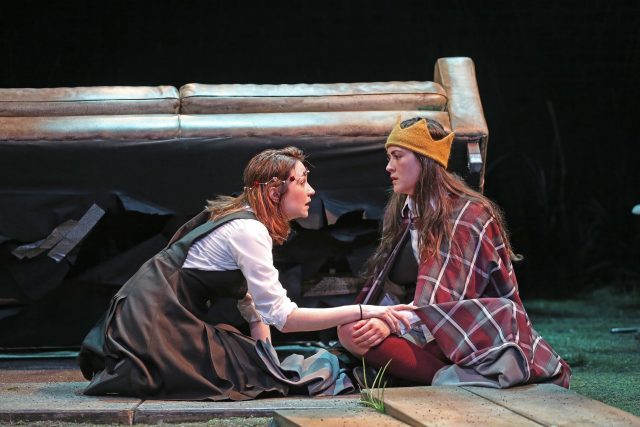
Lady Macbeth (Ismenia Mendes) reaches out to her royal husband (Isabelle Fuhrman) in inventive reimagining of Shakespeare tragedy (photo by Richard Termine)
Lucille Lortel Theatre
121 Christopher St. between Bleecker & Hudson Sts.
Tuesday – Sunday through June 9, $77-$117
212-352-3101 www.redbulltheater.com
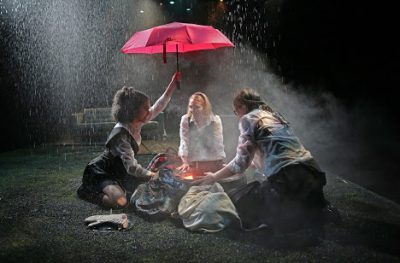
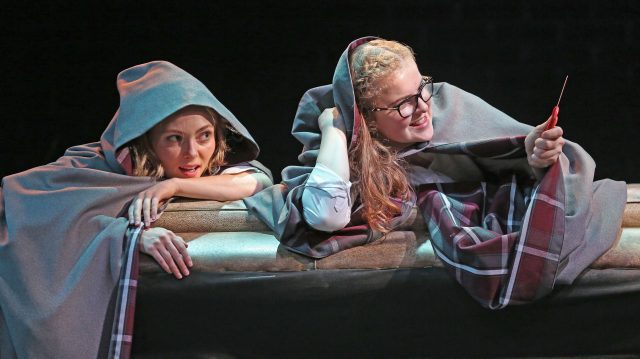
Erica Schmidt’s beautifully frenetic Shakespeare adaptation Mac Beth — yes, she has made the title two words, perhaps to emphasize the more feminine second half of the title — is an exhilarating demonstration of grrl power, ratcheted up to the nth degree. The Red Bull production, which continues at the Lucille Lortel Theatre through June 9, is set at a girls school where seven students enact an all-female version of Macbeth. They are dressed in schoolgirl uniforms of buttoned white shirts under tartan tops and skirts, with bloodred socks reaching up to their knees; aggressively ominous and gender-neutral hooded capes are added for the Weird Sisters. (The costumes are by Jessica Pabst.) Catherine Cornell’s set juts into the audience, covered in fake grass with a partially overturned couch, an iron bathtub, a campfire, and water-filled craters, as if the aftermath of a wild sorority bash. (When the characters imbibe, they do so from red plastic cups, a party staple.) And although they speak in the traditional iambic pentameter, they don’t disguise their voices to be more adult, instead sounding like a bunch of kids invigorated by putting on a show exactly the way they want to.
The Weird Sisters (Sharlene Cruz, AnnaSophia Robb, and Sophie Kelly-Hedrick) stir the boiling cauldron in Mac Beth (photo by Richard Termine)
Macbeth (Isabelle Fuhrman) is returning from a successful military campaign with the loyal Banquo (Ayana Workman) when they come upon three witches (AnnaSophia Robb, Sophie Kelly-Hedrick, and Sharlene Cruz, who play multiple roles) who predict that Macbeth will become Thane of Cawdor, then king, while Banquo’s sons will one day rule. Fear, jealousy, and revenge take over as the power grab is on, but with delicious twists; in the Bard’s day, his plays were performed by an all-male cast, but this twenty-first-century all-woman cast — armed with smartphones — revels in the gender shifts without altering the original text. “Are you a man?” Lady Macbeth (Ismenia Mendes) asks her husband. Facing a ghost (hysterically played by Workman), Macbeth declares, “What man dare, I dare: be alive again, / And dare me to the desert with thy sword; / If trembling I inhabit then, protest me / The baby of a girl. Hence, horrible shadow! / Unreal mock’ry, hence!” It’s as if they are caught up in a teenage horror flick, with all the adolescent tropes in place but seen only from the girls’ point of view. Even one of the witches’ prophecies takes on new meaning when she predicts, “Be bloody, bold, and resolute: laugh to scorn / The power of man, for none of woman born / Shall harm Macbeth.” At one point Lady Macbeth tells a witch, “Unsex me here.”
AnnaSophia Robb and Sophie Kelly-Hedrick play witches and other characters in Bard play set at a girls school (photo by Richard Termine)
Schmidt’s (A Month in the Country, Invasion!) breathlessly paced version flies by in a furious ninety minutes, both sexy and sinister, gleefully performed by the terrific cast led by Fuhrman’s (All the Fine Boys,Orphan) tortured Macbeth and Mendes’s (Marys Seacole, Orange Is the New Black) malevolent Lady Macbeth. Robb (The Carrie Diaries, Bridge to Terabithia), NYU Tisch freshman Kelly-Hedrick, and recent CCNY grad Cruz make strong off-Broadway debuts, playing the witches as well as Duncan, Malcolm, Fleance, Rosse, Angus, Lenox, and other minor characters; in particular, Kelly-Hedrick captures the essence of girlhood — tinged with menace — in her squeaky delivery. Schmidt’s inventive staging also boasts a thrilling storm, a creepy doll, and a touch of gymnastics, although if there was one more loud bang against the tub I was going to scream. Schmidt was inspired to revisit Macbeth by reading stories about girls being murdered in the woods. In Mac Beth, she takes back the power, putting the girls in charge in a gender swap that is as exciting as it is, in this day and age, necessary. Schmidt makes us look at the bloody power plays of Scottish kings as if they are the social dominance battles of high school — and vice versa — and every audience member comes out a winner.
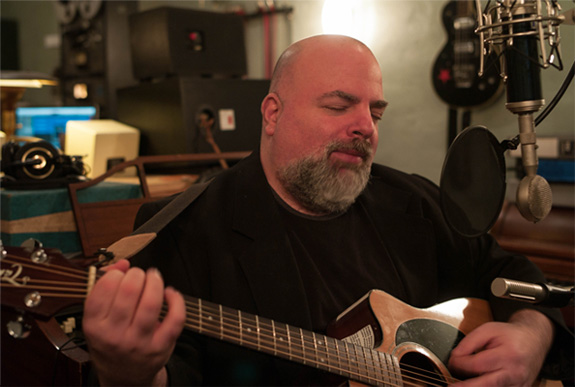
Jim Allen launches his first solo album in sixteen years, Where the Sunshine Bit You, at a release party at the treehouse at 2A on June 2 (photo by Helena Bošković)
JIM ALLEN ALBUM RELEASE SHOW
The Treehouse at 2A
25 Ave. A (upstairs)
Sunday, June 2, 8:30
212-505-2466 2abar.com jimallen.bandcamp.com
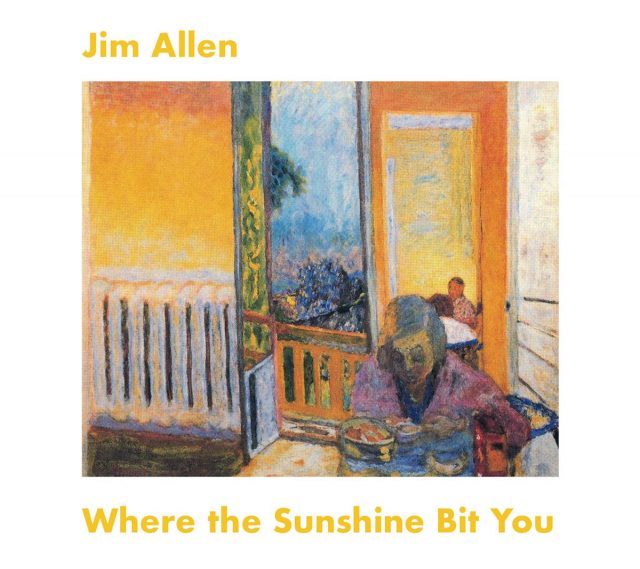
Nearly twenty years ago, I worked a day job with singer-songwriter and freelance journalist Jim Allen, a gracious and friendly man who has a never-ending thirst for music old and new, obscure and popular, with a vast knowledge of his chosen discipline. Allen is a solo artist in addition to being leader of the country band the Ramblin’ Kind and the rock outfit Lazy Lions; this month he has released his first solo record in sixteen years, Where the Sunshine Bit You, a tasty confection of eleven tunes that showcase Allen’s sweet-sounding acoustic guitar and trademark turns of phrases.
Recorded live, the album opens with the swampy folk-blues instant classic “All the Way Down the Line,” in which he sings in his deep baritone, “Yeah, the sign said stop, it was only a suggestion / The dead end sign was really meant to be a question / Where’s that map when we need it most? / Are we christening a country or following a ghost? / Well, the train’s on time all the way down the line.” Jerry Garcia would be proud of “The Day After Tomorrow” (“When the worst of all your dreams decides to call your house a home / Then the arctic freeze is just a breeze compared to where you roam”), while Leonard Cohen would get a kick out of “Wedding of the Dead” (“Here comes the groom all dressed in doom / He’s got a bloodstain on his tie”), Richard Thompson would be honored by “Going Under” (“This hole has got a boat in it, it’s all that I can do / To find a way to float in it till something else comes through”), and Hank Williams is smiling somewhere at “What I Deserve” (“Oh, I was high and dry but now I’m low and drowning / I only hope God’s grading on a curve / When the cotton meets the clay underneath the milky way / And the time arrives to get what I deserve”). Among Allen’s other influences are Tom Waits, Townes Van Zandt, Bob Dylan, Elvis Costello, and Johnny Cash. It all concludes with the foot-stompin’ “High.”
A DIY effort, Where the Sunshine Bit You was recorded live in the studio and mixed by Magic Mike Jung; it features Matt Applebaum on guitars, Joanna Sternberg on bass, Steve Goulding on drums, and Libby Johnson and Jung on vocals. On June 2, Allen will be hosting a record release party at the Treehouse at 2A with a litany of special guests. Below he explains some of his process, his collaboration with his son, and his love of LPs.
twi-ny: What made you decide to do a solo album at this time? Your last one was 2003’s Wild Card.
jim allen: After that album I concentrated more on being in bands than doing the solo singer/songwriter thing, but I would never abandon it. Maybe the singer/songwriter-type material eventually reached — or more accurately, surpassed — critical mass and I felt like I had to do something more concrete with it. Also I began to realize how alarmingly long it had been since I’d last put out a solo album! So I started to envision a predominantly acoustic album of these songs. I think hearing Joanna Sternberg playing standup bass helped spark my imagination of how the songs could work in that setting. Fortunately, Joanna was available for the session.
twi-ny: You are also a singer/songwriter for the Ramblin’ Kind and Lazy Lions. What is your songwriting process like? Do you set out to write songs specifically for one of the bands or yourself, or does the song just come to you and then you figure out where it belongs?
ja: I never start out with any particular direction in mind; it just goes where it goes, not to get all hippie mystic on you or anything. There’s some overlap between my solo stuff and the Ramblin’ Kind, but a lot of the songs will obviously not fit in a country-oriented band. And the Lazy Lions stuff is much more separate; it’s an entirely different set of blocks we’re playing with, so there’s rarely any confusion about which belongs where with them. Occasionally I’ve tried out songs with them that we determined were more Jim Allen songs than Lazy Lions songs.
twi-ny: You have two kids who look like they’re a lot of fun. Are they into music? What do they think of Dad’s albums?
ja: Yeah, they’re possessed of an almost unnatural amount of joie de vivre. They like to hear music, and they love to have ad hoc dance parties at home, with me or my wife playing DJ. But they haven’t made a lot of their own specific preferences known yet. They love to hear my music, though. When I first got copies of this album, my son, who’s seven, wanted to hear it right away and just sat in rapt attention staring at the speaker for the entire thing, which was pretty damn adorable. Actually one of the songs, “The Day After Tomorrow,” began from something he said to me one day, that’s why you’ll see his name co-credited on it. Not that I’d necessarily be so magnanimous as to extend that same courtesy to a non-relative in the same situation.
twi-ny: You recently wrote that you have a “strategic approach” to the WFMU Record Fair. What does that entail?
ja: I’ve been a crate-digger since my teens, but I’ve always taken an open-ended approach to it. I figure if you’re only looking for a specific set of things, you’re gonna have a hard time finding what you want and you’re gonna miss out on a lot of other stuff in the meantime. So I just gravitate to whatever looks good, and inexpensive.
twi-ny: Is there a specific LP you’ve been on the hunt for and have been unable to find?
ja: If I ever encountered the first couple of Butch Hancock albums in the wild for a reasonable amount, I might begin to weep.
twi-ny: We often see each other at shows, by Steve Earle, Richard Thompson, and others. Who have you seen live lately that you love, and what’s coming up for you as a spectator?
ja: Let’s see. Well, most recently I saw my buddy Wes Houston play; he’s been performing longer than I’ve been alive and he sounds better than ever, so I find that inspiring. The last thing before that was Chick Corea in an all-star trio with Christian McBride and Brian Blade, which was blindingly good. I’m never sure exactly what I’ll wind up making it to see, but the next few shows on my docket are Barre Phillips, the jazz bassist, and the Masqueraders, an old-school R&B group that’s performing again, and my old friend Simon Joyner, a great singer/songwriter from Omaha who’s playing at Alphaville in Brooklyn. That’ll be five dollars for the plug, Simon.
twi-ny: In addition to being interviewed about your own records, you have been writing about music for several decades. Who are some of your favorite subjects?
ja: I always say the nicest person I ever interviewed was Jimmie Dale Gilmore; the guy just oozes genuine sweetness and conviviality, even over the phone. Recently I got to talk to Jon Anderson, which was huge for me because I’m an enormous Yes fan, and it was all the more enjoyable because he turned out to be a super-nice guy; he really is the sort of twinkle-eyed hippie prince you might imagine him to be.
twi-ny: If you could choose to write the liner notes for any album or artist, new or old, what/who would it be?
ja: Very interesting question. I got to write notes for some great records. I guess the ultimate would be Leonard Cohen, because he’s had the biggest effect on me.
twi-ny: Who would you most want to write the liner notes for your next record? Feel free to choose a writer no longer with us.
ja: As far as someone to write notes for my album, let’s see. This is a dangerous question because I have a lot of great music journalist friends, you know. So I’ll play it safe and go with someone I’ve never met instead, the British writer Allan Jones, just because he’s so howlingly funny.
twi-ny: On June 2, you will be hosting a record release party at the Treehouse, with such guests as Mike Fornatale, Emily Duff, Libby Johnson, Wes Houston, and Pete Galub. What can you tell us about the show?
ja: I’m taking over the joint for the night. We’ll be playing two sets, from 8:30 to 11. The first set will be the new album in full. And the second set will be some of my old songs plus a bunch of surprise covers and special guests, including the people you mentioned. Matt Applebaum, Paul Foglino, and Steve Goulding, who also happen to be in the Ramblin’ Kind with me, will be playing with me. The Treehouse is above the bar 2A on the corner of Second St. and Ave. A, where Tom Clark, who’s a great musician himself, has been running a great Sunday series for a good while now.
twi-ny: You were born and raised in the Bronx. What did that instill in you?
ja: I guess on one hand, growing up as a weird, arty kid in the midst of the very blue-collar, kind of conservative neighborhood where I lived, I developed a sense of otherness pretty early on. But at the same time, growing up in one of what Manhattanites charmingly refer to as the “outer boroughs,” I also developed an inclination towards lurking around on the periphery of things and sort of observing the hullabaloo from a safe distance. Unfortunately, it did not instill in me the ability to smoothly segue from that into the shameless hucksterism of reminding people that my album, Where the Sunshine Bit You, can be found in both download and CD format at www.jimallen.bandcamp.com. Alas.

 Fiction and reality collide in kinky ways in Julian Shaw’s thriller Use Me, making its world premiere at the twenty-second annual Brooklyn Film Festival. New Zealand-born director Shaw initially set out to make a documentary about Ceara Lynch, a professional humiliatrix who welcomes people to her website by proclaiming, “Here you will find a wide array of fetish and femdom POV videos specially designed to exacerbate your inexplicable urge to have a pretty girl ruin your life.” Ultimately, he decided to create a fictionalized tale in which it is often difficult to tell what is real and what is not. Lynch makes her living by humiliating men, who pay for the privilege; the film’s original title was Ruin Me. Shaw and Lynch, and various other characters, play themselves as he delves into her salacious business of sexual obsession. She has a clear set of guidelines, but when they breach a few key ground rules, Shaw finds himself trapped in a dangerous nightmare involving Lynch, her client Luke Adore (Joseph Reitman), and her protégée Princess Cassie (Jazlyn Yoder).