Irma (Kati Outinen) and M (Markku Peltola) face an uncertain future in Aki Kaurismäki’s The Man Without a Past
THE MAN WITHOUT A PAST (Aki Kaurismäki, 2002)
Metrograph
7 Ludlow St. between Canal & Hester Sts.
Tuesday, April 9, 4:00 & 8:00
Series runs through April 11
212-660-0312 metrograph.com
Metrograph celebrates the career of Finnish auteur Aki Kaurismäki with the fab series “Total Kaurismäki Show,” consisting of seventeen features and an evening of nine shorts by the uniquely talented writer-director who sees the world like nobody else. On April 9, Metrograph will be screening The Man Without a Past, Kaurismäki’s touching, funny, dark, and satiric film that won the 2002 Grand Jury Prize at Cannes. In the brutal opening, an unidentified character gets severely beaten and dies, then wakes up with amnesia. M (Markku Peltola) is soon taken in by a desperately poor family who lives in a shack they call a container. He meets Irma (Kati Outinen, in a small role that won her Best Actress at Cannes), and their potential romance is both sweet and absurd. Kaurismäki wrote, produced, and directed this splendid example of the offbeat nature of his work, which is always intelligent, challenging, and rewarding.
Mirja (Maria Järvenhelmi) and Koistinen (Janne Hyytiäinen) consider their future in Lights in the Dusk
LIGHTS IN THE DUSK (Aki Kaurismäki, 2006)
Tuesday, April 9, 6:15 & 10:15 www.strandreleasing.com
The final installment in his self-described Loser Trilogy (following Drifting Clouds and The Man Without a Past), Lights in the Dusk is another existential masterpiece from Kaurismäki. Janne Hyytiäinen stars as Koistinen, a pathetic little security guard who has pipe dreams of starting his own company. A lonely man with no friends — except for Aila (Maria Heiskanen), who runs a late-night hot-dog van and whom he continually shuns — Koistinen is easily taken in by Mirja (Maria Järvenhelmi), a romantic interest who has ulterior motives. But no matter how bad things get for Koistinen — and they get pretty bad — he just wanders his way through it all, preferring to simply accept the consequences, no matter how undeserved, rather than take a more active role in his life. The character has a lot in common with Kati Outinen’s sad-sack, trampled-upon Iris from Kaurismäki’s The Match Factory Girl — in fact, Outinen makes a cameo in Lights in the Dusk as a cashier at a grocery store.
Marcel (André Wilms) and Arletty Marx (Kati Outinen) face life with a deadpan sense of humor in Aki Kaurismäki’s Le Havre
For more than thirty years, Kaurismäki (Leningrad Cowboys Go America, The Other Side of Hope) has been making existential deadpan black comedies that are often as funny as they are dark and depressing. In the thoroughly engaging Le Havre, Kaurismäki moves the setting to a small port town in France, where shoeshine man Marcel Marx (André Wilms), a self-described former Bohemian, worries about his seriously ill wife (Kati Outinen) while trying to help a young African boy (Blondin Miguel), who was smuggled into the country illegally on board a container ship, steer clear of the police, especially intrepid detective Monet (Jean-Pierre Darroussin), who never says no to a snifter of Calvados. Adding elements of French gangster and WWII Resistance films with Godardian undercurrents — he even casts Jean-Pierre Léaud in a small but pivotal role — Kaurismäki wryly examines how individuals as well as governments deal with illegal immigrants, something that has taken on more importance than ever these days. Through it all, Marcel remains steadfast and stalwart, quietly and humbly going about his business, deadpan every step of the way. Wouter Zoon’s set design runs the gamut from stark grays to bursts of color, while longtime Kaurismäki cinematographer Timo Salminen shoots scene after scene with a beautiful simplicity. Winner of a Fipresci critics award at Cannes and Finland’s official entry for the Best Foreign Language Film Oscar, Le Havre, the first of a proposed trilogy, is another marvelously unusual, charmingly offbeat tale from a master of the form.
John Webster’s 1612 The White Devil gets modern multimedia makeover in Red Bull revival (photo by Carol Rosegg)
Lucille Lortel Theater
121 Christopher St. between Bleecker & Hudson Sts.
Tuesday – Sunday through April 14, $77-$97
212-352-3101 www.redbulltheater.com
“Of all deaths, the violent death is best; / For from ourselves it steals ourselves so fast, / The pain, once apprehended, is quite past,” Flamineo gruesomely observes in John Webster’s 1612 play The White Devil, now being given a flashy, contemporary revival — with plenty of violent death — by Louisa Proske at the Lucille Lortel, where the Red Bull production opened Sunday night. Flamineo is deliciously played by Tommy Schrider, who marches across the stage and into the aisles in his hip black jacket, plotting to get ahead no matter who he leaves in his wake. Flamineo is arranging for his sister, the fashionable, social-climbing Vittoria Corombona (Lisa Birnbaum), to cuckold her milquetoast husband, Camillo (Derek Smith), with the brash Duke of Brachiano (Daniel Oreskes), who is married to the sweetly innocent Isabella (Jenny Bacon), with whom he has a bright son, Giovanni (Cherie Corinne Rice). Isabella’s brother, Francisco de Medici, the Duke of Florence (T. Ryder Smith), is aghast when he learns about the deception and decides to protect his sister, enlisting the help of his good friend, the powerful Cardinal Monticelso (Robert Cuccioli). Cornelia (Socorro Santiago), Flamineo and Vittoria’s mother, is not exactly pleased with her children’s deceptions. Meanwhile, the murderous, anarchic Count Lodovico (Smith), a Rasputin-like presence with a lust for life — and death — is released from prison and has his own aims on Vittoria, aided by Hortensio (Bacon) and Gasparo (Edward O’Blenis). And finally, Vittoria’s servant, Zanche (Rice), falls in love with Francisco. What follows is villainy and jocularity in delightful abundance.
Relationship between Vittoria Corombona (Lisa Birnbaum) and the Duke of Brachiano (Daniel Oreskes) is at center of The White Devil (photo by Carol Rosegg)
Kate Noll’s elegantly minimalist set juts into the audience, who sit on three sides of the bare stage. At the back is a shallow glass-walled lobby with a central doorway flanked by two small video monitors. Blinds roll up and down the windows as needed for Yana Birÿkova’s large video projections, which range from live footage to offstage murders. The compelling sound and music are by Chad Raines. Believed to be Webster’s first solo playwrighting effort — most of his work was done in collaboration with other writers — The White Devil debuted at the Red Bull theater in London more than half a millennium ago and hasn’t had a New York City revival since a 1965 downtown production starring Frank Langella, Carrie Nye, Maria Tucci, and Paul Stevens, but opera and theater director Proske (peerless, La bohème) makes it feel fresh and alive, turning it into a modern noir thriller reminiscent of James M. Cain’s The Postman Always Rings Twice and Double Indemnity. With one minor exception, the cast ably delivers Webster’s (The Duchess of Malfi) poetic language, adding gleeful gestures that elicit laughter despite the tragic proceedings. The text is surprisingly contemporary, ahead of its time, which helps explain why it was initially a failure when it debuted; Proske’s updates are visual in nature. It does not feel like an old play, but it is an age-old story, of passion and love, treachery and vengeance, expertly told.
Brooklyn Museum
200 Eastern Parkway at Washington St.
Saturday, April 6, free (some events require advance tickets), 5:00 – 11:00
212-864-5400 www.brooklynmuseum.org
The Brooklyn Museum celebrates Frida Kahlo in the April edition of its free First Saturday program. There will be live performances by Renee Goust, Calpulli Mexican Dance Company (Puebla: The Story of Cinco De Mayo), and Pistolera (with visuals by Screaming Horses), as well as Yas Mama!’s El Noche de las Reinas with Lady Quesa’Dilla and DJ sets by Hannah Lou and Shomi Noise, hosted by Horrorchata; pop-up poetry with Danilo Machado, Jimena Lucero, and Francisco Márquez; the community talk “Art and Disability” with Dior Vargas and Kevin Gotkin; pop-up gallery talks of “Life, Death, and Transformation in the Americas” with teen apprentices; a hands-on workshop in which participants can adorn instant photos with a Kahlo-like flourish; and an “Archives as Raw History” tour focusing on disabled artists and visitors with archivist Molly Seegers. In addition, the galleries will be open late so you can check out “Frida Kahlo: Appearances Can Be Deceiving,” “Eric N. Mack: Lemme walk across the room,” “One: Do Ho Suh,” “One: Egúngún,” “Something to Say: Brooklyn Hi-Art! Machine, Deborah Kass, Kameelah Janan Rasheed, and Hank Willis Thomas,” “Infinite Blue,” “A Woman’s Afterlife: Gender Transformation in Ancient Egypt,” “Kwang Young Chun: Aggregations,” and more.
Capt. Boyle (Ciarán O’Reilly) and his wife, Juno (Maryann Plunkett), see brighter days ahead in Juno and the Paycock (photo by Carol Rosegg)
Irish Repertory Theatre, Francis J. Greenburger Mainstage
132 West 22nd St. between Sixth & Seventh Aves.
Through May 25, $50-$70
212-727-2737 irishrep.org
The Irish Rep’s inaugural 1988–89 season included The Plough and the Stars, part of Sean O’Casey’s 1923–26 Dublin Trilogy; the company brought it back again in 1997. To celebrate its thirtieth anniversary season, the Irish Rep is presenting revivals of the first two plays in the trilogy, the 1924 Juno and the Paycock and the 1923 The Shadow of the Gunman, in repertory through May 25, along with screenings of the 1937 John Ford film version of The Plough and the Stars with Barbara Stanwyck, Preston Foster, and Barry Fitzgerald and a reading series. For the occasion, which the Irish Rep is calling “The O’Casey Cycle,” the Francis J. Greenburger Mainstage theater has been transformed into a ramshackle 1920s tenement; Charlie Corcoran’s set extends well beyond the stage: Windows and brick walls run up the sides and down the hall, clothes are hanging to dry by the balcony, and there’s even a small bed hidden beneath the stairs by the restrooms. It’s now back in a “darling” adaptation after previous stagings at the Irish Rep by artistic director Charlotte Moore in 1995 and 2013–14.
Capt. Boyle (Ciarán O’Reilly) waxes philosophic with Joxer Daly (John Keating) in Sean O’Casey revival at the Irish Rep (photo by Carol Rosegg)
Juno and the Paycock takes place in 1922, during the Irish Civil War between the Diehard Republicans and the Free Staters, as matriarch Juno Boyle (Tony winner Maryann Plunkett) is trying to make ends meet in her family’s small apartment. Her husband, Capt. Boyle (Ciarán O’Reilly), spends most of his time, and what little money they have, hitting the pub with his best friend, the gangly ne’er-do-well Joxer Daly (John Keating), and complaining about terrible pains in his legs whenever the possibility of a job arises; their daughter, Mary (Sarah Street), is on strike with her trade union; and their son, Johnny (Ed Malone), is a bitter young man who lost an arm in the revolution and is worried that the IRA will show up at any moment to right a wrong. The Boyles hit the jackpot when schoolteacher Charles Bentham (James Russell) arrives to tell them that Capt. Boyle has inherited a significant sum of money from a dead relative. Mary, who has been courted by nudnik Jerry Devine (Harry Smith), begins dating the elegant Bentham, and the captain and Juno immediately start celebrating their good fortune by refurnishing their home and considering moving to a better location. But being a classic Irish melodrama about the futility of the working and lower classes, prosperity is not necessarily waiting for them around the corner.
Johnny (Ed Malone) is nervous as his sister, Mary (Sarah Street), and mother, Juno (Maryann Plunkett), try to calm him down in Juno and the Paycock (photo by Carol Rosegg)
Seamlessly directed by Neil Pepe, the longtime artistic director of the Atlantic Theater, Juno and the Paycock is a joy to behold. It’s somewhat reminiscent of The Honeymooners, only Irish, with Capt. Boyle / Ralph Kramden always scheming to fill his empty coffers, the none-too-bright Joxer / Ed Norton unwittingly by his side, offering comic relief, and Juno / Alice doing her best to keep it all together. “There’ll never be any good got out o’ him so long as he goes with that shouldher-shruggin’ Joxer,” Juno says about her husband. “I killin’ meself workin’, an’ he sthruttin’ about from mornin’ till night like a paycock!” As downtrodden as the times are, O’Casey injects plenty of humor into the story, which was also made into a film by Alfred Hitchcock in 1930. The cast, which is very similar to the 2013–14 edition (the main changes are Plunkett as Juno and Street as Mary; Terry Donnelly has played neighbor Maisie Madigan in all three Irish Rep versions), is outstanding, fully embodying a troubled family and its tight-knit, suspicious community, making the most of O’Casey’s well-drawn characters.
The socioeconomic conditions of 1920s Dublin might not provide a lot of opportunities for the Boyles, but they also have to take a long, hard look at themselves for the desperate situation they’re in, at least some of which they bear responsibility for, as O’Casey explores the concept of living by one’s principles. It’s also about looking forward. “Maybe, Needle Nugent, it’s nearly time we had a little less respect for the dead, an’ a little more regard for the livin’,” Mrs. Madigan says to the tailor (Robert Langdon Lloyd). Joxer, wonderfully played by the tall, gangly, wild-haired Keating, the longtime Irish Rep treasure, has a habit of describing things as “darling,” and that’s just what this production is, a darling adaptation of a powerful, poignant play.
In conjunction with the release of her latest nonfiction feature film, documentarian Penny Lane is being celebrated at the Museum of the Moving Image this week with screenings of all four of her full-length films — Exit Through the Gift Shop, The Pain of Others, Our Nixon, and the new Hail Satan? — in addition to her many shorts: Sometimes I Get Lossy, The Abortion Diaries, The Wren, The Commoners, Nellie Bly Makes the News, The Voyagers, The Pleasure Principle, Kitsch Is a Beautiful Lie, Just Add Water: The Story of the Amazing Live Sea Monkeys, How to Write an Autobiography, Men Seeking Women, Normal Appearances, and We Are the Littletons. Lane — yes, it’s her real name — will be at MoMI for all three Saturday programs to discuss her process and the wide range of her subject matter.
Banksy reveals only so much of himself in compelling documentary
EXIT THROUGH THE GIFT SHOP (Banksy, 2010)
Friday, April 5, 7:00 www.banksyfilm.com
The series opens with Banksy’s 2010 Exit Through the Gift Shop, which Penny Lane selected as an important influence on her. In 1999, L.A.-based French shopkeeper and amateur videographer Thierry Guetta discovered that he was related to street artist Invader and began filming his cousin putting up his tile works. Guetta, who did not know much about art, soon found himself immersed in the underground graffiti scene. On adventures with such famed street artists as Shepard Fairey, Swoon, Ron English, and Borf, Guetta took thousands of hours of much-sought-after video. The amateur videographer was determined to meet Banksy, the anarchic satirist who has been confounding authorities around the world with his striking, politically sensitive works perpetrated right under their noses, from England to New Orleans to the West Bank. Guetta finally gets his wish and begins filming the seemingly unfilmable as Banksy, whose identity has been a source of controversy for more than a decade, allows Guetta to follow him on the streets and invites him into his studio. But as he states at the beginning of his brilliant documentary, Exit Through the Gift Shop, Banksy—who hides his face from the camera in new interviews and blurs it in older footage—turns the tables on Guetta, making him the subject of this wildly entertaining film.
Guetta is a hysterical character, a hairy man with a thick accent who plays the jester in Banksy’s insightful comedy of errors. Billed as “the world’s first Street Art disaster movie,” Exit, which is narrated by Welsh actor Rhys Ifans (Danny Deckchair) and features a soundtrack by Portishead’s Geoff Barrow sandwiched in between Richard Hawley’s declaratory “Tonight the Streets Are Ours,” is all the more exciting and intriguing because the audience doesn’t know what is actually true and what might be staged; although the film could be one hundred percent real and utterly authentic, significant parts of it could also be completely made up. Who’s to say that’s even Banksy underneath the black hood, talking about Guetta, who absurdly rechristens himself Mr. Brainwash? It could very well be Banksy’s F for Fake from start to finish. No matter. Exit Through the Gift Shop is riotously funny, regardless of how you feel about street art, Banksy, and especially the art market itself (as the title so wryly implies). Exit Through the Gift Shop is screening at MoMI on April 5 at 7:00, preceded by two Lane shorts, 2010’s How to Write an Autobiography and 2014’s We Are the Littletons.
Deputy Assistant Dwight Chapin zooms in on the Nixon White House in all-archival documentary (Super 8 film still, Dipper Films)
OUR NIXON (Penny Lane, 2012)
Saturday, April 6, 4:30 www.ournixon.com
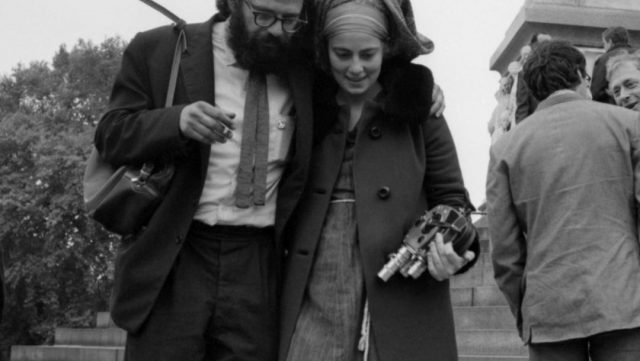
Penny Lane will be at MoMI on April 6 at 4:30 to screen and talk about her debut documentary, the all-archival Our Nixon, which offers a compelling new inside look at the Nixon White House. The classic cautionary tale about power, corruption, and paranoia, which ultimately brought down the thirty-seventh president of the United States, has been told many times before, on film (All the President’s Men, Oliver Stone’s Nixon), in books (Woodward and Bernstein’s The Final Days, RN: The Memoirs of Richard Nixon), onstage (Frost/Nixon, Checkers), and even as an opera (John Adams’s Nixon in China). When Nixon moved into the White House in January 1969, he brought along three key figures: Chief of Staff H. R. Haldeman, Chief Domestic Adviser John Erlichman, and Deputy Assistant Dwight Chapin. And those three men brought along Super 8 cameras, prepared to document not only their daily lives but also how they were going to change the nation. During its investigation of the Watergate scandal, the FBI confiscated more than five hundred reels of footage, totaling more than twenty-six hours, taken by Haldeman, Erlichman, and Chapin, and these home movies, which belong to the Nixon Library and have been digitized specifically for the film, form the basis of Our Nixon. Director-producer Lane combines this deeply personal footage — showing alternate views of the 1969 inauguration, a White House Easter egg hunt, the moon landing, Trisha Nixon’s wedding, Nixon’s trip to China, the Republican National Convention, and other, more mundane events — with carefully chosen audio excerpts from the White House tapes, creating a unique audiovisual experience.
H. R. Haldeman takes home movies at the Great Wall of China in 1974 (Super 8 film still, Dipper Films)
Lane foregoes any political and historical experts in favor of having the protagonists do all the talking, through radio and television interviews (with Mike Wallace, Barbara Walters, and Phil Donahue), oral histories, and the secret White House recordings. In addition, there are supplemental news reports from Walter Cronkite, Dan Rather, Daniel Schorr, and others. As interesting as it is to see the home movies, the audiotapes are mesmerizing, revealing some of the behind-the-scenes manipulations that were often not nearly as planned as most people assume. It is actually both frightening and sad to hear Nixon talking to Haldeman about a just-completed short television address he gave to the nation, the president concerned about how he came off and upset that only one colleague called to congratulate him. And just wait till you hear what they have to say about Secretary of State Henry Kissinger. Although Our Nixon offers no excuses or apologies for the actions of the Nixon White House, it does humanize, instead of demonize, these central figures, who might not have been quite as overtly evil as many people would like to believe. Of course, that doesn’t mean they come across as a group of cuddly teddy bears either.
The bizarre story of John Romulus Brinkley is recounted in unique ways in “Nuts!”
Penny Lane will also be at MoMI for her wonderfully titled, inventively told “Nuts!,” which tells the wacky true tale of Dr. John R. Brinkley, a pivotal twentieth-century figure who was part P. T. Barnum, part Donald Trump, a controversial doctor or a quack, a radio pioneer or a snake-oil charlatan, depending on one’s opinion. He became rich and famous by surgically implanting goat glands into men’s testicles, claiming it increased virility, but his story is about much more than that. “This is a film about John Romulus Brinkley, a doctor, amongst other things, a man who succeeded against terrible odds and powerful opposition, a man who changed the world,” narrator Gene Tognacci explains early on. Lane, who previously profiled another intriguing individual in her debut feature-length documentary, 2013’s Our Nixon, this time follows the often outrageous exploits of Brinkley, using text from Clement Wood’s 1934 book, The Life of a Man: A Biography of John R. Brinkley, home movies and photographs, newspaper and magazine articles, and actual radio broadcasts. She also has seven different animators re-create scenes from Brinkley’s life and career, and each artist or team (Drew Christie & Dane Herforth, Julia Veldman C, Michael Pisano, Krystal Downs, Ace & Son Moving Picture Co., Rose Stark, and Hazel Lee Santino & Downs) employs a unique style while maintaining the film’s overall potent sense of humor. Producer-director Lane, who cleverly edited the film with writer Thom Stylinski, initially casts Brinkley as a sympathetic character just trying to get his own piece of the American dream for him and his family in the tiny town of Milford, Kansas, but as Dr. Morris Fishbein, editor of the Journal of the American Medical Association, gets ever closer in his obsessive quest to discredit Brinkley, everything the goat-gland doctor has built threatens to unravel. But Lane’s genius is yet to come, as she begins to unravel our assumptions and the very process of biography and history itself as the film proceeds to its inevitable conclusion.
It’s hard to believe that “Nuts!” is true, but that’s all part of the fun. Lane just lays it out there for us to see, and you’ll be rooting for Brinkley as he grows his empire, just as you’ll be booing Fishbein for desperately trying to bring him down. Brinkley was a kind of mad genius, understanding how to get ahead in business by giving the people what they want via early infomercials, realizing the vast power of radio, and flouting the rules whenever he could — and then attempting to change them. Lane limits the talking heads to very occasional comments from historian and former Kansas councilman James Reardon, social and cultural historian Dr. Megan Seaholm, Border Radio: Quacks, Yodelers, Pitchmen, Psychics, and Other Amazing Broadcasters of the American Airwaves coauthor Gene Fowler, and Charlatan: America’s Most Dangerous Huckster, the Man Who Pursued Him, and the Age of Flimflam author Pope Brock. “Nuts!” is all the more comic for its reality, and Lane has succeeded wildly in transferring that notion to the way she has made the film, literally revealing the hands of the artist as the pages of Wood’s sycophantic book are turned; by the end, viewers will be questioning the documentary form itself just as they’re questioning Brinkley’s validity. In fact, Lane is readying a public online database “for audiences to consider the epistemological and ethical issues at the heart of the nonfiction storytelling process.” “Nuts!” will be preceded by Lane’s 2004 Kitsch Is a Beautiful Lie and 2011 Just Add Water: The Story of the Amazing Live Sea Monkeys.
BAM Howard Gilman Opera House
Peter Jay Sharp Building
230 Lafayette Ave.
April 4-6, $28-$140, 7:30
718-636-4100 www.bam.org www.transparant.be
You can always expect something unexpected from Belgian director Ivo van Hove, and such is the case with his latest production at BAM, Diary of One Who Disappeared. The Tony and Olivier Award winner has staged the Arthur Miller double play of A View from the Bridge and The Crucible on Broadway, a three-and-a-half-hour rotating version of Ingmar Bergman’s Scenes from a Marriage at New York Theatre Workshop, and the massive four-plus-hour Kings of War at BAM, among other shows that can blow your mind. This week he’s back at BAM with the US premiere of Flemish opera company Muziektheater Transparant’s Diary of One Who Disappeared, a sixty-five-minute adaptation of Leoš Janáček’s song cycle, inspired by the sixty-three-year-old Czech composer’s relationship with twenty-six-year-old Kamila Stösslová. “I don’t have words to express my longing for you, to be close to you,” Janáček wrote to Stösslová. “I know that my compositions will be more passionate, more ravishing: you’ll sit on every little note in them. I’ll caress them; every little note will be your dark eye.” The work features actor Wim van der Grijn, tenor Andrew Dickinson, mezzo soprano Marie Hamard, pianist Lada Valešová, and a choir trio of Raphaële Green, Annelies Van Gramberen, and Naomi Beeldens. The set and lighting is by Jan Versweyveld, with costumes by An D’Huys and four new musical fragments by Annelies Van Parys.
Mayor Don Luigi Magalone (Paolo Bonacelli) introduces political prisoner Carlo Levi (Gian Maria Volontè) to his remote Italian village in Christ Stopped at Eboli
CHRIST STOPPED AT EBOLI (CRISTO SI È FERMATO A EBOLI) (Francesco Rosi, 1979)
Film Forum
209 West Houston St.
April 3-18
212-727-8110 filmforum.org www.rialtopictures.com
Film Forum repertory programming director and Rialto Pictures founder and copresident Bruce Goldstein has spent some 30 years attempting to get the rights to restore and release the 220-minute television version of Francesco Rosi’s 1979 epic, Christ Stopped at Eboli. Now that he has succeeded in his personal quest for that holy grail, it’s easy to see why: The four-part foray into Fascism, faith, and forgotten peasants is a magnificent masterpiece. In 1935, Italian writer, painter, intellectualist, and anti-Fascist leader Carlo Levi (Gian Maria Volontè) was exiled to the remote mountain village of Lucania (now known as Basilicata) in the instep of Italy’s boot, where the small community lived much like its ancestors did. Levi recounted his experience there in his 1945 nonfiction novel, which Rosi adapted into a 150-minute theatrical film and the longer, more in-depth television version; the latter has its long-awaited US theatrical premiere April 3 at Film Forum in a glorious 4K restoration featuring a new translation by Michael F. Moore (who will introduce the 7:00 screening on Wednesday night).
“Christ stopped at Eboli. Where the road and the train abandon the coast and the sea, and venture into the wastelands of Lucania,” Levi says in early voiceover narration. “Christ never came here. Nor did time, the individual soul, or hope, nor did cause and effect, reason or history. No one has set foot on this land, except as a conqueror, an enemy, or an uncomprehending visitor. Today the seasons rush past over the toil of peasants, as they did three thousand years before Christ. In this dark land, without sin or redemption, where evil is not moral, but an earthly sorrow, in all things for eternity. Christ never descended. Christ stopped at Eboli.” It’s not that Jesus stopped in Eboli; he stopped at the edge of the town, without going into this godforsaken place.
Priest Don Traiella (François Simon) shows Carlo Levi (Gian Maria Volontè) the ruins of his church in Christ Stopped at Eboli
The film opens beautifully, with a shot of one of Levi’s paintings, of a child peering over its left shoulder, mouth turned in sadness, mountains in the background, as Piero Piccioni’s lush, aching score plays underneath. (The image is on the cover of Levi’s book Le parole sono pietre, which means “Words are stones.”) Rosi cuts to Levi’s face; with his heavily gray beard and mustache and thick, wavy hair, he resembles a biblical figure. His eyes search off camera, then he shifts his head to gaze at the painting; Rosi zooms in on the child’s forlorn face, and Levi remembers. “Many years have gone by,” he says, sitting in his studio as Rosi focuses on other paintings of distraught men, women, and children. “Years of war . . . and what we call history. Tossed about by fate, I could not keep the promise I made, when I said goodbye to my peasants, that I would return. And I do not know if or when I can keep it. But closed in a room, in a closed world, I indulge in remembering that other world. Imprisoned in its pain and customs, forgotten by history, by the State, eternally patient. That land of mine, without comfort or kindness, where the peasant lives in misery and isolation, in his motionless civilization, on arid soil, in the presence of death.” It’s an elegiac moment of a man measuring regret as the narrative travels back to 1935.
Levi is a gentle soul who has accepted his temporary fate, exiled from his native Turin to the middle of nowhere in southern Italy. He is staying in a dank room with a family who occasionally gives the second bed to an old friend or a local drunk. He speaks very little, instead taking it all in with his penetrating, thoughtful eyes. He can’t fraternize with the other political prisoners in the village (its real name is Aliano; Levi calls it Gagliano), but he does have conversations with the mayor, Don Luigi Magalone (Paolo Bonacelli), a loyal Fascist who censors Levi’s letters; the priest, Don Traiella (François Simon), an alcoholic with a meager flock; and a clarinetist tax collector (played by a street cleaner from Matera) who fills Levi in on the dire situation of the peasants, who have been ignored by Rome. He goes on long walks with his new dog, Barone, who adopted Levi at the Eboli train station, but he is not allowed to go past the local cemetery.
After his sister, Luisa (Lea Massari), pays him a visit, he gets better living quarters and starts painting again; he particularly wants to do a portrait of his housekeeper, Giulia Venere (Irene Papas), the only woman who is permitted to take care of his home because her virtue is already gone, as she has been pregnant seventeen times from numerous men. He takes a liking to Giulia’s young son Carmelino (Carmelo Lauria), who is curious about Levi. Meanwhile, when the townspeople find out that Levi is a doctor, they demand he treat them even though he tells them that despite his degree he has never practiced medicine. He looks around at the misery that is everywhere — gorgeously photographed by Pasqualino De Santis, using a muted, earthy palette that emphasizes the grayness that hovers over everyone as the camera focuses on a crumbling church, a small protest, the vast, desolate emptiness of the rocky landscape surrounding the village, complemented by Piccioni’s sweeping, melodramatic soundtrack — and tries to get by as basically as he can, without complaint or argument save for the occasional sly aside.
Giulia Venere (Irene Papas) is the only woman allowed to work for Carlo Levi (Gian Maria Volontè) in Francesco Rosi masterpiece
Volontè (A Fistful of Dollars, A Bullet for the General), who also appeared in Rosi’s Many Wars Ago, The Mattei Affair, Chronicle of a Death Foretold, and Lucky Luciano (which is screening at Film Forum on April 14), is impeccable as Levi, who carries himself with grace and dignity, participating in life with the peasants and holding his tongue as news reports announce Il Duce’s invasion of Abyssinia, although he sometimes can’t help but mildly scoff at many of the villagers’ uniquely strange rituals and beliefs. He recognizes his elitism but refuses to flaunt it. While Rosi (Salvatore Giuliano, Three Brothers) includes elements of neo-Realism, Christ Stopped at Eboli is a contemporary fable with surreal touches, with a cast of professional and nonprofessional actors who successfully form a cinematic community, encouraged to improvise to heighten reality. It’s a tenderly told tale of southern Italy — Rosi was born in Naples — and a town that has turned its back on a country that has turned its back on it. The film is imbued with a magical mysticism that is intoxicating; it’s clear why Goldstein spent decades trying to bring it back to life, and now it’s a gift for us all.