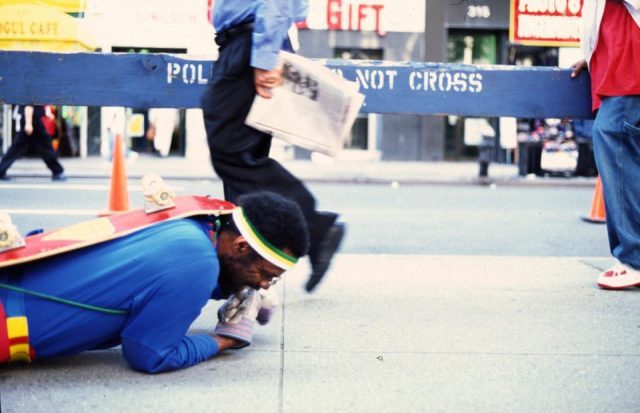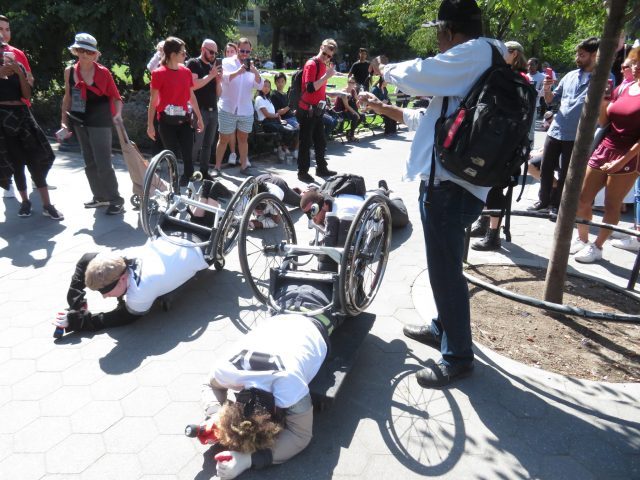
Drew Jacoby and Maria Kochetkova get groovy at the Joyce in Rachel, Nevada (photo by Rachel Neville Photography)
The Joyce Theater
175 Eighth Ave. at 19th St.
July 16-21, $56-$96
212-242-0800 www.joyce.org
Thirty-five-year-old Moscow-born ballerina Maria Kochetkova gives audiences an intimate look into her future with her first solo project, Catch Her If You Can, continuing at the Joyce through July 21. After eleven years as a principal with San Francisco Ballet, the last two overlapping as a principal here in New York City with ABT, Kochetkova has worked with the Joyce Foundation on an evening of seven short pieces and one longer one by seven contemporary choreographers created specifically for the Moscow-born ballerina and several of her friends and colleagues. The program displays a talented woman bridging the gap between the classicism of ballet and the unpredictability of modern dance, and while some pieces are more exciting than others, it makes for a splendid introduction to what is next for Kochetkova.
Maria Kochetkova performs in David Dawson’s At the End of the Day in independent debut (photo by Rachel Neville Photography)
The evening begins with William Forsythe’s Bach Duet (from New Suite), in which Kochetkova pairs with Sebastian Klorborg in a romantic pas de deux that is more balletic in nature, focusing on exquisite use of the upper body and arms in particular. Following Carlo Di Lanno’s bold solo in Myles Thatcher’s Painting Greys, with music by Emmit Fenn, Drew Jacoby wows with her muscular solo in Marco Goecke’s Tué, set to music by Barbara; Jacoby’s back muscles ripple in a dance all their own. Kochetkova next takes center stage, showcasing innovative footwork and astonishing flexibility on the floor to Oleg Malov’s version of Alexander Knaifel’s “O Heavenly King” in Marcos Morau’s Degunino. In David Dawson’s White Swan Pas de Deux (from Swan Lake), Di Lanno and Sofiane Sylve, two statuesque, athletic presences, perform breathtaking lifts and carries to Tchaikovsky’s familiar sounds.
The first act concludes with Jacoby and Kochetkova having a blast with the world premiere of Jacoby’s Rachel, Nevada. Their substantial size difference is put to good effect in front of a screen showing mostly black-and-white optical illusions designed by TOYKYO, with music by Sam Spiegel and opaque costumes by Anja Mlakar. Following intermission, Kochetkova and Kloborg offer up Dawson’s romantic duet At the End of the Day, set to Szymon Brzóska’s “Migrations,” but it’s the grand finale, the world premiere of Jérôme Bel’s Masha Machine — Kochetkova is affectionately known as Masha — that lays bare Kochetkova’s style, devotion to dance, and perhaps surprising sense of humor in a comic and revealing media-rich duet.
German director Tilman Singer’s feature film debut, Luz, is a mesmerizingly dark and moody psychothriller, a thickly atmospheric seventy-minute foray into the unknown. Made on an extremely low budget as his thesis project at the Academy of Media Arts Cologne, the film is about — well, I’m not sure I really know what it’s about, but I also cannot stop thinking about it. The film, which takes place in the late 1980s/early 1990s, opens with a long shot of an office reception area and hallway. A man is working behind the desk when a young woman in a baseball cap walks in agonizingly slowly, buys a soda from a vending machine, and says to the man, “Is this how you wanna live your life? Is this seriously what you want?”
The next scene is set in a gloomy bar where Dr. Rossini (Jan Bluthardt), a psychologist who is being repeatedly paged, and a mysterious woman, Nora Vanderkurt (Julia Riedler), are the only ones drinking. She approaches him, takes a sniff of what appears to be coke, mixes some strange cocktails, and tells him about her girlfriend, who has jumped out of her taxi. He eventually answers his pager; two cops, Bertillon (Nadja Stübiger) and Olarte (Johannes Benecke), have called him in to help interrogate a young woman in a baseball cap who has had an accident in her cab. Her name is Luz (Luana Velis), and she is prone to scream out a unique and profane version of the Lord’s Prayer at any moment. After a few more bizarre moments, Dr. Rossini joins the cops in one of the strangest interrogations you’ll ever see, a brilliantly staged spectacle involving hypnosis, suggestion, and a genius use of sound and image as Luz relates exactly what happened to her, going back to a bizarre ritual held at her Catholic school when she was a girl. (Olarte’s reactions are particularly memorable.) “What you see is distorted,” Luz says at one point, and indeed, everything we see is distorted, and convoluted, and twisted, but all in a captivating way as Singer channels David Cronenberg, David Lynch, John Carpenter, Dario Argento, and Lucio Fulgi, creating a wholly unpredictable work of gleeful madness that immerses you in a hypnotic, demonic labyrinth.
Luz was originally meant to be a thirty-minute short centered around the interrogation, which was filmed first, but writer-director-producer Singer kept expanding it, inspired initially by police sketch artists and then by tales of his wife’s experience in a Catholic girls school in Colombia. He admits that he is not one for scripts, but it doesn’t really matter in this case. Shooting on 16mm film completely indoors and often in claustrophobic spaces, cinematographer Paul Faltz employs a stark palette of muted colors with sparse camera movement, while composer Simon Waskow harkens back to 1970s horror with his ever-threatening score. There’s a theatrical quality to the look of the film — the eerie production design, reminiscent of Stranger Things and Assault on Precint 13, is by Dario Méndez Acosta, who is also one of the producers — as well as the acting. In fact, Singer trained as a theater actor, as did most of the cast; the long interrogation scene is set in a room with rows and rows of chairs, as if an empty theater. Luz opens July 19 at IFC Center, Alamo Drafthouse Downtown Brooklyn, and Nitehawk Cinema, where all the seats deserve to be filled.
Burt Lancaster makes a killer film debut in classic 1946 noir from Robert Siodmak
THE KILLERS (Robert Siodmak, 1946)
Film Forum
209 West Houston St.
July 19–25
Series runs July 19 – August 15
212-727-8110 filmforum.org
In 1950, Edmond O’Brien starred as auditor Frank Bigelow in Rudolph Maté’s classic noir D.O.A., a story told in flashback as Bigelow tries to figure out why someone has poisoned him. Four years earlier, O’Brien dealt with another kind of fatalism in Robert Siodmak’s The Killers, playing insurance agent Jim Reardon, who is investigating why a gas station attendant was brutally gunned down in his bed in suburban Brentwood, New Jersey. The film — which kicks off Film Forum’s four-week salute to Manhattan-born Hollywood star Burt Lancaster on July 19 in a new 4K restoration — opens with cold-hearted contract killers Al (Charles McGraw) and Max (William Conrad) arriving in town, looking for the Swede (Lancaster), aka Pete Lund and Ole Andreson. They waltz into Henry’s Diner, giving orders and exchanging mean-spirited dialogue with no fears or worries. When Nick Adams (Phil Brown) warns the Swede that the men are coming to kill him, the former boxer knows there’s nothing he can do about it anymore; he’s tired of running, and he’s ready to meet his end.
It’s a shocking way to begin a movie; up to that point, it’s a faithful version of Ernest Hemingway’s short story, but the rest is the splendid invention of writers Richard Brooks, Anthony Veiller, and John Huston and producer Mark Hellinger. Reardon soon finds himself meeting with a series of gangsters as they relate, through flashbacks, a plot to rob a payroll, perpetrated by a motley crew that includes “Dum Dum” Clarke (Jack Lambert), “Blinky” Franklin (Jeff Corey), the Swede, and mastermind Big Jim Colfax (Albert Dekker), along with Big Jim’s gun moll, femme fatale extraordinaire Kitty Collins (Ava Gardner). Reardon’s boss (Donald MacBride) wants him to forget about it, since it’s essentially about a meager $2,500 insurance claim, but Reardon is determined to find out what happened to a quarter million in cash, with the help of the Swede’s childhood friend, Lt. Sam Lubinsky (Sam Levene).
Ava Gardner turns more than a few heads in The Killers
The Killers is an intense, passionate heist flick, structured like Citizen Kane, starting with a death and then putting everything together via interviews and flashbacks. Lancaster and Gardner are magnetic, he in his screen debut, she in the film that made her a star. Siodmak (The Dark Mirror, The Spiral Staircase) masterfully navigates the noir tropes, from Miklós Rózsa’s jazzy score, which jumps out from the opening credits, and Woody Bredell’s oft-angled black-and-white cinematography that maintains an ominous, shadowy sensibility throughout to deft characterizations and surprising plot twists. As it makes its way through the seven deadly sins, The Killers lives up to its fab billing as a “Raw! Rugged! Ruthless drama of a man who gambled — his luck — his love — his life for the treachery of a girl’s lips.”
Nominated for four Oscars, for Best Director, Best Film Editing (Arthur Hilton), Best Music, and Best Adapted Screenplay, The Killers, which was also made into a 1958 student short by Andrei Tarkovsky and a 1964 crime drama by Don Siegel starring Lee Marvin, Angie Dickinson, John Cassavetes, Norman Fell, and Ronald Reagan, is screening July 19-25 at Film Forum; the Lancaster tribute continues through August 15 with such other Burt classics as Alexander Mackendrick’s Sweet Smell of Success, Fred Zinnemann’s From Here to Eternity, and Louis Malle’s Atlantic City in addition to such lesser-known movies as John Cassavetes’s A Child Is Waiting, Sidney Pollack’s The Scalphunters, and Norman Foster’s Kiss the Blood Off My Hands.
The future’s not so bright, but Clu Gulager and Lee Marvin still have to wear shades in remake of The Killers
THE KILLERS (Don Siegel, 1964)
Film Forum
209 West Houston St.
Saturday, July 20 – Monday, July 22
212-727-8110 filmforum.org
In conjunction with the screening of the 1946 version of The Killers kicking off Film Forum’s four-week Burt Lancaster festival, the downtown institution is also presenting Don Siegel’s 1964 remake July 20-22. Siegel, who at one point was supposed to direct the 1946 original, sets this adaptation of Ernest Hemingway’s 1927 short story in a bright, candy-colored world that is a far cry from the intricate, shadowy darkness of Robert Siodmak’s earlier noir version; in fact, it’s so luminous that hitmen Charlie Strom (Lee Marvin) and Lee (Clu Gulager) are often wearing dark sunglasses (à la Jake and Ellwood Blues), and the film opens with them walking into a home for the blind, passing by two blind boys playing their own version of cops and robbers. The men are there to kill former race-car driver Johnny North (John Cassavetes), who is now a teacher. Despite being warned by an old man (longtime character actor Burt Mustin) that they are coming, Johnny waits for them, choosing not to run. His lack of a survival instinct confounds Charlie, who goes on a search to find out why Johnny didn’t fight for his life but instead essentially welcomed a brutal death.
Ronald Reagan plays a villain for the first time in his last movie, Don Siegel’s 1964 version of The Killers
Johnny’s sordid tale is related to Charlie and Lee in flashback as they meet up with his mechanic and best friend, Earl Sylvester (Claude Akins); Johnny’s lover, femme fatale Sheila Farr (Angie Dickinson); Farr’s other lover, crime boss Jack Browning (Ronald Reagan); and Jack’s flunky, Mickey Farmer (Norman Fell), as they tell a story of racing, double crosses, and a million-dollar heist. Written by Gene L. Coon and initially intended as a television movie but deemed too violent in the wake of the assassination of JFK and released theatrically, The Killers features plenty of cheesy scenes and none-too-subtle melodrama, but it’s still loads of fun, with a campy sense of humor lurking behind all the blood and guts, with a Rat Packy feel. Reagan is fun to watch in his final movie role before turning to politics — and his first time playing a villain — while the glamorous Dickinson shows off some fine hairdos and couture. Siegel, who had previously directed Invasion of the Body Snatchers and would go on to make Dirty Harry, Madigan, and Escape from Alcatraz, never veers off track as he relies on the great Lee Marvin, in the midst of a terrific run that included The Man Who Shot Liberty Valance, Cat Ballou, The Dirty Dozen, and Point Blank, to drive the action. It might not be very Hemingway-esque, but who cares?
Raquel Cion will celebrate her birthday at Pangea on July 19 with the songs of David Bowie (photo by Karl Giant)
Who:Raquel Cion, Jeremy Bass, Rembert Block, David Cale, Amanda Duarte, Amy Priya Santos, Genevieve Chapin, Michael Ryan Morales, Karl Saint Lucy, DM Salsberg, Zac Selissen What: Benefit for NARAL Pro-Choice America Where:Pangea, 178 2nd Ave., 212-995-0900 When: Friday, July 19, $15-$35 in advance, $20-$40 at the door, 8:00 Why: Since early 2015, glittering chanteuse Raquel Cion has presented her inspiring, ever-evolving show Me & Mr. Jones: My Intimate Relationship with David Bowie, a deeply personal look of the impact the Thin White Duke has had on her life and career. On July 19, Cion will be celebrating her half-century birthday at Pangea, paying homage to Bowie’s fiftieth-birthday concert at Madison Square Garden, performing songs by Mr. Jones with special guests Jeremy Bass, Rembert Block, David Cale, Amanda Duarte, Amy Priya Santos and a backing band consisting of Zac Selissen on guitar, musical director Karl Saint Lucy on keyboards, Genevieve Chapin on bass, Michael Ryan Morales on drums, and DM Salsberg on vocals. Tickets for “Raquel Cion & Friends: A Very Special Birthday Concert” are $35 in advance ($40 at the door) for VIP cabaret seating and hors d’oeuvres and $15 in advance ($20 at the door) for the bar area live feed, with proceeds benefiting NARAL Pro-Choice America. Everyone will partake of what should be a spectacular birthday cake by rogue pastry chef Miranti Dame Cuchi, but not as fabulous as Ms. Cion herself, who will be all dolled up in couture by David Quinn and makeup by Coco Bennett.
Rubin Museum of Art
West 17th St. between Sixth & Seventh Aves.
Sunday, July 21, free (including free museum admission all day), 1:00 – 4:00 rubinmuseum.org
The Rubin Museum’s yearlong exploration of “Power: Within and Between Us” is at the center of its sixth annual block party, taking place July 21. From 1:00 to 4:00, there will be live performances by Building Beats, Fogo Azul Brazilian Women’s Drumline, and Power Painting Jam, food from Van Leeuwen Ice Cream, People’s Pops, Yanni’s Coffee, Cafe Serai, Sweetface Snoballs, and the Commons Chelsea, and activities led by Grassroots Movement in Nepal, Siddhartha School, Tibetan Community of NY/NJ, YindaYin Coaching, Nepal Hip Hop Foundation, and others. “Power begins within us and flows between us. How can we tap into this potential?” the museum asks. The block party also features the art workshops Power Down (in which you can create their own stress balls), Power On (make a portable lamp), and Power Objects (inspired by the Tibetan Namkha). In addition, you can participate in Flower Power (a collaborative floral feast), Power Couple (tracing hands), Power Nap (a guided meditation), Power Poles (scientific experiments with magnets and metallic sand), Power Trip (learn about Himalayan constellations), Net Walk (study movement in unison with artist Milcah Bassel), Playgami (an AR experience with origami artist Uttam Grandhi), and Power Forward (create wind-powered messages with artist Kyung-Jin Kim). As an extra bonus, there will be free admission to the museum all day (11:00 am – 6:00 pm), so you can check out the exhibits “Charged with Buddha’s Blessings: Relics from an Ancient Stupa,” “Masterworks of Himalayan Art,” “The Power of Intention,” “Reinventing the (Prayer) Wheel,” “The Wheel of Intentions,” “Shrine Room Projects: Wishes and Offerings,” and “The Tibetan Buddhist Shrine Room.”
Who: Nearly four hundred restaurants throughout the city What:Summer Restaurant Week Where: All five boroughs When: July 22 – August 16, two-course lunches $26, three-course dinners $42 Why: For more than a quarter of a century, New York City eateries have been offering special deals during Restaurant Week, with a growing number of participants every year. Reservation lines are now open for the immensely popular program, with almost four hundred establishments from across the culinary spectrum offering two-course prix-fixe lunches for $26 and dinners for $42 from July 22 through August 16. (Some restaurants do only lunch or dinner, and others offer the deals only on weekdays.) Most of the prix-fixe menus are available online so you know just what you’re in for. Among the many restaurants are such favorites as ‘21 Club,’ ABC Kitchen, American Cut, Bann, Barbetta, Becco, Burger & Lobster, Casa Lever, Catch NYC, Charlie Palmer Steak, Cipriani, Darbar, DB Bistro Moderne, Delmonico’s, Docks Oyster Bar, Dos Caminos, Estiatorio Milos, Feast, Fish Cheeks, Frankie & Johnnie’s, Glass House Tavern, HanGawi, Haru, Hearth, Inakaya, Indochine, i Trulli, Il Mulino, Lupa Osteria Romana, Lure Fishbar, Mercer Kitchen, Momofuku Nishi, Monkey Bar, the Morgan Dining Room, Nice Matin, Orsay, the Palm Court, Park Avenue Summer, Periyali, Public Kitchen, Quality Eats, Red Rooster, Riverpark, Rosa Mexicano, Rôtisserie Georgette, the Russian Tea Room, Scarpetta, Shun Lee Palace, STK, the Strip House, Tao, Tribeca Grill, the Tuck Room, Untitled, and the Wright.
Shu Qi is an expertly trained killer with a conscience in Hou Hsiao-hsien’s gorgeous period drama The Assassin
THE ASSASSIN (刺客聶隱娘) (NIE YINNIANG) (Hou Hsiao-hsien, 2015)
Film Society of Lincoln Center
West 65th St. between Broadway & Amsterdam Aves.
Thursday, July 18, free, 6:00 & 8:00
Festival runs Thursdays (and one Wednesday) through September 11
212-875-5050 www.filmlinc.org wellgousa.com
On summer Wednesdays at 6:00, the Film Society of Lincoln Center is hosting “50th Mixtape: Free Double Features,” celebrating the institution’s golden anniversary by pairing older favorites with newer ones. The series kicked off June 27 with Agnés Varda’s Cleo from 5 to 7 and Jane Campion’s The Portrait of a Lady and concludes on Wednesday, September 11, with an audience choice. On Thursday, July 18, King Hu’s 1966 Hong Kong wuxia classic from the Shaw Brothers, Come Drink with Me, starring Cheng Pei-pei as Golden Swallow, Yueh Hua as Drunken Knight, Chan Hung-lit as Jade Faced Tiger, and Lee Wan-chung as Smiling Tiger, will open things up, followed by Taiwanese master Hou Hsiao-hsien’s 2015 The Assassin. Hou’s first film in eight years is a visually sumptuous feast, perhaps the most beautifully poetic wuxia film ever made. Inspired by a chuanqi story by Pei Xing, The Assassin is set during the ninth-century Tang dynasty, on the brink of war between Weibo and the Royal Court. Exiled from her home since she was ten, Nie Yinniang (Hou muse Shu Qi) has returned thirteen years later, now an expert assassin, trained by the nun (Fang-Yi Sheu) who raised her to be a cold-blooded killer out for revenge.
After being unable to execute a hit out of sympathy for her target’s child, Yinniang is ordered to kill Tian Ji’an (Chang Chen), her cousin and the man to whom she was betrothed as a young girl, as a lesson to teach her not to let personal passions rule her. But don’t worry about the plot, which is far from clear and at times impossible to follow. Instead, glory in Hou’s virtuosity as a filmmaker; he was named Best Director at Cannes for The Assassin, a meditative journey through a fantastical medieval world. Hou and cinematographer Mark Lee Ping-Bing craft each frame like it’s a classical Chinese painting, a work of art unto itself. The camera moves slowly, if at all, as the story plays out in long shots, in both time and space, with very few close-ups and no quick cuts, even during the martial arts fights in which Yinniang displays her awesome skills. Hou often lingers on her face, which shows no outward emotion, although her soul is in turmoil. Hou evokes Andrei Tarkovsky, Akira Kurosawa, Ang Lee, and Zhang Yimou as he takes the viewer from spectacular mountains and river valleys to lush interiors (the stunning sets and gorgeous costumes, bathed in red, black, and gold, are by Hwarng Wern-ying), with silk curtains, bamboo and birch trees, columns, and other elements often in the foreground, along with mist, fog, and smoke, occasionally obscuring the proceedings, lending a surreal quality to Hou’s innate realism.
There are long passages of silence or with only quiet, barely audible music by composer Lim Giong, with very little dialogue, as rituals are performed, baths are prepared, and a bit of black magic takes place. The opening scenes, set around a breathtaking mountain abbey in Inner Mongolia, are shot in black-and-white with no soundtrack, like a silent film, harkening to cinema’s past as well as Yinniang’s; when it switches over to color, fiery reds take over as the credits begin. Throughout the film, the nun wears white and the assassin wears black, in stark contrast to the others’ exquisitely colorful attire; however, the film is not about good and evil but something in between. Shu and Cheng, who played a trio of lovers in Hou’s Three Times, seem to be barely acting in The Assassin, immersing themselves in their characters; Hou (The Puppetmaster,Flowers of Shanghai) gives all of his cast, professional and nonprofessional alike, a tremendous amount of freedom, and it results here in scenes that feel real despite our knowing better.
Sure, a touch more plot explication would have been nice, but that was not what Hou was after; he wanted to create a mood, an atmosphere, to transport the actors and the audience to another time and place, and he has done that marvelously. The Assassin is a treasure chest of memorable moments that rewards multiple viewings. I’ve seen it twice and can’t wait to see it again — and I’ve given up trying to figure out exactly what it’s about, instead reveling in its immense, contemplative beauty. Hou’s previous full-length film was 2007’s Flight of the Red Balloon; here’s hoping it’s not another eight years till his next one. “50th Mixtape: Free Double Features” continues with such other double headers as Luchino Visconti’s 1963 The Leopard and Alice Rohrwacher’s 2018 Happy as Lazzaro on July 25, Bertrand Bonello’s 2016 Nocturama and Lee Chang-dong’s 2018 Burning on August 15, and Hou’s 2005 Three Times and Barry Jenkins’s Oscar-winning 2016 Moonlight on September 5. Admission is free, first-come, first-served.