twi-ny recommended events

ROOFTOP FILMS / MoMA POPRALLY x STATEN ISLAND: SPLASH

poprally

Snug Harbor Cultural Center
1000 Richmond Terrace, Staten Island
Saturday, July 27, $10 (free for children sixteen and under), 7:00
www.rooftopfilms.com
snug-harbor.org
www.moma.org

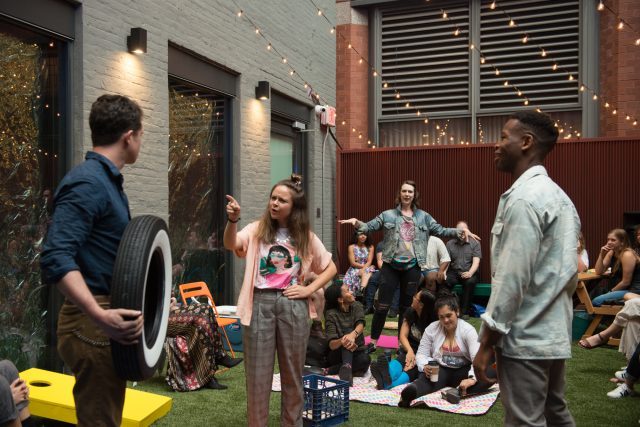
With MoMA’s main digs in Midtown under renovation, the second summer PopRally is going across the river to Staten Island on July 27. Partnering with Rooftop Films, MoMA is holding the festivities at one of the city’s genuine treasures, Snug Harbor Cultural Center & Botanical Garden, for food, drink, music, film, and more. The main event is a 9:00 screening of Ron Howard’s classic 1984 comedy, Splash, starring Tom Hanks as Allen Bauer, a single guy who falls in love with a mermaid (Daryl Hannah) who is being tracked by a scientist (Eugene Levy); John Candy is Hanks’s crazy brother. The evening will also include giveaways, trivia contests, music from DJ Tom of Maker Park Radio and the Gotham Easy Brass Band, beverages from Five Boroughs Brewing Co., and food from Staten Island vendors Ho’ Brah Tacos and Egger’s Ice Cream Parlor. Free shuttle bus service will be provided between Snug Harbor and the Staten Island Ferry terminal before and after the screening. Attendees are encouraged but not required to show up in aquatic costumes; you can bring a blanket (limited chairs will be available) that you can spread out on the South Meadow. Go early and check out the lovely Snug Harbor itself; admission is only five dollars and it’s open till five. PopRally will be traveling to the Bronx next.

ANN TOEBBE: FRIENDS AND RENTALS

Ann Toebbe Friend: Jana, 2018 gouache, paper collage and pencil on panel

Ann Toebbe, Friend: Jana, gouache, paper collage and pencil on panel, 2018

Tibor de Nagy
11 Rivington St.
Tuesday – Saturday through July 27, 10:00 am – 6:00 pm
212-262-5050
www.tibordenagy.com

At first glance, you might think that Ann Toebbe’s “Friends and Rentals” exhibit at Tibor de Nagy on the Lower East Side consists of flat architectural renderings of real home layouts. But up close you’ll see they’re delightfully detailed three-dimensional collages of the interiors of houses, it turns out, owned by Toebbe’s friends and members of her extended family in Ohio and Kentucky. The Cincinnati-born, Chicago-based artist creates the works based on social media postings and actual visits to these houses, but she uses only her memory, not photographs or on-site sketches. Toebbe incorporates flocking, cut paper, yarn, glitter, pencil, gouache, and other materials on panels in constructing these birds’-eye views that serve as unique biographical portraits even though most of them contain no people in them. The rooms are divided to resemble how a brain is compartmentalized into different thought processes and, in these crazy days, how so many of us must multitask, but the works have a calming effect, not a frantic pace. Friend: Jana features a muted brown palette, while Friends: Lisa and Tim is much more colorful, and the only one seen from a horizontal perspective of the standing house. Not surprisingly, LA Air BnB is more standard and folksy than Friend: Becky, which includes children’s toys and a flatscreen TV showing a football game.

Ann Toebbe Friend: Susan, 2019 gouache, paper collage, flocking and pencil on panel

Ann Toebbe, Friend: Susan, gouache, paper collage, flocking and pencil on panel, 2019

You’ll find family photos, religious icons, the American flag, carpets, knickknacks, backyards, Christmas decorations, pets, plants, clocks, birthday presents, and a few lurking human figures, all helping describe people that we are likely never to meet but now somehow know. In the catalog essay “Ann Toebbe Wants to Organize Your Life,” Ryan Steadman writes that Toebbe “empathically [relates] to her subjects’ desire to reinvent themselves in their living spaces by making paintings that are themselves appealing coping strategies. . . . with a fortitude that usually belongs to a librarian or a paleontologist.” Each work is not to scale and is not architecturally sound, as Toebbe, who counts Venezuelan artist Arturo Herrera as her mentor, puts a little fantasy into each life. As you walk around the gallery, you’ll wonder what your home might look like if Toebbe re-created it on panel, but you’ll only be able to imagine it, or perhaps go home and reorganize your own clutter.

41 STRINGS

(photo by Jason Williamson)

Nick Zinner will lead a large, handpicked ensemble to perform “41 Strings” at Rockefeller Center on July 27 (photo by Jason Williamson)

Who: Nick Zinner and an all-star group of musicians
What: “41 Strings”
Where: Rockefeller Center plaza, between 49th & 50th Sts. and Fifth & Sixth Aves.
When: Saturday, July 27, free, 6:00
Why: On July 27, Yeah Yeah Yeahs guitarist Nick Zinner will perform his symphonic composition “41 Strings” in Rockefeller Plaza. A celebration of the four seasons, the four-part, twenty-eight-minute work, cowritten with creative producer Berrin Noorata, debuted in 2011 for the forty-first anniversary of Earth Day. At Rockefeller Center, Zinner, an adventurous musician and photographer who has collaborated on several artistic projects, will be joined by guitarists Paul Banks of Interpol, Lenny Kaye of the Patti Smith Band, Sarah Lipstate of Noveller, Aku Orraca-Tetteh of Florence and the Machine, Ava Mendoza of Unnatural Ways, Angel Deradoorian, and Andrew Wyatt, in addition to synth players Nancy Whang of LCD Soundsystem and Ben Vida of Soft Circle, drummers Brian Chase of Yeah Yeah Yeahs, Ryan Sawyer of Gang Gang Dance, and Hisham Bharoocha of Soft Circle and Black Dice, bassists Jaleel Bunton of TV on the Radio and Andy Macleod, and a thirty-five piece string ensemble with arrangements by Gillian Rivers. The free concert will begin at 6:00 with “IIII” by Bharoocha, Chase, Sawyer, Vida, and student drummers. You can get a taste of what’s to come in this Creators Project video from 2011.

“I DO NOT CARE IF WE GO DOWN IN HISTORY AS BARBARIANS”

“I Do Not Care If We Go Down in History as Barbarians”

How the 1941 Odessa massacre has been remembered is the central focus of Radu Jude’s “I Do Not Care If We Go Down in History as Barbarians”

“I DO NOT CARE IF WE GO DOWN IN HISTORY AS BARBARIANS” (ÎMI ESTE INDIFERENT DACĂ ÎN ISTORIE VOM INTRA CA BARBARI) (Radu Jude, 2018)
IFC Center
323 Sixth Ave. at West Third St.
Opens Friday, July 19
212-924-7771
www.ifccenter.com
bigworldpictures.org

Romanian writer-director Radu Jude follows up his 2017 documentary, The Dead Nation, with “I Do Not Care If We Go Down in History as Barbarians,” a bold, provocative fiction film with nonfiction elements that explores continuing anti-Semitism and bigotry in Romania, Eastern Europe, and the world. The title is taken from a statement made by Romanian military dictator Marshal Ion Antonescu to the Council of Ministers in the summer of 1941, just a few months before the Odessa massacre in which tens of thousands of Jews were killed by Romanian troops. The film is set in contemporary times, as theater director Mariana Marin (Ioana Iacob) is preparing for a live, one-time-only massacre reenactment in the town square. Marin is determined to show what really happened during those days, complete with brutal murders and hangings, but Constantin Movilă (theater director Alexandru Dabija), her connection with the local government, insists that she leave out the gruesome parts, that the show should be a celebration of Romanian heroes. She argues that it would not be fair to the nearly four hundred thousand Jews that were ethnically cleansed by the Romanian military, but he quibbles over what’s true and what the community wants to see. As the show approaches, Movilă threatens to cancel it while numerous actors complain about the negative aspects being depicted, displaying affection for “Uncle Hitler” and a lack of empathy for the exterminated Jews.

“I Do Not Care If We Go Down in History as Barbarians” is like a post-Nouvelle Vague film, echoing elements of French cinema from Jean-Luc Godard and Jacques Rivette to Olivier Assayas and Arnaud Desplechin, with debates of texts by Isaac Babel, Ludwig Wittgenstein, Joseph Goebbels, Nicolae Steinhardt, and others. But instead of becoming pedantic, the discussions serve to enlighten the arguments and define such characters as Movilă and, in particular, Marin, who not accidentally shares the same name with a Romanian poet who wrote, “Serene and bitter, I hurry across my native land / As if tomorrow had already been.” The entire film is seen from Marin’s determined point of view, whether she’s reading in bed with her lover, Ștefan (Șerban Pavlu), getting support from her lead actor, Traian (Alex Bogdan), and right-hand assistant, Oltea (Ilinca Manolache), or smoking and drinking in a bubbles-free bath. She’s mad at the state of the world and disgusted that people don’t want to know the truth of their history; she’s like the tank she insists she must have for the production — and like the tank, which has to stand still, Marin refuses to budge, understanding the difference between compromise and censorship.

In her first leading role, Iacob is mesmerizing throughout the film’s 140 minutes, giving a tour-de-force performance that lays it all out there as she portrays a bold and brash woman who won’t back down from her personal and professional desires; she’s so immersed in the part that at times you’ll think you’re watching a documentary, enhanced by cinematographer Marius Panduru’s wandering, unpredictable camera. Jude (Scarred Hearts, Aferim!) tackles such critical issues as governmental whitewashing of history, the public’s selective memory, and the definition of patriotism itself, a debate raging across America under the current administration as well as in other nations. Whether Marin gets to stage the show or not ends up being besides the point as the people around her reveal their biases and hatreds, something a play is not about to change. “I Do Not Care If We Go Down in History as Barbarians” is a necessary film, but it’s also a frightening one.

LIGIA LEWIS: SENSATION 1 / THIS INTERIOR

Ligia Lewis, minor matter, 2016. Photo by Martha Glenn.

Ligia Lewis, whose minor matter is seen above, translates Sensation 1 for the High Line this week (photo by Martha Glenn)

The High Line, Fourteenth Street Passage
July 23-25, free with advance RSVP, 7:30
www.thehighline.org
ligialewis.com

Dancer and choreographer Ligia Lewis presents the next iteration of her Sensation series July 23-25 with Sensation 1 / This Interior, the first to be performed outside, taking place at 7:30 each night at the Fourteenth Street Passage on the High Line. Sensation 1 premiered as an indoor solo in 2011, followed the next year by Sensation 2; both pieces involved very slow movement that viewed the body as a sculptural object. Now the Dominican-born, Berlin-based Lewis, who has recently completed a trilogy consisting of Sorrow Swag (2014), minor matter (2016), and Water Will (in Melody) (2018), revisits Sensation with dancers Trinity Bobo, Emma Cohen, Rebecca Gual, Miguel Ángel Guzmán, Stephanie Peña, and Jumatatu M. Poe and music by Lewis’s brother, George Lewis Jr., aka Twin Shadow, focusing on the last note of a song on multiple bodies as a shared experience. Admission is free with advance RSVP.

(photo by twi-ny/mdr)

Lubaina Himid’s Five Conversations is part of High Line group show “En Plein Air” (photo by twi-ny/mdr)

Be sure to show up early or stay late and take a walk along the High Line to see its current art commissions. The group show “En Plein Air” comprises works by Ei Arakawa, Firelei Báez, Daniel Buren, Sam Falls, Lubaina Himid, Lara Schnitger, Ryan Sullivan, and Vivian Suter that, like Sensation 1 / This Interior, take advantage of the outdoor location. Also be on the lookout for Simone Leigh’s giant Brick House, a sixteen-foot-high bronze figure of a black woman with long cornrow braids and a skirt that doubles as her body and a dwelling; Ruth Ewan’s Silent Agitator, which demands that it’s “time to organize”; Dorothy Iannone’s I Lift My Lamp Beside the Golden Door, depicting three colorful versions of the Statue of Liberty; and Autumn Knight’s Complete Total Pleasure, a new video about anhedonia, power, race, and control.

And on August 6 at 5:00, the High Line will host “In Conversation: On Top of All This,” a free (with advance RSVP) three-hour gathering on the Spur at Thirtieth St. and Tenth Ave., with poetry, fiction, prompts, and predictions from poet and scholar Lucas Crawford, poet, curator, and artist Anaïs Duplan, and dancer, writer, curator, and choreographer Emily Johnson, including prerecorded audio reflections, readings, and a panel discussion.

MOSTLY MOZART: THE MAGIC FLUTE

(photo © Stephanie Berger, courtesy Lincoln Center)

Pamina (Maureen McKay) and Papageno (Rodion Pogossov) are looking for love in Mostly Mozart Festival production of The Magic Flute (photo © Stephanie Berger, courtesy Lincoln Center)

DIE ZAUBERFLÖTE
David H. Koch Theater, Lincoln Center
20 Lincoln Center Plaza
July 17-20, 7:00
Festival continues through August 10
212-496-0600
www.lincolncenter.org
www.davidhkochtheater.com

Komische Oper Berlin teams up with British company 1927 for a candy-colored fantastical version of The Magic Flute, which kicks off Lincoln Center’s Mostly Mozart Festival. Directed by Suzanne Andrade and Barrie Kosky, the nearly three-hour delight features the Mostly Mozart Festival Orchestra, conducted by Louis Langrée, playing in front of a terrific cast and a large white wall on which Paul Barritt projects fanciful hand-drawn animation throughout. The performers, who mostly appear and disappear through several doors at multiple levels of the wall — the set is by Esther Bialas, who also designed the fun costumes — interact directly with the cartoonish images, petting a black cat, sending hearts, blowing smoke rings, and being chased by a fire-breathing serpent. None of librettist Emanuel Schikaneder’s dialogue is spoken; instead, it is projected in dramatic fonts projected on the wall.

(photo © Stephanie Berger, courtesy Lincoln Center).

The Queen of the Night (Audrey Luna) hovers over it all like a giant spider in The Magic Flute (photo © Stephanie Berger, courtesy Lincoln Center)

After being saved in a dark forest by the Queen of the Night (alternately played by Audrey Luna or Aleksandra Olczyk), Tamino (Julien Behr / Aaron Blake) meets Papageno (Rodion Pogossov / Evan Hughes), who initially takes credit for the rescue and so is punished by the Three Ladies (Ashley Milanese, Karolina Gumos, and Ezgi Kutlu), who make him mute by taking away his mouth, which flies across the screen like a chattering teeth toy. The ladies, who serve the queen, show Tamino a picture of the ruler’s daughter, Pamina (Maureen McKay / Vera-Lotte Böcker), to Tamino, who instantly falls in love with her. But Pamina has been captured by the evil Monostatos (Johannes Dunz) for his boss, the intellectual Sarastro (Dimitry Ivashchenko / Wenwei Zhang). For protection, the ladies give Tamino a magic flute (an animated fairy) and Papageno magic bells that emerge from a box as tiny dancers. As Tamino tries to free Pamina through a series of trials (silence, temptation, fire and water), Papageno searches for his own love.

(photo © Stephanie Berger, courtesy Lincoln Center)

Mrs. Scwhatz, Klatsch, and Tratsch (Ashley Milanese, Karolina Gumos, and Ezgi Kutlu) offer a unique kind of help to Tamino (Julien Behr) and Papageno (Rodion Pogossov) in fanciful Mozart adaptation at Lincoln Center (photo © Stephanie Berger, courtesy Lincoln Center)

Combining vaudeville, silent movie tropes, a bawdy sense of humor, anime, and a heartfelt reverence for Mozart’s extraordinary music, this version of The Magic Flute — Wolfgang’s 1791 work, which premiered only a few months before his death at the age of thirty-five, was not made for opera aficionados but for the general public — creates a devilishly delicious, weird and wonderful world that will bring out the kid in you, although it is not necessarily for die Kinder. The staging is endlessly inventive, and the cast has everything timed to the second as they immerse themselves into the animation, which is spectacular, particularly the Queen of the Night, who is a giant eight-legged spider. Tantalizing references abound: The magic flute itself is a Tinker Bell-like naked winged creature, Monostatos evokes F. W. Murnau’s vampire Nosferatu, Sarastro looks like silent-film pioneer Georges Méliès, Papageno is a cross between Buster Keaton and Ed Wynn, and the magic bells and the three spirit boys recall Henry Darger’s drawings. Diego Leetz deserves special mention for his magnificent lighting design, with its many nods to silent cinema, as well as principal Jasmine Choi and Tanya Dusevic Witek on flute. It’s a shame this production, so bursting with life’s energy and romance, treachery and trepidation, is running only four days, as it’s a Magic Flute for the ages.

THE SECRET LIFE OF BEES

(photo by Ahron R. Foster)

The Daughters of Mary worship the Black Madonna in musical version of The Secret Life of Bees (photo by Ahron R. Foster)

Atlantic Theater Company
Linda Gross Theater
336 West 20th St. between Eighth & Ninth Aves.
Tuesday – Sunday through July 21, $106.50-$126.50
866-811-4111
atlantictheater.org

In a readers guide interview for her 2001 novel The Secret Life of Bees, author Sue Monk Kidd explains, “I began my bee education by reading lots of books. There’s a mystique about bees, a kind of spell they weave over you, and I fell completely under it. I read bee lore and legend that went back to ancient times. I discovered bees were considered a symbol of the soul, of death and rebirth. I will never forget coming upon medieval references which associated the Virgin Mary with the queen bee. I’d been thinking of her as the queen bee of my little hive of women in the pink house, thinking that was very original, and they’d already come up with that five hundred years ago!”

The Virgin Mary / queen bee symbolism lies at the heart of the story, which was made into a 2008 film by Gina Prince-Bythewood starring Dakota Fanning, Jennifer Hudson, Queen Latifah, Alicia Keys, and Sophie Okonedo and has now been turned into a skillfully rendered musical continuing at the Atlantic through July 21. It’s the summer of 1964 in South Carolina, and twenty-two-year-old black maid Rosaleen (Tony nominee Saycon Sengbloh) is determined to exercise her brand-new right to vote. Fourteen-year-old white girl Lily (Elizabeth Teeter) insists on accompanying her. Rosaleen has been helping take care of Lily and her father, T-Ray (Chris Stack), ever since the tragic loss of Lily’s mother. Rosaleen gets attacked by two white racists and is arrested. Lily, after another fight with the angry T-Ray, goes on the run with Rosaleen, spurred by a postcard in her mother’s things of a black Madonna statue in Tiburon. “Not a damn thing in this town / I’m gonna miss / Wherever I’m goin’ / It’s gotta be better than this,” Lily and Rosaleen sing.

When they get to Tiburon, they find a pink house where a group of women make Black Madonna Honey and, as the Daughters of Mary, worship a statue of the black virgin; while August Boatwright (Tony winner LaChanze) immediately wants to take Lily and Rosaleen in, June (Obie winner Eisa Davis) is not so sure, and May (Anastacia McCleskey) is somewhere in between, stuck in mourning for July. Lily is soon working with Zachary (Brett Gray), a black teenager, and learning some life lessons, but T-Ray is trying to track her down — and the horrors of racism await around nearly every corner.

(photo by Ahron R. Foster)

LaChanze belts one out as August Boatwright in world premiere musical at the Atlantic (photo by Ahron R. Foster)

Directed by Tony winner Sam Gold (Fun Home, A Doll’s House, Part 2) and featuring music by Tony and Grammy winner Duncan Sheik (Spring Awakening, Alice by Heart) — who was raised in South Carolina — lyrics by two-time Tony nominee and Drama Desk winner Susan Birkenhead (Jelly’s Last Jam, Working), and a book by two-time Pulitzer Prize winner Lynn Nottage (Sweat, Ruined), The Secret Life of Bees is a poignant, hard-hitting tale that feels all too real as voter suppression of people of color is still a major issue in America. The story loses its way near the end as it gets bogged down in religious fervor and treacly melodrama, but the majority of the show is smart and entertaining; especially notable is the creative way the bees flock around Lily. Mimi Lien’s homey set includes a nine-piece band on the periphery of the stage playing a mix of country, folk, blues, pop, and R&B, led by pianist, music director, and conductor Jason Hart and percussionist and associate music director Benjamin Rahuala.

LaChanze (The Color Purple, Summer: The Donna Summer Musical) is absolutely lovely as August, a strong woman asserting her power, while Sengbloh (Eclipsed, In the Blood) is warm and becoming as Rosaleen, and Teeter (The Crucible, The Hard Problem) is impressive as Lily, a tough kid making grown-up decisions. The cast also includes Romelda Teron Benjamin as Queenie, Vita E. Cleveland as Violet, and Jai’Len Christine Li Josey as Sugar Girl, three Daughters of Mary who serve as a kind of Greek chorus, and Nathaniel Stampley as Neil, a principal who has his heart set on marrying the cold and distant June. The musical might be set fifty-five years ago, but it feels all too real given the racial, economic, and political divides that are tearing this country apart, buzzing around us like so many angry hornets, delivering poisonous stings instead of sweet honey.