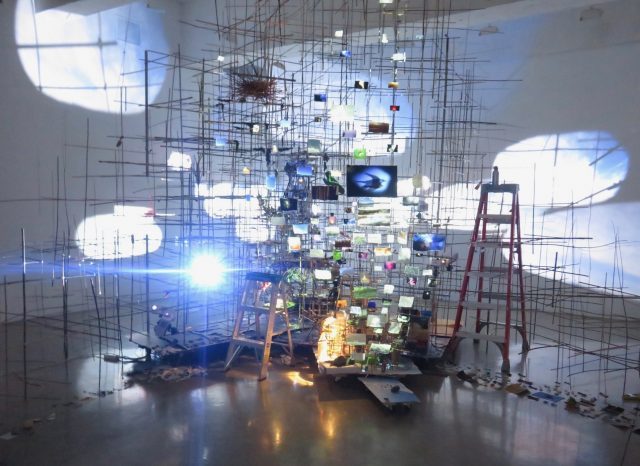
Sarah Sze’s Crescent (Timekeeper) immerses visitors at Tanya Bonakdar (photo by twi-ny/mdr)
Tanya Bonakdar Gallery
521 West 21st St. between Tenth & Eleventh Aves.
Through October 19, free, 10:00 am – 6:00 pm
212-414-4144
www.tanyabonakdargallery.com
www.sarahsze.com
sarah sze slideshow
Sarah Sze has long been creating intricate, fragile ecosystems that feel like a complex construction made of giant toothpicks (and just about anything else she can find) that could come tumbling down with a mere touch. These installations have grown more detailed over time, incorporating high-tech electronic elements while expanding the breadth of its range. Her latest immersive exhibition at Tanya Bonakdar in Chelsea begins outside the gallery and continues in the hallways, large main space, back room, and upstairs, on the walls and the floors and the ceilings. There’s something everywhere, transforming parts of the gallery into her studio, revealing her extraordinary process. Originally a painter who now considers herself a sculptor, the Boston-born, New York-based artist centers the show with Crescent (Timekeeper), an exquisite work consisting of dozens of objects, from ladders, boxes, and rocks to plants, lamps, and bottles. Videos are projected onto torn pieces of paper, including a flying eagle, prowling wolves, the swirling ocean, and a burning fire, enhanced by sound as well, each open in its own internet browser, leaving it up to the viewer to make a narrative.
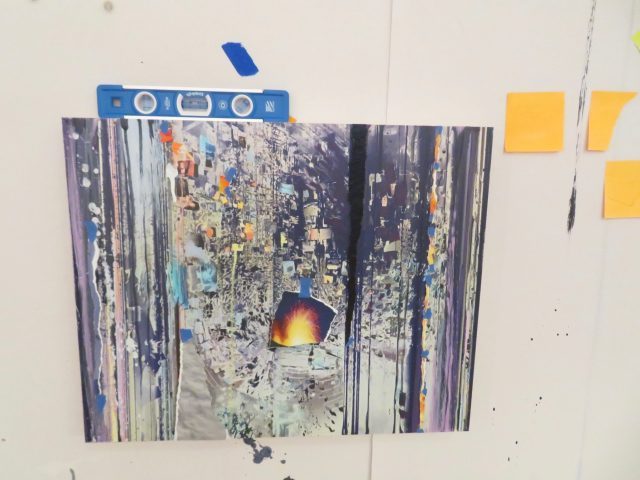
Sarah Sze reveals some of her methodology in Tanya Bonakdar back room (photo by twi-ny/mdr)
There are no barriers to prevent you from getting too close to the delicate piece; there’s a guard situated on the other side of the room, but Sze trusts us to not wreak havoc. She also shows us what she’s doing; the hallway is filled with her notes, some of the materials she uses (tape, paint, push pins, photographs, videos), while behind Crescent (Timekeeper) is a stack of slowly turning projectors, casting light and shadows everywhere. The back room is a cluttered studio setting with boxes, painted canvases with images stuck on, water bottles, paper towels, and other general detritus — the process has become the work.
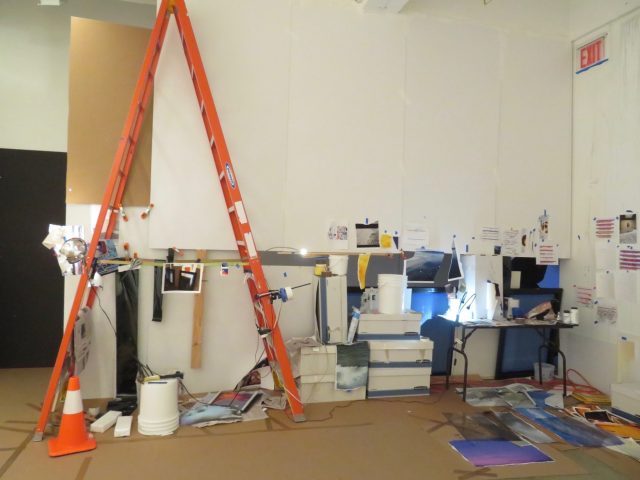
A studio space offers viewers a look at Sarah Sze’s creative process (photo by twi-ny/mdr)
Upstairs is a room of four gorgeous painting collages, streaks of white paint on the floor forming a half-moon around one, as if beaming in through the skylight. Be sure to get close to the works to experience their startling depth. In the smaller, dark room, Sze lays bare her process of projecting tiny images onto a wall, revealing how she first designs them on a computer, then projects them through a sculptural form and onto the far wall. It’s utterly ingenious and wholly captivating.
Sze’s works are particularly suited to our image-saturated urban life, and especially here in New York City: Her Triple Point (Pendulum) is part of MoMA’s “Surrounds: 11 Installations” exhibition opening next week, her Blueprint for a Landscape can be seen all over the 96th St. stop on the Second Ave. subway, and her birdhouse Still Life with Landscape (Model for a Habitat) was on the High Line in 2012. And in 2006, her partially submersive Corner Plot welcomed people to the Scholars’ Gate entrance to Central Park.
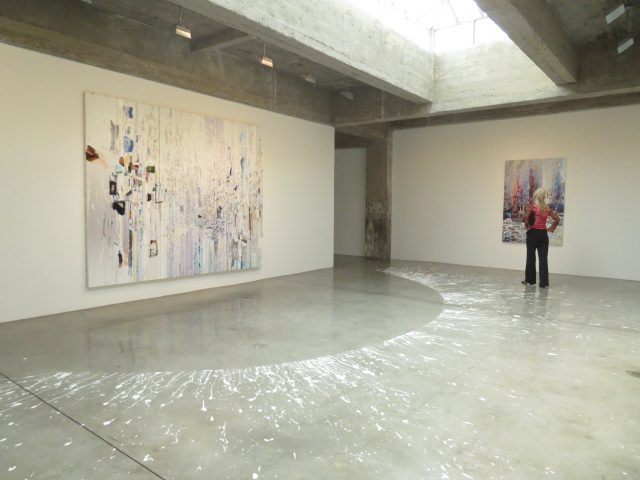
Paint forms a kind of floor sculpture in Sarah Sze show in Chelsea (photo by twi-ny/mdr)
In her 2018 essay “The Tattered Ruins of the Map: On Sarah Sze’s Centrifuge,” Sze’s friend, award-winning writer Zadie Smith, writes, “Like so much of Sarah Sze’s work, Centrifuge is a complex constellation of elements, in which all constituents present themselves simultaneously. . . . After the rupture, after the apocalypse, amid the ruin of cables and wires, someone might ask: what was the purpose of all of those images within and through which we lived?” This is true of her current Chelsea show, as Sze merges disparate components and artistic disciplines, both analog and digital, to forge a deep dive into the nature of time, space, and memory in a chaotic age.
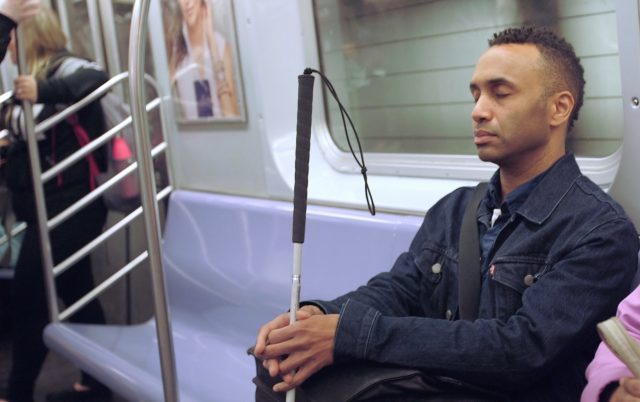
 “In a lot of ways, I feel like I’m just looking for guidance in how to be a blind artist,” filmmaker Rodney Evans says in Vision Portraits, his remarkable new documentary playing October 18-20 at BAM. Evans follows three artists as they deal with severe visual impairment but refuse to give up on their dreams as he seeks experimental treatment for his retinitis pigmentosa. Manhattan photographer John Dugdale lost most of his eyesight from CMV retinitis when he was thirty-two but is using his supposed disability to his advantage, taking stunning photos bathed in blue, inspired by the aurora borealis he sees when he closes his eyes. “Proving to myself that I could still function in a way that was not expected of a blind person was really gonna be the thing,” he says. “It’s fun to live in this bliss.” Bronx dancer Kayla Hamilton was born with no vision in one eye and developed iritis and glaucoma in the other, but she is shown working on a new piece called Nearly Sighted that incorporates the audience into her story. “How can I use my art form as a way of sharing what it is that I’m experiencing?” she asks.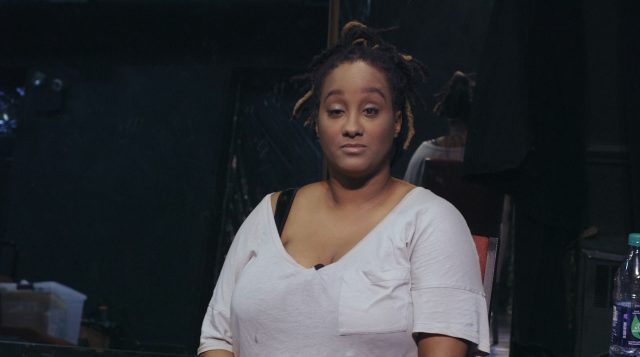
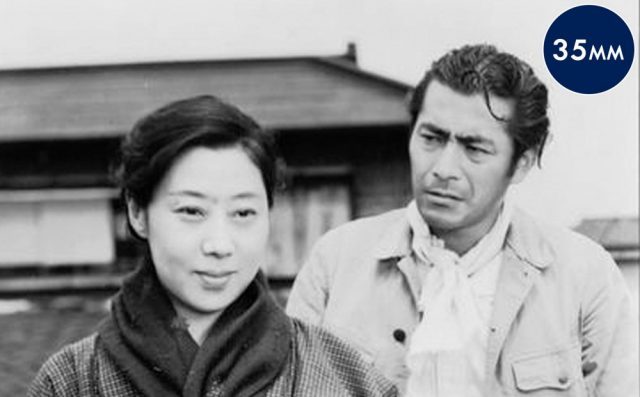
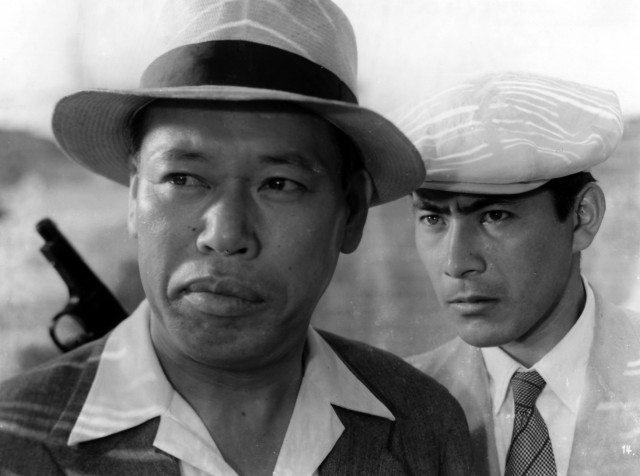
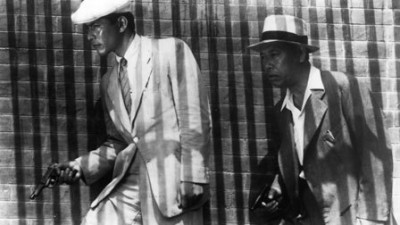
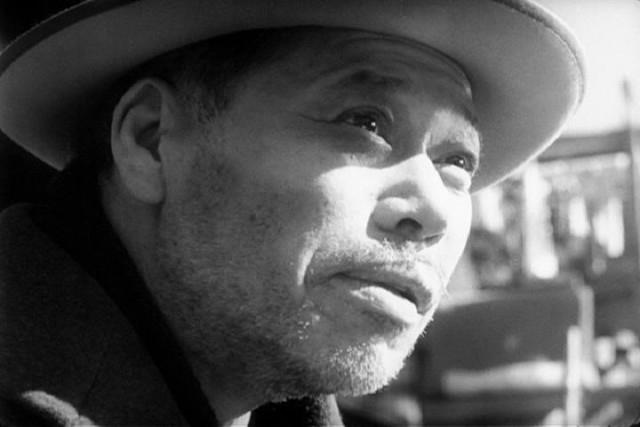
 In Akira Kurosawa’s 1952 gem, Ikiru, winner of a special prize at the 1954 Berlin International Film Festival, the great Takashi Shimura is outstanding as simple-minded petty bureaucrat Kanji Watanabe, a paper-pushing section chief who has not taken a day off in thirty years. But when he suddenly finds out that he is dying of stomach cancer, he finally decides that there might be more to life than he thought after meeting up with an oddball novelist (Yunosuke Ito). While his son, Mitsuo (Nobuo Kaneko), and coworkers wonder just what is going on with him — he has chosen not to tell anyone about his illness — he begins cavorting with Kimura (Shinichi Himori), a young woman filled with a zest for life. Although the plot sounds somewhat predictable, Kurosawa’s intuitive direction, a smart script (cowritten with Hideo Oguni), and a marvelously slow-paced performance by Shimura (Stray Dog, Scandal, Seven Samurai) make this one of the director’s best melodramas.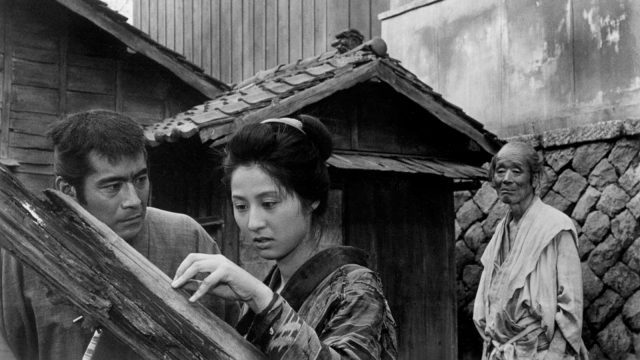
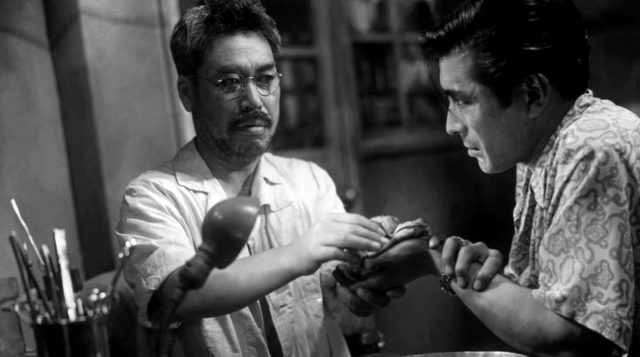
 Loosely adapted from Maxim Gorky’s social realist play, The Lower Depths is a staggering achievement, yet another masterpiece from Japanese auteur Akira Kurosawa. Set in an immensely dark and dingy ramshackle skid-row tenement during the Edo period, the claustrophobic film examines the rich and the poor, gambling and prostitution, life and death, and everything in between through the eyes of impoverished characters who have nothing. The motley crew includes the suspicious landlord, Rokubei (Ganjiro Nakamura), and his much younger wife, Osugi (Isuzu Yamada); Osugi’s sister, Okayo (Kyôko Kagawa); the thief Sutekichi (Toshirō Mifune), who gets involved in a love triangle with a noir murder angle; and Kahei (Bokuzen Hidari), an elderly newcomer who might be more than just a grandfatherly observer. Despite the brutal conditions they live in, the inhabitants soldier on, some dreaming of their better past, others still hoping for a promising future. Kurosawa infuses the gripping film with a wry sense of humor, not allowing anyone to wallow away in self-pity. The play had previously been turned into a film in 1936 by Jean Renoir, starring Jean Gabin as the thief.