twi-ny recommended events

WHITE LIGHT FESTIVAL: EN MASSE

(photo © David Kelly)

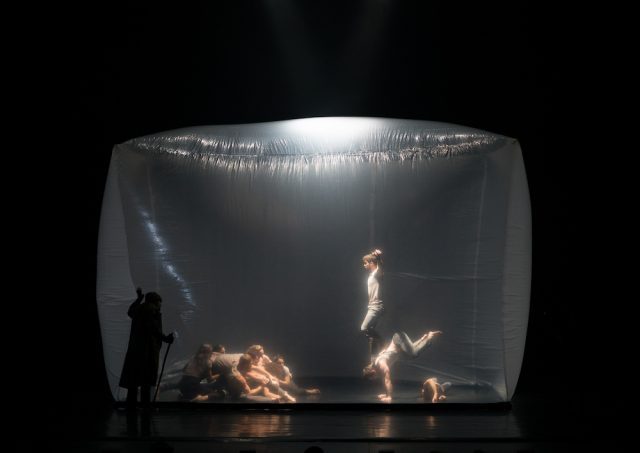
The ten members of Circa Ensemble are trapped in a cube in En Masse (photo © David Kelly)

Gerald W. Lynch Theater at John Jay College
524 West Fifty-Ninth St. between Tenth & Eleventh Aves.
October 23-25, $55-$95
Festival continues through November 24
www.lincolncenter.org
circa.org.au

Australia’s Circa Ensemble returns to Lincoln Center’s White Light Festival for the first time in five years with the death-defying, awe-inspiring En Masse, continuing at the Gerald W. Lynch Theater through October 25. Incorporating acrobatics and gymnastics into contemporary dance with flashes of balletic structures, the Brisbane-based troupe, which presented How Like an Angel at the Union Theological Seminary in 2014, has nothing less than the end of the world on its mind — and what happens after. Created by director and stage designer Yaron Lifschitz with the company, the evening-length work is divided into two related parts. In the first half, the ten extremely talented and brave dancers — Caroline Baillon, Marty Evans, Piri Lee Goodman, Keaton Hentoff-Killian, Cecilia Martin, Hamish McCourty, Daniel O’Brien, Kimberley O’Brien, Jarrod Takle, and Sandy Tugwood — break apart and come together to alternating music by Franz Schubert, Lieders from Schwanengesang (“Ständchen,” “In der Ferne,” “Der Doppelgänger”) and Winterreise (“Der Leiermann,” “Gute Nacht,” “Die Nebensonnen,” “Frühlingstraum”), and electronic music and noise from twenty-six-year-old Swedish composer Klara Lewis (“Msuic I,” “Want,” “Too,” “Beaming”).
(photo © David Kelly)

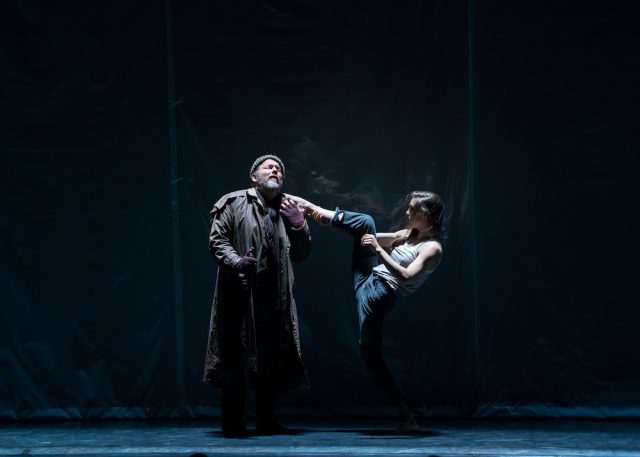
Tenor Robert Murray beautifully sings Schubert Lieders in En Masse (photo © David Kelly)

The Schubert songs are marvelously sung by tenor Robert Murray, dressed like a vagabond with ratty clothing and carrying a tall, twisted walking stick (the costumes are by associate director Libby McDonnell), accompanied by Tamara-Anna Cislowska on a grand piano. The barefoot performers, wearing jeans and gray T-shirts, move in front of and behind a plastic curtain that comes down and raises again to reveal set changes. A woman crawls across the front of the stage, contorting her lower body into seemingly impossible positions. All ten dancers are trapped in a transparent inflated cube. A parade of solos, duets, and trios marches in the front. Three dancers build a precarious human pyramid, climbing on top of one another. The six men and four women run, jump, slide, get thrown, and threaten to fall against the hard floor — at one treacherous point the audience gasped loudly in unison as a man, fifteen feet in the air, falls, face forward. But Lifschitz has built in various fail safes to try to prevent any potential tragedies, unobtrusively using spotters, and the dancers, who have years of highly specialized circus and acrobatic training, are well-practiced at rolling into somersaults and other moves in case a lift, toss, or carry doesn’t go perfectly.

After intermission, the mood changes. Now that we’re familiar with Circa’s movement vocabulary and impressive skills, we’re not as worried about the safety of the performers, who have formed a kind of postapocalyptic community. All ten dancers are onstage for most of the second half, which is set to Igor Stravinsky’s Le sacre du printemps (“The Rite of Spring”), aggressively played by Cislowska and Michael Harvey on pianos that face each other at the back of the stage, and features dazzling lighting by Lifschitz and Richard Clarke. The situation is not quite as dire as the performers expand their repertoire, creating breathtaking formations, moving in unison, banding together to face the future. It’s no mere pie-in-the-sky hopefulness but a deep-seated belief in the innate instinct of humanity to forge ahead, to do whatever is necessary to survive and thrive. The first act is introduced by a quote from Italian philosopher Antonio Gramsci: “The crisis consists precisely in the fact that the old is dying and the new cannot be born,” while the second starts with a dictum from German philosopher Walter Benjamin: “There is no document of civilization that is not at the same time a document of barbarism.” En Masse is a document showing that something new can indeed be born, even in times of crisis and barbarism.
THE ROOF GARDEN COMMISSION — ALICJA KWADE: PARAPIVOT

(photo by twi-ny/mdr)

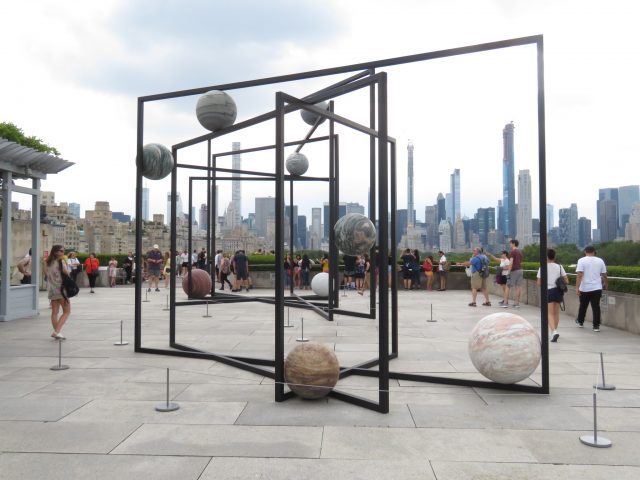
Alicja Kwade has created a unique solar system on the Met roof with Parapivot (photo by twi-ny/mdr)

Metropolitan Museum of Art, Met Fifth Avenue
The Iris and B. Gerald Cantor Roof Garden
1000 Fifth Ave. at 82nd St.
Daily through October 27 (weather permitting)
Recommended admission: $25 adults, children under twelve free
212-535-7710
www.metmuseum.org
parapivot slideshow

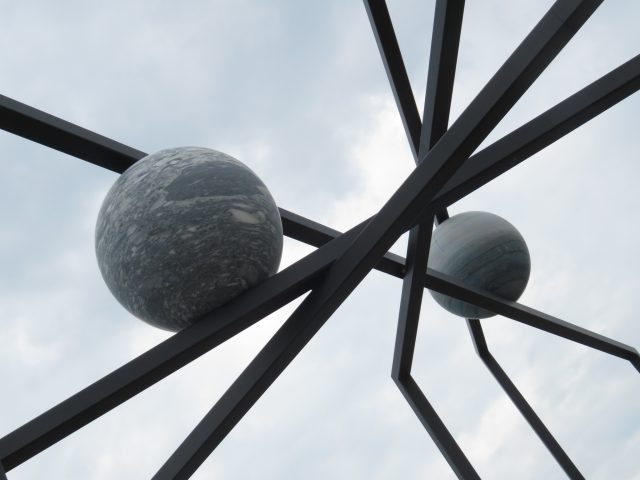
In 2015-16, Berlin-based Polish artist Alicja Kwade turned time upside down and backward in Against the Run, a reconfigured nineteenth-century-style city street clock that stood at the Scholars’ Gate entrance to Central Park. She now focuses her attention on space in her first solo US museum exhibition, Parapivot, continuing on the Met’s roof through October 27. Kwade’s construction consists of nine round, polished stones, evoking planets, precipitously balanced in interlocking steel frames. The daughter of a cultural scientist mother and an art historian father, Kwade’s works often involve scientific inquiry. Overlooking Central Park, Parapivot recalls such earlier pieces by Kwade as Ousia, Changed, Abakus, and But the Same, exploring issues of art, perception, and the natural world.

(photo by twi-ny/mdr)

Polished spheres are like planets in steel-framed construction by Alicja Kwade (photo by twi-ny/mdr)

“The work is not an illustration of something we invented; it’s more like an illustration of us inventing,” Kwade says in a catalog interview with Met chief curator Sheena Wagstaff. “In other words, it’s more like a reflection of ourselves than of something we already did, a sense of what could be a system, what we do, and how we read things.” Thus, Kwade’s solar system will call up different things for different people as they walk around and through it. “I never want to have an answer,” she says in the catalog. “I want to have more questions, but not answers.”

MOUNTAINTOP

Neil Young

Neil Young goes behind-the-scenes of the recording of Colorado in new documentary

MOUNTAINTOP (Bernard Shakey, 2019)
IFC Center, 323 Sixth Ave. at West Third St., 212-924-7771, 7:30
Landmark at 57 West, 657 West 57th St. at Twelfth Ave., 646-233-1615, 7:30
Nitehawk Cinema Williamsburg, 136 Metropolitan Ave., 9:45
One night only: Tuesday, October 22
mountaintopthemovie.com

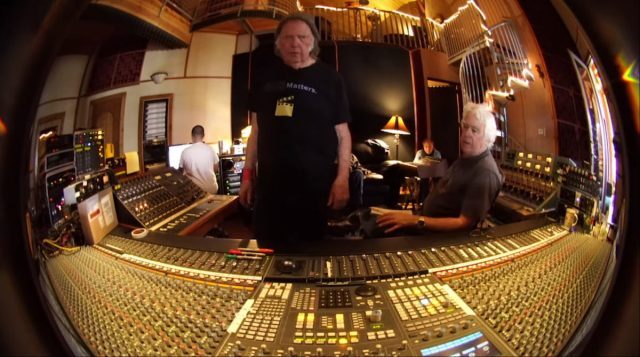
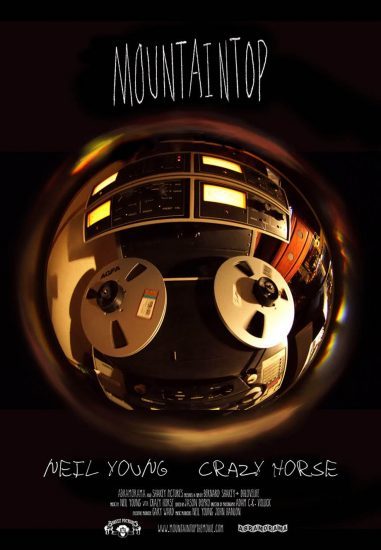
Neil Young invites viewers behind the scenes of the making of his latest album, Colorado, in the documentary Mountaintop, playing in theaters one night only on October 22 in advance of the October 25 release of the record, the first he’s done with his longtime band Crazy Horse since 2012’s Psychedelic Pill. Directed by Young’s filmmaking alter ego, Bernard Shakey, Mountaintop takes place over the course of eleven days in the Studio in the Clouds in the San Juan Mountains outside Telluride, about nine thousand feet above sea level, where four old white guys come together to make some grand rockin’ music about love and climate change. “You might say I’m an old white guy / I’m an old white guy / You might say that,” Young sings on “She Showed Me Love,” about the attempted murder of Mother Nature. The seventy-three-year-old Canadian legend is joined by seventy-five-year-old bassist Billy Talbot and seventy-six-year-old drummer Ralph Molina — the two surviving original Crazy Horse members, who first played with Young on 1969’s Everyone Knows This Is Nowhere — and sixty-eight-year-old guitar virtuoso Nils Lofgren, who was eighteen when he played guitar and piano on Young’s 1970 solo record, After the Gold Rush. (Coincidentally, Lofgren’s other boss, seventy-year-old Bruce Springsteen, is releasing his documentary about his latest album, Western Stars, on Friday.) Early on, the band says they are having an “oxygen party” to keep them going, passing around tanks like bongs. “It’s old guys; young souls still alive in old souls and the music they make together,” Young writes on his website about the film. It’s hard not to laugh when you see the size of the type on the lyric sheets these old guys are using.

“Right now it’s a piece of fucking gold. It’s original fucking greatness,” Young says of the big-sounding “Rainbow of Colors.” After the calmer “House of Love,” on which Young plays piano and harmonica and Lofgren tap-dances, he says, “It doesn’t have to be good; just be great. You know, just feel good.” Young lives up to his billing as the Godfather of Grunge on the punk-infused “Help Me Lose My Mind”; Lofgren refers to Young’s singing on the track as “reckless narration with pitch,” which gets a chuckle out of Young, who is serious and ornery most of the time, understandably unhappy with the monitors (ironically, mostly on the song “Shut It Down”) and other details of the recording process, and he lets his longtime producer and engineer, John Hanlon, know it again and again. Hanlon, a coffee addict who is suffering from poison oak on his hand, has a meltdown at one point, screaming, “This is the most fucked-up studio I’ve ever fucking worked in in my life. . . I’m about ready to leave this fucking project, okay?” He demands that all cameras be removed from the studio and that the scene of him yelling and cursing not appear in the film, but. . . .

mountaintop

Young, who as Shakey has directed or codirected Rust Never Sleeps, The Monsanto Years, Human Highway, Journey through the Past, and Greendale, and cinematographer C. K. Vollick leave the studio to show time-lapse shots of the snowy mountains, bright stars, and rolling clouds outside, primarily on “Green Is Blue,” a piano ballad about climate change. There are also snippets of Young performing at one of his solo acoustic concerts, where he surrounds himself with a circle of guitars. He employs split screens, a fish-eye lens (think the cover of Ragged Glory), a handheld camera, and one mounted on the floor to mix things up. Lofgren plays the pump organ and an accordion, Young plays the vibes and a glass harmonica, and the four men gather to sing lofty background harmonies. Amid all the technical problems — “I love singing in a wet sock,” Young says about the sound — he and Crazy Horse prove they still have it after half a century, particularly when they turn it up on the majestic “Milky Way,” which borrows generously from “Cowgirl in the Sands,” and the hard-rocking “She Showed Me Love.” “We’re gonna do it / Just like we did back then,” Lofgren, Molina, and Talbot sing on “I Do.” Mountaintop is an irresistible fly-on-the-wall doc about the creative process, about collaboration and genius, about all the little things that can go wrong — and delightfully right — in the making of great art, in this case by a bunch of old white guys trying to save the planet, one song at a time.

EMPEROR SERIES: KWAIDAN — CALL OF SALVATION HEARD FROM THE DEPTHS OF FEAR

Kwaidan

Shirō Sano and Kyoji Yamamoto team up at Japan Society for Kwaidan

Japan Society
333 East 47th St. at First Ave.
Thursday, October 24, $30, 7:30
212-715-1258
www.japansociety.org

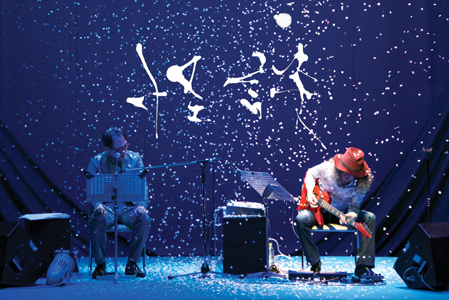
Japan Society gears up for Halloween with the spooky presentation Kwaidan — Call of Salvation Heard from the Depths of Fear. On October 24 at 7:30, popular Japanese film and television actor Shirō Sano (Zutto Anata ga Suki data, Karaoke) will read five tales of the supernatural he selected by Lafcadio Hearn, aka Yakumo Koizumi (1850-1904), with live music played by guitarist Kyoji Yamamoto, of BOW WOW and VOW WOW fame. (Sano and Yamamoto both hail from Matsue City in Shimane Prefecture.) Japanese film fans will be familiar with Hearn’s oeuvre from Masaki Kobayashi’s 1965 horror anthology, Kwaidan, which consists of the Hearn tales “The Black Hair,” “The Woman of the Snow,” “Hoichi the Earless,” and “In a Cup of Tea.” The performance will be preceded by a short lecture by Hearn’s great-grandson, Lafcadio Hearn Memorial Museum director and folklorist Bon Koizumi, and a reception with the artists will follow the show, which is part of Japan Society’s Emperor Series, celebrating Emperor Naruhito’s ascension to the Chrysanthemum Throne on May 1.

THE NEW MoMA

MoMA director Glenn D. Lowry shows off the new museums curatorial (photo by twi-ny/mdr)

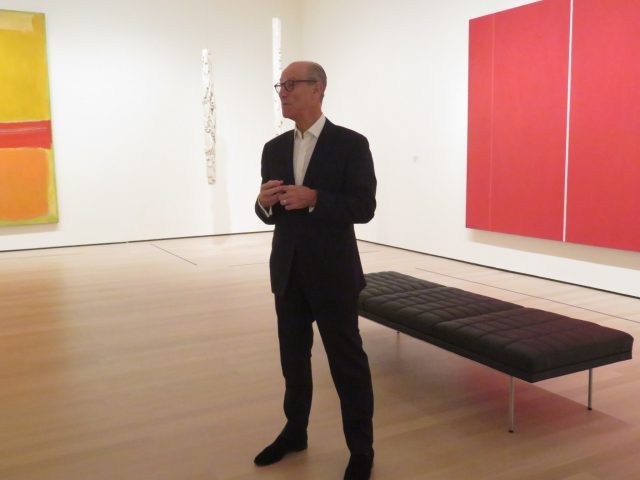
MoMA director Glenn D. Lowry shows off museum’s ambitious new approach (photo by twi-ny/mdr)

MoMA, Museum of Modern Art
11 West 53rd St. between Fifth & Sixth Aves.
Opens Monday, October 21, $14-$25 (sixteen and under free)
212-708-9400
www.moma.org

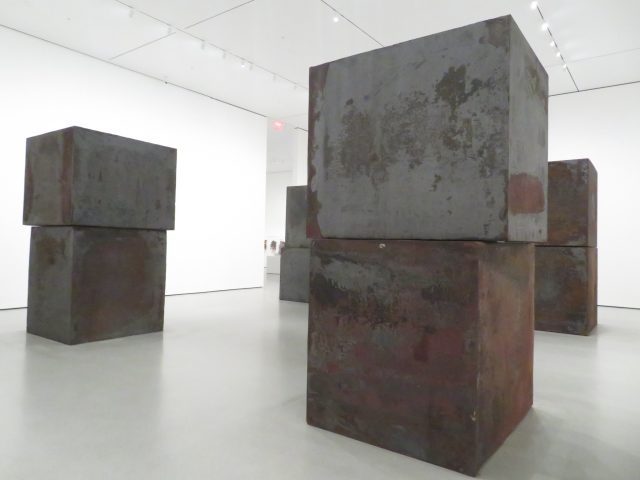
Perhaps no single work of art encapsulates the newly renovated, revamped, and expanded Museum of Modern Art as much as Richard Serra’s 2015 Equal, which gets its own room on the fourth floor. Eight forged weatherproof steel blocks are stacked in pairs, four on four. Despite their title, they are not the same: the random patterns on their sides are not consistent, the light that gleams through gaps in the stacks reveals the blocks are not exact replicas of each other, and they are positioned on different sides. It announces a new MoMA, reopening today with much fanfare after closing on June 16 for four months of reinstallation, a reimagination and reevaluation of how to display items from its ever-growing collection of more than two hundred thousand works. At an intimate press preview, museum director Glenn D. Lowry used all the right words and phrases to bring MoMA into 2019 and beyond, including “a more global perspective,” “pluralism,” “dialogues,” and “diversity.”

He was standing in gallery 404, “Planes of Color,” carefully chosen as representative of the institution’s updated curatorial approach. Instead of being essentially chronological, the room combines painting and sculpture in a more complex way, creating what Lowry said is a “conversation through time and space.” Thus, brought together are an obvious grouping of Russian-born American artist Mark Rothko’s No. 10 and No. 5/No. 22, American artist Ad Reinhardt’s Number 107, and American artist Barnett Newman’s Abraham and Vir Heroicus Sublimis, along with the less-expected choices of Ukraine-born American artist Louise Nevelson’s Hanging Column from Dawn’s Wedding Feast and Indian artist Vasudeo S. Gaitonde’s exquisite Painting, 4. “I hope that my painting has the impact of giving someone, as it did me, the feeling of his own totality, of his own separateness, of his own individuality, and at the same time of his connection to others,” Newman said in a 1965 interview with David Sylvester. “If a meeting of people is meaningful, it affects both their lives.” The same goes for this meeting of artworks.

(photo by twi-ny/mdr)

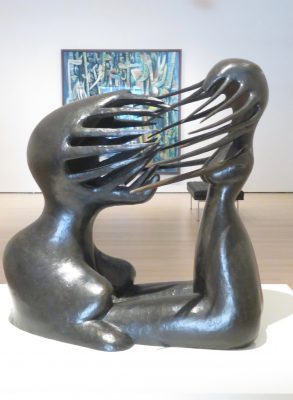
Maria Martins’s The Impossible, III tears apart conventional ideas of curation (photo by twi-ny/mdr)

In gallery 503, “Around Les Demoiselles d’Avignon,” thirteen works by Pablo Picasso from 1905 to 1912 are joined by Louise Bourgeois’s 1947-53 Quarantania, I sculpture and Faith Ringgold’s 1967 painting American People Series #20: Die 1967, a Guernica-inspired canvas about race, class, and violence. One of the museum’s greatest hits, Les Demoiselles d’Avignon, hangs in a corner, given no special prominence. Similarly, Vincent van Gogh’s The Starry Night and Henri Rousseau’s The Sleeping Gypsy, two other perennial favorites, are side by side on a far wall in gallery 501, along with turn-of-the-twentieth-century earthenware by George Ohr. The works on display will rotate every six months, although the classics will most likely always be on view, but not necessarily in the same place. “My ambition is to get past worrying about the canon,” Lowry said. “We’re shaking it up.”

The Worlds to Come gallery on the second floor was inspired by Jack Whitten’s Atopolis: For Édouard Glissant, an eight-panel acrylic canvas depicting a tattered America as if seen from space; it is accompanied by Trisha Donnelly’s Untitled video, Kara Walker’s ink and pencil on paper Christ’s Entry into Journalism, Michaela Eichwald’s Duns Scotus on artificial leather, Deana Lawson’s pigmented inkjet print Thai, and Nairy Baghramian’s styrofoam, aluminum, and cork Maintainers A, a wide range of disciplines and artists that the wall text puts in context of MoMA’s new curatorial decision-making: “Employing a range of forms and materials, some of these works address historical traumas and their present-day echoes, while others imagine a more hopeful future rooted in multiplicity and diversity. Purposefully open-ended, this grouping of works refuses a tidy summation of the art of our time.”

(photo by twi-ny/mdr)

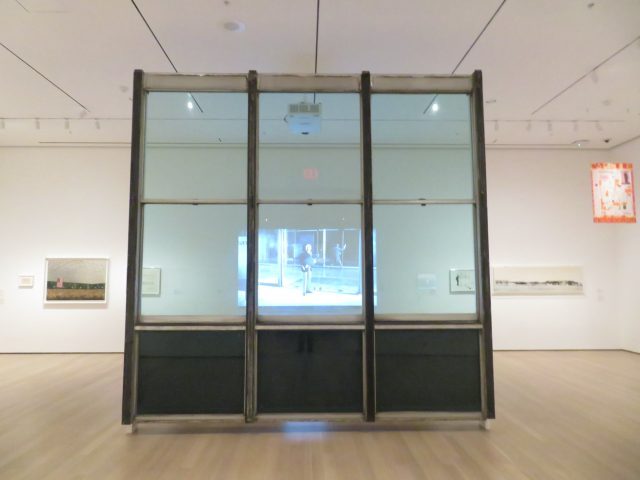
MoMA mixes artistic disciplines in revamped galleries (photo by twi-ny/mdr)

You can find the unexpected everywhere. An excerpt from Jacques Tati’s 1967 comedy Playtime can be viewed in gallery 417 through a piece of the facade from the 1952 UN Secretariat Building in a space dedicated to architecture. Alma Woodsey Thomas’s Fiery Sunset is in a gallery otherwise filled with paintings and sculptures by Henri Matisse. (Matisse’s The Swimming Pool gets its own room, as do Rosemarie Trockel’s Book Drafts and Joan Jonas’s Mirage.) The “Picturing America” gallery includes photographs by Dorothea Lange, Aaron Siskind, Rudy Burckhardt, Edward Weston, Walker Evans, and others alongside paintings by Edward Hopper, another example of the cross disciplines MoMA is now emphasizing.

Visitors to the second-floor contemporary galleries are greeted by Dara Birnbaum’s Technology/Transformation: Wonder Woman video, complete with explosion; to the right are two dozen of Cindy Sherman’s Untitled Film Stills, while to the left is Louise Lawler’s Does Andy Warhol Make You Cry?, a photo of Andy Warhol’s Gold Marilyn Monroe from a 1988 Christie’s auction. It’s a bold, if cheeky, way for MoMA to exclaim its dedication to women artists, blowing up the past.

(photo by twi-ny/mdr)

Richard Serra’s 2015 Equal gets its own room in new MoMA (photo by twi-ny/mdr)

Among what’s new are the Paula and James Crown Creativity Lab, where adults can learn about process and create their own art (kids can still drop in at the Samuel and Ronnie Heyman Family Art Lab in the Education and Research Building), and the fourth-floor Marie-Josée and Henry Kravis Studio, which will host live and experimental programming beginning with David Tudor’s immersive audio installation Rainforest V (variation 1); Tudor’s Forest Speech will be performed in the space October 24, 26, and 27 ($10-$15, 8:00) by Phil Edelstein, Marina Rosenfeld, Stefan Tcherepnin, Spencer Topel, and Jeremy Toussaint-Baptiste as well as three days each in November and December by different sets of musicians.

The museum’s initial exhibitions are all culled from the collection, furthering MoMA’s goal of making more of it available to the public: “Taking a Thread for a Walk,” “The Shape of Shape Artist’s Choice: Amy Sillman,” “Energy,” “Projects 110: Michael Armitage,” “Haegue Yang: Handles” (which will be activated daily at 4:00), “Private Lives Public Spaces” (home movies from dozens of artists and filmmakers), “Surrounds 11: Installations,” “Sur moderno: Journeys of Abstraction ― The Patricia Phelps de Cisneros Gift,” “member: Pope.L, 1978–2001,” and “Betye Saar: The Legends of Black Girl’s Window.” Philippe Parreno’s immersive, site-specific Echo provides sound, light, and movement in the entries on both West Fifty-Third and Fifty-Fourth St., yet more evidence that art is everywhere, in this case putting the visitor at the very center. “It is nearly impossible to make people understand each other,” explained Maria Martins, whose spiky 1946 bronze sculpture The Impossible, III greets people in gallery 401, the theme of which is “Out of War.” With its focus on diversity, juxtapositional dialogues, rotating works, and reconsidered approach to curation, MoMA is trying to get people to understand art, and each other, a whole lot better, in ways that make sense in our current era.

WILLIAM FORSYTHE: A QUIET EVENING OF DANCE

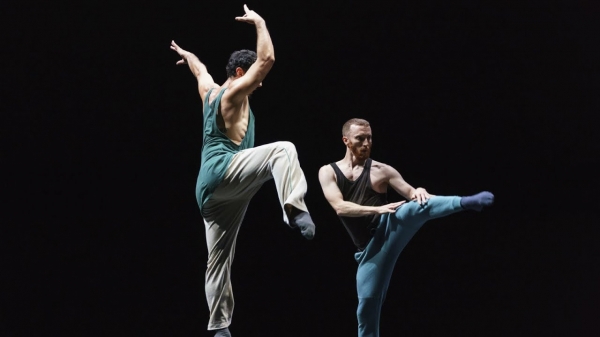
Jill Johnson and Brit Rodemund in A Quiet Evening of Dance. (photo © Mohamed Sadek /  courtesy the Shed)

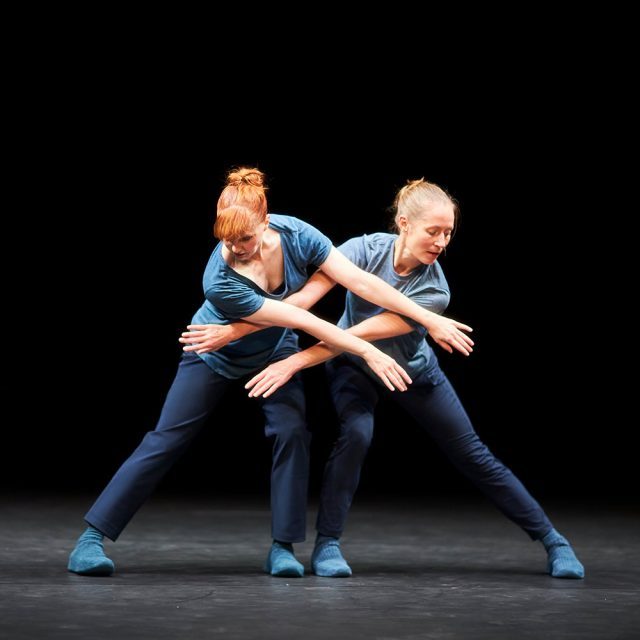
Jill Johnson and Brit Rodemund in William Forsythe’s A Quiet Evening of Dance (photo © Mohamed Sadek / courtesy the Shed)

The Shed
The Griffin Theater in the Bloomberg Building
545 West 30th St. at Eleventh Ave.
Through October 25, $42-$92
646-455-3494
theshed.org

In May 2018, William Forsythe presented a site-specific work as part of “A Prelude to the Shed,” a preview of what New Yorkers could expect from the new arts center at Hudson Yards. The free collaboration, Tino Sehgal: This variation and William Forsythe: Pas de Deux Cent Douze, put visitors right in the middle of the action as near-total darkness evolved into a cappella singing and an energetic duet as the walls of a temporary facility opened to the street. Choreographer and visual artist Forsythe, the former head of Ballet Frankfurt who has worked independently after ending the Forsythe Company in 2015, is back at Hudson Yards with A Quiet Evening of Dance, a lovely evening-length piece continuing through October 25 at the Shed’s Griffin Theater. Consisting of new and reimagined repertory works, the hundred-minute performance is divided into two main sections, taking place on an empty stage at floor level, putting the ten dancers on equal footing with the audience.

William Forsythe’s A Quiet Evening of Dance (photo © Mohamed Sadek / courtesy the Shed)

William Forsythe’s A Quiet Evening of Dance focuses primarily but not exclusively on a series of duets (photo © Mohamed Sadek / courtesy the Shed)

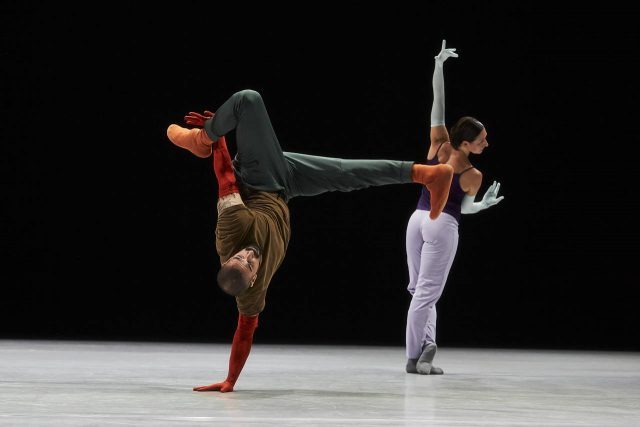
The first half consists of four parts, focusing primarily on duets that are almost like a primer for Forsythe’s choreographic language, which relies heavily on the deconstruction of classical ballet, emphasizing the movement of the arms and hands and upper body. “Prologue,” featuring Parvaneh Scharafali and Ander Zabala, and “Catalogue,” with Jill Johnson and Brit Rodemund, are set in near silence, the only sounds coming from bird tweeting and the dancers’ breathing — some breathe significantly harder than others, like different sounds that emerge from tennis players in the midst of a match, though not as forceful and urgent — and their feet, which glide across the black floor in sneakers covered in wooly socks whose colors sometimes are similar to the wrist-to-biceps gloves they wear that give yet more weight to their arm movement. (The playful costumes are by Dorothee Merg.) Johnson and Rodemund’s duet also has them exploring their entire bodies in a thrilling kind of anatomy lesson. “Epilogue” follows, a series of duets in which Scharafali, Zabala, Johnson, Rodemund, Brigel Gjoka, Riley Watts, Rauf “RubberLegz” Yasit, Jake Tribus, and Roderick George (whom I saw perform a sizzling solo last year when his Pas de Deux Cent Douze partner was unable to dance with him) rotate onstage to Morton Feldman’s soft “Nature Pieces from Piano No. 1,” each dancer establishing their unique personalities: Scharafali with her casual elegance (with her hands at times in her pockets), Johnson with her stoic presence, Watts with his emotional facial gestures, Yasit with his body-twisting (though repetitive) contortions. Gjoka and Watts, moving in rare unison, conclude with “Dialogue (DUO2015)” before intermission.

(photo © Mohamed Sadek /  courtesy the Shed)

Rauf “RubberLegz” Yasit and Parvaneh Scharafali in A Quiet Evening of Dance (photo © Mohamed Sadek / courtesy the Shed)

A co-commission with Sadler’s Wells, where it debuted in October 2018, A Quiet Evening of Dance continues after intermission with “Seventeen / Twenty One,” which is not quite as quiet though just as winning as the dancers, now on a white floor, use the language they explored earlier in a more complexly structured work, set to Jean-Phillippe Rameau’s Baroque “Hippolyte et Aricle: Ritrounelle” from Une Symphonie Imaginaire. The title links the seventeenth and twenty-first centuries — Rameau was born in 1683 — as all ten dancers whirl about the stage, ranging from solos to duets to trios and then everyone coming together for a grand finale.

SLAVE PLAY

(photo by Matthew Murphy)

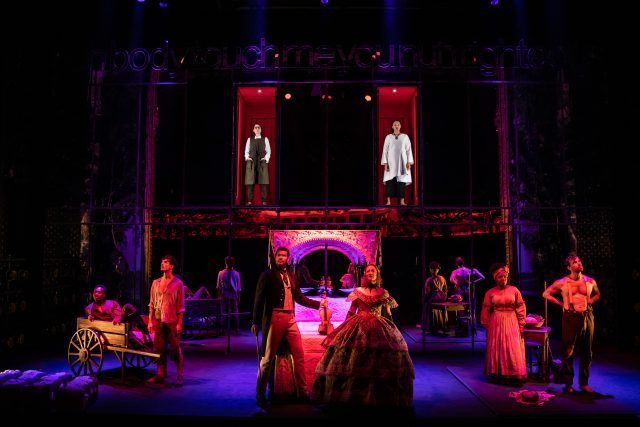
Jeremy O. Harris’s Slave Play has moved from New York Theatre Workshop to Broadway (photo by Matthew Murphy)

Golden Theatre
252 West 45th St. between Broadway & Eighth Ave.
Tuesday – Sunday through January 19, $39-$159
slaveplaybroadway.com

Over the last several years, I’ve had the privilege of seeing four terrific shows first off Broadway and then on, then on the Great White Way. In each case, nothing was lost in the transition to the bigger stage; in fact, three of them received Tony nominations for Best Play — Indecent, Pulitzer Prize recipient Sweat, and The Humans — with The Humans winning the award. (Unfortunately, the sadly overlooked Significant Other had only a short stint on Broadway.)

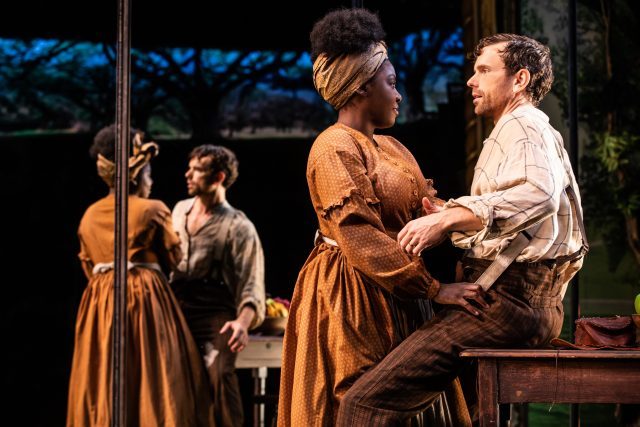
So at first I was surprised to hear that Jeremy O. Harris’s Slave Play, which initially ran at New York Theatre Workshop last season, was heading to the Golden Theatre for a Broadway engagement, not least because of its graphic sexual content as well as its central subject matter involving a trio of dangerous sexual interactions defined by race, gender, and power on a plantation in the Antebellum South as well as today: black slave Kaneisha (Joaquina Kalukango) and her white overseer, Jim (Paul Alexander Nolan); Alana MacGregor (Annie McNamara), the plantation owner’s wife, and her “mulatto” house servant, Phillip (Sullivan Jones); and Dustin (James Cusati-Moyer), a white indentured servant, and Gary (Ato Blankson-Wood), his black boss. Clint Ramos’s set has been expanded, with two levels of mirrored doors that open up to reveal characters and bring on and off various pieces of furniture; the MacGregor plantation is represented by a long horizontal image of the main house on the mezzanine facade that is reflected in the mirrors across the back of the stage so the audience can see itself. At NYTW, the mirrors made it feel like we were all on the plantation, making us complicit in America’s original sin of slavery.

(photo by Matthew Murphy)

Kaneisha (Joaquina Kalukango) and Jim (Paul Alexander Nolan) face issues of race, gender, and power in Slave Play (photo by Matthew Murphy)

But at the Golden, the mirrors feel more gimmicky, less insightful and condemnatory. The two-hour intermissionless play is divided into three sections, each of which now struck me as being too long and repetitive, continuing well past their expiration date. And the shock value of the brutal sex scenes and, especially, the second-act twist seemed much more tame. The cast, which is the same except for Kalukango replacing Parris — Irene Sofia Lucio and Chalia La Tour are also back as politically correct comic facilitators Patricia and Teá, respectively — is again uniformly strong, with Cusati-Moyer standing out as a white man claiming he’s not white. So what happened? Only small tweaks were made to the script and direction. Perhaps it’s the spate of works by black playwrights about the black experience in America; since Slave Play debuted at NYTW, I’ve seen Jackie Sibblies Drury’s Pulitzer-winning Fairview, Thomas Bradshaw’s Southern Promises, Jordan E. Cooper’s 2019 Ain’t No Mo’, Suzan-Lori Parks’s White Noise, Tori Sampson’s If Pretty Hurts Ugly Must Be a Muhfucka Lynn Nottage’s By the Way, Meet Vera Stark, and Harris’s own “Daddy.”

There’s no denying that it’s a boon to the artform that so many diverse voices are now being heard onstage, both on and off Broadway, dealing with issues that must be faced in a society still teeming with institutional and systemic racism; what used to be the exception (August Wilson, Lorraine Hansberry, Ntozake Shange, Adrienne Kennedy) is quickly becoming the norm (see also Lydia R. Diamond, Dominique Morriseau, Danai Gurira, Dael Orlandersmith, and Katori Hall, among others). But maybe the shock I experienced when I first saw Slave Play has worn off a bit as the subject matter becomes more commonplace in American theater. Maybe the Golden is too large a venue for the intimacy Harris is exploring in the show. Maybe the flaws in Slave Play are more evident in this bigger production, particularly when seen for the second time. Or maybe the novelty of the play has just dissipated as more nuanced ones come along. I’m not sure any of that matters from a critical standpoint, as the producers just announced that it’s off to a solid financial start, even extending the run two weeks.