twi-ny recommended events

NYC HORROR: GOD TOLD ME TO

God Told Me To

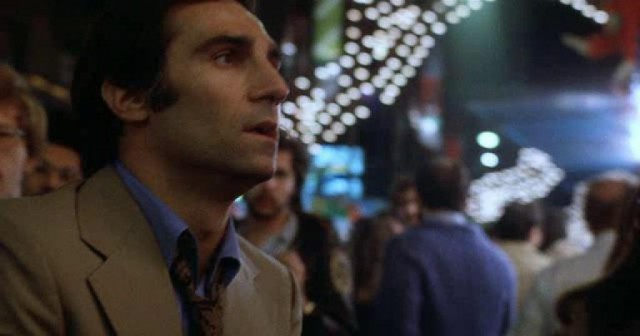
Tony Lo Bianco stars as a New York City cop searching for a cultlike leader in God Told Me To

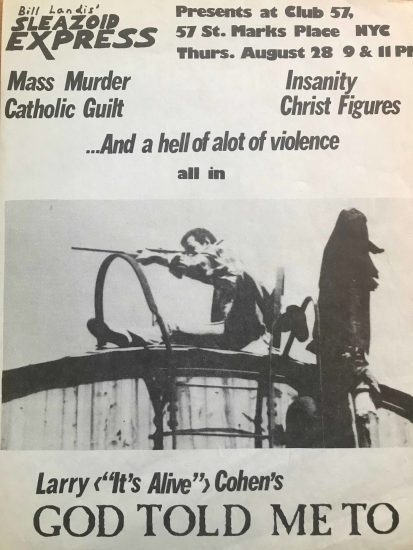
GOD TOLD ME TO (Larry Cohen, 1976)
BAMfilm, BAM Rose Cinemas
30 Lafayette Ave. between Ashland Pl. & St. Felix St.
Saturday, November 2, 4:15
Series runs October 31 – November 5
718-636-4100
www.bam.org

Watching the first half hour of Larry Cohen’s 1976 thriller, God Told Me To, is extremely difficult, given the continuing spate of mass shootings in the United States and the battle over gun control. The film opens with a man (Sammy Williams) on top of a water tower in New York City, picking off random people down below with a .22 caliber rifle. Detective Peter Nicholas (Tony Lo Bianco) risks his life to go face-to-face with the soft-spoken killer, who says he did it because “God told me to.” A religious Catholic suffering a crisis of faith, Nicholas gets the same response from a series of other mass murderers, including a cop played by Andy Kaufman, in his big screen debut, who lets loose during the St. Patrick’s Day Parade. (The next scene takes place at the Feast of San Gennaro, which is held every September in Little Italy, but it’s clear that six months have not elapsed, so we’ll give Cohen, a native of Washington Heights, poetic license in this case.) As Lo Bianco gets deeper and deeper into the mystery that involves an odd, cultlike figure named Bernard Phillips (Richard Lynch), he also has to deal with his estranged wife, Martha (Sandy Dennis), and his younger girlfriend, Casey Forster (Deborah Raffin). As he gets closer to the truth, he is forced to look deep into his soul amid all the madness. God Told Me To is shot by cinematographer Paul Glickman guerrilla style primarily without city permits and using a handheld camera, keeping the viewer off balance; the choppy editing by Michael D. Corey, Arthur Mandelberg, and William J. Waters doesn’t help smooth things out. The production values are quintessential low-budget mid-’70s, eliciting screams not of horror but of campy enjoyment among the middle-aged, who grew up watching these offbeat films at offbeat times in wood-paneled basements. Inspired by the Bible and one of the very first “aliens visited Earth!” books, Erich von Däniken’s bestselling Chariots of the Gods, Cohen, a producer, director, and writer who made such other low-budget faves as Black Caesar, It’s Alive, Q, The Stuff, and The Masters of Horror episode Pick Me Up, creates some intense scenes, including a hellish visit to a burning underground lair, as the twisting plot enters sci-fi territory involving a very special vagina.
god told me to

One of the undersung actors of the 1970s, Lo Bianco, who starred in such films as The Honeymoon Killers, The French Connection, The Seven-Ups, and Bloodbrothers and played Mayor Fiorella La Guardia in his traveling one-man show The Little Flower, gives one of his most nuanced performances in God Told Me To, whether desperately trying to stop killers or learning some hard facts from an elderly woman in a nursing home, portrayed by Oscar winner Sylvia Sidney. (The film also features old-time Broadway and Hollywood actor Sam Levene as publisher Everett Lukas.) Oscar-winning composer Bernard Herrmann was supposed to write the score but sadly passed away before he could begin, so Frank Cordell took over; the film is dedicated to Herrmann, who had written the score for It’s Alive. Fans of 1960s and 1970s television series will have a field day recognizing familiar faces in small roles, character actors who appeared in multitudes of comedies and dramas; among the names you’ll be Googling to see what else they’ve been in are Mason Adams, Richard Lynch, Harry Bellaver, and John Heffernan. God Told Me To, which was also released as Demon, is a gritty, dark film that resonates in a new way today, especially since all of the killers are white American males with apparent links to a supreme being. The film is screening November 2 as part of the BAM series “NYC Horror,” which runs October 31 to November 5 and includes such other scary New York City-set faves as Michael Almereyda’s Nadja, Michael Winner’s The Sentinel, Mark Robson’s The Seventh Victim, and Larry Fessenden’s Habit.

SHIRLEY CLARKE 100: THE CONNECTION

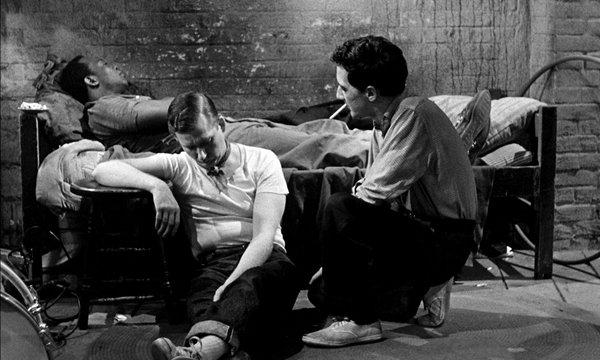
The Connection is part of Shirley Clarke centennial celebration at Film Forum

THE CONNECTION (Shirley Clarke, 1962)
Film Forum
209 West Houston St.
Tuesday, October 29, 12:30; Monday, November 4, 8:30; Tuesday, November 5, 2:30
Series continues through November 5
212-727-8110
filmforum.org
www.milestonefilms.com

“Now look, you cats may know more about junk, see,” square film director Jim Dunn (William Redfield) says midway through The Connection, “but let me swing with this movie, huh?” Adapted by Jack Gelber from his play and directed and edited by Shirley Clarke, The Connection — screening October 29 and November 4-5 in the Film Forum series “Shirley Clarke 100,” celebrating the hundredth anniversary of the New York City native’s birth — is a gritty tale of drug addicts awaiting their fix that was banned for obscenity after only two matinee screenings back in October 1962. In 2012 it was rereleased in a sharp new fiftieth-anniversary print, beautifully restored by Ross Lipman of the UCLA Film & Television Archive. In a New York City loft, eight men are waiting for their man: Leach (Warren Finnerty), the ringleader who has an oozing scab on his neck; Solly (Jerome Raphael), an intelligent philosopher who speaks poetically about the state of the world; Ernie (Garry Goodrow), a sad-sack complainer who has pawned his horn but still clutches tight to the mouthpiece as if it were a pacifier; Sam (Jim Anderson), a happy dude who tells rambling stories while spinning a hula hoop; and a jazz quartet consisting of real-life musicians Freddie Redd on piano, Jackie McLean on sax, Larry Richie on drums, and Michael Mattos on bass. Dunn and his cameraman, J. J. Burden (Roscoe Lee Browne), are in the apartment filming the men as Dunn tries to up the drama to make it more cinematic as well as more genuine. “Don’t be afraid, man,” Leach tells him. “It’s just your movie. It’s not real.”
When Cowboy (Carl Lee) ultimately shows with the stuff, Bible-thumping Sister Salvation (Barbara Winchester) at his side, things take a decidedly more drastic turn. Mixing elements of the French New Wave with a John Cassavetes sensibility and cinema verité style, Clarke made an underground indie classic that moves to the beat of an addict’s craving and eventual fix. Shot in a luridly arresting black-and-white by Arthur Ornitz, The Connection is like one long bebop jazz song, giving plenty of time for each player to take his solo, with standout performances by McLean musically and Raphael verbally. The film-within-a-film narrative allows Clarke to experiment with the mechanics of cinema and challenge the audience; when Dunn talks directly into the camera, he is speaking to Burden, yet he is also breaking the fourth wall, addressing the viewer. Cutting between Burden’s steady camera and Dunn’s handheld one, Clarke adds dizzying swirls that rush past like a speeding subway train. A New York City native, Clarke made such other films as The Cool World and Portrait of Jason and won an Academy Award for her 1963 documentary Robert Frost: A Lover’s Quarrel with the World. This new print of The Connection is part of Milestone Films’ Shirley Clarke Project, which has preserved and restored a quartet of her best work. “Shirley Clarke 100” continues through November 5 with screenings of The Cool World and Robert Frost: A Lover’s Quarrel with the World, shown with the shorts In Paris Parks and Christopher and Me.

WHITE LIGHT FESTIVAL — ZAUBERLAND: AN ENCOUNTER WITH SCHUMANN’S DICHTERLIEBE

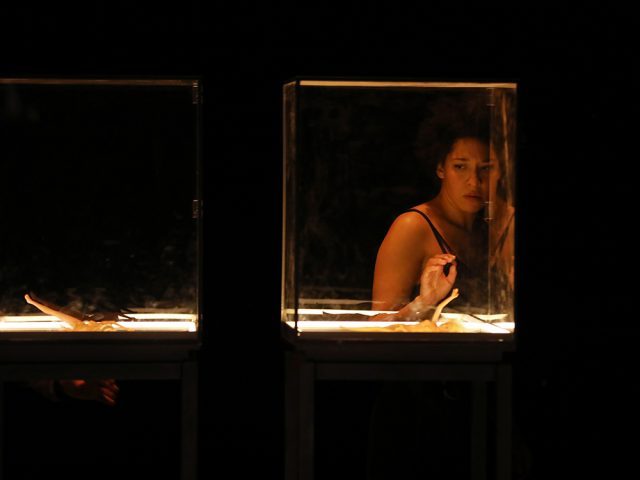
Soprano Julia Bullock plays a pregnant Syrian refugee in reimagined Schumann song cycle (photo copyright Patrick Berger)

Soprano Julia Bullock plays a pregnant Syrian refugee in reimagined Schumann song cycle (photo copyright Patrick Berger)

Gerald W. Lynch Theater at John Jay College
524 West Fifty-Ninth St. between Tenth & Eleventh Aves.
October 29-30, $35-$95
Festival continues through November 24
www.lincolncenter.org

English theater director Katie Mitchell transforms German composer and pianist Robert Schumann’s 1840 song cycle, Dichterliebe (“A Poet’s Love”), into a haunting tale about the European migrant crisis in Zauberland (“Magic Land”), making its New York premiere October 29-30 at Lincoln Center’s White Light Festival. A production of C.I.C.T. — Théâtre des Bouffes du Nord, the eighty-minute piece, staged in the Gerald W. Lynch Theater at John Jay College, features St. Louis-born rising star soprano Julia Bullock, the 2018-19 artist-in-residence at the Metropolitan Museum of Art and the 2019-20 artist-in-residence at the San Francisco Symphony, as a pregnant Syrian refugee fleeing Aleppo for the safer confines of Cologne, leaving her family behind. The original Lieder, with words by German writer Heinrich Heine from his Lyrisches Intermezzo, has been expanded with new text by British playwright Martin Crimp and music by Belgian composer and conductor Bernard Foccroulle, specifically created for Bullock.

The cast also includes Ben Clifford, Natasha Kafka, David Rawlins, and Raphael Zari, with Cédric Tiberghien on piano, sets and costumes by Chloe Lamford, and lighting by James Farncombe. Bullock is best known for Perle Noire: Meditations for Joséphine, a work about Josephine Baker she conceived with Peter Sellars; she has also appeared in Terence Blanchard’s Fire Shut Up in My Bones, John Adams’s Girls of the Golden West, and Leoš Janaček’s The Cunning Little Vixen, among other productions around the world, in addition to being a community activist. Schumann wrote Dichterliebe in the span of a week during a particularly productive time, the year he married Clara Wieck. It takes on a whole new meaning in this contemporary reimagination.

BAM NEXT WAVE FESTIVAL: HAMNET

(photo by Ernesto Galan)

Dead Centre makes its BAM debut with Hamnet (photo by Ernesto Galan)

BAM Fisher, Fishman Space
321 Ashland Pl.
October 30 – November 3, $25
718-636-4100
www.bam.org/hamnet
www.deadcentre.org

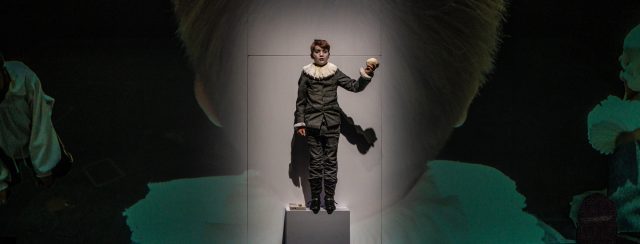
New BAM artistic director David Binder continues his season of BAM debuts with Hamnet, presented by Ireland’s Dead Centre. In 1585, William Shakespeare’s wife, Anne Hathaway, gave birth to twins, son Hamnet and daughter Judith. Hamnet died tragically in 1596 at the age of eleven; three years later, the Bard wrote perhaps his greatest play, Hamlet, at least partly about a young man haunted by the death of his father. Founded in 2012 by Bush Moukarzel and Ben Kidd and based between Dublin and London, Dead Centre has previously staged Beckett’s Room, Lippy, (S)quark!, Souvenir, Chekhov’s First Play, and Shakespeare’s Last Play; all but Lippy deal with writers, including James Joyce and Marcel Proust in addition to Samuel Beckett, Anton Chekhov, and Shakespeare. It has long been debated whether Shakespeare wrote Hamlet specifically in reaction to the death of his son, or whether Hamnet also inspired part of other works. For example, in King John, published in 1623, Constance says, “Grief fills the room up of my absent child.”

“Over centuries of feverish speculation, the most compelling reflections on the presence of Shakespeare’s emotional life in his plays — preeminently, James Joyce’s brilliant pages in Ulysses, but there are many others — have focused on Hamlet,” Shakespeare expert Stephen Greenblatt wrote in 2014 in the New York Review of Books. “This biographical attention to a work deriving from recycled materials and written for the public stage would seem inherently implausible, were it not for the overwhelming impression on readers and spectators alike that the play must have emerged in an unusually direct way from the playwright’s inner life, indeed that at moments the playwright was barely in control of his materials. I will attempt in what follows to trace Hamlet back to a personal experience of grief and to sketch a long-term aesthetic strategy that seems to have emerged from this experience.” The sixty-minute multimedia piece, running October 30 to November 3 at BAM Fisher, features text and direction by Moukarzel and Kidd, with dramaturgy by Michael West, set design by Andrew Clancy, costumes by Grace O’Hara, lighting by Stephen Dodd, sound by Kevin Gleeson, video by Jose Miguel Jimenez, and choreography by Liv O’Donoghue. Aran Murphy plays Hamnet, addressing the audience directly as he shares his tragic tale.

I LIKE WHAT I KNOW: AN EVENING OF ART, HORROR, AND FOOD CELEBRATING VINCENT PRICE

Vincent Price will be celebrated in film, food, and talk at Nitehawk Cinema on October 29

Vincent Price will be celebrated in film, food, and talk at Nitehawk Cinema on October 29

FILM FEAST
Nitehawk Cinema
188 Prospect Park West
Tuesday, October 29, $150, 7:00
nitehawkcinema.com

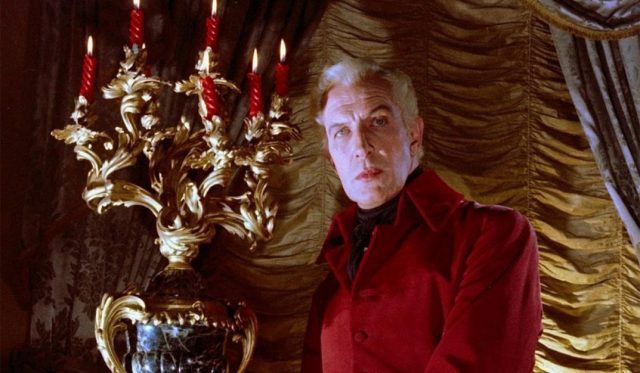
In addition to being a horror legend, St. Louis-born actor Vincent Price was an art collector and a chef, writing several books with his wife, Mary, including the indispensable A Treasury of Great Recipes, and the Vincent Price Art Museum houses his collection at East Los Angeles College. On October 29, just in time for Halloween, the Prospect Park Nitehawk Cinema will pay tribute to the wide-ranging legacy of the inimitable Price, who passed away in 1993 at the age of eighty-two, with the special one-time-only presentation “I Like What I Know: An Evening of Art, Horror, and Food Celebrating Vincent Price.” Part of Nitehawk’s Film Feast series, the festivities feature short videos of Price’s dedication to art; a conversation with Price’s daughter, author and inspirational speaker Victoria Price, moderated by Nitehawk programmer, curator, and writer Caryn Coleman; a screening of Roger Corman’s 1960 Edgar Allan Poe classic The Fall of the House of Usher, in which Price stars as Roderick Usher; Poe giveaways; and a four-course meal consisting of dishes inspired by the film and Price’s love of cooking, accompanied by wine and cocktails: “The Great Hamlet’s Dagger” (poached shrimp canape served on black bread with Aquavit cream and American paddlefish caviar, chives), “Duck Flambe Belle Terrasse” (roasted duck breast, potato rosti, fine herbs salad, and flambeed cognac sauce), “Kraft Suppe” (braised short rib served with marrow bone, celery and leek gremolata, roasted carrots, spaetzle, and rich beef broth), and tart aux framboise (raspberry tart with Scotch-scented pastry cream).

WAVE HILL: FALL OPERA, NATURE WALKS, PHOTOGRAPHY BOOK

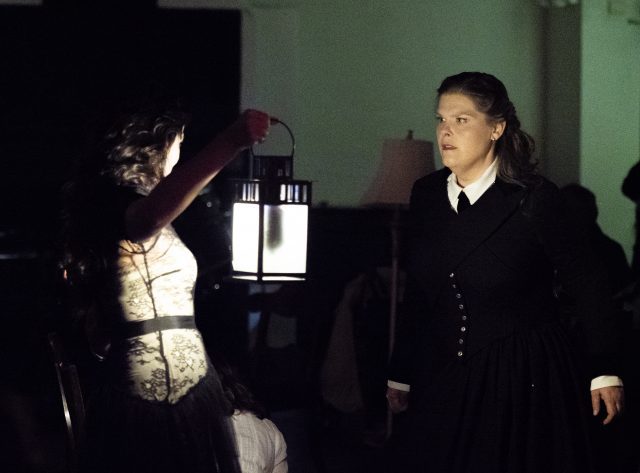
On Site Opera is presenting The Turn of the Screw at Wave Hill (photo by Pavel Antonov)

On Site Opera is presenting The Turn of the Screw at Wave Hill this weekend (photo by Pavel Antonov)

4900 Independence Ave. at West 249th St.
Grounds admission: $10 adults, $6 students and seniors, $4 children 6-18 (free Tuesdays & Saturdays 9:00 am – noon)
The Turn of the Screw: October 25-27, $75
Walks: free with admission unless otherwise noted
www.wavehill.org
osopera.org

There are many ways to experience Wave Hill, the magnificent twenty-eight-acre urban oasis on two former Bronx estates owned by George W. Perkins and transformed by landscape gardener Albert Millard. One of the most unusual, and wonderfully entertaining, is On Site Opera’s adaptation of Benjamin Britten’s 1954 opera The Turn of the Screw, which runs October 25-27, taking place in multiple locations in the Riverdale garden. With a libretto by Mifawny Piper, the chamber opera, based on the 1898 novella by Henry James, is a ghost story set in an English country house where a new governess (Jennifer Check) has arrived to take care of two creepy children, Flora (Ashley Emerson) and her brother, Miles (Jordan Rutter); the house is run by Mrs. Grose (Margaret Lattimore) and is also home to the deceased Peter Quint (Dominic Armstrong), who has a past with Miles, and Miss Jessel (Adriana Zabala), who is uncomfortably close with Flora. The opera begins at the Pergola, overlooking the Hudson River and the Palisades; everyone is given an old-fashioned lantern to carry to light the dark night and help them find their way when the action moves down a path to Wave Hill House, where it continues first in the Mark Twain Room, then in the lovely, cavernous Armor Hall.

The orchestra, conducted by Geoffrey McDonald, features members of the American Modern Ensemble: Max Moston and Victoria Paterson on violin, Philip Payton on viola, Dave Eggar on cello, Roger Wagner on bass, Sato Moughalian on flute, Keve Wilson on oboe, Pascal Archer on clarinet, Charles McCracken on bassoon, Kyle Hoyt on horns, Katie Andrews on harp, Clara Warnaar on percussion, and Jonathan Heaney on keyboards. The opera is directed by Eric Einhorn, with costumes by Amanda Seymour and lighting by Shawn K. Kaufman. There is at least a half hour of standing, so wear comfy shoes, and download the special app that streams the supertitles. The grounds are open for ticket holders, so you can arrive early and wander around on your own. Up next for On Site Opera is Gian Carlo Menotti’s Amahl and the Night Visitors at the Holy Apostles Soup Kitchen December 4-8 and Luigs & Warrender’s Das Barbecü at Hill Country Barbecue Market in the Flatiron District January 26 to February 11.

wave hill book

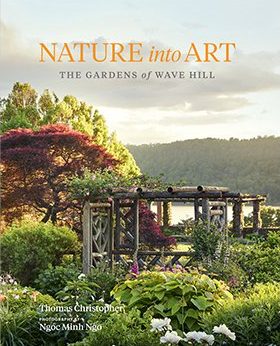
“Gardening is often likened to painting, but really it has more in common with dance,” Thomas Christopher writes in the new book Nature into Art: The Gardens of Wave Hill (Timber Press, September 2019, $40), which shows off the beauty of the Riverdale gardens with gorgeous photography by Ngoc Minh Ngo. “It’s true that gardeners use color, texture, and form in much the same way as do painters, and there is a similar striving to create a composition or view. But like a dance, a garden is a performance through and with time. Unlike a painting, a garden isn’t static; the planting is just a beginning.” (The word opera can replace dance in that sentence without changing the meaning; you can see dance at Wave Hill every spring and summer.) Christopher and Minh journey through the Flower Garden, the Gold Border, the Monocot and Aquatic Gardens, the Shade Border, the Wild Garden, the Alpine House and Troughs, the Herb and Dry Gardens, the Elliptical Garden, and the Conservatory. They also focus on “Wave Hill Through the Seasons”: “This is perhaps the greatest strength of Wave Hill. Its scenes change from day to day and week to week,” Christopher explains. “The colors wax and wane, the foliage changes hue with the seasons, bursting out in spring, settling into summer, flaring in autumn, and then falling away with winter’s onset to reveal the underlying sculpture of the trunks and branches. Some of the transient beauties are fortuitous, of course, but the main outlines of the seasonal displays, the transformations, are planned as carefully as a dancer works out a sequence of steps.” Some of Ngo’s framed photographs from the book, along with work from a new series, are on view in Wave Hill House in the exhibition “Wave Hill Florilegium” through the end of the year.

You can get a personal look at fall at Wave Hill in a series of guided walks, most of which are free with admission to the grounds and some of which require advance registration.

Saturday, November 2
Artist-Led Woodland Walk, with Bahar Behbahani, tracing water flow on the Conifer Slope and in the Herbert and Hyonja Abrons Woodland, 3:00

Sunday, November 3
Forest Bathing: Celebrating Change and the Changing Seasons, with certified forest therapist Gerti Schoen, adults only, $30, 10:00

Wednesday, November 6
Fall Foliage Walk, with senior horticultural interpreter Charles Day, 1:00

Saturday, November 9
Wings over Wave Hill Weekend: Avian Adventures Family Walk, with environmental educator Olivia Kalin, 1:00

Monday, November 11
Wings over Wave Hill Weekend: Garden Walk — Birds and the Winter Garden, with NYC Audubon birding guide and naturalist Tod Winston and senior horticultural interpreter Charles Day, 11:00

WESTERN STARS

Western Stars

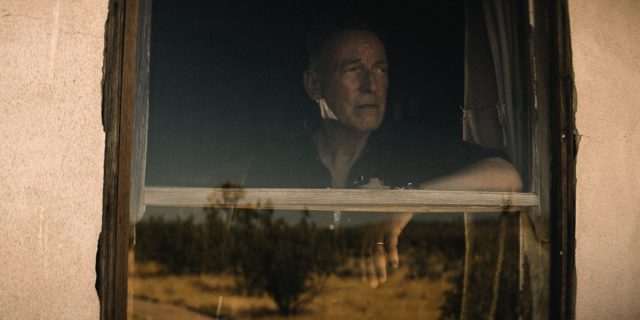
Bruce Springsteen takes a deep look into his life in Western Stars (photo courtesy Warner Bros.)

WESTERN STARS (Thom Zimny & Bruce Springsteen, 2019)
Opens Friday, October 25
brucespringsteen.net
www.warnerbros.com

Bruce Springsteen continues his very public deep dive into his psyche and sense of self with the documentary Western Stars, which opens in theaters on October 25. The movie is part of an unofficial trilogy that began with the 2016 memoir Born to Run and was followed by Springsteen on Broadway. Bruce’s (mostly) one-man show ran at the Walter Kerr Theatre for more than a year, concluding in mid-December 2018, and it earned him a special Tony; Western Stars premiered in early October at the Toronto International Film Festival. In June, Springsteen released his nineteenth studio album, Western Stars, a gorgeous collection of swirling California pop songs, paying tribute to the likes of Jimmy Webb, Burt Bacharach, and Glen Campbell, about characters from the West facing loneliness as they grow older. Bruce opted not to tour behind the album and instead decided to make a film highlighting the music while adding thoughtful, poignant narration, ruminating on character, faith, change, moving forward, and growing wiser with age.

Bruce headed into his hundred-year-old barn on his Colts Neck farm in New Jersey and performed the album live for a small, intimate group of friends and relatives, who sit at small tables as if at a nightclub, politely clapping after some songs. Bruce is joined by his wife, Patti Scialfa, on acoustic guitar and vocals; backup singers including E Street Band violinist Soozie Tyrell; a horn section with regular Bruce sideman Curt Ramm; E Streeter Charlie Giordano on piano and accordion; and a thirty-piece string orchestra. The songs are not mere re-creations from the album but are given more life and breadth here, with dazzling, lush versions of “Hitch Hikin’,” “The Wayfarer,” “Tucson Train,” “Chasin’ Wild Horses,” “Hello Sunshine,” and others; he turns “Stones” and “Moonlight Motel” into powerful duets with Scialfa, who does not sing on the record. (He has called the film a “love letter” to Scialfa.) He also adds a bonus encore that is tremendous fun.

(photo courtesy Warner Bros.)

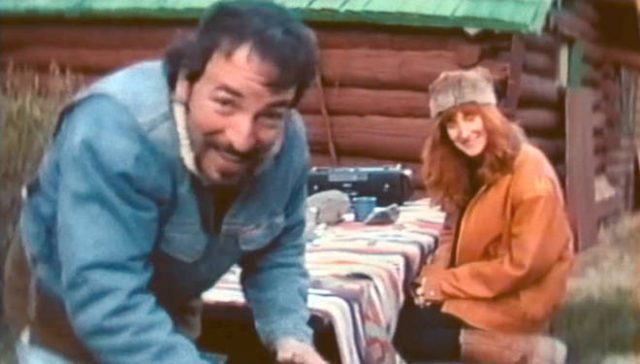
Bruce and Patti pose for the camera on their honeymoon in Western Stars (photo courtesy Warner Bros.)

In between each song, Bruce talks either on camera or in voice-over about the upcoming tune and/or his state of mind as cinematographer Joe DeSalvo films him around the farm and follows him as he visits with his horses and goes to Joshua Tree National Park in Southern California. Codirected by Springsteen and his longtime collaborator and videographer, Thom Zimny, the film features an inordinate amount of shots of Bruce driving around in cars, donning cowboy hats, examining himself in mirrors, looking out in the distance contemplatively, driving around some more, and putting on more cowboy hats amid close-up after close-up of his expressive face. “The older you get, the heavier that baggage becomes that you haven’t sorted through, so you run. I’ve done a lot of that kind of running,” he admits, waxing philosophic in his gravelly, distinctive voice. “Change — how do you change yourself?” he asks. “It’s easy to lose yourself or never find yourself.” he explains. Zimny intercuts vintage home movies from the Springsteen family archive, including Bruce as a child and, later, in a sweetly romantic moment with Patti at a picnic on their honeymoon, all with new instrumental music playing underneath.

Just as with his autobiography and Broadway show, Springsteen brings up personal flaws and his intense difficulty finding true and complete happiness, powerful stuff coming from an ultra-successful artist in a happy marriage with three apparently good kids. “We all have our broken pieces. . . . In this life, nobody gets away unhurt,” he opines. His vision of the mythological American male in the West is not John Wayne’s, and it’s not Sam Shepard’s or the Beach Boys’ either; in fact, in the title track, the narrator is a minor actor whose claim to fame is that he was shot by the macho Wayne at the end of a movie (“That one scene bought me a thousand drinks / Set me up and I’ll tell it for you, friend”). In the bright-sounding “Hello Sunshine,” Springsteen is not so much welcoming the sun but practically begging it to not go away. “Had enough of heartbreak and pain / Had a little sweet spot for the rain / For the rain and skies of gray / Hello sunshine, won’t you stay,” he sings, with more than a touch of desperation. As he noted on his 1988 Tunnel of Love Express tour, “It’s a dark ride,” but as always with Bruce, it’s another one worth taking.