twi-ny recommended events

PLAY IT LOUD: INSTRUMENTS OF ROCK AND ROLL

Joan Jett Melody Maker, 1977 Gibson (photo by twi-ny/mdr)

Joan Jett’s 1977 Melody Maker Gibson is part of Met exhibition “Play It Loud” (photo by twi-ny/mdr)

Metropolitan Museum of Art, Met Fifth Ave.
Gallery 199
1000 Fifth Ave. at 82nd St.
Through Through October 1, $25 suggested admission
212-535-7710
www.metmuseum.org

In 2011, the Met hosted “Guitar Heroes: Legendary Craftsmen from Italy to New York,” focusing on the lutherie tradition of Italian Americans in New York and New Jersey, artisans making violins, mandolins, guitars, and other stringed instruments. In the current exhibition “Play It Loud: Instruments of Rock & Roll,” the Met turns it up to eleven, celebrating the stringed and nonstringed apparatus of rock and pop music since the 1950s. In Mott the Hoople’s 1973 staple “All the Way from Memphis,” Ian Hunter refers to his guitar as a “six-string razor,” an “axe,” and “electric junk.” He continues: “Some dude said, ‘Rock ’n’ rollers, you’re all the same / Man, that’s your instrument.’ / I felt so ashamed.” Ian and Mott might not be represented in the Met exhibit — or in the Rock and Roll Hall of Fame — but there’s nothing for anyone to be ashamed of regarding this exciting collection of nearly two hundred items, with most of the instruments displayed in vitrines, like sculptural works of art, which of course they are.

(photo by twi-ny/mdr)

Keith Emerson’s 1960s Modified Hammond L-100 organ features two knives Emerson would stab the keys with (photo by twi-ny/mdr)

Don’t go straight to the labels, which contain information about who made the instrument and who played it on what songs; it’s a lot of fun trying to figure out whose instrument it is. You’re likely to guess twangers by Rick Nielsen of Cheap Trick, Prince, Bo Diddley, Buddy Holly, Ravi Shankar, and Bruce Springsteen, but others will surprise and delight you. One of the first items you’ll encounter is Jerry Lee Lewis’s 1955 Petite Grand Piano; for some reason, the signage refers to Lewis, who is eighty-three, in the past tense. Among the many gems are Chuck Berry’s 1958 Gibson, Louis Jordan’s 1954 Mark VI alto saxophone, Muddy Waters’s 1958 Telecaster known as “the Hoss,” Les Paul’s 1942 “Klunker,” Jimi Hendrix’s 1967 “Love Drops” Flying V, Joni Mitchell’s 1978 GB10NT George Benson Signature, Jack White’s 1964 Airline Res-O-Glas, Joe Perry’s 1985-86 X-100 Blade Runner, Stevie Ray Vaughan’s 1963 “Number One” composite Stratocaster, Robert Trujillo’s 2007–08 “Aztec De La Chloe” five-string bass, Keith Emerson’s 1968 Customized Moog Modular Synthesizer with keyboard, ribbon controllers, and stand, Ian Anderson’s 1975 Model 18-0 flute, Lady Gaga’s 2014 ARTPOP piano with custom housing, and Paul Stanley’s 1979–80 Cracked Mirror Iceman in addition to instruments played by Duane Allman, the Edge, Angus Young, Jeff Beck, Flea, Patti Smith, Ray Manzarek, Paul Butterfield, Nancy Wilson, Clarence Clemons, Steve Vai, Neil Young, Tina Weymouth, Bob Dylan, and dozens more.

(photo by twi-ny/mdr)

Met exhibition is not just about classic guitars (photo by twi-ny/mdr)

These are not mere artifacts; Jerry Garcia’s Wolf was taken out of the museum so John Mayer could play it at a recent Dead & Co. show at CitiField, and a Stones guitar is out on the road with the band right now. There are several striking guitars from Met fave Steve Miller, who will playing a show in the Grace Rainey Rogers Auditorium on September 28 and contributed to the 2011 “Guitar Heroes” exhibit. Don’t miss Kurt Cobain’s destroyed 1993 left-handed Fender Stratocaster, Eric Clapton’s trippy 1964 “The Fool” SG (and the original headstock, which earns its own vitrine), Pete Townshend’s 1973 Gibson SG Special (which he smashed during a photo shoot and is now encased in Lucite), and a fragment of Hendrix’s 1967 Monterey Pop Fender Stratocaster, which he famously lit on fire. Four guitar greats tell their stories in a circular case that houses their gear and video monitors: Jimmy Page, Keith Richards, Eddie Van Halen, and Tom Morello. (Having seen Morello shred live, I understand exactly why he’s part of this elite quartet.) Several bands display their stage setup, including the Beatles, the Who, Metallica, and the Roots. The exhibition, which was inspired by Brad Tolinski and Alan di Perna’s book Play It Loud: An Epic History of the Style, Sound, and Revolution of the Electric Guitar and is co-organized by the Met’s Jayson Kerr Dobney and the Hall of Fame’s Craig J. Inciardi, is supplemented by vintage concert posters by Lee Conklin, Bonnie MacLean, Rick Griffin, and others. It’s easy to argue why certain musicians are not part of the show (What, no Richard Thompson or Lou Reed?!? Where’s Ritchie Blackmore, Bob Mould, and Johnny Ramone?), but it’s better to just enjoy who is in it. Below are the remaining special events being held in conjunction with the exhibition, which runs through October 1.

Prince Love Symbol, 1993

Prince’s 1993 Love Symbol captures his trademark glyph (photo by Cathy Hapka for twi-ny)

Saturday, September 7
Black Rock Coalition: History of Our Future, with the BRC Orchestra, Fantastic Negrito, Nona Hendryx, Vernon Reid, Corey Glover, and Will Calhoun, “Captain” Kirk Douglas, Stew, the Family Stand, Carl Hancock Rux, and Toshi Reagon, Grace Rainey Rogers Auditorium, $25, 7:00

Sunday, September 8
Sunday at the Met — Play It Loud: Instruments of Rock and Roll, panel discussion with Anthony DeCurtis, David Fricke, Holly George-Warren, Jayson Dobney, and Craig J. Inciardi, Grace Rainey Rogers Auditorium, free with Museum admission, 2:00

Friday, September 13
MetFridays: Play It Loud — ETHEL and Friends: Four for Fighting, Great Hall Balcony Bar, 5:00–8:00; screening of Woodstock (Michael Wadleigh, 1970), Bonnie J. Sacerdote Lecture Hall, 6:00; Conversations with . . . curators Jayson Dobney and Craig J. Inciardi, Gallery 199, 6:00; Signs and Symbols of Rock and Roll, with designers from ThoughtMatter, a band-name generator, and a button workshop, Great Hall, 6:00; Building Instruments with Atelier Rosenkrantz, Gallery 681, 6:00; Tie-Dye Workshop, Carroll Classroom, 6:00; Reflections on Woodstock with Chris Molanphy, Art Study Room, 6:30; Lez Zeppelin Live, preceded by discussion with Steph Paynes and Brad Tolinski, free with advance RSVP, Grace Rainey Rogers Auditorium, 7:15; all free with museum admission, 5:00–9:00

Saturday, September 28
Steve Miller Band and Jimmie Vaughan Band in Concert, Grace Rainey Rogers Auditorium, 7:00

BETRAYAL

(photo by Marc Brenner)

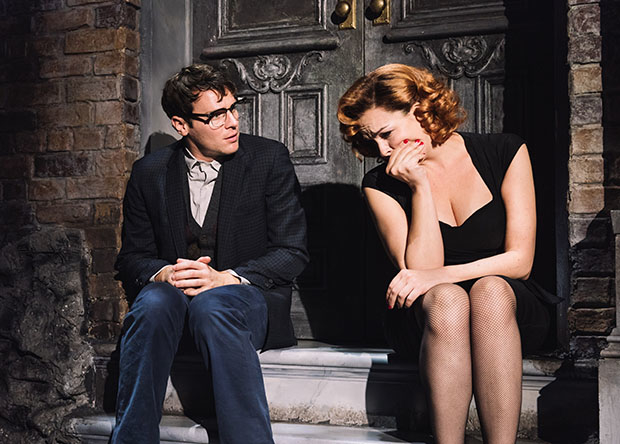
Jerry (Charlie Cox), Emma (Zawe Ashton), and Robert (Tom Hiddleston) are caught up in a circular love triangle in Betrayal (photo by Marc Brenner)

Bernard B. Jacobs Theatre
242 West 45th St. between Broadway & Eighth Ave.
Tuesday – Sunday through December 8, $25 – $189
betrayalonbroadway.com

Jamie Lloyd’s minimalist reimagining of Harold Pinter’s Betrayal, which opened tonight at the Jacobs, is not just a great revival; it’s a wholly new, brilliant work of art that is so fresh and alive that I feel like I’ve never seen the play before, although I have twice. Inspired by Pinter’s real-life affair with Joan Bakewell, Betrayal goes backward in time as it details a circuitous love triangle involving gallery owner Emma (Zawe Ashton), her husband, book publisher Robert (Tom Hiddleston), and his best friend, literary agent Jerry (Charlie Cox). The story begins in 1977, as Jerry and Emma meet two years after their long affair ended, and concludes in 1968, when they first became attracted to each other. It’s like a mystery where you know who the killer and victim are but now have to find out what led to that outcome. Except in Betrayal there are no victims; all three protagonists are complicit in the lies and deceit that are deconstructed over the course of ninety tense minutes. (Perhaps the only victim is Jerry’s unseen wife, Judith.)

The suspense starts at the rise of the curtain, which reveals Soutra Gilmour’s stark set, featuring three chairs and the three characters standing in front of a long, L-shaped marble wall. Jerry and Emma each grab a chair and move to the tip of the stage, where they sit down and share intimate details of their relationship. It’s uncomfortable in an exciting yet unsettling way, getting right in the face of the audience; meanwhile, Robert stands in the back, as if a ghost listening in, the cuckold all alone. Throughout the play, as it travels in reverse chronology, the three characters are onstage nearly the entire time, moving the chairs around as they go from a bar to a restaurant to a furnished room, from England to Italy. In most of the scenes, two of them are speaking while the other hovers cryptically, although all three appear together a few times, amplifying the dynamic among them. They wear the same clothes through most of the play — Gilmour designed the costumes as well — as if they are trapped by time. The set also includes two rotating sections, slowly spinning the characters in circles, mimicking their relationships, especially at one dazzling moment when one circle goes clockwise, the other counterclockwise, leaving the audience awed and nearly dizzy. Jon Clark’s lighting amplifies the suspense, creating eerie shadows as the wall moves up and back.

(photo by Marc Brenner)

Emma (Zawe Ashton) considers her predicament in Pinter revival (photo by Marc Brenner)

All three characters lie, emitting falsehoods that are so intertwined with who they are that it’s impossible to take anything they say at face value. Their memories are untrustworthy too; for example, Jerry keeps forgetting whose kitchen he was in when he threw Charlotte, Emma and Robert’s daughter, up in the air, a seemingly insignificant fact that he just can’t get right, if we are to believe Emma. Lloyd (Assassins, Pinter’s The Caretaker) makes the most of Pinter’s trademark pauses and silences, incorporating specialized movement and incidental sound and music by Ben and Max Ringham; he even slyly includes a snippet of Susan Boyle’s haunting version of Depeche Mode’s “Enjoy the Silence.”

The three leads are phenomenal in a play that has always been a big-name vehicle. Raul Julia, Blythe Danner, and Roy Scheider teamed up in the Broadway debut in 1980, Liev Schreiber, Juliette Binoche, and John Slattery joined together for the 2000 revival, and Daniel Craig, Rachel Weisz, and Rafe Spall starred in Mike Nichols’s 2013 iteration; the 1983 film boasted Jeremy Irons, Patricia Hodge, and Ben Kingsley. The tall, lithe, classically trained Hiddleston (The Avengers, Othello) is elegant and graceful as Robert, a potent counterpart to Cox’s (Daredevil, Incognito) more earthy and straightforward Jerry; their longtime bromance adds an extra dimension to their individual relationships with Emma, who is stunningly portrayed by novelist, playwright, film director, and actress Ashton (Velvet Buzzsaw, Gone Too Far!); it is easy to see why both men fall in love with her. Emma is smart, beautiful, and ambitious, enticingly barefoot throughout, a woman who knows what she wants and is not afraid to go after it, but she doesn’t necessarily fully contemplate the potential consequences of her decisions. Eddie Arnold is humorous as the waiter in an Italian restaurant, but this Betrayal is not a dark tale in need of comic relief. I had never thought of it as a comedy, but it is surprisingly laugh-out-loud funny, particularly in Hiddleston’s often satirical delivery.

(photo by Marc Brenner)

Zawe Ashton, Charlie Cox, and Tom Hiddleston excel in Jamie Lloyd revival of Betrayal at the Jacobs (photo by Marc Brenner)

Theater is different from books and movies in that you can see plays multiple times in unique adaptations, each making their own mark on the story, for good or bad. You can read a book or see a film more than once, but it doesn’t change, although you do. With Betrayal, Lloyd has breathed new, vital life into Pinter’s nearly forty-year-old Olivier Award winner. In the opening scene, Emma tells Jerry, “It’s nice, sometimes, to think back. Isn’t it?” He replies, “Absolutely.” It’s also more than nice to think forward. Don’t miss this opportunity to see this profound, organic interpretation that captures the heart and soul of Pinter’s bold original.

NYU SKIRBALL FALL 2019 SEASON

Skirball

Joanne Akalaitis’s site-specific Bad News! I Was There . . . leads small audiences through the Skirball Center

NYU Skirball Center for the Performing Arts
566 La Guardia Pl.
September 6 – December 9
212-992-8484
nyuskirball.org

NYU Skirball’s mission is to “present work that inspires yet frustrates, confirms yet confounds, entertains yet upends.” They are staying true to their goals with an extremely impressive and daring fall season of music, theater, dance, literature, and talks. The season gets under way September 6-8 ($40) with the New York City premiere of former New York Shakespeare Festival head and five-time Obie winner Joanne Akalaitis’s Bad News! I Was There . . . , a site-specific performance in English, Greek, French, and German that takes four groups through the lobby, dressing room, and backstage area of the theater, mixing in sung and spoken excerpts from classic Greek tragedy. “‘I was there’ is a refrain heard every day on the news, often followed by ‘How can this happen? What’s wrong here? What should we do?’” Akailitis says about the show.

Philippe Quesne’s The Moles, set in a world without humans and words, consists of four presentation September 12-14: “Parade of the Moles,” a free tour of Greenwich Village on Thursday at 2:00; “Night of the Moles” on Friday and Saturday night ($30, 7:30), taking place in a burrow; and the family-friendly “Afternoon of the Moles” on Saturday afternoon ($20, 7:30), as the Moles form a punk band. If you missed Sam Mendes’s brilliant production of The Lehman Trilogy at the Park Avenue Armory, you can catch one of two “National Theatre Live” screenings at the Skirball on September 15 ($25, 2:00 & 7:00) On September 16, “NYU Writes: A Celebration of Writers and Writing at NYU” brings together Jeffrey Eugenides, Jonathan Safran Foer, Terrance Hayes, Yusef Komunyakaa, Nick Laird, Sharon Olds, and Zadie Smith, hosted by Deborah Landau (free with advance RSVP, 7:00).

(photo by Andrew Lieberman)

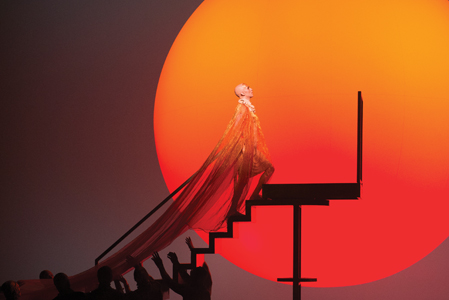
Daniel Fish reimagines Don DeLillo’s White Noise in multimedia production (photo by Andrew Lieberman)

Tony nominee Daniel Fish follows up his controversial reimagining of Oklahoma! with White Noise, a seventy-minute multimedia show “freely inspired” by Don DeLillo’s 1985 National Book Award-winning novel. Zoe Coombs Marr, Ursula Martinez, and Adrienne Truscott take on critics in Wild Bore September 27-28 ($35-$45, 7:30). And that just takes us through September; below are some of the highlights from October to December:

Sunday, October 6
National Theatre Live: Fleabag, $25, 7:00

Friday, October 11
and
Saturday, October 12

John Kelly: Underneath the Skin, $35-$45, 7:30

John Kelly channels Samuel Steward in show at Skirball

John Kelly channels Samuel Steward in show at Skirball

Friday, October 18
and
Saturday, October 19

ICE: George Lewis’s Soundlines — A Dreaming Track, $35-$45, 7:30

Friday, October 25
and
Saturday, October 26

Mette Ingvartsen: to come (extended), US premiere, $35-$45, 7:30

Friday, November 8
and
Saturday, November 9

Big Dance Theater: The Road Awaits Us, Ballet, Cage Shuffle: Redux, $35-$45, 7:30

Friday, December 7
and
Saturday, December 8

The Builders Association: Elements of Oz, $20-$25, 7:30

POLYESTER WITH JOHN WATERS AND KEN KING

Polyester

Francine Fishpaw (Divine) faces a series of suburban dilemmas in John Waters’s odoriferous Polyester

POLYESTER (John Waters, 1981)
IFC Center
323 Sixth Ave. at West Third St.
Thursday, September 5, 7:00 & 9:15
212-924-7771
www.ifccenter.com

Camp champ John Waters will be at IFC Center on September 5 for a Q&A and extended introduction at two screenings of a new 4K restoration of his cult classic suburban satire Polyester, joined by costar Ken King, who plays Baltimore Foot Stomper Dexter Fishpaw. The crudely rambunctious film follows the misadventures of the Job-like Francine Fishpaw, ravishingly portrayed by drag queen extraordinaire Divine. Her God-fearing life takes a bitter turn when she catches her nasty, demanding husband, porn purveyor Elmer (David Samson), with his sexpot secretary, Sandra Sullivan (Mink Stole). Her status in the community, so precious to her, is ruined as she becomes an alcoholic, unable to rein in her wildly promiscuous daughter, Lu-Lu (Mary Garlington) — who has the hots for bad boy Bo-Bo Belsinger, played by Dead Boys frontman Stiv Bators!! — or her inhalant-abusing foot-fetishist son. She also receives no emotional or financial support from her skunk of a mother, La Rue (Joni Ruth White). The only one who stands by her is her ultra-strange, simple-minded bestie, the Baby Jane-like although kindhearted Cuddles Kovinsky (Edith Massey), but she finds a glimmer of hope in a handsome hunk of a he-man (Hollywood heartthrob Tab Hunter!!) who tantalizingly keeps showing up on her radar in a flashy white sports car, like Suzanne Somers does to Richard Dreyfuss in American Graffiti.

Polyester

Francine (Divine) falls for the hunky Todd (Tab Hunter) in Polyester

When the Douglas Sirk-inspired Polyester premiered in May 1981 at the old Waverly, which became the IFC in 2005, it was shown in Odorama — each moviegoer was given a scratch-and-sniff card of ten smells that were signaled by the corresponding number blinking on the screen. (I unfortunately still remember number nine all too well.) It’s not just a gimmick; in the movie, Francine is constantly sniffing around like an animal, though she is not so much hunting prey as being prey. The acting is about as over the top as it gets and the editing and camerawork DIY sloppy as writer, producer, and director Waters, who had previously made such films as Pink Flamingos and Female Troubles and would go on to make Cry-Baby, Serial Mom, and Hairspray, addresses such issues as pornography, abortion, religion, addiction, marriage, class, fat shaming, parenting, and the movies themselves with a brash sense of humor that can never go too low. Baltimore native Waters fills the film, his first major hit, with his usual Dreamlanders cast of oddball actors; in addition to Divine, Massey, and Stole, you’ll find Susan Lowe, Cookie Mueller, George Hulse, Mary Vivian Pearce, Sharon Niesp, Jean Hill, George Figgs, and Marina Melin in small roles. The score features a trio of songs — Hunter sings the title track, written by Chris Stein and Debbie Harry of Blondie, while Bill Murray warbles Harry and Michael Kamen’s “The Best Thing.” Nearly forty years later, Polyester is still like nothing you’ve ever seen before, a wacky work that established Waters in popular culture as a unique auteur with his own unique cinematic language.

WHITNEY BIENNIAL 2019

(photo by twi-ny/mdr)

Nicole Eisenman’s aptly named Procession nearly proceeded out of the Whitney Biennial (photo by twi-ny/mdr)

Whitney Museum of American Art
99 Gansevoort St.
Wednesday – Monday through September 22, $18-$25 (eighteen and under free; pay-what-you-wish Fridays 7:00 – 9:30)
Some programs require advance registration and/or tickets
212-570-3600
whitney.org

The most viscerally entertaining work at the 2019 Whitney Biennial is Nicole Eisenman’s aptly named Procession, which first proceeded onto the sixth floor terrace, then nearly proceeded out of the building. The France-born, Brooklyn-based artist was part of a protest against the Whitney’s vice chairman, Warren Kanders, whose Safariland company makes tear-gas canisters, among other items used by security forces on civilians around the world. Eight artists — Eisenman, Michael Rakowitz, Korakrit Arunanondchai, Meriem Bennani, Nicholas Galanin, Eddie Arroyo, Agustina Woodgate, and Christine Sun Kim — demanded their work be removed from the biennial as long as Kanders remained on the board; they were responding to an original call for a boycott made by Hannah Black, Ciarán Finlayson, and Tobi Haslett. Two years ago, artist and writer Black argued that Dana Schutz’s painting Open Casket, depicting Emmett Till in his coffin, “must go,” claiming it was cultural appropriation. The Whitney decided to add signage to Schutz’s canvas, explaining the controversy and letting viewers decide for themselves. But this time around, the Whitney agreed to pull the contributions from the eight artists — only to stop when Kanders resigned from the board, not admitting any guilt but not wanting the story to “undermine the important work of the Whitney.”

(photo by twi-ny/mdr)

Agustina Woodgate’s National Times erases “master/slave” time (photo by twi-ny/mdr)

The site-specific Procession is an oddball collection of near-mythical bronze and plaster figures trudging along, a mix of classical and contemporary styles. Visitors are allowed to walk on the platform and get up close to the individual elements, which contain plenty of humor; watch out for the gaseous release. If you’d like to comment on the piece, Eisenman has a message for you: “How’s my sculpting? Call 1-800-EAT-SHIT.” Meanwhile, after much consternation, Marcus Fischer opted to keep his audio installation, Ascent/Dissent, in the Allison and Warren Kanders Stairway as a tribute to Felix Gonzalez Torres’s Untitled (America) string of lightbulbs that hang down the center of the stairwell. For more on the Kanders situation, Forensic Architecture’s eye-opening Triple-Chaser digs deep into the making and distribution of tear-gas canisters using an AI algorithm.

(photo by twi-ny/mdr)

Joe Minter’s ’63 Foot Soldiers is composed of found objects (photo by twi-ny/mdr)

The rest of the survey of twenty-first-century American art is, as always, a hit-or-miss affair, with many works dealing with international sociopolitical issues. Alexandra Bell’s Friday, April 21, 1989 — Front Page looks at how the New York Daily News reported the Central Park Five case. Bennani’s Mission Teens invites viewers to sit in a tropical “video viewing garden” to experience her films on colonialism. Robert Bittenbender uses garbage he collected in Long Island City to create wall sculptures that comment on gentrification. Kota Ezawa’s large-scale animation National Anthem was made from smaller watercolors of football players taking a knee during “The Star-Spangled Banner.” Sofía Gallisá Muriente explores the fraught relationship between mainland America and Puerto Rico in Lluvia con Nieve (Rain with Snow), as does Daniel Lind-Ramos in his found-object sculptures Sentinels and Maria-Maria; the latter reimagines the Virgin Mary through Hurricane Maria, which devastated his homeland.

Calvin Marcus (1988-), Los Angeles Painting, 2018. Watercolor and vinyl paint on linen, 79 x 101 5/8 in. (200 x 258 cm). Image courtesy the artist; Clearing, New York and Brussels; and David Kordansky Gallery, Los Angeles

Calvin Marcus, Los Angeles Painting, watercolor and vinyl paint on linen, 2018 (image courtesy the artist; Clearing, New York and Brussels; and David Kordansky Gallery, Los Angeles)

Three videos by Ilana Harris-Babou take on such issues as reparations and redlining. Joe Minter’s ’63 Foot Soldiers uses found materials, including license plates, signs, helmets, sneakers, and a small flag, to reference the civil rights movement and the current state of wealth and class inequality. Woodgate’s National Times consists of clocks keeping “master/slave” time, the minute hand equipped with sandpaper that slowly erases the numbers. In My Soul Remainer, ballet star Jock Soto dances to Laura Ortman’s violin, playing a combination of musical notes and environmental sounds amid a mountain landscape. On select Fridays, Saturdays, and Sundays, five dancers (Hector Cerna, Tiffany Mangulabnan, Charles Gowin, Violetta Komyshan, Josep Maria Monreal Vidal, Amy Saunder, Mauricio Vera, Allison Walsh, Jennifer Whalen, Tyler Zydel) move within Brendan Fernandes’s The Master and Form scaffold-like installation, in which the performers get ready at individual spots where they interact with ash wood and leather works on black carpets, their bodies mimicking the shape of the sculpture, then inhabit a central scaffold-like installation that looks like it belongs in a children’s playground before grabbing on to floor-to-ceiling ropes lined up in front of full-length windows.

(photo by twi-ny/mdr)

Brendan Fernandes’s The Master and Form is performed Fridays, Saturdays, and Sundays (photo by twi-ny/mdr)

Two of the most striking images in the show are Curran Hatleberg’s Untitled (Camaro), a photograph of a red Camaro stuck on top of two dumpsters in a junkyard, and Calvin Marcus’s gorgeous Los Angeles Painting, a fiery red future visible through a car windshield; both can be seen as harbingers of doom, a theme that hovers over this biennial, though the exhibit, curated by Jane Panetta and Rujeko Hockley, is not without hope. Also keep an eye out for impressive works by Simone Leigh, Brian Belott, Todd Gray, Maia Ruth Lee, and the late Barbara Hammer. Below are the remaining special screenings and live performances; some require advance tickets or RSVP.

Thursday, September 5
and
Saturday, September 7

Autumn Knight: Sanity TV, third floor, Susan and John Hess Family Theater, $10, 7:30

Saturday, September 7
Whitney Block Walk, free with advance RSVP, 4:30, 5:00, 5:30, 6:00

Friday, September 13
Steffani Jemison with Garrett Gray: On Similitude, third floor, Susan and John Hess Family Theater, $10, 7:30

Saturday, September 14
Whitney Block Walk, free with advance RSVP, 4:30, 5:30

Sunday, September 15
From Seneca Village to Brooklyn: A Conversation with Tomashi Jackson, with Tourmaline, Tsubasa Berg, Diana diZerega, Jonathan Kuhn, Meredith B. Linn, Kelly Mena, K-Sue Park, Nan Rothschild, Marie Warsh, and Stephen Witt, third floor, Susan and John Hess Family Theater, free with advance RSVP, 7:30

Thursday, September 19
Madeline Hollander — Ouroboros: Gs, Pamella and Daniel DeVos Family Outdoor Largo, free with museum admission, 5:00 – 9:00

Friday, September 20, 7:00
and
Saturday, September 21, 4:00

What Was Always Yours and Never Lost, short films followed by a Q&A with curator Sky Hopinka and some of the filmmakers, Susan and John Hess Family Theater, $10

MAKE BELIEVE

(photo by Joan Marcus)

The Conlee kids are forced to fend for themselves in Bess Wohl’s Make Believe (photo by Joan Marcus)

2econd Stage Theater
Tony Kiser Theater
305 West 43rd St. between Eighth & Ninth Aves.
Tuesday – Sunday through September 22, $30-$89
2st.com/shows

Bad things tend to happen in fictional stories involving attics. Think V. C. Andrews’s Flowers in the Attic, Yoji Sakate’s The Attic, Alfred Hitchcock’s The Birds, and Dan Curtis’s Burnt Offerings. If the brain is like a house with many rooms, the attic is where psychological fear resides (very different from the more otherworldly horrors that await in basements; ghosts live in attics, while demons hide down below). Such is the case with Bess Wohl’s poignant Make Believe, which has been extended at 2econd Stage’s Tony Kiser Theater through September 22. The Harvard and Yale grad further establishes herself as one of our smartest, most perceptive playwrights with the eighty-five-minute drama, even if there’s nothing particularly exceptional about the premise: Four young siblings become troubled adults because of severe parental neglect. But it’s Wohl’s skill in writing insightful dialogue and creating strong characters in convincing situations that makes the show a worthy successor to such previous works as American Hero, Small Mouth Sounds, and Continuity. So it’s no surprise that her next play, Grand Horizons, will make its New York debut on Broadway at the Hayes Theater in December.

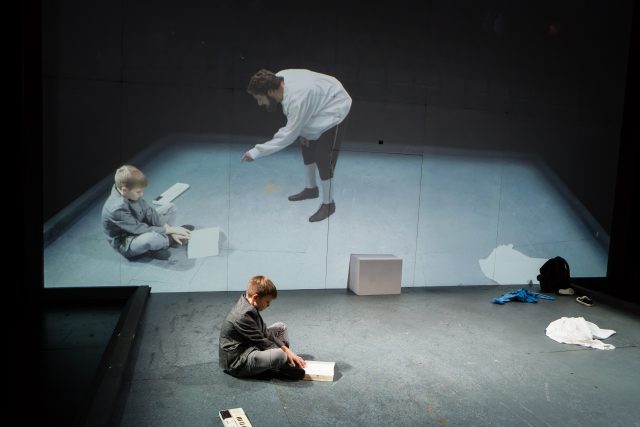
Make Believe begins in 1980, as twelve-year-old Chris (Ryan Foust), ten-year-old Kate (Maren Heary), seven-year-old Addie (Casey Hilton), and five-year-old Carl (Harrison Fox) are playing in their attic, pretending to be “one big happy family,” Kate says, more wish fulfillment than reality. The attic, designed by David Zinn, is decked out with a large tent, tables and chairs, and large windows facing the street. Their father is on a business trip, and their mother has seemingly disappeared. At first the kids act like it’s no big deal, but as day turns into night and then day again, they start worrying about their survival, deciding to fend for themselves without ratting out their parents.

(photo by Joan Marcus)

The grown-up Conlees face a traumatic moment in their past in Bess Wohl play (photo by Joan Marcus)

As the show opens, Addie is playing with her Cabbage Patch Kid while her siblings hover in the background, dressed as ghosts in white sheets with eye holes cut out. It’s more ominous than sweet; something is going to happen that will haunt them for the rest of their lives. When they sit down for a pretend dinner with Kate as the mom, Chris as the dad, and Carl as the dog, they mimic their parents’ unhappiness and their own reticence about getting older and becoming adults. “Remember: Don’t ever have children,” Kate advises her siblings. Later, Addie says, “Grown-ups aren’t real anyway. They’re only monsters with masks on.” Just when you think that the whole show will be with the children only, the adults (Kim Fischer, Susannah Flood, Brad Heberlee, Samantha Mathis) enter the picture, and it’s not a pretty one. It’s thirty years later, and they’re back in the attic, revealing the scars their childhood imprinted on them.

The four young actors in Make Believe are exceptional; I could have watched them all night, each one doing a superb job handling complex material. Director Michael Greif (Dear Evan Hansen, Rent) provides a smooth transition to the present, the kids now adults picking up the pieces of their haunted past. The themes of how parents can mess up their children’s future and how hard it is for kids to get over bad memories are common ones, but Wohl maneuvers through it with breathtaking finesse and a quick wit. “Grow up. Grow up, you idiots,” the young Kate says, to which Addie responds, “A wolf is coming.” In Make Believe, the wolf is at the door of the attic, then and now, ready to attack.

LITTLE GEM

(photo by Carol Rosegg)

Kay (Marsha Mason) brings up some very private details in Little Gem at the Irish Rep (photo by Carol Rosegg)

Irish Repertory Theatre, Francis J. Greenburger Mainstage
132 West 22nd St. between Sixth & Seventh Aves.
Through September 8, $50-$70
212-727-2737
irishrep.org

Three generations of women in a North Dublin family share their foibles and exert their fortitude in successive monologues in Marc Atkinson Borrull’s engaging if not quite sparkling revival of Elaine Murphy’s Little Gem, running at the Irish Rep through September 8. First seen in the US at the Flea in 2010, the hundred-minute play begins with eighteen-year-old Amber (Lauren O’Leary), who enters a doctor’s office waiting room (the antiseptic set is by Meredith Ries) and talks about a night of partying at a high school ball with her best friend, Jo, involving drugs and alcohol, dancing, and her maybe-boyfriend, Paul. “Jo and me just did a line in the toilets. Feeling nice. The music is thumping in my chest. Unce, unce, unce. Like this fuzzy feeling, know exactly where I am but when I close my eyes I could be anywhere,” she says dreamily.

When she is done, her mother, Lorraine (Brenda Meaney), comes in and, while Amber watches her, discusses a strange occurrence at the store where she works that ends up with her having to speak with human resources. The “HR bird” asks her about her ill father. “She reaches across the desk and touches my hand. Don’t remember the last time someone touched me, hugged me, or even bleedin’ nudged me,” Lorraine admits to the audience.

And then Kay (Marsha Mason), Amber’s grandmother and Lorraine’s mother, walks in and, while the other two look at her, describes her vaginal itch and her ill husband, Gem, who she loves but calls a “cantankerous oul’ fuck.” She says, “I’m the wrong side of sixty, not dead. I haven’t had sex in well over a year and it’s killing me.” So off she goes to Ann Summers to purchase her very first vibrator.

(photo by Carol Rosegg)

Grandmother Kay (Marsha Mason), granddaughter Amber (Lauren O’Leary), and mother Lorraine (Brenda Meaney) share their fears and desires in Irish Rep revival (photo by Carol Rosegg)

Sex, significant others, loneliness, and the pains of life and death are the key themes as the trio of women continue alternating monologues. Amber becomes pregnant. Lorraine, who is divorced from Ray, goes on her first date ever with a man she met at a salsa dance class. And Kay tries to use her vibrator while worrying about Gem’s health. They meander across the stage, occasionally sitting down, as they open up about intimate details of their innermost fears and desires; while the youngest, Amber, has no filter, Lorraine is ready to burst out of her sheltered existence and Kay is a bit surprised by how brutally honest she is.

Everything about Murphy’s (Ribbons, Shush) first play is solid, from Borrull’s (Beginning, Outlying Islands) effective direction to the performances by four-time Oscar nominee Mason (The Goodbye Girl, Fire and Air), Meaney (Indian Ink, Incognito), and, in her off-Broadway debut, O’Leary (The Awkward Years), but Little Gem never quite grabs you as it should, falling just short of reaching the next level it aims for. Like life itself, it can be disappointing, but there are enough genuine moments to recommend it, even if it doesn’t glitter.