twi-ny recommended events

JASON MORAN

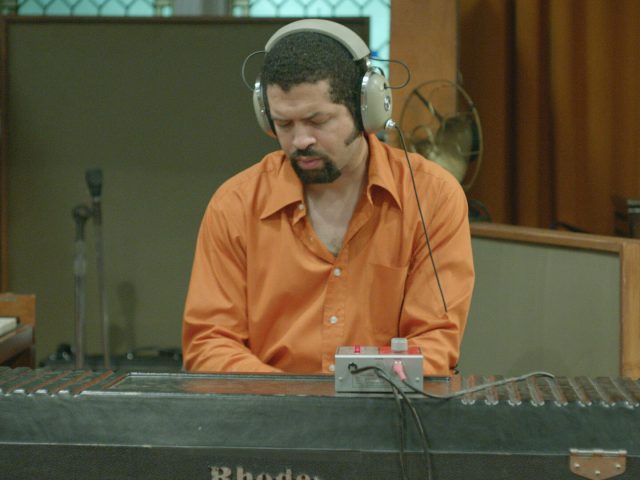
Stan Douglas, Luanda-Kinshasa, 2013. Video, color, sound; 6:01 hours. © Stan Douglas; Courtesy the artist and David Zwirner, New York

Jason Moran performs in Stan Douglas’s six-hour 2013 video Luanda-Kinshasa (© Stan Douglas / courtesy the artist and David Zwirner, New York)

Whitney Museum of American Art
99 Gansevoort St.
Through January 5 (adults $25, eighteen and under free
whitney.org

Atop his official website, Jason Moran identifies himself simply as “Musician.” As his retrospective at the Whitney reveals, he is much more than that. Born in Houston in January 1975, jazz pianist and composer Moran released his debut album, Soundtrack to Human Motion, twenty years ago and has expanded his horizons significantly since then. In addition to recording such discs as Facing Left, Same Mother, Artist in Residence, Bangs, and Looks of a Lot, many with his group, the Bandwagon, consisting of bassist Tarus Mateen and drummer Nasheet Waits, he collaborates with a bevy of visual artists, creates large-scale installations, and makes eye-catching drawings.

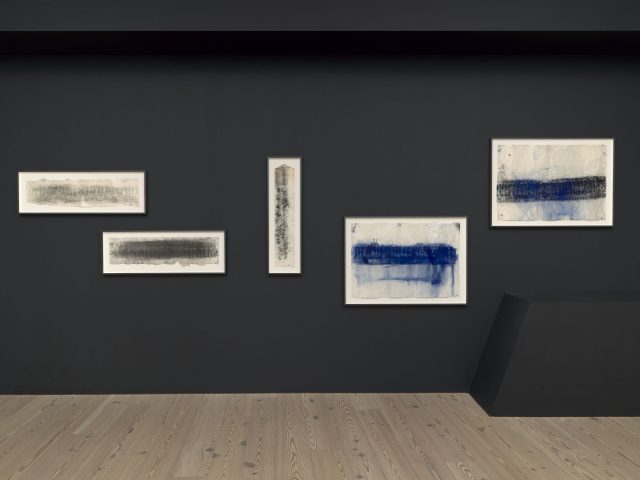
Installation view of Jason Moran (Whitney Museum of American Art, New York, September 20, 2019-January 5, 2020). From left to right: Jason Moran, Run 2, 2016; Jason Moran, Run 6, 2016; Jason Moran, Strutter’s Ball, 2016; Jason Moran, Blue (Creed) Gravity 1, 2018; Jason Moran, Black and Blue Gravity, 2018. Photograph by Ron Amstutz

Jason Moran’s music-inspired drawings are a highlight of multidisciplinary show at the Whitney (photograph by Ron Amstutz)

The show, simply titled “Jason Moran,” is an eye-opening exploration of a multitalented artist, one of the most surprisingly delightful exhibits of the year. Upon entering the eighth floor, you encounter Moran’s “Run,” an ongoing series of works in which Moran tapes a sheet of paper, often a vintage player piano roll, over his piano, caps his fingers in charcoal and dry pigment of different colors, and plays the keyboard, resulting in horizontal abstract images that he gives such titles as Black and Blue Gravity and Two Wings 2. Screening on a loop in the far corner is Glenn Ligon’s The Death of Tom, what was supposed to be a re-creation of the final scene from Edison/Porter’s 1903 silent movie Uncle Tom’s Cabin, in which white actors played the main characters in blackface, but it turned into something very different because Ligon improperly loaded the film, resulting in what he called “blurry, fluttery, burnt-out black-and-white images, all light and shadows.” Moran improvised the score based on Bert Williams and Alex Rogers’s 1905 song “Nobody,” a hit for the black vaudeville team of Williams and George Walker, who fought racism on the road and stereotypes in their live performances. The Death of Tom might not have been the film Ligon set out to make, but it still takes on the same ideas.

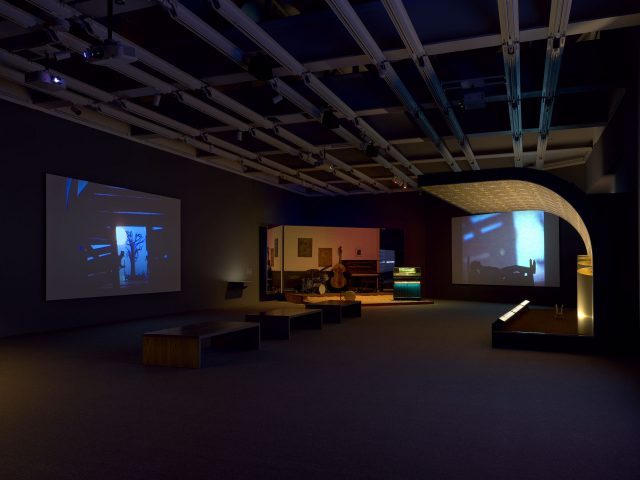
Installation view of Jason Moran (Whitney Museum of American Art, New York, September 20, 2019-January 5, 2020). Projections: Kara Walker, National Archives Microfilm M999 Roll 34: Bureau of Refugees, Freedmen and Abandoned Lands: Six Miles from Springfield on the Franklin Road, 2009. Stages from left to right: Jason Moran, STAGED: Slugs’ Saloon, 2018; Jason Moran, STAGED: Savoy Ballroom 1, 2015. Photograph by Ron Amstutz

Jason Moran exhibition features room of large-scale installations and three-channel videos (photograph by Ron Amstutz)

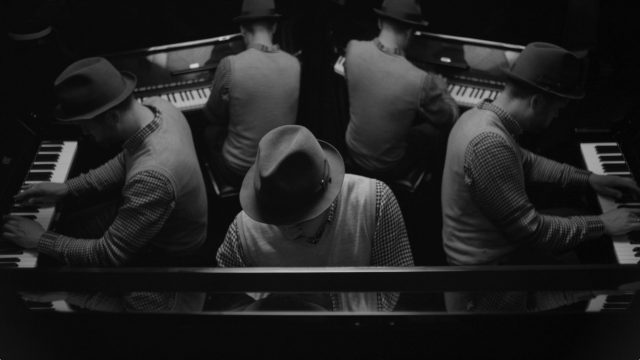
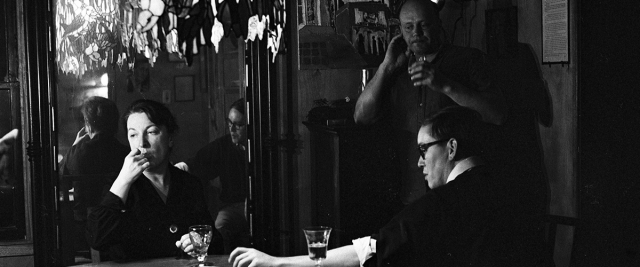
The main room of the exhibit is a beaut, featuring a trio of sculptural installations inspired by the stages of historic New York City jazz clubs, Harlem’s Savoy Ballroom, Midtown’s Three Deuces, and the Lower East Side’s Slugs’ Saloon. Three large screens show behind-the-scenes footage and/or full short films from ten of Moran’s collaborations, with such artists as Joan Jonas, Carrie Mae Weems, Adam Pendleton, Julie Mehretu, Ryan Trecartin, Lizzie Fitch, and Theaster Gates. In Lorna Simpson’s three-channel Chess, on two screens the artist plays chess in a mirrored room that makes it look like there are five of her; she’s dressed as a man in one, a woman in the other. Meanwhile, on the third screen, Moran plays the piano in a similarly mirrored space, improvising one of Brahms’s fifty-one exercises for piano. The black-and-white keyboard mimics the black-and-white chess sets as both Moran and Simpson display expert finger control.

Lorna Simpson, still from Chess, three-channel video, black-and-white, sound, 2013 (courtesy the artist and Hauser & Wirth / © Lorna Simpson)

Lorna Simpson, still from Chess, three-channel video, black-and-white, sound, 2013 (courtesy the artist and Hauser & Wirth / © Lorna Simpson)

Kara Walker’s National Archives Microfilm M999 Roll 34: Bureau of Refugees, Freedmen and Abandoned Lands: Six Miles from Springfield on the Franklin Road is a thirteen-plus-minute full-color video using her trademark cut-paper silhouettes like shadow puppets to tell the story of brutal violence perpetrated against an African American family during the Reconstruction era. (On October 12, Moran and Walker teamed up for the New York premiere of her Katastwóf Karavan, in which he played a steam-powered calliope housed in Walker’s old-fashioned circus wagon adorned with cut-steel silhouettes depicting powerful slave scenes.) In between some of the videos are interludes in which improvisations by Moran emit from a player piano on the “Three Deuces” stage. On January 3 and 4, Tiger Trio, consisting of pianist Myra Melford, bassist Joëlle Léandre, and flutist Nicole Mitchell, will perform at the Whitney as part of the “Jazz on a High Floor in the Afternoon” program.

Finally, around a corner, Stan Douglas’s Luanda-Kinshasa brings together Jason Moran and a group of other musicians in a fictitious recording session in a reconstruction of Columbia’s 30th Street Studio, known as the Church, where between 1949 and 1981 such artists as Bob Dylan, Aretha Franklin, Vladimir Horowitz, Billie Holiday, Charles Mingus, and Miles Davis made albums. Inspired by Jean-Luc Godard’s Rolling Stones concert film Sympathy for the Devil, Douglas films the band over two days in a 1970s-style setting, improvising as if this is a follow-up to Miles Davis’s 1971 album Live-Evil, part of which was recorded at the Church. Douglas himself improvises through the editing process, ending up with a six-hour jam session. Be sure to allow plenty of time to experience “Jason Moran,” an artistic jam session you won’t soon forget.

TWI-NY TALK: DAYLON SWEARINGEN

(Covy Moore/CovyMoore.com)

Rising PBR star Daylon Swearingen is looking forward to the Monster Energy Buck Off at the Garden (photo by Covy Moore/CovyMoore.com)

PBR: UNLEASH THE BEAST
Madison Square Garden
31st – 33rd Sts. between Seventh & Eighth Aves.
January 3-5, $28-$221
1-800-732-1727
pbr.com
www.msg.com

Professional bull rider Daylon Swearingen may be only twenty, but he’s already amassed an impressive resume. The 2019 PBR Canada champ, ranked #13 in the world last season, was raised in a rodeo family and has been taking home major trophies since he was sixteen. His parents, Sam and Carrie, run the Rawhide Rodeo Company; Sam was a bareback rider, while Carrie was a barrel racer and trick rider. Daylon’s younger brother, Colton, is a champion steer wrestler and calf roper competing for the Southeastern Oklahoma State University Savage Storm, and their uncles Mike Swearingen and Ken Phillips are rodeo vets as well.

The 5’6″, 150-pound Daylon, who goes by the nickname Day, will be in New York City January 3–5 for the annual Monster Energy Buck Off at the Garden, where PBR will Unleash the Beast to a rabid fan base here in the Big Apple. Daylon, who lives in Piffard, New York, spends his busy time shuttling between PBR and college tournaments; he is studying for an associate’s degree in land and ranch management at Panola College in Texas, where he met his girlfriend, fellow rodeo teammate McKynzie Bush, a barrel racer and breakaway roper. Twi-ny continues its tradition of profiling PBR participants — past years have featured interviews with Sean Willingham, Flint Rasmussen, Tanner and Jesse Byrne, and Cooper Davis — with an inside look at Day, who talks about family, studying, setting high goals, and domestic violence awareness; as young children, he and Colton witnessed terrible violence before his mother left their birth father and married Sam Swearingen, who brought the boys up.

twi-ny: You come from a rodeo family. Growing up, was there ever anything else you wanted to do?

daylon swearingen: Not really. I just wanted to ride bulls and be around rodeo, produce rodeos and stuff like that. I think it was just we always had chaps on and had a belt buckle and cowboy boots. I remember always being around it.

twi-ny: You’ve been winning competitions since you were sixteen. When did you realize that you were good enough to make a career out of it?

ds: Probably when I was sixteen and I started entering the bull riding at the rodeos. Just going to my dad’s rodeos I made a pretty good amount of money, and that made me believe I could make a living doing it.

twi-ny: You’re currently ranked #2 in the world and recently won the PBR Canadian Championship and the National Collegiate Rodeo Association Bull Riding Championship. Is it scary having so much success so quickly?

ds: I wouldn’t say it’s scary. I set my standards high, and if you have high goals you should be able to achieve high goals.

twi-ny: You’re only twenty years old, but you’ve already ridden more than two hundred bulls and just this summer logged thirty thousand miles going back and forth between college rodeo and professional tournaments. How’s your body holding up?

ds: My body is holding up good. I took some time after the NFR [National Finals Rodeo, which concluded December 14] just to feel good.

twi-ny: Do you have a different mind-set whether you’re competing in college rodeo or PBR, facing some of your heroes?

ds: I just have to ride the bull for eight seconds. It doesn’t matter the caliber, you just have to make the eight seconds. You have to ride like you want to be where you want to get to. My mind-set is the same every time I get on a bull.

twi-ny: Your girlfriend, McKynzie Bush, is also on the Panola College team. Since you’re on the road so much, how difficult is it to maintain the relationship?

ds: It’s a little difficult, especially over the summer. I went to see her, and she came to see me. I don’t like long-distance relationships, but we made it work.

twi-ny: You’re on course for graduating next May with an associate degree in land and ranch management. When do you find the time to study?

ds: I can study when I am sitting in the car, not doing a whole bunch, sometimes in hotel rooms, when I get real bored and have that idle time and should be doing something.

twi-ny: What are your ultimate plans with the degree?

ds: Just to have it in case something happens, I can fall back on that associate’s degree and what I have learned both in school and out.

Jeff Collins – my coach at school who is the 2000 World Champion bareback rider – has helped me out a lot. Going to school gave me the opportunity to live in Texas a little bit. I enjoy Texas, and also the stuff I have learned about electricity, hydraulics, all these systems, grazing cattle, and all of that. I have seen it on the ranch side, but I have never seen it as someone who studies it and gets all the facts behind everything.

Daylon Swearingen

Daylon Swearingen has been winning major tournaments since he was sixteen

twi-ny: You have said that Cochise is the fiercest bull you’ve ridden, yet you’ve had your best score on him, a 92 in Tulsa in August. What’s the secret to lasting eight seconds on this particular beast?

ds: I just kept moving, get around there. I was just riding loose. I didn’t think about it a whole bunch, and it just kind of happened.

twi-ny: Do you have any other favorite bulls?

ds: I have tons of favorite bulls. I breed some cows myself at home in New York. I have Bruiser calves, a couple Pearl Harbor calves. [Ed Note: Bruiser is a three-time PBR World Champion bull, while the late Pearl Harbor was a beloved world champion contender.] I enjoy a lot of bulls.

twi-ny: On your vest, you wear a symbol that supports domestic violence awareness, inspired by a terrible family situation. What do you think is most misunderstood about domestic violence in America?

ds: I think it is overlooked as a problem because so many people have a family together, or they are in a comfort zone and feel like they can’t get out. With the family part, so many people don’t want their kids growing up without a dad, so they give second and third chances. But in reality it affects those kids. They don’t think the kids see, but the kids see way more than they let on. Just getting out and not feeling stuck, kids can change if they want to. You can’t change another person, but you can change what you’re doing and your actions.

twi-ny: You’ve lived in North Carolina, Georgia, Texas, and Piffard, New York. Next week, you’ll be competing at Madison Square Garden. Does that hold any special meaning for you since you’re now a New Yorker, or is it just another bull riding event?

ds: I feel like it is kind of special. Madison Square Garden is the first place we took bucking bulls to – this major event. It is kind of cool PBR’s season starts in New York, and it’s definitely one I have always wanted to get on tour by. So now that I am there, it is very exciting.

twi-ny: When you’re in New York City, what else do you plan on doing?

ds: Try not to get hit by a taxi.

Seriously, ride some bulls.

WHAT SHE SAID: THE ART OF PAULINE KAEL

Pauline Kael

The life and career of film critic Pauline Kael is profiled in documentary What She Said

WHAT SHE SAID: THE ART OF PAULINE KAEL (Rob Garver, 2018)
Film Forum
209 West Houston St.
Opens Wednesday, December 25
212-727-8110
www.whatshesaidmovie.com
filmforum.org

I would love to read Pauline Kael’s review of Rob Garver’s What She Said: The Art of Pauline Kael, a documentary about the influential and pugnacious film critic who wrote about movies in her own unique, highly subjective way for nearly forty years. But the California-born Kael passed away in 2001 at the age of eighty-two, and we’ll never know. But in the film, which opens Christmas Day at Film Forum, we do learn about what many of her supporters and detractors, colleagues, fans (known as Paulettes), and targets thought of her. “We’re not talking about film criticism here; we’re talking about Pauline Kael,” explains writer and director Paul Schrader, who referred to Kael as his “second mother” in a 2001 Film Comment essay. “And, in the end of the game, what Pauline Kael promoted wasn’t film. It was her.”

Garver traces Kael’s career from her early days writing (ever-so-briefly) for McCall’s and the New Republic before moving to the New Yorker, where she covered “The Current Cinema” from 1968 to 1991, aside from a six-month hiatus when she attempted to produce a film with Warren Beatty for Paramount. Garver combines new and old interviews with Kael’s home movies and private photographs, television appearances, and narrated clips from her reviews and letters; among those discussing Kael and her work — the two are inseparable — are filmmakers John Boorman, Robert Towne, Quentin Tarantino, and David O. Russell, actor Alec Baldwin, writers Molly Haskell, Greil Marcus, Stephanie Zacharek, David Edelstein, Camille Paglia, Michael Sgragow, Joe Morgenstern, and Lili Anolik, and, seen in archival footage, Woody Allen, Norman Mailer (who referred to Kael as “lady vinegar”), Francis Ford Coppola, Robert Evans, Jerry Lewis, David Lean, and others. “Pauline could be very combative and very provocative and she could be cruel, for no reason,” Pulitzer Prize winner Morgenstern notes; Lean stopped making films for several years after Kael excoriated him at a luncheon.

We hear a lot from Kael, who split her time between New York City and her country home in Great Barrington, Massachusetts, through archival footage as well as narration by Sarah Jessica Parker, who reads excerpts from Kael’s personal and professional writings; in her last review, of Steve Martin’s 1991 film L.A. Story, Kael called Parker a “bouncy nymph.” While she was loathed by plenty of people inside and outside the industry, Kael was also beloved and needed by others. She says, “People don’t tend to like a good critic. They tend to hate your guts. If they like you, I think you should start getting worried.” Marlene Dietrich wrote to her, “I am quite lost without your opinions on films.” Directors such as Wes Anderson would send her their films even after she retired, just to hear what she thought. But her daughter, Gina James, notes, “There are times when people will tell me something that she said to them and I think, that’s impossible, and then I realize they couldn’t have made it up because it is just shocking.”

Garver (Comic Belief, The Man in the Yellow Cap) also includes snippets from hundreds of films; while the clips from such movies as Vittorio De Sica’s Shoeshine, Robert Wise’s The Sound of Music, Lean’s Lawrence of Arabia, Coppola’s Apocalypse Now, Arthur Penn’s Bonnie and Clyde, Jean-Luc Godard’s Bande à part, Alain Resnais’s Hiroshima Mon Amour, Charlie Chaplin’s Limelight, Stanley Kubrick’s 2001: A Space Odyssey, Bernardo Bertolucci’s Last Tango in Paris, and Brian De Palma’s Casualties of War are effective because they are shown in context with her reviews of those films, the snippets are also overused as punctuation, adding an unnecessary exclamation point at the end of a sentence to drive home a point that is already clear. For example, when Edelstein states, “Pauline would write about something, and you would not only love reading it, but then you would want to see what she wrote about so you could argue with her, or you could relive it with her, you could see it through her eyes,” Garver follows that with a scene from Martin Scorsese’s Taxi Driver in which Robert DeNiro as Travis Bickle puts his fingers over his eyes as he watches a movie. It might be cute, but it’s also extraneous.

Ultimately, Garver’s main point is that love her or hate her, Kael, who left behind a vast legacy of her writings, including thirteen books (I Lost It at the Movies, Kiss Kiss Bang Bang), and had several unsuccessful relationships with men, changed how we approach film criticism and experience films themselves. “She turned the movie review, which is this kind of flimsy vehicle — it’s a thumbs-up or thumbs-down endeavor — into this expressive art form. I mean, it was as expressive as the short story or the sonnet,” writer Lili Anolik says. Film Forum is hosting several Q&As and panel discussions during the scheduled two-week run, with Garver December 26 and 27 at 7:00, December 28 at 4:30, and December 29 with composer Rick Baitz as well at 2:30, with Zacharek and Monica Castillo on January 2 at 7:00, and with Owen Gleiberman on January 4 at 4:30.

THE SOUND INSIDE

(photo by Jeremy Daniel)

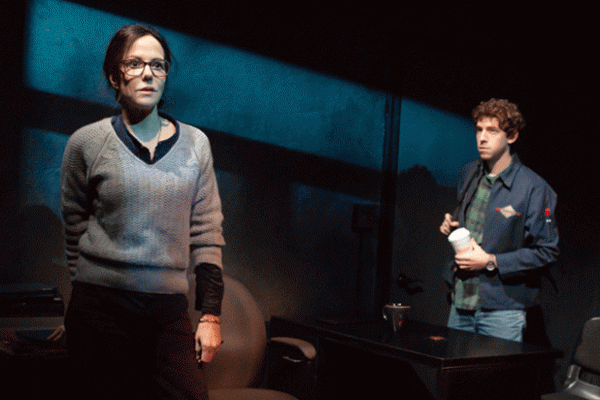
Mary Louise Parker and Will Hochman star in Adam Rapp’s The Sound Inside on Broadway (photo by Jeremy Daniel)

Studio 54
254 West 54th St.
Tuesday – Sunday through January 12, $49-$169
212-719-1300
soundinsidebroadway.com
www.lct.org

The Sound Inside is one of the most beautifully composed shows I have ever seen, an exquisitely rendered work that could have come only from the mind of an expert storyteller. Originally presented in 2018 at the Williamstown Theatre Festival and commissioned by Lincoln Center, it is written by novelist and playwright Adam Rapp, a Pulitzer Prize finalist who has authored such books as The Year of Endless Sorrows, Punkzilla, and Know Your Beholder and such plays as Red Light Winter, The Metal Children, and Blackbird, which he adapted into a 2007 film he also directed. In The Sound Inside, a luminous Mary Louise Parker stars as fifty-three-year-old Yale professor Bella Lee Baird. (Rapp has taught at the Yale School of Drama, and his mother’s maiden name is Baird.) Bella, who has written a mildly well received book, Billy Baird Runs through a Wall, alternates between telling her story in the first and third persons directly to the audience, as if narrating a novel, and participating in scenes with one of her students, the enigmatic and cynical Christopher Dunn (Will Hochman).

“A middle-aged professor of undergraduate creative writing at a prestigious Ivy League University stands before an audience of strangers,” Bella says to open the play. “She can’t quite see them but they’re out there. She can feel them — they’re as certain as old trees. Gently creaking in the heavy autumn air. Is this audience friendly, she wonders? Merciful? Are they easily distracted? Or will they hear this woman out? And what about her? Ironically, she often dissuades her students from describing a protagonist in too fine of detail. Readers only need a few telling clues.” Rapp and director David Cromer, who subtly transforms Studio 54 into an intimate classroom, follow that advice, offering only a few telling clues at a time as we excitedly hear this captivating woman out.

(photo by Jeremy Daniel)

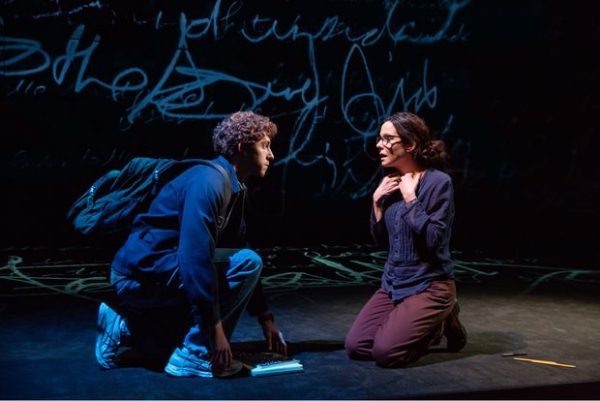
Christopher Dunn (Will Hochman) talks literature and more with his professor, Bella Lee Baird (Mary Louise Parker) (photo by Jeremy Daniel)

Christopher shows up at Bella’s office one day without an appointment. He has a supreme distaste for rules and regulations and eschews common decency. “Do me a favor. Next time you want to stop by without an appointment at least shoot me an email first,” she tells him. “Yeah, I don’t really do that,” he responds. They discuss Dostoyevsky, hipster baristas, and the book Christopher is writing. They strike up a friendship, but Christopher knows he is taking up a lot of her time. “I mean, if you get tired of me just say so and I can go like wander campus and get mentally prepared for the big football game coming up with Harvard this weekend,” he says. “Stockpile the coldcuts. Get my face painted. Do some steroids. Headbutt random campus bulletin boards, etcetera, etcetera.”

Bella, who’s dealing with stomach cancer and has no one else in her life, welcomes the offbeat Christopher into her daily existence. “I have no children and I’ve never been married,” she tells the audience. “Like many single, self-possessed women who’ve managed to find solid footing in the slippery foothills of higher education, I’ve been accused of being a lesbian. And a witch. And a maker of Bulgarian cheese. And a collector of cat calendars. Both my parents are dead. My father suffered a fatal heart attack at sixty-two and I’ll get to my mother in a minute. I have no brothers or sisters. I live in faculty housing. I don’t own property. I’m essentially a walking social security number with a coveted Ivy League professorship and a handful of moth-bitten sweaters.” As they grow closer, they both consider breaking down the barriers that make them each such lonely beings, committing to no one but themselves.

It’s impossible not to become instantly infatuated with Bella, so bewitchingly played by Tony, Obie, and Emmy winner Parker (Proof, Weeds). You want to just rush onstage and give her a giant hug to assure her everything will be all right, even if it won’t. Parker holds the audience in her hands, giving a tour-de-force lesson in acting. Hochman (Sweat, Dead Poets Society) is impressive in his Broadway debut, not intimidated in the least. Rapp celebrates literature without getting pedantic as he explores Dostoyevsky’s Crime and Punishment, Anne Tyler’s The Accidental Tourist, and James Salter’s Light Years. Alexander Woodward’s set features several rooms that move into the foreground and disappear into the background, superbly lit by Heather Gilbert, each one representing a different aspect of Bella’s life. Tony winner Cromer (The Band’s Visit, Our Town) keeps up a lively pace as the characters scrutinize what they are to each other.

The play refers several times to a framed photograph in Bella’s office of a “woman standing in the middle of a harvested cornfield. She’s in all black and tiny in the vast dead field,” she tells Christopher, who asks, “Is that you in the photograph? Of course it is.” But Bella says she has no idea who it is. The next time he visits her in her office, Christopher is mesmerized by the photo and asks, “Has she gotten smaller? . . . I have this weird feeling that if I come back tomorrow the field will be covered. With snow. Like twenty inches. But no footprints. The woman’s just there. As if the field imagined her.” Bella asks, “Do you think it would be a better image?” He replies, “Maybe not better. But somehow more inevitable.” It’s a fabulous moment in a fabulous play, and one that zeroes in on just who these two people are and what they want out of life.

THE SORCERESS (DI KISHEFMAKHERIN)

()

Jazmin Gorsline excels as bride-to-be Mirele in The Sorceress (photo © Victor Nechay – Properpix.com)

Museum of Jewish Heritage — A Living Memorial to the Holocaust
Edmond J. Safra Plaza, 36 Battery Pl.
Through December 29, $59-$125
866-811-4111
nytf.org
mjhnyc.org

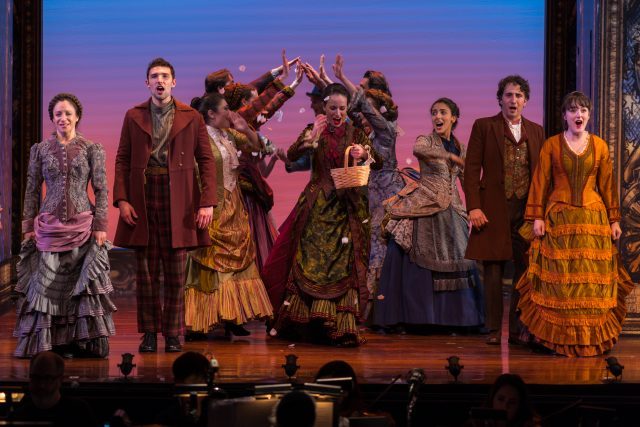
Two years ago, the National Yiddish Theatre Folksbiene presented a work-in-progress version at the Museum of Jewish Heritage of The Sorceress (“Di Kishefmakherin”), the first Yiddish theater production to be performed in America. The company, which has had tremendous success with its spectacular adaptation of Fiddler on the Roof, is now back at its MJH home with a full staging of The Sorceress, a delightful if slight operetta that continues through December 29, including two special performances with a buffet on Christmas Day.

(photo © Victor Nechay - Properpix.com)

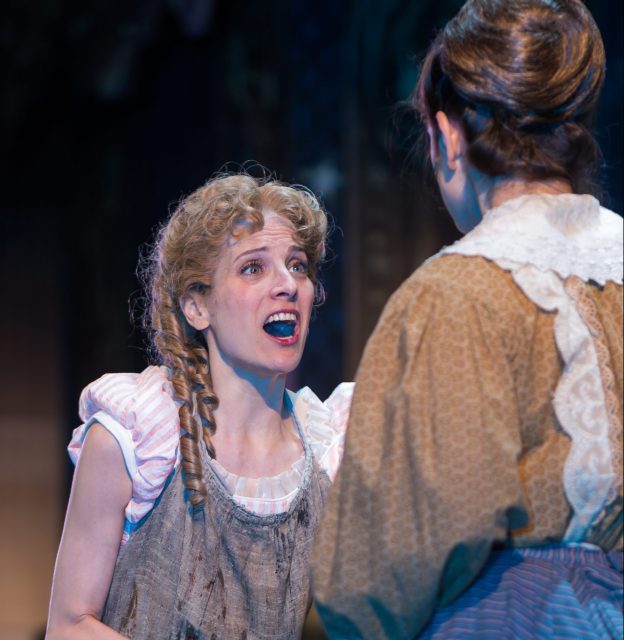
Dani Apple, Lexi Rabadi, Lorin Zackular work up some dastardly magic in National Yiddish Theatre Folksbiene production (photo © Victor Nechay – Properpix.com)

Written by Avrom Goldfaden, the Father of Yiddish Theater, it’s a Cinderella-like tale set in the town of Botoshani, Romania, where the young, lovely Mirele (Jazmin Gorsline) is preparing to wed the handsome and stalwart Markus (Josh Kohane). At her birthday party, she is sad, unable to celebrate because she misses her mother, who died too young. “Is it fair, my dear daughter, that you disturb the celebration with such sad thoughts?” her father, the wealthy Avromtshe (Bruce Rebold), sings. “Isn’t your stepmother faithful just like your very own mother?” he adds, but therein lies the problem. Avromtshe’s new wife, Basye (Rachel Botchan), is, yes, an evil stepmother who plots with the local sorceress, Bobe Yakhne (Mikhl Yashinsky), to make sure she gets exactly what she wants. She has her husband arrested and forces a separation between Markus and Mirele in a greedy plan that confounds the close-knit community, which is struggling to survive in hard times.

Unlike NYTF’s wonderful 2015 production of The Golden Bride, The Sorceress shows its age; written in 1877, it was brought to America in 1883 by fourteen-year-old actor and soon-to-be Yiddish legend Boris Thomashefsky. Some of the jokes are once-fresh (maybe) but now stale vaudeville routines, including one involving needles, salesman Hotsmakh (Steve Sterner), and Koyne (Lexi Rabadi), but other moments are heartbreaking, such as the handler’s (Rebecca Brudner) desperate call as she sells her wares. “Nobody in the world, / Can live out their years. / Without earning a little money. / A job is a burden,” she sings. Gorsline and Kohane are in fine voice, as is the always dependable Botchan. Yashinsky overplays the title character, chewing up far too much of Dara Wishingrad’s set, which resembles those used in a traveling show. Dani Apple, Lorin Zackular, and Rabadi are playful as a trio of witches; the large cast also includes Dylan Seders Hoffman as Basye’s daughter, Lize, Jonathan Brody as the conniving Uncle Elyokem, Mark Alpert as Katsef the butcher, and Samuel Druhora as the Turkish organ grinder. Izzy Fields’s appealing, elaborate costumes capture the era and its strife, while Merete Muenter’s choreography makes excellent use of the small space, especially in the market scene.

(photo © Victor Nechay - Properpix.com)

The Sorceress features a large cast at the Museum of Jewish Heritage (photo © Victor Nechay – Properpix.com)

But the real star of the show, which is helmed by NYTF associate artistic director Motl Didner, is the music, marvelously performed by Lauren Brody on accordion, Elise Frawley on viola, Evan Honse and Rebecca Steinberg on trumpet, Sam Katz and Inna Langerman on violin, Tony Park on clarinet, Reenat Pinchas on cello, George Rush on bass, Matt Temkin on drums and percussion, and associate musical conductor D. Zisl Slepovitch and conductor Zalmen Mlotek on piano. It’s light and frothy one moment, then dastardly and devious the next, as the story takes on such relevant topics as wealth inequality, human trafficking, and the spreading of wicked lies through the social construct. The Sorceress is the first fully restored work in NYTF’s Global Restoration Initiative, which resurrects lost Yiddish plays through extensive research. May there be many more.

MATZOBALL

matzoball

Capitale
130 Bowery
Tuesday, December 24, $50-$75, 9:00 pm – 3:00 am
matzoball.org

Free Christmas Eve? The thirty-third annual Matzoball for singles is taking place on December 24 at Capitale on Bowery, a holiday extravaganza running from nine at night to three the next morning. Partnering with the Gift of Life Marrow Registry, the all-night party started primarily for Jewish singles, but now singles of all religions and ethnicities are welcome, as long as they are twenty-one or over. General admission is $50, with the VIP Fast Pass offering front-of-line privileges and a half-hour open bar for $75. There will be a live DJ performance and lots of dancing and mingling; there will also be Matzoballs, which were founded in 1987 by Andrew Rudnick, held Christmas Eve in Boston, Philadelphia, Los Angeles, DC, and three Florida cities. And as a bonus, it just happens to be Hanukkah as well.

VARDA: A RETROSPECTIVE

(Agnès Varda © Cine Tamaris)

The remarkable life and career of Agnès Varda is being celebrated by Film at Lincoln Center (Agnès Varda © Cine Tamaris)

Film at Lincoln Center, Walter Reade Theater
165 West 65th St. between Eighth Ave. & Broadway
December 20 – January 6
www.filmlinc.org

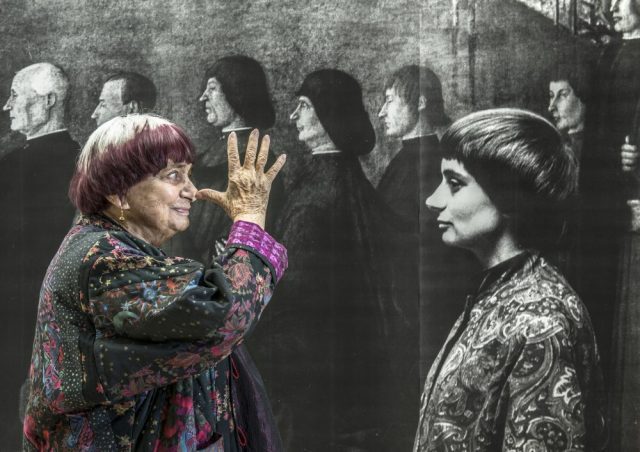
“I live in cinema. I feel I’ve lived here forever,” Agnès Varda memorably said. The Belgian-born French filmmaker, photographer, and visual artist died earlier this year at the age of ninety, leaving behind an innovative and influential legacy that is being celebrated by Lincoln Center as we say goodbye to 2019 and welcome in 2020, albeit without one of the greatest of all time. “Varda: A Retrospective” is already under way at Film at Lincoln Center, comprising more than two dozen features, documentaries, and shorts, from 1955’s La Pointe Courte to 2019’s Varda by Agnès, and boasting such unique and astounding works as Le bonheur, Cléo from 5 to 7, The Gleaners and I, Vagabond, and, yes, Kung-Fu Master! (with Jane Birkin and Charlotte Gainsbourg!). Every afternoon beginning at 1:00, “Free Loop: Agnès Varda Q&As at Film at Lincoln Center” will be shown for free in the Elinor Bunin Munroe Film Center Amphitheater, while the five-part series Agnès Varda: From Here to There will screen in the Walter Reade Theater December 22 at 12:30, December 23 at 2:00, and December 24 at 1:00, free with advance registration. There is also a free gallery exhibition with rare archival footage, photographs, and ephemera related to Varda and her remarkable career and life, which included a nearly thirty-year marriage to auteur Jacques Demy, with whom she had two children, producer and costume designer Rosalie Varda and actor and director Mathieu Demy. Varda’s The Young Girls Turn 25, which creates a reunion of the cast and crew of her husband’s The Young Girls of Rochefort where that classic was shot, can be seen December 27 and January 2. Below are only some of Varda’s best; as a bonus, from January 4 to 6, Rosalie Varda will introduce and/or participate in Q&As at half a dozen screenings.
BEACHES OF AGNES

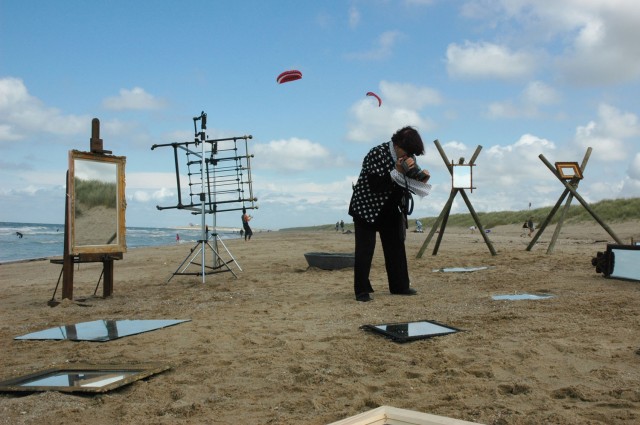
Agnès Varda takes an unusual approach to autobiography in The Beaches of Agnès

THE BEACHES OF AGNÈS (LES PLAGES D’AGNÈS) (Agnès Varda, 2008)
Tuesday, December 24, 4:15
Sunday, December 29, 6:00
Sunday, January 5, 6:00 (introduced by Rosalie Varda)
www.filmlinc.org

“The whole idea of fragmentation appeals to me,” Agnès Varda says in the middle of her unusual cinematic autobiography, the César-winning documentary The Beaches of Agnès. “It corresponds so naturally to questions of memory. Is it possible to reconstitute this personality, this person Jean Vilar, who was so exceptional?” She might have been referring to her friend, the French actor and theater director, but the exceptional Belgian-French Varda might as well have been referring to herself. Later she explains, “My memories swarm around me like confused flies. I hesitate to remember all that. I don’t want to.” Fortunately for viewers, Varda (Jacquot de Nantes, One Hundred and One Nights) does delve into her past in the film, sharing choice tidbits from throughout her life and career, in creative and offbeat ways that are charmingly self-effacing. Using cleverly arranged film clips, re-creations, photographs, and an array of frames and mirrors, the eighty-year-old Varda discusses such colleagues as Jean-Luc Godard, Chris Marker, and Alain Resnais; shares personal details of her long relationship with Jacques Demy; visits her childhood home; rebuilds an old film set; speaks with her daughter, Rosalie Varda, and son, Mathieu Demy; talks about several of her classic films, including La Pointe Courte, Cléo from 5 to 7, and Vagabond; and, in her ever-present bangs, walks barefoot along beaches, fully aware that the camera is following her every move and reveling in it while also feigning occasional shyness. Filmmakers don’t generally write and direct documentaries about themselves, but unsurprisingly, the Nouvelle Vague legend and first woman to win an honorary Palme d’or makes The Beaches of Agnès about as artistic as it can get without becoming pretentious and laudatory. The January 5 screening will be introduced by Rosalie Varda.
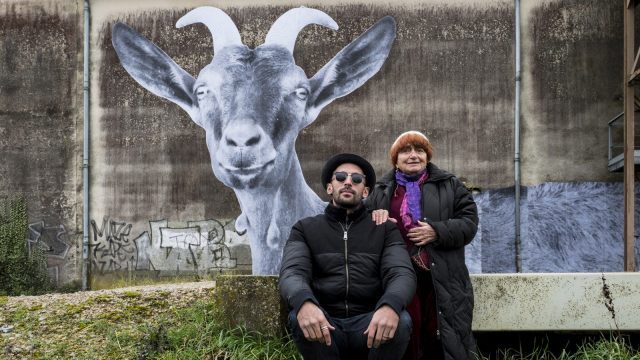
JR and Agnès Varda have a blast in the masterful Faces and Places

JR and Agnès Varda have a blast with people and animals in the masterful Faces and Places

FACES PLACES (VISAGES VILLAGES) (Agnès Varda & JR, 2017)
Tuesday, December 24, 2:15
Monday, December 30, 8:30
Wednesday, January 1, 8:45
www.filmlinc.org
cohenmediagroup.tumblr.com

“We’ll have fun making a film,” legendary eighty-eight-year-old Belgian-born French auteur Agnès Varda tells thirty-three-year-old French photographer and street artist JR in Faces Places (Visages Villages), a masterful road movie that may very well be the most fun film of 2017. The unlikely pair first met when Varda accepted an invitation from JR, whose practice involves wheat-pasting giant black-and-white photos of men, women, and children on architectural structures, to visit his Paris studio. (JR brought his “Inside Out” art project to Times Square in 2013.) When Varda saw JR’s blow-up of a 1960 self-portrait Varda shot of herself standing in front of a Bellini painting in Venice, the two instantly hit it off and decided to make a film together, heading out in JR’s small photo-booth truck to team up with people in small towns throughout France, including coal miners, dockworkers, farmers, a church-bell ringer, and factory workers. The reactions of the villagers — shrewd, curious, flattered — to JR’s enormous wheat-pasted blow-ups of themselves on their neighborhood walls, barns, abandoned housing, containers, water towers, and other locations are fascinating. “JR is fulfilling my greatest desire. To meet new faces and photograph them, so they don’t fall down the holes of my memory,” Varda, who edited the film with Maxime Pozzi-Garcia, says. Varda and JR make a formidable duo, finding a childlike innocence in their collaboration that is simply captivating to watch.
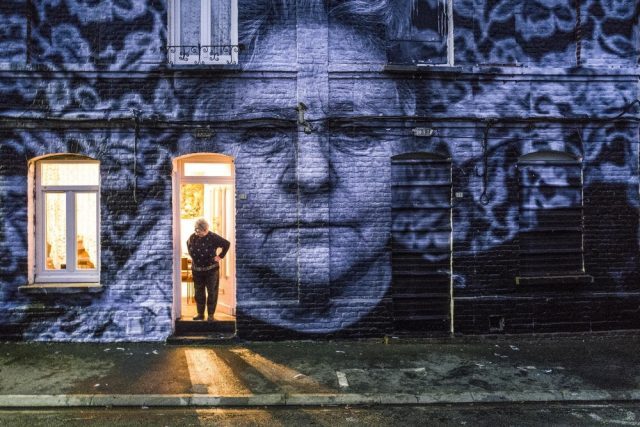
Cinematic collaboration between Agnès Varda and JR results in stunning visions of humanity

Cinematic collaboration between Agnès Varda and JR results in stunning visions of humanity

Varda continually tries to get JR to remove his ever-present dark glasses, remembering how her friend and colleague Jean-Luc Godard once let her take pictures of him without glasses, but JR prefers to maintain his mystery, a man who photographs tens of thousands of people’s faces around the world while never fully showing his own. Varda, who relies on the “power of imagination,” even sets up an afternoon with Godard at his home in Switzerland, preparing by having JR roll her furiously through the same Louvre galleries the protagonists run through in Godard’s Band of Outsiders, but of course nothing with Godard ever goes quite as planned. “Chance has always been my best asset,” Varda proclaims in the film, and it is chance, and the willingness to enthusiastically embrace every moment of life, that helps give Faces Places its immeasurable charm. The film, which features a playful score by Matthieu Chedid (‑M-) and was executive produced by Varda’s daughter, Rosalie Varda-Demy, subtly tackles socioeconomic issues but is primarily a marvelous celebration of genuine humanity.
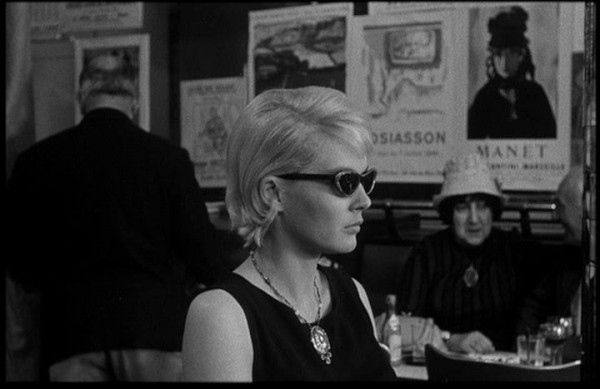
Cléo (Corinne Marchand) looks back at her life in Agnès Varda’s Nouvelle Vague classic

Cléo (Corinne Marchand) looks back at her life in Agnès Varda’s Nouvelle Vague classic

CLEO FROM 5 TO 7 (CLÉO DE 5 À 7) (Agnès Varda, 1962)
Wednesday, December 25, 8:30
Saturday, December 28, 4:30
Saturday, January 4, 7:00 (introduced by Rosalie Varda)
www.filmlinc.org

After getting a biopsy taken and drawing the death card while consulting a fortune-teller, popular French singer Cléo (Corinne Marchand) begins looking back at her life — and wondering just what’s left of it — while awaiting the dreaded results. The blonde beauty talks with old friends, asks her piano player (Michel Legrand, who composed the score) to write her a song, and meets a dapper gentleman in the park, becoming both participant and viewer in her own existence. As Cléo makes her way around town, director (and former photographer) Agnès Varda (Jacquot de Nantes, Lions Love [. . . and Lies]) shows off early 1960s Paris, expertly winding her camera through the Rive Gauche. Just as Cléo seeks to find out what’s real (her actual name is Florence and that gorgeous hair is a wig), Varda shoots the film in a cinema verité style, almost as if it’s a documentary. She even sets the film in real time (adding chapter titles with a clock update), enhancing the audience’s connection with Cléo as she awaits her fate, but the movie runs only ninety minutes, adding mystery to what is to become of Cléo, as if she exists both on-screen and off, alongside the viewer. A central film in the French Nouvelle Vague and one of the first to be made by a woman, Cléo de 5 à 7 is an influential classic even as it has lost a step or two over the years. The January 4 screening will be introduced by Varda’s daughter, Rosalie Varda.
LE BONHEUR

François (Jean-Claude Drouot) tries to convince Thérèse (Claire Drouot, his real-life wife), that he has plenty of happiness to spread around in Le Bonheur

LE BONHEUR (HAPPINESS) (Agnès Varda, 1965)
Thursday, December 26, 3:00
Saturday, January 4, 9:00 (introduced by Rosalie Varda)
www.filmlinc.org/films/le-bonheur

In 1965, French Nouvelle Vague auteur Agnès Varda said about her third film, Le Bonheur, which translates as Happiness: “Happiness is mistaken sadness, and the film will be subversive in its great sweetness. It will be a beautiful summer fruit with a worm inside. Happiness adds up; torment does too.” That is all true nearly fifty years later, as the film still invites divided reaction from critics. “Miss Varda’s dissection of amour, as French as any of Collette’s works, is strikingly adult and unembarrassed in its depiction of the variety of love, but it is as illogical as a child’s dream,” A. H. Weiler wrote in the New York Times in May 1966. “Her ‘Happiness,’ a seeming idyll sheathed in irony, is obvious and tender, irresponsible and shocking and continuously provocative.” All these decades later, the brief eighty-minute film is all that and more, save for the claim that it is illogical. In a patriarchal society, it actually makes perfect, though infuriating, sense.
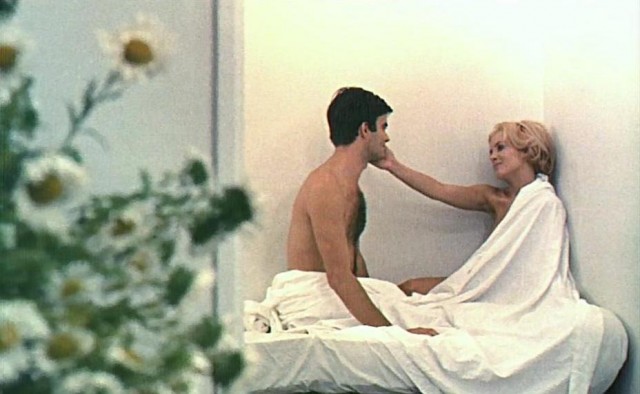
François and Émilie (Marie-France Boyer) seek out their own happiness in Nouvelle Vague classic

François (Jean-Claude Drouot) and Émilie (Marie-France Boyer) seek out their own happiness in Nouvelle Vague classic

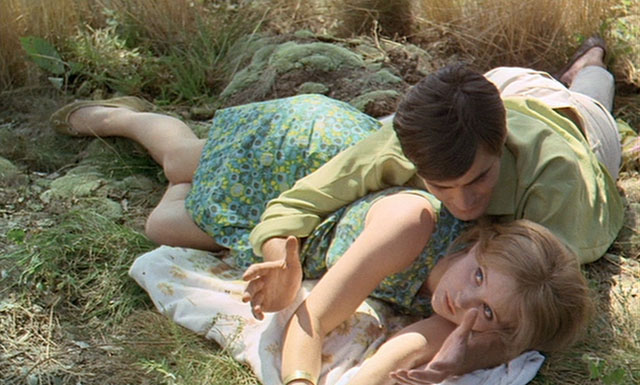
French television star Jean-Claude Drouot (Thierry La Fronde) stars as the handsome François, who is leading an idyllic life with his beautiful wife, Thérèse (Claire Drouot), and their delightful kids, Pierrot (Olivier Drouot) and Gisou (Sandrine Drouot), in the small, tight-knit Parisian suburb of Fontenay. While away on a job, François meets the beautiful Émilie (Marie-France Boyer), a postal clerk who connects him to his wife via long-distance telephone, flirting with him although she knows he is happily married. And despite being happily married, François returns the flirtation, offering to help with her shelves when she moves into an apartment in Fontenay. Both François and Émilie believe that there is more than enough happiness to go around for everyone, without any complications. “Be happy too, don’t worry,” Émilie tells him. “I’m free, happy, and you’re not the first,” to which he soon adds, “Such happiness!” And it turns out that even tragedy won’t put a stop to the happiness, in a plot point that angered, disappointed, confused, and upset many critics as well as the audience but is key to Varda’s modern-day fairy tale. The January 4 screening will be introduced by Varda’s daughter, Rosalie Varda.
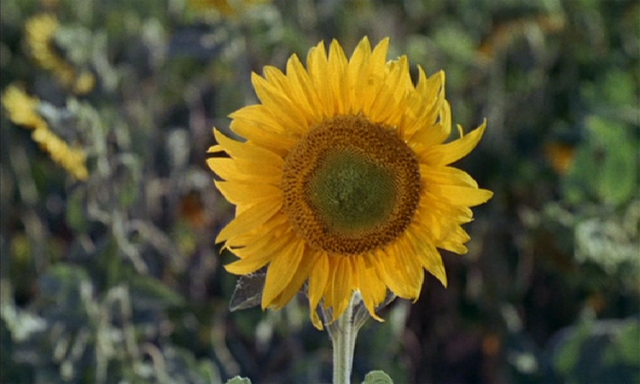
The beauty of nature plays a key role in LE BONHEUR

The beauty of nature plays a key role in Le Bonheur

Le Bonheur is Varda’s first film in color, and she seems to have been heavily influenced by her husband, Jacques Demy (The Umbrellas of Cherbourg, The Young Girls of Rochefort), bathing the film in stunning hues that mimic Impressionist paintings, particularly the work of Pierre-Auguste Renoir, in a series of picnics and flower-filled vases. In a sly nod, at one point a black-and-white television is playing the 1959 film Le Déjeuner Sur L’herbe (“Picnic on the Grass”), which was directed by Jean Renoir, one of Auguste’s sons, and also deals with sex, passion, procreation, and nature. Le Bonheur also features numerous scenes that dissolve out in singular blocks of color that take over the entire screen. Cinematographers Claude Beausoleil and Jean Rabier shoot the film as if it takes place in a candy-colored Garden of Eden, all set to the music of Mozart, performed by Jean-Michel Defaye. Varda doesn’t allow any detail to get away from her; even the protagonists’ jobs are critical to the story: François is a carpenter who helps builds new lives for people; Thérèse is a seamstress who is in the midst of making a wedding gown; and Émilie works in the post office, an intermediary for keeping people together. As a final touch, François, who represents aspects of France as a nation under Charles de Gaulle, and his family are played by the actual Drouot clan: Jean-Claude and Claire are married in real life (and still are husband and wife after nearly sixty years later), and Olivier and Sandrine are their actual children, so Le Bonheur ends up being a family affair in more ways than one.
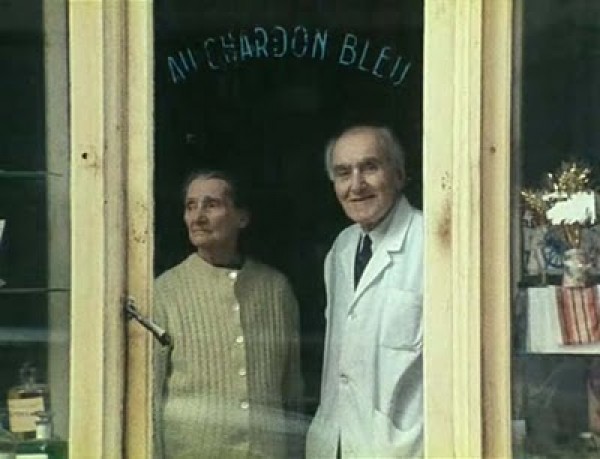
Agnès Varda looks back at her past in charming Daguerréotypes

DAGUERRÉOTYPES (Agnès Varda, 1975)
Tuesday, December 31, 4:00
www.filmlinc.org

Legendary auteur Agnès Varda’s eighty-minute documentary, Daguerréotypes, which only received its official U.S. theatrical release in 2011 at the Maysles Cinema, is an absolutely charming look at Varda’s longtime Parisian community. In the film, Varda turns her camera on the people she and husband Jacques Demy lived with along the Rue Daguerre in Paris’s 14th arrondissement. Varda, who also narrates the film, primarily stands in the background while capturing local shopkeepers talking about their businesses and how they met their spouses as customers stop by, picking up bread, meat, perfume, and other items. Varda uses a goofy, low-rent magic show as a centerpiece, with many of the characters attending this major cultural event; the magician references the magic of both life and cinema itself, with Varda, a former photographer, titling the film not only after the street where she lives but also directly evoking the revolutionary photographic process developed by Louis Daguerre in the 1820s and ’30s. Daguerréotypes has quite a different impact now than it did back in the mid-1970s, depicting a time that already felt like the past but now feels like a long-forgotten era, when neighbors knew one another and lived as a tight-knit community.