twi-ny recommended events

I WISH I KNEW

Zhao Tao wanders through modern-day China in Jia Zhang-ke’s elegiac documentary

I WISH I KNEW (Jia Zhang-ke, 2010)
Metrograph
7 Ludlow St. between Canal & Hester Sts.
Opens Friday, January 24
212-660-0312
metrograph.com

Throughout his professional career, which began with the 1997 underground hit Pickpocket, Sixth Generation Chinese writer-director Jia Zhang-ke has shuttled easily between documentaries (Useless, 24 City) and narrative features (The World, Still Life) — and it’s not always obvious which is which, as his steady, poetic style is built on subtlety, slow rhythms, and an innate sense of realism (and he freely mixes fantasy and reality as well). His 2010 documentary, the Cannes Film Festival Un Certain Regard selection I Wish I Knew, adds elements of fiction to its compelling examination of the intimately personal side effects that resulted from the Chinese civil war and Cultural Revolution, as many people left Shanghai for Taipei and Hong Kong. Jia and interviewer Lin Xudong meet with elderly men and women who tell tragic stories of family and friends being murdered and executed by the government; an especially poignant scene is set at a community gathering where senior citizens dance to Dick Haymes’s version of the old standard “I Wish I Knew”; one of the interviewees sings into the camera, “I wish I knew someone like you could love me / I wish I knew you place no one above me / Did I mistake this for a real romance? / I wish I knew, but only you can answer,” which could be as much about a personal relationship as the revolution itself. Jia also talks with several filmmakers and actresses, from Hou Hsiao-hsien and Wang Toon to Huang Baomei, Rebecca Pan, and Wei Wei, illustrating how Shanghai has been depicted on film with clips from such movies as Hou’s Flowers of Shanghai, Xie Jin’s Huang Baomie, Wang’s Red Persimmon, Lou Ye’s Suzhou River, Wang Bing’s To Liberate Shanghai, Wong Kar-wai’s Days of Being Wild, and Michelangelo Antonioni’s Cina.

As the nearly two-hour documentary reaches its conclusion, they interview younger people, including bestselling writer, blogger, and race-car champion Han Han, who don’t share the same conflicted memories of communism and the Cultural Revolution, instead praising an evolving modern-day capitalistic Shanghai that has brought them vast wealth, with no interest in the past of Deng Xiaoping, Mao Zedong, and Chiang Kai-shek. Throughout the film — which is finally being released theatrically in the US, opening January 24 at Metrograph in a rarely screened director’s cut that puts back censored images and adds missing facts — Jia’s onscreen muse, Zhao Tao, who has appeared in many of his works, walks through contemporary Shanghai, pausing as she languidly looks out over the ever-changing city, where intensely poor neighborhoods are being torn down right around the corner from massive construction projects. Commissioned for the 2010 World Expo held in Shanghai, I Wish I Knew might not have been quite what the expo folk expected, but then again, they did give carte blanche to Jia, who never takes the easy way out, creating yet another complex, confusing, and controversial cinematic experience.
TICKET ALERT — ST. PETERSBURG BALLET THEATRE: SWAN LAKE

Swan Lake

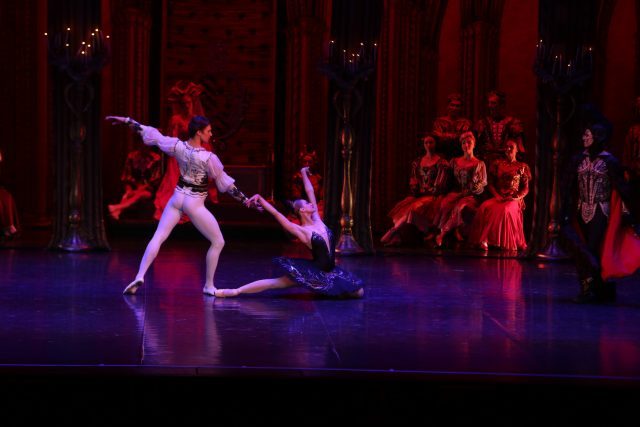
St. Petersburg Ballet Theatre makes its US debut in February with Swan Lake at BAM (photo by KT)

BAM Howard Gilman Opera House
30 Lafayette Ave. between Ashland Pl. & St. Felix St.
February 15-16, $35-$135, 7:30
718-636-4100
www.bam.org
spbt.ru

Internationally acclaimed Russian prima ballerina Irina Kolesnikova and the St. Petersburg Ballet Theatre will make their US debut February 15-16 at BAM with their lush and lavish production of Pyotr Ilyich Tchaikovsky’s Swan Lake. Rejected by the Kirov and the Bolshoi because of her size, Kolesnikova ultimately made a home — and a family — with the St. Petersburg Ballet Theatre, eventually marrying founder Konstantin Tachkin, with whom she has two children. They’ve come a long way since he called her a “little red lump in a T-shirt” when she auditioned at the age of ten.

Not to be confused with the St Petersburg Festival Ballet or the St Petersburg State Ballet — the name issue is currently in court — the St. Petersburg Ballet Theatre has toured with such classics as The Nutcracker, Giselle, Cinderella, and The Sleeping Beauty, but their gem is Swan Lake, with two dozen swans and Kolesnikova as Odette/Odile. At BAM, they will be accompanied by the Chamber Orchestra of New York, conducted by Timur Gorkovenko. The Vaganova-trained Kolesnikova also has performed the title role in the company’s Her Name Was Carmen, its unique take on the Georges Bizet ballet based on Prosper Mérimée’s novella, with the setting moved to a refugee site, inspired by her 2016 visit to Balkan camps.

QUEENS ROW

(photo © Paula Court)

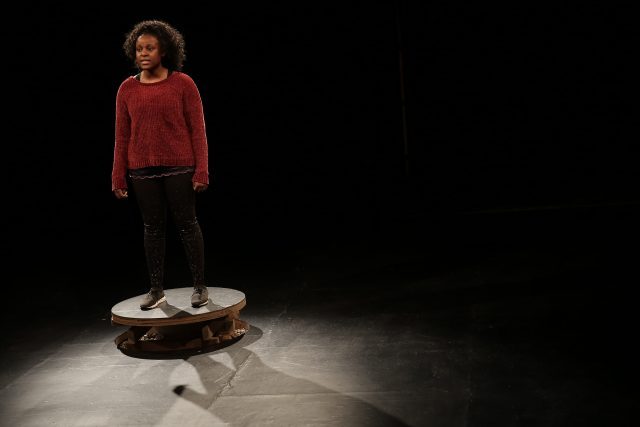
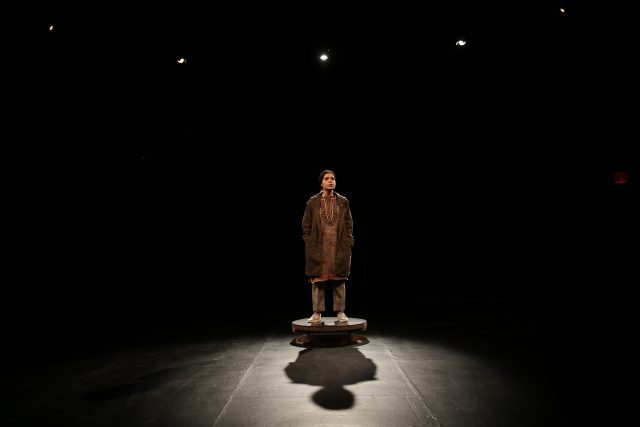
Nazira Hanna delivers the first of three monologues in Richard Maxwell’s Queens Row (photo © Paula Court)

The Kitchen
512 West 19th St. between Tenth & Eleventh Aves.
Wednesday – Saturday through January 25, $20-$25
212-255-5793 ext11
thekitchen.org
www.nycplayers.org

Experimental theater master Richard Maxwell’s Queens Row is a poetic meditation on loneliness in a postapocalyptic world. Continuing at the Kitchen through January 25, the sixty-minute show takes place in the Chelsea institution’s empty upstairs gallery space, a black box with an exposed sink area and a small balcony. The play consists of three monologues delivered by a trio of nonprofessional actors, sharing their characters’ deeply personal stories surrounding a shooting death, each woman somewhat more physical and emotional than the one before. First up is a woman (mixed-media artist Nazira Hanna) in a Native American-style top who is from the fictional town of Queens Row, Massachusetts; she stands stock-still on a small circular platform carved right out of the floor and lifted slightly by blocks of wood. Her words are cold and direct, her body rigid, as she announces, “I am a woman who had a child. I don’t have a name. I don’t have ID, and I never did, if you can imagine. There is no record of my fingertips or my eyeballs. . . . I was born and no one could stop that from happening. I had a child, and no one could stop that from happening. My son was killed, and no one could stop that from happening. And I exist in this place, asserting a certain right to exist, and to speak, and just like you, hopelessly existing.” She talks of a civil war, of riots “fueled by racism, xenophobia, foreign influence, class anger, and a simmering paranoia, hysteria on all sides.” The play was inspired by a dystopian dream Maxwell had, and her tale is like a nightmare, tinged with reality.

(photo © Paula Court)

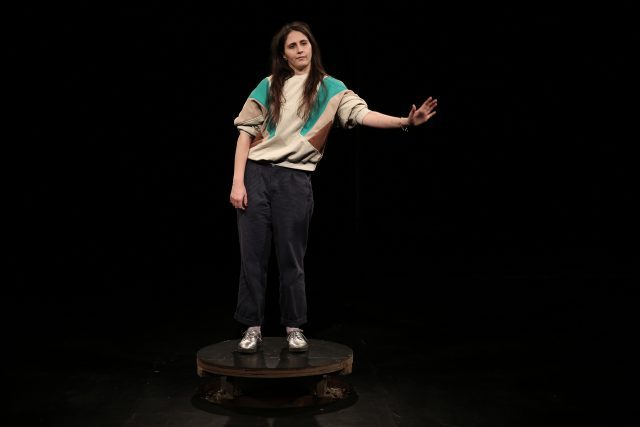
Soraya Nabipour picks up the story of the impact of loss in NYC Players production at the Kitchen (photo © Paula Court)

When she is done, she walks offstage through a door and is replaced by a second, younger woman (theater maker, facilitator, and PhD researcher Soraya Nabipour) from Odessa, Texas, wearing sneakers, black leggings, and a red sweater. She addresses a person no longer with us, bringing up seemingly random incidents from their past. “I string together memories as though it were some kind of lifeline,” she says. “Is it that we’re so much the same or that we need each other. We horrify each other but we’d die without each other, you know this, and you can’t stand it. Love is the thing you do when there’s nothing left to do. Love is the thing to do beyond words.” She is slightly more active although still appears confined, her past haunting her.

She is followed by a third woman (musician Antonia Summer, who recently trained at the National Youth Theatre in London) in a colorful shirt and long hair. She is from Las Cruces, New Mexico, and moves her body in herky-jerky ways that match her awkward speech patterns; she speaks as if she is learning language right in front of us. “t 6 d 5 6 s 5 6 e r r t s…………………… ient to fine a ja e, msrtik talking to …. pl this is right mao i, r;lorm r p & u.p.i. I,” she says before becoming understandable. “I get electrified with excitement when the towers which dot the horizon light up and connect together aligning that curve that arcs into me blasting my insides with light I am the offspring orphaned by fate and fatality My.” She talks of a father and a mother, of pain and desire, and asks, “whut is progeny?”

(photo © Paula Court)

Antonia Summer is the liveliest of three connected women in Richard Maxwell’s postapocalyptic Queens Row (photo © Paula Court)

Written and directed by Maxwell, who previously presented The Evening, Natural Hero, and The End of Reality at the Kitchen with his NYC Players company, Queens Row is a gripping fantasy of a frightening near-future. Each character is circled above by a dozen lights, casting dramatic, often eerie shadows across the floor. (The set and lighting design is by Sascha van Riel, with costumes by Kaye Voyce.) The show isn’t so much a warning shot as an alternate reality that hovers just outside our purview; Maxwell includes several ghostly moments that are as scary as they are disconcerting. Hanna, Nabipour, and Summer — perhaps not uncoincidentally brown, black, and white — are each effective in her own right, the three of them interrelated by absence, implying how we all are connected in this dangerous universe, where dire actions have far-reaching consequences. As always with NYC Players, it is a challenging experience, told in uniquely Maxwellian style.

YOU ARE UNDER OUR SPACE CONTROL

Experimental

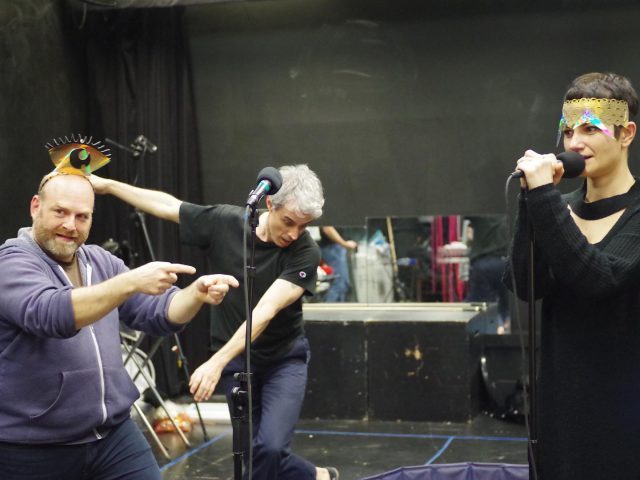
Experimental multimedia space opera lands You Are Under Our Space Control at La MaMa this week (photo courtesy Object Collection)

The Downstairs at La MaMa’s Annex
66 East Fourth St.
Thursday – Sunday, January 23 – February 2, $25
212-475-7710
lamama.org
objectcollection.us

Brooklyn-based Object Collection returns to La MaMa this week after taking its Fugazi opera-in-suspension It’s All True to Norway, England, and Texas, with the utopian space opera You Are Under Our Space Control, making its world premiere January 23 – February 2. The company, whose “works upset habitual notions of time, pace, progression, and virtuosity. . . . [valuing] accumulation above cohesion,” goes on an adventure into the great unknown, exploring “space travel, transhumanism, astronautics, and the resurrection of the dead” in a world devoid of natural resources.

The show is written and directed by Object Collection cofounder Kara Feely, the text inspired by Sun Ra, the Russian Cosmists, and astronaut interviews; the music is by cofounder Travis Just, inspired by John Cage’s 1951 “Music of Changes.” The laboratory-like set design is by Peiyi Wong, with lighting by Jeanette Yew, video by Eric Magnus, sound by Robin Margolis, and streaming and programming by Scott Cazan. The multimedia piece will be performed by Steven Ali, Avi Glickstein, Yuki Kawahisa, Annie Kunjappy, Alessandro Magania, Daniel Allen Nelson, Nicolás Noreña, and Fulya Peker along with percussionist Shayna Dunkelman, guitarist Taylor Levine, and singer-songwriter Ava Mendoza. You can get a taste of what’s in store by checking out the music here, including such songs as “Full Contrast,” “Humans, Humans,” “Total Trance,” and “More Hospitable than Antarctica Might Be.” Once the run ends, video feeds will be posted online so you can create your own version of YAUOSC.

HANS HAACKE: ALL CONNECTED

(photo by twi-ny/mdr)

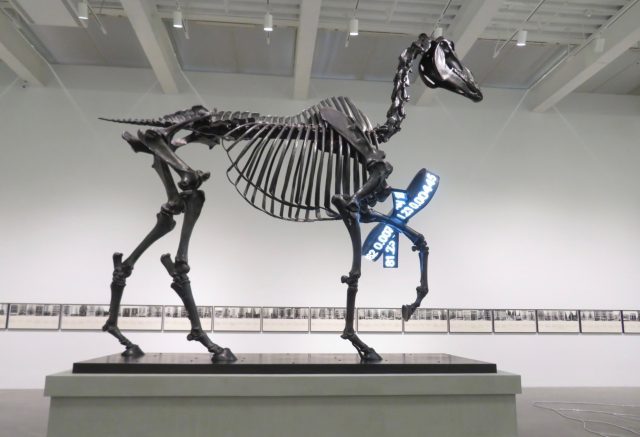
Hans Haacke’s 2014 Gift Horse is centerpiece of first museum survey in more than thirty years (photo by twi-ny/mdr)

New Museum of Contemporary Art
235 Bowery at Prince St.
Tuesday through Sunday through January 26, $12-$18
212-219-1222
www.newmuseum.org

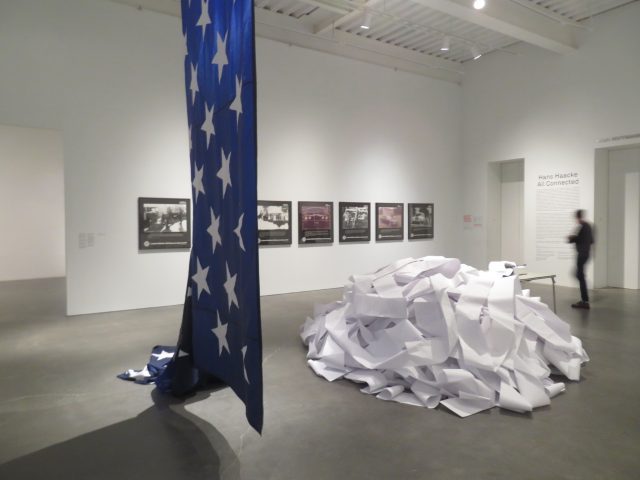
In 1986, the New Museum held the survey “Hans Haacke: Unfinished Business”; more than thirty-three years later, its follow-up, “Hans Haacke: All Connected,” which runs through January 26, reveals that the German-born longtime New Yorker is still hard at work with lots on his mind. “‘Artists,’ as much as their supporters and their enemies, no matter of what ideological coloration, are unwitting partners in the art-syndrome and relate to each other dialectically,” Haacke wrote in 1974. “They participate jointly in the maintenance and/or development of the ideological make-up of their society. They work within that frame, set the frame and are being framed.” The retrospective takes up nearly the entire museum, long since moved from its much smaller 1980s Bowery location, from the lobby to the fifth floor, and comes along at just the right moment; several artists recently threatened to refuse to allow their work to appear in the Whitney Biennial due to the corporate activity of a member of its board of directors, while other artists will not participate in arts institutions that accept money from the Sacklers and other billionaire families who made their fortune in controversial industries. The now-eighty-three-year-old Haacke was well ahead of them; in 1971, his solo show at the Guggenheim was canceled because it revealed questionable financial ties between museum trustees and the art world. One of those works, Shapolsky et al. Manhattan Real Estate Holdings, a Real-Time Social System, as of May 1, 1971, which uses text and images to document the holdings of a slum landlord, is part of “All Connected,” which is populated by works Haacke has created for more than a half a century, pieces that uncover sociopolitical links between art and commerce, class, corporations, and the environment through photography, sculpture, and installation.

(photo by twi-ny/mdr)

State of the Union, A Breed Apart, and News explore ideas of systems, organizations, and information (photo by twi-ny/mdr)

Gallery-Goers’ Birthplace and Residence Profile, Part 1 tracks where visitors to his November 1969 exhibit at Howard Wise Gallery resided; attendees of “All Connected” can share some of their personal data in New Museum Visitors Poll on the fifth floor. Politics takes center stage in works depicting Ronald Reagan, Margaret Thatcher, the American flag, George H. W. and Barbara Bush, and the Bundestag. A Breed Apart consists of Leyland Vehicles ads for Jaguar and Land-Rover with photos and statements that raise issues of racism and colonialism. In a similar vein, Thank You, Paine Webber uses the broker’s catchphrase to go inside the company’s business culture. “After thirty years, Thank You, Paine Webber gained an unfortunate new topicality,” Haacke writes on the accompanying label. “While much had changed, we were rudely reminded that much is still the way it was then. The exploitation of people’s misery — in this particular case, for PR purposes, but indicative of corporate attitudes and behavior more generally — continues unabated.” Seurat’s “Les Poseuses” (small version) traces the ownership of Georges-Pierre Seurat’s 1888 painting Les Poseuses, which started out as a gift and eventually was sold at auction for more than a million dollars in 1970. And On Social Grease comprises six photo-engraved magnesium plates that display quotes about corporate art ownership from a media executive, bank chairmen, and a politician. “From an economic standpoint, such involvement in the arts can mean direct and tangible benefits,” David Rockefeller is quoted on one of the plaques. “It can provide a company with extensive publicity and advertising, a brighter public reputation, and an improved corporate image.”

The second floor is an environmental wonderland of kinetic sculpture involving earth, air, fire, and water. Condensation Cube creates its own liquid ecosystem, complete with rainbows. Fans propel Blue Sail, White Waving Line, and Sphere in Oblique Air Jet. A small spark makes its way down High Voltage Discharge Traveling. Water sloshes in Large Water Level and Wave and freezes in Floating Ice Ring and Ice Stick. And Grass Grows is a large clump of dirt, right on the floor, that indeed has grass growing on it. In a catalog interview, Haacke talks about a shift that occurred in 1968. “I realized that my work did not address the fraught social and political world in which we lived. It was an incident that made me understand that, in addition to what I had called physical and biological systems, there are also social systems and that art is an integral part of the universe of social systems. The present debate over climate change is a perfect example of the interconnectedness of the physical, biological, and social.”

(photo by twi-ny/mdr)

Detail, On Social Grease, six photo-engraved magnesium plates mounted on aluminum, 1975 (photo by twi-ny/mdr)

The showpiece of the exhibit is Haacke’s 2014 Gift Horse, a large-scale sculpture, designed for Trafalgar Square, of the skeleton of a horse mounted on a plinth. An electronic bow around its frontal thighbone transmits a live digital printout of the FTSE 100 ticker of the New York Stock Exchange. In the catalog, which includes contributions from Olafur Eliasson, Carsten Höller, Park McArthur, Sharon Hayes, Daniel Buren, Andrea Fraser, Thomas Hirschhorn, Walid Raad, Tania Bruguera, and others, Haacke talks about Boris Johnson’s reaction to Gift Horse. “I heard him say that the skeleton of the horse reminded him of the London subway system’s need for urgent repair. People were rolling their eyes,” he tells exhibition curators Gary Carrion-Murayari and Massimiliano Gioni. “I was standing behind him when he was spouting these lines and took a close-up photograph of his hair. The Brexiteer’s hair matches that of Donald Trump.” And let’s leave it at that.

TIMON OF ATHENS

(photo by Henry Grossman)

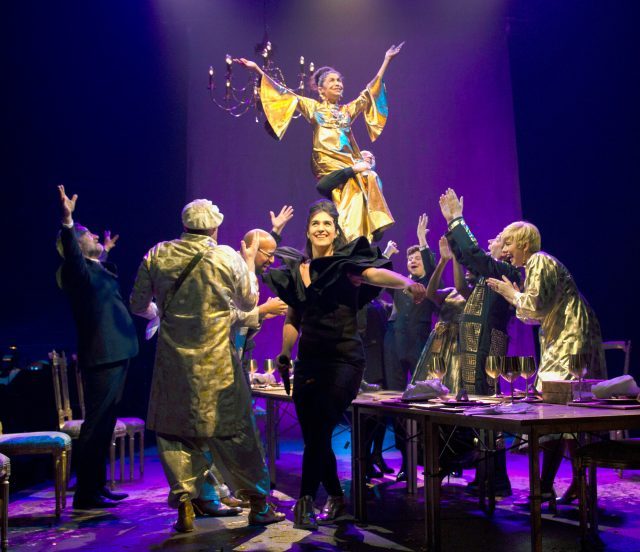
Timon (Kathryn Hunter) throws a feast fit for a queen in Timon of Athens (photo by Henry Grossman)

Theatre for a New Audience, Polonsky Shakespeare Center
262 Ashland Pl. between Lafayette Ave. & Fulton St.
Tuesday – Sunday through February 9, $90-$115
866-811-4111
www.tfana.org

New York-born British actress Kathryn Hunter glitters and glows in William Shakespeare and Thomas Middleton’s Timon of Athens, which opened tonight at Theatre for a New Audience’s Polonsky Shakespeare Center in Fort Greene. Simon Godwin’s production, initiated at the Royal Shakespeare Company and presented here in association with DC’s Shakespeare Theatre Company, should become the gold standard for the rarely performed play, a penetrating and very funny evisceration of greed and true friendship centered around a lust for jewels above all things. The text has been edited by Emily Burns and Godwin to make the lead character female, and TFANA regular Hunter runs with it, delivering an unforgettable, voracious performance as Timon (rhymes with Simon), a widowed noblewoman who loves to host feasts in her mansion where guests bring her trinkets and flatter her to no end and she gives them piles of cash and valuable gems. Painter (Zachary Fine) gives her an absurd portrait, Poet (Yonatan Gebeyehu) heaps words of praise on her, and Jeweller (Julia Ogilvie) offers her a fine stone, and she recompenses them manyfold. Sempronius (Daniel Pearce) insists that Timon not allow one of her servants, Lucilius (Adam Langdon), to marry his daughter despite their being in love, but he changes his mind quickly when she promises him money as a kind of dowry/bribe.

Her loyal steward, Flavius (John Rothman), notifies her that her wealth is dwindling, and the cynical philosopher, Apemantus (Arnie Burton), warns her not to put her faith in these false friends, but she is too caught up in the revelry to pay attention. “I wonder men dare trust themselves with men, / Methinks they should invite them without knives — / Good for their meat and safer for their lives,” Apemantus, the only character not wearing shimmering black or gold but instead a Patti Smith T-shirt, tells the audience. A few moments later, after Timon asks him to be silent, he says, “So. / Thou wilt not hear me now; thou shalt not then. / I’ll lock thy heaven from thee. / O, that men’s ears should be / To counsel deaf, but not to flattery!” When she finally understands that her coffers are empty, she sends out Flaminia, Lucilius, and Flavius to Lucullus (Dave Quay), Sempronius, and Lucia (Shirine Babb), asking for loans, but the trio is cruelly denied. Furious at this drastic change of events, the formerly happy-go-lucky Timon turns her back on the life she so treasured and shared with others. “Nothing I’ll bear from thee / But nakedness, thou detestable town,” she says of Athens. “Take thou that too, with multiplying bans. / Timon will to the woods, where she shall find / Th’unkindest beast more kinder than mankind. / The gods confound — hear me, you good gods all! — / The citizens both within and out that wall, / And grant as Timon grows her hate may grow / To the whole race of mankind, high and low! / Amen.” In the second act, Timon, now in tattered rags, is a bitter woman who spends most of her days digging her own grave until she is discovered by visitors from her past, including Alcibiades (Elia Monte-Brown), who has become the leader of an angry mob protesting the Athenian government.

(photo by Henry Grossman)

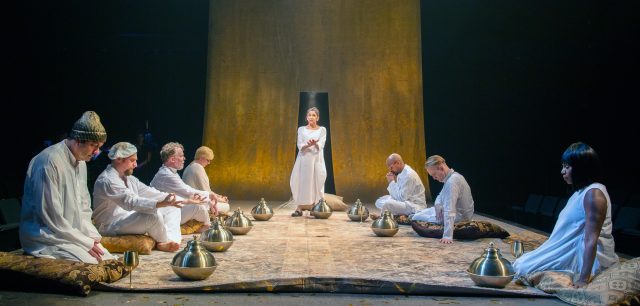
Timon of Athens is regendered in Simon Godwin’s glittering production at TFANA (photo by Henry Grossman)

Godwin’s sublime and timely interpretation of Timon of Athens addresses homelessness, income inequality, the dispossessed, an unsympathetic state, and humankind’s propensity for greed. Timon is a complex character, both antihero and cautionary figure of what can happen if wealth is all that matters and friends are available for purchase. I would say that Hunter is a revelation in the title role, but she’s been a revelation in almost everything I’ve seen her in, from Peter Brook and Marie-Hélène Estienne’s The Valley of Astonishment and Fragments to Hideki Nota’s The Bee and Colin Teevan’s The Emperor. Here she displays a ruggedly coarse physicality that is utterly majestic and downright enthralling, a force of nature unto itself, whether she’s being lifted by her sycophantic, hypocritical guests or carving her own epitaph. The glorious costumes, which range from ostentatious dresses to sleek black suits and, eventually, sackcloth and ashes, are by Soutra Gilmour, who also designed the impressive sets; the stage juts out far into the audience, who sit on three sides, with ramps leading off through two corners.

In the first act, opulence is on view, with a festive table, a large gold backdrop that serves as a doorway, and, later, a rug that apparently needs to be fastened more securely to the floor, as several actors tripped over different parts the night I went. The transformation to a forest for the second act is so dramatic you might want to stay in your seats and watch it instead of hurrying out for the restroom or a drink. At rear left, guitarist and bouzuki player Christopher Biesterfeldt, percussionist Philip Coiro, clarinetist Joshua Johnson, and singer Kristen Misthopoulos perform music by composer Michael Bruce, including one piece based on a Cretan peasant hymn and another from Shakespeare’s fifty-third sonnet. Monte-Brown and Rothman stand out in a strong cast, but it’s Hunter, who has previously portrayed King Lear, Richard III, and Cyrano, who will take your breath away while also making you wonder why you’ve never read or seen this play before.

NEW YORK JEWISH FILM FESTIVAL: BROKEN BARRIERS (KHAVAH)

Broken Barriers

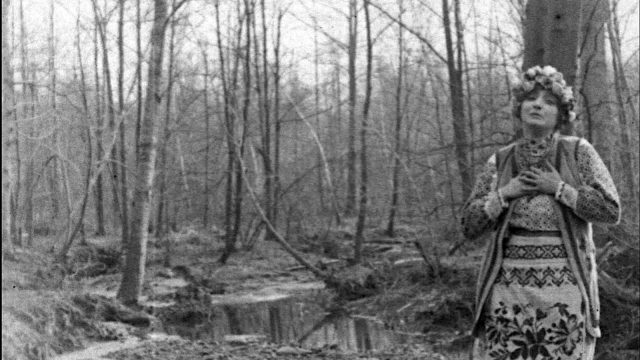
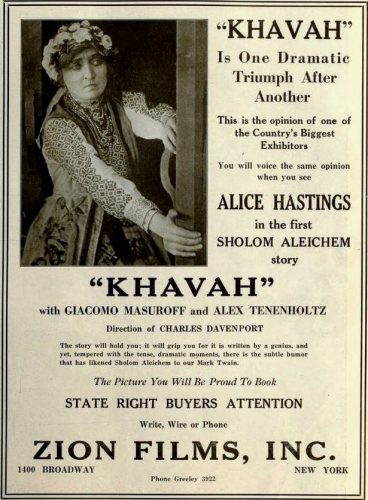
Alice Hastings stars as lovestruck Khavah in rediscovered Broken Barriers

BROKEN BARRIERS (KHAVAH) (Charles E. Davenport, 1919)
Walter Reade Theater, Film at Lincoln Center
165 West 65th St. between Broadway & Amsterdam Aves.
Sunday, January 19, 12:30
Festival runs January 15-28
212-875-5050
www.filmlinc.org
thejewishmuseum.org

The New York Jewish Film Festival pulls out a special treat on January 19, the world premiere of the National Center for Jewish Film’s restoration of the long-lost Broken Barriers, aka Khavah, the first cinematic adaptation of one of Sholem (Sholom) Aleichem’s Tevye the Dairyman stories. The tale will be familiar to fans of Fiddler on the Roof, although there are significant narrative distinctions. In a small Ukraine village, the Jewish Khavah (Alice Hastings), daughter of Tobias the Milkman (Giacomo Masuroff) and Golde (Billie Wilson), falls for the Russian Orthodox Fedka (Alexander Tenenholtz), son of Ivan (Phil Sanford), the chief constable, and Parasha (Sonia Radin), after one of Fedka’s friends (Raymond Friedgen) drunkenly assaults Khavah’s younger sister Tzeitel (Hanna [Ganna Kehlmann] Kay). As Fedka and Khavah consider marriage, Tobias (an alternate pronunciation of Tevye) grows angrier and forbids their relationship. But when a devastating government decree is delivered to Ivan, everyone reconsiders their future.

khava 2

Billed as “a love drama of the Ukraine” in the opening credits, Broken Barriers features actors from Maurice Schwartz’s Yiddish Art Theater on Irving Place (Schwartz would go on to famously play “Tevya” on stage and screen) and the Russian Opera Company; only Sanford had any cinematic experience, and it shows, as the acting is heavy-handed, especially by Hastings, who seems to be attempting to break barriers with her overemoting. (“Broken shall be the barriers that stand between me and happiness!” Khavah declares to her father.) But director Charles E. Davenport tells a tight little tale, limiting the amount of dialogue intertitles and including such poetic statements as “Conscience has a way of bringing us all to the realization that paternal efforts in our behalf are too lightly valued.” Cinematographers Irving B. Ruby and Jack Young shot the film outdoors in the New Jersey wild and in a Manhattan studio, effectively capturing the strife of a poor Ukrainian village while using superimposition to evoke memories. At the heart of the story is whether religious beliefs trump family; the reaction of Fedka’s parents and Khava’s are very different, as is the ending of this rediscovered nugget. The screening will be accompanied by live music by Donald Sosin. A joint presentation of Film at Lincoln Center and the Jewish Museum, the festival continues through January 28 with such other works as Elise Otzenberger’s My Polish Honeymoon, Rachel Rusinek and Eyal Ben Moshe’s I Was Not Born a Mistake, and Dror Zahavi’s closing night selection, Crescendo, about an attempt to establish an Israeli-Palestinian youth orchestra.