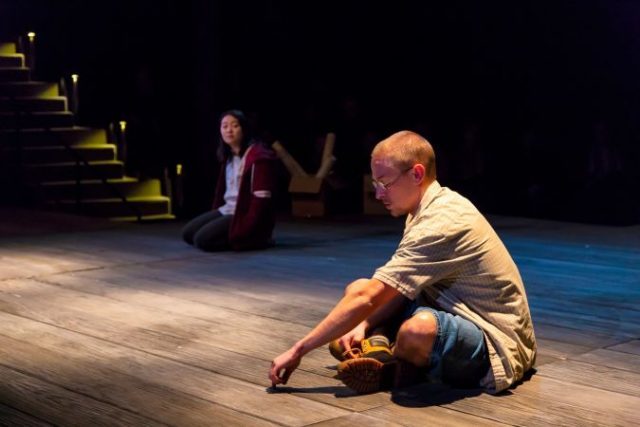
Joe (Edmund Donovan) takes issue with his mother (Judith Ivey) in Samuel D. Hunter’s Greater Clements (photo by T. Charles Erickson)
Lincoln Center Theater at the Mitzi E. Newhouse
150 West 65th St. between Broadway & Amsterdam Ave.
Through January 19, $92
212-362-7600 www.lct.org
Samuel D. Hunter takes a sharp snapshot of a downtrodden America in the poignant drama Greater Clements, which ends its run at Lincoln Center’s Mitzi E. Newhouse Theater on Sunday. The play is set in Hunter’s home state of Idaho, the site of many of his works (A Bright New Boise, Lewiston/Clarkston). It’s 2017, and Greater Clements is at the end of the line; the Dodson Mine suffered a horrific tragedy in 1972 and shut down in 2005, and now there’s a referendum to abolish the town as a civic entity, at least in part as a reaction to the flood of wealthy Californians moving in. Maggie (Judith Ivey), who owns the local mine museum, is closing up shop; she has just brought her mentally ill twenty-seven-year-old son, Joe (Edmund Donovan), back from a stint in Anchorage, where he went to get away from some trouble he caused but did not necessarily fully understand. Maggie is visited by her high school flame, the gentle and stoic Japanese-American Billy (Ken Narasaki), and his adventurous fourteen-year-old granddaughter, Kel (Haley Sakamoto); Maggie, who is divorced, and Billy, who is widowed, flirt around with the idea of perhaps getting back together. Meanwhile, Maggie’s friend and employee, Livvy (Nina Hellman), is leading the charge for the town to remain incorporated, and Wayne (Andrew Garman), the police chief, is keeping a close watch on Joe, who appears to have potentially dangerous tendencies.
Kel (Haley Sakamoto) tries to befriend Joe (Edmund Donovan) in Greater Clements (photo by T. Charles Erickson)
Shrewdly and discerningly directed by Hunter’s longtime collaborator, Davis McCallum (Stupid Fucking Bird,London Wall), the nearly three-hour Greater Clements explores a wide range of issues, from Japanese internment camps and cancer to mental illness and gentrification, from corporate insensitivity and greed to fear and, perhaps most pointedly, loneliness. Dane Laffrey’s potent, active set, which includes a small part of the audience seated in a corner section virtually amid the action, features a second level that descends from above; unfortunately, the construction requires numerous poles that will occasionally block some of your view as the setting changes from the mine and the museum to a bedroom and living room. Yi Zhao’s lighting is supremely effective in the scenes that take place in the mine itself, putting us inside the dark underbelly of America. Tony and Obie winner Ivey (Steaming, Hurlyburly) is exquisite as Maggie, bringing an intimate, realistic warmth to a stalwart woman who deserves better out of life, but Donovan (Lewiston/Clarkston; Xander Xyst, Dragon: 1) steals the show with his powerful, in-your-face portrayal of a man all-too-aware of his situation but not necessarily capable of controlling it.
The Rev. Dr. Martin Luther King Jr. would have turned ninety-one years old on January 15; he was only thirty-nine when he was assassinated. In 1983, the third Monday in January was officially recognized as Martin Luther King Jr. Day, honoring the birthday of the civil rights leader who was shot and killed in Memphis on April 4, 1968. You can celebrate his legacy on Monday by participating in the twenty-fifth annual Martin Luther King, Jr., Day of Service or attending one of numerous special events taking place around the city all weekend long. Below are some of the highlights.
Saturday, January 18
BAMcafé Live 2020: The 1865 w/ Major Taylor, curated by Black Rock Coalition, BAM Peter Jay Sharp Building, 30 Lafayette Ave., free, 9:00
Saturday, January 18
through
Monday, January 20 BCM Celebrates Dr. Martin Luther King Jr., with Volunteer Projects with Repair the World, Create a Peace Box workshop in ColorLab, Storytelling in the Sensory Room, and the Heart of a King Shadow Puppetry Workshop, $13, 11:00 am – 5:00 pm
Sunday, January 19 Martin Luther King Day Choral Eucharist, with the Cathedral Choir, volunteer Chorale and Boy and Girl Choristers, and poet in residence emerita Marilyn Nelson, 11:00 am followed by a Spirituals SING led by Alice Parker, Cathedral of St. John the Divine, 1047 Amsterdam Ave. at 2:00, free
Soul to Soul, with IMPACT Repertory Theatre, Lisa Fishman, Cantor Magda Fishman, Elmore James, and Tony Perry, conceived and directed by Zalmen Mlotek, Museum of Jewish Heritage, 36 Battery Pl., $35-$65, 2:00
Monday, January 20 Dr. Martin Luther King, Jr. Commemorative March: “Equity Now: Today’s Youth Speak Out for Social Change,” Harriet Tubman Memorial Triangle on 122nd St. at 10:00 am to Manhattan Country School at 150 West 85th St. at 2:00, free
Thirty-Fourth Annual Brooklyn Tribute to Dr. Martin Luther King, Jr., with keynote speaker Nikole Hannah-Jones, performances by Son Little and the Brooklyn Interdenominational Choir, the art exhibition “Picture the Dream,” and a screening of Aretha Franklin documentary Amazing Grace (Alan Elliott & Sydney Pollack, 2018), BAM Howard Gilman Opera House, 30 Lafayette Ave., free, 10:30 am
Honoring Dr. Martin Luther King Jr., including a scavenger hunt in the “Activist New York” exhibit, storytelling, and art workshops, Museum of the City of New York, 1220 Fifth Ave at 103rd St., free with museum admission of $14-$20 (under twenty free), 11:00 am – 2:00 pm
Fuminori Nousaku Architects’ “Holes in the House” is focus of Japan Society discussion (photo by twi-ny/mdr)
Who:Fuminori Nousaku,Mio Tsuneyama, Jing Liu What: Architectural talk Where:Japan Society, 333 East 47th St. at First Ave., 212-715-1258 When: Friday, January 17, $15, 5:00 Why: In conjunction with the exhibition “Made in Tokyo: Architecture and Living, 1964/2020,” Japan Society is hosting the talk “Architectural New Wave: From Ruins to the Future of Housing,” featuring Tokyo architects Fuminori Nousaku and Mio Tsuneyama and moderated by SO–IL founder Jing Liu. The discussion will focus on sustainability and adaptive reuse, centering on Fuminori Nousaku Architects’ ongoing project “Holes in the House,” the renovation of a 1980s steel frame warehouse in Nishi, Shinagawa Ward. “Made in Tokyo,” which is curated and designed by Atelier Bow-Wow, continues through January 26, featuring drawings, plans, photography, video, and sculpture that depict the changing urban landscape between the 1964 Tokyo Olympic Games and the upcoming 2020 Games. Among the highlights are Nobuaki Takekawa’s “Cat Olympics: Soccer Field,” Tomoyuki Tanaka’s “Dismantling of Shinjuku Station,” and akihisa hirata’s “nine hours Akasuka, Capsule Hotel.” At 6:00 Friday night, the popular mixer “Escape East @ 333” includes free admission to the galleries with RSVP, a docent-led tour, complimentary snacks, drink specials, and a site-specific installation by Zai Nomura.
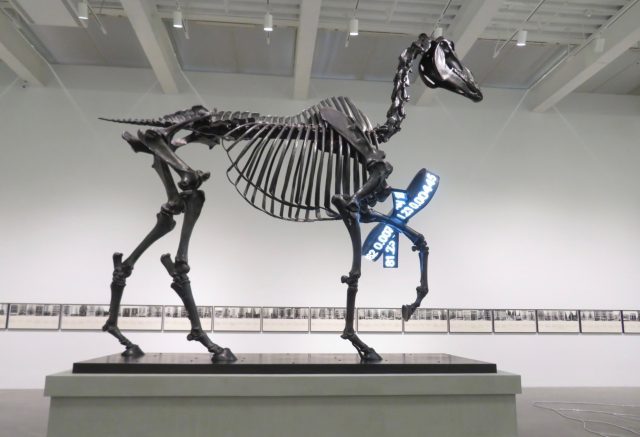
Hans Haacke’s 2014 Gift Horse is starting point for New Museum panel discussion (photo by twi-ny/mdr)
New Museum of Contemporary Art
235 Bowery at Prince St.
Thursday, January 16, $10, 7:00
Exhibition continues through January 26
212-219-1222 www.newmuseum.org
Debate has raged across the country over public statues honoring figures who are now considered by many to be controversial, from Civil War leaders to doctors and presidents. Here in New York, there have been calls to take down James Earle Fraser’s statue of Theodore Roosevelt because of claims that Roosevelt was a white supremacist, and She Built NYC, organized to erect statues of pioneering women, refused to include Mother Frances Cabrini in their final list of subjects even though she garnered the most nominations in a public vote. (Governor Cuomo intervened; a statue of the saint will go up in Battery Park’s South Cove.) On January 16, the New Museum is hosting the panel discussion “The Plinth and Monumentality,” which will examine monument-making from multiple angles. The conversation, featuring artist and curator Kendal Henry of the New York City Department of Cultural Affairs, artist and Hunter College associate professor Paul Ramírez Jonas (whose “Half-Truths” ran at the museum last year), architect, designer, and educator J. Meejin Yoon, and moderator Andrew An Westover of the New Museum, is being held in conjunction with the museum’s current exhibition “Hans Haacke: All Connected,” a retrospective of the eighty-three-year-old German-born, New York-based artist who has been exploring the sociopolitical links between art and commerce, class, corporations, and the environment through photography, sculpture, and installation for more than half a century.
The centerpiece of the exhibit is Haacke’s 2014 Gift Horse, a large-scale sculpture of the skeleton of a horse mounted on a platform, taking up much of the fourth floor gallery space. An electronic bow around its frontal thighbone transmits a live digital printout of the FTSE 100 ticker of the New York Stock Exchange. Also on view is DER BEVÖLKERUNG [TO THE POPULATION], a provocative public project Haacke proposed for the Bundestag. In a catalog interview, Haacke notes, “I consider how the public might understand a work and whether it would, indeed, promote openness and democratic values or — to put it in French revolutionary terms — liberté, égalité, fraternité.”
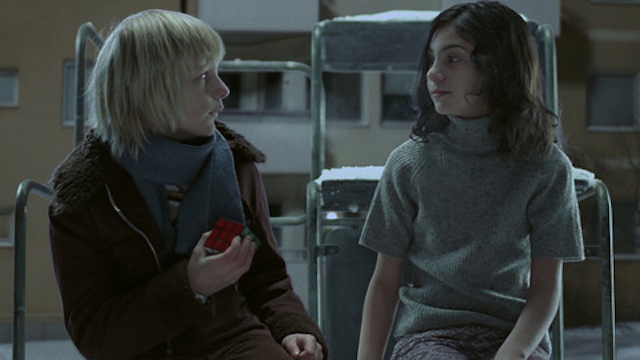
Oskar (Kåre Hedebrant) and Eli (Lina Leandersson) discover a different kind of love in Let the Right One In
LET THE RIGHT ONE IN (LÅT DEN RÄTTE KOMMA IN) (Tomas Alfredson, 2008)
Nitehawk Cinema Prospect Park
188 Prospect Park West
Tuesday, January 21, $95, 7:15 nitehawkcinema.com
If you have a taste for the ghoulish, you’re likely to get sucked in by Nitehawk’s latest Film Feast, in which a multicourse meal accompanies a movie for the cinematic gourmand. On January 21, Nitehawk’s Prospect Park branch will be serving up a delicious gem, the original Swedish thriller Let the Right One In, a chilling yet tender coming-of-age story about friendship and the meaning of family. In a snow-covered Stockholm suburb, twelve-year-old Oskar (Kåre Hedebrant) is severely bullied by Conny (Patrik Rydmark), Andreas (Johan Sömnes), and Martin (Mikael Erhardsson). The frail, blond Oskar dreams of getting even, but he always backs down. But then he meets the dark-haired, somewhat feral Eli (Lina Leandersson, dubbed by Elif Ceylan), who has moved in next door in their apartment complex. While Oskar lives with his divorced mother (Karin Bergquist) — his father (Henrik Dahl) has moved out to the country — Eli lives with Håkan (Per Ragnar), an older father figure who goes out to gather what Eli needs to survive: blood. But the aging Håkan begins encountering difficulties, forcing Eli to go out and hunt down her own food. As people start to go missing in the small community, Eli and Oskar’s friendship begins to blossom, two outsiders coming to terms with who they are. But when Oskar suddenly strikes back, Conny’s older brother, Jimmy (Rasmus Luthander), gets involved, and the steaks, er, stakes, get a whole lot higher.
Based on the 2004 novel by John Ajvide Lindqvist, Let the Right One In is a gripping horror film that is one of the best of the young century. By making the protagonists children with common adolescent problems, Lindqvist, who wrote the screenplay, and director Tomas Alfredson (Tinker Tailor Soldier Spy, The Snowman) create a more realistic setting, so the scares are that much more intense. Hedebrant and Leandersson have a magical chemistry, their tentativeness and fears intoxicating. They exist in a world that is meant only for them; all of the adults are essentially peripheral, whether parents, teachers, or community members wondering what is going on, and the other kids are merely in their way. And it’s all about that very moment; they both might be twelve, but Eli is going to be that age forever while Oskar gets older.
The atmosphere is thick and tense throughout, elevated by Hoyte van Hoytema’s inventive cinematography and Johan Söderqvist’s dramatic score, performed by the Slovak National Symphony Orchestra. Despite some very memorable scenes involving shocking violence, at its heart Let the Right One In is a sweetly innocent love story, albeit with a few unusual complications. Matt Reeves directed a 2010 English-language remake starring Kodi Smit-McPhee and Chloë Grace Moretz, and the National Theatre of Scotland staged a terrific theatrical adaptation that played at St. Ann’s Warehouse in 2015, but there’s still nothing like the original, a visually stunning and psychologically adept fresh new take on the vampire legend.
The five-course feast, with each dish and cocktail named after a part of the film, consists of “”A Little About Drugs” (black cherry, lemon infused Absolut, clarified lemon juice, black shaved ice) with “Good Job Pig” (caraway scented pork belly, pickled carrots, rosemary parsnip purée); “You Smell Funny” (lingonberry, Swedish punsch, allspice, cinnamon, Absolut, Amaro Pasubio, violets, Laphroaig 10 Yr.) with “the Sled Drag” (blodpudding, celery root, Napa cabbage, lingonberry); “Oskar, Do You Like Me?” (acid adjusted apple juice, dill infused Absolut, pine, Salers, pickled apple) with “I’m Trapped” (Swedish meatballs with pour it yourself Absolut gravy); “Virginia!” (Absolut, banana, cream, walnut, caraway, served ice cold) with “Blood Brothers” (rye bröd, gravlax, apple, dill crème fraîche, beet reduction splatter), and “Thank You” (frozen chocolate and espresso martini, white shaved ice) with a “Bloody Kiss” (Hallongrotta, Absolut Pear whipped cream, powdered sugar). Smaklig måltid!
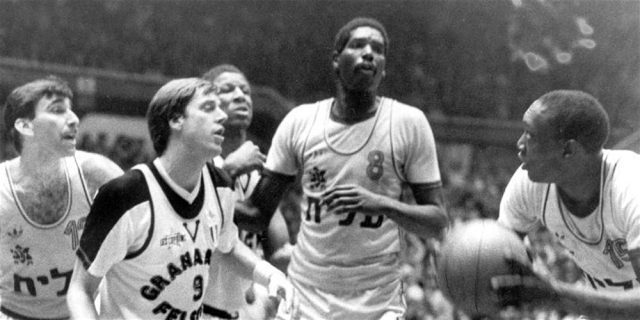
The life and times of Aulcie Perry on and off the court are documented in New York Jewish Film Festival opener
AULCIE (Dani Menkin, 2019)
Walter Reade Theater, Film at Lincoln Center
165 West 65th St. between Broadway & Amsterdam Aves.
Thursday, January 16, 8:30
Festival runs January 15-28
212-875-5050 www.filmlinc.org thejewishmuseum.org
Israeli director Dani Menkin follows up his 2016 documentary, On the Map, about Maccabi Elite Tel Aviv’s unlikely victory in the 1976-77 European Champions Cup, with an inside look into the life of one of its stars in Aulcie, the opening night selection of the New York Jewish Film Festival. After being the last man cut from the New York Knicks in 1976, Newark native Aulcie Perry was recruited to play for Maccabi in Israel, where the 6-10 black man — an unusual sight in the Land of Milk and Honey — quickly became a superstar, helping the team to championships, falling in love with top model Tami Ben Ami, and hanging out in hot clubs, living the high life. But it all came tumbling down in a haze of drugs, and Menkin traces Perry’s attempt to put it all back together, primarily by finding the daughter he has not seen since she was a baby.
The film is set up as Perry’s confession to that daughter, Cierra Musungay. “I always knew one thing: that I wanted to tell you my story, the way it is, with the good and the bad,” he says at the beginning. “So where do I start? People say you start at the beginning. But I wanted to start at the end, or when I thought the end was coming.” He was inspired to track her down after facing a serious health scare. “I think, that only when I almost died, I started to really live. And that’s when I wanted to find you and, maybe in some ways, find myself,” he adds.
Top model Tami Ben Ami and basketball superstar Aulcie Perry are shown as the hot couple in Aulcie
Menkin goes back and forth between archival footage, animation by Assaf Zellner, and interviews with Aulcie’s sister Bernadine Lewis, his friends Wayne Tyre and Roy Young, his ex-girlfriend Juanita Jackson, his son Aulcie Perry Jr., and many men from his Maccabi family, including former teammates Earl Williams and Tal Brody, team president Shimon Mizrahi, co-owner Oudi Recanati, coach Zvi Sherf, and manager Shamluk Maharovsky, who was like a father to him. “In Israel, there wasn’t that much prejudice against black players, and he felt at home here,” NBA commentator Simmy Reguer says. “Aulcie came in like a blessing from the gods,” fellow Jersey native and team captain Brody recalls. And Sports Illustrated writer Alexander Wolff explains, “At Maccabi Tel Aviv, Aulcie Perry was Michael Jordan, Kareem Abdul-Jabbar rolled into one.”
Now sixty-nine, Perry is honest and forthright thorughout, admitting his failings and wanting to make up for lost time. He makes no excuses for his precipitous fall, and he’s not seeking sympathy. He’s a man who made mistakes and wants a chance to set things right. Aulcie is a cautionary tale of redemption with heart and soul, focusing on the need to be part of a family, no matter how different and unexpected it may be. Aulcie is having its New York City premiere January 16 at 8:30 at the Walter Reade Theater, with Perry, Menkin, and producer Nancy Spielberg (brother of Steven) participating in a Q&A. Aulcie might be the opening selection of the New York Jewish Film Festival, but the twenty-ninth annual fest actually kicks off a day earlier with Picture of His Life, a documentary codirected by Menkin and Yonatan Nir about Yom Kippur War veteran and underwater photographer Amos Nachoum, showing on January 15 at 1:00, with Menkin, Spielberg, and Nachoum present. A joint presentation of Film at Lincoln Center and the Jewish Museum, the festival continues through January 28 with such other works as Marceline Loridan-Ivens’s centerpiece The Birch Tree Meadow, starring Anouk Aimée and August Diehl, a fiftieth anniversary presentation of Vittorio De Sica’s The Garden of the Finzi-Continis, and Dror Zahavi’s closing night selection, Crescendo, about an attempt to establish an Israeli-Palestinian youth orchestra.
London-born comedian and disability activist Jess Thom returns to the BRIC House Ballroom with a spectacular sixty-minute presentation, a brilliantly conceived evening that reimagines the theatrical experience, for both actor and audience. In May 2016, Thom, who has Tourette Syndrome, held the New York premiere of her Edinburgh Fringe hit Backstage in Biscuit Land at the Brooklyn arts institution, delivering a “one-woman show for two” that humorously looks at her life and how she deals with Tourette’s, a neurological disorder that causes her to uncontrollably shout out words and phrases, such as “biscuit,” “hedgehog,” “sausage,” “I love cats,” and “Fuck a goat.” (Only ten percent of those with Tourette’s have copralalia, involving foul language.) She also uses a wheelchair, as her disability comprises various physical tics, such as banging her chest whenever she says “biscuit,” that make it too dangerous for her to walk on her feet.
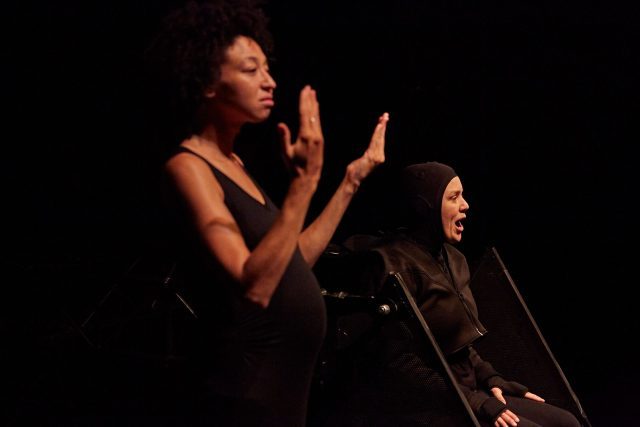
Back at BRIC for the Public Theater’s Under the Radar Festival, Thom is performing Samuel Beckett’s 1972 monologue Not I in a relaxed, inclusive environment. As you enter the small, intimate black-box space, Thom is in her wheelchair, greeting each audience member and inviting them to sit either on cushions, benches, or folding chairs. She is friendly and outgoing, and she doesn’t pause or change moods when the tics come up. She even plays off them; for example, when she says, “I love cats,” she quickly adds something like, “Well, I don’t really even like cats,” and when she proclaims, “Fuck a goat,” she responds by assuring everyone that no one will be having sex with an animal. Meanwhile, to her right, ASL performer Lindsey D. Snyder signs everything Thom says, including the verbal tics. Reaching the whole audience matters to Thom: The seating in Not I is inspired by how she was rudely treated when she attended a 2011 show by stand-up comic Mark Thomas, when theater staff confined her to a sound booth because other members of the audience objected to her gesticulations and vocal outbursts.
Once everyone is settled, she explains the plans for the evening and describes how a friend had told her that she should consider staging her own version of Not I, because it relates so organically to her life. The play, which has been performed by such actresses as Jessica Tandy, Beckett muse Billie Whitelaw, Julianne Moore, and Lisa Dwan and gets its title because it is told in the third person by the protagonist, is an ellipses-filled diatribe of incomplete thoughts and tangents that generally runs between nine and fifteen minutes; it is not a race, but the performer is expected to go through the 2,268 words as fast as possible. “I am not unduly concerned with intelligibility. I hope the piece may work on the nerves of the audience, not its intellect,” Beckett wrote in a 1972 letter to Tandy prior to the play’s world premiere at Lincoln Center. Dressed all in black, wearing a balaclava and a hoodie, Thom, in her wheelchair, is lifted eight feet in the air (the set is designed by Ben Pacey), and she is lit so only the bottom half of her face can be seen. Usually, only the actress’s mouth can be seen, as if it exists by itself, but changes had to be made because of Thom’s Tourette’s. As she power-drives through the piece, she occasionally gets caught in a series of “biscuit” moments but then forges ahead. She is moving through the dialogue so fast, and so unpredictably, that Snyder, also dressed in black and taking the place of the Auditor, the second character in the play, is practically dancing on the floor. (Beckett’s movement directions for the Auditor note, “This consists in simple sideways raising of arms from sides and their falling back, in a gesture of helpless compassion.”)
The audience is not meant to understand every word and plot detail as a woman, identified as “Mouth” in the script, relates several stories involving shopping in a supermarket, going to court, sitting on a mound in Croker’s Acres, and searching for cowslips in a field, bringing up such concepts as shame, torment, sin, pleasure, and guilt. This protagonist has suffered an unnamed trauma that has led to her becoming an outcast from society and virtually unable to communicate with others via speech. It’s clear why Thom’s friend suggested Not I for her, perhaps most evident from the following excerpt:
“what? . . tongue? . . yes . . . lips . . . cheeks . . . jaws . . . tongue . . . never still a second . . . mouth on fire . . . stream of words . . . in her ear . . . practically in her ear . . . not catching the half . . . not the quarter . . . no idea what she’s saying . . . imagine! . . no idea what she’s saying! . . and can’t stop . . . no stopping it . . . she who but a moment before . . . but a moment! . . could not make a sound . . . no sound of any kind . . . now can’t stop . . . imagine! . . can’t stop the stream . . . and the whole brain begging . . . something begging in the brain . . . begging the mouth to stop . . . pause a moment . . . if only for a moment . . . and no response . . . as if it hadn’t heard . . . or couldn’t . . . couldn’t pause a second . . . like maddened . . . all that together . . . straining to hear . . . piece it together . . . and the brain . . . raving away on its own . . . trying to make sense of it . . . or make it stop . . .”
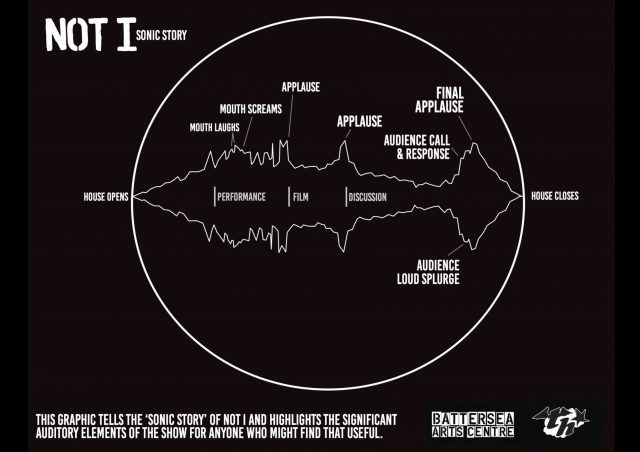
Not I has a sound map to ensure everyone is comfortable and no one feels excluded for auditory reasons
When we go to live theater and watch someone stumble over lines or hesitate and stammer as if they’ve lost their place, our hearts tend to sink and we don’t want the actor to be embarrassed. But when Thom, tearing through the words at a frenetic pace, suddenly goes into “biscuit” mode, not only are we rooting for her, we are with her every second, willing her on to get to the finish line with glory. It’s exhilarating when she storms back into Beckett’s language. But it’s important to note that we are not rooting for her because of or in spite of her disability (a word, by the way, that she freely uses); we are helping carry her to the end in a communal act that goes far beyond mere kindness.
The Beckett section is followed by Sophie Robinson’s short documentary Me, My Mouth, and I, which goes behind the scenes of the creation of Thom’s performance, and then Thom — who is also known as Touretteshero for her work with children and for her same-named organization that seeks to “change the world one tic at a time” — offers the audience the chance to talk to their neighbors about their thoughts on the play and ask her questions. The evening, which is passionately directed by her longtime collaborator Matthew Pountney, concludes with Thom signing copies of her 2012 book, Welcome to Biscuitland, in which Stephen Fry writes in the foreword, “Jess is a true hero, with or without her Touretteshero costume. Jess fuck biscuit Thom, I biscuit fuck fuck biscuit salute biscuit you.” And so will you.