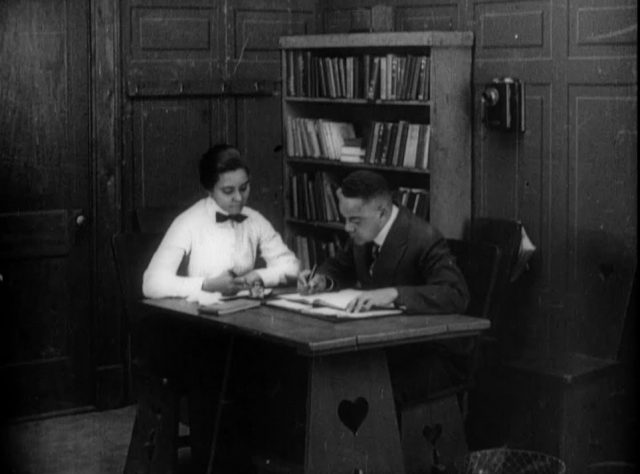
Sylvia Landry (Evelyn Preer) seeks to raise money to expand education for black children in Within Our Gates
WITHIN OUR GATES (Oscar Micheaux, 1920) / ST. LOUIS BLUES (Dudley Murphy, 1929)
Film Forum
209 West Houston St.
Tuesday, January 28, 6:35
Series continues through February 13
212-727-8110 filmforum.org
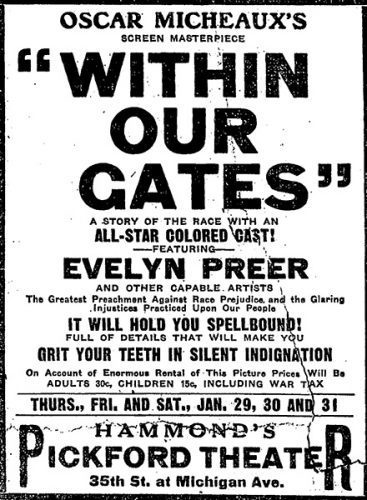
#OscarsSoWhite and #OscarsSoMale have you disappointed and mad? Film Forum is offering just the medicine with its four-week, sixty-film festival “Black Women: Trailblazing African American Actresses & Images, 1920 – 2001.” Running through February 13, the wide-ranging series consists of movies starring Hattie McDaniel, Dorothy Dandridge, Cicely Tyson, Ethel Waters, Josephine Baker, Diana Ross, Angela Bassett, Diahann Carroll, Oprah Winfrey, Juanita Moore, Whoopi Goldberg, Billie Holiday, Lena Horne, Ruby Dee, Eartha Kitt, Abbey Lincoln, Gloria Foster, Ella Fitzgerald, Vonetta McGee, Alfre Woodard, Lonette McKee, Lynn Whitfield, Janet Jackson, Queen Latifah, Pam Grier, Tamara Dobson, Whitney Houston, Halle Berry, and many others, made by black, white, male, and female directors. The oldest film being presented is the oldest surviving film made by an African American director, Oscar Micheaux’s Within Our Gates, on January 28 at 6:35. A response to D. W. Griffith’s Birth of a Nation, Micheaux’s film, released in 1920 after trouble with the censor board, packs a whole lot into its seventy-nine minutes, giving the film an epic feel as it deals with violent crime, rape, slavery, poverty, education, love quadrangles, Jim Crow, subservient blacks, mixed-race romance, the Great Migration, and other incendiary topics.
“I have always tried to make my photoplays present the truth, to lay before the Race a cross-section of its own life, to view the Colored heart from close range,” Micheaux explained on January 24, 1925. “It is only by presenting those portions of the Race portrayed in my pictures, in the light and background of their true state, that we can raise our people to greater heights. . . . The recognition of our true situation will react in itself as a stimulus for self-advancement.” He does just that with Within Our Gates, in which Evelyn Preer plays Sylvia Landry, a young woman in love with Conrad Drebert (James D. Ruffin). However, Sylvia’s supposed friend, the manipulative Alma Prichard (Floy Clements), is also in love with Conrad and determined to steal him from her. Meanwhile, Alma’s stepbrother, gangster Larry Prichard (Jack Chenault), wants Sylvia, who is not interested in him. Larry is being closely watched by a detective, Philip Gentry (William Smith), who was tipped off by the FBI as to his whereabouts.
A car accident leads Sylvia to meet Dr. V. Vivian (Charles D. Lucas) and philanthropist Elena Warwick (Mrs. Evelyn), who wants to help Sylvia, but Elena’s friend, the racist Geraldine Stratton (Bernice Ladd), would rather see no women gain the right to vote if a new amendment would include black women as well. The story shifts gears when Alma tells Dr. Vivian about Sylvia’s past, involving Sylvia’s adopted family, a robbery and shooting, a white landlord (Ralph Johnson) and his brother (Grant Gorman), and a tattletale Uncle Tom (E. G. Tatum) seeking to gain favors, all shown in flashback. It’s a complex tale filled with surprising twists, and it’s a critically important film in the history of black cinema.
Micheaux’s first work was The Homesteader, which is lost; he would go on to make such pictures as Body and Soul, Veiled Aristocrats, and Underworld. The Library of Congress Motion Picture Conservation Center restored Within Our Gates in 1993 from a lone Spanish print, so most intertitles were rewritten in English, and a section in the middle was lost. In 2016, DJ Spooky (aka Paul D. Miller) added a guitar-and-piano-based soundtrack, but the Film Forum screening of a 35mm print will be accompanied by a live score played by Steve Sterner. In addition, it will be preceded by Dudley Murphy’s sixteen-minute 1929 short St. Louis Blues, highlighted by Bessie Smith in her only film appearance. The series continues with such films as both Foxy Brown and Jackie Brown, The Color Purple, Set It Off, Lady Sings the Blues, Monster’s Ball, and Dirty Gertie from Harlem U.S.A.
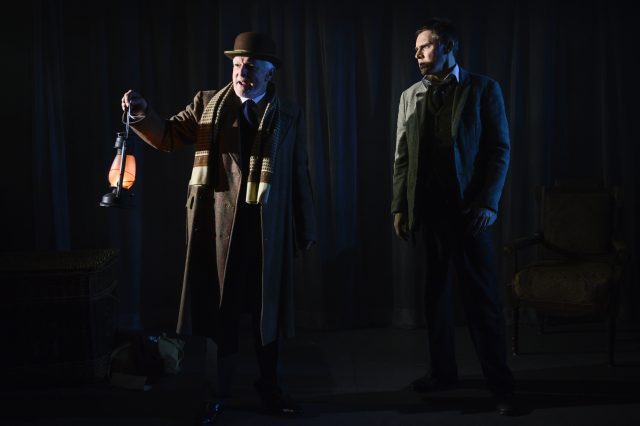
David Acton and Ben Porter reprise their London roles in New York debut of The Woman in Black (photo by Jenny Anderson)
The McKittrick Hotel
530 West 27th St. between Tenth & Eleventh Aves.
Wednesday – Monday through April 19, $85 mckittrickhotel.com
A few months ago, I finally gave in and saw The Perfect Crime, the mystery that’s been running in Manhattan since 1987 and features Catherine Russell; having racked up more than thirteen thousand performances in the same role, she’s now in the Guinness Book of World Records. Yet there was nothing special about it that made me understand its longevity. So it was with both trepidation and curiosity that I went to the New York premiere of The Woman in Black, which has been playing in London’s West End continuously since 1989. The two-act, 130-minute show is being staged in the McKittrick Hotel’s Club Car, the previous home of the National Theatre of Scotland’s fun, immersive drama The Strange Undoing of Prudencia Hart, among other presentations.
Adapted by Stephen Mallatratt from Susan Hill’s Gothic novel and directed by Robin Herford, The Woman in Black gets off to a slow start, establishing a play-within-a-play format that could use a jump to get things going. A finicky old man named Arthur Kipps (David Acton) has hired an actor (Ben Porter) to punch up a ghost story he has written, based on events that happened to him. “I recalled that the way to banish an old ghost that continues its hauntings is to exorcise it,” Kipps says. “Well, then. Mine should be exorcised. I should tell my tale. I should set it down on paper, with every care and in every detail. I would write my own ghost story, and then, that my family might know and that I might be forever purged of it, relive it through the telling. The first part, the writing, I have done. Now comes the telling. I pray for God’s protection on us all.”
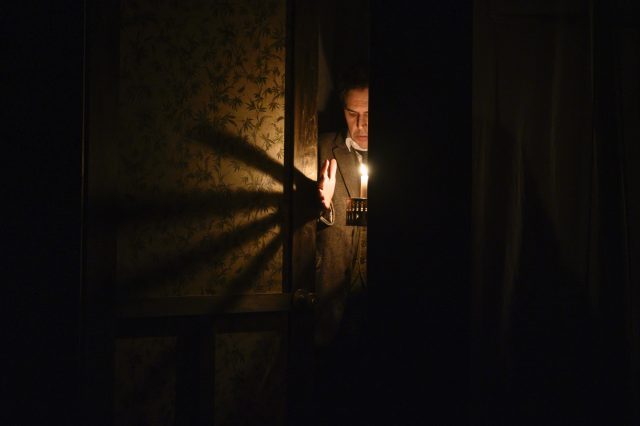
Mr Kipps (Ben Porter) wonders what’s behind the locked door in Gothic drama at the McKittrick Hotel (photo by Jenny Anderson)
The first act introduces the audience to the setup: The old man has no sense of drama and repeatedly proclaims that he is not a performer, which is why he needs the Actor. (As in the script, Porter will heretofore be called Kipps, and Acton will be Actor.) In reciting the tale, the actor takes on the persona of Kipps as a young man, while Kipps juggles all the other roles, including a lawyer, a dapper gentleman with a dog, a landlord, a legal agent, and a carriage driver. Michael Holt’s set is spare, with a chair, a large wicker basket, and a curtain in the back that later reveals covered furniture behind it. Anshuman Bhatia’s lighting and Sebastian Frost’s sound play key parts in giving the show a bigger feel. Guests sit in chairs lined up in long rows; the bar features such cocktails as Woman in Black Punch, the Old McKittrick, and Mr Kipps. You can also have “Pie & a Pint”: a beer and a pub platter, pie & mash, or duck shepherd’s pie. A full dinner is available before the show.
The story that Kipps wants the Actor to tell is about himself as a young lawyer, as he travels to the end of nowhere, Eel Marsh House, for the funeral of a longtime client of his firm, the very much not-beloved Mrs Alice Drablow; in addition, he is to go through her papers to make sure her accounts are in order. As Kipps and the Actor play out the scenes, the latter often interrupts, concerned about how certain elements will be brought to life onstage. “There are so many things we cannot represent. How do we represent the dog, the sea, the causeway? How the pony and trap?” he asks. Kipps responds, “With imagination, Mr Kipps. Ours, and our audience’s.” He also notes that the unseen Mr Bunce will be using sound effects to further enhance the telling. The closer Kipps gets to Eel Marsh House, the creepier people act when they learn where he is going. And beware the Woman in Black, who’s liable to make you jump out of your skin.
The first act’s meta-discussion of stagecraft is repetitive and stodgy, but the show finally finds its groove in the second act, once Kipps arrives at his destination and dives into his research — and wonders what’s behind the locked door. After a bumpy beginning, the Actor settles into his responsibilities portraying numerous characters quite well while experiencing those long-gone days all over again. “I have a horror of it,” he tells Kipps. “Watching you, it is as if I relive it all, moment by moment . . . though you, of course, will never suffer as I did — I must always tell myself that.” Such is the nature of theater, which merely attempts to re-create and capture a sense of reality. There are plenty of scares as the denouement approaches; we were fortunate to have a screamer next to us, which was a bonus. Acton and Porter, who have performed the play in the West End, have an amiable camaraderie; Herford likes to keep things fresh, so he changes the cast in London every nine months (which is a far cry from the situation in The Perfect Crime). The Woman in Black is scheduled to run through March 8, but shows have a habit of extending at the McKittrick; Sleep No More has been playing there since 2011. [Ed. note: The Woman in Black has now been extended through April 19.] Of course, it looks like nothing will ever top The Mousetrap, the Agatha Christie show that has been running in the West End since 1952. Perhaps most important, The Woman in Black feels right at home in the Club Car, providing plenty of chills and thrills once the exposition gets out of the way.
Gallery Korea of the Korean Cultural Center New York
460 Park Ave. between Fifty-Seventh & Fifty-Eighth Sts., sixth floor
Monday – Friday through January 31, free
212-759-9550 www.koreanculture.org
To celebrate its fortieth anniversary, the Korean Cultural Center New York is hosting the three-part exhibition “Nam June Paik: The Maestro of Time,” which continues at Gallery Korea weekdays through January 31. The free show also honors the fourteenth anniversary of the death of the Father of Video Art, who passed away on January 29, 2006, in Miami when he was seventy-three. The centerpiece is Paik’s massive M200/Video Wall, a barrage of eighty-six television monitors blasting colorful sounds and images that Paik created for the bicentennial of the passing of Wolfgang Amadeus Mozart, who died in Vienna in 1791 at the age of thirty-five. The video sculpture, which Paik referred to as “moving wall paintings,” predicted the age of digital information bombardment as pictures and snippets of performances fly by, from the Korean American artist’s friends and collaborators Joseph Beuys, Merce Cunningham, and John Cage to David Bowie and a man dressed as Mozart. As Paik said way back in 1965, “The cathode-ray tube will someday replace the canvas.”
Nam June Paik’s Video Chandelier No. 4 is part of Korean Cultural Center New York celebration and tribute (photo by twi-ny/mdr)
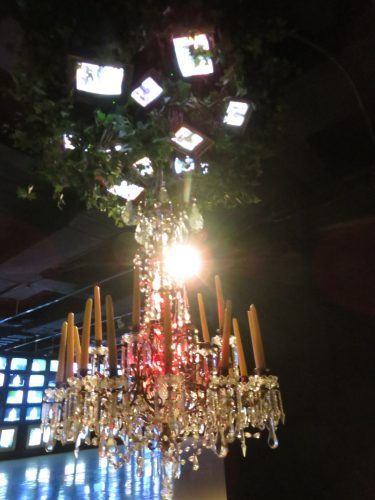
Tucked away in a corner of the gallery is Paik’s Video Chandelier No. 4, a low-hanging chandelier dangling from what appears to be the top of a tree that has small video monitors in its leaves instead of fruit, strikingly linking technology to nature. Also on view is a series of black-and-white photographs by Jae-young Choi of one of Paik’s avant-garde gut performances, in which the man who coined the term “electronic superhighway” staged a shamanistic ritual on his birthday in 1990, paying tribute to Beuys. Gallery Korea is open 9:00 to 5:00 Monday to Friday but will stay open till 8:00 on January 29.
MoMA, Museum of Modern Art
11 West 53rd St. between Fifth & Sixth Aves.
Through February 1, $14-$25 (sixteen and under free)
212-708-9400 www.moma.org
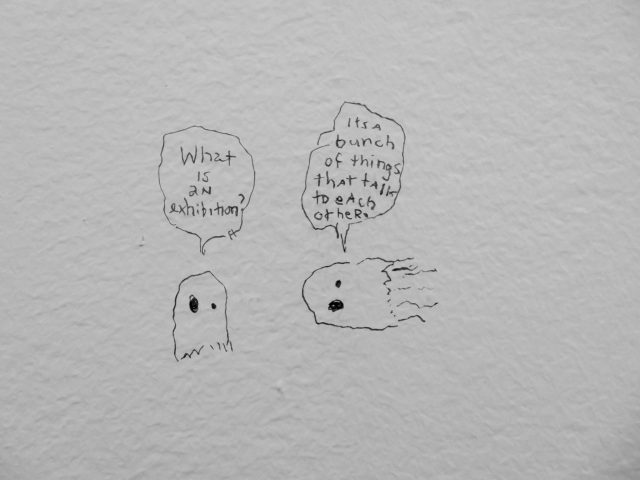
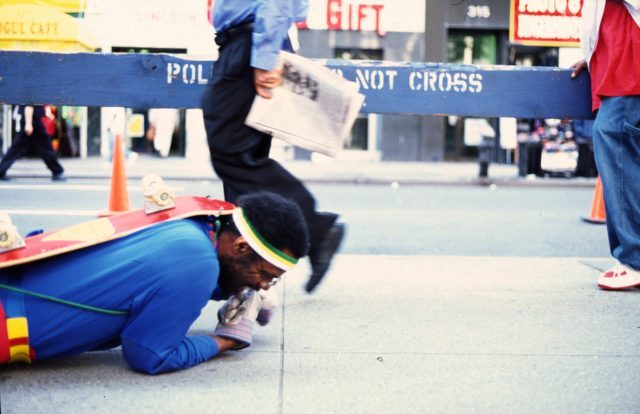
The first thing you must do when you go to MoMA is check out whether there is a backpack hanging on the wall at the end of the “member: Pope.L 1978–2001” exhibition; if it’s not there, it means that Newark-born Conceptual artist William Pope.L is somewhere in the galleries, either performing on a yellow square near the front, doodling on the walls, or interacting with visitors. Since the late 1970s, Pope.L has been holding interventions and live performances that expose racism, classism, poverty, homelessness, and other societal ills. “I am a fisherman of social absurdity, if you will,” he has said. “I am more provocateur than activist. My focus is to politicize disenfranchisement, to make it neut, to reinvent what’s beneath us, to remind us where we all come from.” The show, which continues through February 1, features photographs, film footage, and paraphernalia from many of his Crawls and acts of resistance, in which he takes to the streets in unusual ways as a form of protest.
Pope.L has been adding doodles to the walls during run of show at MoMA (photo by twi-ny/mdr)
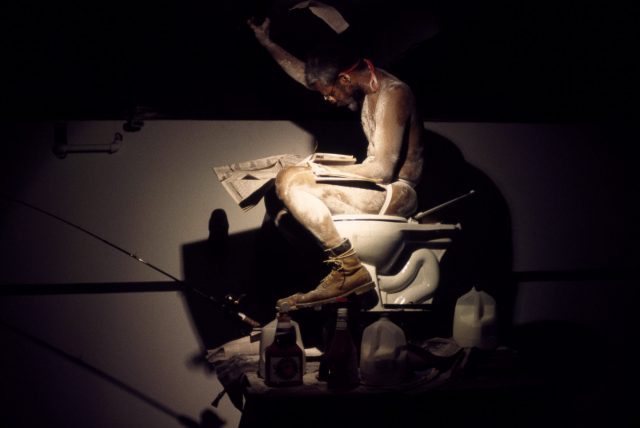
In Thunderbird Immolation, he doused himself with cheap wine and surrounded himself with matches, evoking the Buddhist ritual of self-immolation but here calling into question the marketing of cheap alcohol in poor minority communities. For The Great White Way and Snow Crawl, Pope.L put on a Superman suit. For Member a.k.a. Schlong Journey, he donned business attire and had a long white cardboard tube with a stuffed white bunny on the end protruding from his crotch, as if it were an enormous phallus, as he walked around Harlem, revealing issues of black masculinity and white supremacy. For Sweet Desire a.k.a. Burial Piece, he buried himself in the ground standing up, only his shoulders and head visible, and looked at a melting bowl of ice cream that he could not bend his head over and eat, emphasizing “have-not-ness.” And for Eating the Wall Street Journal, Pope.L built a tall toilet throne which he climbed up to and then, while sitting on the bowl, read, then tore up, chewed, and spat out pages of the newspaper because of its promise of individual wealth.
In a back room, you can watch several of his experimental performances, including Eracism, Aunt Jenny Chronicles, and Egg Eating Contest; be sure to look behind the screen for a bonus. The Black Factory Archive consists of items donated by people from around the country that they consider black objects. “The Black Factory is an industry that runs on our prejudices,” Pope.L wrote of the project. “We harvest all your confusions, questions, and conundrums, and transform them into the greatest gift of all: possibility!” And in ATM Piece, he chained himself to the front door of a midtown bank, wearing only a skirt made out of bills. Throughout the galleries, you’ll also see small rectangles cut out of the wall; “Typically what cannot be seen is what we most like to see,” he says of the work, Hole Theory. On January 26 at 2:00, MoMA’s Creativity Lab will host a discussion on Pope.L with Brooklyn-based artist Steffani Jemison and MoMA curatorial assistant Danielle Jackson that examines Pope.L’s influence.
Pope.L exhibitions at MoMA and the Whitney are filled with hidden surprises (photo by twi-ny/mdr)
Member is part of “Pope.L: Instigation, Aspiration, Perspiration,” a collaboration between MoMA, the Public Art Fund, and the Whitney. On September 21, PAF staged Conquest, in which blindfolded volunteers from across the diversity spectrum crawled from the West Village through Washington Square Park and ultimately to Union Square Park. Groups of five, from people in wheelchairs to pregnant women, from the elderly to the blind and deaf and men and women with prosthetic limbs, as well as able-bodied participants, crawled one block each, raising ideas of physical privilege. And Pope.L’s Choir is on view at the Whitney through March 8 in the free main-floor space, a thousand-gallon tank surrounded by microphones that fills up with water sourced from the Hudson after he poured in some water from Flint, Michigan, then empties out via a pipe system as snippets of gospel music and other sounds can be heard. Around the gallery are such phrases as “NGGR WATER,” “HLLOW WTR,” and “NDVSBL WTR,” evoking Jim Crow, segregated drinking fountains, and the lead crisis in Flint. “I think there’s a kind of arrogance in using this kind of material in this quantity,” he says on the audioguide to Choir. ”I think that in some ways, I’m expressing a kind of privilege in being able to do this. There’s a kind of edge to that in the work.” That statement applies directly to member at MoMA and Pope.L’s entire career as well.
Gōng xǐ fā cái! New York City is ready to celebrate the Year of the Rat with special events all over town. People born in the Year of the Rat, the first zodiac sign, are clever and resourceful and have the potential to be wealthy and prosperous. Below are some of the highlights happening here in the five boroughs during the next several weeks of Chinese New Year.
Lunar New Year Celebration, with family-friendly arts and crafts, mask-making workshop, lantern making, zodiac animal origami, compost activities, face painting ($5), winter tree tour, plant sale, zodiac-themed storytelling, lion dance performance, and more, Queens Botanical Garden, 43-50 Main St., free, 12 noon – 4:00
Saturday, February 1 Lunar New Year Family Festival, with “Sounds of the New Year” featuring the pipa and the erhu, “Whirling, Twirling Ribbons” workshop, lion dance performance, food, storytelling, face painting, zodiac arts and crafts, a gallery hunt, more, Museum of Chinese in America, 215 Centre St., $12, 10:00 – 1:00 and 2:00 – 5:00
Lunar New Year Chinese Temple Bazaar, with food, live performances, activities, and more, Flushing Town Hall, 137-35 Northern Blvd., $5, 11:00 & 2:00
Lunar New Year Festival: Year of the Rat, Lunar New Year Parade, Sesame Street Puppeteers Featuring Alan Muraoka, Integrating Identity with Vincent Chong, Festive Feast with Emily Mock, Luminous Lanterns with China Institute, Wu-Wo Tea Ceremony & Bubble Tea Gatherings, Hand-Pulled Noodle Demonstration, Creative Calligraphy with Zhou Bin, Metal Mouse Masterpieces with the Rubin Museum of Art, Hero Rats with Lydia DesRoche, Fierce Dragon Creations, Luminous Lanterns with China Institute, more, Met Fifth Ave., free with museum admission (some events require advance tickets), 11:00 am – 5:00 pm
Family Day: Moon over Manhattan, with Bo Law Kung Fu: Lion Dance and Kung Fu demonstration, Rabbit Days and Dumplings, arts & crafts, and more, Asia Society, 725 Park Ave., $5-$12, 1:00 – 5:00
Lunar New Year, with music and dance, martial arts, theater, a lion parade, and more, presented with the New York Chinese Cultural Center, Brookfield Place, 230 Vesey St., free, 2:00 – 3:15
Sunday, February 2 Chinese New Year Family Festival, with lion dances, dumpling and paper-lantern workshops, storytelling, a puppet show, live music, more, China Institute, 40 Rector St., general admission free, some programs $20 in advance, 12:00 – 4:00 pm
Wednesday, February 5 Classic Films for the New Year:Eat Drink Man Woman (Ang Lee, 1994), China Institute, 40 Rector St., $5, 6:30 pm
Friday, February 7 Lunar New Year Night Market, with food and drinks, live performances, art and culture, lion dance, vendors, and more, Museum of Chinese in America, 215 Centre St., $99 (includes one-year MoCA membership), 6:00 – 10:00
Saturday, February 8
Super Saturday Lion Dances, throughout Chinatown, free
Sunday, February 9 Twenty-first annual New York City Lunar New Year Parade & Festival, with cultural booths in the park and a parade with floats, antique cars, live performances, and much more from China, Korea, Japan, Vietnam, Taiwan, Malaysia, Singapore, and other nations, Chinatown, Sara D. Roosevelt Park, and Columbus Park, free, 11:00 am – 3:30 pm
THE WOOSTER GROUP: A PINK CHAIR (IN PLACE OF A FAKE ANTIQUE)
NYU Skirball Center for the Performing Arts
566 La Guardia Pl.
January 23 – February 2, $35-$50
212-992-8484 nyuskirball.org thewoostergroup.org
There are certain actors who just pull you in instantly; from the moment you first see them onstage, you’re hooked. For many, it might be Al Pacino or Nathan Lane, Audra MacDonald or Mary Louise Parker. Jim Fletcher is like that for a lot of intrepid, adventurous theatergoers. Tall, balding, and ruggedly handsome, the Ann Arbor native didn’t start acting until he was thirty-five, in 1998; previously he had been a teacher, a caseworker, a dogwalker, an art handler, and a pedicab driver, among other day jobs. For the past two decades he has performed extensively with some of the premier experimental theater groups in the city, most prominently Richard Maxwell’s NYC Players and Elizabeth LeCompte’s Wooster Group, in addition to collaborating with the art collective Bernadette Corporation. Among the shows Fletcher has appeared in are Elevator Repair Service’s Gatz, Maxwell’s Isolde, and Compagnie l’heliotrope’s Pollock.
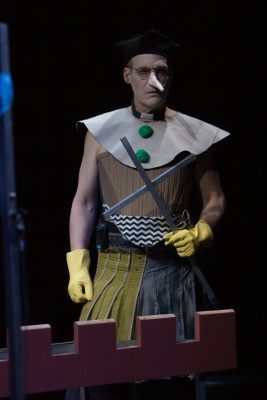
A poet as well, he’s also ridiculously busy; in the past few weeks, as we conducted this interview over email, he and Sean Lewis reprised Bro-Tox at La MaMa, he stopped by the Kitchen to check out Maxwell’s latest play, Queens Row, and he’s heavy into rehearsals for the Wooster Group’s A Pink Chair (In Place of a Fake Antique), which runs at the NYU Skirball Center January 23 through February 2. The production, which was previously seen at the company’s much smaller home, the Performing Garage in SoHo, is a tribute to Polish avant-garde theater director and artist Tadeusz Kantor, with Kantor’s daughter, Dorota Krakowska, serving as dramaturg. Fletcher plays a priest; there are some funny behind-the-scenes videos on the Wooster Group’s website in which he makes a cross and plays silly word games with the cast and crew. (The cast also features Zbigniew Bzymek, Enver Chakartash, Ari Fliakos, Gareth Hobbs, Andrew Maillet, Erin Mullin, Suzzy Roche, Danusia Trevino, and Kate Valk; to find out more about the Wooster Group, the Carriage Trade Gallery on Grand St. is hosting a multimedia retrospective of the company through January 26.) Below, Fletcher discusses, in his inimitable poetic style, his dream role, working with some of the most original creators in theater, and his carpentry skills.
twi-ny: I was at a lunch party a few months ago and got into a conversation with a woman about experimental theater. She burst out about how much she loves an actor named Jim Fletcher, and we proceeded to rave about various shows we’ve seen you in. It seems you have a cult fan club out there. How does that feel?
jim fletcher: It feels great. Please elaborate! Mind you, I’m going by what you’re saying. It sounds like there’s energy bouncing around. I love that. More. Surplus. Slurplus. You know, house rules. . . . There’s energy out there in the room, I love it too, I’m devoted too. Devotion is juicy.
twi-ny: Devotion is indeed juicy. You are part of several experimental collectives that have devoted fan bases of their own, primarily the New York City Players, the Wooster Group, and Bernadette Corporation. How did you get connected with them?
jf: I’m working with people I love. It seems I never asked myself what kind of work I wanted to do, and also never the follow-up question, who best to do it with. In that sense I’m not a productive person. I think when you get close to people, you spontaneously start working in some way . . . out of sheer energy or whatever it is. Surplus.
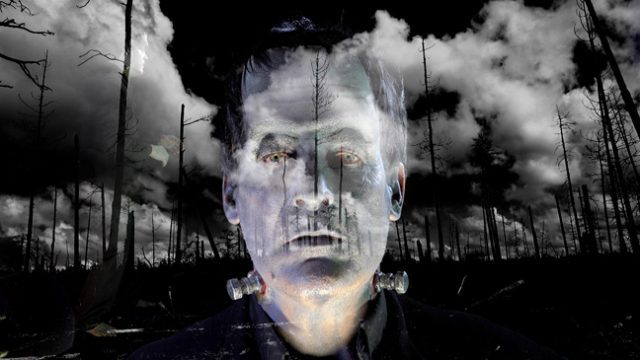
Jim Fletcher played Frankenstein’s monster in Tony Oursler’s Imponderable (photo courtesy Museum of Modern Art)
twi-ny: What are the main differences between working with Richard Maxwell and with Elizabeth LeCompte?
jf: It’s easier for me to say what they have in common. In both cases it’s deep water, bright, alive. Like swimming in the ocean. Limitless, often extremely simple. Always big. And buoyant. Potentially dangerous because there’s power and a lot of desire. I’ve been lucky to work with them both. Ever-fresh. Always something other than what I would have imagined.
With Rich, among so many other things (ongoing), I learned the practice of active listening in the room, with your body and with your subtle body for that matter . . . whatever body you can muster. Listening to time, listening to others, to minds, listening to story and to space, without withdrawing your energy or agency, your own reasons — what can that yield, where will it go? Honestly that’s something you can pursue for as many years and hours as you have available, with audience.
With Liz I saw the whole situation get put into motion. You get a little as if your feet are off the ground. Could go in any direction at any time. Dreaming of flight. Something’s gained in translation. Movement. And she employs very complex orchestration — of lighting, sound, voice. Language. Set design. Onstage behavior. Machinery. And yes, video. All indisputably unified by the principle of a single viewpoint, that of a person watching — specifically, of her watching. It’s quite thrilling. You know sometimes as a performer in these great stage architectures of hers I simply don’t get it until I see the videotape of us trying to do it. There’s no way to really perceive it or even imagine it from onstage.
twi-ny: For a nonproductive person, you seem to work nonstop in a wide variety of genres. Among the characters you’ve portrayed over the last few years are Jackson Pollock, Jay Gatsby, and Lemmy Caution. Do you have a dream character you’d love to play?
jf: When I was first getting to know the artist Tony Oursler, he asked me that same question over coffee, “What’s your dream role?” I said “Frankenstein,” meaning, of course, Frankenstein’s monster. Seems like a year later as I was going into his studio for a few hours’ work, his assistant Jack [Colton] said to me, “I think we’ll get you into the Frankenstein makeup first.” Total surprise. Zero preparation. No time to think about it. It was so much like a dream. And my text was a song that Tony had dreamed that night, “Spark of Life.” He’d woken up and recorded it as it had come to him and I listened to it several times while Enver Chakartash and Naomi Raddatz did a genius monster makeover on me, which took all of a half hour. Frankenstein the created being. I sang it into Tony’s camera and it was strange. When I finished he pulled his face from behind the monitor; there was a tear rolling down his cheek. The tear of Frankenstein.
twi-ny: Ah, that was Imponderable, which was the centerpiece of his big MoMA show. I saw him and Constance DeJong bring back Relatives at the Kitchen two years ago. You’ve been in numerous productions at the Kitchen, as well as La MaMa, Abrons Arts Center, and the Performing Garage. For the next two weekends, you’ll be at the Skirball Center with A Pink Chair, which was previously staged at La MaMa and REDCAT in LA. Skirball is doing amazing things under Jay Wegman. What has the process been like bringing A Pink Chair there?
jf: [Skirball director] Jay Wegman makes things flow. He makes a deal spontaneously, no head-scratching, and sticks to it. Sometimes you have to sort of check yourself and say, yes, he’s really doing this. You can feel the Wegman effect when you’re working inside the institution — it was like that at Abrons too when he was there. A lot of heart. A lotta lot. He doesn’t flinch. And he seems radically relaxed somehow.
Once I was meeting with him in his office at Abrons and I casually admired this or that thing on his wall or on the desk, to which he repeatedly replied, “Do you want it?” It was very disarming and somehow a challenge. A kind of destabilizing personal bounty. I think he was serious. That’s the wild effect he has. . . . He leaves you pondering that to yourself: “I think he was serious? . . .”
twi-ny: Have there been any major adjustments to A Pink Chair given the larger stage and much bigger house?
jf: The show is feeling great in Skirball. It was conceived on a large scale, so it looks at home here. Skirball is a great space. The crowds here somehow have a kind of living room feeling . . . rather than some kind of modeled civic space. It’s a civic space that’s not trying too hard to look like one. It just is one. Very comfortable. Not obsessed with being the last word in design.
But so many of the shows I’ve seen here look great! I have noticed as an audience member here that I feel I’m able to be in contact with people sitting all the way across the room from me. Not every theater has that. Is it the curved rows? The warm array of nipple-shaped glass lamps as ceiling lighting?
As far as adjustments, we are spending a lot of time getting the sound right. That’s a major adjustment for any new venue we go to. Liz plays the room like a hi-fi set.
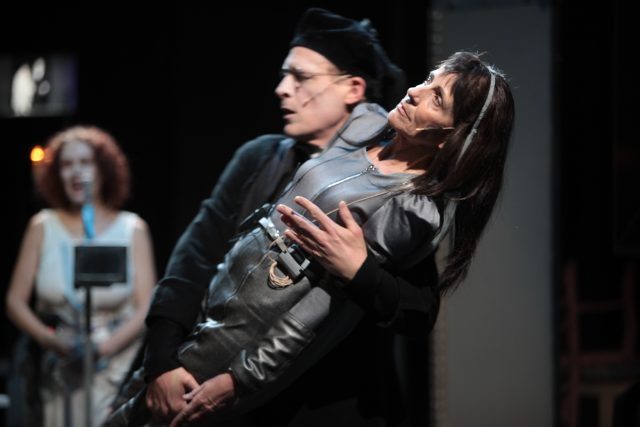
Jim Fletcher carries away Suzzy Roche in A Pink Chair (photo by Steve Gunther)
twi-ny: Speaking of being in the audience, when I am not in the audience watching you onstage, I often see you in the audience of other shows. What do you like to do on those rare occasions when you’re not in a theater?
jf: Burpees. Other stuff too. 🙂 Let’s spend some time together.
twi-ny: We’ll do so at Skirball, so getting back to A Pink Chair, can you talk a little about your character, the priest?
jf: About my character, I want to say up top, again: costumes by Enver Chakartash, in collaboration with Liz. When you swirl, it twirls. I have enough sense to know when a costume is doing the work for me, so I stay out of its way and let it do it.
The set is kind of like a territory, with different zones and thresholds, and a void, and a highly populated sector. In the most basic way I’d say A Pink Chair is a visit to the Underworld. A daughter (true story) engages a theater company (us) to help her go there to try to make contact with her father who was the great theater artist Tadeusz Kantor. How did we think to look there for him? That’s where he seemed to be headed in the final play he actually saw through to production, I Shall Never Return. The performers in A Pink Chair sometimes feel like pieces, subject to the zone they are in, and able to move in ways specific to each person. Mind you these are not explicit rules . . . it’s just how it has developed. Like laws of nature. What you’re seeing is a history of intelligent development . . . aimed at you, me, the unknown soldier, coming to see the show. My character the priest is one of those that is able to cross the void, for instance.
twi-ny: According to a behind-the-scenes video, it looks like you had a bit of a problem nailing your own cross; what are your carpentry skills like?
jf: I guess a crucifix is probably about the simplest thing you can make from wood. The rugged cross: Nail one piece of wood to another bisecting the smaller one, but not the larger one, at right angles. They say Christ was a carpenter. . . .
Zhao Tao wanders through modern-day China in Jia Zhang-ke’s elegiac documentary
I WISH I KNEW (Jia Zhang-ke, 2010)
Metrograph
7 Ludlow St. between Canal & Hester Sts.
Opens Friday, January 24
212-660-0312 metrograph.com
Throughout his professional career, which began with the 1997 underground hit Pickpocket, Sixth Generation Chinese writer-director Jia Zhang-ke has shuttled easily between documentaries (Useless, 24 City) and narrative features (The World,Still Life) — and it’s not always obvious which is which, as his steady, poetic style is built on subtlety, slow rhythms, and an innate sense of realism (and he freely mixes fantasy and reality as well). His 2010 documentary, the Cannes Film Festival Un Certain Regard selection I Wish I Knew, adds elements of fiction to its compelling examination of the intimately personal side effects that resulted from the Chinese civil war and Cultural Revolution, as many people left Shanghai for Taipei and Hong Kong. Jia and interviewer Lin Xudong meet with elderly men and women who tell tragic stories of family and friends being murdered and executed by the government; an especially poignant scene is set at a community gathering where senior citizens dance to Dick Haymes’s version of the old standard “I Wish I Knew”; one of the interviewees sings into the camera, “I wish I knew someone like you could love me / I wish I knew you place no one above me / Did I mistake this for a real romance? / I wish I knew, but only you can answer,” which could be as much about a personal relationship as the revolution itself. Jia also talks with several filmmakers and actresses, from Hou Hsiao-hsien and Wang Toon to Huang Baomei, Rebecca Pan, and Wei Wei, illustrating how Shanghai has been depicted on film with clips from such movies as Hou’s Flowers of Shanghai, Xie Jin’s Huang Baomie, Wang’s Red Persimmon, Lou Ye’s Suzhou River, Wang Bing’s To Liberate Shanghai, Wong Kar-wai’s Days of Being Wild, and Michelangelo Antonioni’s Cina.
As the nearly two-hour documentary reaches its conclusion, they interview younger people, including bestselling writer, blogger, and race-car champion Han Han, who don’t share the same conflicted memories of communism and the Cultural Revolution, instead praising an evolving modern-day capitalistic Shanghai that has brought them vast wealth, with no interest in the past of Deng Xiaoping, Mao Zedong, and Chiang Kai-shek. Throughout the film — which is finally being released theatrically in the US, opening January 24 at Metrograph in a rarely screened director’s cut that puts back censored images and adds missing facts — Jia’s onscreen muse, Zhao Tao, who has appeared in many of his works, walks through contemporary Shanghai, pausing as she languidly looks out over the ever-changing city, where intensely poor neighborhoods are being torn down right around the corner from massive construction projects. Commissioned for the 2010 World Expo held in Shanghai, I Wish I Knew might not have been quite what the expo folk expected, but then again, they did give carte blanche to Jia, who never takes the easy way out, creating yet another complex, confusing, and controversial cinematic experience.