twi-ny recommended events

MUSEUM OF THE STREET

2628 Maple Ave., LA, April 1997

“2628 Maple Ave., LA, April 1997” (photo courtesy Camilo José Vergara / Museum of the Street)

Who: Naa Oyo A. Kwate, Lawrence Hubbard, Camilo José Vergara, Ben Katchor
What: Slideshow presentation and panel discussion about “religious visions, public memorials, political effigies, historical tableaux, and commercial signage found in the Black and Latinx neighborhoods of America”
Where: The New School, 66 West Twelfth St., Alvin Johnson/J. M. Kaplan Hall
When: Wednesday, December 11, free, 7:00
Why: “For more than four decades I have devoted myself to photographing and documenting the poorest and most segregated communities in urban America,” Chilean-born, New York-based writer and photographer Camilo José Vergara notes about his ongoing project “Tracking Time,” part of his Museum of the Street. He continues, “I feel that a people’s past, including their accomplishments, aspirations, and failures, are reflected less in the faces of those who live in these neighborhoods than in the material, built environment in which they move and modify over time. Photography for me is a tool for continuously asking questions, for understanding the spirit of a place, and, as I have discovered over time, for loving and appreciating cities.”

Mrs. Ada Marshall, Martin Luther King Drive at Bostwick, Jersey City, 2004.

“Mrs. Ada Marshall, Martin Luther King Drive at Bostwick, Jersey City, 2004” (photo courtesy Camilo José Vergara / Museum of the Street)

In conjunction with “The Other Street Art,” architecture editor and writer Cynthia Davidson’s recent interview with Vergara, the New School is hosting an illustrated discussion on December 11 at 7:00 with Vergara, Rutgers associate professor Naa Oyo A. Kwate, PhD, South LA comics artist Lawrence “Raw Dog” Hubbard, and Parsons associate professor and Julius Knipl creator Ben Katchor. “When my friend, the cartoonist Ben Katchor, saw my photos, he said, these institutions only want diversity that fits their narrow definitions of art,” Vergara says in the interview, which can be read in full here. “If the nature of the work challenges the economic basis of their institutions, they won’t recognize it, including street muralists, who work for little money in poor neighborhoods. Their work is meant to be ephemeral and would undermine the economic existence of major art institutions. Unlike the artists selected by the Getty, the largely unrecognized street artists have not enjoyed a privileged upbringing, nor have they had any training beyond high school art classes.” Be prepared for a lively and eye-opening evening.

THE COURTROOM: A RE-ENACTMENT OF DEPORTATION PROCEEDINGS

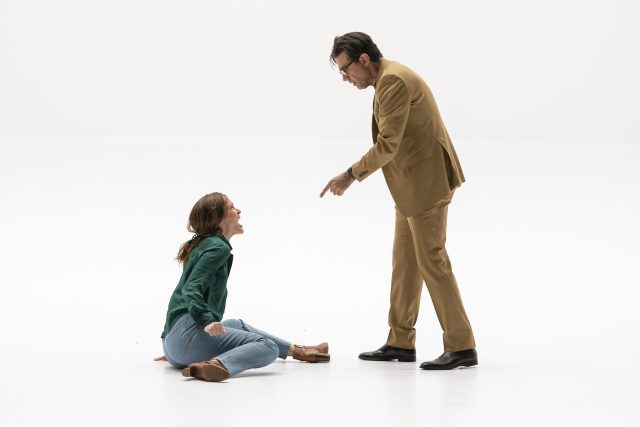
The Courtroom details a hot-button immigration case (photo by Maria Baranova)

The Courtroom details a hot-button immigration case (photo by Maria Baranova)

The Great Hall at the Cooper Union
7 East Seventh St.
Monday, December 9, free with advance RSVP, 7:00
waterwell.org
cooper.edu

In 2006, Filipino immigrant Elizabeth Keathley, whose husband is an American citizen, voted in Indiana elections. The next year, after a government official learned at a citizenship interview that she had done so despite not being a citizen herself, the Department of Homeland Security demanded her deportation. Her breakthrough legal case is dramatized in Waterwell founder Arian Moayed’s The Courtroom: A Re-enactment of Deportation Proceedings, a traveling free show that comes to the Great Hall at the Cooper Union on December 9. The stellar cast features five-time Obie winner and Tony nominee Kathleen Chalfant (Wit, Angels in America), two-time Obie winner J. Smith-Cameron (As Bees in Honey Drown, Succession), Happy Anderson, Hanna Cheek, Michael Bryan French, Mick Hilgers, Linda Powell, Jason Ralph, and Kristin Villanueva. All of the dialogue is taken verbatim from court transcripts; the ninety-minute play is directed by Waterwell artistic director Lee Sunday Evans (Dance Nation, Intractable Woman). Admission is free with advance RSVP, but it is strongly encouraged that you arrive early to grab a seat, as the civic-minded, socially conscious Waterwell (The Flores Exhibits, Fleet Week Follies) generally overbooks to make sure the house is full.

MIDNIGHT FAMILY

Juan Ochoa in Midnight Family

EMT Juan Ochoa deals with corrupt police in Luke Lorentzen’s Midnight Family

MIDNIGHT FAMILY (Luke Lorentzen, 2019)
Metrograph
7 Ludlow St. between Canal & Hester Sts.
Opens Friday, December 6
212-660-0312
metrograph.com
midnightfamilyfilm.com

Following nearly 120 screenings at film festivals around the world and winning more than two dozen awards, Luke Lorentzen’s spellbinding documentary Midnight Family opens December 6 for a weeklong run at Metrograph. The San Francisco–based Stanford grad initially went south of the border to make a different movie, but after meeting the Ochoa family, he quickly changed direction, embedding himself for six months over three years with Fernando (Fer) Ochoa and his two sons, Juan, who is now seventeen, and Josué, now ten, riding along with them in their private ambulance as they roam around Mexico City searching for hurt people in desperate need of assistance. The film announces at the beginning that there are only about forty-five government ambulances for nine million people in the city, so a slew of independently operated vehicles use radio scanners and police tips to race toward scenes of accidents so they can take victims to nearby hospitals and get paid for their efforts. However, they are not necessarily properly trained EMTs, and their ambulances are often not registered — the Mexican health-care system is in such disarray that there is little if any oversight anywhere — and if the people they pick up are poor, they don’t collect on the bill.

But the Ochoas, who named their business Med Care, soldier on, going out night after night. They are truly concerned about helping men, women, and children who require medical care, even if they don’t always know the best methods to treat them while speeding toward either a public or private hospital — sometimes making the decision based on whether they have a deal with that hospital to get some cash in exchange for delivering patients. There’s a good reason why it says on their ambulance: “Urgencias Basicas,” which means “basic emergencies.”

Lorentzen expertly unfolds the narrative, as the emergencies start with a broken nose and build up to much more serious health situations. It plays out like a thriller, first with the Ochoas racing through crowded streets and on sidewalks, trying to get to the accident scene before another ambulance does, then roaring to the hospital while their new passenger is still alive. Serving as producer, director, cinematographer, and editor, Lorentzen uses two Sony FS-7s, one mounted on the windshield facing in, the other either handheld or on a tripod in the back, making viewers feel like they’re in the ambulance, experiencing the breathtaking, claustrophobic nature of the Ochoas’ everyday experiences, enhanced by Matías Barberis’s immersive sound design and natural light, which is often quite beautiful, as street lamps and glowing gas stations add a magical quality to the darkness.

There are no talking heads, no experts discussing the health-care crisis, no pontificating about how bad things are. It’s just the Ochoas and their ambulance. Even when they take a break, Fer relaxes right in front of the vehicle, ready to jump into action if a call comes in. “I’d love to take just one night off to show people how screwed they’d be without us. This city would be a mess without private ambulances,” Juan says. Even with them, it’s quite a mess, as Lorentzen does not shy away from the ethical questions raised by the Ochoas’ modus operandi. But in the end, Midnight Family is a gripping and powerful look at the struggles to get quality health care and make a living in Mexico while also evoking the countless medical issues that are prevalent around the world — and in America too.

LITTLE JOE

Little Joe

Alice Woodard (Emily Beecham) surveys her creation in Jessica Hausner’s Little Joe

LITTLE JOE (Jessica Hausner, 2019)
Quad Cinema
34 West 13th St. between Fifth & Sixth Aves.
Opens Friday, December 6
212-255-2243
www.littlejoefilm.com
quadcinema.com

Emily Beecham was named Best Actress at Cannes for her role as a scientist and single mother who creates a different kind of monster in Jessica Hausner’s tense and gripping Little Joe, which opens Friday at the Quad. The Austrian director’s first English-language film was inspired directly by Frankenstein and Invasion of the Body Snatchers while evoking elements of Rosemary’s Baby and Little Shop of Horrors as it plays with horror, sci-fi, teen drama, and other genre conventions. Beecham is Alice Woodard, a plant breeder who is developing a flower she believes can make people happy through its “mood-lifting, antidepressant” scent. She names the new species Little Joe, after her son, Joe (Kit Connor), and even sneaks one plant home for him from the highly secured lab, which is blatantly against the rules.

She works at a science institute — a pristine environment with sterile-looking halls and researchers walking around in white lab coats — with Chris (Ben Whishaw), who has a crush on her, Bella (Kerry Fox), who goes everywhere with her dog, assistants Ric (Phénix Brossard) and Jasper (Andrew Rajan), and their boss, Karl (David Wilmot), who is hesitant to release the plant to the public until rigorous testing proves its safety, even though there’s an important plant show coming up where it would be perfect to introduce it. But after the lovely red blooms start emitting clouds of white spores, first Bella’s dog, then Alice’s coworkers and son, along with his friend Selma (Jessie-Mae Alonzo), begin changing.

Little Joe

Joe (Kit Connor) and his mother, Alice (Emily Beecham), sit down for takeout in stylized, atmospheric Little Joe

Written by Hausner (Lourdes, Amour Fou) with Géraldine Bajard, Little Joe is thick with foreboding, as scenes play out slowly to creepy electronic music by late Japanese composer Teiji Ito, who scored films by Maya Deren. The film is set in a timeless world of brightly lit, vividly contrasting pastel yellows, reds, greens, pinks, purples, and blues that conjure the 1970s but there are cell phones; cinematographer Martin Gschlacht, editor Karina Ressler, costume designer Tanja Hausner (the director’s sister), and production designer Katharina Wöppermann invoke the atmosphere of such cult faves as auteurs John Carpenter and David Cronenberg and novelist Ira Levin — who wrote The Stepford Wives, The Boys from Brazil, and Rosemary’s Baby — as Alice soon finds herself fighting against what appears to be a spreading conspiracy, all the while exploring her fears with her understanding psychotherapist (Lindsay Duncan). Alice’s bowl-cut red hair is reminiscent of Mia Farrow’s in Rosemary’s Baby (and her last name, Woodard, is similar to Rosemary’s, Woodhouse). Like that classic horror film, Little Joe focuses on the concept of birth and parenthood from a female point of view; even as Alice tries to protect her scientific creation, she is attempting to hold on to her pubescent son as he and his father, Ivan (Sebastian Hulk), become closer. “The ability to reproduce is what gives every living being meaning,” Bella says.

Perhaps the scariest part of the film is how realistic it feels despite its heavily stylized artifice. Hausner, for her first English-language movie, consulted with neuroscientist James Fallon, biologist Hanns Hatt, and other experts to research the validity of her plot, particularly in an age where there is global controversy over the efficacy of genetically modified food and animal and human cloning. Beecham (Sulphur and White, Into the Badlands) is superb as Alice, a stand-in for all of us, someone who just wants to bring happiness to the world but, in this case, may not fully understand the price it comes with.

EI ARAKAWA: WEWORK BABIES (11 Cortlandt Alley)

Ei Arakawa

[A group of children follow each other down a dirt path in a wooded forest, their backs turned away from the camera. The path leads towards a grassy clearing, lit by radiant sun. Across the frame is the logo for “WeWork,” offset on a diagonal.]

Artists Space
11 Cortlandt Alley
Sunday, December 8, free, 2:00
212-226-3970
artistsspace.org

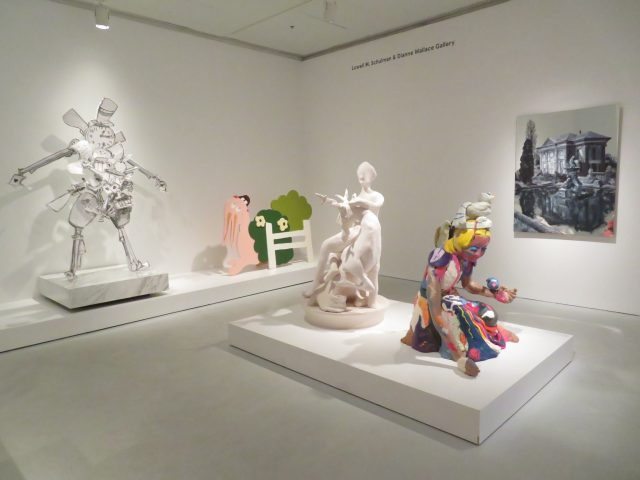
Fukushima-born, LA–based performance artist Ei Arakawa will lead a parade of a different kind on Sunday, December 8, inaugurating the new home of Artists Space. The former New Yorker is presenting WeWork Babies (11 Cortlandt Alley), beginning at 2:00 outside Artists Space at 11 Cortlandt Alley with a march of plastic infants that will then go into the lobby and down into the cellar gallery, which serves as an art baby nursery. The piece, complete with Q&A, will be performed by Arakawa, Malik Gaines, Tony Jackson, Sohee Kim, Erika Landström, Shuang Liang, George Liu, Yuri Manabe, Molly McFadden, Gela Patashuri, Jamie Stevens, and Tinatin Tsiklauri, with music by Boston-born, Brooklyn-based composer and installation artist Stefan Tcherepnin and his seven-month-old son, Igor Törnudd-Tcherepnin. Founded in 1972, Artists Space “strives for exemplary conditions in which to produce, experience, and understand art, to be a locus of critical discourse and education, and to advocate for the capacity of artistic work to significantly define and reflect our understanding of ourselves.” The opening-month celebration continues with such other free programs as the album launch “Speaker Music: drape over another” on December 13 and the book launch “Alexander Zevin: Liberalism at Large” on December 16.

THE BUILDERS ASSOCIATION: ELEMENTS OF OZ

Unique app is key part of multimedia Elements of Oz

The Builders Association is restaging multimedia Elements of Oz at Skirball Center this weekend

NYU Skirball Center for the Performing Arts
566 La Guardia Pl.
December 7-8, $20-$25
212-992-8484
www.elementsofoz.com
nyuskirball.org

Three years ago, we saw the Builders Association’s multimedia Elements of Oz at the 3LD Art and Technology Center. The multimedia presentation is now back for three shows at NYU Skirball, December 7 at 3:00 and 7:30 and December 8 at 3:00, closing out Skirball’s yearlong celebration of the fiftieth anniversary of Stonewall. Below is our slightly amended review of the December 2016 production.

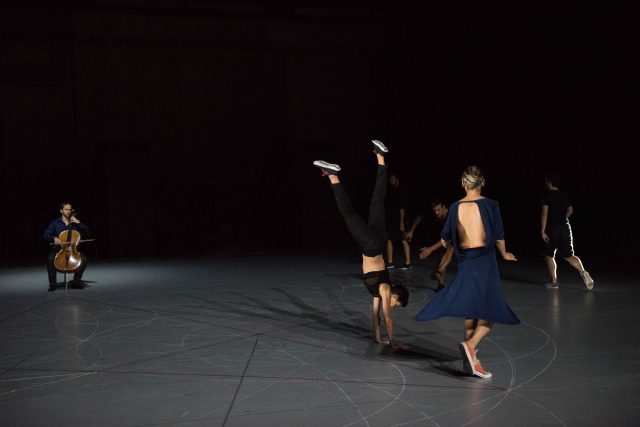
The Builders Association (Sontag:Reborn, Invisible Cities) takes audiences on a wild trip down the yellow brick road as it deconstructs and reconstructs The Wizard of Oz in its fun and innovative multimedia experimental production Elements of Oz. Conceived by Marianne Weems, Moe Angelos, and James Gibbs, directed by Weems, and cowritten by Gibbs and Angelos, Elements of Oz delves into the legend and legacy of the classic 1939 film, sharing little-known stories, reenacting key scenes, and examining its online presence, including theories about how the book and movie are metaphors for the U.S. monetary system and gold standard. The show presents a small corp of actors who reenact and reshoot key scenes, creating a new version via multiple monitors that project what is happening onstage and freeze-frames taken from previous scenes. The piece is performed by Angelos, Sean Donovan, and Hannah Heller, who each portray several characters — all three play Dorothy Gale at various points. They not only switch roles, they also shift from commenting on the film to acting in its re-creation, and from past to present, telling tales of 1939 moviemaking and its ongoing reverberations in popular culture.

Following a YouTube overture, Angelos delivers the first of many “talking points,” giving inside information to the audience. “It’s a masterpiece,” she says about the film, “but all we see is the magic. We don’t see all the brutal work and failure.” Elements of Oz reveals how much of that magic was made as stage manager April Sigler, associate lighting designer Elliott Jenetopulos, video designer Austin Switser, production manager Brendan Regimbal, and technical director Carl Whipple set up and break down Neal Wilkinson’s sets, filming short scenes that are then edited live to mimic the original, shot by shot, and played back on a large onstage screen as well as the monitors that fill the theater. Meanwhile, Moe relates stories about Margaret Hamilton and her double, Betty Denko, suffering major injuries; how “Somewhere Over the Rainbow” was almost left on the cutting-room floor; that some of the munchkins were repurposed as flying monkeys; and what really happened when the film went from black-and-white to color.

Just as The Wizard of Oz made use of cutting-edge technology, so does Elements of Oz, which has a unique innovation of its own. During the show, which is based on both the film and the book by L. Frank Baum, there are moments that are best viewed through your smart phone or tablet via a free augmented reality app, designed by John Cleater, that enhances what you’re watching by adding visual and aural effects, from snow to giggling munchkins to other cool surprises. Angelos (the Five Lesbian Brothers), Donovan (Thank You for Coming: Play), and Heller (The World Is Round) are hysterical as they change from role to role, with Angelos as Dorothy and Glinda, the mustachioed Donovan as Dorothy, Uncle Henry, Mike Wallace, the Scarecrow, the Tin Man, Salman Rushdie, and the Wizard, and Heller as Dorothy, Aunt Em, the Wicked Witch, the Scarecrow, Judy Garland, and Ayn Rand. (The costumes are by Andreea Mincic, with lighting by Jennifer Tipton, sound design and original music by Dan Dobson, and interactive design and programming by Jesse Garrison.) Originally presented by Peak Performances @ Montclair State University, the goofy and charming Elements of Oz is probably about twenty minutes too long, as things get a little repetitive, and as fun as the app is, you’ll find yourself at times looking at your phone, waiting for the next bit of AR to take place, instead of watching what is happening onstage. But like the original book and film, Elements of Oz is an enjoyable mind-expanding journey — and be sure to keep that app on as you exit Skirball and head toward Washington Square Park.

FIRST SATURDAYS: BEST OF THE BOROUGH

Tuesday_Smillie_S.T.A.R._2000

Tuesday Smillie, S.T.A.R., watercolor, collage on board, 2012 (courtesy of the artist / © Tuesday Smillie)

Brooklyn Museum
200 Eastern Parkway at Washington St.
Saturday, December 7, free (some events require advance tickets), 5:00 – 11:00
212-864-5400
www.brooklynmuseum.org

The Brooklyn Museum shows off the best of the borough in the December edition of its free First Saturday program. There will be live performances by Los Hacheros, Gemma, DJ Laylo, Adrian Daniel, and drag collective Switch n’ Play (featuring Divina GranSparkle, K.James, Miss Malice, Nyx Nocturne, Pearl Harbor, and Vigor Mortis with special guest Heart Crimson); Visual AIDS screenings of short films commemorating the annual Day With(out) Art, followed by a conversation between filmmakers Iman Shervington and Derrick Woods-Morrow, moderated by writer Mathew Rodriguez; a book talk on Elia Alba’s The Supper Club with Sur Rodney (Sur) and Jack Waters, focusing on the conversation from the book that asks “What Would an HIV Doula Do?”; a curator tour of the Arts of Japan galleries with Joan Cummins; teen apprentice pop-up gallery talks in “Nobody Promised You Tomorrow: Art 50 Years After Stonewall”; a night market with handmade artisanal products; and a poetry reading and book signing by Brooklyn poet laureate Tina Chang from her latest book, Hybrida. In addition, the galleries will be open late so you can check out “Garry Winogrand: Color,” “Nobody Promised You Tomorrow: Art 50 Years After Stonewall,” “yasiin bey: Negus,” “One: Xu Bing,” “Pierre Cardin: Future Fashion,” “JR: Chronicles,” and more.