twi-ny recommended events

THE THIN PLACE

(photo by Joan Marcus)

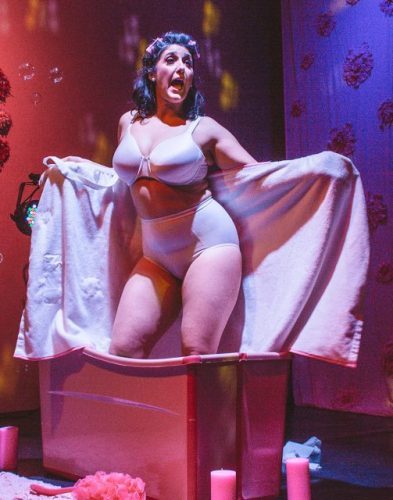
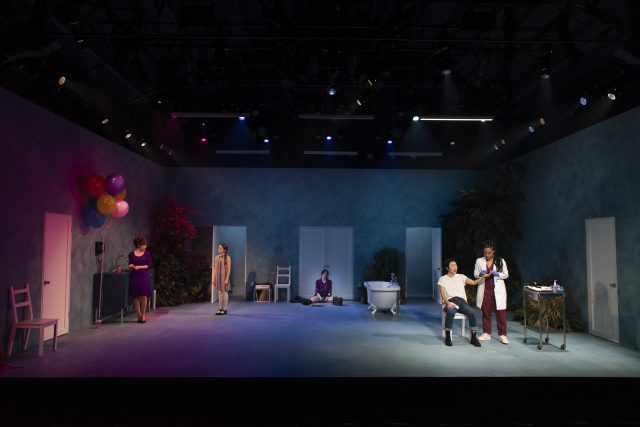
Hilda (Emily Cass McDonnell) wants to contact her deceased grandmother in New York premiere of Lucas Hnath play (photo by Joan Marcus)

Playwrights Horizons, Peter Jay Sharp Theater
416 West 42nd St. between Ninth & Tenth Aves.
Tuesday – Sunday through January 26, $59-$99
www.playwrightshorizons.org

The opening credits for the 1960s horror anthology series The Outer Limits are famous among TV aficionados: A stern voice announces, “There is nothing wrong with your television set. Do not attempt to adjust the picture. We are controlling transmission. If we wish to make it louder, we will bring up the volume. If we wish to make it softer, we will tune it to a whisper. . . . For the next hour, sit quietly and we will control all that you see and hear. We repeat: There is nothing wrong with your television set. You are about to participate in a great adventure. You are about to experience the awe and mystery which reaches from the inner mind to — the outer limits.” That statement also applies to live theater, where we sit in the dark and let cast and crew control transmission, using sound, light, costumes, architecture, dialogue, acting, and other crafts as we give up control, usually for more than an hour, and go on what we hope will be a great adventure. Florida-born playwright Lucas Hnath and British-born director Les Waters take us on such a journey in The Thin Place, which opened last night at Playwrights Horizons, where they turn the Peter Jay Sharp Theater into a haunted house worthy of The Outer Limits, The Twilight Zone, Thriller, and other classic spine-tingling tale spinners.

(photo by Joan Marcus)

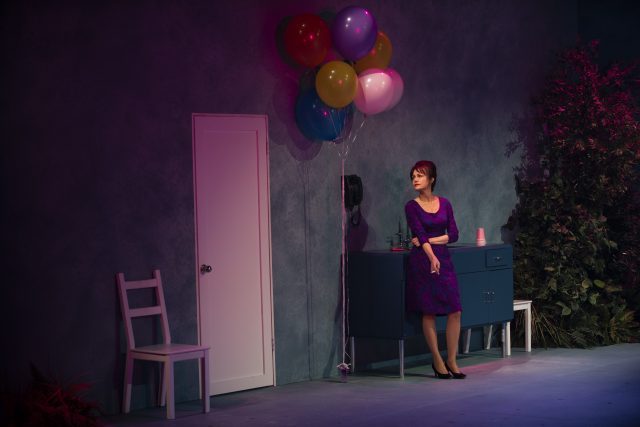
Linda (Randy Danson) and Hilda (Emily Cass McDonnell) become good friends in Lucas Hnath’s The Thin Place at Playwrights Horizons (photo by Joan Marcus)

Describing a party/performance he attended in Japan, the well-connected Jerry (Triney Sandoval) tells his friends Sylvia (Kelly McAndrew) and Linda (Randy Danson) and Linda’s friend Hilda (Emily Cass McDonnell), “So then at a certain point someone steps forward and begins to tell a story, a ghost story, and at the end of the story the uh teller extinguishes the candle — and then another person steps forward and tells another story, and tries to make their story even scarier than the last, and when they’re done, they extinguish another candle, and —” Sylvia cuts him off, saying, “For every candle? Jesus, sounds like torture.” What follows is not torture but delicious chills as Hilda proceeds to tell her own idiosyncratic and inexorably compelling ghost story.

Waters, the former artistic director of the Actors Theatre of Louisville, and Hnath are regular collaborators; several of Hnath’s plays have originated at that Kentucky theater. When Waters (For Peter Pan on Her 70th Birthday, Big Love) told Hnath (The Christians, A Doll’s House, Part 2) about what he calls “the thin place” — “where the line between this world and some other world is very thin” — Obie winner and Tony nominee Hnath was inspired to create a superb ninety-minute play about the power of the mind while cleverly toying with theatrical conventions. The play is narrated by Hilda, who often talks directly to the audience. Linda is an older woman who makes her living as a psychic medium, apparently communicating with the spirits of the dead. After Hilda attends one of Linda’s readings, the two women become close friends.

As a child, Hilda and her beloved grandmother would try to telepathically send words to each other, with some success. “I have no idea if it was real — was I really hearing her thoughts in the space just behind and a little above my eye?” Hilda asks. “Or was it something else. Did I just get good at guessing, guessing the kinds of words and thoughts and . . . now my grandmother — she said that what she was doing was — and my mother really would not have liked this — was that what she was doing was getting me ready for the day she died. . . . She’d be able to send words to me from beyond the grave. Just like you know how you pick up a phone and say hi how are you,” she says, evoking the Twilight Zone episode “Long Distance Call.”

(photo by Joan Marcus)

Some potentially demonic topics are up for discussion at a dinner party in The Thin Place (photo by Joan Marcus)

Hilda wants Linda to help her speak again with her deceased grandmother — and perhaps find out what has happened to a missing family member. Linda brings Hilda to Sylvia’s house for a small dinner party, joined by Jerry, where they discuss Linda’s abilities. “I was thinking about it one night and it just sorta hit me that — I mean, if you look at it from the right angle — what Linda does — she grabs people’s minds — people she’s never met before, somehow she just manages to work her way in there, and people end up really trusting her,” he points out, echoing the pact we all make with creators when we enter theaters.

Danson (Arts and Leisure, Good Person of Szechuan), McAndrew (Men on Boats, Novenas for a Lost Hospital), McDonnell (The Antipodes, Mercury Fur), and Sandoval (Bernhardt/Hamlet, Marvin’s Room) are all excellent as they try to pull the wool over our eyes; Danson is warm and motherly as Linda, while McDonnell brings a spooky innocence to Hilda. Waters and Hnath are in control all the way, leading us deep into the eerie mysteries of this fantastical drama.

Mimi Lien’s effectively sparse set consists of a pair of comfy-looking armchairs that face the audience. Mark Barton’s house lights are on for much of the play, until they’re not. The show is not just a ghost story but a tale that takes place in the thin place between fiction and reality, between the living and the dead, between performer and attendee, about the things that go bump in the night — in our head and right before our eyes, what Rod Serling calls “the middle ground between light and shadow, between science and superstition, [which] lies between the pit of man’s fears and the summit of his knowledge.” Go with an open mind. But do go.

THIS IS PAIN: AN EXHIBITION BY TRINA MERRY

“This Is Pain” seeks to spread messages of hope about chronic pain (photo by twi-ny/mdr)

“This Is Pain” seeks to spread messages of hope about chronic pain (photo by twi-ny/mdr)

Oculus Outdoor Plaza
Westfield World Trade Center
December 12-15, free, 8:00 am – 8:00 pm
www.thisispain.com
trina-merry-k7b4.squarespace.com

Bodypainting world champion and visual artist Trina Merry returns to the Oculus for a new project that is near and dear to her heart. Under the soaring white arcs of the shopping and transportation center, the Seattle-born, New York City–based artist has previously painted people’s bodies so they blend in with their surroundings as part of her international “Urban Camouflage” series. From December 12 to 15 at the Oculus, Merry is presenting “This Is Pain,” an immersive installation that details the compelling stories of eight men and women suffering from near-crippling chronic pain. Merry has built a vertebrae-like structure with eight large-scale video monitors that face inside and eight more that face outside, showing encounters in which the subjects talk about their injuries/illnesses, describe their terrible pain, and get their bodies painted by Merry, who is inspired by their tales, making each person an artwork as unique as themselves and as specific as their stories.

(photo courtesy Trina Merry)

Installation features short videos of people discussing their chronic pain and artist Trina Merry painting their bodies (photo courtesy Trina Merry)

Merry became interested in chronic pain after being struck by lightning, leaving her with “crippling and continuous aches and pains throughout my body as well as a heightened sensitivity to electricity,” she explains in her artist statement. “I escaped to Yosemite to seek respite, and it is there that I was led to painting as a means of recovery. . . . My hope is that this exhibit can help generate understanding and compassion and show the world what living with chronic pain is really like.” She turned to bodypainting at the suggestion of her friend Amanda Palmer.

(photo by twi-ny/mdr)

Artist and chronic pain sufferer Trina Merry talks about her latest project at the Oculus (photo by twi-ny/mdr)

Merry, who was influenced by Yves Klein, Yayoi Kusama, and Verushka and studied with Robert Wilson and Marina Abramovic at Watermill, modeled the white structure to evoke a spinal column — the spinal cord is a major bundle of nerve fibers where severe pain can originate due to neurological damage — and to sit alongside the Oculus, Santiago Calatrava’s massive transportation hub entrance that resembles a bird in flight or a skeletal rib cage. Of course, it is also by Ground Zero, where so much physical, psychological, and emotional pain has occurred on and after 9/11/2001. Pushed past their comfort zones by Merry, the eight brave people who discuss their health situations and, in most cases, bare their bodies as they’re painted are Patricia from Berkeley Heights, New Jersey, who was injured doing yoga and feels burning pain that feel like electric lightning bolts; Cathy from LA, who believes in mind over matter; Cindi from Harrisburg, Pennsylvania, whose pain feels like cactus splinters and who works with the American Chronic Pain Association; Tom from LA, a military veteran whose pain feels to him as if he’s wrestling a tiger on fire; Shannon from Austin, a wife and mother who indulges in simple acts of kindness and compassion to combat her pain (“My pain is like a tornado. It comes in and wreaks havoc on my entire body.”); Trish from Latrobe, Pennsylvania, who has battled joint pain for more than thirty years (“My pain manifests as fire in my knees.”); Al from Littleton, Colorado, who has had nearly two dozen surgeries, including twelve spinal fusions, to fight off pain that he says feels like hot lava; and Tony and Emmy winner Kristin (Chenoweth) from LA, who suffered an accident while on-set six years ago and has experienced kaleidoscopic, disorienting pain ever since, although she refuses to let it keep her offstage or off-camera. Sponsored by a pharmaceutical company, “This Is Pain” also gives people the opportunity to post their own stories here in the hope of bringing more understanding to a very real problem.

NIGHTMARES: LIVE PODCAST TAPING

nightmares

Who: Emily Flake, Kat Burdick, Amanda Duarte, Jean Grae, Porochista Khakpour, Kembra Pfahler
What: Live podcast taping of Nightmares: Good People, Bad Dreams
Where: The Red Room at KGB, 85 East Fourth St.
When: Sunday, December 15, free (two-drink minimum), 7:00
Why: Cartoonist-writer-performer-teacher-illustrator Emily Flake’s podcast Nightmares: Good People, Bad Dreams invites “the funniest and most interesting people around” to talk “about what messed up things go through their heads at night.” On December 15 at 7:00, the show will be taped live at the Red Room at KGB as Flake and her guest cohost, comedian Kat Burdick, are joined by writer-performer Amanda Duarte, hip-hop artist and polymath genius Jean Grae, writer-teacher-lecturer Porochista Khakpour, and performance artist, filmmaker, and the Voluptuous Horror of Karen Black lead singer Kembra Pfahler for what should be a wildly unpredictable evening of laughs and scares.

JUDGMENT DAY

(photo by Stephanie Berger)

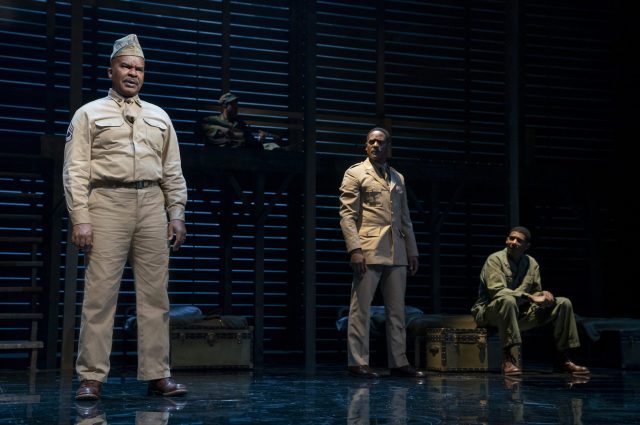
Stationmaster Thomas Hudetz (Luke Kirby) salutes as train passes by in Judgment Day (photo by Stephanie Berger)

Park Ave. Armory, Wade Thompson Drill Hall
643 Park Ave. at 67th St.
Monday – Saturday through January 10, $55-$195
212-933-5812
www.armoryonpark.org

In his 1936–37 work Judgment Day, Austro-Hungarian novelist and playwright Ödön von Horváth warns of the rise of fascism in Germany, comparing it to a speeding train approaching a station that has no idea it’s coming. That’s the central motif in Richard Jones’s admirable if uneven new production, adapted by Christopher Shinn, that opened today at Park Ave. Armory for a run through January 10. Jones, who presented a fierce version of Eugene O’Neill’s The Hairy Ape at the armory in 2017, once again makes unique use of the building’s vast Wade Thompson Drill Hall; Paul Steinberg’s set features oversized, flat, painted plywood trees around the back, sides, and corners and two giant, movable blocks of unpainted wood, like a child’s toys, one in the shape of an arch, the other flat and angled like a stray wall from The Cabinet of Dr. Caligari. Mimi Jordan Sherin’s stark lighting creates distinct reflections on the shiny black floor, like the characters’ souls on display.

It’s the 1930s, and a lumberjack (Andy Murray), the gossipy Frau Leimgruber (Harriet Harris), and a traveling salesman (Jason O’Connell) are waiting for a local train. Stationmaster Thomas Hudetz (Luke Kirby) emerges only to ring the signal bell, standing at attention and saluting as the express roars by, thrillingly portrayed by Drew Levy’s immersive sound design and the actors’ dramatic reactions. After seeing off her fiancé, butcher Ferdinand (Alex Breaux), ingénue Anna (Susannah Perkins) teases the straitlaced Hudetz as his shrewish wife, Frau Hudetz (Alyssa Bresnahan), watches from above. Anna makes an unexpected and unwelcome move, beginning a chain of events that leads to the death of eighteen people, including a track worker (O’Connell) and train driver Pokorny (Maurice Jones) but leaving a witness, stoker Herr Kohut (George Merrick).

(photo by Stephanie Berger)

Paul Steinberg’s set features two large movable wooden structures (photo by Stephanie Berger)

A policeman (Charles Brice) and detective (Joe Wegner) arrive to find out what happened, but falsehood, deception, and long-simmering desires and grievances soon boil over. “I’m telling the truth! I swear to everything!” Frau Hudetz argues. Frau Hudetz’s brother, pharmacist Alfons (Henry Stram), becomes an outcast even after he disowns his sister. “Everything is connected,” he insists, but no one is listening to him. Guilt and mob mentality tear at the fabric of this small community, resulting in yet more death and destruction. “People are so fickle,” waitress Leni (Jeena Yi) says. “Who gives a shit about people,” Hudetz responds.

(photo by Stephanie Berger)

Paul Steinberg’s set steals the show in new production at Park Ave. Armory (photo by Stephanie Berger)

Jones’s staging often makes the characters look like little figures in a dollhouse, dwarfed by the two wooden blocks, as if they’re being manipulated by unseen forces. In his sharp uniform (the costumes are by Antony McDonald) and direct speech, Hudetz resembles a Nazi. “I was always a diligent official!” he says over and over, reminiscent of what would later become the Third Reich excuse “I was only following orders.” Judgment Day is a biting indictment of prewar German morality, written by Horváth after he had fled Germany and shortly before he died in Paris when struck by a tree branch during a thunderstorm at the age of thirty-six. The parable can’t quite carry the weight of the production through its ninety minutes, drifting between Expressionism and realism while evoking the style of Bertolt Brecht and a streamlined Robert Wilson, sometimes getting stuck in between. But there are numerous breathtaking moments as Jones (Into the Woods, The Trojans), Shinn (Dying City, Where Do We Live), and Horváth (Tales from the Vienna Woods, Youth without God) take aim at the spread of fascism and groupthink, in the 1930s and now.

A LOS LOBOS CHRISTMAS

Los Lobos

Los Lobos has released it first Christmas record and will be playing new seasonal tunes at the Society for Ethical Culture this week

The Concert Hall at New York Society for Ethical Culture
2 West 64th St. at Central Park West
Saturday, December 14, $55-$95
www.metropolitanpresents.com
www.loslobos.org

Mexican East LA band Los Lobos, which means “the wolves,” named its second album How Will the Wolf Survive? after an article in National Geographic. “It was like our group, our story: What is this beast, this animal that the record companies can’t figure out? Will we be given the opportunity to make it or not?” founding member Louie Pérez told Rolling Stone in 1989 when the 1984 record was named the thirtieth best of the past decade by the magazine. Los Lobos has made it, and on their own terms, having released more than twenty records and toured relentlessly around the world for more than forty years (they started as a high school group in 1973), led by founding members David Hidalgo and Cesar Rosas on guitar and vocals, Pérez on drums and vocals, Conrad Lozano on bass and vocals (since 1974), and newbie Steve Berlin on keyboards and woodwinds; he came on board in 1984. As is their trademark, Los Lobos, who come to the New York Society for Ethical Culture for a show December 14, is once again venturing into new territory with its first Christmas album, Llegó Navidad (Rhino, October 2019), a collection of eleven traditional Latin holiday tunes and one original.

“We’re not doing the typical ‘Silent Night’ and all that, which is fine,” Pérez says in a promotional video, continuing, “I mean, I wouldn’t mind doing that in our own kind of way. But there is such a wealth of traditional songs, songs that have been around for a while from all over Latin America.” The band explored more than 150 tunes before deciding what to record. “It took us a while to find the stuff we felt comfortable with,” Hidalgo said. The album includes such gems as “La Rama,” “Reluciente Sol,” “It’s Christmas Time in Texas,” “Las Mañanitas,” “Regalo De Reyes,” and “Christmas and You,” bringing Los Lobos’ unique flair and flavor to foster a feliz navidad for everyone. “Is this true to our ethos? I’d say absolutely,” Berlin explains. At Ethical Culture, you can expect a generous mix of old favorites (“One Time One Night,” “Will the Wolf Survive?”), cool covers (“Bertha,” “Volver, Volver”), and soon-to-be-classic Latin Christmas songs.

HALFWAY BITCHES GO STRAIGHT TO HEAVEN

(photo © Monique Carboni)

Stephen Adly Guirgis’s Halfway Bitches Go Straight to Heaven features another large cast of well-drawn characters (photo © Monique Carboni)

Atlantic Theater Company
Linda Gross Theater
336 West 20th St. between Eighth & Ninth Aves.
Tuesday – Sunday through December 29, $81.50
866-811-4111
atlantictheater.org

New York City native Stephen Adly Guirgis has spent much of his career creating wickedly funny, socially relevant plays set in minority communities where the underrepresented, the underserved, and the marginalized confront religion, law enforcement, poverty, racism, systemic institutions, and family dynamics as they battle against a system set up to keep them down. Most of his plays, including Our Lady of 121st Street, In Arabia, We’d All Be Kings, and The Little Flower of East Orange, feature large ensembles that form tight-knit communities onstage. Such is the case with Guirgis’s return to the Atlantic, where his Pulitzer Prize-winning play, Between Riverside and Crazy, debuted in 2014, with the world premiere of the fiendishly hilarious and hard-hitting Halfway Bitches Go Straight to Heaven, which opened last night at the Linda Gross Theater.

(photo © Monique Carboni)

A woman’s residence is the setting for new play by Pulitzer Prize winner Stephen Adly Guirgis (photo © Monique Carboni)

The three-hour LAByrinth Theater coproduction, which flies by with one intermission, takes place in Hope House, a government-funded women’s residence for addicts, the abused, the mentally ill, and survivors of domestic violence. It is run by the strict, serious Miss Rivera (Elizabeth Rodriguez) and Nigerian social worker Mr. Mobo (Neil Tyrone Pritchard). Among those who find shelter at the home are the tough-talking Sarge (Liza Colón-Zayas); her single-mother girlfriend, Bella (Andrea Syglowski); teenage poet Little Melba Diaz (Kara Young); the foul-smelling Betty Woods (Kristina Poe); ex-con Queen Sugar (Benja Kay Thomas) and her bestie, Munchies (Pernell Walker); the lonely, alcoholic Rockaway Rosie (Elizabeth Canavan); the wheelchair-bound rule-breaker Wanda Wheels (Patrice Johnson Chevannes); the trans Venus Ramirez (Esteban Andres Cruz); and the twentysomething Taina (Viviana Valeria), who takes care of her mentally ill mother, Happy Meal Sonia (Wilemina Olivia-Garcia). Also on the staff are eager white millennial social worker Jennifer (Molly Collier); ex-con janitor Joey Fresco (Victor Almanzar); and Father Miguel (David Anzuelo), who has a dark secret in his past. Seventeen-year-old Mateo (Sean Carvajal), whose mother is staying at the home, often helps out, allowed to hang around as the women share their often very private concerns about their troubled lives.

Narelle Sissons’s bilevel set consists of the main gathering room, a stoop, an outdoor bench, a dark alley, a balcony, and a concrete front space where the residents gossip and drink and smoke in defiance of the regulations. LAByrinth artistic director John Ortiz (Guinea Pig Solo, Jack Goes Boating) infuses the proceedings with tremendous vitality as Guirgis’s well-developed characters fight for survival. Taina has a chance to go back to school but is terrified of leaving her mother. Venus insists on staying even though several residents cruelly reject her claim to female identity, accusing her of unfairly invading their safe space. Father Miguel jostles with a man (Greg Keller) who demands to see his wife, who has a restraining order against him. Miss Rivera isn’t sure that Jennifer has what it takes to deal with the residents, who can be harsh and unforgiving. Wanda Wheels seems determined to drink herself to death. And at the center of it all is Sarge, superbly played by Guirgis regular and Tony nominee Rodriguez (Orange Is the New Black, The Motherf**ker with the Hat). A veteran with PTSD, Sarge is fierce and unrelenting, quick to brutally insult people, especially Venus and Betty, but she sometimes lets her more tender and loving side show through. She tells Bella, “I commanded a platoon. I survived combat. Kept my people safe. Took care of the villagers as much as I could. I looked death in the eye — twice — and I didn’t flinch. I can do this, Bella. I can do this with you. If you let me.” Sarge approaches her life like she’s embroiled in a never-ending war, which is true of many of the women living there.

(photo © Monique Carboni)

Ex-cons Queen Sugar (Benja Kay Thomas) and Joey Fresco (Victor Almanzar) face off in Halfway Bitches Go Straight to Heaven (photo © Monique Carboni)

The title comes from a poem Little Melba Diaz reads that sums up much of what the play is about, the difficulties and challenges these women can’t break free from: “Halfway Bitches go straight to Heaven / I ex-caped foster care and met a boy named Kevin / He was the apple of my eye but nigga turned into a lemon . . . No money in my pocket, I was feeling kinda low. . . . Words are turds and rhymes are crimes / Memories mere summaries, / Though I might some day share some of these,” she declares. Despite getting a little syrupy as it winds down, Halfway Bitches Go Straight to Heaven is another deeply affecting, honest, and gutsy work that lays bare the lives of too many women who rightfully doubt there’s any light at the end of the tunnel for them.

YAYOI KUSAMA: EVERY DAY I PRAY FOR LOVE

Yayoi Kusama (photo courtesy David Zwirner)

Yayoi Kusama, Infinity Mirrored Room — Dancing Lights That Flew Up to the Universe, mirrored glass, wood, LED lighting system, metal, and acrylic panel, 2019 (photo courtesy David Zwirner)

David Zwirner
537 West 20th St. between Tenth & Eleventh Aves.
Tuesday – Saturday through December 14, free, 10:00 am – 6:00 pm
www.davidzwirner.com
online slideshow & video

What? You’re not on line yet? This is the last week to see Yayoi Kusama’s latest show at David Zwirner, “Every Day I Pray for Love,” another fabulous immersive presentation by the Japanese artist who turned ninety this year. All the furor is specifically for the new Infinity Mirrored Room — Dancing Lights That Flew Up to the Universe, a spectacular closed-in space of mirrors, hanging balls, and changing colored lights that create a beautiful, endless world. But you’ll have to wait upwards of two and a half hours and more to spend thirty seconds in the room, most of which you will spend snapping photos and video instead of experiencing its bountiful wonder. However, there’s much more to “Every Day I Pray for Love,” and you don’t have to line up outside in the freezing cold to see it.

(photo by twi-ny/mdr)

Yayoi Kusama’s Clouds slither toward “My Eternal Soul” paintings at David Zwirner (photo by twi-ny/mdr)

In the main, large gallery, forty-two of Kusama’s “My Eternal Soul” paintings are arranged in three rows, exciting, colorful canvases that feature her trademark faces, circles, dots, eyes, embryos, and abstract geometric shapes and patterns, boasting such positive names as The Beauty of Millions of Love Seekers Flying Infinitely to the Universe, Shapes Full of Love That Have Always Shone in My Heart, Road to Eternal Love and Hope, The Limit of the Endless Beauty That Colours Spoke of Is Infinite, Such a Beautiful Love and Life Found by Us, and Challenge to New Art by I Who Thought the Splendor of the Universe Cannot Be More. On the floor of the room are several conglomerations of Kusama’s stainless-steel with patina and wax Clouds, which resemble dripped mercury taken solid form. Like the spheres in her Narcissus Garden, which people lined up to see in the Rockaways in the summer of 2018, you can walk among them and follow the changing reflections caused by the light from above.

(photo by twi-ny/mdr)

Yayoi Kusama’s cast aluminum “Souls of Women That Continue Forever” hang over garden of soft sculptures as part of “Every Day I Pray for Love” (photo by twi-ny/mdr)

At the base of the stairwell is the black-and-white fiberglass-reinforced plastic and stainless-steel Pumpkin, which you can look into, as its insides have already been scooped out. The upstairs gallery contains a childlike garden of sewn and stuffed soft sculptures with spiky elements and playful faces (for example, I Will Love with All My Heart and The Greatness of This Figure Talking Through Humankind and the Universe); “Souls of Women That Continue Forever,” a wall of cast aluminum shapes with women’s profiles repeated over and over in different colors; and two more acrylic paintings, including one whose title captures Kusama’s ethos: There Is No One Who Is Unmoved by How Amazing It Is to Be Able to See the Beauty of Creation Everyday in This World and Universe We Live In. And finally, be sure to go behind the black curtain to check out the awe-inspiring Ladder to Heaven, twelve LED-lit rungs with round mirrors above and below that make it seem like the ladder is going both deep underground as well as into the heavens as the color shifts like a James Turrell installation.

So don’t get too caught up waiting in line for the infinity room and risk not seeing the rest of this wonderful show, by perhaps the most popular, happy-making, and critically acclaimed living artist in the world. (And, yes, Instagram-friendly as well.) Meanwhile, Kusama — who still works every day, going from the Seiwa Hospital for the Mentally Ill in Tokyo, where she has lived voluntarily since 1977, to her nearby studio — is most likely busy preparing her next batch of paintings, sculptures, and, just maybe, another infinity room that people are already dreaming of lining up for. As she writes on one of the walls of the gallery: “My entire life has been painted in these paintings. / Every day, any day. / I will never cease dedicating my whole life to my love / for the universe. / Oh my dearest art. / With the challenge of creating / new art, I work as if dying / these works are my everything.”