twi-ny recommended events

THE SOUND INSIDE

(photo by Jeremy Daniel)

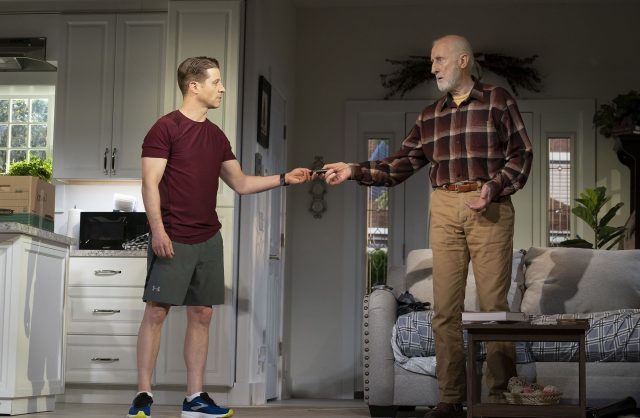
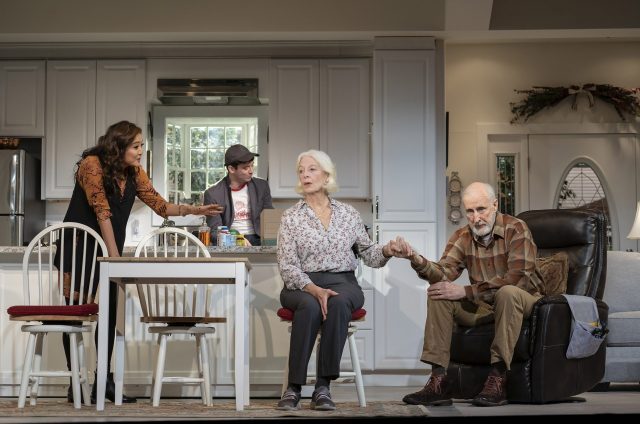
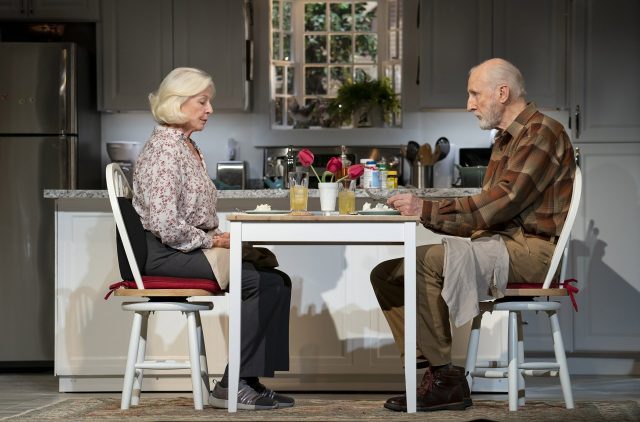
Mary Louise Parker and Will Hochman star in Adam Rapp’s The Sound Inside on Broadway (photo by Jeremy Daniel)

Studio 54
254 West 54th St.
Tuesday – Sunday through January 12, $49-$169
212-719-1300
soundinsidebroadway.com
www.lct.org

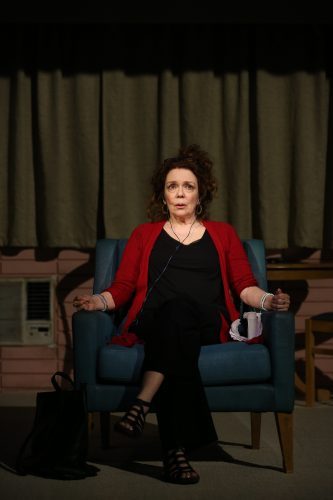
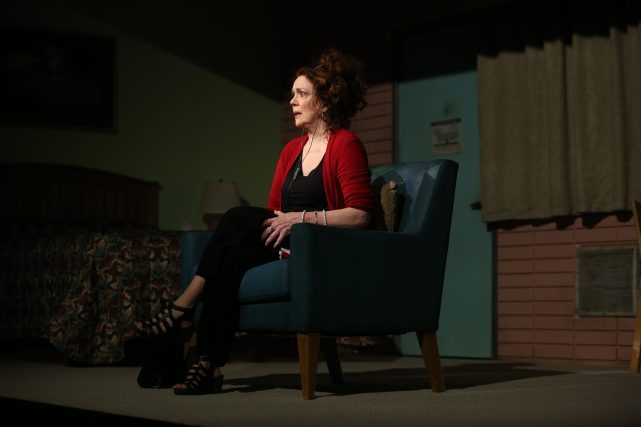
The Sound Inside is one of the most beautifully composed shows I have ever seen, an exquisitely rendered work that could have come only from the mind of an expert storyteller. Originally presented in 2018 at the Williamstown Theatre Festival and commissioned by Lincoln Center, it is written by novelist and playwright Adam Rapp, a Pulitzer Prize finalist who has authored such books as The Year of Endless Sorrows, Punkzilla, and Know Your Beholder and such plays as Red Light Winter, The Metal Children, and Blackbird, which he adapted into a 2007 film he also directed. In The Sound Inside, a luminous Mary Louise Parker stars as fifty-three-year-old Yale professor Bella Lee Baird. (Rapp has taught at the Yale School of Drama, and his mother’s maiden name is Baird.) Bella, who has written a mildly well received book, Billy Baird Runs through a Wall, alternates between telling her story in the first and third persons directly to the audience, as if narrating a novel, and participating in scenes with one of her students, the enigmatic and cynical Christopher Dunn (Will Hochman).

“A middle-aged professor of undergraduate creative writing at a prestigious Ivy League University stands before an audience of strangers,” Bella says to open the play. “She can’t quite see them but they’re out there. She can feel them — they’re as certain as old trees. Gently creaking in the heavy autumn air. Is this audience friendly, she wonders? Merciful? Are they easily distracted? Or will they hear this woman out? And what about her? Ironically, she often dissuades her students from describing a protagonist in too fine of detail. Readers only need a few telling clues.” Rapp and director David Cromer, who subtly transforms Studio 54 into an intimate classroom, follow that advice, offering only a few telling clues at a time as we excitedly hear this captivating woman out.

(photo by Jeremy Daniel)

Christopher Dunn (Will Hochman) talks literature and more with his professor, Bella Lee Baird (Mary Louise Parker) (photo by Jeremy Daniel)

Christopher shows up at Bella’s office one day without an appointment. He has a supreme distaste for rules and regulations and eschews common decency. “Do me a favor. Next time you want to stop by without an appointment at least shoot me an email first,” she tells him. “Yeah, I don’t really do that,” he responds. They discuss Dostoyevsky, hipster baristas, and the book Christopher is writing. They strike up a friendship, but Christopher knows he is taking up a lot of her time. “I mean, if you get tired of me just say so and I can go like wander campus and get mentally prepared for the big football game coming up with Harvard this weekend,” he says. “Stockpile the coldcuts. Get my face painted. Do some steroids. Headbutt random campus bulletin boards, etcetera, etcetera.”

Bella, who’s dealing with stomach cancer and has no one else in her life, welcomes the offbeat Christopher into her daily existence. “I have no children and I’ve never been married,” she tells the audience. “Like many single, self-possessed women who’ve managed to find solid footing in the slippery foothills of higher education, I’ve been accused of being a lesbian. And a witch. And a maker of Bulgarian cheese. And a collector of cat calendars. Both my parents are dead. My father suffered a fatal heart attack at sixty-two and I’ll get to my mother in a minute. I have no brothers or sisters. I live in faculty housing. I don’t own property. I’m essentially a walking social security number with a coveted Ivy League professorship and a handful of moth-bitten sweaters.” As they grow closer, they both consider breaking down the barriers that make them each such lonely beings, committing to no one but themselves.

It’s impossible not to become instantly infatuated with Bella, so bewitchingly played by Tony, Obie, and Emmy winner Parker (Proof, Weeds). You want to just rush onstage and give her a giant hug to assure her everything will be all right, even if it won’t. Parker holds the audience in her hands, giving a tour-de-force lesson in acting. Hochman (Sweat, Dead Poets Society) is impressive in his Broadway debut, not intimidated in the least. Rapp celebrates literature without getting pedantic as he explores Dostoyevsky’s Crime and Punishment, Anne Tyler’s The Accidental Tourist, and James Salter’s Light Years. Alexander Woodward’s set features several rooms that move into the foreground and disappear into the background, superbly lit by Heather Gilbert, each one representing a different aspect of Bella’s life. Tony winner Cromer (The Band’s Visit, Our Town) keeps up a lively pace as the characters scrutinize what they are to each other.

The play refers several times to a framed photograph in Bella’s office of a “woman standing in the middle of a harvested cornfield. She’s in all black and tiny in the vast dead field,” she tells Christopher, who asks, “Is that you in the photograph? Of course it is.” But Bella says she has no idea who it is. The next time he visits her in her office, Christopher is mesmerized by the photo and asks, “Has she gotten smaller? . . . I have this weird feeling that if I come back tomorrow the field will be covered. With snow. Like twenty inches. But no footprints. The woman’s just there. As if the field imagined her.” Bella asks, “Do you think it would be a better image?” He replies, “Maybe not better. But somehow more inevitable.” It’s a fabulous moment in a fabulous play, and one that zeroes in on just who these two people are and what they want out of life.

THE SORCERESS (DI KISHEFMAKHERIN)

()

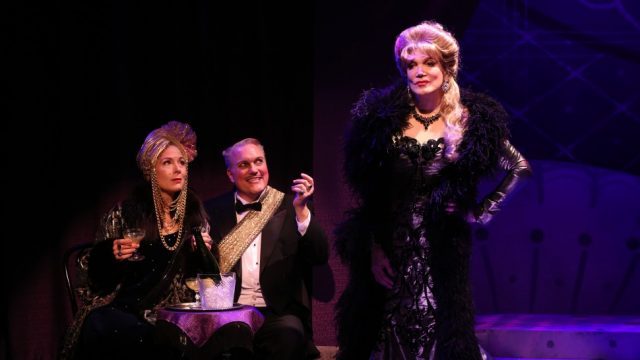
Jazmin Gorsline excels as bride-to-be Mirele in The Sorceress (photo © Victor Nechay – Properpix.com)

Museum of Jewish Heritage — A Living Memorial to the Holocaust
Edmond J. Safra Plaza, 36 Battery Pl.
Through December 29, $59-$125
866-811-4111
nytf.org
mjhnyc.org

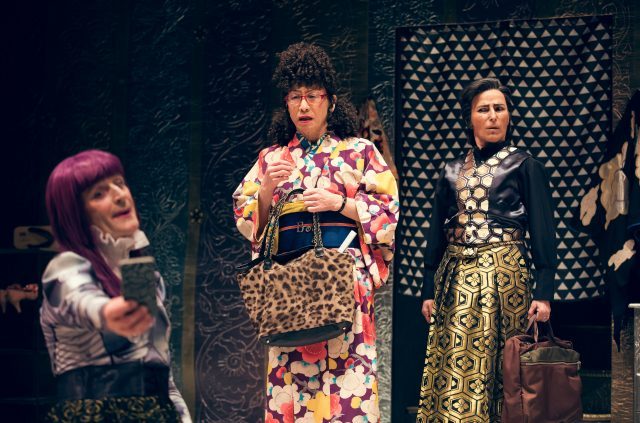
Two years ago, the National Yiddish Theatre Folksbiene presented a work-in-progress version at the Museum of Jewish Heritage of The Sorceress (“Di Kishefmakherin”), the first Yiddish theater production to be performed in America. The company, which has had tremendous success with its spectacular adaptation of Fiddler on the Roof, is now back at its MJH home with a full staging of The Sorceress, a delightful if slight operetta that continues through December 29, including two special performances with a buffet on Christmas Day.

(photo © Victor Nechay - Properpix.com)

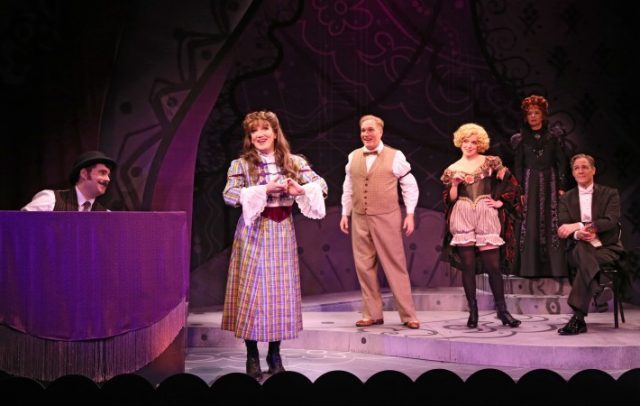
Dani Apple, Lexi Rabadi, Lorin Zackular work up some dastardly magic in National Yiddish Theatre Folksbiene production (photo © Victor Nechay – Properpix.com)

Written by Avrom Goldfaden, the Father of Yiddish Theater, it’s a Cinderella-like tale set in the town of Botoshani, Romania, where the young, lovely Mirele (Jazmin Gorsline) is preparing to wed the handsome and stalwart Markus (Josh Kohane). At her birthday party, she is sad, unable to celebrate because she misses her mother, who died too young. “Is it fair, my dear daughter, that you disturb the celebration with such sad thoughts?” her father, the wealthy Avromtshe (Bruce Rebold), sings. “Isn’t your stepmother faithful just like your very own mother?” he adds, but therein lies the problem. Avromtshe’s new wife, Basye (Rachel Botchan), is, yes, an evil stepmother who plots with the local sorceress, Bobe Yakhne (Mikhl Yashinsky), to make sure she gets exactly what she wants. She has her husband arrested and forces a separation between Markus and Mirele in a greedy plan that confounds the close-knit community, which is struggling to survive in hard times.

Unlike NYTF’s wonderful 2015 production of The Golden Bride, The Sorceress shows its age; written in 1877, it was brought to America in 1883 by fourteen-year-old actor and soon-to-be Yiddish legend Boris Thomashefsky. Some of the jokes are once-fresh (maybe) but now stale vaudeville routines, including one involving needles, salesman Hotsmakh (Steve Sterner), and Koyne (Lexi Rabadi), but other moments are heartbreaking, such as the handler’s (Rebecca Brudner) desperate call as she sells her wares. “Nobody in the world, / Can live out their years. / Without earning a little money. / A job is a burden,” she sings. Gorsline and Kohane are in fine voice, as is the always dependable Botchan. Yashinsky overplays the title character, chewing up far too much of Dara Wishingrad’s set, which resembles those used in a traveling show. Dani Apple, Lorin Zackular, and Rabadi are playful as a trio of witches; the large cast also includes Dylan Seders Hoffman as Basye’s daughter, Lize, Jonathan Brody as the conniving Uncle Elyokem, Mark Alpert as Katsef the butcher, and Samuel Druhora as the Turkish organ grinder. Izzy Fields’s appealing, elaborate costumes capture the era and its strife, while Merete Muenter’s choreography makes excellent use of the small space, especially in the market scene.

(photo © Victor Nechay - Properpix.com)

The Sorceress features a large cast at the Museum of Jewish Heritage (photo © Victor Nechay – Properpix.com)

But the real star of the show, which is helmed by NYTF associate artistic director Motl Didner, is the music, marvelously performed by Lauren Brody on accordion, Elise Frawley on viola, Evan Honse and Rebecca Steinberg on trumpet, Sam Katz and Inna Langerman on violin, Tony Park on clarinet, Reenat Pinchas on cello, George Rush on bass, Matt Temkin on drums and percussion, and associate musical conductor D. Zisl Slepovitch and conductor Zalmen Mlotek on piano. It’s light and frothy one moment, then dastardly and devious the next, as the story takes on such relevant topics as wealth inequality, human trafficking, and the spreading of wicked lies through the social construct. The Sorceress is the first fully restored work in NYTF’s Global Restoration Initiative, which resurrects lost Yiddish plays through extensive research. May there be many more.

MATZOBALL

matzoball

Capitale
130 Bowery
Tuesday, December 24, $50-$75, 9:00 pm – 3:00 am
matzoball.org

Free Christmas Eve? The thirty-third annual Matzoball for singles is taking place on December 24 at Capitale on Bowery, a holiday extravaganza running from nine at night to three the next morning. Partnering with the Gift of Life Marrow Registry, the all-night party started primarily for Jewish singles, but now singles of all religions and ethnicities are welcome, as long as they are twenty-one or over. General admission is $50, with the VIP Fast Pass offering front-of-line privileges and a half-hour open bar for $75. There will be a live DJ performance and lots of dancing and mingling; there will also be Matzoballs, which were founded in 1987 by Andrew Rudnick, held Christmas Eve in Boston, Philadelphia, Los Angeles, DC, and three Florida cities. And as a bonus, it just happens to be Hanukkah as well.

VARDA: A RETROSPECTIVE

(Agnès Varda © Cine Tamaris)

The remarkable life and career of Agnès Varda is being celebrated by Film at Lincoln Center (Agnès Varda © Cine Tamaris)

Film at Lincoln Center, Walter Reade Theater
165 West 65th St. between Eighth Ave. & Broadway
December 20 – January 6
www.filmlinc.org

“I live in cinema. I feel I’ve lived here forever,” Agnès Varda memorably said. The Belgian-born French filmmaker, photographer, and visual artist died earlier this year at the age of ninety, leaving behind an innovative and influential legacy that is being celebrated by Lincoln Center as we say goodbye to 2019 and welcome in 2020, albeit without one of the greatest of all time. “Varda: A Retrospective” is already under way at Film at Lincoln Center, comprising more than two dozen features, documentaries, and shorts, from 1955’s La Pointe Courte to 2019’s Varda by Agnès, and boasting such unique and astounding works as Le bonheur, Cléo from 5 to 7, The Gleaners and I, Vagabond, and, yes, Kung-Fu Master! (with Jane Birkin and Charlotte Gainsbourg!). Every afternoon beginning at 1:00, “Free Loop: Agnès Varda Q&As at Film at Lincoln Center” will be shown for free in the Elinor Bunin Munroe Film Center Amphitheater, while the five-part series Agnès Varda: From Here to There will screen in the Walter Reade Theater December 22 at 12:30, December 23 at 2:00, and December 24 at 1:00, free with advance registration. There is also a free gallery exhibition with rare archival footage, photographs, and ephemera related to Varda and her remarkable career and life, which included a nearly thirty-year marriage to auteur Jacques Demy, with whom she had two children, producer and costume designer Rosalie Varda and actor and director Mathieu Demy. Varda’s The Young Girls Turn 25, which creates a reunion of the cast and crew of her husband’s The Young Girls of Rochefort where that classic was shot, can be seen December 27 and January 2. Below are only some of Varda’s best; as a bonus, from January 4 to 6, Rosalie Varda will introduce and/or participate in Q&As at half a dozen screenings.

BEACHES OF AGNES

Agnès Varda takes an unusual approach to autobiography in The Beaches of Agnès

THE BEACHES OF AGNÈS (LES PLAGES D’AGNÈS) (Agnès Varda, 2008)
Tuesday, December 24, 4:15
Sunday, December 29, 6:00
Sunday, January 5, 6:00 (introduced by Rosalie Varda)
www.filmlinc.org

“The whole idea of fragmentation appeals to me,” Agnès Varda says in the middle of her unusual cinematic autobiography, the César-winning documentary The Beaches of Agnès. “It corresponds so naturally to questions of memory. Is it possible to reconstitute this personality, this person Jean Vilar, who was so exceptional?” She might have been referring to her friend, the French actor and theater director, but the exceptional Belgian-French Varda might as well have been referring to herself. Later she explains, “My memories swarm around me like confused flies. I hesitate to remember all that. I don’t want to.” Fortunately for viewers, Varda (Jacquot de Nantes, One Hundred and One Nights) does delve into her past in the film, sharing choice tidbits from throughout her life and career, in creative and offbeat ways that are charmingly self-effacing. Using cleverly arranged film clips, re-creations, photographs, and an array of frames and mirrors, the eighty-year-old Varda discusses such colleagues as Jean-Luc Godard, Chris Marker, and Alain Resnais; shares personal details of her long relationship with Jacques Demy; visits her childhood home; rebuilds an old film set; speaks with her daughter, Rosalie Varda, and son, Mathieu Demy; talks about several of her classic films, including La Pointe Courte, Cléo from 5 to 7, and Vagabond; and, in her ever-present bangs, walks barefoot along beaches, fully aware that the camera is following her every move and reveling in it while also feigning occasional shyness. Filmmakers don’t generally write and direct documentaries about themselves, but unsurprisingly, the Nouvelle Vague legend and first woman to win an honorary Palme d’or makes The Beaches of Agnès about as artistic as it can get without becoming pretentious and laudatory. The January 5 screening will be introduced by Rosalie Varda.

JR and Agnès Varda have a blast in the masterful Faces and Places

JR and Agnès Varda have a blast with people and animals in the masterful Faces and Places

FACES PLACES (VISAGES VILLAGES) (Agnès Varda & JR, 2017)
Tuesday, December 24, 2:15
Monday, December 30, 8:30
Wednesday, January 1, 8:45
www.filmlinc.org
cohenmediagroup.tumblr.com

“We’ll have fun making a film,” legendary eighty-eight-year-old Belgian-born French auteur Agnès Varda tells thirty-three-year-old French photographer and street artist JR in Faces Places (Visages Villages), a masterful road movie that may very well be the most fun film of 2017. The unlikely pair first met when Varda accepted an invitation from JR, whose practice involves wheat-pasting giant black-and-white photos of men, women, and children on architectural structures, to visit his Paris studio. (JR brought his “Inside Out” art project to Times Square in 2013.) When Varda saw JR’s blow-up of a 1960 self-portrait Varda shot of herself standing in front of a Bellini painting in Venice, the two instantly hit it off and decided to make a film together, heading out in JR’s small photo-booth truck to team up with people in small towns throughout France, including coal miners, dockworkers, farmers, a church-bell ringer, and factory workers. The reactions of the villagers — shrewd, curious, flattered — to JR’s enormous wheat-pasted blow-ups of themselves on their neighborhood walls, barns, abandoned housing, containers, water towers, and other locations are fascinating. “JR is fulfilling my greatest desire. To meet new faces and photograph them, so they don’t fall down the holes of my memory,” Varda, who edited the film with Maxime Pozzi-Garcia, says. Varda and JR make a formidable duo, finding a childlike innocence in their collaboration that is simply captivating to watch.

Cinematic collaboration between Agnès Varda and JR results in stunning visions of humanity

Cinematic collaboration between Agnès Varda and JR results in stunning visions of humanity

Varda continually tries to get JR to remove his ever-present dark glasses, remembering how her friend and colleague Jean-Luc Godard once let her take pictures of him without glasses, but JR prefers to maintain his mystery, a man who photographs tens of thousands of people’s faces around the world while never fully showing his own. Varda, who relies on the “power of imagination,” even sets up an afternoon with Godard at his home in Switzerland, preparing by having JR roll her furiously through the same Louvre galleries the protagonists run through in Godard’s Band of Outsiders, but of course nothing with Godard ever goes quite as planned. “Chance has always been my best asset,” Varda proclaims in the film, and it is chance, and the willingness to enthusiastically embrace every moment of life, that helps give Faces Places its immeasurable charm. The film, which features a playful score by Matthieu Chedid (‑M-) and was executive produced by Varda’s daughter, Rosalie Varda-Demy, subtly tackles socioeconomic issues but is primarily a marvelous celebration of genuine humanity.

Cléo (Corinne Marchand) looks back at her life in Agnès Varda’s Nouvelle Vague classic

Cléo (Corinne Marchand) looks back at her life in Agnès Varda’s Nouvelle Vague classic

CLEO FROM 5 TO 7 (CLÉO DE 5 À 7) (Agnès Varda, 1962)
Wednesday, December 25, 8:30
Saturday, December 28, 4:30
Saturday, January 4, 7:00 (introduced by Rosalie Varda)
www.filmlinc.org

After getting a biopsy taken and drawing the death card while consulting a fortune-teller, popular French singer Cléo (Corinne Marchand) begins looking back at her life — and wondering just what’s left of it — while awaiting the dreaded results. The blonde beauty talks with old friends, asks her piano player (Michel Legrand, who composed the score) to write her a song, and meets a dapper gentleman in the park, becoming both participant and viewer in her own existence. As Cléo makes her way around town, director (and former photographer) Agnès Varda (Jacquot de Nantes, Lions Love [. . . and Lies]) shows off early 1960s Paris, expertly winding her camera through the Rive Gauche. Just as Cléo seeks to find out what’s real (her actual name is Florence and that gorgeous hair is a wig), Varda shoots the film in a cinema verité style, almost as if it’s a documentary. She even sets the film in real time (adding chapter titles with a clock update), enhancing the audience’s connection with Cléo as she awaits her fate, but the movie runs only ninety minutes, adding mystery to what is to become of Cléo, as if she exists both on-screen and off, alongside the viewer. A central film in the French Nouvelle Vague and one of the first to be made by a woman, Cléo de 5 à 7 is an influential classic even as it has lost a step or two over the years. The January 4 screening will be introduced by Varda’s daughter, Rosalie Varda.

LE BONHEUR

François (Jean-Claude Drouot) tries to convince Thérèse (Claire Drouot, his real-life wife), that he has plenty of happiness to spread around in Le Bonheur

LE BONHEUR (HAPPINESS) (Agnès Varda, 1965)
Thursday, December 26, 3:00
Saturday, January 4, 9:00 (introduced by Rosalie Varda)
www.filmlinc.org/films/le-bonheur

In 1965, French Nouvelle Vague auteur Agnès Varda said about her third film, Le Bonheur, which translates as Happiness: “Happiness is mistaken sadness, and the film will be subversive in its great sweetness. It will be a beautiful summer fruit with a worm inside. Happiness adds up; torment does too.” That is all true nearly fifty years later, as the film still invites divided reaction from critics. “Miss Varda’s dissection of amour, as French as any of Collette’s works, is strikingly adult and unembarrassed in its depiction of the variety of love, but it is as illogical as a child’s dream,” A. H. Weiler wrote in the New York Times in May 1966. “Her ‘Happiness,’ a seeming idyll sheathed in irony, is obvious and tender, irresponsible and shocking and continuously provocative.” All these decades later, the brief eighty-minute film is all that and more, save for the claim that it is illogical. In a patriarchal society, it actually makes perfect, though infuriating, sense.

François and Émilie (Marie-France Boyer) seek out their own happiness in Nouvelle Vague classic

François (Jean-Claude Drouot) and Émilie (Marie-France Boyer) seek out their own happiness in Nouvelle Vague classic

French television star Jean-Claude Drouot (Thierry La Fronde) stars as the handsome François, who is leading an idyllic life with his beautiful wife, Thérèse (Claire Drouot), and their delightful kids, Pierrot (Olivier Drouot) and Gisou (Sandrine Drouot), in the small, tight-knit Parisian suburb of Fontenay. While away on a job, François meets the beautiful Émilie (Marie-France Boyer), a postal clerk who connects him to his wife via long-distance telephone, flirting with him although she knows he is happily married. And despite being happily married, François returns the flirtation, offering to help with her shelves when she moves into an apartment in Fontenay. Both François and Émilie believe that there is more than enough happiness to go around for everyone, without any complications. “Be happy too, don’t worry,” Émilie tells him. “I’m free, happy, and you’re not the first,” to which he soon adds, “Such happiness!” And it turns out that even tragedy won’t put a stop to the happiness, in a plot point that angered, disappointed, confused, and upset many critics as well as the audience but is key to Varda’s modern-day fairy tale. The January 4 screening will be introduced by Varda’s daughter, Rosalie Varda.

The beauty of nature plays a key role in LE BONHEUR

The beauty of nature plays a key role in Le Bonheur

Le Bonheur is Varda’s first film in color, and she seems to have been heavily influenced by her husband, Jacques Demy (The Umbrellas of Cherbourg, The Young Girls of Rochefort), bathing the film in stunning hues that mimic Impressionist paintings, particularly the work of Pierre-Auguste Renoir, in a series of picnics and flower-filled vases. In a sly nod, at one point a black-and-white television is playing the 1959 film Le Déjeuner Sur L’herbe (“Picnic on the Grass”), which was directed by Jean Renoir, one of Auguste’s sons, and also deals with sex, passion, procreation, and nature. Le Bonheur also features numerous scenes that dissolve out in singular blocks of color that take over the entire screen. Cinematographers Claude Beausoleil and Jean Rabier shoot the film as if it takes place in a candy-colored Garden of Eden, all set to the music of Mozart, performed by Jean-Michel Defaye. Varda doesn’t allow any detail to get away from her; even the protagonists’ jobs are critical to the story: François is a carpenter who helps builds new lives for people; Thérèse is a seamstress who is in the midst of making a wedding gown; and Émilie works in the post office, an intermediary for keeping people together. As a final touch, François, who represents aspects of France as a nation under Charles de Gaulle, and his family are played by the actual Drouot clan: Jean-Claude and Claire are married in real life (and still are husband and wife after nearly sixty years later), and Olivier and Sandrine are their actual children, so Le Bonheur ends up being a family affair in more ways than one.

Agnès Varda looks back at her past in charming Daguerréotypes

DAGUERRÉOTYPES (Agnès Varda, 1975)
Tuesday, December 31, 4:00
www.filmlinc.org

Legendary auteur Agnès Varda’s eighty-minute documentary, Daguerréotypes, which only received its official U.S. theatrical release in 2011 at the Maysles Cinema, is an absolutely charming look at Varda’s longtime Parisian community. In the film, Varda turns her camera on the people she and husband Jacques Demy lived with along the Rue Daguerre in Paris’s 14th arrondissement. Varda, who also narrates the film, primarily stands in the background while capturing local shopkeepers talking about their businesses and how they met their spouses as customers stop by, picking up bread, meat, perfume, and other items. Varda uses a goofy, low-rent magic show as a centerpiece, with many of the characters attending this major cultural event; the magician references the magic of both life and cinema itself, with Varda, a former photographer, titling the film not only after the street where she lives but also directly evoking the revolutionary photographic process developed by Louis Daguerre in the 1820s and ’30s. Daguerréotypes has quite a different impact now than it did back in the mid-1970s, depicting a time that already felt like the past but now feels like a long-forgotten era, when neighbors knew one another and lived as a tight-knit community.

A FACE IN THE CROWD: REMEMBERING LEE REMICK

The Europeans

Lee Remick lights up the screen in 2K restoration of The Europeans

THE EUROPEANS (James Ivory, 1979)
Quad Cinema
34 West 13th St. between Fifth & Sixth Aves.
December 20-26
212-255-2243
quadcinema.com

From her big-screen debut in Elia Kazan’s A Face in the Crowd in 1957, it was clear that Massachusetts native Lee Remick would be more than just another face in the crowd. In conjunction with the theatrical release of the fortieth anniversary 2K restoration of The Europeans, the Quad is celebrating Remick with that 1979 Merchant Ivory costume drama in addition to six other works that make up the too-brief series “A Face in the Crowd: Remembering Lee Remick.” In The Europeans, Remick, who tragically passed away in 1991 at the age of fifty-five, plays the très chic and cultured Eugenia Münster, who has arrived from the continent with her brother, bohemian painter Felix Young (Tim Woodward), seeking to stay awhile with their cousins, the Wentworths, who have a large country estate outside Boston.

Patriarch Mr. Wentworth (Wesley Addy) is suspicious of the siblings, who are very different from his more staid family. Eugenia’s marriage to a German prince is falling apart, so she is in the market for a new partner. One potential match is the ne’er-do-well Clifford Wentworth (Tim Choate), but Eugenia has her eyes on the more mature Robert Acton (Robin Ellis), another cousin of the Wentworths from a different side of the family. Unitarian minister Mr. Brand (Norman Snow) is in love with one of Clifford’s sisters, the iconoclastic, church-skipping Gertrude (Lisa Eichhorn), who has taken a liking to Felix, who thinks that Mr. Brand is a better match for Gertrude’s sister, Charlotte (Nancy New). Also in the mix is Robert’s younger sister, the ingénue Lizzie (Kristin Griffith).

Adapted by Ruth Prawer Jhabvala from the novella by Henry James, directed by James Ivory, and produced by Ismail Merchant — the trio would also collaborate on James’s The Bostonians (with Remick) in 1984 and The Golden Bowl in 2000 — The Europeans is a slowwwww-moving melodrama that too often feels like it’s going nowhere during its mere ninety minutes. Remick is simply fab as Eugenia, a twinkle ever-present in her sparkling eyes as she bandies about in Judy Moorcroft’s jaw-dropping costumes and dazzling hairdos. The film looks great, courtesy of cinematographer Larry Pizer and art director Jeremiah Rusconi, and Remick is transfixing, lifting another of James’s tales of morally corrupt European nobility vs. the wealthy, prim, upright Puritans of New England. As a bonus, the ninety-one-year-old Ivory (A Room with a View, Call Me by Your Name) will be at the Quad on December 20 for a Q&A following the 7:15 screening.

A Face in the Crowd

Lee Remick made her feature-film debut in Elia Kazan’s A Face in the Crowd

Remick made twenty-eight feature films and more than two dozen television movies and miniseries in addition to appearing on Broadway several times. The Quad festival, running December 20–26, shows her alongside some of Hollywood’s finest leading men. In Otto Preminger’s gripping and tense Anatomy of a Murder, she’s married to Ben Gazzara, who is on trial for murder, caught between defense attorney James Stewart and prosecutor George C. Scott. In Robert Mulligan’s emotional Baby the Rain Must Fall, Remick is married to Steve McQueen in a story by Horton Foote. Remick was nominated for an Oscar for her daring performance in Blake Edwards’s harrowing Days of Wine and Roses, in which she and Jack Lemmon battle the bottle in a big way. In Gordon Douglas’s gritty, effective The Detective, Remick is having marital problems with Frank Sinatra, a cop on a brutal case. In Richard Donner’s still terrifying The Omen, Remick and Gregory Peck are a high-powered Washington couple who just might be raising the devil. And Remick sizzles in the Trump-ist A Face in the Crowd, in which Andy Griffith made his film debut as well. Remick had a uniquely mesmerizing charm; when she’s onscreen, you can’t take your eyes off her, no matter who she is next to. Head over to the Quad to see for yourself — and be prepared to fall in love with one of the most underrated stars of the twentieth century.

CURATORS’ CHOICE: WHAT YOU GONNA DO WHEN THE WORLD’S ON FIRE?

What You Gonna Do When the World’s on Fire?

Titus Turner looks up to his older brother, Ronaldo King, in What You Gonna Do When the World’s on Fire?

WHAT YOU GONNA DO WHEN THE WORLD’S ON FIRE (Roberto Minervini, 2018)
Museum of the Moving Image
35th Ave. at 36th St., Astoria
Friday, December 20, 7:30
Series continues through January 12
718-777-6888
www.movingimage.us
www.kimstim.com

Roberto Minervini follows up his Texas Trilogy – The Passage, Low Tide, and Stop the Pounding Heart – with the powerful sociopolitical call to action What You Gonna Do When the World’s on Fire?, which is screening December 20 in the Museum of the Moving Image’s annual series “Curators’ Choice,” a collection of the best works of the past twelve months, which curator Eric Hynes and assistant curator Edo Choi call “among the best film years in memory.”

What You Gonna Do When the World’s on Fire? is shot in sharp, distinctive black-and-white by cinematographer Diego Romero Suarez-Llanos so that it looks like a fictional work from the civil rights era, but it is an all-too-real documentary that shows what’s happening in the US today, even though far too many Americans would deny the inherent realities the movie depicts. Italian-born director Minervini, who is based in the American south, tells four poignant stories steeped in oppression: Judy Hill is struggling to get by, running a bar that has become an important meeting place for the Tremé community while also caring for her elderly mother, Dorothy; Ashlei King hopes that her young sons, fourteen-year-old Ronaldo King and nine-year-old Titus Turner, come back safe after going out to play in a junkyard; Mardi Gras Indian Chief Kevin Goodman melds black and Native American traditions in changing times; and Krystal Muhammad and the New Black Panther Party for Self Defense protest the killings of two African American men at the hands of police.

What You Gonna Do When the World’s on Fire?

The New Black Panther Party for Self Defense fights the power in What You Gonna Do When the World’s on Fire?

Beautifully edited by Marie-Hélène Dozo, the film, which was shot in Louisiana and Mississippi in the summer of 2017, captures the continuing results of institutionalized, systemic racism and income inequality in the United States. “We’ve been set free, but we’re still being slaves,” Judy Hill proclaims. “Nowadays, people don’t fight; they like to shoot,” Ronaldo teaches Titus. What You Gonna Do When the World’s on Fire? is the kind of film that should be widely seen, including in schools around the country, to highlight the everyday impact of racial injustice. There are no confessionals in the film, no so-called experts discussing socioeconomic issues; instead, it’s real people, struggling to survive and fighting the status quo and America’s failure to effectively face and deal with its original sin. The most controversial section involves the New Black Panther Party for Self Defense, the members of which march through town declaring, “Black power!” When they face off against the police, they make some arguable choices, but what’s most important is what has taken place to even put them in that situation. There’s a good reason why the title, What You Gonna Do When the World’s on Fire?, is framed as a question, one that every one of us should look in the mirror and answer for ourselves.

What You Gonna Do When the World’s on Fire?

Judy Hill struggles to get by in poignant, important film by Roberto Minervini What You Gonna Do When the World’s on Fire?

“Curators’ Choice” continues through January 12 with such other 2019 popular and little-seen gems as Quentin Tarantino’s Once Upon a Time . . . in Hollywood, James Gray’s Ad Astra, Kent Jones’s Diane, and the director’s cut of Ari Aster’s Midsommar and features Q&As with Jones, Aster, Penny Lane (Hail Satan?), Alex Ross Perry (Her Smell), Brett Story (The Hottest August), Nathan Silver, Cindy Silver, and Jarred Alterman from Cutting My Mother, and Julia Reichert, Steve Bognar, and Jeff Reichert from American Factory.

RETURN ENGAGEMENT: IS THIS A ROOM

(photo by Carol Rosegg)

FBI Special Agent Justin C. Garrick (Pete Simpson) confronts Reality Winner (Emily Davis) in Is This A Room (photo by Carol Rosegg)

Vineyard Theatre
Gertrude and Irving Dimson Theatre
108 East 15th St. between Union Square East & Irving Pl.
December 20 – January 19, $35-$100
www.vineyardtheatre.org

If you missed Tina Satter’s off-Broadway hit Is This A Room, it will be back at the Vineyard for a limited return engagement December 20 through January 19, with the same cast and crew. Below is my original review of this must-see work.

In 2017, upon first reading the official FBI “Verbatim Transcription” of the initial interrogation of twenty-five-year-old linguist Reality Winner regarding leaked classified information, Half Straddle founder and artistic director Tina Satter knew she had her next play. She also knew she had her star, company member Emily Davis. The resulting show, Is This A Room, which debuted at the Kitchen before evolving into the production returning to the Vineyard, is a gripping re-creation of the event, a dramatic word-for-word account of the FBI’s fascinating methods of questioning and Winner’s uncertain answers, at least at the beginning.

Parker Lutz’s spare stage consists of a few raised platforms and posts that represent both the outside and the inside of Winner’s house in Augusta, Georgia. There is no furniture and no props other than stuffed versions of Winner’s dog and cat. (Amanda Villalobos designed the animal puppets.) There is also a row of twelve seats along the back of the stage where a dozen audience members sit, including me; I felt like part of a jury and a person under surveillance, watched by Winner, the FBI agents, and the crowd in the regular seats. Special Agents Justin C. Garrick (Pete Simpson) and R. Wallace Taylor (TL Thompson) arrive at Winner’s (Davis) house just as she has come home from shopping. The men are in plainclothes; Winner is wearing a white button-down shirt, cut-off jean shorts, and yellow high-top canvas sneakers without socks, her hair pulled back in a knot. (The costumes are by Enver Chakartash.) While Garrick is friendly with Winner, making conversation about pets, exercise, work, weapons, and perishables, Taylor is much more direct and in her face, engaging in a variant of the classic good-cop, bad-cop scenario. In addition, an unidentified male agent (Becca Blackwell) in battle fatigues, as if ready for any kind of possible trouble, keeps entering and leaving, helping out with the dog and cat and securing the interior and exterior spaces.

(photo by Carol Rosegg)

Special Agents R. Wallace Taylor (TL Thompson) and Justin C. Garrick (Pete Simpson) interrogate Reality Winner (Emily Davis) as an “unknown male agent” (Becca Blackwell) looks on (photo by Carol Rosegg)

“Okay, well, the reason we’re here today is that we have a search warrant for your house,” Garrick tells Winner, who responds innocently, “Okay.” Garrick: “All right. Uh, do you know what this might be about?” Winner: “I have no idea.” Garrick: “Okay. This is about, uh, the possible mishandling of classified information.” Winner: “Oh my goodness. Okay.” As the interrogation continues, everyone starts letting their hands show a little more as the truth slowly comes out in drips and drabs. However, even though we now know that the investigation dealt with Russian interference in the 2016 presidential election, at that point those elements were still classified, so a crash of sound and instant darkness detonates at each redaction, excitingly jolting the audience. (The lighting is by Thomas Dunn, with sound by Lee Kinney.)

Satter (Straight White Men, House of Dance) casts no judgments on the characters, telling the story as it happened; your personal beliefs will help you decide if you think there are heroes or villains in the true story. Davis (Satter’s The Seagull [Thinking of You] and In the Pony Palace/Football) sublimely captures the essence of the nervous, jittery Winner, who spent six years in the Air Force, was employed by the military contractor Pluribus International Corporation, had NSA security clearance, speaks Farsi, Dari, and Pashto, and only wants to do what is right for her country; even though most of the audience knows the outcome, either by having followed the news or read the insert in the program, it is utterly compelling watching Davis as Winner is confronted with more and more evidence against her. The three actors portraying the FBI agents are all effective, with Simpson (Straight White Men, Gatz) standing out as Garrick, garnering sympathy despite his manipulative methods. Is This A Room is a riveting play that explodes with importance at a very specific moment in time when whistleblowers are harassed and threatened by people in power who are trying to cover up vital information.