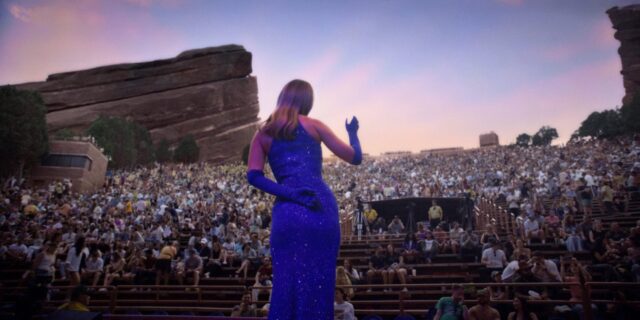
Christopher Nelius’s Whistle is the opening-night selection of the 2025 DOC NYC festival
DOC NYC 2025
IFC Center
323 Sixth Ave. at West Third St.
Village East by Angelika
181-189 Second Ave. at 12th St.
SVA Theatre
333 West Twenty-Third St. between Eighth & Ninth Aves.
November 12-21, $13-$30 per screening, ten-ticket package $170
www.docnyc.net
The 2025 iteration of the annual DOC NYC festival, ten days of documentary shorts, features, and animated works at IFC Center, the Village East, the SVA Theatre, and online, gets underway November 12 with the opening-night selection, Christopher Nelius’s Whistle, about Carole Anne Kaufman, the Whistling Diva, and other mouth musicians at the Masters of Musical Whistling festival in Hollywood. Kaufman will participate in a postscreening Q&A with fellow whistlers Jay Winston, Lauren Elder, Molly Lewis, Anya Ziordia Botella, and Davitt Felder. There are two centerpiece films: Carl Deal and Tia Lessin’s Steal This Story, Please! follows around activist journalist and Democracy Now! host Amy Goodman, who will appear with the directors at two shows, November 13 and 14, while Celia Aniskovich’s The Merchants of Joy delves into the New York City Christmas tree trade. The closing night film is Ivy Meeropol’s Ask E. Jean, which tells the story of E. Jean Carroll, who successfully sued Donald Trump twice.
The festival is divided into such sections as “Resilience,” “Fight the Power,” “Investigations,” and “Sonic Cinema” in addition to several competitions; among the many highlights are Raoul Peck’s Orwell: 2+2=5, Alan Berliner’s Benita, Ian Bell’s WTO/99, Joe Beshenkovsky and James A. Smith’s Mata Hari, Isa Willinger’s No Mercy, Tyler Measom and Craig A. Williams’s If These Walls Could Rock, and Amy Berg’s It’s Never Over, Jeff Buckley.
Below is a closer look at some of the standouts; keep watching this space for more reviews as DOC NYC continues.
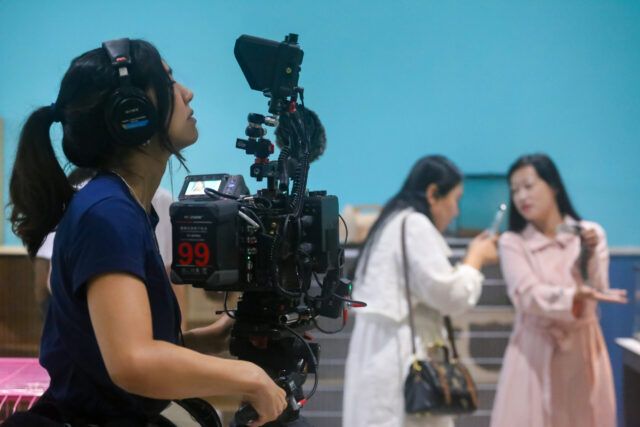
Elizabeth Lo is given remarkable access to a love triangle in award-winning documentary Mistress Dispeller
MISTRESS DISPELLER (Elizabeth Lo, 2024)
Village East
Thursday, November 13, 9:20
www.docnyc.net
In her debut feature-length documentary, 2020’s Stray, Elizabeth Lo tracked a remarkable homeless canine named Keytin as the golden mutt lived a dog’s life on the streets of Istanbul, allowing Lo to capture his every move, telling the dog’s story from his perspective.
Lo has followed that up with Mistress Dispeller, in which the participants in a love triangle allow Lo to capture their every move, telling their story from each of their unique perspectives.
Taking inspiration from Chantal Akerman’s Jeanne Dielman, 23 Quai due Commerce, 1080 Bruxelles and Akira Kurosawa’s Rashomon, Lo’s film explores a relatively new “love industry” in China, mistress dispellers, who, for fees of tens of thousands of dollars and more, are hired by women who believe their husbands are having an affair; over the course of two or three months, the dispeller, using a false identity, ultimately convinces the mistress to end the illicit romance through a structured technique. They do so in a calm, unobtrusive way, treating all three parties with dignity and respect.
It took three years for Lo to find mistress dispeller Wang Zhenxi, then get permission to document one of her cases, in which Mrs. Li wants to end her husband’s affair with the younger Fei Fei. Wang poses as a cousin of Mr. Li’s who is interested in learning the married couple’s favorite pastime, badminton. Wang carefully orchestrates various meetings in which she spends time alone with the mistress, studies her motivations and emotions, and comes up with a plan. Lo’s mounted, still camera is in every room, every car — but not necessarily Lo, who sometimes leaves the camera recording as she exits the space, permitting her subjects to talk more openly without her watching. “I am just a vessel in their lives,” Wang says, and so is Lo. (Lo had previously interviewed Mrs. Li’s younger brother, who was a dispelled male mistress and recommends Wang in the film.)
Although it is made clear from the start that this is not some kind of game, there are winners and losers. “It’s just like a war. You either win or lose everything,” Wang explains. Fei Fei admits, “Winning or losing isn’t the question. Actually, neither is important to me anymore. Because there are many more important things than winning.” But later she states, “I can’t keep losing though, right? Everyone wants to win. Why can’t the winner be me?”
Lo directed, produced, and photographed the film in addition to writing and editing it with Charlotte Munch Bengtsen. She gives equal weight to Mr. Li, Mrs. Li, and Fei Fei while delving into Wang’s methods. Time and money is never discussed; instead, Lo focuses on the care Wang employs in her business, determined to achieve a satisfying result for all involved. The access Lo is supplied is astounding; of course, only Mrs. Li knows what’s happening at first, but soon Mr. Li understands as well, while Fei Fei discovers the deception only at the conclusion.
Lo does not seek to elicit any judgments, but she includes several scenes in which Mrs. Li and Fei Fei carefully tend to their personal style, taking care to dress well and get their hair done, while Mr. Li, the object of each woman’s affection, is not exactly a fashion plate or a great conversationalist. However, the film does not ask us to question the love — and we know from the start that Wang’s goal is to restore the marriage, with the mistress out of the picture.
In a program note, Fei Fei says, “I am willing to participate in filming because, considering the long river of life, this is a small part of it. But it’s also something that’s significant to me right now. I see this as a documentary of my life. It is also a portrait of love. From the beginning of our encounter, to the middle of the relationship, and the end, it’s all part of this process of love. . . . Love doesn’t disappear, it just diverts. It’s just a process of love moving around. It’s quite meaningful to make time to recall and witness the process for yourself — whether the path you take is right or not. . . . When others see this film, they might gain some insights from it.”
Meanwhile, Mrs. Li explains, “Teacher Wang taught me a lot. About love, and other things. She said, ‘Look, you are going through this, this difficulty, and we should film it, so more women, more people, can face their families and learn how to handle a situation like this. . . .’ I want more people to know that love doesn’t come easy, especially for people at our age. Don’t give up so easily.”
The film also touches on aspects of contemporary Chinese dating, from matchmaking seminars and fairs to online channels. Lo occasionally cuts away for drone shots of cities and mountainous landscapes, incorporating all of China into the narrative, merging the inner and outer worlds of the people and the country.
Mistress Dispeller screens November 13 at the Village East, with Lo and producer Emma D. Miller on hand for a Q&A.
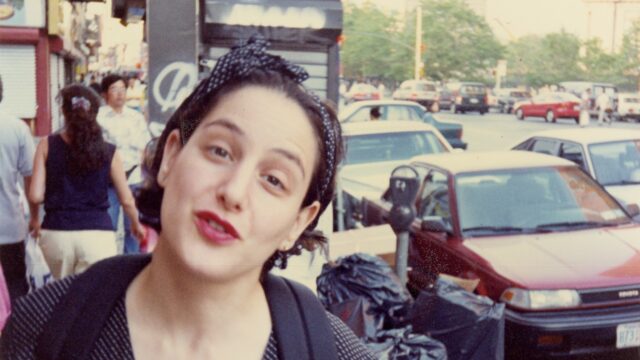
Award-winning filmmaker explores the life and career of Benita Raphan in new documentary
BENITA (Alan Berliner, 2025)
IFC Center
Friday, November 14, 7:00
Village East
Sunday, November 16, 11:30 am
www.docnyc.net
Shortly after learning of his friend and longtime collaborator Benita Raphan’s suicide on June 10, 2021, documentarian Alan Berliner was asked by her family if he would complete the film she was working on when she died, at the age of fifty-eight. They gave him full access to her extensive archives, comprising notebooks, outtakes, drawings, photographs, and other ephemera. Berliner spent a year doing research and ultimately decided instead to make a film about her, in an attempt to better understand Betina as a person and filmmaker and, perhaps, why she hanged herself.
“Think of this film as an experiment in collaboration,” Berliner says at the start of the aptly titled Benita. “Benita left behind thousands of pieces; my job was to splice them together, to make a mash-up of our different filmmaking styles, to do whatever it takes to bring Benita’s creative spirit to life. But as much as anything, I also just wanted the joy of being able to work with Benita, one final time.”
Berliner conducted new interviews with more than a dozen people from Betina’s private life and professional career, including her mother, Roslyn Raphan; her friends Lucy Eldridge, Shari Spiegel, Miriam Kuznets, and Eric Latzky; her former boyfriend Eric Hoffert of the Speedies; composers Hayes Greenfield and Robert Miller, and SVA chair Richard Wilde. Together they paint a portrait of an eclectic, unusual, and caring avant-garde artist who was able to charm people into participating in the creation of her films — for free. Among the numerous words they use to describe her are “complex,” “serious,” “charismatic,” “a singular soul,” “a nonconformist,” “unpredictable,” “an irregular verb,” “nervous,” “anxious,” “intense,” “incredibly humble,” “fragile,” “vulnerable,” and “a scientist in an artist’s body.”
“I want to work on fun stuff, and her stuff is fun,” sound designer Marshall Grupp says.
“I wanted to help her, I wanted her to succeed,” notes postproduction facilitator Rosemary Quigley.
Producer, director, writer, editor, and narrator Berliner incorporates scenes from about half of Benita’s thirteen short films, focusing on ones that explore creativity, intelligence, and mental illness: 2002’s 2+2 (mathematician John Nash), 2004’s The Critical Path (architect Buckminster Fuller), 2008’s Great Genius and Profound Stupidity (author Helen Keller), and 2018’s Up to Astonishment (poet Emily Dickinson).
“Benita’s films aren’t really meant to be understood,” Berliner (First Cousin Once Removed, Intimate Stranger) explains. “She’s more interested in helping you make connections and stirring up feelings about her subjects using abstraction, layering, and rapid editing, sometimes all at once, to express things that can’t always be put into words, things like dreams, stream of consciousness, or visual metaphors. When Benita takes us inside the complicated minds of her subjects, she’s also trying to show us what it’s like inside her own.”
The film excerpts reminded me of the work of experimentalists Hollis Frampton, Stan Brakhage, and Maya Deren and such surrealists as Luis Buñuel and Salvador Dalí yet wholly original. Clips in which Benita is filming her shadow as she walks down the sidewalk or crunching on ice are poetically beautiful and memorable.
A 2019 Guggenheim fellow, Benita wrote down such thoughts as “Don’t be afraid to have bad ideas,” “Mistakes are an opportunity to start again & do it right,” and “Celebrate the confusion.” However, her more recent words ranged from “afraid” and “lost” to “I’m not myself” and “falling apart.”
She spent more time by herself near the end, dedicating many of her days to her dogs, including one who had severe psychological issues and another she named Rothko, after abstract painter Mark Rothko, who committed suicide in 1970 at the age of sixty-six. “Dogs don’t repeat any of your secrets,” she wrote.
Berliner captures Benita’s inner strength and unique style, but it’s not always possible to figure out why someone chooses death over life; mental illness is too often too difficult to diagnose, especially among friends and relatives.
Benita is making its world premiere at DOC NYC, screening November 14 at IFC Center and November 16 at the Village East, with Berliner, the recipient of last year’s DOC NYC Lifetime Achievement Award, on hand for Q&As following each show.

Documentary explores Seattle protests against the WTO in 1999 (photo by Rustin Thompson)
WTO/99 (Ian Bell, 2025)
Village East
Friday, November 14, 9:00
IFC Center
Monday, November 17, 1:00
Online November 15-30
www.wto99doc.com
www.docnyc.net
Young and old march through the streets, forming blockades and human chains. Signs denounce globalization and corporatization. Angry farmers and union workers demand they be heard. Cries of fascism ring out. Local police, state troopers, and the National Guard douse protesters with pepper spray and tear gas, toss flash-bang grenades, and shoot the crowd with rubber bullets. Mysterious agitators in all black smash store windows. Donald Trump and Roger Stone weigh in on free trade and tariffs.
A documentary about government intervention into blue cities in 2025? A “No Kings” rally gone bad? Clips from the Rodney King and George Floyd protests?
No, Ian Bell’s riveting WTO/99 is composed exclusively of archival footage of the Battle of Seattle, when, beginning on November 30, 1999, tens of thousands of local, national, and international men and women took to the streets to protest the WTO Ministerial Conference being held in the largest municipality in the State of Washington. Bell includes no talking heads, no experts, no eyewitnesses, only film and video taken by news organizations and individuals. No one is identified by name, and occasional interstitial text notes the time and day, with just little bits of information.
Two early exchanges set the tone. After buying a gas mask, a pair of twentysomethings are preparing to head into Seattle. “I know we are all hoping this is gonna be peaceful, but do you think that the police will use tear gas?” the man asks. The woman answers, “I’m gonna say that, no, they’re not going to use tear gas.” The man says, “What do you think would make them go to that extreme?” The woman responds, “They would go to those extremes if there was a need for it. That’s the positive attention that I want to set out there for them, that they would do it if there’s a need, and I don’t think that there will be.”
On the TV show Seattle Police: Beyond the Badge, a law enforcement official explains, “We’re not looking to provoke anything; in fact, Seattle has a long and well-deserved history of working well with demonstrators, regardless of their views.”
Both sides might have been hoping for peace, but violence escalates as the WTO has to rearrange its schedule. Mayor Paul Schell proclaims, “The city is safe,” despite evidence to the contrary.
Among the familiar faces getting in sound bites are Bernie Sanders, Bill Clinton, Al Gore, Roger Stone, Michael Moore, Amy Goodman, Tom Hayden, Ralph Nader, Howard Schultz, and Alan Keyes. At a club, a supergroup consisting of Dead Kennedys leader Jello Biafra, Soundgarden guitarist Kim Thayil, Nirvana bassist Krist Novoselic, and Sweet 75 drummer Gina Mainwal rock out for the cause.
In his feature documentary directorial debut, Seattle native Bell and co-editor Alex Megaro weave in events coming from both sides in a fury that matches what is happening on the ground; much of the footage is jerky and low-tech, adding to the chaos. “I think we all need to thank the inventor of video cameras,” one man says.
The film evokes such other poignant works about protests and rallies as Stefano Savona’s Tahrir: Liberation Square, David France’s How to Survive a Plague, and Daniel Lindsay and T. J. Martin’s LA 92, but WTO/99 feels particularly relevant now, given what is happening with ICE and the National Guard in cities all across the country.
“I’ve never seen the United States come to this,” another man says, but now it seems to be happening every week, available for everyone to watch on their smartphones as the discord unfolds in real time.
WTO/99 is screening November 14 at the Village East, followed by a Q&A with Bell, Megaro, producer Laura Tatham, and archival producer Debra McClutchy, and November 17 at IFC Center; it will be available online November 15– 30.

Meredith Monk looks at her past, present, and future in Billy Shebar’s celebratory and deeply affecting documentary
MONK IN PIECES: A CONCEPT ALBUM (Billy Shebar, 2025)
Village East
Wednesday, November 19, 3:45
www.docnyc.net
monkinpieces.com
Near the beginning of Billy Shebar’s revelatory documentary, Monk in Pieces, composer Philip Glass explains that Meredith Monk “was a self-contained theater company. She, amongst all of us, I think, was the uniquely gifted one — is the uniquely gifted one.” It’s an important correction because Monk, at eighty-three, is still hard at work, creating live performances and films that defy categorization.
While several of her earliest projects were met with derision in critical circles, today she is revered for her remarkable output, although it is still impossible to put her into any kind of box. At one point in the documentary, a chorus of Monk scholars sings her praises; one says, “She’s achieved so much, has received so many accolades, and yet she’s this unknown,” a second notes, “She kind of falls through the cracks of music history,” and a third admits, “We don’t know how to talk about her.”
Written, directed, and produced by Shebar — whose wife, coproducer Katie Geissinger, has been performing with Monk since 1990 — and David Roberts, Monk in Pieces does a wonderful job of righting those wrongs, celebrating her artistic legacy while she shares private elements of her personal and professional life. Born and raised in Manhattan, Monk details her vision problem, known as strabismus, in which she is unable to see out of both eyes simultaneously in three dimensions, which led her to concentrate on vocals and the movement of her physical self. She studied Dalcroze Eurhythmics: “All musical ideas come from the body; I think that’s where I’m coming from,” she says. All these decades later, her distinctive choreography and wordless tunes are still like nothing anyone else does.
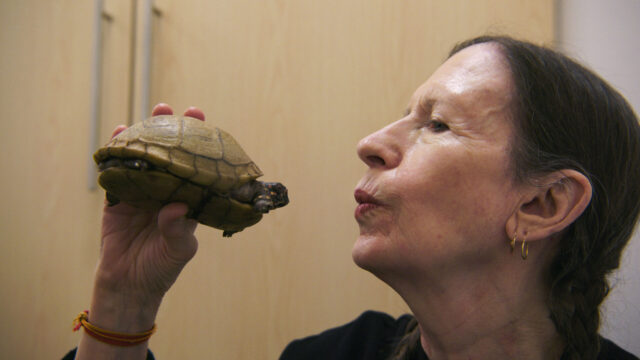
Meredith Monk shares a special moment with her beloved turtle, Neutron
Unfolding at a Monk-like unhurried pace, the ninety-five-minute documentary is divided into thematic chapters based on her songs, including “Dolmen Music,” “Double Fiesta,” “Memory Song,” “Turtle Dreams,” and “Teeth Song,” while exploring such presentations as Juice (1969), the first theatrical event to be held at the Guggenheim; Education of the Girlchild (1973), in which a woman ages in reverse; Quarry (1976), a three-part opera about an American child sick in bed during WWII; Impermanence (2006), inspired by the sudden death of her partner, Mieke von Hook; and her masterwork, Atlas (1991), in which the Houston Grand Opera worries about her numerous requests and production costs, whether the piece will be ready in time, and if it even can be considered opera. There are also clips from Ellis Island, Book of Days, Facing North, and Indra’s Net, her latest show, which was staged at Park Ave. Armory last fall. In addition, Monk reads from her journals in scenes with playful animation by Paul Barritt.
Monk opened up her archives for the filmmakers, so Shebar, Roberts, and editor Sabine Krayenbühl incorporate marvelous photos and video from throughout Monk’s career, along with old and new interviews. “It was her voice that was so extraordinary, not only the different kind of sounds she could make, but the imagination she was using in producing the sound . . . totally individual,” Merce Cunningham says. WNYC New Sounds host John Schaefer gushes, “I don’t know when words like multimedia and interdisciplinary began to become in vogue, but Meredith was all of those things.” Her longtime friend and collaborator Ping Chong offers, “She had to fight to be acknowledged in the performing arts world because critics were saying that what she was doing was nonsensical, was crazy, was not serious; in a way, it’s a fight to survive. Pain is where art comes from. . . . Art has to come out of need. And now she’s an old master.”
And Björk, who recorded Monk’s “Gotham Lullaby,” touts, “Meredith’s melody making is like a timeless door that’s opened, like a gateway to the ancient is found. It definitely affected my DNA. . . . Her loft that she has lived in for half a century is an oasis in a toxic environment.” Among the other collaborators who chime in are longtime company member Lanny Harrison; composer Julia Wolfe; and David Byrne, for whom she created the opening scene of his 1986 film, True Stories, and who says he learned from Monk that “you can do things without words and it still has meaning, it still has an emotional connection.”
Some of the most beautiful moments of the film transpire in Monk’s loft, where she tends to her beloved forty-two-year-old turtle named Neutron, puts stuffed animals on her bed, meditates while staring at windows lined with Tibetan prayer flags, composes a new song, looks into a mirror as she braids her trademark pigtails, and sits at her small kitchen table, eating by herself. Surrounded by plants and personal photographs, she moves about slowly, profoundly alone, comfortable in who she is and what she has accomplished, contemplating what comes next.
“What happens when I’m not here anymore?” Monk, who received the 2014 National Medal of Arts from President Barack Obama, asks while working with director Yuval Sharon, conductor Francisco J. Núñez, and performer Joanna Lynn Jacobs on a remounting of Atlas for the LA Philharmonic in 2019. “It’s very rare that anybody gets it.”
Monk in Pieces goes a long way toward rectifying that, filling in the cracks, helping define her place in music history.
Monk in Pieces screens November 19 at 3:45 at the Village East; followed by a Q&A with Monk, Shebar, Krayenbühl, and producer Susan Margolin.
[Mark Rifkin is a Brooklyn-born, Manhattan-based writer and editor; you can follow him on Substack here.]