twi-ny recommended events

THE TALES WE TELL: JODY OBERFELDER’S STORY TIME AT WEST PARK

Jody Oberfelder makes use of nearly every nook and crannie of the Center at West Park for Story Time (photo by twi-ny/mdr)

STORY TIME
The Center at West Park
165 West Eighty-Sixth St. at Amsterdam Ave.
Friday, May 16, and Saturday, May 17, $24–$30, 7:30
www.centeratwestpark.org
www.jodyoberfelder.com

New York–based director, dancer, choreographer, and filmmaker Jody Oberfelder activates the endangered Center at West Park in the landmarked West Park Presbyterian Church with the inspiring, exhilarating Story Time, one of the best site-specific works of her long, distinguished career.

As the audience enters the soaring space, activity begins subtly, then with increasing urgency. Mariah Anton Arters, Caleb Patterson, and Andi Farley Shimota are at rest in niches on a windowsill but soon hop down and proceed amid the pews and columns with unbounded energy. Michael Greenberg walks slowly up and down the aisles perusing a red book, stopping to point out a line for audience members to read. A smiling Oberfelder approaches people, holding out an hourglass for them to ponder. Nyah Malone is spread across a piano, eventually sitting on the bench and playing a few notes. Shimota is in a back room, balancing apples and oranges until Caleb Patterson knocks over one of her cairns and runs away. Grace Bergere moves ever-so-carefully around the pews, magically spinning a red ball representing the globe.

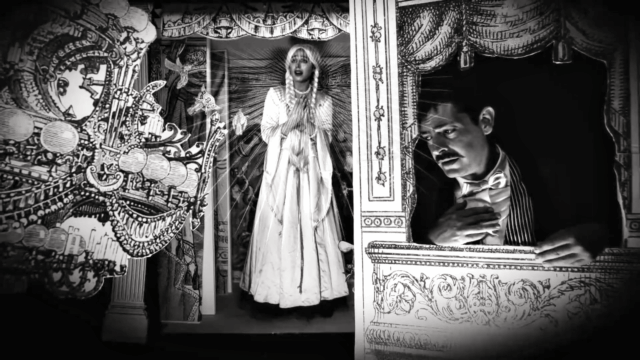
The audience is encouraged to immerse themselves in the action, not just find a seat but wander around and engage with the performers (without obstructing them); for example, I tried to build a few fruit cairns myself but failed miserably. Be sure to check out Nick Cassway’s two wallpaper collages of the performers and Tine Kindermann’s stunning dioramas of fairy tale classics.

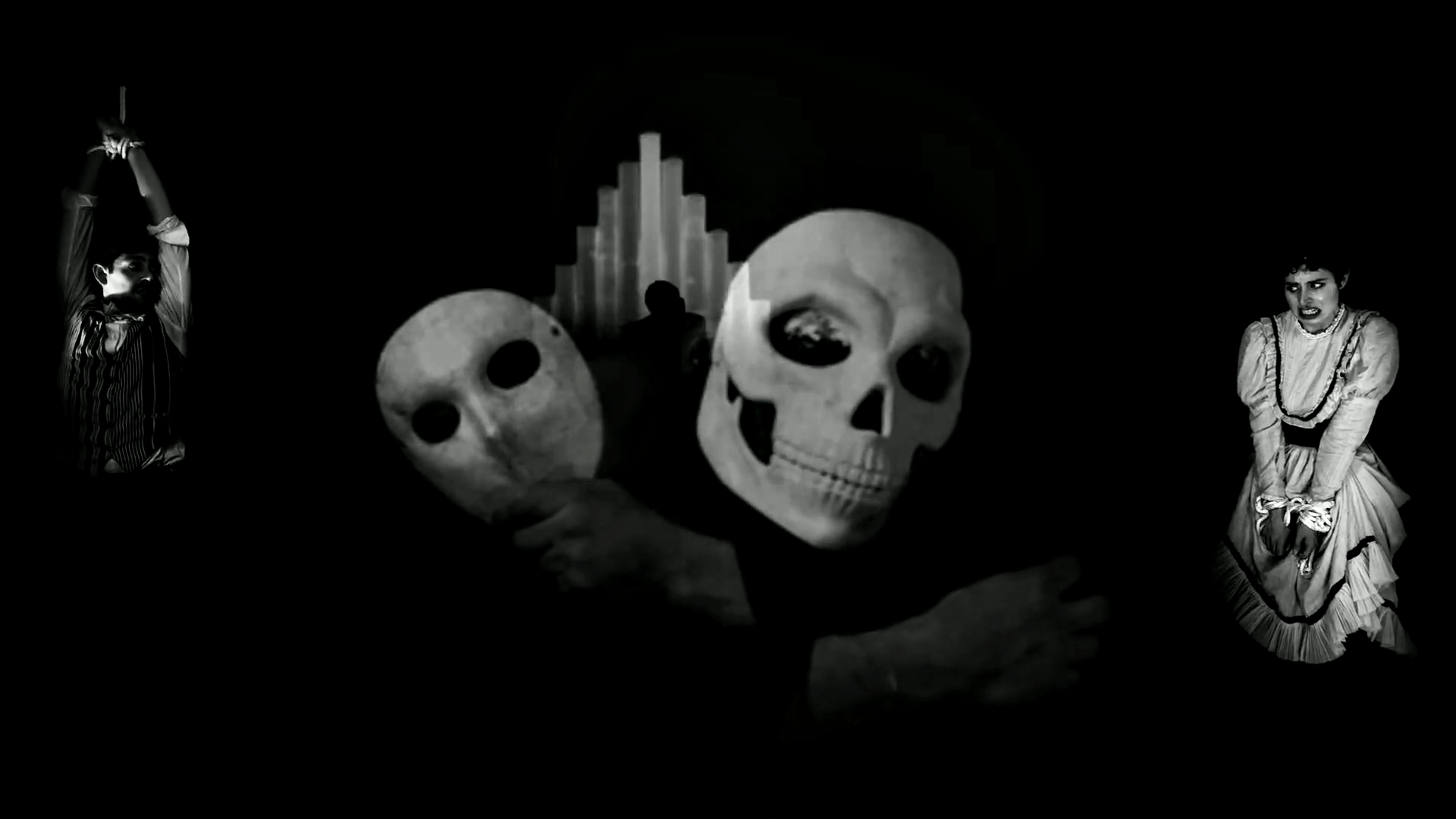
What follows are eighteen vignettes on a proscenium stage where the church altar would have been, in front of a large pipe organ. Gargoyles come to life as Bergere, who Oberfelder met when the singer was busking in Tompkins Square Park, sings her original composition “A Little Blood” on the lip of the stage. Greenberg and Arters become Merlin and Morgana, respectively, dancing to isomonstrosity’s “I Hope She Is Sleeping Well.” Shimota is a Hungarian princess and Patterson a potential suitor, interacting to Villa Delirium’s medieval-style folk ballad “Hungarian Countess” and the Parisian Marie Antoinette sex parable “Marie.”

Patterson and Shimota are tempted by Kindermann’s gingerbread cookies in a retelling of Hansel and Gretel while Kindermann sings live. Oberfelder dances with a broom, Greenberg mimics using a knife, Malone dangles a birdcage, and an apple entraps Patterson and Shimota. Bluebeard meets an ogre as Arters and Patterson perform a duet to Bergere’s “Billy,” with Bergere on harmonium and Kindermann on saw. Everyone comes together for a thrilling grand finale.

The ninety-minute Story Time boasts some of Oberfelder’s finest choreography, highlighted by breathtaking lifts and carries infused with an innate playfulness, incorporating a bevy of surprising objects and a charming scene involving small chairs and a table, with a few lovely nods to Pina Bausch. The vastly talented performers switch quickly between Katrin Schnabl’s costumes, which range from elegant dresses to a ratty hair shirt; Connor Sale’s lighting is soft and gentle.

Story Time is itself a fairy tale, an enchanting production that is part of the movement to protect and save the landmark church building while also investigating the stories we are told, and that we tell ourselves and each other, in this deeply divided time in America and around the world.

Near the conclusion, a musical interlude features Bergere on guitar as she and Kindermann sing lyrics by Oberfelder: “From the womb where they bled / In this place purple dread / But open your eyes, see / A pleasure awaits / Through myriad gates / The tail meets its head.”

Pleasures galore await all through the gates of the Center at West Park, which itself will hopefully have a happy ending.

[Mark Rifkin is a Brooklyn-born, Manhattan-based writer and editor; you can follow him on Substack here.]
COLLECTING AND CONNECTING MEMORIES: ED SCHMIDT’S EDWARD

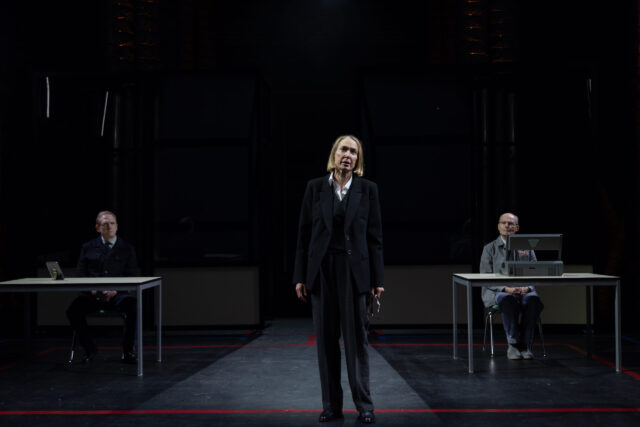
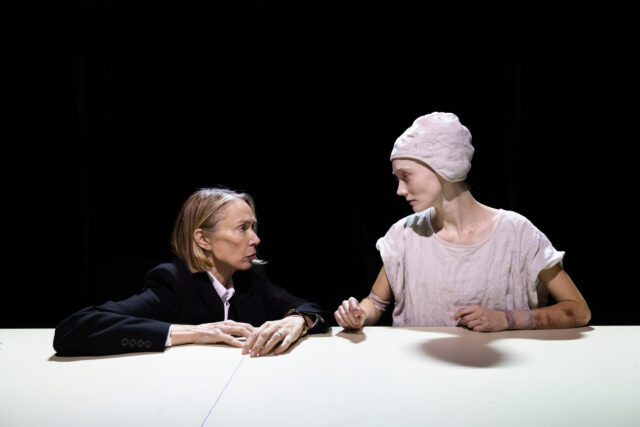
Ed Schmidt’s Edward is an intimate and poetic tale of an ordinary man’s life (photo courtesy Ed Schmidt)

EDWARD
All Street Gallery
119 Hester St. between Forsyth & Eldridge Sts.
Through May 18
edschmidttheater.com
allstnyc.com

Ed Schmidt knows about endings. His 2010 solo show, My Last Play, was ostensibly his swan song, written two years after the death of his father and a transformative rereading of Our Town, concluding a twenty-year career that had also featured Mr. Rickey Calls a Meeting, The Last Supper, held in his Brooklyn kitchen, and the monthly variety show Dumbolio. Nevertheless, in 2015, Schmidt, at the time a professor and basketball coach at Trinity on the Upper West Side, wrote and performed the high school basketball drama Our Last Game, staged in an actual high school locker room.

Thankfully, Schmidt is back again with the superb Edward, the poetic, graceful, intimate tale of one Edward O’Connell, an unspectacular but respectable and enigmatic divorced father and educator. The hundred-minute play takes place at All Street Gallery on Hester St., with the audience of between twelve and eighteen people sitting around a long white table covered with twenty-seven objects and an empty box. Fortunate ticket holders are encouraged to arrive early and examine each piece, to pick them up and scrutinize them closely: A Brooks Robinson baseball glove. Four neckties. Mr. Potato Head. A copy of The Catcher in the Rye. A “Goose Girl” Hummel. An ashtray. A jazz CD. A postcard of a boy on a lake. A business card.

“Edward O’Connell died twelve years ago, at the age of seventy-three, and left behind this box, and all that it contained,” Schmidt, resembling a mild-mannered Kevin Costner and sounding like a toned-down Albert Brooks, begins. “With these twenty-seven objects, there are over ten octillion ways to tell Edward’s story. Ten octillion. That’s a one followed by twenty-eight zeroes. That’s the number of grains of sand on the Earth. Multiplied by the number of stars in the Milky Way. In other words, an unfathomable number. Tonight, we will tell one of those ten octillion versions.”

Wearing a dark suit and white shirt, Schmidt then serves as an Our Town–style Stage Manager, going through the objects in random order, each one a way into Edward’s life, directly or indirectly. He speaks in the third person although it feels like he’s channeling O’Connell, delving deep into his being. We learn about Edward’s wife, Angela, and their children and grandchildren; his love of the Celtics and Red Sox; his battles with department head Nona and headmaster Renée Marsh at his school, Enright Academy; his first car; his favorite word; the vacation when he thought his son had drowned; where he was at seminal moments in US history; his multiple regrets.

Many passages unfurl with a quiet majesty. “He likened her transformation to watching a sunset: you can sense a change coming — the air cools, the light fades, the sky pinkens, and then, all of a sudden, you realize, ‘It’s dark. When did that happen?’ Or perhaps the proper metaphor was a sunrise, and darkness slowly, suddenly turning to day,” he muses.

Others are experiences that everyone can relate to. “You know how, on every To Do List, there’s that one task that never gets done? It’s the one item that, for whatever mysterious reason, you can’t cross off, and it ends up getting transferred to the next list and the next and the next, and, in the end, you either complete the task or you just let it slip away and forget, but, in either case, your inability to follow through feels like a moral failure. Why did it take me so long to clean out the gutters? Or send that thank-you note? Or throw away that box of stuff in the attic? What is wrong with me?”

But each helps us learn who Edward O’Connell was and, in turn, who Ed Schmidt is — and who we are. As you walk around the table, examining the objects, several almost certainly will stand out to you personally, bringing up your own memories; for me, the baseball glove, The Catcher in the Rye, the small rock, and the Hummel figurine sent me back. The friend I attended with had actually completed the very jigsaw puzzle that was on the table. Schmidt’s writing is so evocative that the stories will also remind you of similar situations you got tangled up in as a child and an adult.

In Francesco Bonami’s newly updated semifictional Stuck: Maurizio Cattelan — The Unauthorized Autobiography, about the Italian artist and prankster, Bonami writes, “Here is my story of his story. You can believe it or not — it doesn’t matter, just as long as you enjoy it, that’s enough. If cultivating ‘doubt’ is essential to life . . . well, Maurizio Cattelan harvests doubts like nobody else.” Schmidt has accomplished a similar feat with Edward.

Spoiler alert: The next two paragraphs give information about the show that you might not want to know before seeing it but was a critical part of my connecting with the work. The objects are chosen one at a time by the audience, going around in a clockwise circle. I thought long and hard about the two that I selected, wanting to impress Schmidt, hoping they would lead to great anecdotes that I would feel partly responsible for, and imagining that I could have shared my own reminiscence about them.

It seems impossible for Schmidt to know O’Connell as well as he does, especially since Edward did not leave behind a memoir or journal. But as real as O’Connell’s life appears to be, did he even exist? Did Schmidt make it all up, or perhaps use elements from his own life in crafting the play? Going on an intense Google search, I found that there is very little on the internet about Schmidt, and there seems to be no Edward O’Connell who died in 2012 at the age of seventy-three. However, I did find facts about other Edward O’Connells and various Schmidts that pop up in Edward, from names to professions to family relationships. For example, Schmidt talks about a skiing accident that Edward’s brother, Steven, had. I discovered a Substack post by political pundit Steve Schmidt about a skiing accident as well as a news story about a man named Steve Schmit who survived a life-threatening skiing mishap. Coincidence? Maybe — but maybe not.

Spoilers over, it’s also clear that Schmidt has some prankster in him too, as well as a wicked sense of humor, which emerges in his official bio, where he calls himself a “Playwright, Performer, Director, Producer, Genius,” lists the many rejections his plays have received from “some of the most and least venerable theater companies in America,” and explains that “none of Mr. Schmidt’s work has been made possible, in part or in whole, by the generous support of the National Endowment for the Arts, the New York State Council on the Arts, or the New York City Department of Cultural Affairs, or of any corporate foundation or charitable institution, though it’s not for lack of trying.”

As Bonami posits about Cattelan, “It doesn’t matter, just as long as you enjoy it, that’s enough.” For one thoroughly enjoyable evening in a Lower East Side gallery, it was enough to believe in Edward O’Connell, to believe in Ed Schmidt, and just maybe to believe in oneself.

[Mark Rifkin is a Brooklyn-born, Manhattan-based writer and editor; you can follow him on Substack here.]
WRECKING BALL: FACING THAT FINAL ALL NIGHTER

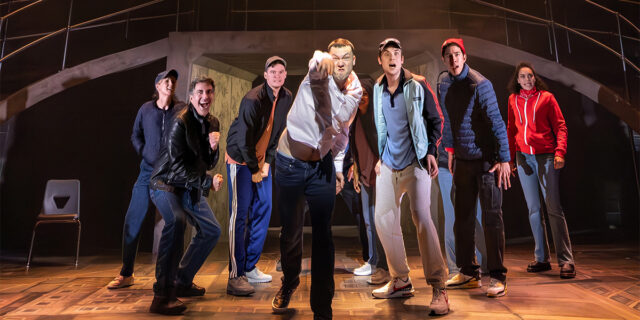
Five college seniors have quite a night ahead of them in world premiere play (photo by Evan Zimmerman for MurphyMade)

ALL NIGHTER
Newman Mills Theater
Robert W. Wilson MCC Theater Space
511 West Fifty-Second St. between Tenth & Eleventh Aves.
Through May 18, $55-$99
allnighterplay.com

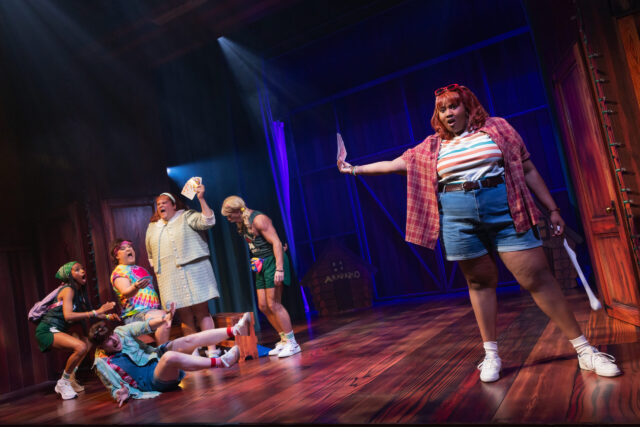
Much like the characters in Natalie Margolin’s All Nighter, in which five seniors are in the home stretch of college, pulling their last all-night session studying and writing papers before graduation in a few days, the play itself is entering its final weekend, graduating with honors, high on the dean’s list.

At a small liberal arts college in rural Pennsylvania in 2014, a group of close friends gather in a glassed-in social ballroom; their usual table is taken by an archrival, making them immediately uneasy. Things will only get worse.

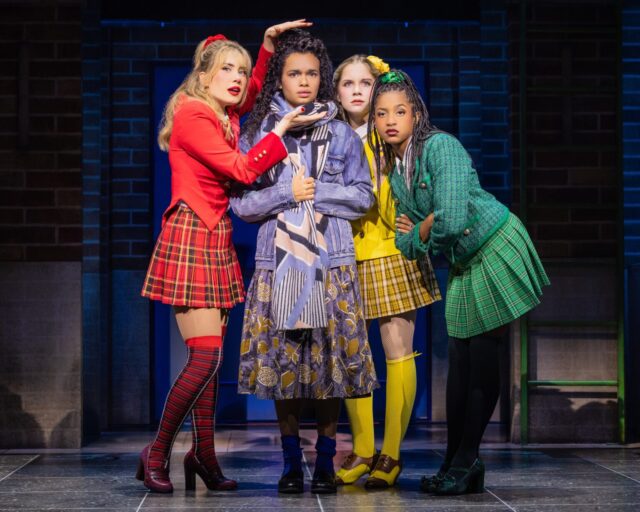
Darcie (AnnaSophia Robb) seems to have it all under control, an attractive blond with good grades, a serious boyfriend, and a clear direction. Lizzy (Isa Briones) is somewhat scattershot and upset that two of her Adderall pills are missing. Jacqueline (Tony nominee and Grammy winner Kathryn Gallagher) is concerned what will happen to her and her girlfriend once school is over and believes that their house is haunted by a ghost who is acting out. Tessa (Alyah Chanelle Scott) is stressed out by how much she has to do while recovering from a hangover. And Wilma (Tony nominee Julia Lester) is a force of nature, a loud fairy punk who gets on everyone’s nerves as she speaks without a filter and keeps interrupting their studying.

Margolin captures the essence of what they’re experiencing in sharp scenes filled with realistic dialogue.

Lizzy: If I think about how much work I have to do in the next twelve hours I might actually vomit.
Jacqueline: It will get done. We’ve done this so many times.
Darcie: It’s the home stretch.
Tessa: I really do love you guys.
Darcie: I’m already crying.
Jacqueline: I love you guys so much. I just wish we were at a different table.
Tessa: Stop.
Lizzy: I can’t believe we graduate in five days.
Darcie: Let’s all hold hands.
Tessa: Let’s pray for everyone’s love and happiness and success.
Darcie: I’m seriously so proud of all of you.
Jacqueline: It has to stay like this. Even after graduation.
Darcie: When our real lives begin!
Tessa: How daunting.

Tessa (Alyah Chanelle Scott), Jacqueline (Kathryn Gallagher), and Wilma (Julia Lester) face an uncertain future in Natalie Margolin’s All Nighter (photo by Evan Zimmerman for MurphyMade)

When Tessa finds out that someone has stolen her credit card and is using it, she is determined to find the thief, who appears to be on campus. Wilma is devastated that Darcie tells her she doesn’t look good in orange. They share Lizzy’s Adderall and Wilma’s Focalin. They gossip about themselves and others. They agree how important hummus has been to their college experience. Darcie’s laptop keeps dinging suspiciously. They sing Miley Cyrus’s “Wrecking Ball,” belting out, “I guess I should’ve let you in / I never meant to start a war / I just wanted you to let me in.”

As morning approaches and deadlines near, powerful secrets emerge that threaten their friendship and their futures.

All the elements come together beautifully, from Wilson Chin’s relatable set and Michelle J. Li’s appropriate costumes (wait till you see what Wilma wears) to Ben Stanton’s lighting (which narrows focus to spotlight characters’ poignant side chats) and M. L. Dogg’s sound, complete with immersive chatter. Jaki Bradley’s crystal-clear direction makes us feel like we’re in the room with the young women while also making us recall the all nighters that we pulled in college. The cast, which includes a few changes since the play opened, is sensational; the actors’ depiction of the fears and desires that come at such an important time of life hit the mark.

I’m glad that I never have to go through that period myself again, but I loved going through it with Darcie, Lizzy, Jacqueline, Tessa, and Wilma.

[Mark Rifkin is a Brooklyn-born, Manhattan-based writer and editor; you can follow him on Substack here.]

GOLDEN THREADS AT THE SOUTH STREET SEAPORT

Sammy Bennett, A Little Beyond, Acrylic, screen-print, dye-sublimation, found objects, embroidery, foam, wire, cardboard, canvas, silk, 2025 (photo by twi-ny/mdr)

THE GOLDEN THREAD II: A FIBER ART EXHIBITION
BravinLee programs
207 Front St. between Fulton & Beekman Sts.
Through May 16, free, noon – 6:30
www.bravinlee.com
golden thread slideshow

BravinLee programs follows up last year’s “The Golden Thread” with a second iteration of the fabric installation, consisting of works by five dozen artists, highlighted by ten site-specific installations. Continuing through May 16, “The Golden Thread II” features colorful, often fragile pieces across five floors, a panoply of soft sculptures on the walls and floors and hanging from the ceiling.

Be sure to take each set of steps (including the spiral staircase) and go through every open door so you don’t miss a thing; be on the lookout especially for Felix Beaudry’s Put, an outstretched pink arm and hand; Sammy Bennett’s multipart camping-like installation (A little Beyond, Empty Lot, Mr. Grasshopper Meets a Shoe); Ruby Chishti’s An Intangible Sanctuary of Ocean and Stars II, a repurposed men’s wool overcoat; Ana Maria Hernando’s El intento del agua (“The Intent of Water”), a kind of endless blue wedding dress exuberantly pouring out of the bricks; Tomo Mori’s (we) keep going, a large loom using a metal pulley; Tura Oliveira’s Wheel of Fortune, an enormous red figure being tortured in a grain hoist evoking a Catherine wheel; Manju Shandler’s The Elephant in the Room, a big pachyderm huddling in a corner; Jacqueline Surdell’s Untitled [we can be stars], a cord, line, and steel construction resembling a giant fist coming toward the viewer; Halley Zien’s fabulously detailed fabric collages Morning Mourn and Family Sing; and Karen Margolis’s beautifully delicate Divagation, made from cotton-covered chicken wire, Acrylic, thread, rope, moss, paper, clay, eggshells, fishing line, nails, studio detritus wrapped in salvaged silk, organza, and grandmother’s unraveled bedspread. There are also contributions from Lesley Dill, Rashid Johnson, Valerie Hegarty, Sheila Pepe, Christopher Wool, Deborah Kass, Walter Robinson, and Jess Blaustein.

In her artist statement, Margolis explains, “I am drawn to discarded and damaged materials — remnants of past lives — which I collect, dismantle, and reconfigure into artificial nature sanctuaries. This process reflects my preoccupations with mending and regeneration. Rooted in wabi-sabi philosophy embracing imperfection and impermanence, my artmaking is directed at capturing the impact of destructive forces having worked their way through a material. These material transformations develop analogies between nature and psychological experience, blurring boundaries between solid form and the evanescence of emotions. Inspired by the micro-violence of spiders, my recent works explore themes of imprisonment and chrysalises.”

Bennett notes, “My work references quotidian settings pumped full of melodrama that give recognition to everyday life as a constant struggle. This large-scale installation transports you from the city to a damp forest in transition from winter to spring, where flowers are budding, insects are chirping, and an abandoned building serves as a reminder that everything we create will eventually be reclaimed by Mother Earth.”

And Oliveira points out, “A limp, humanoid figure is tangled in the spokes of an eighteenth-century grain hoist. Nerve endings crawl across the sculpture’s surface and the figure’s abdomen sags open in the shape of an unblinking eye, a wound from which sinewy tentacles spill, reaching outward like severed nerves or roots searching for ground. Titled after both the tarot card and the game show, in this work the grain hoist becomes the breaking wheel of public execution, history turns like a great wheel and catches us in its spokes.”

On May 16, Tiny Pricks Project author and activist Diana Weymar, whose American Sampler features hand-stitched vintage textiles and cotton floss with such sayings as “I ask you to have mercy,” “Nature gives us everything,” and “She said enough,” will be at the show from 3:00 to 6:00, signing copies of her new book, Crafting a Better World (Harvest, September 2024, $25). Weymar explains about her piece, “I work in the increasingly liminal space where textiles, text, and social media overlap. My work tracks current political discourse, pop culture, and cultural work from the past. Making text by hand is a sensory processing experience that provides a contrast to the speed with which we post language and communicate.”

[Mark Rifkin is a Brooklyn-born, Manhattan-based writer and editor; you can follow him on Substack here.]
EVERYTHING IS A MOVIE: MOI-MÊME AT SEGAL FEST

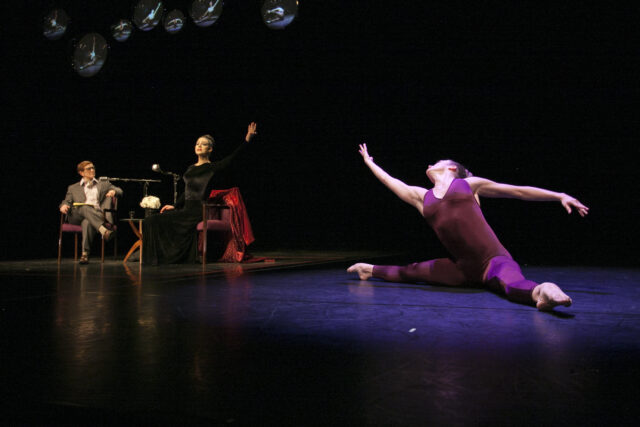
Mojo Lorwin finishes his father’s film, Moi-même, after more than half a century

MOI-MÊME (Mojo Lorwin & Lee Breuer, 1968/2024)
Segal Center Film Festival on Theater and Performance
Anthology Film Archives
32 Second Ave. at Second St.
Saturday, May 17, $10– $14, 3:00
Festival runs May 15– 28
www.thesegalcenter.org
www.anthologyfilmarchives.org

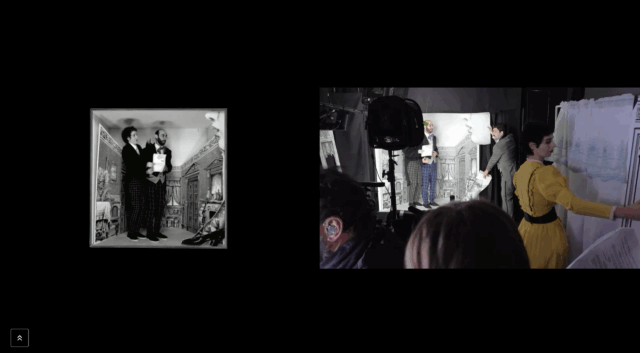
In 1968, experimental theater director, playwright, and poet Lee Breuer began making a black-and-white improvised film during the May 1968 Paris riots, where he was living at the time. He and cinematographer John Rounds shot the footage but never added sound, edited it, or wrote a script. In 1970, Breuer cofounded the seminal New York City company Mabou Mines with Philip Glass, Ruth Maleczech, JoAnne Akalaitis, David Warrilow, and Frederick Neumann, winning numerous Obies among other accolades over the next half century, but he never finished the movie, which itself is about making a movie.

Breuer died in January 2021 at the age of eighty-three; one of his children, Mojo Lorwin, decided to complete the project, hiring voice actors and musicians and serving as writer, director, editor, and producer. The result is the hilarious Nouvelle Vague satire Moi-même (“Myself”), a sixty-five-minute foray into the world of François Truffaut, Jacques Rivette, Jean-Pierre Melville, Agnès Varda, William Klein, and Jean-Luc Godard, who makes a cameo, walking backward as Kevin shares a series of statements ending with “Everything is a movie.”

Kevin Mathewson stars as Kevin (voiced in 2024 by Declan Kenneally), an adolescent who is making a film with his alter ego (Patrick Martin). As he proceeds around town, he meets up with a strange driver (executive producer Russ Moro / 2024 composer Olivier Conan), a movie producer (Frederick Neumann / David Neumann, Frederick’s son), a starlet (Ginger Hall / Clove Galilee, Breuer and Maleczech’s daughter), the son of a baron (Warrilow / David Neumann), an Italian heiress (Renata / Tessie Herrasti), a revolutionary actress (Anna Backer / Tiera Lopper), her replacement (Judy Mathewson, Kevin’s younger sister / Ruma Breuer, Lee’s granddaughter), a sleazy agent (Mark Smith / Alon Andrews), a couple of goons (Pippo and Mike Trane / Frier McCollister), and the owner of a film shop (Lee Pampf / Thomas Cabus). He is often accompanied by his conscience (Maleczech / Alexandra Zelman-Doring) as he faces financial and creative crises.

Lorwin has fun with cinematic and societal tropes while maintaining the underground, DIY feel; for example, he doesn’t match the dialogue exactly to the movement of the characters’ mouths as they make such proclamations as “The movies aren’t fair,” “The movies are a game and everyone who plays is a cheater,” and “All I want is to be seen and heard.” The soundtrack consists of unexpected sound effects and songs and music by Frank LoCastro, Alex Klimovitsky, Eliot Krimsky, Conan, and others.

There’s lots of drinking and smoking, violent shootings, political ranting, discussions of art and love, vapid gatherings, a heist, a touch of psychedelia, and superfluous nudity, nearly everything you could possibly want in a French film.

“Film costs money, more than you’ve got,” the driver barks at Kevin. “Producers are perverts,” Kevin tells the actress while preparing a baby bottle of milk. Unable to afford film reels, Kevin says, “Film is more expensive than love and revolution.”

Describing the film to the agent, Kevin explains, “Here it is: It’s me, but it’s not me. You dig? I mean, it’s the film adaptation of me. I just need a little bread to turn boring old me into moi-même. Feels like doors are finally opening for me.” He delivers the last line as a door opens in front of him.

Perhaps the most important line of dialogue is given to Kevin from a man on the street, who tells him, “There are no rules.” I would add, “Viva la revolución!”

Moi-même is being shown May 17 at 3:00 at Anthology Film Archives as part of the Segal Center Film Festival on Theater and Performance, followed by a Q&A with Lorwin (Summer in the City, 2020 Brooklyn Film Festival) and Kevin Mathewson, moderated by Segal Center executive director Frank Hentschker. The festival runs May 15– 28 at Anthology and the CUNY Graduate Center and includes such other presentations as the North American premiere of Aniela Gabryel’s Radical Move, the US premiere of Sophie Fiennes’s Acting, Pinny Grylls and Sam Crane’s Grand Theft Hamlet, and a Richard Foreman retrospective.

Meanwhile, Mabou Mines (The Lost Ones, The Gospel at Colonus, Dollhouse) is still going strong; their latest piece, This Like a Dream Keeps Other Time, is playing May 15– 18 at their East Village home, @122CC.

[Mark Rifkin is a Brooklyn-born, Manhattan-based writer and editor; you can follow him on Substack here.]

TO SAVE AND PROTECT: STORY TIME AT WEST PARK

Jody Oberfelder will activate the endangered West Park Presbyterian Church with Story Time (photo courtesy Jody Oberfelder Projects)

STORY TIME
The Center at West Park
165 West Eighty-Sixth St. at Amsterdam Ave.
Friday, May 16, and Saturday, May 17, $24–$30, 7:30
www.centeratwestpark.org
www.jodyoberfelder.com

In June 2021, Jody Oberfelder Projects presented Amphitheater activating the endangered East River Park bandshell through live music and dance. At the time, Oberfelder noted that the piece “challenges the pending demolition of this fifty-acre park that transformed Lower Manhattan more than eighty years ago through inscribing the space with our movement inspired from human connections. We believe it is time to be happy again and reconnect with our community through our common joie de vivre, our passion for dance.” Despite a valiant battle that went to the courts, the amphitheater was torn down that December.

A New York–based director, dancer, choreographer, and filmmaker, Oberfelder is fighting for another worthy cause with her latest work, Story Time, which takes place throughout the Center at West Park in the landmarked West Park Presbyterian Church, which is also under threat of demolition. On March 8, hundreds of people gathered at a Love Our Landmarks: Save Park West rally to keep the wrecking ball away from the 135-year-old institution, with such special guests as actors Mark Ruffalo, Matthew Broderick, Laurence Fishburne, Julianna Margulies, and Fisher Stevens and local politicians Mark Levine, Brad Hoylman-Sigal, and Gale Brewer.

“It would be a tragedy if this landmarked building and thriving community arts hub were demolished — especially given that there is a viable plan to save it,” Manhattan borough president Mark Levine said at the protest. “We cannot allow this vital piece of our city’s history and culture to be lost. We must do everything in our power to protect it. I fully support the community-driven effort to preserve this unique and special place for New Yorkers. I call on the Landmarks Preservation Commission to take immediate action to save this gem. We will not give up the fight.”

Oberfelder, who has also staged works in an officers house on Governors Island, in the 6½ Ave. corridor in midtown Manhattan, in a garden pool at the Victoria and Albert Museum, in Green-Wood Cemetery, in a partially enclosed lot in Brisbane, and in a seventeenth-century baroque palace in Portugal, will be activating Park West on May 16 and 17 at 7:30, leading audience members from the sanctuary on foot to various nooks and crannies holding surprises before bringing myths and fairy tales to life as the audience sits in the historic pews.

The sets are designed by Juergen Riehm, Tine Kindermann, Johanna Maier, and Nick Cassway, with costumes by Katrin Schnabl, lighting by Connor Sale, music by Ellen Reid, Maurice Ravel, Žibuoklė Martinaitytė, Frank London, and, playing live, Tine Kindermann and Grace Bergere, and dramaturgy by Rebekah Morin. The piece was conceived, directed, and choreographed by Oberfelder in collaboration with the performers: Mariah Anton, Andi Farley-Shimota, Michael Greenberg, Nyah Malone, and Caleb Patterson.

“Across cultures and time, people have always gathered around stories — to make sense of the world, to find direction, to feel less alone,” Oberfelder said in a statement. “Dance is its own kind of storytelling: fleeting, wordless, yet full of meaning. There’s a Grimm tale that ends, ‘And the mouth of the person who last told this story is still warm.’ That warmth — that sense of something just passed on — is what I hope lingers. I want audiences to arrive with wonder, to follow the threads of their own journey, and perhaps leave seeing themselves as the hero in their own unfolding tale.”

She added via email, “How do we stand up when our country is pushing us down? How do we courageously live and give, redirect and inspire? Art is transformative. I’ve created a piece that I hope, with each turn of the page, addresses dark and light. How do we keep our humanity in this heroic journey? Especially right now, with everything coming at you faster than you can imagine. How do you summon your inner hero to survive?”

Tickets for the immersive, site-specific Story Time are $24–$30 to follow Oberfelder on her never-ending quest to bring unique, often interactive dances that ask all the right questions to unusual and thrilling locations across the globe, including right here in New York City.

And in this case, here’s hoping this fairy tale has a happy ending.

[Mark Rifkin is a Brooklyn-born, Manhattan-based writer and editor; you can follow him on Substack here.]
MORE MADNESS AND MELODRAMA: FIVE EVENINGS ENCORE ENGAGEMENT

Tamara (Snezhana Chernova) and Ilyin (Roman Freud) reunite after being apart for seventeen years in Five Evenings (photo by Alexandra Vainshtein)

FIVE EVENINGS
The West End Theatre
263 West Eighty-Sixth St. at Broadway
May 28 – June 15, $54.65
www.fiveevenings.com

“No, this is madness,” Zoya says to Ilyin at the start of Jewish-Soviet playwright Aleksandr Volodin’s Five Evenings, a multigenerational melodrama that is as relevant today as it was when it was first presented in 1959 at the Leningrad State Academic Bolshoi Drama Theater and later adapted into an award-winning 1978 film by Nikita Mikhalkov.

The work was revived by director Eduard Tolokonnikov and producer Polina Belkina for a sold-out run at the Chain Theatre in March and is having an encore engagement May 28 to June 15 at the West End Theatre, with Yelena Shmulenson or Snezhana Chernova as Tamara, Roman Freud as Ilyin, Ekaterina Cherepanova as Katya, Aleksei Furmanov as Slava, Inna Yesilevskaya or Iryna Malygina as Zoya, and Dima Koan as Timofeev. The ninety-minute play (with intermission) will be performed in Russian with English surtitles; the set design is by Jenya Shekhter, with lighting by Hannah Wolland, sound by Denis Zabiyaka, and costumes by Natasha Danilova.

The story looks at two relationships, between the older Tamara and Ilyin and the younger Katya and Slava. In the second evening, they’re together at Tamara’s, and the two men have a chat while Slava sets the table, a scene that is representative of Volodin’s character development and dialogue:

Ilyin: See how nice it is? When there’s a white tablecloth and flowers on the table; it’s awkward to be petty, rude, or mean. The tablecloth should have creases from the iron — they bring back childhood memories.
Slava: How poetic.
Ilyin: One must live wisely, without haste. Remember, life’s book is full of unnecessary details. But here’s the trick: You can skip those pages.
Slava: Well, this is one page I don’t feel like reading. Aunt Toma can clean up when she gets here. After all, isn’t there a division of labor?
Ilyin: Don’t make me angry — get to work.

Katya walks in as Ilyin is teaching Slava how to box, declaring, “What are you doing, you slimy snake? What are you doing?!” A moment later, Ilyin says to Katya, “A demonic woman. Is that a manicure you’ve got there?”

Five Evenings revival is back for an encore run at the West End Theatre (photo by Alexandra Vainshtein)

Born in Minsk and raised in Moscow after his mother’s death when he was five, Aleksandr Lifshitz — he changed his last name to Volodin because Lifshitz was too Jewish and was impacting his ability to get published — was drafted into the Red Army during WWII and was injured twice before earning a medal for courage. His first play, The Factory Girl, debuted in 1955 and traveled throughout the USSR. Five Evenings, which deals with time, suffering, resilience, and rebuilding, was followed by such plays as My Elder Sister and Do Not Part with Your Beloved in addition to several screenplays.

A champion of the individual who subtly rejected Stalinism in his works, Volodin died in 2001 in St. Petersburg at the age of eighty-two; his son Vladimir Lifschitz, professor emeritus of computer science at the University of Texas at Austin, revoked the copyright of his father’s plays in Russia after Putin invaded Ukraine.

As note above, the Chain run sold out, so act fast if you want to catch this production.

[Mark Rifkin is a Brooklyn-born, Manhattan-based writer and editor; you can follow him on Substack here.]