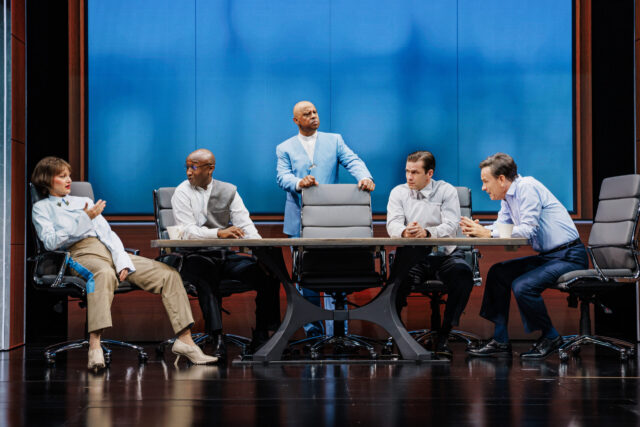
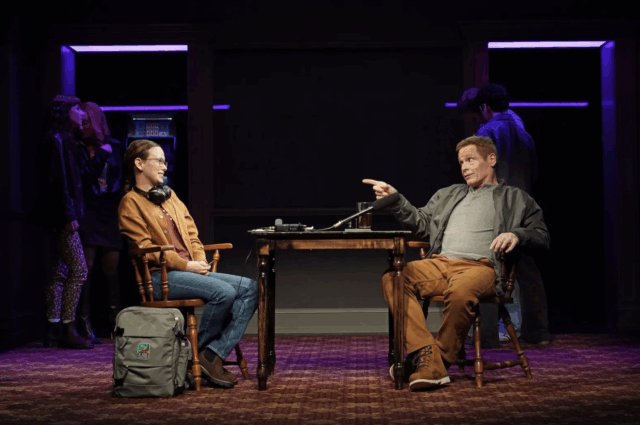
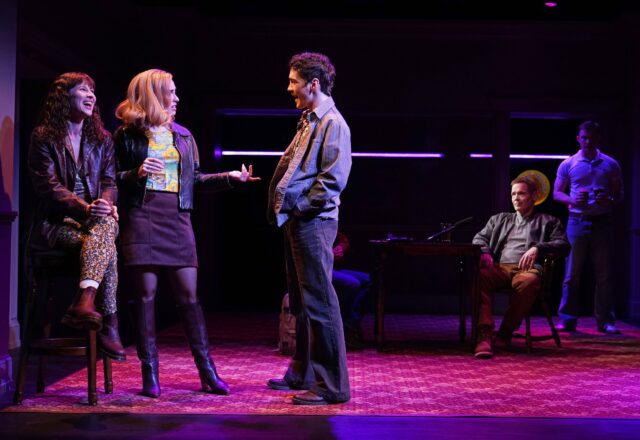
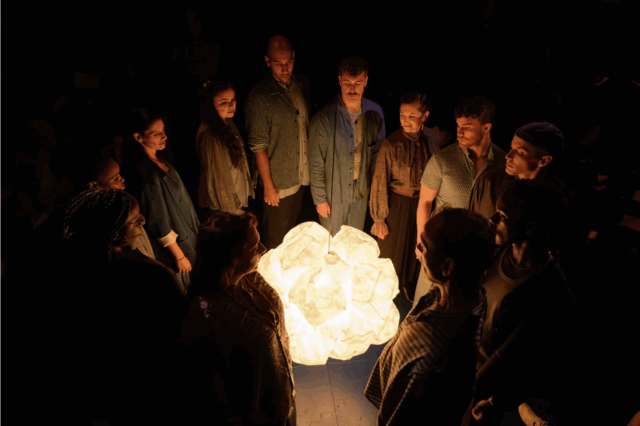
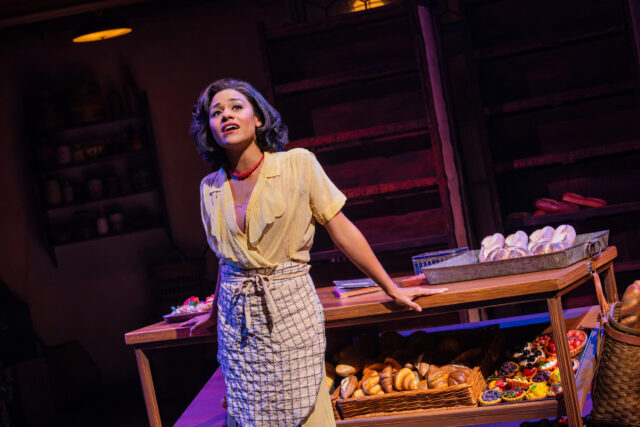
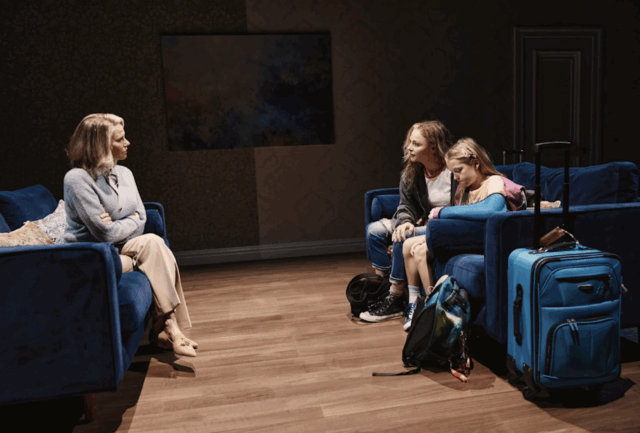
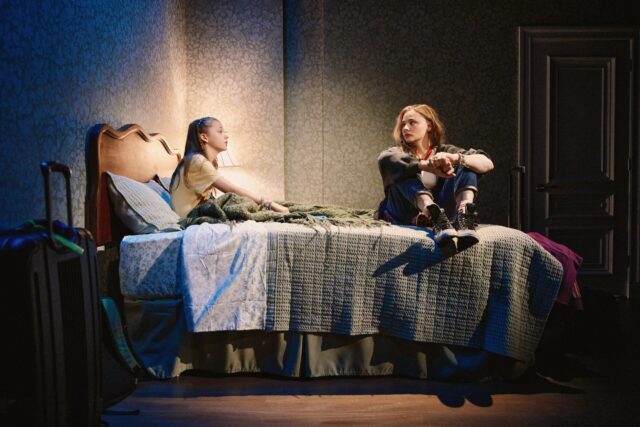
Jack Ferver reimagines Our Town through a deeply personal queer lens in My Town (photo by Jeremy Jacob)
MY TOWN
NYU Skirball Center for the Performing Arts
566 La Guardia Pl.
November 21-22, $42-$57, 7:30
nyuskirball.org
jackferver.com
“Oh, earth, you’re too wonderful for anybody to realize you,” Emily Webb says in Thornton Wilder’s Our Town. “Do any human beings ever realize life while they live it? — every, every minute?”
Dancer, actor, choreographer, and professor Jack Ferver has been sharing their unique and impassioned realizations about life in deeply personal and intensely funny and frightening shows since 2007; their works are complex, intoxicating fusions of pop culture, Hollywood glitz and glamour, childhood trauma, and loneliness, filtered through a distinctively queer sensibility. Their latest piece, My Town, running November 21 and 22 at the NYU Skirball Center, incorporates Emily, a romantic idealist who serves as the heart and soul of Wilder’s 1938 Pulitzer Prize–winning drama about the fictional early-twentieth-century American community of Grover’s Corners.
In a 2010 review of Rumble Ghost, an intimate story about the search for a missing child inspired by the 1982 film Poltergeist, I noted that Ferver “once again makes viewers squirm for a whole range of reasons.” For more than fifteen years, they have both challenged and delighted audiences with such obsessive yet relatable pieces as All of a Sudden, a reimagination of Tennessee Williams’s 1959 melodrama Suddenly, Last Summer; Night Light Bright Light, an examination of the 1964 suicide of dancer, actor, and choreographer Fred Herko; and Everything Is Imaginable, in which Ferver is like a devilish cherub paying tribute to Judy Garland and Martha Graham while asking us all to take stock of our lives.
“Artists are the stomachs of society. We digest the indigestible,” they told me in a 2012 interview focusing on Two Alike. “That means we explore all terrains. Gender and sexuality roles are assigned or taken in hopes of a sense of self, as a branch of the ego. And the ego begins with ‘Me, not me.’ As an artist I make my work so that people donʼt feel as lonely as I have felt. Therefore my work expands into something more akin to ‘I am you.’”
It’s been six years since Ferver presented a major work, yet they’ve been extraordinarily busy, teaching, choreographing for other creators, curating an upcoming Graham exhibition at Bard, making the film Nowhere Apparent with their partner, Jeremy Jacob, and revisiting the Little Lad, the bizarrely affecting character they played in a 2007 Starburst commercial for its new berries and cream flavor that went viral during the pandemic.
I recently met with Ferver over Zoom, discussing the creative process, Wilder and Williams, the Little Lad, growing up in Wisconsin, pets, and more.
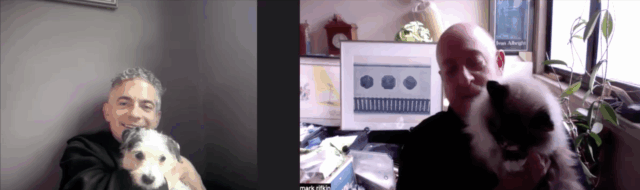
Jack Ferver introduces Nomi to Tuki over Zoom (screenshot by twi-ny/mdr)
twi-ny: Oh, who’s that?
jack ferver: Here’s Nomi. She is a Parson Terrier and we got her in February of ’21 from a really great rescue org, Korean K9. Who’s that baby?
twi-ny: This is Tuki. She’s Maine Coon and Siberian, with a little Ragdoll. And she’s just adorable and cute and fluffy. This is all fur. She’s not very heavy. It’s just fur, and look at that tail!
jf: She’s so sweet. I know that we’re very blessed with our animal angels.
twi-ny: Yes. We got her through Beth Stern’s organization; she works with the North Shore Animal League.
jf: Nomi was four. We had been looking for a dog for a while and she looked so sad. She had come from breeding and also a meat market. My partner said, “This looks like the saddest dog I’ve ever seen.” And I said, “Let’s go get her.” And then we got her and she’s just completely changed my life. We have both changed. They said, I don’t think she’ll ever play. Our trainer wasn’t sure if she ever would. And she plays every morning. I mean, I’ve really moved upstate, for two reasons. One was because of Bard, where I’m a professor. The other was that she was just so happy up here. But in just a moment, she will need to go back to the city.
twi-ny: Since I last saw you, you became a TikTok sensation with the Little Lad, garnering two million followers. How did that come to be?
jf: Well, someone had posted the commercial during the lockdown and told people to do things with it. I wasn’t on TikTok. Friends of mine were and started messaging me, saying there’s all these people impersonating that character and using the advertisement.
It was the fall of 2021, so we’re still kind of in the lockdown. Like, how are we returning? There’s just this day where I said, I’m not going to do anything. I don’t have the capacity or the bandwidth. And then there was this day where I said, Just go to Fourteenth Street and get a wig and do it. And I did; I did one post and overnight it had hundreds of thousands of followers.
And then within a few months it was a million and then it went up to two million. And my partner, Jeremy Jacob, who’s a visual artist and a filmmaker and made the video and music for My Town, we made one film together where the Little Lad is trying to track down their mom, who is supposedly Anna Wintour. We did that. I did some other long-format YouTubes and a bunch of TikToks and people really loved it. I haven’t opened TikTok in so long. The Little Lad hasn’t shown themselves since, wow, July 2023, which was pretty much when I started working on this show. I loved doing it.
I think a benefit that I hadn’t foreseen with it was I was really curious how my work would get to places in America where it’s simply not going to tour. There are curators in cities in America who wouldn’t feel comfortable with my work, with its queerness and its femmeness and its examination of trauma, and also use the use of humor.
I started to receive all of these emails from young people who had found the Little Lad and then found my website; there were some incredibly touching emails. Years ago, when I started making my work, I saw how broke I was going to be. I said, Well, you better have a good sentence, like one that you can remember, because this is going to be so hard. It certainly has been.
What I always loved from art was that it made me feel less alone. So that was my sentence, that I’d make work for people to feel less alone. And so to receive emails from people who were able to then get this material that I saw no way of ever getting to them. . . . Also, in the lockdown, I opened up almost all of the works of mine that I have documentation for, which aren’t all of them, but for all the ones I do, I opened them for free on my website so that people would have access to that. And I’ve kept it open because it’s my way of dealing with what we have culturally and what we don’t — or rather don’t have in terms of support culturally.
twi-ny: That also relates to the audience, which wants to know Jack Ferver. So much of your work is about queer isolation; it really all comes together with Little Lad and the two million followers —
@thereallittlelad
jf: Little Lad was such a place of just complete play. In a lot of my pieces, there has been playfulness. There’s also been, and I think probably always will be, a lot of darkness, a lot of dealing with really difficult material. So to have this other [creation] that’s not close to me, I think that was also the thing that was so fun, that it was so far from me.
Someone who was so important to me when I was growing up was Paul Reubens. I was eight when Pee-Wee was coming out. And so to be a lonely, queer, bullied kid who saw this queer-in-every-which-way character taking up space, having a lot of fun. . . . I don’t think the Little Lad would have ever existed if it hadn’t been for Paul Reubens. Pee-wee was so informative for the Little Lad. I certainly didn’t think about it when I did the commercial.
I was paid very little for it, because this was before YouTube was monetized. And it was like the Twin Peaks of commercials. It was so strange, so desired that it instantly went to YouTube and was being watched there. It stopped running on the networks, so that stopped the paychecks.
twi-ny: I was looking back at the last time I saw one of your live shows, and it’s been a while.
jf: It’s been a long time.
twi-ny: Over the last six years, you played Arkadina in The Seagull: The Rehearsal, you did It’s Veronique at Hesse-Flatow, you worked with Parker Posey on Abracadabra. Oh, you were talking before about having fun; I had a blast at The Last Bimbo of the Apocalypse, which you choreographed. So much fun, and very serious elements too. You also did Is Global Warming Camp? at MASS MoCA. And now you’re curating a Martha Graham exhibition, one of your heroes, at the New York Public Library. I kind of know why you haven’t been around for six years.
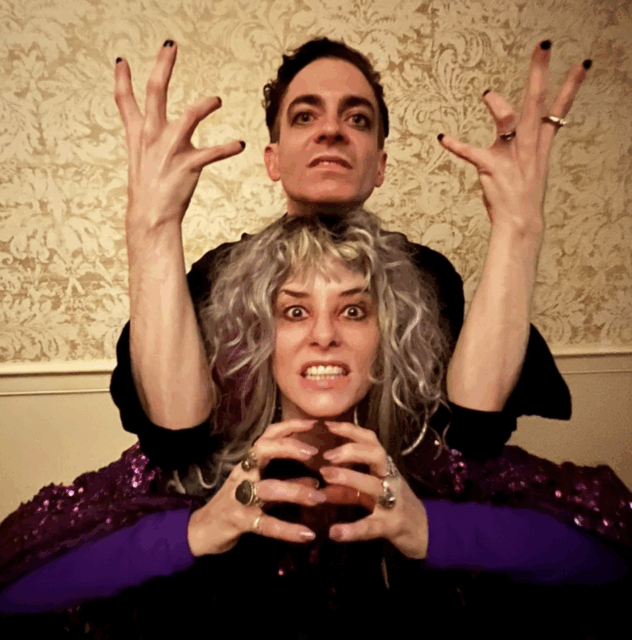
Jack Ferver and Parker Posey collaborated on Abracadabra (Instagram photo courtesy Jack Ferver)
jf: The last show in New York was Everything Is Imaginable; we did it in 2018 and it came back in 2019. And then that year, I was also the AIDS Oral History fellow with Jeremy at the New York Public Library of the Performing Arts, the Jerome Robbins Dance Division. So that year of 2019 through 2020 was spent with that archive.
We did a lecture performance in January of 2020. Working with that archive answered so many questions for me, or I would say really reified answers I had about where people were who would be mentors for me and what had happened with funding. It was an incredible and devastating event. It was an audience that was filled with a lot of women who afterwards said, “Thank you for saying my friend’s name, which I haven’t heard in years.” And then in rolled this pandemic and the lockdown and I left and went and lived at Parker’s and taught and wrote and really had time to reassess and have space and to think about what it was that I wanted to do artistically, in many aspects of life, and then because art is the big forerunner of what I do in my life, what I wanted to do. So much of the lockdown was spent writing and then the MASS MoCA show came up, which I started working on in 2021 and it went up in 2022. Then Jeremy and I made [Nowhere Apparent] through All Arts. It’s still streaming on the All Arts platform.
With MASS MoCA, it was this question, I’ve created this show, am I gonna try and get these presenters from NYC or from wherever to come to North Adams in the early fall? I really had met full burnout with trying to do that with presenters.
So at that time, Garen Scribner, who was in Everything Is Unimaginable, was changing paths to being a manager and said, I would love to be your manager. And I said, Great. So then Jay Wegman, who used to be the artistic director of Abrons, had given me free space for ten years when he was there. That’s how I made most of my work. And so Garen said, Let’s have a conversation with Jay, who was now at Skirball.
twi-ny: That’s the connection.
jf: I’ve been working on [My Town] since the summer of 2023. I’ve never worked harder on a piece. A lot of the things that are, I would say, more familiar if I look back at some of the formal things in my work, such as the use of film, that isn’t there. It begins sheerly by fiction of a story that’s not me, that’s about a schoolteacher and her student in 1911 in this town that I live in now, and then through trauma time starts to collapse.
A lot of characters emerge through this show, which is also something very different. And there’s a different approach to the solo format, which I might be doing for quite a while, I think, inside of my work. Through this work, I’m literally having more time alone. That Joan Didion quote: “Do not complain. Work harder. Spend more time alone.” And so my writing practice and my movement practice have just had so much more space.
I love teaching at Bard. I feel so grateful that I love to teach so much, and I feel so grateful I’m at Bard, which makes total sense for the way I work. It’s so interdisciplinary, and I work with professors from different parts of the college.
twi-ny: Are you hopeful for our next generation of writers and performance artists?
jf: That really solidified for me too during the AIDS Oral History Project, that I’m one of the bridge makers. We’ll never fix that gap, and we’ll never heal that canyon. But some of us will work to help build the bridge and those students, our students, will continue to be that bridge.
This piece has just been — oh, Mark, if I performed it a thousand times, I would never perform it for as many hours as I’ve rehearsed it.
twi-ny: It’s a solo piece.
jf: It is.
twi-ny: You’re very influenced by previous media: plays, movies, television, like Black Swan, Poltergeist, Suddenly, Last Summer, The Maids. So you’ve chosen in this case to take on Our Town, which is maybe the most famous play for its numerous characters.
jf: Yes.

twi-ny: And you’ve turned it into this one-person show. Why Our Town?
jf: A lot of the work had already been made. And then there was this moment where the character of Emily Webb emerged for me. And it emerged at a point in the process when, in the way I was talking and describing things, I was reminded of the stage manager. Then Emily Webb arrived and also Simon Stimson, the “queer-coded” chorus leader who hangs himself. I talked about both of them in Is Global Warming Camp? I talked about their deaths in that piece. And I was curious about why this woman meets her death in childbirth and then the queer-coded one hangs himself.
So I became really interested in tapping into, perhaps, could Emily get revenge with the stage manager before going back to the cemetery? It’s a very brief moment in the show. I was contacted by the Wilder estate; I felt very happy to be contacted by them. There’s nothing really of Our Town in there. There’s a part where it’s my fantasy if Emily got to confront the stage manager. But I think where I see the haunting of Our Town in it is that there’s someone describing things that aren’t there, that aren’t onstage. So many of my works don’t have a set. They generally have taken place in an “empty space,” to quote Peter Brook. It’s this thing of me using the power of my imagination to evoke the audience’s power of imagination. So much of that for me came from dance, but I also really see where that also comes from this experiment that Wilder did for America.
As Wilder’s essay that he put out to the American theatergoers says, you were just here for the soporific and for the baubles and for being entertained and you are asleep at the wheel. And so I’m gonna strip everything down. I connected very much in that way with Wilder. I will use language to evoke where we are. So that is where Our Town happens from. And I’d also say, yes, that I’m so many characters through this work. I’m very rarely me. And if I am, it’s some aspect of self. What I see from my work is that the stage is the psyche. It’s the psychic space.
I think this has been true of all of my work. And now it’s very clear to me that I am playing all of the aspects of self that get shattered in trauma and then jockey for attention. So when I’ve worked with a cast, they have also been aspects of self or aspects of whether they’re coming to it from a more narcissistic position or from a more victimized position.
They are all the shattered aspects that happen from trauma, and they will look to jockey and fight and spar to get the audience’s attention, to get the attention of the witnessers.
twi-ny: I wonder if that’s why you often don’t have a lot of set design. You were talking about this black space inside yourself or inside your mind, and right now you’ve chosen to be on Zoom in a dark corner.
jf: [laughs] Yes, this is where I do take my calls.
twi-ny: Last night I saw The Seat of Our Pants at the Public Theater, a musical adaptation of Wilder’s The Skin of Our Teeth. So clearly his estate is having fun with people taking Thornton to other levels.
jf: Well, I think of Wilder and I think of Williams; I would love to, if I ever have it in me, to write a more narrative play — I’ve always been so curious of what it would be like for the two of them at a bar. They were obviously so creative, so utterly American, and very angry, incredibly angry artists, and a lot of their work comes from revenge. It’s clear on the page. Our Town is a deeply vengeful play. It is so much of an agony of how people are not waking up and are not being awake to the present moment.
I wish that we had more of that content of trying to wake us up. I mean, we’re so polarized; I’m the billionth person to say that. That’s not new news of how polarized we are, so inside of our own vectors, and so unwilling to see the other person.
twi-ny: It’s very scary. So Emily Webb took what you were already working on in this other direction, gave another part to it. What was the initial genesis before Our Town was even on the page?
jf: First it was Wisconsin Death Trip, the book by Michael Lesy, which has those photos and police records from the late 1800s into the early 1900s.
twi-ny: That’s where you grew up, in Wisconsin.
jf: I did. I grew up relatively close to where a lot of that material for that book takes place. So first there was that, and then, as I went on, that began to fall away. And because I was researching where I grew up, what was it like as the town was forming, and what was it like where I am now? Because they look very similar. Where I have landed looks very similar to where I grew up, which is a big shock because I was very, “I’m getting out of this town.” That real queer kid adventure of “I’m going to move to New York City and . . .”
twi-ny: Be a star!
jf: Yeah. Where I grew up was on the Wisconsin River, on the train tracks facing the Wisconsin Ferry Bluffs. And now I live on Amtrak. Just down the street are the train tracks, the Hudson River, and the Catskills. So I thought, Okay, let me do research between these two towns. Then that began to fall away. I don’t know where this story came from of this schoolteacher and her student in 1911 in a town that is maybe this town that I live in now. And I wrote this really long, incredibly detailed, graphic, honestly . . . novella. I started to read it to a friend of mine and I said, This is going to be my next piece. And he said, Well, it can’t be because you’ve written a novella and no one will sit through this. You could do this as a book on tape. I think I was at page twenty and still reading what was going on for them. And he said, You can’t. What’s the show? It’s a show. We’re not going to sit through . . .
twi-ny: Five hours of . . .
jf: Yeah, five hours of reading a story. That was what began. I think part of where that came from was really this interest in what happens to this schoolteacher, who’s marked as a woman in my script but she might possibly be a trans man, though she doesn’t have language for that at that time.
I won’t say more than that of what happens to her and the student. But I decided to have there be a traumatic event that rips through time. And that will tie this town back to Wisconsin, and I thought about portals and trauma and how we have memories of places that perhaps we’ve been or haven’t been. I thought about amnesis, this recollection of something that we haven’t experienced but feels very familiar, a knowledge of something that we haven’t directly experienced. What is that? There’s so much that opened, I believe, inside of the collective consciousness during the lockdown, and I’m so curious about what it will be to keep those psychic doors open, art’s ability to keep those psychic doors open. I started going through those doors: I’ll take a long walk to the cemetery, I’ll take a run through the woods. I don’t think if I was spending so much time alone and in nature . . . I don’t know if these doors would have opened that way.
twi-ny: That’s fascinating. Speaking of opening doors, My Town is going to be at Skirball. I’m thinking of the shows that I’ve seen of yours, they take place mostly in great spaces but small ones; this one is huge. How did Skirball and its size figure into the work?
jf: Immediately I knew that Jeremy was gonna have to make a video. It’s too big of a space. At one point it was a duet and then I cut that part. [laughs] There was another section that happened in this show that is another show. It’s just another show, and maybe I will make that other show.
But that duet needed to just go away. There were actual scenic pieces that were going to be constructed. And as it went on, I just thought the way that my experience of going to Skirball has been . . . they do screenings of films there. I’ve never seen a film screened there, but there’s times where it reminds me that I could be coming here to see the first screening of The Phantom of the Opera. It has this very grand theater feeling to it. So I wanted Jeremy to make a video that wouldn’t be illustrative to what I was saying but that would provide another element of projection, which I mean both literally and metaphorically, so that there would also be this projective element that’s happening while I am working through all of these projections and the audience is projecting onto me, onto the roles I’m playing, and then also dealing with their projections of this projection. So that was where the screen came from. There’s a large screen that’s behind me that I wouldn’t say I interact with as much as it is functioning as another part of the mind. And in the ways that, as Freud said, we’re always doing at least two things. And formally, I thought there needs to be something more here for the audience.
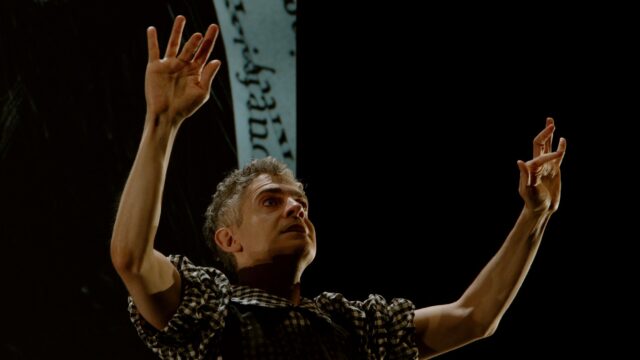
Jack Ferver plays multiple aspects of their self in My Town (photo by Jeremy Jacob)
And then Jeremy went further and said, I also think the whole piece has to be underscored, and so wrote an entire score — pending on how I do it. Every show is slightly different every time. This show has very specific reasons why it’s different every time that I won’t say; I’ll just leave that a secret. So it rides somewhere between sixty and sixty-five minutes, and the score has cues in it that’s from my text. I foresee our collaboration continuing on in that way. I always knew it was going to be me; at one point I thought it might be two people. Then I was like, Nope, it’s just me. Me and this video. I was also really interested in the size of it, and one person out there trying to work through something really difficult, because that is also what I experience people to be like right now. They have community and they have friends, but a lot of the people I see or what I see reflected back are a lot of people feeling very isolated in a very huge space.
twi-ny: Well, I’ve seen several solo shows at Skirball; it is a huge space. I’m not trying to scare you —
jf: Fortunately, I first got to do this piece at EMPAC in Troy, New York. We had a technical residency there, and I had it set up so it would feel the same as Skirball. So I’ve already tested it out.
For me, it’s the hardest performance I’ve ever done. It’s a gauntlet. I pretty much don’t stop moving through the majority of it. The text is so incredibly dense, and because I’m dealing with temporal disorder it has tricky syntax shifts that are . . .
twi-ny: But that’s your own fault. You gave it to you.
jf: I run best on a muddy track. I really wanted to let go of a lot of things and go through these doors that were opening and really listen to this writing that was coming through. In the lockdown, I wrote at least sixty pages of poetry that maybe no one will ever see. There are two poems that made it into this piece, modified. And there are reasons that they’re in the work, which I won’t say. I think it gets explained as the piece goes on. My desire for pushing my writing and pushing the psychological iconographies of my choreography has always continued to grow. So I wanted to push myself to do the hardest thing I had done so far.
twi-ny: Judging by what I’ve seen of your work previously, I know how hard you push yourself and how much you open up and reveal of yourself. I can’t wait to see this one.
jf: Yes. I’m terrified. It’s a piece that is so terrifying and so freeing all at once. But I don’t think the piece works as well if that’s not the state that I’m in. I’ve made it so that there’s no way to do it not terrified. Formally it’s just so hard, and again it has a psychological reason in it, which is when we hunt for memories and when we try to understand and make sense of extreme trauma and the way that the massive crush of heterogeneous voices falling upon us while we ask for something good to be done creates such a hardship of not becoming bitter, not shutting down, not coldly and decisively picking a lane and sticking to it.
Allowing oneself to remain open is something that I also wanted this work to encourage people to do and really to do through also what I don’t see much of right now, which is mystery and humor, and not easy humor — I mean, I’m great at that, but the humor that comes from recognition.
[There will be a talkback with Ferver following each performance. Mark Rifkin is a Brooklyn-born, Manhattan-based writer and editor; you can follow him on Substack here.]