twi-ny recommended events

BEWARE THE DARKNESS: THE DEATH OF RASPUTIN ON GOVERNORS ISLAND

Grigory Rasputin (Jake Ryan Lozano) charms Tzarina Alix (Zina Zinchenko) and the audience in immersive show on Governors Island (photo by Maria Baranova)

THE DEATH OF RASPUTIN
Governors Island
The Arts Center at Governors Island (LMCC Building 110)
Thursday – Sunday through June 28, $44-$250
www.deathofrasputin.com

“Hail, all that is light,” Father Grigory Rasputin (Jake Ryan Lozano) says amid all the darkness in The Death of Rasputin.

Theater collective Artemis Is Burning places the audience right in the middle of the mysterious story of the real-life infamous Russian mystic in the immersive experience, running at LMCC’s Arts Center at Governors Island through June 28.

Born a peasant in Siberia in January 1869, Grigory Rasputin became a wandering monk who managed to embed himself with the Romanov royal family for more than a decade, having a major impact on the Russian empire. The seventy-five-minute show is set in 1916 in St. Petersburg, where Rasputin (Jake Ryan Lozano) is treating the young son of Tzar Nicholas II (Audrey Tchoukoua) and his wife, the Tzarina Alix (Zina Zinchenko). While part of Russia considers Rasputin a saint, others believe he is a dangerous heretic.

Audience members, who are strongly encouraged to dress in black to maintain an eerie, dark atmosphere, go from room to room, following either specific characters or plot threads. The narrative unfolds in twenty-one scenes over eleven acts, and it is impossible to see it all; be prepared to be involved in one room while hearing screaming, shouting, singing, and other sounds from other spaces, but that’s fine. As in the immersive-theater standard-bearer, Sleep No More, everyone comes together for the grand finale.

As you go from Rasputin’s apartment, Katya’s Bar, and the palace to a study, a military tent, and a foreboding dungeon, you’ll meet such fictional and real characters as Dread Uncle Duke Nikolai Nikolavich (Louis Butelli), the commander of the Russian military, who is planning on assassinating Rasputin; wealthy heir Felix Yusupov (Adam Griffith), who has returned to Russia after a year away and is immediately repelled by Rasputin while also falling for bar owner Katarina (Ginger Kearns); Olga Lohktina (Manatsu Tanaka), Dread Uncle’s wife who worships Rasputin; palace maid Petra (Lucy York Struever), who is a spy for the revolution, sending secret messages via radio transmission with bartender Fyodor (Cashton Rehklau); and Father Iliodor (Tim Creavin), who quickly realizes it will take more than prayer to bring Rasputin down.

Eulyn Colette Hufkie’s period costumes range from lush and elegant to wild and natty, with moody, often reddish lighting by Devin Cameron and cacophonic sound by Stephen Dobbie. Lili Teplan’s sets are intricately designed, many with chairs and couches; the choreography, which has to work around the unpredictable audience with care, is by James Finnemore.

Creator and coirector Ashley Brett Chipman, creative producer and codirector Hope Youngblood, cowriter and assistant artistic director Julia Sharpe, and cowriter David Campbell always have something going on — be prepared to grab a cord and chant, read through desk diaries (“Whenever I dream there is blood.”), hold Father Iliodor’s hands in solemn prayer, or pour drinks for the Tzar and Tazarina. And don’t pull out your cellphone; there is no photography or video — you’re required to put a privacy sticker over the lens of your phone — and checking messages would affect the ensemble and the audience, since everyone is so close together.

Lozano is ferociously energetic as Rasputin, a role previously portrayed by such actors as John Belushi on Saturday Night Live, Rhys Ifans in The King’s Man, Lionel Barrymore in Rasputin and the Empress, and Christopher Lee in the 1966 Hammer horror film The Mad Monk. Tanaka is hypnotic as Lohktina, and Creavin is steadfast as Father Iliodor.

As with all such immersive shows (Then She Fell, The Grand Paradise, Empire Travel Agency), the more you put into it, the more you’ll get out of it. And, as in real life, be careful where you put your trust and faith.

[Mark Rifkin is a Brooklyn-born, Manhattan-based writer and editor; you can follow him on Substack here.]

DINING AROUND DOWNTOWN FOR FIVE TO TEN BUCKS

DINE AROUND DOWNTOWN
Fosun Plaza
Between Liberty & Pine and Nassau & William Sts.
Wednesday, June 11, free (dishes $5-$10), 11:00 am – 2:30 pm
www.downtownny.com

Presented by the Downtown Alliance since 1997, Dine Around Downtown will take place June 11, featuring signature dishes from nearly fifty Lower Manhattan restaurants, from pizza places and burger joints to steak and seafood houses. Among the participating eateries selling plates for $5 to $10 are Beckett’s Bar & Grill, Boogie Lab Bakery, Café Patoro, Delmonico’s, Fraunces Tavern, Harry’s, Luke’s Lobster, Metropolis by Marcus Samuelsson, Monk McGinn’s, Poulette Rotisserie, Stone Street Tavern, and Tin Building by Jean-Georges. You can find the menu for what each eatery will be serving here; this year’s special guest is Rocco DiSpirito.

[Mark Rifkin is a Brooklyn-born, Manhattan-based writer and editor; you can follow him on Substack here.]
INTERESTING/NOT-INTERESTING: SARAH RUHL’S EURYDICE REVIVED AT SIGNATURE

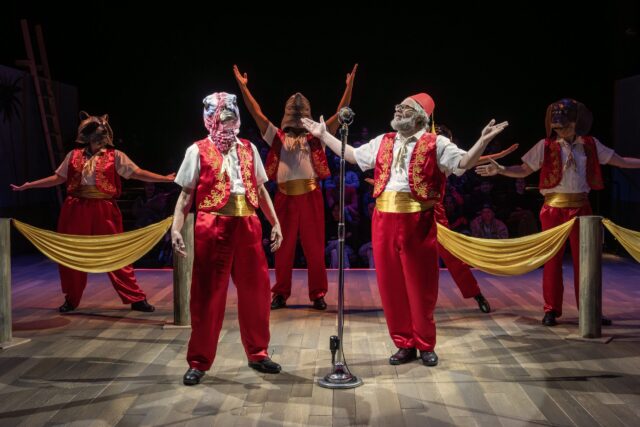
Big Stone (David Ryan Smith), Loud Stone (Maria Elena Ramirez), and Little Stone (Jon Norman Schneider) serve as an oddball Greek chorus in Sarah Ruhl’s Eurydice at the Signature (photo by HanJie Chow)

EURYDICE
The Pershing Square Signature Center
The Romulus Linney Courtyard Theatre
480 West 42nd St. between Tenth & Eleventh Aves.
Tuesday-Sunday through June 27, $105-$172
www.signaturetheatre.org

The Signature Theatre’s revival of Sarah Ruhl’s Eurydice is nothing if not “interesting.” In fact, that word appears in the ninety-minute show nearly two dozen times.

Originally staged in 2003, the play reimagines the Ancient Greek legend of the master musician Orpheus; his true love, Eurydice; and Hades, lord of the underworld, reframing it from the point of view of Eurydice and adding her father to the story, making their relationship the center of the narrative. Also known as a Nasty Interesting Man, the lord of the underworld is single, his wife, Persephone, having been eliminated from this plot, in which he sets his desires on Eurydice.

Eurydice: I read a book today.
Orpheus: Did you?
Eurydice: Yes. It was very interesting. . . . It had very interesting arguments.
Orpheus: Oh. And arguments that are interesting are good arguments?
Eurydice: Well — yes. . . .
Orpheus: I made up a song for you today.
Eurydice: Did you!?
Orpheus: Yup. It’s not interesting or not-interesting. It just — is.

Eurydice (Maya Hawke) and Orpheus (Caleb Eberhardt) decide to get married, and on their wedding day she is lured by the Nasty Interesting Man (T. Ryder Smith) to his nearby fancy loft with the promise of seeing a letter from her deceased father (Brian d’Arcy James). “I’m not interesting, but I’m strong. You could teach me to be interesting. I would listen,” the man tells Eurydice. “Orpheus is too busy listening to his own thoughts. There’s music in his head. Try to pluck the music out and it bites you. I’ll bet you had an interesting thought today, for instance. I bet you’re always having them.” The meeting, in which the man declares his love for her, results in Eurydice’s death.

She arrives in the underworld via an elevator during a downpour. She is greeted by a trio of odd munchkin-like clowns who serve as an unhelpful Greek chorus: Big Stone (David Ryan Smith), Little Stone (Jon Norman Schneider), and Loud Stone (Maria Elena Ramirez). Her trip across the River of Forgetfulness has erased her memories; she does not recognize her father, who is excited to see her and must teach her the language of the underworld so she can remember who she is. He builds her a room made of string and they bond all over again, including reading to her from King Lear, not exactly the best example of a father’s relationship with his daughters: “We two alone will sing like birds i’ the cage. / When thou dost ask my blessing, I’ll kneel down / And ask of thee forgiveness; so we’ll live, / And pray and sing.”

Up above, Orpheus writes her letters and composes a symphony that he is able to get to her through a mail slot. Meanwhile, the Nasty Interesting Man is determined to make Eurydice his bride, wooing her by riding around on a tricycle like he’s a deranged young kid at a birthday party. Orpheus figures out a way to enter hell without dying, and he and the lord of the underworld battle for Eurydice’s affections as her father wants whatever she thinks is best for her.

Father (Brian d’Arcy James) and daughter (Maya Hawke) reconnect in the underworld in Signature revival (photo by HanJie Chow)

Ruhl wrote the play as a way to connect with her father, who passed away in 1994 when she was twenty. Much of the ninety-minute show feels overly personal and esoteric, difficult to follow, as if we are being taught a different language that will take more time to understand. Les Waters (Dana H., Recent Alien Abductions), who has directed the play numerous times over the years, might be too close to it, unable to smooth out the many bumps in the narrative. Set designer Scott Bradley and sound designer Bray Poor return from Waters’s 2007 production at Second Stage; the action takes place in a tilted, tiled spa with exposed piping. Oana Botez’s costumes range from Eurydice’s father’s tailored suit to the lord of the underworld’s bizarre get-ups and the Stones’ devilishly clownish, colorful attire.

Five-time Tony nominee d’Arcy James (Shrek: The Musical, Something Rotten) is the star of the show, portraying the kind of caring father anyone would want; from constructing the string room to pretending to walk Eurydice down the aisle, he is hypnotic and charming. Hawke is enticing in her off-Broadway debut, but she and Eberhardt (The Comeuppance, On Sugarland) never quite ignite. Smith (Oslo, Our Lady of Kibeho) is game but appears to have pedaled in from another theater. The character’s appearances made me think of a favorite Looney Tunes cartoon, Hair-Raising Hare, in which Bugs Bunny, giving the orange Gossamer a manicure, says, “My, I’ll bet you monsters lead innnteresting lives. . . . I’ll bet you meet a lot of innnteresting people too. I’m always innnterested in meeting innnteresting people.”

The Orpheus story has been dazzling Broadway audiences since Hadestown opened in 2019; Ruhl’s Eurydice, the conclusion to her three-play series at the Signature following Letters from Max and Orlando, is, well, to put it in one word, “interesting.”

[Mark Rifkin is a Brooklyn-born, Manhattan-based writer and editor; you can follow him on Substack here.]
WORD ALCHEMY: XU BING AT CHINA INSTITUTE

Who: Xu Bing, Susan L. Beningson, Owen Duffy
What: Talk and book launch
Where: China Institute in America, 100 Washington St.
When: Tuesday, June 10, free ($49.87 with book), 6:30
Why: Last year, Asia Society Texas hosted “Xu Bing: Word Alchemy,” an exhibition of more than fifty of the Chinese artist’s works from throughout his nearly half-century career, including woodcut prints, videos, drawings, and installations. Born in China in 1955 and based in Brooklyn and Beijing, Bing has displayed “Phoenix” at the Cathedral Church of St. John the Divine, “The Living Word” at the Morgan Library, Square Word Calligraphy: Crossing Brooklyn Ferry, Walt Whitman at the Brooklyn Museum, and The Character of Characters at the Met. On June 10, he will be at China Institute in America — where his work will be featured in the fall exhibit “Metamorphosis: Chinese Memory and Displacement” — to launch the full-color catalog of “Word Alchemy,” joined by exhibition curators Susan L. Beningson and Owen Duffy.

[Mark Rifkin is a Brooklyn-born, Manhattan-based writer and editor; you can follow him on Substack here.]
STRIKING CHOICES: THE WASH AT WP THEATER

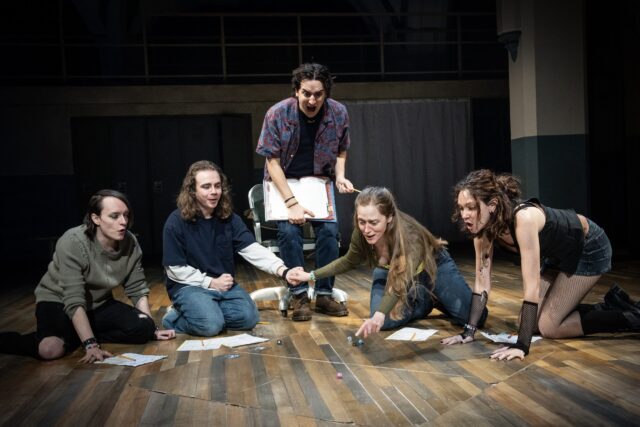
A group of Black laundresses prepares to strike in Kelundra Smith’s The Wash (photo by Hollis King)

THE WASH
WP Theater
2162 Broadway at 76th St.
Tuesday – Sunday through June 29, $30-$45
www.newfederaltheatre.com

The real Atlanta Washerwomen’s Strike of 1881 is the setting of Kelundra Smith’s moving if earnest The Wash, making its New York premiere at the WP Theater. A production of Woodie King Jr.’s New Federal Theatre, the fictionalized story is an account of one of first workers’ strikes in American history, all too often left out of our national narrative. Smith powerfully reclaims Black history, as well as her own; the seven characters all carry the names of Smith’s actual female ancestors and family members.

The play begins as a kind of symphony, as five Black women go about their business, washing and drying white people’s clothes using buckets, irons, and washboards, in front of two movable walls onto which are projected colorful abstract images that evoke the work of Georgia-born African American artist Alma Thomas.

The walls are soon spun around to reveal the inside of a double barrel shotgun house where the women gather to clean, gossip, and share their personal stories. The home is rented by Anna (Eunice Woods), a practical widow who runs a sort of workers’ cooperative, washing laundry collected from white Atlanta households. Anna wants to make sure everyone working there gets paid, although their clients aren’t paying them, evading their bills and paying in beans and rice instead of cash. Among the women is Anna’s closest friend, the god-fearing Jeanie (Bianca LaVerne Jones), who lives upstairs. Anna dreams of having her own bakery where she can sell her honeycomb cornbread and Jeanie’s “oh my” pies.

Jeanie: We been over this a thousand times. We ain’t answerin’ to white folks. We done got us a system. We only gots to talk to dem when we pick up they dirty clothes and drop off the clean ones. Dey pissed about it.
Anna: War been over almost twenty years. We oughta be past dis by now.
Jeanie: Dem crackers just killed the president. It ain’t over to dem.
Anna: It’s getting worse. I don’t know how much longer we can go on like this. No mo rice, beans, and hand-me-downs.

Jeanie has just found out that her son and daughter-in-law are going to have a baby, so she needs to make enough money to afford a bus ticket to Rochester. Thomasine (Margaret Odette), who has four young children, is married to an abusive husband. The newly married and madly in love Charity (Alicia Pilgrim) is looking forward to having kids. And Jewel (Kerry Warren) is in college, where she is very good friends with another woman student. The women are fed up with doors being slammed in their faces when they ask for payment, so they start considering striking, and a heated discussion ensues.

Anna: What else are we gonna to do? We tried waiting. We tried asking. We supposed to go the police?
Charity: They’ll arrest us for callin ’em.
Jewel: We wouldn’t be the first. Remember a few years ago in Galveston and Jackson? They did it.
Thomasine: They tried that here last year and the year before. Police pulled washerwomen’s hair out in the street.
Charity: But this a new day. Mrs. Anna say the Cotton Expo comin’.
Jewel: Plus, after they stole the election from that Negro alderman last year, I think folks will hear us out.
Anna: Jeanie, we did say —
Jeanie: We was just talkin’.
Anna: That’s the problem. It’s a lot of talkin’ ’round here, but now it’s time to demand. No pay, no wash.
Jeanie: Strike? If we ain’t workin’, how we gonna pay the property tax?
Thomasine: I got four kids comin’ up like dandelions. Somethin’ is better than nothin’.

The real Atlanta Washerwomen’s Strike of 1881 inspired play making NYC premiere at WP Theater (photo by Hollis King)

Anna: Something ain’t paying my property taxes. Matter of fact, we not even gettin’ something. We’re gettin’ anythang, and that’s worse. If we can set our own rates, I can pay my taxes ’fore the law come.
Jeanie: Think about this, Anna. What good it’ll do if we strike? It’s plenty of washerwomen in this city. Folk’ll take dey laundry to somebody else, and we’ll have a stain on us.
Jewel: She’s right. It’ll only work if everyone does it. We have to get more women to join us.
Jeanie: More womens? This Atlanta. Dem crackers will have us swingin’ from a Georgia pine.
Jewel: Times are changing. Negroes comin’ up around here.

They gather in a church basement, where they establish their makeshift headquarters for the strike, forming a union called the Washing Society. They are surprised and suspicious when Mozelle (Rebecca Haden), a single white mother, shows up, offering to help get the white laundry women in Castleberry to join the fight. As the number of strikers increases dramatically and the newspapers pick up the story, Anna, Jeanie, Thomasine, Charity, and Jewel reexamine what they want out of their lives, as individuals and as Black women.

The Wash is the conclusion of Smith’s Reconstruction Trilogy, following The Vote and The Knot. She and director Awoye Timpo (In Old Age, Good Grief) build a heartwarming portrait of community among the women, six unique characters who come together while facing their complicated personal situations. The narrative becomes repetitive, and the continual turning around of Jason Ardizzone-West’s set is time consuming and grows a bit tedious; perhaps the play would benefit from being streamlined from 135 minutes with intermission to a more concise 90 minutes without a break.

Gail Cooper-Hecht’s period costumes capture the look of the time, while Belynda M’baye’s wide-ranging props fill the shelves of Anna’s kitchen and workspace. Abhita Austin’s projections include shots of actual newspaper articles weighing in on the strike. Choreographers Adesola Osakalumi and Jill Vallery create scenes with movement that are like dances, all lit by Victor En Yu Tan, achieving what Smith explains in the script: “This play is meant to move like the wind; it’s gentle and breezy in some moments and swift and sharp in others.”

Pulling no punches, The Wash might wear its heart on its sleeve, but it tells an important, little-known story in a way that makes it relevant today, rather than just another episode from America’s shameful past.

[Mark Rifkin is a Brooklyn-born, Manhattan-based writer and editor; you can follow him on Substack here.]

AWAITING THE PENUMBRA: LUNAR ECLIPSE AT SECOND STAGE

Em (Lisa Emery) and George (Reed Birney) take stock of their life together in Donald Margulies’s Lunar Eclipse (photo by Joan Marcus)

LUNAR ECLIPSE
The Pershing Square Signature Center
The Irene Diamond Stage
480 West 42nd St. between Tenth & Eleventh Aves.
Tuesday – Sunday through June 22, $74-$114
2st.com

Donald Margulies’s immeasurably moving and intelligent Lunar Eclipse begins with a man (Reed Birney) sitting in a folding chair under a tree in the middle of a grassy field, crying inconsolably. He tries to hide his sorrow when a woman (Lisa Emery) arrives, but soon they are both digging deep into their lives as the earth passes between the sun and the moon.

The couple is named George and Em, after George Gibbs and Emily Webb, the neighbors who fall in love in Thornton Wilder’s Our Town. Although the play is not specifically about those two characters, it does echo Wilder’s approach, making them represent any wife and husband looking back after fifty years, the good times and the bad. It’s nearly impossible to not imagine yourself in one of those chairs — regardless of your current age — next to your longtime partner, taking stock of your accomplishments and failures as the sky turns from bright to dark to bright again.

For ninety minutes, George and Em bicker over minute things, discuss their children, remember their first night together, and honor the many dogs they had, buried around them in that field. Although no time period is given, cellphones never appear. George and Em talk about their health problems; George is afraid he’s starting to lose his mind. He says, “Feel like I’m at sea, sometimes, in the middle of a storm. Looking for a place to land only there’s no land in sight.” Em replies, “You’re the sharpest man I know.” But George insists he is changing, and not for the better. “Isn’t that something? To think that we’re here? At this stage? Already? Look at us: Almost done. Lights out.”

As the total eclipse begins, George pulls out his binoculars, laments having had his telescope stolen, and hopes to see the rare Japanese Lantern Effect. Em asks George why he was crying, and although he is initially hesitant, he eventually tells her. They talk a lot about love and death.

Describing a troubling experience he’d had very early that morning, a kind of walking nightmare, George says, “My heart . . . was racing . . . I could feel blood rushing to my head. I could hear it in my ears. Afraid if I said anything, if I made any sound at all, if I’d budged one inch, everything would just . . . crack.”

She kisses his hand, and he wonders why she did that. He is worried about the future of humanity. She asks if she has ever done anything that surprised him. He’s sorry to hear about her sadness. In some ways they evoke not only Wilder’s George and Emily but also Edward Albee’s George and Martha from Who’s Afraid of Virginia Woolf?, although not nearly as extreme, nonviolent, and relatively sober.

They’re not rich, they don’t have a close, loving family, and they recently said goodbye to their last dog, but they still care about each other, even if he doesn’t want to admit it.

George: Anything I can do to help . . .
Em: You mean that?
George: Of course I mean that.
Em: Thank you. That’s kind of you to say.
George: I’m not being kind. I’m your husband.

Em (Lisa Emery) and George (Reed Birney) remember the good times and the bad in beautiful Second Stage play (photo by Joan Marcus)

Em sums up their life — all of our lives — when she then says, “The worst thing in the world that could possibly happen happens and you go to sleep and morning comes and whataya know, you wake up and you’re still breathing. You didn’t die during the night. That’s your punishment, I guess: You live another day. And all the days after that.”

Presented by Second Stage at the Signature Center, Lunar Eclipse is a near-masterpiece by the Brooklyn-born, New Haven–based Margulies, who won the Pulitzer Prize in 2000 for Dinner with Friends, was a finalist for two other Pulitzers (for Sight Unseen and Collected Stories), and won the Thornton Wilder Prize for literary translation in 2018. Margulies dedicated the work to his father-in-law, George Street, a Kentucky farmer who died in 2010.

Walt Spangler’s set is a lovely, inviting grassy expanse beautifully lit by Amith Chandrashaker, with Sinan Refik Zafar’s nature sounds encompassing the theater, immersing the audience in the experience, along with Grace Mclean’s gentle music. S. Katy Tucker’s video projections follow the course of the eclipse in the sky behind the actors, who are dressed in Jennifer Moeller’s casual costumes. My lone quibble is when dark clouds are projected as George mentions dark clouds hanging over him.

Drama League nominee Kate Whoriskey (Clyde’s, Sweat) directs the show with a compassionate, tender hand, giving plenty of room for Margulies’s poetic dialogue to shine out of the shadows. For the next lunar eclipse, you’ll want to find a grassy, private space where you can sit next to your loved one and enjoy the event, but be careful what you share.

Tony winner Birney (Chester Bailey, The Humans) and Drama Desk nominee Emery (Six Degrees of Separation, A Kind of Alaska) are sensational together, he both gentle and brash as George, who admits to being disappointed with how his life ended up, she touching and considerate as Em, who believes she did the best she possibly could.

Which is all any of us can ask for.

[Mark Rifkin is a Brooklyn-born, Manhattan-based writer and editor; you can follow him on Substack here.]

STOPPING BY A DINER ON A SNOWY EVENING: WILLIAM INGE AT CLASSIC STAGE

Bus Stop takes place in a comfy diner in small-town Kansas during a snowstorm (photo by Carol Rosegg)

BUS STOP
Classic Stage Company, Lynn F. Angelson Theater
136 East Thirteenth St. between Third & Fourth Aves.
Through June 8, $76-$132
www.classicstage.org

This is the last weekend to see Jack Cummings III’s ravishing adaptation of William Inge’s Bus Stop, the 1955 play that was expanded into a popular film in 1956 — famously starring Marilyn Monroe — and turned into a musical, Cherry, in 1972.

A coproduction of Classic Stage Company, the National Asian American Theatre Company (NAATCO), and Transport Group, the story takes place in a small-town Kansas diner, where a bus has been sidelined because of road closures during a March storm. Working the night shift are Elma (Delphi Borich), a high school student saving money for college, and the older Grace (Cindy Cheung), who needs a jolt of excitement in her life.

The local sheriff, Will (David Lee Huynh), prepares them for the bus’s arrival, letting them know that it will be at least several hours before the roads are cleared. Soon the bus driver, Carl (David Shih), enters, followed by Dr. Lyman (Rajesh Bose), a professor attracted to literature, alcohol, and Elma; Cherie (Midori Francis), a nightclub chanteuse; Bo (Michael Hsu Rosen), a twenty-one-year-old Montana rancher determined to marry Cherie; and his right-hand man, the loyal Virgil (Moses Villarama), who travels with his guitar.

Over the course of one evening, the men approach the women and a variety of encounters ensue: couplings motivated by convenience, lechery, and thunderstruck first love that would raise a few questions about consent today. With deft artistry, the company makes the story work without raising the hackles of every woman in the audience, which it could well do. The characters rhapsodize about love and loss, sex and grief, either looking back at where their life went wrong or gazing into a future they hope will be filled with something better.

Peiyi Wong’s diner set is realistic and charming, while Mariko Ohigashi’s costumes evoke midcentury America. As the narrative focuses on various pairs having conversations, R. Lee Kennedy’s lighting shifts on them but keeps the others in clear view. Cummings III, who previously directed Inge’s Picnic, The Dark at the Top of the Stairs, and Come Back, Little Sheba, maintains an even flow during the show’s two hours, including one pause and one intermission. The all-Asian ensemble is excellent, although it takes time for one of the key plots to heat up.

The diner might not have rye bread, cheese, or booze, but it’s still a lovely place to settle in for a few hours, especially when you need a break from what’s going on outside.

[Mark Rifkin is a Brooklyn-born, Manhattan-based writer and editor; you can follow him on Substack here.]