An all-star lineup will pay tribute to Octavia E. Butler on February 24 via Symphony Space
Who: Branden Jacobs-Jenkins, N. K. Jemisin, Walter Mosley, Imani Perry, Yetide Badaki, Adepero Oduye What: Readings and conversations Where:Symphony Space Virtual Space When: Wednesday, February 24, $15, 7:00 Why: In honor of the fifteenth anniversary of the passing of award-winning American science-fiction writer Octavia E. Butler, who died on February 24, 2006, at the age of fifty-eight, a stellar group of writers and actors are gathering virtually at Symphony Space for an evening of readings and live discussion. A feminist and, arguably, an Afro-futurist, Butler wrote such works as Kindred, Bloodchild and Other Stories, and the Patternist, Xenogenesis, and Earthseed series. In her 1998 MIT speech “Devil Girl from Mars: Why I Write Science Fiction,” she said, “It’s impossible to begin to talk about myself and the media without going back to how I wound up writing science fiction and that is by watching a terrible movie.The movie was called Devil Girl from Mars, and I saw it when I was about twelve years old, and it changed my life.” There’s no telling how many people’s lives were changed by reading Butler; the evening will feature playwright Branden Jacobs-Jenkins, authors N. K. Jemisin, Walter Mosley, and Imani Perry, and actors Yetide Badaki and Adepero Oduye.
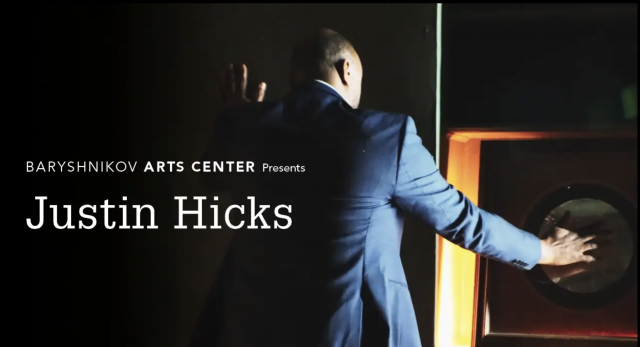
Who:Justin Hicks, Meshell Ndegeocello What: Live conversation about Hicks’s Use Your Head for More Where:Baryshnikov Arts Center Zoom When: Wednesday, February 24, free with RSVP, 8:00 (Use Your Head for More available on demand through March 1 at 5:00) Why: On February 24 at 8:00, multidisciplinary artist and performer Justin Hicks, who was born in Cincinnati and is based in the Bronx, will be joined by DC-born singer-songwriter, musician, and ten-time Grammy nominee Meshell Ndegeocello to talk about Hicks’s world premiere commission from the Baryshnikov Arts Center, Use Your Head for More, which is streaming for free through March 1 at 5:00. The half-hour piece is an experimental audiovisual poem with spoken text based on a 2004 conversation Hicks had with his mother, found sound and background vocal samples from members of his family, and rich, dreamlike imagery, from empty corners and doors to a wrinkled hand repeatedly rubbing a wall, all bathed in a golden glow and filmed in his home. “The saying ‘Use your head for more than a hatrack’ became a song my mom wrote as a reminder to her children that mining your imagination offers a way to create lushness with little at hand,” Hicks said in a statement. “She would also use it in moments to let us know that your brain is much more valuable than anything you could acquire. She used songs to remind us of things that kept us safe.”
Use Your Head for More, which features editing by Breck Omar Brunson, lighting by Tuce Yasak, cinematography and styling by Kenita Miller-Hicks, and vocals by Jade Hicks and Jasmine Hicks, is part of the BAC Artist Commissions initiative, which was started in September 2020 to support new online works made during the COVID-19 pandemic; Mariana Valencia’s brownout premieres March 1, followed by Holland Andrews’s Museum of Calm March 15-29, Stefanie Batten Band’s Kolonial May 3-17, Tei Blow’s The Sprezzaturameron May 17-31, and Kyle Marshall’s STELLAR June 7-21.
Round House Theatre in Maryland and McCarter Theatre Center at Princeton have teamed up to deliver an extraordinary gift during the pandemic lockdown. Continuing through April 30, “The Work of Adrienne Kennedy: Inspiration & Influence” is a fabulous crash course in all things Adrienne Kennedy, consisting of staged readings of four of the eighty-nine-year-old Pittsburgh native’s avant-garde plays, filmed onstage at the Round House without an audience, along with four panel discussions. I am embarrassed to admit that I knew relatively little about Kennedy and had seen only two of her works, the Signature’s 2016 revival of her 1964 debut, Funnyhouse of a Negro, and TFANA’s 2018 world premiere of He Brought Her Heart Back in a Box. That last work is the shining star of the virtual program, which celebrates Kennedy’s uncompromising fierceness, her unique use of narrative, and her brilliant understanding of such issues as race, slavery, whiteness, and power in America.
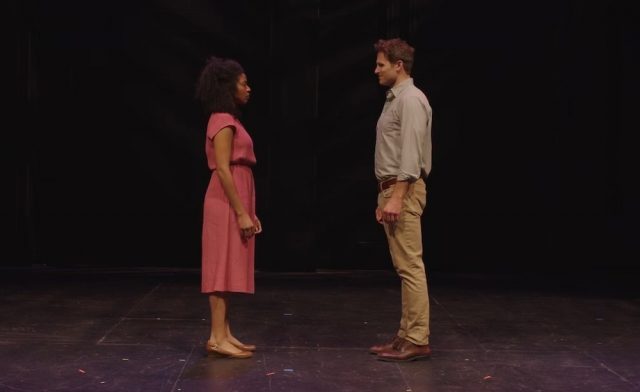
Directed by Nicole A. Watson, He Brought Her Heart Back in a Box is one of the best plays of the coronavirus crisis. Inspired by events in her own life and featuring snippets from Noël Coward’s Bitter Sweet and Christopher Marlowe’s The Massacre at Paris, the half-hour show, introduced by Jeremy O. Harris and with stage directions read by Agyeiwaa Asante, takes place during WWII, in the fictional town of Montefiore, Georgia. The white Christopher (Michael Sweeney Hammond), heir to a successful local business, is declaring his love for Kay (Juliana Canfield), the daughter of a white writer and a Black woman who died mysteriously shortly after Kay was born. Christopher doesn’t seem to fully comprehend the dilemma of their potential relationship, especially as Kay learns more about what happened to her mother.
At TFANA, you could check out a miniature model of the town; here Watson incorporates models presented to us in a person’s hands, a miniature house, graveyard, and train car and station onto and through which she projects images of racism in the Jim Crow south, ingenious stagecraft that could only be this effective onscreen, shot in close-up by cinematographer Maboud Ebrahimzadeh, with visual effects by Kelly Coburn and editing by Joshua Land of Mind in Motion. Canfield and Hammond, who also portrays the father, deliver most of their lines while at music stands, socially distanced but intrinsically tied together. Simply dazzling.
Kim James Bey and Deimoni Brewington play mother and son in Adrienne Kennedy’s Sleep Deprivation Chamber (photo courtesy Round House Theatre)
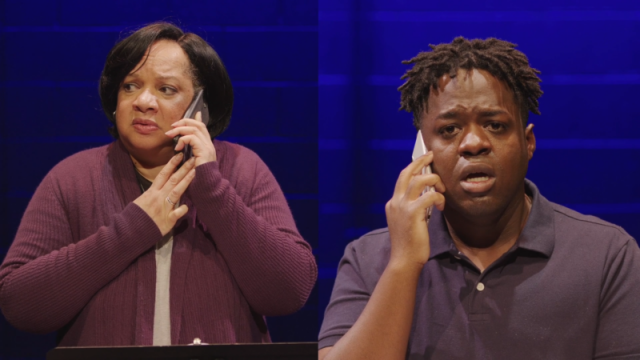
Original director Michael Kahn introduces Kennedy’s very personal 1996 play, the Obie-winning Sleep Deprivation Chamber, which she wrote with her son, Adam P. Kennedy, about something that actually happened to him. Driving home one day, just down the street from his father’s house, a Black man is pulled over by a white police officer and is brutally beaten. It’s winter, and the Antioch College Theatre Department is rehearsing Hamlet. “Ophelia, betrayal, disillusionment,” five students announce twice, establishing the tone of the play. Kim James Bey stars as Adrienne Kennedy alter ego Suzanne Alexander, mother of Teddy (Deimoni Brewington), who was visiting his dad, David Alexander (Craig Wallace), in Arlington, Virginia, where the incident occurred.
Director Raymond O. Caldwell cuts between Suzanne reading letters she has sent in defense of her son; Teddy on the stand, describing what happened in detail; his older brother, March (Marty Lamar), speaking on a terrace; Teddy’s lawyer, Mr. Edelstein (David Schlumpf), trying to convince the prosecutor, Ms. Wagner (Jjana Valentiner), that they can come to an agreement without going to trial; David Alexander testifying about what he saw; flashbacks from Suzanne’s life, with other actors playing a younger version of her and other characters (Imani Branch, Sophia Early, Janelle Odom, Moses Princien, and Kayla Alexis Warren); and Officer Holzer (Rex Daugherty) giving his side of the story of the encounter. The constant shifting in time and space, along with dream scenes and surreal touches, furthers the confusion surrounding the event, one that is all too representative of what the Black Lives Matter movement is battling against. It’s a powerful if familiar story, handled with grace and anger.
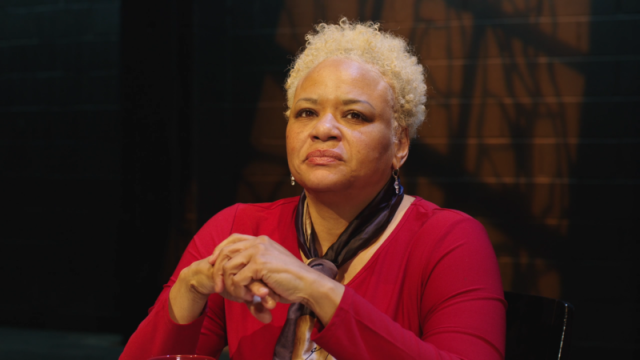
“I was asked to talk about the violent imagery in my work, bloodied heads, severed limbs, dead father, dead Nazis, dying Jesus,” Suzanne (Lynda Gravatt) says at the beginning of Ohio State Murders, repeating words she stated in Sleep Deprivation Chamber. Introduced by Awoye Timpo and Arminda Thomas of Classics, Ohio State Murders, published in 1992, offers a different perspective on Suzanne, who is played in flashbacks by Billie Krishawn set between 1949 and 1952. The modern-day Suzanne is in the library at Ohio State, delivering a speech about what occurred when she was a student there, involving her English teacher, Robert Hampshire (Daugherty).
It’s a sordid tale of racism, sex, and murder that brings to life earlier episodes from her time at college, filmed in black-and-white, as the younger Suzanne faces her complicated situation with her aunt Louise (Andrea Harris Smith), her ex-boyfriend Val (Yao Dogbe), her new friend David Alexander (Dogbe), and her roommate, violinist Iris Ann (Heather Gibson). Along the way she learns about Sergei Eisenstein, Thomas Hardy, and the importance of symbols. Directed by Valerie Curtis-Newton, the hourlong work is poignant and sharp, the flashback scenes like a kind of noir mystery. Unfortunately, Gravatt, who tells the story from start to finish, never quite finds the right rhythm in her narration, emphasizing the wrong words and reading too obviously, which is a shame, because the language is powerful and poetic. But Krishawn is mesmerizing as Kennedy’s young alter ego.
Caroline Clay gives a dazzling solo performance in Adrienne Kennedy’s Etta and Ella on the Upper West Side (photo courtesy Round House Theatre)
Caroline Clay is exquisite as the narrator in the world premiere of Etta and Ella on the Upper West Side, hitting all the right notes. The play, directed by Timothy Douglas, is like an interwoven short story, set in Manhattan, as two sisters, Ella and Etta Harrison, fight over men, writing, and hairdos. Sitting at a table in front of the brick wall at the back of the stage, Clay discusses musician and writer Troupe, the Vanishing Literary Club, and murder — yes, another reference to Ohio State Murders and Sleep Deprivation Chamber — in a captivating matter-of-fact way while her eyes search the space and notes appear on the screen. (For example, “sometimes he walks to the roof of the brownstone and looks to the Harlem” and “suddenly Etta stood up.”)
About ten minutes in, the narrator gets to the heart of the dilemma. “‘Ella, I’ve asked my editor, can I stop you from writing articles about me?’ He told me to leave you alone. I told him you’re making me sick. ‘I think if you leave her alone, she’ll stop. I don’t want to upset you, Etta, but I saw parts of manuscript she submitted to Grove on you. Do you want to see it? I took a look to see if she’s violating your legal rights. I feel this is leading to something terrible between you.’” Who has the right to tell whose story has become a major issue over the last few years.
Kennedy’s words sing as the narrator describes characters’ clothing, their quirks, and their desires as they meander through New York City, from the Upper West Side and the Hudson River to the Strand and the East Village, and lament what happened to old, treasured movie theaters like the Thalia and the New Yorker. Kennedy draws a pretty picture of the metropolis as she focuses in on the relationship between two sisters who are practically clones of each other.
Kennedy — the first syllable of her first name is pronounced “ah,” not “ay” — deserves to be more famous than she is, her acclaim currently relegated to the inner circle of theater people, but this program should go a long way to spreading the word about just how important she is to the canon. “The Work of Adrienne Kennedy: Inspiration & Influence” is a fitting tribute to one of America’s most talented playwrights, a fearless woman who has taken on the status quo for five decades, tackling difficult subjects with elegance and beauty, revealing the dark underbelly of a nation unable, and unwilling, to reckon with its past. After experiencing these four tales, you’ll never miss another Adrienne Kennedy play when it comes to your town.
You can take a deeper dive by watching the four talks, which are available for free: “Influence & Imagination,” with Eisa Davis, Zakiyyah Alexander, and Haruna Lee; “Acting Adrienne Kennedy,” with Watson, Clay, Crystal Dickinson, and Mikéah Ernest Jennings; “Critical Reflections,” with Jill Dolan, Rohan Preston, and Regina Victor; and “The Black Avant Garde,” with Caldwell, Daniel Alexander Jones, and Holly Bass.
San Francisco Playhouse
Mondays at 10:00 through March 1, free with RSVP (available on demand for an extended period of time) www.sfplayhouse.org
San Francisco Playhouse has been busy during the pandemic lockdown with its Zoomlet series, new and classic short works premiering at 10:00 EST on Monday nights, bookended by an introduction and an in-depth discussion often featuring the playwright in addition to the actors, director, and SFP cofounder and artistic director Bill English. Up next is Perfect Numbers by Diana Burbano, about a homeless woman and a philosophical octopus, with Stacy Ross and Michelle Talgarow, directed by Katja Rivera, streaming live February 22, followed March 1 by the final winter presentation, River’s Message by Conrad A. Panganiban, directed by Jeffrey Lo.
After the initial livestream, most of the works can still be seen on demand on the company’s website. A handful of the early entries are no longer available, and you’re likely to kick yourself for missing them: The Logic by Will Arbery with Jesse Vaughn and E. J. Gibson, directed by Michael Torres; Night Vision by Dominique Morriseau with Joseph Pendleton and Tristan Cunningham, directed by Margo Hall; Great to See You by Theresa Rebeck, with Susi Damilano, John Walker, and Pamela Walker; and The Forgotten Place by Jeff Locker, with James Seol and Jomar Tagatac, directed by Lo.
However, you can still catch eighteen works, including Walls Come Tumbling Down by Genevieve Jessee, with Leigh Rondon-Davis, Kenny Scott, and Dwayne Clay, directed by Darryl V. Jones; Two Pigeons Talk Politics by Lauren Gunderson, with Nic A. Sommerfeld and El Beh, directed by Tracy Ward; an excerpt from The Bacchae by Euripides, with Anthony Fusco and John Douglas Thompson, directed by Carey Perloff; Flight by DeLanna Studi, with Eileen DeSandre, Brent Florendo, and Tanis Parenteau, directed by Marie-Claire Erdynast; Cashed Out by Claude Jackson Jr., with Rainbow Dickerson, Carolyn Dunn, and Lulu Goodfox, directed by Edris Cooper-Anifowoshe, which has been commissioned for a full-length production; and an excerpt from Oedipus Rex by Sophocles, with Steven Anthony Jones and Thompson, directed by Perloff, in addition to works by Ian August, Lee Cataluna, Candrice Jones, Dipika Guha, Lynne Kaufman, Geetha Reddy, and Aaron Loeb. Most of the programs run more than an hour, but the plays themselves are between ten and forty-five minutes. The introductions and postshow talks reveal a fun camaraderie among the participants, who are truly enjoying the experience, even if it is over Zoom, with everyone chiming in from wherever they are sheltering in place.
SFP has also been hosting live Fireside Chats with some of the best playwrights and directors in the business, including Simon Stephens, Pam MacKinnon, Rajiv Joseph, Lauren Yee, Aaron Posner, Stephen Adly Guirgis, Luis Alfaro, and several of the Zoomlet writers, moderated by English, which you can watch here. In addition, SF Playhouse was among the first companies to get permission to stage works in their theater, without an audience and adhering to all Covid-19 protocols. Last season included Yasmina Reza’s Art, Brian Copeland’s solo show The Jewelry Box, and Jason Robert Brown’s Songs for a New World. “Act II: Adjusting Mid-Air” consists of Erika Dickerson-Despenza’s [Hieroglyph] March 13 through April 3, Julia Brothers’s one-woman show I Was Right Here March 27 to April 17, and Ruben Grijalva’s Shoot Me When . . . May 1 to 22.
Jilly Ballistic’s With Great Power Comes No Accountability kicks off Playwrights Horizons’ Lighthouse Project (photo by twi-ny/mdr)
Playwrights Horizons
416 West Forty-Second St. between Ninth & Tenth Aves.
Through February 28, free www.playwrightshorizons.org
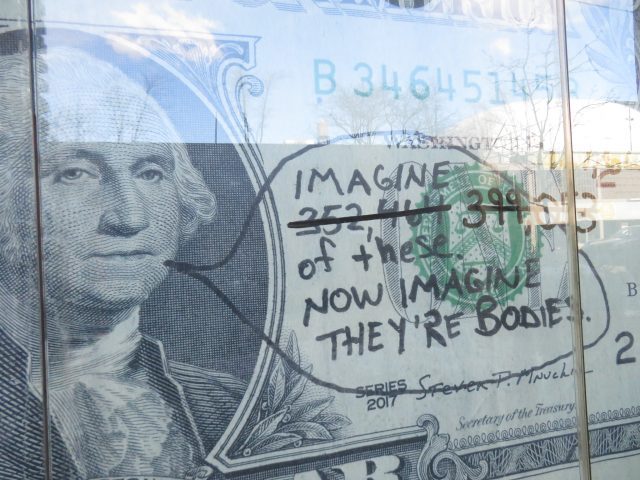
Theaters around the country are facing severe financial hardships as a result of the coronavirus pandemic lockdown, but the enormous dollar bill in the window facade of the shuttered Playwrights Horizons building on West Forty-Second St. is only partly about money; it’s primarily about the cost of death, specifically the ultimate price paid by hundreds of thousands of Americans who have died from Covid-19. The piece is titled With Great Power Comes No Accountability, and it is by Jilly Ballistic, who has been decorating the subway and subway platforms for decades. The title of this aboveground work was previously used by Ballistic on an L train platform on January 31, 2020, before the full nature of the health crisis was known. The giant note of legal tender is signed by then-Treasury Secretary Steven Mnuchin, and Ballistic initially wrote on it, “IMAGINE 352,464 of these. Now imagine they’re bodies,” in a word bubble being spoken by President George Washington. Ballistic has returned to the bill several times, using a Sharpie to cross out that number and write in 399,053, then crossing that out and adding 427,626. The coronavirus crisis is costing America in multiple ways, each and every day.
“It’s difficult to conceptualize such large numbers, especially when those numbers are linked to something so tragic as these deaths. There’s a danger, though, if we don’t fully grasp the atrocity: we allow those in power to get away with murder. What better way for a politician to understand our pain than using money as a metaphor?” Ballistic says in her artist statement. She sees the piece as “a reflection on corruption, failure, value, and death in America.” The work is the inaugural installation in Playwrights Horizons’ Lighthouse Project, which is curated by artist, activist, and writer Avram Finkelstein, a founder of the Silence=Death Project, and two-time Tony-winning set and costume designer and activist David Zinn (The Flick, Circle Mirror Transformation). With Great Power Comes No Accountability will remain on view through February 28, to be followed by commissions from Ken Gonzales-Day, Dread Scott, and others.
Jilly Ballistic’s With Great Power Comes No Accountability looks at the cost of the coronavirus pandemic (photo by twi-ny/mdr)
“This year, this theater is celebrating its fiftieth anniversary under remarkably strange circumstances: a global pandemic, a historical reckoning, and a constitutional crisis,” artistic director Adam Greenfield explained. “In this moment, we want to rediscover the ways our building can be used, to expand the range of artists and disciplines we present, to create a culture of inquiry that pervades the entire building, inside and out, so that genuine artistic innovation can be met with genuine openness.” Zinn added, “I know a lot of things are happening quietly inside of theaters to meet both this racial and economic moment, but I also feel like theaters have a moral responsibility to communicate to the world outside the building. What we’re making is a vehicle for communication — for this need for our buildings to speak for this moment. Jilly’s piece in particular addresses this moment with weight and a sense of political irony that is heartbreaking, and it’s responsive to current events in a very immediate way.”
The Lighthouse Project will also include online conversations, workshops, concerts, and other events addressing this dire moment in time. You can watch the first two talks, “Public Art / Public Space” with Greenfield, Ballistic, Finklestein, and Joy Episalla and “Theater and Society” with Natasha Sinha, Michael R. Jackson, Heather Raffo, Michael John Garcés, and Mimi Lien, here. Up next is “Profiled” on March 3 at 7:00 with Sinha, Lileana Blain-Cruz, Clint Ramos, and Gonzales-Day talking about Gonzales-Day’s Playwrights installation, which will consist of two large-scale digitally edited photographs, part of his long-term series that looks at portraiture through historical memory, race, museum display, moral character, beauty, and the body.
Red Bull will delve into Hannah Cowley’s The Belle’s Stratagem, in latest benefit reading and Bull Session
Who:Red Bull Theater company What: Livestreamed benefit reading of Hannah Cowley’s The Belle’s Stratagem Where:Red Bull Theater website and Facebook Live When: Monday, February 22, free with RSVP (donations accepted), 7:30 (available on demand through February 26 at 7:00); Bull Session, February 25, free with RSVP, 7:30 Why: In her plan “Staging the 18th-Century Prostitute for the 21st-Century: A Dramaturgical Approach to Teaching Cowley’s The Belle’s Stratagem,” professor Melinda C. Finberg wrote of Hannah Cowley’s 1780 work, “While The Belle’s Stratagem is set firmly in the fashionable society of late-eighteenth-century London, and its style is reminiscent of Cowley’s Restoration and Augustan predecessors, Cowley’s comedy demonstrates concerns about the laboring classes and their relationship to the moneyed elite. The title of Cowley’s comedy pays homage to one of her favorite Augustan playwrights, George Farquhar (1677-1707), and his The Beaux’s Stratagem (1707), and like many of these earlier comedies, The Belle’s Stratagem juxtaposes two story lines: Letitia Hardy’s ingenious plot to win the heart of her betrothed, Doricourt, against the marital problems of jealous Sir George Touchwood and his wife, the naïve Lady Frances. Both plots concern men learning to respect the women in their lives both before and after marriage, and are further connected by questions regarding the nature and fluidity of identity. Interwoven with these plots are transitional scenes among servants, tradesmen, and con artists who make their livings off the excesses of fashionable life.”
You can find out how relevant the play still is when Red Bull presents a benefit reading of The Belle’s Stratagem on February 22 at 7:30, directed by Gaye Taylor Upchurch and starring Cecil Baldwin, Jasmine Batchelor, Mark Bedard, Neal Bledsoe, Lilli Cooper, Peter Jay Fernandez, Santino Fontana, Tony Jenkins, Lauren Karaman, Aaron Krohn, Heather Alicia Simms, and Chauncy Thomas. The reading will be available on demand through February 26 at 7:00. On February 25 at 7:30, a live Bull Session on the play, which was advertised back in the day as “A Variety of Serious and Comic Songs,” will feature Upchurch, scholar Dustin D. Stewart, and members of the cast discussing the work and Cowley, who decided to take up playwrighting after a “dull night at the theater” and was involved in a professional rivalry with Hannah More (Percy, The Search after Happiness).
Purim is one of the most joyous of holidays of the year, when Jews around the world gather together to celebrate the defeat of the evil Haman and the saving of the Jewish people in the Persian city of Shushan in the fifth century BCE. Temples host “spiels,” humorous sketches telling the story of Queen Vashti, King Ahasuerus, Mordecai, Esther, and Haman; congregants arrive in costume and use noisemakers known as groggers every time Haman’s name is mentioned; the traditional fruit-filled three-cornered pastry known as hamantaschen is served; plenty of alcohol is mandated; and the whole Megillah, the Book of Esther, is read. With synagogues shuttered because of the pandemic lockdown, the party has gone virtual, with festivities zooming in from all over for you to enjoy from the confines of your home. All of the below events are free; some require advance registration.
On February 21 at 2:30, the Congress for Jewish Culture is presenting Itzik Manger’s Megillah Cycle, an adaptation of the 1968 Broadway musical The Megilla of Itzik Manger, conceived and directed by Mike Burstyn, who will reprise his original roles of the Interlocuter and the master tailor Fanfosso in addition to playing King Ahasuerus, previously portrayed by his father, Pesach Burstein. The international cast also includes Shane Baker, Eli Batalion, Jamie Elman, Daniel Kahn, Lia Koenig, Noah Mitchel, Eleanor Reissa, Joshua Reuben, Suzanne Toren, Allen Lewis Rickman, Yelena Shmulenson, and Avi Hoffman (as Haman), many of whom should be familiar to fans of Yiddish theater here in New York City. The free show, which will be performed in Yiddish with English subtitles, with commentary written by the late Joe Darion, artwork by Adam Whiteman, and music by Uri Schreter, will be broadcast on YouTube, where it will be available for an unlimited amount of time.
As you can tell, Purim is supposed to be a party, and the funniest party of them all is likely to be Met Council’s appropriately titled “Funny Story,” a free virtual table read of the Megillah with an all-star cast of comedians: Elon Gold, Howie Mandel, Bob Saget, Jeff Garlin, Judy Gold, Jeff Ross, Russell Peters, Susie Essman, Triumph the Insult Comic Dog, Bari Weiss, Claudia Oshry, Violet Benson, Montana Tucker, and Eli Leonard, benefiting the organization’s Covid-19 Emergency Fund.
The National Yiddish Theater Folksbiene will be livestreaming its Purim blowout February 22 to 25, with a fifteen-minute Yiddish lesson with Motl Didner on Monday at 1:00; Zalmen Mlotek’s Purim-themed “Living Room Concert” on Tuesday at 1:00; the Hava Tequila Cabaret with Adam B. Shapiro, Dani Apple, Stephanie Lynne Mason, Daniella Rabbani, Lauren Jeanne Thomas, Bobby Underwood, Mikhl Yashinksy, and Michael Winograd on Wednesday at 7:00; and “The Megillah in Yiddish” reading, followed by a performance by the Brooklyn klezmer band Litvakus, on Thursday at 7:00.
On February 25 at 7:00, the Temple Emanu-El Streicker Center is putting on “The Masked Megillah,” a spiel inspired by the popular television program The Masked Singer. While the shul is not divulging the secret identities of who will be sharing the story of Purim in song and dance, the teaser features the one and only Tovah Feldshuh, from Golda’s Balcony and The Walking Dead.
And from February 25 to 28, the Yiddishkayt Initiative is offering a Purim edition of the International Virtual Yiddish Fest, consisting of “Bright Lights . . . Big Shushan: A Musical Megillah” with Cantor Shira Ginsburg on Thursday at 8:00; “Shmoozing with Avi,” featuring Phillip Namanworth the Boogie Woogie Mystic, on Thursday at 10:00; Aelita’s “Songs from the Heart” concert on Friday at 4:00; Isaac Bashevis Singer’s Gimpel Tam (Gimpel the Fool) starring Dori Engel on Friday at 8:00; a “PurimShpiel” concert with the Chorny-Ghergus Duo on Saturday at 2:00; the multimedia “KhapLop,” beloved children’s stories translated into Yiddish by Miriam Hoffman and read by her son, actor Avi Hoffman, on Sunday at noon; and a watch party of Itzik Manger’s Megillah Cycle on February 28 at 2:00.