Online solo shows during the pandemic have found new ways to challenge and entertain the audience, as with online adaptation of Franz Kafka’s Letter to My Father (photo by Eileen Meny Photography)
With theaters shuttered across the country — and the world — since last March, companies big and small have been coming up with creative and inventive ways to put on shows, from benefit Zoom readings to, more recently, live and recorded presentations onstage, following all Covid-19 protocols and performed by a minimal cast without an audience. Among the highlights have been Arlekin Players Theatre’s State vs. Natasha Banina, starring Darya Denisova, directed by her partner, Igor Golyak, streamed live from their living room; Jefferson Mays in Michael Arden’s tech-heavy A Christmas Carol, filmed at the empty United Palace theater on Broadway at 175th St.; Ryan J. Haddad’s Hi, Are You Single?, recorded live at the Woolly Mammoth in DC in front of a limited masked audience of staff members; Lauren Gunderson’s The Catastrophist, in which William DeMeritt portrays her husband, virologist Nathan Wolfe, filmed at the Marin Theatre in San Francisco; Bill Irwin’s updated version of On Beckett / In Screen, which begins with him walking down Twenty-Second St. and entering the Irish Rep, trudging through an empty theater to the stage; and Patrick Page’s All the Devils Are Here: How Shakespeare Invented the Villain, a crash course in the Bard’s bad guys, taped at Shakespeare Theatre Company’s vacant home at the Harman Centre for the Arts in DC.
A trio of new one-person shows have pushed the envelope with casting, technology, and location, resulting in virtual productions that challenge and entertain the viewer, offering sustained thrills and, occasionally, a bit of frustration. Even the most jaded of theatergoers who have refused to recognize what has been occurring online should reconsider by streaming at least one of these ambitious, worthwhile works.
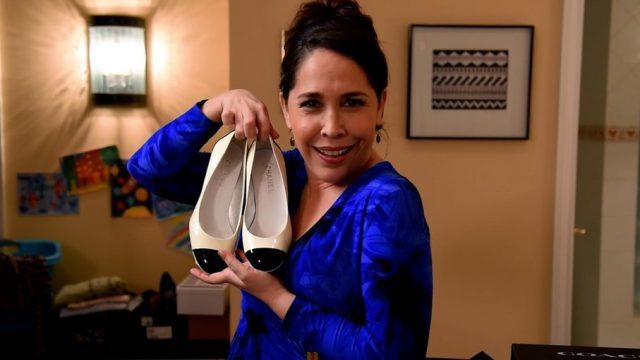
Andréa Burns recounts her sad dating history and love of fancy shoes in virtual reimagining of Theresa Rebeck’s Bad Dates
BAD DATES
George Street Playhouse
Twenty-four-hour stream available on demand through March 14, $33
georgestreetplayhouse.org
George Street Playhouse’s online adaptation of Theresa Rebeck’s Bad Dates is a family affair. Originally performed by Tony winner Julie White at Playwrights Horizons in 2003, the play now features Andréa Burns as Haley Walker, a divorced single mother who, after years of struggling with finances while raising her daughter, Vera, has been promoted to managing the restaurant where she worked as a waitress and is ready to start dating again now that Vera is thirteen. The lively seventy-five-minute monologue is set in the home of George Street Playhouse board member Sharon Karmazin, a producer of such Tony-winning shows as Clybourne Park, Dear Evan Hansen, and The Band’s Visit. It’s directed in person (not over Zoom) by Burns’s husband, Peter Flynn (Curvy Widow, Smart Blonde), the streaming director of Stars in the House, Seth Rudetsky and James Wesley’s daily benefits for the Actors Fund, and filmed and edited by Burns and Flynn’s seventeen-year-old son, Hudson Flynn, the technical director of Stars in the House. (You can watch Burns guest hosting a “Date Night” edition of the series with Peter here.)
Burns (In the Heights, On Your Feet! The Story of Gloria Estefan) is effervescent as Haley, who can’t wait to get back into the dating scene. She agonizes over which shoes to wear — there are several dozen boxes of fancy footwear in her bedroom, along with a box of cold, hard cash — and tries on a parade of dresses. “Okay, this looks good, right? This is very good,” she says, checking herself out in a full-length mirror. “I look like a hooker. Well, maybe I can wear this with a scarf. You know, look like a hooker wearing a scarf.” She wanders from the bedroom to the bathroom to the closet to down the hall to get the unseen Vera’s approval, charmingly blathering on directly into the camera, aware we are watching her every move. She shares details of a series of bad dates, compares her life to that of the fictional Mildred Pierce in Michael Curtiz’s 1945 film, and recognizes her strengths and weaknesses, her successes and failures.
“It seems like I’m the only one who knows anything about how the place works,” she says about the restaurant. “So, you know, finally, the noncriminal Romanians go, ‘To hell with it,’ and they put me in charge because apparently, I’m some sort of weird restaurant idiot savant. Who knew? Born to run a restaurant. Which is exciting, when you find something, that strange combination of who you are and what you can do — to find your gift like that. How many people get that to fall on their head like that? ’Cause I started out being, like, just a waitress trying to support herself and her kid. I was just another person who married a moron and then had a load of shit to deal with.”
She unloads the shit with an infectious demeanor leading up to a surprise ending. A full crew helps make the production a joy, with fab costumes by Lisa Zinni, sharp lighting by Alan C. Edwards, incidental music and sound by Ryan Rummery, grand hair and makeup by Dorothy Petersen, and fun props and sets by Helen Tewksbury. Bad Dates makes for a great date night, streaming through March 14.
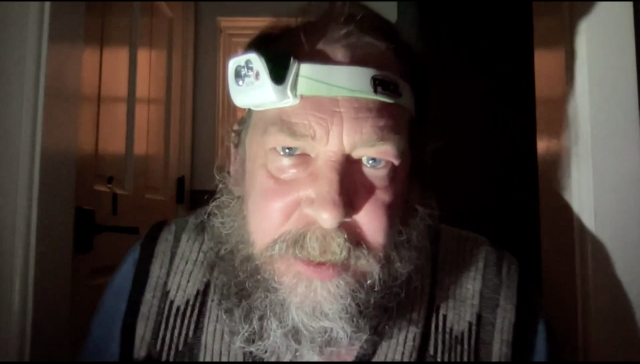
Bill Camp explores his family home in online adaptation of Samuel Beckett short story (photo courtesy Theatre for a New Audience)
FIRST LOVE
Theatre for a New Audience
Available on demand through March 1, free with registration
www.tfana.org
Tony and Emmy nominee and Obie winner Bill Camp is all on his own in JoAnne Akalaitis’s adaptation of Samuel Beckett’s 1946 short story “First Love” for Theatre for a New Audience, streaming through March 1. The seventy-five-minute show takes place in Camp’s family home in Vermont, where he travels through several rooms while telling us his woeful tale of love, loss, and isolation. Camp (The Crucible, The Queen’s Gambit), with his scruffy, scraggly beard and wearing a Petzl headlamp as if he were going spelunking, looks like a hermetic recluse as he lies on the floor, rolls across the wall, and puts his face uncomfortably right up against the screen, speaking with an absurdist tongue.
“I associate, rightly or wrongly, my marriage with the death of my father, in time, That other links exist, on other levels, between these two affairs, is not impossible. I have enough trouble as it is in trying to say what I think I know,” he begins. In the memory play, the wholly unreliable narrator doesn’t understand why he can’t stay in his father’s house after the home is sold, shares why he has “no bone to pick with graveyards,” meets a woman named Lulu on a bench and starts an odd relationship with her, and doesn’t hesitate to talk about his bowel movements and erections. “What mattered to me in my dispeopled kingdom, that in regard to which the disposition of my carcass was the merest and most futile of accidents, was supineness in the mind, the dulling of the self and of that residue of execrable frippery known as the non-self and even the world, for short,” he opines.
Camp is not completely alone in the making of the show, which was rehearsed and filmed over Zoom. The collaboration with Akalaitis also features lighting by Jennifer Tipton, costume and scenery by Kaye Voce, and video design by Eamonn Farrell. (In 2007-8, Camp, Akalaitis, Tipton, and Voce worked together on Beckett Shorts at New York Theatre Workshop.) Camp’s strange adventure through the house is captured by three carefully positioned laptop cameras, one of which is sometimes picked up and carried by him, giving the piece a Blair Witch Project feel. Throughout, the narrator is on edge, literally and figuratively, Camp daring us to look away, but we can’t. And this is the only chance we get to see this version of First Love.
“If theaters opened up tomorrow, I wouldn’t do this on the stage: It’s made specifically for Zoom and our times, and very do-it-yourself,” Akalaitis notes in the program. “Part of my wanting to do it is to acknowledge that the world has changed. One of the big game players in cultural change was Samuel Beckett, to whom I owe so much. It just felt right to put this work by a young, war-damaged Beckett — this mean-spirited, mordant, misanthropic piece from the point of view of this fucked up, misogynist character — in the hermetic setting of Zoom.” You can learn more about the production in two Q&As with the cast and crew here.
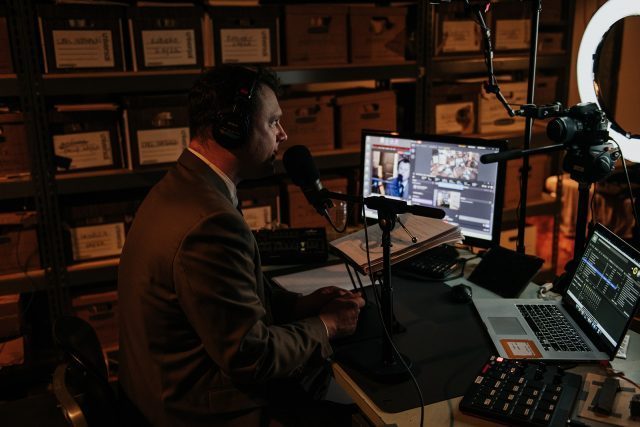
Michael Guagno reprises his stage role in Letter to My Father for livestreamed production (photo by Eileen Meny Photography)
FRANZ KAFKA’S LETTER TO MY FATHER
M-34
Fridays at 7:00 and Sundays at 3:00 through March 28, free with registration (suggested donation $15)
www.m-34.org/kafka
In May 2012, M-34 premiered Letter to My Father, a one-man show adapted and directed by James Rutherford and performed by Michael Guagno, the latter sitting at a desk with a microphone and computer at the Magic Futurebox theater in Brooklyn. He reads Hannah Stokes and Richard Stokes’s translation of a 1919 letter Franz Kafka wrote to his father, Hermann, a ritual slaughterer; it’s a dark, deeply personal, and disturbing confession that his father never saw. Rutherford and Guagno have now adapted the work for the internet, presenting the show Friday nights and Sunday afternoons through March 28.
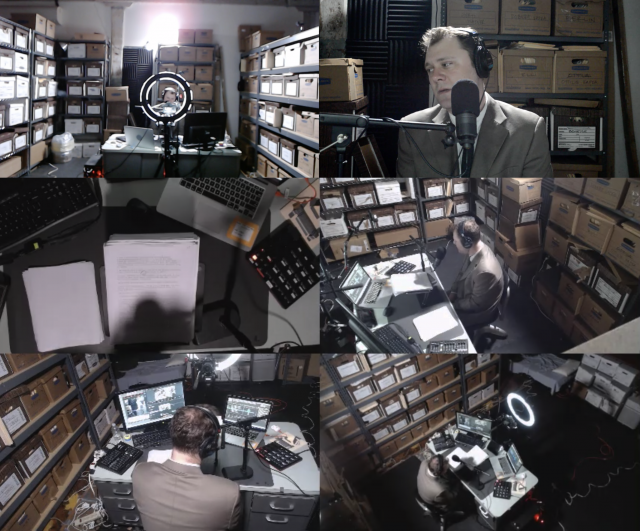
The seventy-five-minute play streams live from a cramped, crowded room in M-34’s rehearsal space in Industry City in Brooklyn; the set, designed and lit by Oona Curley and Stacey DeRosier, is filled with rows and rows of boxes organized in a Kafkian manner on shelves. Some of the boxes come with a Kafka-like warning on them: “Contents: From: Destruct:” In a far corner, a mattress is on the floor, and closer to the center is a desk with two computers and a large microphone.
The interactive streaming platform allows each audience member to choose from three feeds: one straight-on view of Guagno at the desk, a second shot from the side (and sometimes upside down), and a third that consists of four different views that are harder to make out, not as crystal clear as the others. You can decide how to arrange the three feeds on your screen, and you also have the choice to watch only one feed at a time by switching over to Twitch. (Don’t worry; it’s easy to get back, and an instructional video is sent with the link.) There’s also a live chat associated with each view, although the night I attended, no one used it. As much as I love live chats during some shows, this one truly requires your attention; headphones are highly recommended, as is closing all other browser windows and turning off your cell phone, just like you were in an actual venue.
Guagno casually flips the pages of the long diatribe, which has been annotated just like the actual letter, but he knows the text so well he is not merely reading the words. When the stream begins, it takes a few minutes to figure out what is going on; don’t worry that you’re doing anything wrong with the controls, as things will soon become more explicit. Guagno eventually crawls out of bed, goes over to the desk, and delivers the opening lines of the letter:
“You asked me recently why I claim to be afraid of you. I did not know, as usual, how to answer, partly for the very reason that I am afraid of you, partly because an explanation of my fear would require more details than I could even begin to make coherent in speech. And if I now try to answer in writing it will still be nowhere near complete, because even in writing my fear and its consequences raise a barrier between us and because the magnitude of material far exceeds my memory and my understanding.”
Ominous sounds and foreboding music by Dave Harrington hover over the scene as Guagno brings up memories of humiliation, guilt, contempt, powerlessness, defenselessness, and “an orgy of malice,” suffering psychological and physical parental abuse no child should encounter. When he quotes the father specifically, Guagno clicks on a keyboard that triggers a prerecorded, deeper voice, as if Hermann were suddenly in the room, overwhelming Kafka again. “Not a word in contradiction!” the father demands. “I’ll gut you like a fish,” he threatens.
Kafka’s recounting of life under his father’s thumb is done not so much to assign blame but to explain how the writer became who he is. It’s not a stretch to rethink such Kafka works as The Trial, The Metamorphosis, A Hunger Artist, and the unfinished The Castle in light of this filial relationship. One example gets to the heart of the matter:
“There is only one episode from those early years that I remember directly, perhaps you remember it too. I was whining persistently for water one night, certainly not because I was thirsty, but in all probability partly to be annoying, partly to amuse myself. After a number of fierce threats had failed, you lifted me out of my bed, carried me out onto the pavlatche and left me awhile all alone, standing outside the locked door in my nightshirt. I do not mean to say that this was wrong of you, perhaps at that time there really was no other way of having a peaceful night, but I mention it as a characteristic example of the way you brought me up and the effect it had on me. This incident almost certainly made me obedient for a time, but it damaged me on the inside. I was by nature unable to reconcile the simple act (as it seemed to me) of casually asking for water with the utter horror of being carried outside. Years later it still tormented me that this giant man, my father, the ultimate authority, could enter my room at any time and, almost unprovoked, carry me from my bed out onto the pavlatche, and that I meant so little to him.”
Guagno is appropriately efficient in his performance; the haunting specter of Kafka’s father lingers in the air, exacerbating the already claustrophobic nature of the production, which features media design by
Lacey Erb, technology design by Casey Robinson, and technical direction by David Rudi Utter. When the feeds grow ever-so-slightly out of sync as the end approaches, that is not a glitch but a look further inside Kafka’s troubled mind.
Like Bad Dates and First Love, this adaptation of Letter to My Father could only exist in a virtual setting. The productions are not film or theater but a new hybrid format that should outlive the pandemic. All three shows deal with issues of belonging, isolation, and family crises that are crucial to this unique moment in history; though written by different writers at different times for distinct purposes, together they feel of a piece, a kind of trilogy that reveals a little of all of us as we face personal loss as well as that of in-person theater.