twi-ny recommended events

OLD VIC: IN CAMERA — A CHRISTMAS CAROL

Andrew Lincoln shines a light on a different aspect of Scrooge’s psyche in Old Vic adaptation (photo by Manuel Harlan)

A CHRISTMAS CAROL
The Old Vic, London
Through December 24, £10-£65
www.oldvictheatre.com

For its fourth “In Camera” presentation, the Old Vic has revived Jack Thorne’s 2017 reimagining of Charles Dickens’s A Christmas Carol, which moved to Broadway in fall 2019 and plans to return next holiday season. Thorne’s bold adaptation minimizes the traditional ghost story elements and instead develops a narrative that focuses on Ebenezer Scrooge’s childhood trauma (George Samuel Townsend plays him as a boy, Andrew Lincoln as an adult) and how it influenced his development into the greedy, heartless man he now is — revealing the psychological damage wrought by a demanding, overbearing father (Michael Rouse), never mentioned in Dickens’s original; the boy’s relationship with his adored sister, Fan (Melissa Allan), named only once by Dickens; and his one chance at love with Belle (Gloria Obianyo), the daughter of his employer, Mr. Fezziwig (Clive Rowe), who in this version runs a funeral parlor, although Dickens himself never elucidates Fezziwig’s business.

The heart-tugging Cratchit family — Scrooge’s clerk, Bob (John Dagleish), Bob’s wife (Maria Omakinwa), and their children, including the lame Tiny Tim (Rayhaan Kufuor-Gray, Lara Mehmet, Lenny Rush, or Eleanor Stollery) — is almost an afterthought in Thorne’s retelling, while Scrooge’s deceased partner, Jacob Marley (Rouse), is given more prominence, as is Scrooge’s nephew, Fred (Eugene McCoy). The Ghosts of Christmas Past, Present, and Future are portrayed by a trio of women (Julie Jupp, Golda Rosheuvel, and a surprise third character) who are not daunting spirits but rather have much more intimate connections with Scrooge.

Old Vic’s “In Camera” livestreamed production of A Christmas Carol follows Covid-19 protocols (photo by Manuel Harlan)

The Old Vic’s “In Camera” series, live plays streamed direct from its London stage, adhering to all Covid-19 protocols and performed without an audience, previously offered very short runs of Brian Friel’s Faith Healer with Michael Sheen, David Threlfall, and Indira Varma, Stephen Beresford’s Three Kings with Andrew Scott, and Duncan MacMillan’s Lungs with Claire Foy and Matt Smith. Helmed by Tony-winning artistic director Matthew Warchus (Matilda, God of Carnage), A Christmas Carol is riveting theater for most of its two-hour length. The action is filmed with multiple cameras that give tantalizing close-ups as well as long views, while the tech crew often utilizes split screens so expertly that it’s sometimes difficult to figure out whether actors are actually next to each other or are socially distancing, especially during several handshakes.

Lincoln (The Walking Dead, Parlour Song) is sensational in one of the most familiar roles ever written, playing Scrooge as a flawed human being rather than a brutally cold and unforgiving ogre. It’s a welcome change, as are the changes brought to other minor characters, with stand-out performances by Obianyo, Rowe, and Rosheuvel. The cast also features Rosanna Bates as Jess, Tim van Eyken as Nicholas, and Sam Lathwood as Ferdy. This is not your grandparents’ Christmas Carol.

The set by Rob Howell, who also designed the period costumes, is anchored by a slotted-wood floor, with frames without doors through which characters enter and exit and dozens of lanterns hanging from the ceiling. At the 2017-19 in-person shows, audience members received clementines and cookies; the Old Vic tries to maintain a level of interactivity by having an online quiz that begins about an hour before the play starts and by providing a family activity pack that can be downloaded for free here.

Which brings us to the ending. Throughout the show, Christmas carols are played by a masked band in the balcony, consisting of pianist and musical director Will Stuart, cellists Christopher Allan and Pedro Vieira da Silva, violinist Clare Taylor, and clarinetist Martin Robertson. The songs often get in the way of the narrative, especially with Thorne’s (Harry Potter and the Cursed Child, His Dark Materials) unexpected twists, but it all becomes particularly annoying when the music, acting, and staging all combine to go way over the top during Scrooge’s rethinking of what Christmas means. What was a gripping, tense tale instantaneously lapses into a tired traditional holiday finale, turning its back on everything that came before. It had challenged what we know about this classic story but then settled for the lowest common denominator for its conclusion, which is a shame. Or, of course, I’m just being a scrooge. Bah, humbug.

PAM TANOWITZ DANCE: FINALLY UNFINISHED PARTS 1 & 2

Pam Tanowitz Dance’s Finally Unfinished streams from the Joyce through December 26

JoyceStream
The Joyce Theater
December 12-26, $13
www.joyce.org
pamtanowitzdance.org

Pam Tanowitz Dance (PTD) continues its digital site-specific season with Finally Unfinished: Part I, streaming from the Joyce through December 26. During the pandemic, with theaters emptied by health restrictions, the Bronx-born Tanowitz, who was a 2013 Joyce Residency Artist, has created several outdoor works that take dance fans and performers outside. David, a solo for American Ballet Theater principal dancer David Hallberg as part of “ABT Today: The Future Starts Now,” is set at the Glass House in New Canaan, while Solo for Russell: Sites 1-5, a solo for New York City Ballet principal dancer Russell Janzen for NYCB’s New Works Festival, guided viewers around the Lincoln Center campus, from the Illumination Lawn to the Damrosch Park Bandshell. (In June 2019, Tanowitz’s Time is forever dividing itself toward innumerable futures took place in several locations in Nelson A. Rockefeller Park in Battery Park City for the 2019 River to River Festival.)

Now Tanowitz has returned to the Joyce Theater, where she has presented such works as Passagen and Heaven on One’s Head in February 2014, Sequenzas in Quadrilles and the story progresses as if in a dream of glittering surfaces in September 2016, and New Work for Goldberg Variations in December 2019, with a multipart show created specifically for online viewing through JoyceStream. Made following Covid-19 protocols during a residency on Governors Island, the work, following an iteration livestreamed from the Annenberg Center in Philadelphia on October 15, is a “flexible dance piece” that is set in and around the Joyce, from the proscenium stage to the wings, from the aisles to the balcony.

“We finally finished Finally Unfinished, but it’s never really finished,” Tanowitz announces before the curtain literally rises on Jason Collins, Christine Flores, Zachary Gonder, and Victor Lozano, who perform Gustave Le Gray, No. 2 on an empty stage. The four barefoot dancers, wearing tan shorts and T-shirts designed by Reid Barthelme and Harriet Jung, move gingerly in unison to a score by Caroline Shaw played by pianist Amy Yang; the camera shoots them from multiple angles, with closeups of their bare legs and long shots from the back of the theater.

After ten minutes, they are joined by Brittany Engel-Adams, Lindsey Jones, and Melissa Toogood for the explosion that is Finally Unfinished: Part 1. Amid piped-in crowd noises (“Field Recordings” by Dan Siegler) and recordings of cues from PTD’s 2014 appearance at the Joyce (“Cueing Sound Score,” with the disembodied voices of Laurie Benoit and Jeff Segal), Toogood takes over the stage, dressed in a full-length space-age onesie with a hood, followed by a masked cameraman in the same outfit. Soon everyone has changed costumes (including some garb that incorporates the design and color of the seats in the audience, the curtain, and the carpeting) as they dance to “Furtive Movements,” an electronic score by Ted Hearne, performed by cellist Ashley Bathgate and percussionist Ron Wiltrout. It all builds to an exhilarating crescendo until a peaceful and quiet finale with, of course, no applause.

But it’s not quite over; Finally Unfinished: Part II continues online with what PTD calls “a Digital Curio Case.” Designed by Jeremy Jacob and beginning with old footage of a clapping crowd, Part II reveals some of Tanowitz’s inspirations and creative process, including text (“Nowhere is a dead end”), cutouts of the dancers, a collection of clips from films in which characters perform playful dances using their fingers on a table (The Gold Rush, A Band Apart, Benny & Joon), a behind-the-scenes look at costumes by Barthelme and Jung and scenery by Suzanne Bocanegra, recommended reading, and more.

From the dances to the multimedia scrapbook, it’s a judicious and entertaining tribute to the Joyce using the internet as medium during a health crisis that has left us all in front of our screens, unable to experience dance and other live entertainment in person. As Tanowitz says, “It’s a different format now. / What format should it be? / We finished it for you. / It’s never finished for me.”

STAND WITH TEACHERS

Who: Stevie Van Zandt, Eddie Vedder, Margo Price, Bruce Springsteen, Sammy Hagar, Steve Buscemi, Bobby Cannavale, Lowell Levinger, Matisyahu, Whoopi Goldberg, Melle Mel, Tom Morello, Edward Norton, Vincent Pastore, Maureen Van Zandt, Trønd Fausa Aurvåg, Steinar Sagen
What: Holiday fundraiser for TeachRock
Where: TeachRock
When: Monday, December 21, $25-$150, 8:00
Why: “Little Steven’s TeachRock program brings an essential curriculum of music and culture into school and makes it available at no cost to educators. In a time of cutbacks in arts funding, Steve’s programs are keeping kids engaged in the arts, and in school — this is his greatest legacy,” Bruce Springsteen said about his longtime E Street Band cohort Stevie Van Zandt’s TeachRock, an organization dedicated to teaching arts, and specifically popular music, in schools. Part of the nonprofit Rock and Roll Forever Foundation, TeachRock has adapted to remote learning by making available special lesson packages for children of all ages.

On December 21 at 8:00, Van Zandt and TeachRock will host a benefit fundraiser highlighted by performances by board members Springsteen and Jackson Browne, Eddie Vedder, Margo Price, and Matisyahu in addition to appearances by Sammy Hagar, Steve Buscemi, Bobby Cannavale, Whoopi Goldberg, Melle Mel, Tom Morello, Edward Norton, Vincent Pastore, Maureen Van Zandt, and, from Lillyhammer, Trønd Fausa Aurvåg and Steinar Sagen. Tickets are $25 or $150 to get your name added to the TeachRock Solidarity Wall. “Music connects us, even when we must be apart,” Van Zandt said in a statement. “Our amazing teachers stood by us and provided structure, emotional support, and a reassuring sense of normalcy to our children during Covid. Now we’re going to stand with teachers and provide them the resources they need to keep kids engaged, emotionally healthy, and learning.” The hourlong event will be followed by a Holiday Video Jukebox featuring songs by Little Steven and the Disciples of Soul, Darlene Love, Dean Frasier, and others.

HOMESICK

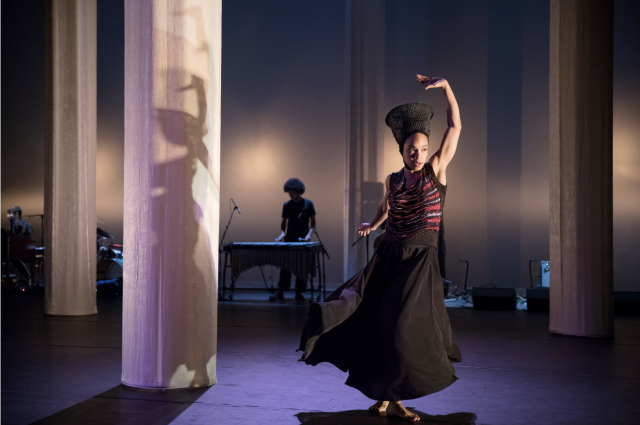
Danielle Agami looks deep inside herself in Homesick (photo courtesy Source Material)

HOMESICK
December 20 – January 10, $10-$25 (pay-what-you-can)
www.homesickthefilm.com
www.sourcematerialcollective.com

Israeli-born, LA-based dancer and choreographer Danielle Agami has reimagined her autobiographical solo piece, Framed, which had its world premiere in May 2018 at NYU Tisch School of the Arts, as the fifteen-minute film Homesick, streaming online December 20 to January 10. In the work, she looks deep inside herself as a woman and a creator, asking such questions as “What is expected for me to provide? Will dance be enough? Am I enough?” Directed by Samantha Shay and photographed by Victoria Sendra for Source Material, Homesick follows Agami as she moves from her apartment to a bar (where she is served by real-life Icelandic cocktail bartender Martin Cabejsek) to an indoor flower market (where she is joined by Jordan Klitzke) to a vast outdoor landscape and, as an encore, around Jerry Moss Plaza at the Music Center in LA.

For much of the film, Agami, a former Batsheva dancer and gaga teacher who has run Ate9 Dance Company since 2012, first in Seattle, then in LA, changes between a black negligee, head shaved, to regular clothing and fuller hair, moving in fits and starts on her hands and knees, shaking her head in trancelike gestures, petting a cat, and extending her arms as if searching for freedom and love. “For me, there are two kinds of home,” she narrates. “There is the outer, and the inner. When I feel safe and peaceful in my surroundings and my mind, I feel at home, and everything falls into place.” Agami dances to a pair of haunting songs by Iceland-based Danish musician Sara Flindt, aka ZAAR, “Homesick” and “How Many Hearts.” The film is followed by a Q&A with Agami (Pick a Chair, calling glenn), Shay (In These Uncertain Times, Light), Sendra, and Flindt, moderated by CalArts professor of dance cinema Francesca Penzani.

GOODBYE, DRAGON INN

Tsai Ming-liang’s Goodbye, Dragon Inn is a poignant, poetic farewell to the cinema

GOODBYE, DRAGON INN (Tsai Ming-liang, 2003)
Metrograph Digital
Opens virtually December 18
metrograph.com

Taiwanese master Tsai Ming-liang’s Goodbye, Dragon Inn is a heart-stirring elegy to going to the movies, now streaming in a gorgeous 4K restoration at Metrograph Digital. The accidentally prescient 2003 film takes place in central Taipei in and around the Fu-Ho Grand Theater, which is about to be torn down. For its finale, the Fu-Ho is screening King Hu’s 1967 wuxia classic Dragon Inn, Hu’s first work after moving from Hong Kong to Taiwan; the film is set in the Ming dynasty and involves assassins and eunuchs.

In 2020, Tsai’s film seems set in a long-ago time as well. It opens during a crowded showing of Dragon Inn in which Tsai’s longtime cinematographer, Liao Pen-jung, places the viewer in a seat in the theater, watching the film over and around two heads in front of their seat, one partially blocking the screen, which doesn’t happen when viewing a film on a smaller screen at home — especially during a pandemic, when no one is seeing any films in movie theaters. Right now, Goodbye, Dragon Inn takes on a much bigger meaning, particularly since Warner Bros. recently announced that all its 2021 movies will be streamed, although they’ll play in theaters where allowed. The lockdown has changed how we experience movies forever.

Most of the film focuses on the last screening at the Fu-Ho, with only a handful of people in the audience: a jittery Japanese tourist (Mitamura Kiyonobu), a woman eating peanuts or seeds (Yang Kuei-mei), a young man in a leather jacket (Tsai regular Chen Chao-jung), a child, and two older men, played by Jun Shih and Miao Tien, who are actually the stars of the film being shown. (They portray Xiao Shao-zi and Pi Shao-tang, respectively, in Dragon Inn.) In one of the only scenes with dialogue, Miao says, “I haven’t seen a movie in a long time,” to which Chun responds, “No one goes to the movies anymore, and no one remembers us anymore.”

The tourist, a reminder of Japan’s occupation of Taiwan from 1895 to 1945, spends much of the movie trying to find a light for his cigarette — a homoerotic gesture — as well as a better seat, as he is constantly beset by people sitting right next to him or right behind him and putting their bare feet practically in his face or noisily crunching food, even though the large theater is nearly empty. In one of the film’s most darkly comic moments, two men line up on either side of him at a row of urinals, and then a third man comes in to reach over and grab the cigarettes he left on the shelf above where the tourist is urinating. Nobody says a word as Tsai lingers on the scene, the camera not moving. In fact, there is very little camera movement throughout the film; instead, long scenes play out in real time as in an Ozu film, in stark contrast to the action happening onscreen.

Meanwhile, the ticket woman (Chen Shiang-chyi), who has a disabled foot and a severe limp, cleans the bathroom, slowly steams and eats part of a bun, walks down a long hallway, and brings food to the projectionist (Tsai mainstay Lee Kang-sheng). She is steeped in an almost unbearable loneliness; she peeks in from behind a curtain to peer at the few patrons in the theater, and at one point she emerges from a door next to the screen, looking up as if she wishes to be part of the movie instead of the laborious life she’s living.

A woman (Chen Shiang-chyi) works during the final screening at the Fu-Ho Grand Theater in Goodbye, Dragon Inn

In his Metrograph Journal essay “Chasing the Film Spirit,” Tsai, whose other works include Rebels of the Neon God, The River, The Hole, and What Time Is It There? — which has a scene set in the Fu-Ho, where he also held the premiere — writes, “My grandmother and grandfather were the biggest cinephiles I knew, and we started going to movies together when I was three years old. We would go to the cinema twice a day, every day. Sometimes we would watch the same film over and over again, and sometimes we would find different cinemas to watch something new. That was a golden age for cinema, and I’m proud my childhood coincided with that time.”

He continues, “Nowadays everyone watches movies on planes. On any given flight, no matter the airline, you can choose from hundreds of films: Hollywood, Bollywood, all different types of movies. However, you can count on one thing: You’ll never find a Tsai Ming-liang picture on a plane, as I make films that have to be seen on the big screen.” Unfortunately, in 2020, we currently have no choice but to watch Goodbye, Dragon Inn on a small screen, but watch it you must; it’s a stunningly paced elegiac love letter, and even more essential during a pandemic, when we are all forced to watch films from the safety of our homes, our only seatmates those we are sheltering in place with. Already we were watching more films than ever on our private screens and monitors — as well as on airplanes — but it will be quite a while before we again participate in the communal pleasure of sitting in a dark theater with dozens or hundreds of strangers, staring up at light being projected onto a screen at twenty-four frames per second, telling us a story as only a movie can. What I wouldn’t give right now to be in that theater, a head partially blocking my view, bare feet in my face, someone crunching too loudly right behind me.

MUSEUM TOWN

Laurie Anderson entertains art lovers at MASS MoCA in Museum Town

MUSEUM TOWN (Jennifer Trainer, 2020)
BAM Film
Opens virtually Friday, December 18, $12
www.museumtownmovie.com
www.bam.org

Back in August, desperate to get out of New York City and see some art amid the pandemic lockdown, my wife and I headed north to the Berkshires to MASS MoCA and the Clark Institute, two museums that had reopened with timed tickets, limited capacity, mask wearing, and social distancing. It was my second visit to MASS MoCA and my wife’s first to the extraordinary institution, whose complicated story is told in Jennifer Trainer’s debut documentary, Museum Town, which releases virtually through BAM on December 18. (You can read about our trip here.)

After watching the film, you’ll be ready to head north as well, even though New York museums are now open. As it says on one of Jenny Holzer’s marble benches at MASS MoCA, “Words tend to be inadequate.” You have to see it to believe it.

Trainer notes her unique relationship with the museum at the start: “In 1986, I moved from Manhattan to the Berkshires as a freelance journalist. I soon caught wind of a preposterous idea to turn an old factory into the world’s largest museum of contemporary art and broke the story for the New York Times. Then I signed on to help. Building MASS MoCA from the ground up consumed the next twenty-eight years of my life. . . . I’ve moved on from the museum, but I knew I had to finish writing the story I’d started nearly three decades ago. It was simply too big, too beautiful, too improbable to leave untold.”

Trainer and cowriters Noah Bashevkin and Pola Rapaport reveal it’s all those things and more, going back to the sprawling location’s beginnings as Arnold Print Works, which operated from 1860 to 1942, then as the Sprague Electric Company from 1942 to 1985, whose sudden and unexpected closure decimated the town. But then Thomas Krens, the former director of the Williams College Museum of Art, had the idea of turning the industrial complex into a contemporary art museum, and Williams graduate Joseph C. Thompson joined him in what the latter called “a radical rethinking of what a museum could be.” (Krens and Thompson became founding directors of MASS MoCA, a position Thompson held for thirty-three years.) That astonishing idea sparked ongoing economic and political battles over the value of such an institution for the town of North Adams, which was not a bastion of modern-art lovers. “It was hell on earth to get open,” Thompson remembers.

The residents of the struggling working-class town were not exactly keen on the plan. “People in North Adams are not ready for this,” recalled museum volunteer Ruth Yarter, who had been working at Sprague since 1943, while she was still in high school. Amid the location’s fascinating history, some of which is narrated by Meryl Streep, Trainer focuses in on some of the remarkable art that has been installed in large warehouse spaces, in nooks and crevices, and in gravity-defying outdoor spaces, including Primary Separation, a sculpture by Don Gummer, Streep’s husband.

“MASS MoCA isn’t so concerned about the art world and the museum world. What it really wants to do is make art happen,” curator Denise Markonish says, and much of it is art that can’t happen anywhere else; MASS MoCA thrives on allowing artists to take risks. Trainer shows temporary and long-term installations by Louise Bourgeois, Laurie Anderson, Sol LeWitt, Spencer Finch, Franz West, Joseph Beuys, Michael Oatman, and others — seeing James Turrell testing out his immersive Into the Light room is a special treat — and doesn’t shy away from the controversy surrounding Christoph Büchel’s Training Ground for Democracy, a fierce court fight about creative control over the unfinished work.

Nick Cave surveys the future home of his massive installation “Until” in Museum Town

Interspersed throughout the documentary is an irresistible behind-the-scenes look at the installation of American multidisciplinary artist Nick Cave’s 2016-17 “Until,” a vast, fantastical landscape of found objects, chandeliers, crystals, lawn jockeys, and myriad other items that address racism, gun violence, police brutality, and gender issues; the name of the exhibition comes from the phrase “innocent until proven guilty.” (You can see my photos here.)

“This is just this place of imagination and dreaming,” Cave says as he works with a large staff from the museum, including director of fabrication and art installation Richard Criddle and fabricator Megan Tamas, to make the seemingly impossible come to life, revealing that collaboration is an art form itself.

MASS MoCA also hosts live events in its unusual spaces, so Trainer has filled the documentary with an impressive soundtrack featuring songs by Bill Callahan, Wilco, Sharon Jones & the Dap-Kings, David Byrne (whose exhibition “Desire” ran at the museum in 1996), Ruthie Foster, the War on Drugs, Lucius, and others in addition to an original score by John Stirratt and Paul Pilot.

“How the hell did it happen?” architect Simeon Bruner asks at the beginning of the film. Thanks to Trainer, now we know.

THE LONG GOODBYE: ONLINE EDITION

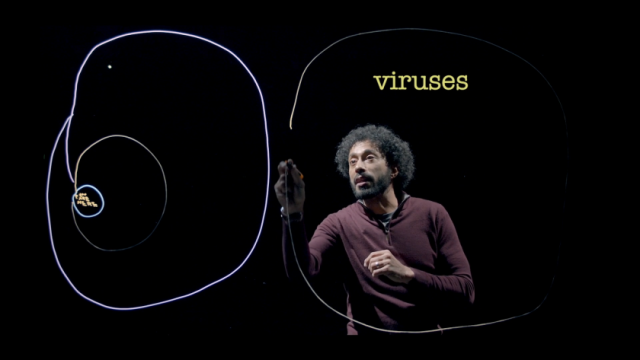
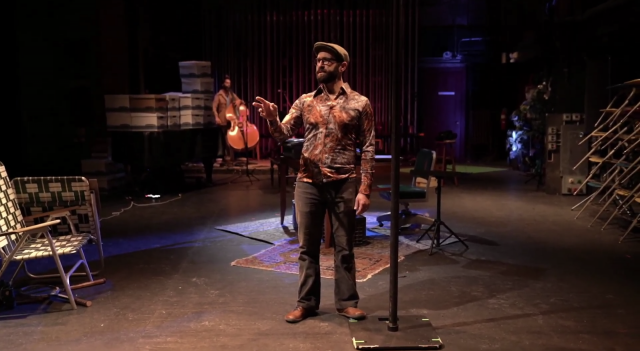
Actor, activist, and rapper Riz Ahmed takes viewers on a personal journey of music and storytelling in one-time-only livestream of The Long Goodbye

Who: Riz Ahmed
What: One-man show with music and stories
Where: BAM, Manchester International Festival
When: Saturday, December 19, $6.75 – $27 (pay-what-you-feel), 3:00
Why: Back in March, British actor, musician, and activist Riz Ahmed was scheduled to premiere his one-man show, The Long Goodbye, at the Manchester International Festival, followed by a run at BAM this fall, but the pandemic lockdown scrapped those plans. Emmy winner Ahmed has appeared in such films as Nightcrawler, Sound of Metal, and his latest, Mogul Mowgli, such television shows as Dead Set, The Night Of and The OA, and such plays as Stephen Adly Guirgis’s Jesus Hopped the ‘A’ Train and the opera Gaddafi in addition to being a founding member, known as Riz MC, of the hip-hop band Swet Shop Boys, which has released the full-length record Cashmere and the EPs Swet Shop and Sufi La. This past March, he released the concept album The Long Goodbye, featuring such tracks as “The Breakup (Shikwa),” “Can I Live,” “Deal with It,” and “Karma,” with such special guests as Mindy Kaling, Mahershala Ali, and Hasan Minhaj. You can check out his latest video, “Once Kings,” here.

Ahmed combines all those talents in his virtually reimagined The Long Goodbye: Online Edition, streaming live one-time-only on December 19 at 3:00. Co-commissioned by MIF and BAM, the thirty-minute presentation is a companion piece to the full show, which has been postponed to 2021, once theaters are allowed to open and welcome audiences once again. Directed by Kirsty Housley with sound by Gareth Fry, the show is a personal journey with live music and storytelling that asks the question: “How did we get here?” Tickets are $6.75 to $27 based on what you can pay, but they are very limited, so act now if you want to catch what should be a unique, compelling experience.