twi-ny recommended events

STRAY

Keytin takes Elizabeth Lo on an amazing journey in Stray

STRAY (Elizabeth Lo, 2020)
Film Forum Virtual Cinema
Opens Friday, March 5
filmforum.org/film/stray
www.straymovie.com

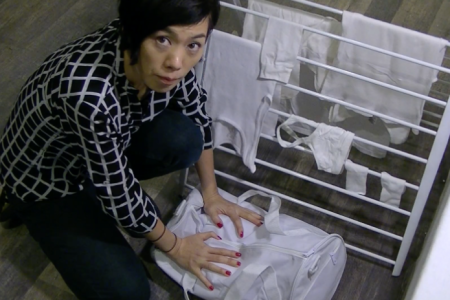
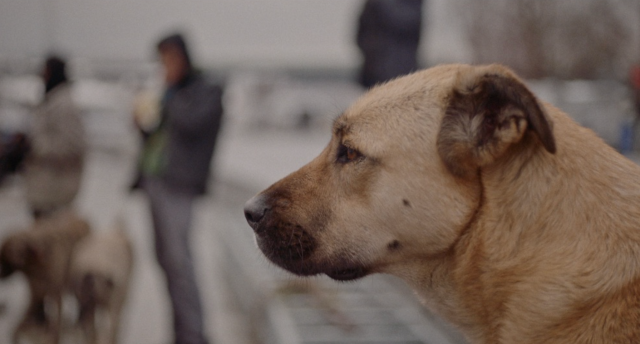
You can have Sounder, Old Yeller, and Lassie, cheer on Balto, Benji, and Beethoven. But the best movie dog ever is Keytin, the extraordinary golden mutt who is the star of Elizabeth Lo’s masterful feature-length debut, Stray. Lo follows the remarkable canine as she wanders through the streets of Istanbul and other parts of Turkey, living a dog’s life, in a place that until fairly recently would regularly round up strays and euthanize them mercilessly. Everywhere she goes, she meets up with people she knows and who love her, from a dock to a dangerous construction site; she also plays with such puppy pals as Nazar and Kartal. Keytin scavenges for food, cuddles up with homeless refugee children from Aleppo, relaxes amid traffic, and chases a cat, all with a look in her eyes that reveals great depth and understanding that humans can only dream of. The film was born out of loss; Lo notes in her director statement, “The impetus for Stray is personal. When my childhood dog died, I felt a quiet need to suppress my grief at his passing. I was shocked that something as personal as how my heart responds to the death of a loved one could be shaped by an external politics that defined him or ‘it’ as ‘valueless.’ As my grief evolved, I also saw how our moral conceptions of who or how much one matters can be in constant flux. This transformative moment is what propels Stray’s exploration into value, hierarchy, and sentience.”

The pandemic has only increased the meaning of pets in our lives, as if we needed more reasons to worship them. For many people, their dogs and cats have been their sole companions while sheltering in place, and it is devastating every time someone posts on social media that their dog or cat has passed — to say nothing of friends and relatives who have been stricken with the coronavirus and did not survive. Crouching down to get the dog’s perspective, Lo filmed the independent, purposeful Keytin for six months, with no choice but to let the confident canine guide the action as they encounter class, ethnic, and gender differences while making deep connections with everyone Keytin comes into contact with — a connection the audience will make as well, especially if they are watching the film at home, all alone. The soundtrack mixes a splendid score by Ali Helnwein with snippets of poignant conversation overheard on Keytin’s journeys, accompanied by occasional intertitles with wise, relevant quotes by Diogenes and Themistius, including “Human beings live artificially and hypocritically and would do well to study the dog.” As I said, Best. Movie. Dog. Ever. Stray begins streaming March 5 via Film Forum Virtual Cinema, complete with a conversation between Lo and filmmaker Rachel Grady and a Q&A with Lo and Joanne Yohannan from the North Shore Animal League, moderated by film critic Tomris Laffly.

POST THEATRICAL: PARTY LINE

PARTY LINE
Let’s Make a Theatre Company
March 8-15, pay-what-you-can
Tickets must be purchased by March 7
www.posttheatrical.org

With venues shuttered since last March, theater companies have come up with different, creative — and, in some cases, old-fashioned — ways of presenting works. On Site Opera’s To My Distant Love, Woolly Mammoth’s Human Resources, and 600 Highwaymen’s A Thousand Ways (Part One): A Phone Call took place over the telephone, while Ars Nova’s P.S. consists of a year of letters between two childhood friends, arriving every few weeks in the mail.

Purchase professor Scott Adkins and his Let’s Make a Theatre Company, formed last April during the pandemic, use both methods of delivery for Party Line, running March 8-15 and part of Post Theatrical, a festival of durational works from Pittsburgh’s RealTime Interventions that unfold through letters. In the 1930s and 1940s, communities used party lines, local telephone circuits in which users could hear other people’s conversations, resulting in the spread of gossip and other information (and misinfornmation). In Party Line, audience members receive a prerecorded phone call, via a robo-call platform, every night for eight days at 8:00, lasting between two and ten minutes each as an audio narrative evolves. In addition, they receive a self-addressed stamped envelope to correspond with any character of their choosing — who will write back. Of course, with the postal system experiencing historic delays, there’s no guarantee how long this part of the work will take, and it’s ironic given how many Americans have spent much of the crisis either sanitizing the mail or putting it aside for a while before opening it.

Adkins (Lakeview Terrace, TupuTupuTupu) wrote and directed the play, which features Ellen Walz, Chris Padro, Shavell Fernandez, Peter Moriarty, Sara Meade, Trevor Vaughan, Izzy Hamboussi, and Leah Bickley, with sound design and engineering by Gavin Price. Pay-what-you-can tickets must be purchased by March 7. Other Post Theatrical shows include the Wallpaper Company’s All Light on Earth Comes from Somewhere Else, New Georges’ Dream/Home, and Melisa Tien’s The Community Forest.

LUDIC PROXY: FUKUSHIMA

Japan Society: Online Contemporary Theater
Saturday, March 6, 9:30; Sunday, March 7, 4:30; Thursday, March 11, 8:00 (followed by a live Q&A), $15
Available on demand March 12—26, $15
www.japansociety.org
ayaogawa.com

In 2015 at Walker Space, Tokyo-born, Brooklyn-based playwright, director, performer, and translator Aya Ogawa debuted Ludic Proxy, a three-part immersive, apocalyptic play that takes place in the past (Pripyat, post-Chernobyl), the present (Fukushima, post-disaster), and the future (New York, underground). Ogawa has now adapted the middle section for the virtual multimedia production Ludic Proxy: Fukushima, streaming live through Japan Society on March 6, 7, and 11 (and available on demand March 12-26). The title, a phrase coined by a game designer, “refers to the phantom knowledge of something or somewhere real gained through game play,” Ogawa explains in a video about the reimagining. Originally commissioned by PlayCo in 2010, Ogawa was inspired to write Ludic Proxy following the 2011 Great East Japan Earthquake, tsunami, and nuclear disaster in Fukushima Prefecture, the death of her mother, and the birth of her second child. “The collision of [these personal life-changing events and the global disasters] created the foundation for this play. And it made me really think about, How does the intrinsic human tendency to play, to want to play, help us process the catastrophes that we experience in life?” she adds. The three-act play gave the audience the opportunity to help direct the narrative, like a choose-your-own-adventure story; that component will be adapted for the virtual presentation, about two sisters (Saori Tsukada as Maho and Yuki Kawahisa as Maki) in Fukushima. Online viewers will be asked to vote on what one of the sisters, an avatar for the audience, says and does, meaning that every live performance is unique.

Live, online show features interactive component for audience to help steer the action (photo © Ludic Proxy: Fukushima 2021)

“During this almost year that we’ve been living through this pandemic, I’ve really been thinking about the Fukushima section,” Ogawa continues. “It has audience interaction built into it that translates naturally to a digital platform but also there is something newly resonant about its premise today in 2021.” The sisters are attempting to connect in a way that relates to the problems so many American families are having today amid different belief systems involving politics and Covid-19, while honoring the tenth anniversary of the Fukushima disaster. If you buy a ticket for March 6 or 7, you will also have access to the subsequent live performances; the March 11 show will be followed by a live Q&A with Ogawa (The Nosebleed, Journey to the Ocean, oph3lia). From March 12 to 26, on-demand viewers will be able to control the path of the prerecorded narrative themselves instead of via online polling by everyone watching. Ludic Proxy: Fukushima is part of Japan Society’s ongoing program “Ten Years Later: Japan Society Remembers 3.11,” which also includes the March 9 symposium “Resiliency & Recovery: A U.S.-Japan Dialogue Ten Years after 3.11” and “Tea Time Season Three: Remembering 3.11.” In addition, Ogawa is the special guest at the next PlayClub on March 9 at 5:00, a live conversation about Toshiki Okada’s 2018 Time’s Journey Through a Room; sign up now to read a copy of the script, which also deals with the 2011 earthquake and tsunami, and participate in the discussion, facilitated by Kate Loewald.

ADJUST THE PROCEDURE

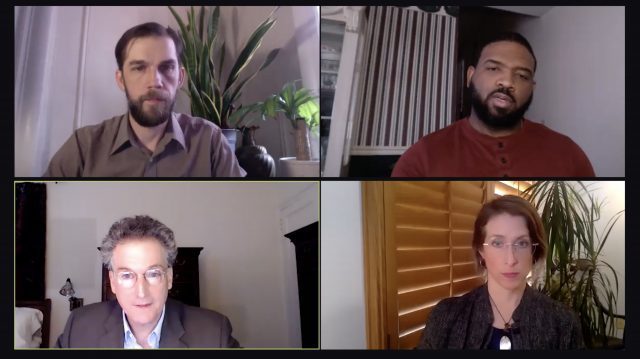
Adam Files, Nicholas Miles Newton, Meagan Moses, and Ed Altman (clockwise from top left) get into a tense Zoom meeting in Adjust the Procedure

ADJUST THE PROCEDURE
Available on demand through March 28, $10
spincyclenyc.com

A new genre of theater has arisen during the pandemic lockdown: Zoom plays about Zoom gatherings, both personal and professional. I’m not talking about Zoom benefits with actors reading Shakespeare and Sophocles or Fast Times at Ridgemont High and The Princess Bride but new works written for Zoom, performed on Zoom — and set on Zoom. For the Public, Richard Nelson’s What Do We Need to Talk About? reunited the familiar Apple family with the original cast — Jon DeVries (Benjamin Apple), Stephen Kunken (Tim Andrews), Sally Murphy (Jane Apple Halls), Maryann Plunkett (Barbara Apple), Laila Robins (Marian Apple Platt), and Jay O. Sanders (Richard Apple) — holding a Zoom family meeting. Rough & Ready Productions’ seven-minute Brown, an early entry from April 2020, imagines a Zoom brainstorming session about the color of cruise line swimwear, particularly prescient given the status of cruises over the last year. And Jordan E. Cooper’s Mama’s Got a Cough (with the wonderful Danielle Brooks) is fourteen of the funniest minutes you’ll ever spend on Zoom, as a family convenes an emergency online meeting to figure out what to do about their elderly matriarch.

Spin Cycle and JCS Theater Company take it to the next level with Adjust the Procedure, which delves deep into the psychological impact the coronavirus crisis is having on individuals as well as institutions, in this case a university. Written and directed by Jake Shore, the play is built around several Zoom meetings dealing with the school’s Counseling and Wellness center and what might have gone wrong in the case of student David De La Cruz. Director of academic development Kyle (Adam Files) first discusses the issue with assistant dean of student achievement Ben (Nicholas Miles Newton), relating a call he received from the suicidal undergraduate.

“In most circumstances I wouldn’t have pressed him on it at all, I would’ve just followed the procedure, but I felt I had a responsibility to deal with it on my own for some reason,” a concerned Kyle says.

Ben initially seems more interested in following the rules than facing the reality of the situation. He replies, “I would advise against intervening. . . .” That conversation ends with Ben’s advice:

“You need to know your role, Kyle, and it’s going to help a great deal in the long run. The life of this student is not on your back. It does not hang in the balance due to anything that you’ve done or will do. That’s just not the way it is. You talking to him, interfering, it’s just not going to matter that much in the grand scheme of things. It’s brutal, I’m sorry to say it, but it’s the truth. You don’t have that type of responsibility to him, or to any other student. It’s just not your job.”

On another call they are joined by director of enrollment management Aimee (Meagan Moses), who appears to only care about the numbers on her spreadsheet rather than the students themselves. She explains with robotic precision, “As you both know, for the most part, we weathered the storm caused by the international student problem, and in addition to that, we’ve made up for the additional students who either dropped out, transferred, or exited for reasons directly tied to the pandemic.” Those reasons include deportation.

Despite Ben’s pleas for Kyle to stop, the latter continues to press the issue as they discover more about Counseling and Wellness and where the De La Cruz case failed. Soon Kyle, Ben, and Aimee are on a Zoom call with executive dean Frank (Ed Altman), who is all about protecting the university’s reputation and avoiding any kind of legal trouble, no matter the truth. The four of them get into it, ascertaining things about themselves and their colleagues they might not like, leading to a surprise ending.

Available on demand over the Stellar platform through March 28, Adjust the Procedure gets off to a slow start, just talking heads Zooming in from wherever they are sheltering in place, but Shore (The Devil Is on the Loose with an Axe in Marshalltown, Down the Mountain and Across the Stream) picks up the pace as he brings up pertinent issues that address how the pandemic has been handled from multiple perspectives. Kyle represents the person who wants to do right but is thwarted by rules and procedures that need to be reevaluated. Ben is the earnest employee who might agree with Kyle but is not about to rock the boat. Aimee is the efficiency expert who can’t see the human component. And Frank claims that he is “worried about society unraveling,” but his beliefs about just what that society is don’t necessarily gel with the others’.

No one comes out unscathed in this trenchant Covid-19 parable; it might be specifically about a university, since education has been so hard hit during the pandemic, but it could also be about corporations and local, state, and federal governments as they face the reality of mounting death tolls and economic collapse and decide how they are going to proceed, choosing whose interests to put first amid the bureaucracy and numbers crunching.

At one point the four characters are discussing a new class at the school, “Free Will: The Big Lie.” Frank pounces on the subject, declaring, “Do you know what an immature adolescent is going to think when he finds out that free will doesn’t exist? He’ll misconstrue it. All of a sudden, there’s no accountability for one’s actions. If there’s no free will, then there’s no control.”

As has been made all too clear during this crisis, control is all about power — control of information, of the media, of statistics, of money, of scientific interpretation — primarily at the expense of the individual, the poor schnooks trying to do right by themselves, their family, their school district, and their community, attempting to assert whatever free will is supposed to exist in a representative democracy. And as we have learned, procedures need to be adjusted, and fast.

GRIEF AND GRIEVANCE: ART AND MOURNING — SPECIAL EVENTS

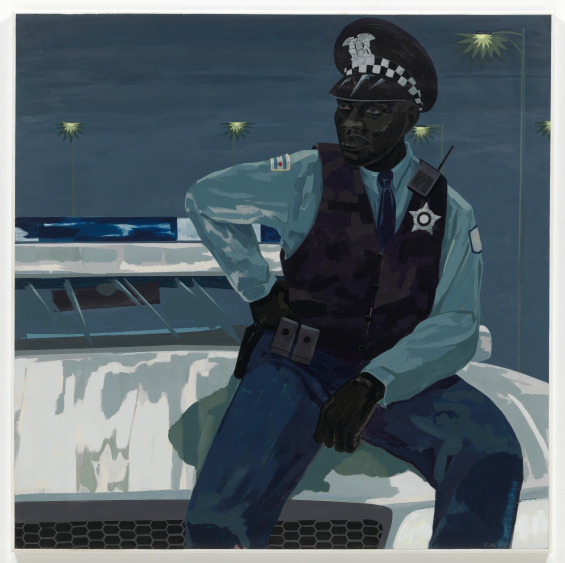
Kerry James Marshall, Untitled (policeman), acrylic on PVC panel with plexiglass frame, 2015 (Museum of Modern Art, Gift of Mimi Haas in honor of Marie-Josée Kravis. © Kerry James Marshall. Courtesy the artist and Jack Shainman Gallery, New York)

GRIEF AND GRIEVANCE: ART AND MOURNING
New Museum
235 Bowery at Prince St.
Special online events free with RSVP
Exhibition runs through June 6, $12-$18
www.newmuseum.org

The New Museum exhibition “Grief and Grievance: Art and Mourning in America” is an extraordinary collection of nearly one hundred works by thirty-seven artists taking on racism and violence in Black communities. The show was conceived by Nigerian curator Okwui Enwezor prior to the coronavirus crisis and the BLM protests and scheduled to open around the time of the presidential election, but it was delayed because of the pandemic lockdown and Enwezor’s death in March 2019 at the age of fifty-five. Completed by Naomi Beckwith, Massimiliano Gioni, Glenn Ligon, and Mark Nash, the exhibit includes new and older painting, sculpture, photography, video, and installation by such artists as Terry Adkins, Jean-Michel Basquiat, Garrett Bradley, Theaster Gates, Arthur Jafa, Rashid Johnson, Simone Leigh, Kerry James Marshall, Julie Mehretu, Lorna Simpson, Hank Willis Thomas, Kara Walker, Nari Ward, and Carrie Mae Weems exploring how we deal with loss.

In conjunction with the exhibit, the New Museum is hosting weekly live online conversations and virtual tours, featuring an all-star lineup of participating artists. All programs are free with advance RSVP; click on each title for more information.

Tuesday, March 2, 5:00
Melvin Edwards in Conversation with Massimiliano Gioni

Wednesday, March 3, 4:00
Virtual Tour: “Grief and Grievance: Art and Mourning in America”

Friday, March 12, 7:00
LaToya Ruby Frazier in Conversation with Margot Norton

Thursday, March 18, 4:00
Kerry James Marshall in Conversation with Massimiliano Gioni

Tuesday March 23, 4:00
Dawoud Bey in Conversation with Gary Carrion-Murayari

Thursday, April 1, 7:00
Adam Pendleton in Conversation with Andrew An Westover

Thursday, April 8, 7:00
Hank Willis Thomas in Conversation with Margot Norton

Rashid Johnson, Antoine’s Organ, black steel, grow lights, plants, wood, shea butter, books, monitors, rugs, piano, 2016 (photo by Dario Lasagni)

Thursday, April 15, 7:00
Rashid Johnson in Conversation with Massimiliano Gioni

Thursday, April 29, 2:00
Jennie C. Jones in Conversation with Gary Carrion-Murayari

Monday, May 3, 2:00
Tiona Nekkia McClodden in Conversation with Margot Norton

Thursday May 13, 7:00
Okwui Okpokwasili in Conversation with Massimiliano Gioni

Thursday May 20, 4:00
Howardena Pindell in Conversation with Margot Norton

Tuesday, June 1, 4:00
Sable Elyse Smith in Conversation with Margot Norton

Thursday, June 3, 7:00
Tyshawn Sorey in Conversation with Gary Carrion-Murayari

BOSTON LYRIC OPERA: THE FALL OF THE HOUSE OF USHER

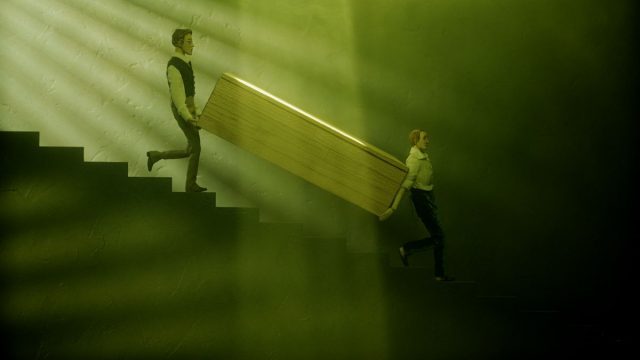
Boston Lyric Opera reimagines Philip Glass’s The Fall of the House of Usher for the virtual world (photo courtesy BLO)

THE FALL OF THE HOUSE OF USHER
Boston Lyric Opera / Operabox.tv
Available on demand through June 30, $10 for seven-day stream
Live conversation March 3, free with RSVP, 8:00
blo.org
www.operabox.tv

As with theater and dance, opera has been developing a new life online during the pandemic lockdown. It’s not a replacement for what we had before, and will have after, but some companies have been spurred to creative leaps by the crisis, not merely to raise money and stay busy and relevant, but also to explore what it can look like for artists to work together over Zoom or in person only with those in their pod, in empty theaters, energized by this weird new world.

White Snake Projects’ Alice in the Pandemic reimagined the Lewis Carroll character going down a rabbit hole filled with deserted streets and crowded hospitals, incorporating 3-D animation. City Lyric Opera’s interactive Threepenny Opera asked the at-home audience to bring signs and participate in other ways. On Site Opera’s audio-only To My Distant Beloved took place over the phone, performed for one person at a time. Here Arts Center’s all decisions will be made by consensus was the first Zoom opera, streamed live over the growing platform. Jean-Luc Fafchamps’s Is this the end? found soprano Sarah Defrise playing a teenager on the run through the nooks and crannies of la Monnaie in Brussels, escaping from mysterious masked figures. And Marina Abramović explored operatic endings in her multimedia 7 Deaths of Maria Callas, streamed live in front of a masked, socially distanced audience at Bayerische Staatsoper in Munich.

Boston Lyric Opera has made a splash with its highly inventive virtual adaptation of Philip Glass’s 1988 opera, The Fall of the House of Usher, featuring a libretto by Arthur Yorinks based on the 1839 Edgar Allan Poe short story, which was also made into a popular horror film in 1960 by Roger Corman starring Vincent Price. BLO takes a unique approach in telling the tale of twins Roderick (Jesse Darden) and Madeline Usher (Chelsea Basler), who are visited by an old friend of Roderick’s, William (Daniel Belcher), who quickly notices that something is amiss in the mansion. Also on the scene are the Ushers’ servant (Jorgeandrés Camargo) and physician (Christon Carney).

Several distinct visual elements and contrasting narratives make up the opera, as director James Darrah, screenwriter Raúl Santos, and cinematographer Pablo Santiago cut between the Ushers’ impending demise, employing puppets and stop-motion animation, and the desperate journey undertaken by the mute Luna, a young Guatemalan girl attempting to enter the United States, told using hand-drawn charcoal drawings and cutouts. The ninety-minute work includes archival footage of danger, devastation, old television ads, recent news reports of ICE detention centers, and happy families while touching on issues of mental illness as seen both in the nineteenth century and today. The show is bookended by Sheila Vand as a Rod Serling–like host, welcoming us with “Good evening. Not what you expected? Well, there’s nothing to be scared of just yet.” The score was conducted by David Angus remotely; Annie Rabbat serves as concertmaster. Production designer Yuki Izumihara creates a spectacularly creepy atmosphere, with costumes and dolls by Camille Assaf and art direction by Yee Eun Nam.

Produced during the pandemic lockdown, The Fall of the House of Usher looks and sounds great, although the haunting story doesn’t always mesh together, leaving you occasionally scratching your head, and the final twist is likely to both delight and confound you. Perhaps some of your questions will be answered in the live Zoom community conversation taking place March 3 at 8:00. In addition, the interactive digital reading room complete with Easter eggs for a gamelike frisson and an essay on the company’s website expand the experience.

KEEP MOVING

WP Theater
Streaming through March 14, pay-what-you-can
wptheater.org/show/keep-moving

For arts institutions now facing a pandemic lockdown that has lasted nearly a year with no immediate end in sight, it helps to have a sense of humor. And that’s precisely what Monica Bill Barnes & Company have plenty of in Keep Moving. Presented by WP Theater, Keep Moving is a ten-chapter series conceived and created by Monica Bill Barnes and company creative producing director and performer Robbie Saenz de Viteri that looks at how a group of women have dealt with the health crisis.

The digital presentation is hosted by Saenz de Viteri with a wry smile as he speaks with Barnes and several of the dancers, mostly via Zoom but a few over the phone, with no visuals. Chapters such as “Get. Ready. To. Go.,” “The Only Tedious Part,” “It Is Super Essential,” “Oh Hey I Do Exist,” and “Then I’m Gonna Fix the World” introduce such participants as Julieta Rodriguez-Cruz, Manuela Agudelo, Nadjie Forte, Kai Chen, Anakeiry Cruz, mentor Wendy Rogers, and others as Saenz de Viteri focuses on how everyone has been surviving the lockdown, with a specific focus on the company’s collaboration with Hunter College on a project called The Running Show. It’s both funny and poignant as the young women talk about what it means to be a dancer and the older ones discuss how that changes over a career. In “Even Though I Was Alone,” Barnes thinks she’s out of shape and Naja Newell, Esther Nozea, and Amanda Konstantine Perlmutter dance in their kitchen or bedroom or out on the street as they keep moving despite all the current limitations. Extended through March 14, Keep Moving offers a tantalizing inside look at the creative process during a time of crisis, stagnation not an option.