Elmgreen & Dragset’s The Hive welcomes busy bees to Moynihan Train Hall (photo by twi-ny/mdr)
Who: Elmgreen & Dragset (Michael Elmgreen and Ingar Dragset), Nicholas Baume What:Public Art Fundlive discussion Where:The Cooper Union on Zoom When: Thursday, March 11, free with RSVP, 1:00 Why: On January 1, Moynihan Train Hall opened to the public with much fanfare, highlighted by site-specific commissions from Stan Douglas (Penn Station’s Half Century), Kehinde Wiley (Go), and Elmgreen & Dragset. The Hive, E&D’s inverted cityscape on the ceiling of the Thirty-First St. midblock entrance, has dazzled visitors, who stare up at ninety-one miniature buildings that contain seventy-two thousand LEDs and weigh more than thirty thousand pounds, part mysterious metropolis, part cave stalactites. The duo of Denmark-born Michael Elmgreen and Norway-born Ingar Dragset, who have been combining art, architecture, performance, and installation for more than a quarter of a century, will discuss the construction and meaning of The Hive in a free Public Art Fund conversation hosted by the Cooper Union on Zoom, straight from their Berlin studio. The event will be moderated by PAF director and chief curator Nicholas Baume. To catch Baume’s January 28 talk with Douglas, go here.
FIAF will fly in the Paris Opera & Ballet’s playful Play this week, with a live talk March 11
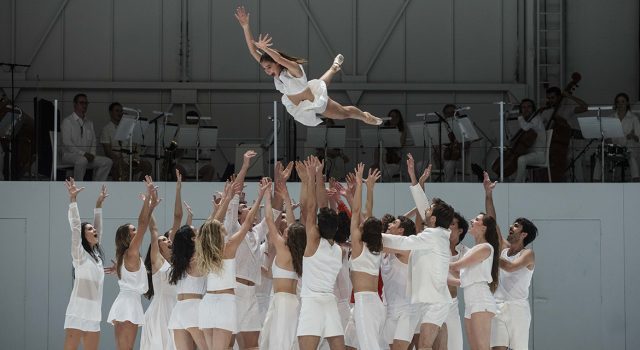
Who:The Paris Opera & Ballet What: Virtual screening and live discussion Where:French Institute Alliance Française (FIAF) online When: Thursday, March 11, $15, 12:30 (stream available on demand March 8-14) Why: Swedish dancer, choreographer, and director Alexander Ekman’s first commission from the Paris Opera & Ballet was the wild and woolly Play, a 2017 work that featured women dressed as deer, a furious rain of green balls, large blocks floating in the air, and other dreamlike scenarios. “We thought of life by analogy with the journey, with a pilgrimage, which had a serious purpose at the end, but the thing was to get to that end, success or whatever it is, or maybe heaven after your death, but we missed the point the whole way along,” a disembodied voice explains. FIAF will be streaming a recorded version of the production, with music composed by the Harlem-based Mikael Karlsson, from March 8 to 14; each $15 ticket also gives you access to a livestreamed Zoom talk with Ekman (Cacti,Tuplet), Karlsson, and theater critic Laura Cappelle on March 11 at 12:30.
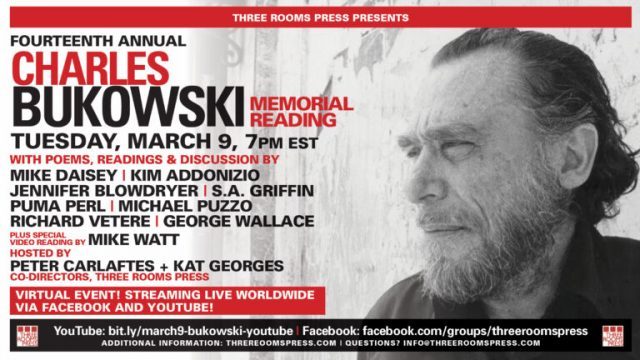
Who: Mike Watt, Mike Daisey, Jennifer Blowdryer, Kim Addonizio, S. A. Griffin, Puma Perl, George Wallace, Richard Vetere, Michael Puzzo, Peter Carlaftes, Kat Georges What:Annual Charles Bukowski Memorial Reading Where:Three Rooms PressYouTube and Facebook When: Tuesday, March 9, free, 7:00 Why: “What sort of cultural hangover keeps Charles Bukowski in print and popular more than twenty years after his death?” S. A. Griffin asks in his Three Rooms Press essay “Charles Bukowski: Dean of Another Academy.” “In light of the fact that a good portion of what has been published since his passing in 1994 may not be the man’s best work, along with some heavy editing at times, why does Charles Bukowski remain relevant well into the 21st century?” The fourteenth annual Charles Bukowski Memorial Reading, which this year takes place virtually on March 9 at 7:00, will explore what Bukowski would think about today’s social-media-obsessed society in the midst of a pandemic lockdown, with tribute readings by monologist Mike Daisey, performance artists Jennifer Blowdryer, poets Kim Addonizio, S. A. Griffin, Puma Perl, and George Wallace, and playwrights Richard Vetere and Michael Puzzo, hosted by Kat Georges and Peter Carlaftes of Three Rooms Press and featuring a special video appearance by bassist extraordinaire Mike Watt (Minutemen, Dos, Firehose, Big Walnuts Yonder). Admission is free.
Who: Joyce Carol Oates, Zibby Owens What: Livestreamed conversation Where:The Temple Emanu-El Streicker Center When: Tuesday, March 9, free with RSVP, $25 with book, 11:00 am Why: On February 16, mother of four and creator and host of the podcast “Moms Don’t Have Time to Read Books”Zibby Owens was introduced as the moderator for the Temple Emanu-El Streicker Center’s new virtual conversation series, “Women on the Move.” Owens, whose Moms Don’t Have Time To: A Quarantine Anthology (Skyhorse, February 2021, $24.99) was published last month, spoke with Jeanine Cummins on February 23 and Nicole Krauss on March 3. On March 9 at 11:00 in the morning, Owens will Zoom in with eighty-two-year-old living legend Joyce Carol Oates, the New York State native who has written more than a hundred novels, novellas, short stories, essays, and plays. The latest collection from the winner of two O. Henry Awards, the National Book Award, the Jerusalem Prize, and the National Humanities Medal is The (Other) You: Stories (HarperCollins, February 2021, $26.99), which, among other things, is about the act of reading itself. “Bought a bookstore. Mostly secondhand books,” the title story begins. Admission to the live webinar is free with RSVP, although you can receive a copy of the book for a $25 fee.
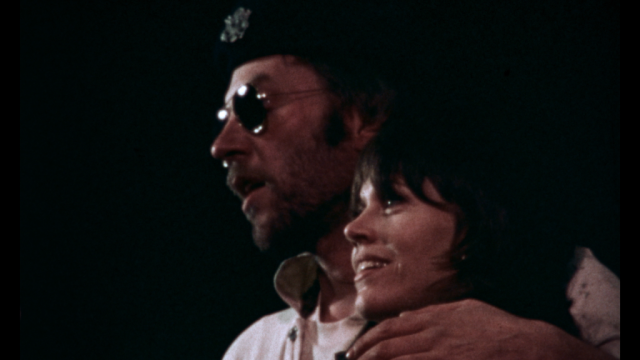
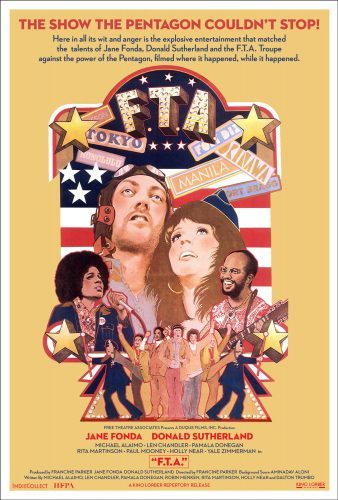
In 1972, actress Jane Fonda was excoriated for posing for a picture in North Vietnam sitting on an anti-aircraft gun with members of the Viet Cong, earning her the nickname “Hanoi Jane.” But the previous year, Fonda was being cheered wildly by US soldiers as she brought the antiwar F.T.A. tour to American military bases in Hawaii, Japan, Okinawa, and the Philippines. The tour, alternately known as “Fun, Travel, and Adventure,” “Free the Army,” “Free Theater Associates,” “Foxtrot Tango Alpha,” and “Fuck the Army,” featured comedy sketches and music with Fonda, fellow actors Donald Sutherland, Pamela Donegan, and Michael Alaimo, singer-songwriters Rita Martinson, Len Chandler, and Holly Near, and comedian Paul Mooney. Kino Marquee has just released a 4K restoration by IndieCollect of Francine Parker’s rarely screened, little-known 1972 film, F.T.A., documenting the Pacific section of the tour. The movie, about “the Show the Pentagon Couldn’t Stop!,” according to its ad campaign, ran for a week before being pulled from theaters by the distributor, who destroyed most copies.
“Histories of the Vietnam War all mention the widespread antiwar movement that was centered on college campuses. What most histories don’t tell you is that an equally widespread and powerful movement against the war existed inside the military itself,” Fonda says in a new video introduction, recorded in what has become a very familiar scene to viewers of Fire Drill Fridays, her weekly show about climate change and the Green New Deal, which the two-time Oscar and Emmy winner hosts in her home, sitting in front of a wall of photos.
The brainchild of court-martialed antiwar army doctor Howard Levy, F.T.A. was created specifically as “a counter show to the very pro-war, sexist” Bob Hope shows that were so popular, Fonda notes. She had just completed shooting Klute and so she invited her costar, Sutherland, who had previously appeared in such war films as The Dirty Dozen,M*A*S*H,Kelly’s Heroes, and Johnny Got His Gun, to join her. Working with material garnered from GI magazines in addition to skits written by the likes of Jules Feiffer and Herb Gardner, the revue ended up entertaining some 64,000 active-duty soldiers, sailors, marines, and air force men and women. But it wasn’t just fun and games; Fonda, Sutherland, and the rest of the team were there to make a point.
The film doesn’t open with comedy or music but with an unidentified GI saying, “I mean, how can you write your mother and tell her that her handsome young darling marine, her hero, is anti-military? But I sat down and I wrote her a letter and told her exactly how I felt, and my mother wrote back and she said she fully understood and she was happy I felt that way.” Parker follows that with several other servicemen and -women explaining that they were serving in the military either to avoid jail or because they didn’t have any other options, not because they wanted to fight Communism and defend democracy in Southeast Asia.
The narrative then shifts to the tour itself, an alternative modern vaudeville with political songs and short skits that skewer the government and military leaders, poking fun at the bureaucracy while focusing on the very real class, gender, and race differences that are inherent in war and society. “I went down to that base / They took one look at my face / And read out an order to bar me / I said, ‘Foxtrot Tango Alpha’ / ‘F-f-free the army,’” Fonda sings with Chandler and others.
Amid the laughs — and there are many of them, including one funny scene in which Sutherland and Alaimo play two sports announcers, both named Red, calling the war as if it were a football game — Parker, Fonda, and Sutherland speak with more antiwar soldiers, individually and at small gatherings, where they feel comfortable enough to express their views about chemical warfare and nuclear weapons. The crowd gets rocking singing along with such songs as Chandler’s “My Ass Is Mine” and “Set the Date!” and Robin Menken’s “Nothing Could Be Finer Than to Be in Indochina!” and “So Nice to Be a Member of the Military Class,” while Martinson’s “Soldier, We Love You,” about injustice and inequality, hits hard and Beverly Grant’s feminist rant, “I’m Tired of Bastards Fuckin’ Over Me,” brings down the house.
Produced by Parker, Fonda, and Sutherland, F.T.A. is a clarion call against the misuse of military power; it feels today much more than a mere time capsule celebrating opposition to one war fifty years ago but a shot across the bow for protestors everywhere fighting against the military-industrial complex, against corrupt government, in a country that’s more divided than ever and where identity politics have run rampant.
“You won’t see a change here [overseas] until you see a change back in the world [in the US],” one man says. “Gimme a cause that I can believe in and let me die for that,” another adds. After watching F.T.A., you’ll realize that 2021 is not as different from 1971 as you might have thought, or wanted it to be.
Jake Austin Robertson and Tessa Albertson star in a pandemic-filmed version of Samuel Beckett’s Happy Days from the Wild Project
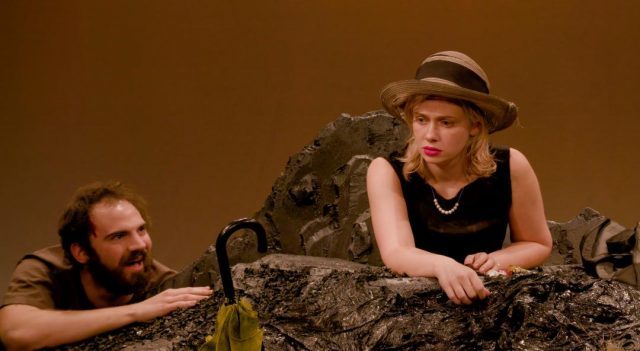
Who: Tessa Albertson, Jake Austin Robertson What: Filmed performance of Happy Days by Samuel Beckett from the Wild Project Where:Stellar platform When: March 5-7, 11-13, 19-21, and 26-28, free with RSVP (suggested donation $25; stream available for twenty-four hours) Why: In May 2020, after beating their coronavirus infections, married couple Tony Shalhoub and Brooke Adams revisited Samuel Beckett’s Happy Days, which they toured with in 2015, performing it live from their bedroom for Stars in the House, when it was still rare to see two people together onscreen. The two-character absurdist drama, which is primarily a two-act monologue by the actress, is a quintessential piece tailor-made for the pandemic lockdown. The woman spends the entire play in a kind of volcanic mound of dirt, only the upper part of her body visible, so Covid-19 protocols are easier to follow than if the play had a bigger cast with actors moving about a stage. The scenario also evokes how each one of us has been trapped in near-isolation while sheltering in place for a year now. The Wild Project is now tackling the play, which premiered at the Cherry Lane in 1961, streaming a sixtieth anniversary recording made in its East Village theater, with Tessa Albertson as Winnie and Jake Austin Robertson as Willie.
Previous pairings have included Fiona Shaw and Tim Potter, Dianne Wiest and Jarlath Conroy, and Rosaleen Linehan and Richard Johnson; Albertson (Shrek the Musical,Younger), at only twenty-four, and Robertson (Madman), who is not much older, are among the youngest actors to perform the roles. The hybrid theater/film, which is available Fridays, Saturdays, and Sundays in March for twenty-four-hour streams, is directed by Nico Krell, incorporating elements from Beckett’s personal notebook from when the author helmed a production starring Billie Whitelaw in 1979; the new work features cinematography by Michael Cong, editing by Marco Villard, scenic design by Colleen E Murray and Nadja Antic, costumes by Jules Peiperl, sound by Stanley Mathabane, and lighting by Kia Rogers. Albertson twists her face throughout a goofy yet charming performance, the camera often coming in closer than human beings should ever be photographed. The way the yellow umbrella is stuck in the set is deliciously squishy, and Albertson’s lipstick is practically a character unto itself. “Another happy day,” Winnie proclaims early on. At a time when we all barely know what day it is when we wake up, lost in a coronavirus fog, you can never have too many happy days. As Winnie also says, “Here all is strange.”
As a teenager, I first became aware of the government’s use of Agent Orange in Vietnam on a 1980 episode of Barney Miller, in which Sgt. Wojciehowicz (Max Gail) calls in representatives from the air force, the government, and a chemical company to explain the possibly dangerous side effects of the compound. (Their ultimate answer: They just don’t know.) In 1982, I was at Pier 84 for a benefit concert for victims of Agent Orange, featuring Ian Hunter, Todd Rundgren, Paul Butterfield, and John Cale. Nearly forty years later, it took another form of popular entertainment to make me aware that many of the problems associated with the herbicide have not gone away — and are still being denied by those using the vilified chemical compound.
“I was born in war, I grew up in war, and we are at war now,” French-Vietnamese activist, journalist, and author Tran To Nga says early on in Kate Taverna and Alan Adelson’s award-winning documentary, The People vs. Agent Orange, opening virtually March 5 at New Plaza Cinema here in New York City. The film details the long-lasting effects of the deployment of Agent Orange on four generations in Vietnam as well as the devastating impact it is having in the Pacific Northwest, specifically in Five Rivers in Oregon, where it is used for brush eradication. Yes, “is,” present tense.
Written and produced by Taverna, Adelson, and Véronique Bernard, directed by Taverna and Adelson (In Bed with Ulysses,Lodz Ghetto), and edited by Taverna, the revelatory film follows two converging story lines: Nga’s fight for justice in Paris and South Vietnam and environmentalist and author Carol Van Strum’s battle over the deployment of Agent Orange, made with the controversial chemical Dioxin (in 2,4,5-T and 2,4-D), in Oregon’s Five Rivers area between 1975 through today. Taverna and Adelson meet with human rights lawyers, including Bruce Anderson and Jonathan Moore working with Van Strum and Susan Swift, who formed the group Citizens Against Toxic Sprays (C.A.T.S.), and Bertrand Repolt, William Bourdon, and Amélie Lefebvre representing Nga, who know it won’t be easy, as the chemical companies (Dow, Monsanto) are not about to give in. “This case will be merciless,” Bourdon says.
The filmmakers incorporate archival footage of news reports and interviews from the 1960 and 1970s, whistleblower video taken by Oregon spray helicopter crew member Darryl Ivy in 2015, and home movies and photos of Van Strum, Nga, and their families, detailing the terrible personal tragedies they have suffered. Nga visits a children’s hospital where kids have severe birth defects, walks through the tiger cages in Poulo Condor Prison on Con Dao Island in Vietnam where her mother was tortured, and returns to the forest where she and her husband, Kieu Xuan Long, were married. Van Strum and Swift discuss how they have been followed, intimidated, and harassed by mysterious men in black cars. Retired Oregon physician Dr. Renee Stringham talks about how, after recording a serious increase in the number of birth defects among her patients, her family was threatened. And Heather Bower, founder of Children of Vietnam Veterans Health Alliance, shares her information about birth defects wile displaying her own.
Among the other experts adding their voices are David Zierler, author of The Invention of Ecocide, Peter Sills, lawyer and author of Toxic War, André Bouny, author of Agent Orange: Apocalypse Vietnam, former Senate majority leader Thomas Daschle, and retired air force scientist Dr. James Clary, who chokes up when he says, “I was getting so angry that my own government didn’t want to provide help to veterans who were suffering.” Nobody goes on the record to defend the chemical companies, although retired senior US district judge Jack Weinstein tiptoes around some pointed questions.
“Agent Orange spared no one,” Nga says. And the horrors are far from over. To find out more, you can watch two recent panel discussions featuring the filmmakers, Van Strum, and other activists, researchers, and journalists here.