twi-ny recommended events

THE JOY OF RESISTANCE: RACHAEL SAGE, KRISTEN FORD, AND HANNAH JUDSON AT MERCURY LOUNGE

Who: Rachael Sage and the Sequins, Kristen Ford, Hannah Judson
What: Joy = Resistance Tour
Where: Mercury Lounge, 217 East Houston St.
When: Thursday, July 24, $15 in advance, $20 at door, 6:00
Why: The Joy = Resistance Tour pulls into Mercury Lounge on July 24, as Rachael Sage and Kristen Ford are joined by Hannah Judson for what should be a special night of music and inclusivity. MPress Records founder Sage will be performing with her longtime trio, the Sequins: Trina Hamlin on harmonica, Andy Mac on drums, and Kelly Halloran on violin; they will be celebrating the release of Sage’s latest single, “Live It Up,” while highlighting songs from her upcoming album, Canopy, along with old favorites. The L.A.-based Ford will be playing tunes from her debut full-length, Pinto, out August 22 from Righteous Babe; produced by Grammy winners Ani DiFranco and John Driskell Hopkins, it includes such tracks as “Wild Heart,” “Whiplash,” and “White Man’s Dream.” Judson, a Chicago-based French-American singer-songwriter, will be featuring tunes from her latest LP, Satellites Grace the Sky Like Tumbleweeds (Boneyard Records), which boasts such numbers as “Feather,” “Take the Angel Down,” and “Ocean Blue Eyes.”

On the gorgeously poetic “Just Enough” from Canopy, the New York City–based Sage sings, “I feel love in the morning when you wake me up / Love in the middle of the day don’t stop / I feel love in the evening, fills my cup just enough . . . shalalala. . . .” Discussing the tune, she says, “At first listen, [it] seems like a romantic love song and to some degree it started out that way when I was first writing it. But the longer I’ve played it live out on tour the more now it feels like it’s equally a mantra to oneself about being enough as you are: lovable enough, accomplished enough, attractive enough, smart enough . . . all the things that, for instance, a best friend or any loved one might acknowledge in you are truly, unconditionally, and authentically enough.”

There should be plenty of enough at Mercury on July 24 when Sage, Ford, and Judson take the stage on the Lower East Side.

[Mark Rifkin is a Brooklyn-born, Manhattan-based writer and editor; you can follow him on Substack here.]
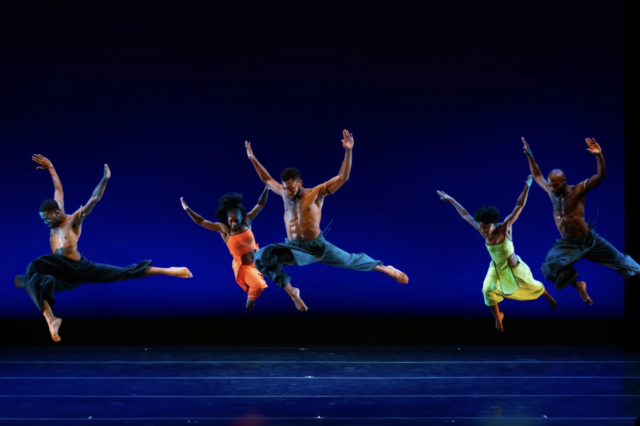
WAVING THE FLAG: ARTIST’S CHOICE AT CHELSEA FOUNDATION

Mark Hogancamp tries to rebuild his life in a carefully constructed alternate reality (photo by Tom Putnam)

ARTIST’S CHOICE: MOVIE NIGHTS
The FLAG Art Foundation
545 West 25th St. between Tenth & Eleventh Aves.
Wednesday, July 23, July 30, August 6, free with advance RSVP, 7:00
www.flagartfoundation.org

For the next three Wednesdays, the FLAG Art Foundation is hosting free screenings of works handpicked by three artists, films that have been meaningful to them in their life and artistic practice. The series begins July 23 with Jeff Malmberg’s Marwencol, selected by New York City–born, Jersey City–based Ana Benaroya, who explores the human body and aspects of herself in colorful characters in manic situations. For July 30, LA-based Ethiopian-American multidisciplinary artist Awol Erizku has chosen three of the most important and influential indie films ever made, Maya Deren and Alexander Hammid’s Meshes of the Afternoon, Chris Marker’s La Jetée, and Ousmane Sembène’s Black Girl. The program concludes August 6 with short films picked by Baltimore-born painter, writer, and musician Cynthia Daignault.

MARWENCOL (Jeff Malmberg, 2010)
Wednesday, July 23, free with advance RSVP, 7:00
www.flagartfoundation.org
www.marwencol.com

Named Best Documentary at numerous film festivals across the country, Marwencol offers a surprising look inside the creative process and the fine line that exists between art and reality. On April 8, 2000, Mark Hogancamp was nearly beaten to death outside a bar in his hometown of Kingston, New York. He spent nine days in a coma and more than a month in the hospital before being released, suffering severe brain damage that has left his memory a blur. To help put his life back together, he began using toys and dolls — Barbies, celebrity replicas, army men — to re-create his personal journey. He makes dolls of his friends and relatives, the people he works with, and others, constructing an alternate WWII-era universe he calls Marwencol, complete with numerous buildings and plenty of Nazis. He captures the detailed story in photographs that are not only fascinating to look at but that also help him figure out who he was and who he can be.

This miniature three-dimensional world is reminiscent of the two-dimensional one carefully fashioned by outsider artist Henry Darger in his fifteen-thousand-page manuscript, The Story of the Vivian Girls, in What is known as the Realms of the Unreal, of the Glandeco-Angelinnian War Storm, Caused by the Child Slave Rebellion, which also features an alternate reality involving military battles set amid stunning artwork. Director, producer, and editor Jeff Malmberg makes no judgments about Hogancamp, and asks the same of the audience. In his first full-length film, Malmberg shares the compelling story of a deeply troubled, flawed man suddenly forced to begin again, using art and creativity to bring himself back to life. He speaks with Hogancamp’s mother, his old roommate, the prosecutor who handled his case, and others who are first seen proudly holding the doll Hogancamp made of them. And Malmberg doesn’t turn away from the more frightening aspects of Hogancamp’s daily existence. Marwencol is an unforgettable portrait of lost identity and the long road to redemption.

Chris Marker

Chris Marker’s La Jetée is a postapocalyptic thriller about movies and memory, told almost exclusively through still images

LA JETÉE (Chris Marker, 1962) / MESHES OF THE AFTERNOON (Maya Deren and Alexander Hammid, 1943) / BLACK GIRL (LA NOIRE DE . . .) (Ousmane Sembène, 1966)
Wednesday, July 30, free with advance RSVP, 7:00
www.flagartfoundation.org

The Flag series continues with an inspired trio of wildly different low-budget, black-and-white works that experiment with the language of cinema. Chris Marker’s La Jetée is a nearly half-hour postapocalyptic dystopian thriller set in a world that calls “past and future to the rescue of the present.” Told almost completely in dark, eerie black-and-white photographs — the camera moves only once, pulling back on the opening establishing shot of the titular pier at Paris’s Orly airport, and at another point a woman opens her eyes in bed — La Jetée explores time and memory as a WWIII survivor (Davos Hanich) in the underground Palais de Chaillot galleries revisits an event that occurred with a woman (Hélène Chatelain) on the jetty. The film, referred to in the credits as “un photo-roman,” is narrated by Jean Négroni, with the only dialogue occasional unintelligible whispering by the German scientists in charge of the mysterious operation; the soundtrack also includes lush music from Trevor Duncan and a repeated thumping that mimics heartbeats. The film explores both art as memory and memory as art as well as the cinema itself; for example, Marker (Sans Soleil, Le joli mai) references Alfred Hitchcock’s Vertigo when the man and woman look at the rings of a Sequoia tree, and it has gone on to influence such films as Terry Gilliam’s 12 Monkeys, the Matrix trilogy, and countless other movies and videos. It’s a mesmerizing work that brings fresh insight upon each viewing.

In 1943, the husband-and-wife team of Maya Deren and Alexander Hammid made the fourteen-minute masterpiece, Meshes of the Afternoon, at their home in Hollywood. The silent work — soundtracks were added by others later — is a celebration of the surreal, filled with shots of shadowy figures and such objects as a flower, a key, a knife in a loaf of bread, and a telephone receiver off its cradle. Stairs and slow motion figure prominently as a black-draped figure with a mirror for a face haunts the proceedings and the protagonist is joined by her doppelgänger. The film stands with such works as Salvador Dalí and Luis Buñuel’s Un Chien Andalou and Ballet Mécanique, René Clair’s Entr’acte, and Jean Cocteau’s The Blood of a Poet as masterpieces of the avant-garde.

Diouana (Mbissine Thérèse Diop) seeks so much more out of life in Ousmane Sembène’s Black Girl

Ousmane Sembène’s debut, 1966’s Black Girl, launched an award-winning career that established the Senegalese author and filmmaker as a leading international storyteller for five decades. In Black Girl, also known as Le noire de . . . , Mbissine Thérèse Diop stars as Diouana, a Senegalese woman who leaves Dakar to work for a wealthy French family in Antibes. Colonialism rules the day as she tries to assert her identity but is treated with dismissive condescension. Early on, a dinner-party guest announces, “I’ve never kissed a black woman,” and pecks her on each cheek as she stares away blankly and the others laugh. “I’ve got a feeling she’s angry,” another guest says, while one of the men adds, “Their independence has made them less natural.” Diouana dreams of a better life as she remembers what it was like in Senegal, but she is thwarted by racism and bigotry every step of the way. Sembène, who would go on to make such films as Mandabi, Faat Kiné, and Moolaadé, incorporates a unique editing style with an often playful silent-film-like score to share Diouana’s longing for something else.

[Mark Rifkin is a Brooklyn-born, Manhattan-based writer and editor; you can follow him on Substack here.]
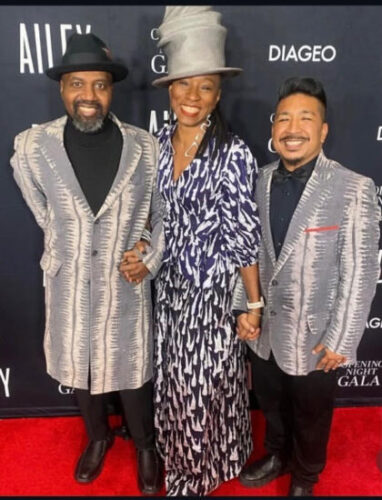
OEDIPUS REIMAGINED: THE GOSPEL AT COLONUS ON LITTLE ISLAND

Revival of The Gospel at Colonus on Little Island tells story of redemption and retribution (photo by Julieta Cervantes)

THE GOSPEL AT COLONUS
The Amph at Little Island
Pier 55, Hudson River Park at West Thirteenth St.
July 8-26, $10 standing room, $25 seats sold out, 8:30
littleisland.org

One of the grandest theatrical events of the summer is taking place on Little Island, Shayok Misha Chowdhury’s rousing, impassioned adaptation of Lee Breuer and Bob Telson’s The Gospel at Colonus, a spirited, spiritual retelling of the Oedipus and Antigone myths.

In 1983, Obie winner and Mabou Mines founding co-artistic director Breuer (Mabou Mines DollHouse, Peter and Wendy) teamed up with composer Telson (Chronicle of a Death Foretold, Bantú) to reimagine Robert Fitzgerald’s version of Sophocles’s Oedipus at Colonus as a Pentecostal revival meeting. The show debuted at BAM’s Next Wave Festival and was mounted on Broadway five years later, with Morgan Freeman as the Messenger; Oedipus was portrayed by Clarence Fountain and the Five Blind Boys of Alabama.

A tale of witness and testimony, of redemption and retribution, The Gospel at Colonus is a revelation at the Amph, where it begins each night amid the glow of sunset over the Hudson. David Zinn’s set is bathed in red; much of the action occurs in a broken circle in the center surrounding a four-step platform, in front of a yellow foot bridge running between high grass. Stacey Derosier’s lighting, switching from red to green to blue, illuminates Montana Levi Blanco’s loose-fitting purple and sackcloth gray costumes, a combination of Greek togas and Sunday finest. Garth MacAleavey’s sound design allows nature to mingle with the crisp, clear music and dialogue.

Stephanie Berry (On Sugarland, Déjà Vu) is sensational as the Preacher, serving as a kind of narrator and oracle. “Think no longer that you are in command here, / But rather think how, when you were, / You served your own destruction / Welcome, brothers and sisters, / I take as my text this evening the Book of Oedipus,” she announces at the start. “Oedipus! Damned in his birth, in his marriage damned, / Damned in the blood he shed with his own hand! / Oedipus! So pitifully ensnared in the net of his own destiny.”

Stephanie Berry, Davóne Tines, and Frank Senior portray different aspects of Oedipus (photo by Julieta Cervantes)

Oedipus — portrayed as a group by blind jazz vocalist Frank Senior, opera bass-baritone Davóne Tines, and Berry — has already blinded himself for having unknowingly killed his father and married his mother, Jocasta, who then hanged herself, and fathered four children with her, two sons, Eteocles and Polyneices, and two daughters, Antigone (Samantha Howard) and Ismene (Ayana George Jackson). Eteocles is a traitor and Polyneices (Jon-Michael Reese) a usurper, taking opposite sides in an upcoming battle, while Antigone and Ismene seek peace.

“Let every man in mankind’s frailty / Consider his last day; and let none / Presume on his good fortune until he find / Life, at his death, a memory without pain. / Amen,” Evangelist Antigone says.

On his journey, Oedipus encounters Jocasta’s brother, Deacon Creon (Dr. Kevin Bond), the former king, who has been tasked with returning Oedipus to Thebes; a friend (falsetto Serpentwithfeet), who welcomes him to Colonus; Pastor Theseus (Kim Burrell), who vows never to drive him away; and the Balladeer (Brandon Michael Nase), who initially refuses Oedipus and Antigone entry into his church and later questions Testifier Polyneices’s attempt to get back in his father’s good graces.

Kim Burrell rips the roof off the joint several times at Little Island (photo by Julieta Cervantes)

Pulitzer finalist Chowdhury (Public Obscenities, Rheology) beautifully flows Breuer’s poetic dialogue (his book earned him a Tony nomination) into Telson’s gospel, blues, and R&B score, featuring Breuer’s potent, emotional lyrics. (Breuer, who died in January 2021 at the age of eighty-three, and Telson, who at seventy-six is still making music, also collaborated on such other projects as Sister Suzie Cinema, The Warrior Ant, and Bagdad Cafe — The Musical.) “Who is this man? What is his name? Where does he come from?” a choragos (Brandon Michael Nase) demands, as if he could be addressing any of us. “Child, I’m so glad you’re here / There’s hope for me / There’s a prophecy . . . I’ve been waiting for a sign / to ease my troubled mind,” Oedipus (Senior and Tines) sings in “Through My Tears.” Oedipus (Tines) later tells Polyneices, “Once you held the power / And when you did you drove me out / Made me a homeless man / You are no son of mine.” But soon Serpentwithfeet is praying, “Let not our friend go down / In grief and weariness / Let some just God spare him / Any more distress” in “Eternal Sleep.”

Burrell tears the roof off the joint — or she would have if the Amph had a roof — in a pair of rip-roaring numbers, “Jubilee (Never Drive You Away)” and “Lift Him Up,” that gets the crowd moving and grooving, hooting and hollering. Among the other notable songs are “Live Where You Can,” “You’d Take Him Away,” and “Evil,” although the finale, “Let the Weeping Cease,” feels unnecessary. Music directors Dionne McClain-Freeney and James Hall lead a terrific band, consisting of McClain-Freeney on piano, Butch Heyward on organ, Bobby Bryan on guitar, Booker King on bass, Jackie Coleman on trumpet, Taja Graves-Parker on trombone, Jason Marshall and Isaiah Johnson on baritone sax, Kevin Walters on alto sax, and Clayton Craddock on drums; the horns perform on high scaffolds at the corners of the stage nearest the river; the superb James Hall Worship & Praise choir includes Pastor Charles, Schanel Crawford, Jaqwanna Crawford, Jacquetta Fayton, Angie Goshea, Robyn McLeod, TJ Reddick, Teddy Reid, Vischon Robinson, Lenny Vancooten, Eugene Marcus Walker, and Darlene Nikki Washington.

In the closing hymn, Serpentwithfeet declares, “There is no end.” That statement is certainly true of the Greek myth of Oedipus; there is no end to the myriad ways this twisted, heart-wrenching can be told, and The Gospel at Colonus on Little Island is among the most inventive, nourishing the soul for ninety glorious minutes.

[Mark Rifkin is a Brooklyn-born, Manhattan-based writer and editor; you can follow him on Substack here.]
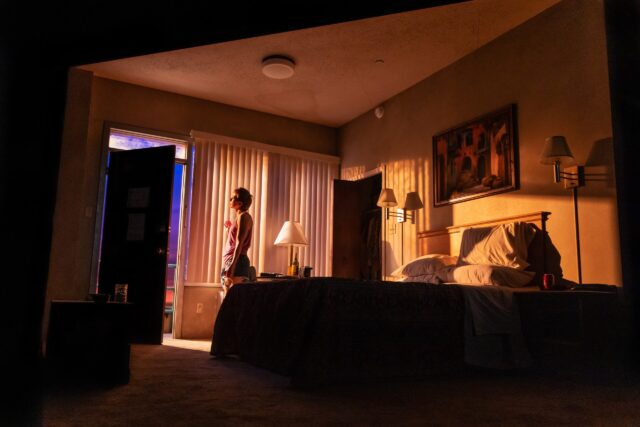
SCARY STORIES IN THE DARK: THE WEIR RETURNS TO IRISH REP

Jack (Dan Butler) shares a ghost story as Jim (John Keating), Finbar (Sean Gormley), Brendan (Johnny Hopkins), and Valerie (Sarah Street) listen intently in The Weir (photo by Carol Rosegg)

THE WEIR
Irish Repertory Theatre, Francis J. Greenburger Mainstage
132 West Twenty-Second St. between Sixth & Seventh Aves.
Wednesday – Sunday through August 31, $60-$125
212-727-2737
irishrep.org

There’s a reason why the Irish Rep keeps returning to Conor McPherson’s The Weir: It’s a marvelous play, and a marvelous adaptation.

The work debuted in England in 1997 and on Broadway two years later; Ciarán O’Reilly first staged it at the Irish Rep in 2013 and again in 2015 by popular demand. The company presented a livestreamed version in July 2020, and now it’s back in person for another engagement through August 31. As in all previous iterations, Sean Gormley is Finbar Mack, John Keating is Jim Curran, and Dan Butler is Jack Mullen; this time around Johnny Hopkins is Brendan Byrne and Sarah Street is Valerie.

The hundred-minute show is set in 1998 in a rustic pub in a rural town near Carrick in the north of Ireland. On a night with a raging wind that sounds like banshees are prowling the weir and pushing against the door, the characters share stories of the supernatural that chill the bone, especially as real life seeps into the tales — part Edgar Allan Poe, part Twilight Zone, part Oscar Wilde.

You know it’s going to be an unusual evening when Jack discovers that the Guinness tap is out of order; he’s not about to have a Harp, the only other draft option. “Well, would you not switch them around and let a man have a pint of stout, no?” Jack asks. Brendan replies, “What about the Harp drinkers?” Jack answers derisively, “‘The Harp drinkers.’” Brendan: “Your man’s coming in to do it in the morning. Have a bottle.” Jack: “I’m having a bottle. I’m not happy about it, now mind, right? But, like.” I understand that exchange all too well.

Finbar is a proudly successful businessman who left for nearby Carrick but is now back for a visit, accompanied by the younger, single Valerie, to whom he has rented an old house once owned by Maura Nealon. Jack is a lifelong bachelor who runs a local garage where Jim occasionally works when not caring for his elderly mother. Brendan has taken over the bar and connected farm from his father and lives upstairs. Jack doesn’t trust the married Finbar, thinking that he has ulterior motives in shepherding around the inquisitive, personable Valerie.

Upon arriving, Finbar orders a Harp, eliciting a chuckle from Jack and Brendan; Valerie asks for white wine, sending Brendan on a hunt to try to find a bottle he received as a Christmas present. What each person drinks — beer, wine, or “small ones,” meaning shots of whiskey — and smokes helps define how they are viewed by the others and lead to playful blarney.

Valerie is interested in the many photos that line one of the walls, and the men start filling her in on the history of the region and the roles their families played in it. Looking at a picture of the weir, Finbar tells her, “Nineteen fifty-one. The weir, the river, the weir, em, is to regulate the water for generating power for the area and for Carrick as well.” A moment later, examining a photo of a scenic field, Finbar asks Jack to tell the story of the fairy road (based on something that actually happened to McPherson’s grandfather). Jack is hesitant, but Finbar insists, even though the events take place in the Nealon house where Valerie is now staying. The ninety-year-old tale involves a widow, a young prankster, and mysterious knocks at the door.

While Finbar dismisses the story as “only old cod,” Valerie notes, “Well. I think there’s probably something in them. No, I do.” Finbar shares a yarn about a spectral figure on the stairs, then Jim relates a frightening event that occurred in a church graveyard. After, the men want to stop telling these tales, but Valerie has one of her own that explains her situation all too well. She says, “No, see, something happened to me. That just hearing you talk about it tonight. It’s important to me. That I’m not . . . bananas.” It’s a devastating narrative, one that the men don’t want to believe is true. The evening concludes with Jack recalling the most critical moment of his life, free of supernatural elements but no less haunting.

The Weir opened at London’s Royal Court Upstairs to an audience of sixty; McPherson (Shining City, Girl from the North Country) wasn’t expecting much from his fourth play, which was directed by Ian Rickson, but it was an instant hit, transferring to the Duke of York’s for a two-year run and earning McPherson an Olivier. It’s been revived around the world over the years, including a new production directed by McPherson this summer and fall in Dublin and London, starring Brendan Gleeson as Jack, a part previously played by Jim Norton, Sean McGinley, Brendan Coyle, and Brian Cox.

The Irish Rep production is exemplary in every way. Charlie Corcoran’s set is wonderfully detailed and inviting, a comforting respite from the threatening winds, expertly captured by Drew Levy’s sound design. Leon Dobkowski’s costumes are naturalistic, from Jack’s black-and-white suit and Jim’s old-fashioned cardigan to Finbar’s persnickety ensemble and Valerie’s purple sweater and knee-high boots; Michael Gottlieb’s lighting keeps it all appropriately shadowy, while Deirdre Brennan’s props add to the believability of the constructed environment.

O’Reilly’s (Molly Sweeney, The Emperor Jones) direction is impeccable, every detail, every movement, every pause accounted for, fully immersing the audience in the play’s magic. At times I felt like bellying up to the bar, grabbing a pint and a small one, and regaling the denizens with one of my own ghost stories, of which I have quite a few.

Butler (Travesties, The Lisbon Traviata), New York City treasure Keating (Autumn Royal, Two by Singe), and Gormley (Jonah and Otto, A Day by the Sea) are such old hands at The Weir that they are like three friends out for yet another evening of drinking, smoking, and talking about life. Hopkins (The Home Place, Rock Doves) fits right in as the publican — the only one who doesn’t impart his own anecdote — while the exquisite Street (Aristocrats, Belfast Girls) has a constant glow around her, giving Valerie a saintlike quality; you want to be in her presence and bask in that radiance.

“There’s no dark like a winter night in the country,” Jack says during his first tale. “And there was a wind like this one tonight, howling and whistling in off the sea. You hear it under the door and it’s like someone singing. Singing in under the door at you. It was this type of night now. Am I setting the scene for you?”

That’s exactly the scene O’Reilly and McPherson set for us with The Weir, which is so much more than a series of eerie saws; it is a play about the stories we tell others, and ourselves, and what we believe and don’t, as we search for our place in an ever-complicated world.

[Mark Rifkin is a Brooklyn-born, Manhattan-based writer and editor; you can follow him on Substack here.]
BREATHING UNDERWATER: DROWNING DRY AT IFC

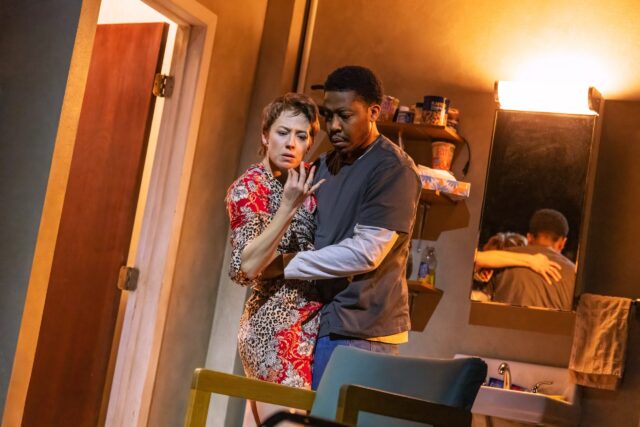
A summer outing offers multiple traumatic situations in Lithuanian drama Drowning Dry

DROWNING DRY (SESĖS; SISTERS) (Laurynas Bareiša, 2024)
IFC Center
323 Sixth Ave. at West Third St.
July 18-31
www.ifccenter.com
www.dekanalog.com

In 2018, Lithuanian filmmaker Laurynas Bareiša served as one of the cinematographers on Marija Kavtaradzė’s debut feature, Summer Survivors, about young adults dealing with mental illness. Bareiša now follows up his own debut feature, the 2021 crime drama Pilgrims, with the haunting Drowning Dry, which could have also been called Summer Survivors. (The Lithuanian title, Sesės, means “Sisters.”)

Close siblings Ernesta (Gelminė Glemžaitė) and Justė (Agnė Kaktaitė) have traveled with their families for a weekend getaway at a cabin on a lake. Ernesta is married to Lukas (Paulius Markevičius), an MMA champion, and they have a young son, Kristupa (Herkus Sarapas); Justė is married to Tomas (Giedrius Kiela), a schlubby dude jealous of Lukas’s strength, and they have a young daughter, Urte (Olivija Eva Viliüné). They all go swimming off the pier, but when tragedy strikes, their relationships with one another change — until Bareiša, who wrote, directed, and photographed the film, reverses time and the result of the event is altered, rearranging the dynamics. Bareiša ends up doing this multiple times, as various episodes happen differently from how they occurred originally, so the interaction among the characters keeps shifting as they face alternate forms of grief and trauma.

Drowning Dry is named after the medical term “dry drowning,” an urban myth that instills fear in parents that their children can drown long after they have been rescued from water. “Dry drowning is a symbol of this overprotection of kids because the real medical condition is very rare,” Bareiša told the Hollywood Reporter. Bareiša was inspired to make the film after having to resuscitate his two-year-old son and thinking about four paths the near-tragedy could have taken, represented by the adults in the film. By the end, numerous characters are having breathing difficulties, requiring help.

The film unfurls in long, uncut scenes in which Bareiša barely moves the camera; it is as if we are there with the family, sitting at the table, standing by the pier, waiting for the ambulance — or perhaps seeing it as a memory of our own grief. The repetition, or doubling, of certain scenes puts the audience in the position of questioning what they’re experiencing and wondering about the disparate paths their personal trauma could have led to.

Drowning Dry opens July 18 at IFC Center, with Bareiša on hand for Q&As at the 7:20 shows on Friday, moderated by Ryan Lattanzio, and Saturday, moderated by Sierra Pettengil.

[Mark Rifkin is a Brooklyn-born, Manhattan-based writer and editor; you can follow him on Substack here.]
INHERITANCE & THE AMERICAN DREAM: DEATH & TAXES AT IFC

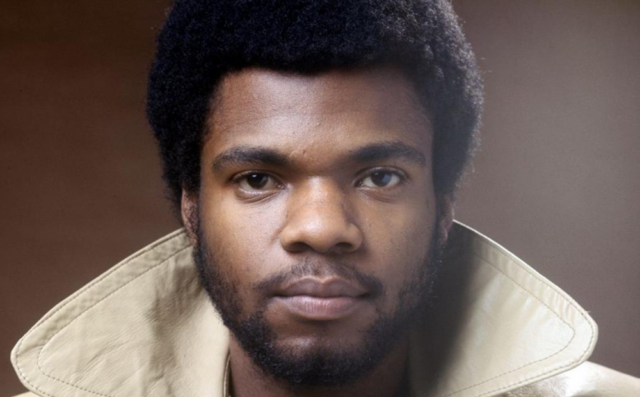
Harvey Schein, Joy Schein, Justin Schein, and Mark Schein pose for a family photo in 1978 (courtesy Schein Family Archives)

DEATH & TAXES: MY FATHER, OUR FAMILY, AND THE COST OF THE AMERICAN DREAM (Justin Schein, 2024)
IFC Center
323 Sixth Ave. at West Third St.
July 17–24
www.ifccenter.com
www.deathandtaxesfilm.com

“If more and more wealth can be accumulated and provided to heirs without ever paying any taxes, then we are on the way to a permanent aristocracy in America,” Clinton Labor secretary Robert Reich says in Justin Schein’s Death & Taxes, a heartfelt and passionate film opening July 17 at IFC.

More than twenty years in the making, the documentary focuses on Justin’s father’s obsession with the estate tax. Harvey Schein was a successful executive in the music industry, landing top jobs at Columbia, Sony in Japan, and Warner, although his famous temper often got him in trouble. Born in 1927 in the Bronx and raised in East New York, Harvey joined the navy, then went to school on the GI Bill and graduated from Harvard Law. He married Joy Gitlin, a dancer and social worker from toney Jamaica Estates, and they had two sons, Mark and Justin.

The film begins in 2003 as the Scheins are in their country home in Connecticut; Harvey has gathered them there to discuss what to do after he is gone.

“Welcome to a Schein family meeting,” Justin narrates in voice-over. “That’s my dad, holding forth on his favorite subject: keeping his hard-earned money from the taxman when he dies. It’s not a bad problem to have, as long as you don’t let it drive you crazy. But unfortunately it did.”

Justin, codirector Robert Edwards, and editors Purcell Carson and Brian Redondo intercut archival news footage, home movies and photos, animation, and new interviews with family members, friends, Harvey’s colleagues, and numerous economists and consultants who offer their thoughts about Harvey and taxes and how things have changed over the years.

Mark Schein talks about how saving money was a “military dictate.” Harvey’s executive assistant Yvonne Johnson calls him “frugal. . . . Everybody knows he had a very, very difficult personality.” Former CBS Records president Clive Davis notes that Harvey “had one Achilles heel in his tendency to be argumentative.”

Harvey’s parents left him nothing, so he was proud of what he built, but he wasn’t about to just hand over millions of dollars to the government to use for welfare and other programs he disagreed with. His disdain for the estate tax even led to his moving to Florida to avoid paying it, jeopardizing his marriage when Joy wanted to head back north and live in New York City.

Meanwhile, Justin, acknowledging the privilege he was born into, speaks with experts on both sides of the estate tax controversy. Republican pollster and strategist Frank Luntz, who renamed the estate tax “the death tax,” considers it “confiscation.” Americans for Tax Reform founder Grover Norquist argues, “I think the death tax does violate people’s sense of the American dream. . . . It’s up to you, and as long as you don’t hurt anybody else, nobody cares.” Heritage Foundation senior fellow Stephen Moore defends Harvey, explaining, “The evidence shows that giving money to the people is not a formula for economic success.”

Justin points out that the estate tax affects only those who are worth at least $13.6 million, a tiny minority of Americans. Institute on Tax and Economic Policy director Amy Hanauer says, “It is 0.1 percent of estates in America that have been subject to the estate tax. It is really the very, very, very wealthy.” Institute for Policy Studies senior scholar Chuck Collins, referring to “the wealth defense industry,” asks, “Should we be ruled by small numbers of wealthy families? Should they dominate our system? So it’s a very American idea to limit the concentration of power.” ProPublica journalist James Bandler posits, “The wealthy have found all sorts of legal ways to reduce their taxes, in some cases to zero.” Discussing government programs, Princeton University sociologist Matthew Desmond offers, “We’re all on the dole.” And Bootstrapped author Alissa Quart contends, “If you think you’re self-made, call your mother.”

While the right-wing news media claims that the death tax is a form of double taxation, Roosevelt Institute president and CEO Felicia Wong, Maven Collaborative economist Anne Price, and New School economist Darrick Hamilton delve into the racial wealth gap. “That kind of passing down of inequalities end up crystalized in wealth inequality,” Wong says. Hamilton adds, “Taxes are used to strategically direct resources in ways to promote economic activity; a big question is for whom.”

Harvey Schein and Joy Schein’s retirement in Sanibel, Florida, did not go as planned (photo by Justin Schein, 1994)

At the heart of the film is the concept of the American dream, something that Justin wants to be available to everyone but is distressed by people like his father who refuse to pay their fair share. Remembering his daily trip to private school, passing through minority communities in disrepair, he recalls, “Looking out the bus window as a kid, I could see that people were hurting.” Showing a map depicting the redlining of New York City, he continues, “My school bus drove right through one of these red areas; each one marks a nonwhite neighborhood excluded from loans. And without a loan, a whole segment of the population was prevented from buying into the American dream of building family wealth.”

Under the current administration, the wealth gap is likely to grow, based on projections surrounding the passage of the One Big Beautiful Bill, and the bickering over the Trump tax cuts will remain as heated as ever. Republicans will battle with Democrats, red states will feud with blue states, the rich will fight with the poor, and fathers will clash with sons.

Since this is Justin’s film, he gets the last word: “When the wealthy are able to avoid paying their share of taxes, the rest of the country gets left behind.”

The US theatrical release of Death & Taxes takes place July 17–24 at IFC. Justin Schein will be on hand for several Q&As, on July 17 at 7:00 with Patriotic Millionaires chair Morris Pearl, New York City comptroller Brad Lander, and New York Working Families Party codirector Ana María Archila, moderated by Strong Economy for All Coalition executive director Michael Kink, on July 18 at 6:35 with Collins, on July 19 at 6:35 with Desmond, and on July 20 at 1:35 with Hamilton and Stronger Together deputy director Charles Khan.

[Mark Rifkin is a Brooklyn-born, Manhattan-based writer and editor; you can follow him on Substack here.]

DO YOU BELIEVE IN MAGIC? OPEN OPENS AT WP THEATER

Megan Hill reprises her role as a magician in Crystal Skillman’s Open (photos by Jeremy Varner)

OPEN
WP Theater
2162 Broadway at 76th St.
Tuesday – Sunday through July 27, $65.79
wptheater.org

In the off-Broadway premiere of Crystal Skillman’s 2019 Open, Kristen (Megan Hill), a queer magician and writer, uses her talent as an amateur prestidigitator in telling her heart-wrenching story of true love, relating specific sleight-of-hand acts to events in her life, believing that she might be able to affect the outcome.

In The Year of Magical Thinking, Joan Didion’s memoir of personal tragedy that was adapted into a solo play, the National Book Award winner writes, “I was thinking as small children think, as if my thoughts or wishes had the power to reverse the narrative.”

Psychology Today defines magical thinking as “the need to believe that one’s hopes and desires can have an effect on how the world turns. . . . Spirits, ghosts, patterns, and signs seem to be everywhere, especially if you look for them. People tend to make connections between mystical thinking and real-life events, even when it’s not rational.”

The seventy-five-minute play is divided into three sections and a bonus: “First Love,” “Commitment,” “Sacrifice,” and “Promise.” It takes place on a spare black set designed and lit by Sarah Johnston. Kristen is already onstage as the audience enters, doing a small, slow dance, in her own world. Once everyone is seated, she addresses the audience directly: “I’m here. I’m here. I am here. Your magician,” she begins, as if trying to convince herself. “Here you are. An audience. A kind of audience. Thank you for joining me. It’s incredible. Imagining you here.”

Of course, she is here, and we are here, but Open is about, as Kristen declares, “the power of the imagination!” There are no props; Kristen mimics all the magic — pulling flowers out of a hat, shuffling a deck of cards, levitating, linking metal rings — with just her body, Johnston’s lighting (which casts dramatic shadows), and Emma Wilk’s sound effects, so we can hear the specific tricks if not actually see them happening in front of us. It’s all connected to her relationship with Jenny, a woman she meet-cutes at the Strand, then goes to Marie’s Crisis with on a date.

Kristen pantomimes handing an audience member an egg covered by a red scarf, and the person obliges; she shares the background of the scarf, which had been handed down from her grandmother to her mother to her, and then she gave it to Jenny. The tale delves into love, birth, and homophobia, ending with the squawks of a parrot flying away. The scene prepares us for what is to follow, memories initiated by imaginary magic tricks that drive a nonlinear narrative in which Kristen attempts to come to terms with a tragedy that she considers herself significantly responsible for.

Kristen has written a YA romantasy about two boys who use magic and fall in love. Jenny asks what the first line is, and Kristen tells her: “Magician! Are you a coward? Don’t you want to live?” Fear and apprehension are themes Skillman keeps returning to. For example, when Kristen mimes juggling, she says, “Secrets are the balls we keep in the air. Ours will come crashing down this evening.”

Everything Kristen does is for Jenny; she believes they were destined to be together. She explains, “Well . . . every person who has ever loved — has a magician! King Arthur had Merlin. Roy had Siegfried. Penn has Teller. Jenny has me. So we imagine.” But then she adds, “For I have to confess — this world and I . . . reality . . . we don’t really get along.”

But therein lies the problem with the play: reality and fantasy never quite mesh and too often seem forced. At one point Kristen cuts a rope in two, ties them in a knot, makes the knot disappear, then reveals to us that the rope is in one piece again; it is a too-obvious metaphor for what is happening between her and Jenny, especially when she next compares it to the boys in her novel, explaining, “They would make their own rules. They would take each other apart and put each other back together again. They were . . . safe.

Kristen works at Staples, a company whose motto is “Worklife Solutions for All. We Inspire What Could Be, and Help Make It a Reality,” while Jenny works at an LGBT Community Center, which declares, “They can try to diminish our flame. But our flame is so strong we only grow bigger and burn brighter.”

Aptly directed without flourish by Jessi D. Hill (Surely Goodness and Mercy, Vanishing Point), Open starts slowly and does build energy; Megan Hill (Eddie and Dave, Trade Practices), who originated the role — Skillman (Wild, Geek) wrote the part with her in mind — takes a while to hit her stride. Some vignettes work better than others, and the details of the plot occasionally get confusing. But certain parts hit hard and are deeply affecting; at one shocking moment, a woman sitting behind me let out the loudest, most heartbreaking gasp I have ever heard at a show.

Continuing at the WP Theater on the Upper West Side through July 27, Open also deals with the concepts associated with the title, from being open to new challenges, new loves, and new situations (including watching a show about a magician with no actual magic in it) to being emotionally open and honest with friends and relatives to standing in front of a door and wondering whether to open it to, perhaps most critically, opening one’s eyes to reality. Early on, Kristen tells us, “Magic isn’t denial. . . . When I say ‘abracadabra’ we will accomplish our task! To bring forth the reality of the imagination. Abracadabra, did you know? Means ‘as it is spoken.’ As I have been brought here, so have you.”

Too much of Open feels like it is based on magical thinking, if not ultimately to reverse the narrative or affect the outcome but to convince oneself how to face reality, even in the most dire of circumstances, more like a dramatized therapy session than a play imbued with the intoxicating spirit of magic and imagination.

[Mark Rifkin is a Brooklyn-born, Manhattan-based writer and editor; you can follow him on Substack here.]