twi-ny recommended events

ADDING IT UP: AN EXPERIMENTAL REVIVAL FROM THE NEW GROUP

Mrs. Zero (Jennifer Tilly) has a lot to say to Mr. Zero (Daphne Rubin-Vega) in New Group experimental revival (photo by Monique Carboni)

THE ADDING MACHINE
Theatre at St. Clement’s
423 West 46th St. between Ninth & Tenth Aves.
Tuesday – Sunday through May 17, $39-$135; livestream May 7, $39.99, 7:00
thenewgroup.org

At the heart of the New Group’s revival of Elmer L. Rice’s 1923 satire, The Adding Machine, extended at the Theatre at St. Clement’s through May 17, is humanity’s fear of displacement and extinction — not by another species but by our own creations.

Ten years ago, Israeli theoretical computer scientist Moshe Vardi said, “We are approaching a time when machines will be able to outperform humans at almost any task. I believe that society needs to confront this question before it is upon us: If machines are capable of doing almost any work humans can do, what will humans do?”

Technological unemployment has been on the minds of humans since ancient times; warnings about robots and machinery taking over have been posited by Aristotle, John Maynard Keynes, Isaac Asimov, Rod Serling, Philip K. Dick, and Stanley Kubrick.

Pulitzer Prize winner Rice’s (Street Scene) prescient work now features “experimental” revisions by Thomas Bradshaw that make it relevant to the current day, as AI threatens not only the future of a wide range of workers but of humanity itself.

As the audience enters the theater, a light shines down on an adding machine that boldly sits center stage; a sign of progress, it may not appear threatening, but to many it can be seen as a villain whose presence, in this case, will lead to violence and a journey into the afterlife.

Among the most important changes Bradshaw has made is the addition of a friendly narrator (Michael Cyril Creighton) who announces at the beginning, “You are about to witness a heart-warming tale about modern life crushing the human spirit. This isn’t a place where life is ‘lived,’ but rather ‘endured.’ A world of worn-out routines, frayed tempers, and dreams so thoroughly flattened that no one even remembers having them. . . . Listen, I know this all might sound depressing and why the hell would you even want to endure this, let alone pay for it, but fear not! I promise there’s plenty of humor in watching humans try to navigate a society that keeps nudging them toward becoming polite and obedient. You may even recognize a few things from your own life. If so, I apologize in advance.”

That opening is followed by a long, biting monologue in which Mrs. Zero (Jennifer Tilly), in bed with her husband, Mr. Zero (Daphne Rubin-Vega), lets loose a verbose diatribe about going to the pictures, getting older, and their failed marriage, exacerbated by Mr. Zero’s attraction to a young woman who lives in their complex, his inability to get promoted at his accounting job, and how “Captain Standish doesn’t stand at attention for me anymore.” Tucked under the covers, Mr. Zero barely moves, as if he’s dead, ignoring his wife, who is tired of playing second fiddle.

“What about me? Where do I come in?” she argues. “You think I don’t know what it’s like — going to that office every day, adding numbers till you feel like one. But I do. My office is this house, these same four walls. And I been adding, too. Adding the days, my gray hairs, and the silences you could bury a life inside. Adding and adding until the total’s too much to bear.”

Humans performing office work are doomed in The Adding Machine (photo by Monique Carboni)

The next day, Mr. Zero believes he is going to be celebrated at work for his twenty-fifth anniversary. He earns his salary writing down numbers that his longtime colleague, the efficient Daisy Diana Dorothea Devore (Sarita Choudhury), reads aloud from receipts. He talks down to her, making her angry.

“You make me sick,” he says. She opines, “I wish I was dead.” They bicker like an old couple. He admits that maybe he would marry her, while she notes that it might be too late for them to have kids. He cuts her off, declaring, “Can’t you slow up? What do you think I am — a machine?”

When the cold-hearted boss (Creighton) tells Mr. Zero that he’s being replaced by an adding machine, the disgruntled employee murders him. At a dinner party that night, during which the host Zeros discuss sports, health, voting, immigrants, and other topics with the Ones, Twos, Threes, Fours, Fives, and Sixes (all played by Creighton), Mr. Zero is arrested, unapologetic for what he has done. At his trial, he delivers a numbers-laden, racist, misogynistic tirade about the societal ills that led him to kill his boss. Soon he finds himself in the Elysian Fields, where he is met by a series of surprises.

In The Adding Machine, life is a boring numbers game that can’t be won. As Lt. Charles (Creighton) explains to Mr. Zero, “Before there were numbers, there was counting. Before there was meaning, there was routine.”

There is little that is routine about the play, directed by New Group founding artistic director Scott Elliott, who has previously collaborated with Bradshaw on Intimacy, Burning, and The Seagull/Woodstock; they are not afraid to take chances and challenge the audience. Although not everything works — several of the afterlife scenes are awkward — what does succeed takes things from the sublime to the ridiculous, or, perhaps, the ridiculous to the more ridiculous.

It begins with casting. In the long-forgotten, misguided 1969 film, Milo O’Shea played Mr. Zero, Phyllis Diller was Mrs. Zero, and Billie Whitelaw portrayed Daisy Devore. In the play, Tilly (Don’t Dress for Dinner, The Women) is like a one-woman band as Mrs. Zero, her alternately squeaky, gravelly voice littered with musical grunts and sighs. Choudhury (the New Group’s Roar, The Flatted Fifth, and Rafta, Rafta . . .) is elegant and alluring as Daisy, an excellent foil to Mr. Zero, portrayed as a short, squat, angry man by two-time Tony nominee Rubin-Vega (Rent, the New Group’s Everything’s Turning into Beautiful) in a bulky suit and mustache. Creighton (The Amateurs, Stage Kiss) is warm and welcoming as the narrator, a tour guide, a man who has committed matricide, the boss, the lieutenant, Judy O’Grady, and other characters.

Derek McLane’s set consists of file cabinets that turn into other pieces of furniture, a back wall with dozens of lamps and fans in their own cubbies, and an electric chair that takes the place of the adding machine. The costumes are by Catherine Zuber, with stark lighting by Jeff Croiter and sharp sound by Stan Mathabane.

There is plenty of debate on how AI will affect people’s jobs. According to Authentic Ventures partner Robin Bordoli, “I think what makes AI different from other technologies is that it’s going to bring humans and machines closer together. AI is sometimes incorrectly framed as machines replacing humans. It’s not about machines replacing humans but machines augmenting humans.”

Journalist Kevin Drum counters, “Sometime in the next forty years, robots are going to take your job. I don’t care what your job is. If you dig ditches, a robot will dig them better. If you’re a magazine writer, a robot will write your articles better. If you’re a doctor, IBM’s Watson will no longer ‘assist’ you in finding the right diagnosis from its database of millions of case studies and journal articles. It will just be a better doctor than you.”

In the play, the fixer (Creighton) from the claims department tells Mr. Zero, “The machine is quicker, it never makes a mistake, it’s always on time. It presents no problems of housing, traffic congestion, water supply, sanitation.”

That’s something that is going to keep being heard as long as humans are on this earth.

[Mark Rifkin is a Brooklyn-born, Manhattan-based writer; you can follow him on Substack here.]

BALANCING THE BALUSTRADE: A BRILLIANT NEW BROADWAY COMEDY

A series of meetings of the Vernon Point Neighborhood Association opens up old and new wounds in The Balusters (photo by Jeremy Daniel)

THE BALUSTERS
Samuel J. Friedman Theatre
261 West Forty-Seventh St. between Broadway & Eighth Ave.
Tuesday – Sunday through May 24, $58-$347
www.manhattantheatreclub.com

Yesterday afternoon I bumped into Richard Thomas on the Upper East Side. I told him how fabulous I thought The Balusters, the new Broadway play he’s starring in, is and what a great cast he’s working with. But as much fun as I had at the show, it appears that he is having even more, if that’s possible, gushing about David Lindsay-Abaire’s script and the entire ensemble. His smile was even bigger than mine.

Making its world premiere at MTC’s Samuel J. Friedman Theatre, The Balusters takes on a kitchen sink of contemporary issues, from homophobia, racism, classism, and corruption to toxic masculinity, privilege, bigotry, and furniture. And it does so in hilarious ways; I can’t remember the last time I laughed so long and hard during a play or clapped so often after side-splitting, sparkling lines of dialogue.

The hundred-minute comedy is set at several meetings of the Vernon Point Neighborhood Association, where a group of nine people regularly gather to discuss the state of their beloved community, a peaceful, old-fashioned enclave steeped in history, boasting well-manicured lawns, comfortable, attractive porches, and an overall flavor of Victorian elegance. The host is the newest member, Kyra Marshall (Anika Noni Rose), who has recently moved from Baltimore with her husband and their twin daughters. She lives in a beautifully designed home with fashionable chairs and couches, fancy china, and paintings of and by distinguished Blacks on the walls, as if overseeing the coming shenanigans, including, in the foyer, a print of George DeBaptiste’s 1978 portrait of Toussaint L’Ouverture, who was born a slave and went on to be a leader of the Haitian Revolution, and, above the fireplace, a flower-laden portrait of a Black feminist that evokes the work of contemporary Black American artists Harmonia Rosales and Kehinde Wiley. (The elegant set is by two-time Tony and two-time Emmy winner Derek McLane.)

The gavel-wielding president of the association is Elliot Emerson (Thomas), a fuddy-duddy real-estate broker intent on protecting the legacy of Vernon Point. The other members are Latino contractor Isaac Rosario (Ricardo Chavira); the acerbic, antagonistic Jewish treasurer, Ruth Ackerman (Margaret Colin); Willow Gibbons (Kayli Carter), a young, white vegan who sees microaggressions everywhere; Brooks Duncan (Carl Clemons-Hopkins), a gay Black travel writer who is married and has a son; the somewhat hapless Alan Kirby (Michael Esper), a white man in his fifties who considers himself an ally and doesn’t understand why he is so often ignored; Melissa Han (Jeena Yi), an ambitious Asian American lesbian and lawyer who is the vice president; and Penny Buell (Marylouise Burke), the elderly white secretary who used to work for Elliot and is not nearly as doddering as she might let on, surprising everyone with sharply focused acerbic quips. Also present is Luz Baccay (Maria-Christina Oliveras), Kyra’s ultra-efficient Filipino housekeeper who left the Emersons’ employ for unstated reasons.

New resident Kyra Marshall (Anika Noni Rose) has no idea what she’s in for after joining group (photo by Jeremy Daniel)

Among the topics of discussion are expanding the hours of the safety van to catch porch pirates, how to handle kids who don’t live in Vernon Point but hang out there, and the plain, ahistorical balusters the Crawfords may be installing, which insult Elliot and lead to the following exchange, which helps define the characters while establishing the play’s central metaphor.

Elliot: Farmhouse balusters aren’t true to the period or style of the original railing. They’d look ridiculous on that Queen Anne.
Melissa: But we don’t police our neighbors.
Elliot: It’s not policing. If you live here, you’ve agreed to certain guidelines.
Kyra: I hate to ask, but what exactly are balusters?
Elliot: I’m sorry, Kyra. We should’ve started with that.
Isaac: They’re the posts that support a railing. They’re like spindles but with footings.
Kyra: Okay, I’m gonna nod and pretend I know what that means.
Melissa: You’re gonna learn so much useless information here.
Elliot: It’s not useless. The balusters are important. They hold everything up. A porch’ll fall to pieces without the right support.
Ruth: As riveting as this is, may we move on?

When Kyra suggests that the group request stop signs for a corner where numerous accidents have occurred, heated arguments ensue, eventually becoming personal over the course of several meetings and leaving no one unscathed, their biases revealed via revenge, gossip, and carelessness.

Penny Buell (Marylouise Burke) is deceptively clever and prescient in brilliant new Broadway comedy (photo by Jeremy Daniel)

The Balusters is brilliantly written by Tony and Pulitzer winner Lindsay-Abaire (Rabbit Hole, Kimberly Akimbo) and expertly directed with a wry sense of humor by Tony winner Kenny Leon (Purlie Victorious: A Non-Confederate Romp Through the Cotton Patch, Home). It is reminiscent of both Bruce Norris’s Tony- and Pulitzer-winning Clybourne Park and Jonathan Spector’s Tony-winning Eureka Day, two plays that explore what can go wrong when small groups of people think they can decide what’s right and wrong for others. It will also likely remind New Yorkers of why they don’t want to be on their coop board.

Five-time Tony nominee Emilio Sosa’s costumes are impeccable, and four-time Tony nominee Allen Lee Hughes’s lighting and six-time Tony nominee Dan Moses Schreier’s sound — he also composed the excellent interstitial music, which features a rap bent — are in sync throughout, especially when thunder and lightning strike at just the right instances.

The terrific ensemble forms an outrageously funny extended family, led by Emmy winner Thomas (Our Town, The Little Foxes) as an older man seeing his carefully curated life slip away and Tony winner Rose (Caroline, or Change, A Raisin in the Sun) as a younger woman who is not afraid to get in Elliot’s way, but theater treasure Burke (Ripcord, Infinite Life), in her seventh collaboration with Lindsay-Abaire, steals the show as Penny, who always knows just what to say.

“I’d just like to remind us that everyone in this room is a decent person,” Penny interjects at one point when things are threatening to get out of hand. “We wouldn’t be here if we didn’t care about our neighbors. At the same time, no one is perfect, and sometimes people make mistakes.”

Now, where’s my gavel?

[Mark Rifkin is a Brooklyn-born, Manhattan-based writer; you can follow him on Substack here.]

IRISH COLD CASE: SCORCHED EARTH AT ST. ANN’S

Suspect John McKay (Luke Murphy) is interrogated by Detective Alison Kerr (Sarah Dowling) in Scorched Earth (photo by Teddy Wolff)

SCORCHED EARTH
St. Ann’s Warehouse
45 Water St.
Through April 19, $74
stannswarehouse.org
www.atticprojects.com

Writer, director, choreographer, dancer, and actor Luke Murphy returns to St. Ann’s Warehouse, following 2024’s sci-fi gem Volcano, with the searing Scorched Earth.

I called the nearly four-hour Volcano “an eruption of ingenuity, a multimedia, multidisciplinary melding of past, present, and future bathed in mystery.” The same can be said of the ninety-minute Scorched Earth.

“What does it take to be from somewhere?” Detective Alison Kerr (Sarah Dowling) asks while discussing a questionable case, setting the stage for a play steeped in humans’ relationship with one another and the land.

The show takes place in a small, tight-knit, unnamed Irish town where the body of a wealthy man, William Dean (Will Thompson), was found on a ten-acre plot of land he had just won at auction, outbidding John McKay (Murphy), a tenant farmer who had worked on the property for eight years. Ten years after the death, Kerr has reopened the case. She brings in McKay for twenty-four hours of interrogation, a digital clock on the wall counting down the time.

The fractured narrative shifts kaleidoscopically in time and space, between the interrogation, re-creations of past events, and a radio talk show where host Leanne Meany (Tyler Carney-Faleatua) speaks with Dean, both before and after his death. Alyson Cummins’s stark set is a bleak, gray, angled room in which the cast of five moves around tables and chairs, an open door morphs into a telephone booth where Sergeant Leahy (Ryan O’Neill) calls Kerr, and a rectangular section of the back wall slides open to reveal other elements. Patricio Cassinoni’s slide projections depict crime-scene photos, pages from official reports, and aerial views of the contested land while putting the murder in context of other similar disputes through Irish history.

Much of the story is told through captivating movement that takes the story in fascinating directions, brilliantly expanding the tense atmosphere as the police procedural unfolds. McKay dances with a grass body (Carney-Faleatua) that is less a green monster than a piece of the land. The deceased Dean writhes around on the floor, his body like a limp, boneless creature. There’s even a country line dance where, as Leahy announces, “no one has to touch each other,” a sly reference to the previously accepted claim that Dean died because of a fall, not at the hands of a murderer.

Meanwhile, the townsfolk seem far more concerned about John O’Donnell’s missing donkey than what happened to Dean, which they seek to remain buried in the cold earth.

Scorched Earth incorporates thrilling dance in police-procedural narrative (photo by Teddy Wolff)

Scorched Earth was inspired by John B. Keane’s 1965 play The Field, which was adapted into a 1990 film by Jim Sheridan that featured an Oscar-nominated Richard Harris as an elderly Irish tenant farmer who is fighting to own the land his family has worked on for generations, as well as by Mark O’Connell’s A Thread of Violence: A Story of Truth, Invention, and Murder, Myles Dungan’s Land Is All That Matters: The Struggle That Shaped Irish History, and Andrew Jarecki’s The Jinx, the Peabody-winning docuseries about real estate heir Robert Durst and a long-unsolved murder.

Cork-born Murphy (Sleep No More, Pass the Blutwurst, Bitte) is magnetic as McKay, a deeply conflicted man who firmly believes the land should have been his. Dowling, who portrays a bartender and a bank teller in addition to Kerr, is cool and calm as the determined detective. Thompson, who starred opposite Murphy in Volcano, brings nuance to Dean, a rich mogul who can afford to buy whatever he wants. (Perhaps the character was also based partly on William K. Dean, a doctor who retired to a New Hampshire farm where he was murdered in 1918; the case, investigated by a private detective named Wilhelm DeKerlor — oddly similar to “Kerr” — remains unsolved.) O’Neill and Carney-Faleatua provide expert support.

Scorched Earth is a scintillating success all the way around, including Cummins’s costumes, Stephen Dodd’s stark lighting, which beams in from the sides of the set, and composer Rob Moloney’s wide-ranging score. Everything merges beautifully for an exhilarating, powerful surprise Sisyphean conclusion where it all comes tumbling down, no matter who you are or where you’re from.

[Mark Rifkin is a Brooklyn-born, Manhattan-based writer; you can follow him on Substack here.]

BANG BANG: REBECCA DE MORNAY IN THE PUSHOVER AT THE CHAIN

Pearl Penny Chen (Di Zhu) and Evelyn (Rebecca De Mornay) have some unfinished business in The Pushover (Dan Wright Photography)

THE PUSHOVER
Chain Theatre
312 West Thirty-Sixth St. between Eighth & Ninth Aves.
Wednesday – Sunday through April 26, $45–$69
www.chaintheatre.org

Rebecca De Mornay makes an impressive New York stage debut in the world premiere of John Patrick Shanley’s curiously uneven but ultimately satisfying modern noir The Pushover.

De Mornay, who rose to stardom in the 1980s and ’90s in such films as Risky Business and The Hand That Rocks the Cradle and more recently has had recurring roles on such series as John from Cincinnati and Jessica Jones, portrays Evelyn, an elegant kingpin involved in a lesbian love triangle with hyper-anxious chef Pearl Penny Chen (Di Zhu) and hyper-anxious restaurant manager, gambler, thief, and drug addict Soochi (Christina Toth). The action shifts from an exclusive spa in New Mexico, where Evelyn conducts her business, to an Asian restaurant in Queens, where Pearl is trying to restart her life and career.

Pearl sends Soochi, who has stolen from her, to Evelyn so that Soochi can make restitution. But Evelyn’s unexpected shifts between jokes and threats set a tone of menace early on.

Describing her exclusive spa, Evelyn explains, “Yeah, there’s an abundance of staff serving a pretty small clientele. And also, it’s the heat of the day, so a lot of folks hang in their rooms about now, or schedule treatments. Me? I like to use the time to pay parking tickets.” An unimpressed Soochi says, “You seem to have a lot of them.” Evelyn replies, “It’s worse than you think. I don’t even have a car.”

A few moments later, Evelyn, who admits to being a “gangster” and a “monster,” snarls, “I warn you! Do not talk shit about Pearl. She was my best shot, you understand? And when you cheated her, you cheated me. And you don’t want to cheat me. No, you do not.”

Evelyn has a plan to make things right, but it is impossible to trust the drug-addled Soochi, producing an explosive finale involving souls, money, and guns.

Soochi (Christina Toth) is at the center of a dangerous love triangle in John Patrick Shanley world premiere at the Chain (Dan Wright Photography)

The Pushover is clumsily directed by Kirk Gostkowski (Humpty Dumpty, Leave Me Behind) and is hampered by an unnecessary frame story in which Pearl meets with a therapist (Christopher Sutton, who plays multiple small roles). The changes in Jackson Berkley’s small, intimate set slow down the pace, and Debbi Hobson’s costumes, from spa robes to white gloves, call too much attention to themselves.

Tony, Pulitzer, and Oscar winner Shanley is one of America’s finest playwrights and screenwriters; his resume includes Doubt and Outside Mullingar on Broadway, Prodigal Son and Danny and the Deep Blue Sea off Broadway, and the films Moonstruck and Five Corners. This new play doesn’t stand up to his best.

Yet somehow it works. It has the feel of the Cher and Nancy Sinatra heartbreak song “Bang Bang (My Baby Shot Me Down)” and Rebekah Del Rio’s dream-pop “No Stars,” both of which can be heard at the Chain, adding to the noirish mood. And De Mornay (Born Yesterday, Closer) provides a steadying force as Evelyn, a strong-willed, powerful woman who knows what she wants and says what she means; she commands the stage with an engaging magnetism, bringing the narrative back to its focus each time it is about to go off the rails.

When Soochi becomes upset after Evelyn asks about the blouse she’s wearing, the mob boss says, “It was a trivial question. Maybe that’s the real problem. Maybe the real problem is you want everything to be important, and everything isn’t important.”

It’s a statement that also describes The Pushover.

[Mark Rifkin is a Brooklyn-born, Manhattan-based writer; you can follow him on Substack here.]

SINCE MY BABY LEFT ME: HEARTBREAK HOTEL AT DR2

Simon Leary and Karin McCracken face heartache in Heartbreak Hotel at DR2 Theatre (photo by Evan Zimmerman for MurphyMade)

HEARTBREAK HOTEL
DR2 Theatre
103 East 15th St. between Irving Pl. & Park Ave.
Tuesday – Sunday through April 19, $29-$56
heartbreakhotelplay.com
www.darylroththeatre.com

New Zealand company EBKM sets the tone for the American premiere of Heartbreak Hotel during the entrance music, with such songs about romantic pain and misery as Aimee Mann’s “Save Me,” Alanis Morissette’s “That I Would Be Good,” Cher’s “Believe,” and Lenny Kravitz’s “It Ain’t Over ’Til It’s Over” preparing the crowd for what is to come at the small, intimate DR2 Theatre.

Writer and star Karin McCracken, who cofounded the troupe with director Eleanor Bishop, comes onstage, walks to the lip, and, with the lights on, looks out at the audience and says, “I was hoping to get to know everyone a bit before we start, so I’m going to ask you a couple of questions. For the first question, you don’t need to respond out loud. If you just think your answer, and make eye contact with me, I’ll be able to tell. It’s just a thing I’m able to do. So: Is anyone here heartbroken, or grieving, or otherwise bereft?” Starting at the back, she then goes row by row, looking into the eyes of each of the ninety-nine audience members, a clever way to form an instant connection.

She then explains she’s neither a musician nor a singer but she has taken up both disciplines because she read that creativity promotes neuroplasticity and singing suppresses cortisol, relieving stress — “Unless you’re singing in an environment that would naturally promote anxiety, like live performance.”

Over the course of about seventy minutes, she shares her story directly with the audience, re-creating scenes from her character’s past. Simon Leary performs all the other roles: a tinder date, her gay bestie, a supermarket worker, a doctor, and her former partner, who she was with for six years. She also plays, on synthesizer, relevant songs by Bonnie Raitt, Sinéad O’Connor, and the Cranberries, dances, and uses such other scientific terminology as “norepinephrine,” “monocytes,” “RNAs,” “serotonin,” “oxytocin,” “Takotsubo syndrome,” and “chipotle sauce,” which serves as medical explanations regarding love and loss as well as potential excuses for why humans make certain decisions.

Karin McCracken wrote and stars in US premiere of EBKM’s Heartbreak Hotel (photo by Evan Zimmerman for MurphyMade)

Dressed in a country-rock-style jacket with sequins, fringe, and tassels, she deals with her situation with limited success, clearly unable to put the relationship behind her, in scenes such as “Dating While Heartbroken,” “The Science: Protest,” and “Anxious/Avoidant,” the words passing by on a semicircle of LED boxes like digital ticker tape. The production design, which also features pink shag carpeting, is by Rachel Marlow (who also did the lighting) and Brad Gledhill of Filament Eleven 11, with sound by Te Aihe Butler that ranges from a German club to a noisy bar to a quiet beach.

McCracken is engaging as the unnamed woman, imbuing her with a believable honesty, refusing to make her a victim while not afraid to reveal her flaws and mistakes. You’ll root for her to finally take those necessary next steps even as she keeps getting in her own way. Leary slides neatly from character to character, making subtle changes in each as the woman’s story unfolds.

It all leads to a powerful finale, one that resonates with Presley’s 1956 hit — “Well, since my baby left me / I found a new place to dwell / It’s down at the end of Lonely Street / At Heartbreak Hotel / Where I’ll be, I’ll be so lonely, baby / I’m so lonely / I’ll be so lonely, I could die” — but has a hopeful twist at the end, hinting that there may be a way out of the woman’s self-imposed prison.

On the way out of the theater, each audience member is given a small pamphlet consisting of notes and resources, from poetry and music influences to illustrations and acknowledgments, including one for her mum.

Early on in the show, her mother, in a prerecorded voiceover, says, “When someone is in the midst of a heartbreak, it feels like time has stopped — because they want the past and don’t want what the future holds. A state of limbo. It’s a terrible thing.”

As always, mother knows best.

[Mark Rifkin is a Brooklyn-born, Manhattan-based writer and editor; you can follow him on Substack here.]

PLAYING CHICKEN: KRYMOV LAB’S UNCLE VANYA AT LA MAMA

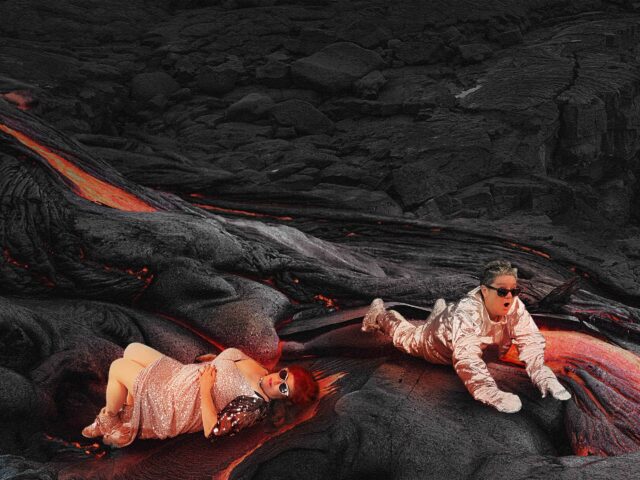
Vanya (Zach Fike Hodges) makes an appeal to Yelena (Shelby Flannery) as Waffles (Amen Igbinosun) watches and Professor Serebryakov (Colin Buckingham) reads in Krymov Lab NYC production at La MaMa (photo by Marina Levitskaya)

UNCLE VANYA, SCENES FROM COUNTRY LIFE
La MaMa Experimental Theatre Club
The Ellen Stewart Theatre
66 East Fourth St. between Second Ave. & Bowery
Tuesday – Sunday through April 12, $10-$60
212-475-7710
www.lamama.org

“When I was supposed to have a master class at Hunter College and I was preparing and I decided to look at Uncle Vanya, the scenes I was going to use for that master class, all of a sudden I felt nauseated,” Dmitry Krymov said at a talkback following the April 1 matinee of Uncle Vanya, scenes from country life at La MaMa, where he pointed out how everything had changed since Russia invaded Ukraine. He was in Philadelphia at the time, preparing The Cherry Orchard, and has been unable to return to his home country ever since. “I felt this is the food I put in the refrigerator many, many years ago, and I’m warming it up over and over again. I was so mad at myself for doing so that I decided to do what you just saw. That was the idea. I jumped in my bed. That’s what you were seeing right now. What you just saw was a work of my imagination at that particular moment.”

And what an imagination Krymov has. His new play is not a reimagination or a reinvention of Chekhov’s 1898 tragicomedy but a glorious explosion of its innards. Krymov shifts the focus to Yelena (Shelby Flannery), who spends most of the show sitting near the front of the stage in her knickers, the rest of the characters seated in a semicircle behind her. A city denizen, Yelena does not want to be in the country, instantly uncomfortable as she is harassed by flies and frightened by the sounds of wild animals nearby. Over the course of ninety inspired minutes, she is approached by Dr. Astrov (Javier Molina), an environmental activist who is in love with her; her husband, Professor Serebryakov (Colin Buckingham), who owns the family estate; Vanya (Zach Fike Hodges), the brother of the professor’s late wife who has no life outside the estate; Sonya (Natalie Battistone), daughter of the professor’s late wife who works with Vanya and is worried about becoming a spinster; Waffles (Amen Igbinosun), a simple-minded man who lives on the estate, faithful to the spouse who abandoned him years before for another man; Vanya’s controlling mother (Anya Zicer); the stern nanny (Tim Eliot) who makes a terrifying chicken soup; and a hen (MaryKate Glenn) wearing pink bunny slippers and a rooster (Sasha Drey) who plays the acoustic guitar.

The existence of the hen and rooster serves as a microcosm of Krymov’s approach to the narrative. In the original play, at one point the nanny calls out to the chickens on the estate and tells Sonya, “The speckled hen has disappeared with her chicks. I am afraid the crows have got her.” Krymov turns that brief mention into a heart-wrenching subplot. The two costumes are hilarious until they’re not, when the actors remove at least part of them. Meanwhile, the set is a long vertical rectangular slightly rising white platform that leads to a large horizontal canvas in the back on which designer Emona Stoykova has painted a rough black-and-white country scene inspired by Vincent Van Gogh’s last painting, “Wheatfield with Crows,” evoking not only the killer crows but the tragedy of Van Gogh’s suicide by gun — the firearm a mainstay of Chekhovian drama and something that Krymov also turns inside out and upside down.

Eventually, Vanya gets tired of not being the center of attention and screams out, “I am the main character of this play! . . . THIS PLAY IS ABOUT ME! IT’S CALLED UNCLE VANYA. NOT UNCLE PROFESSOR, NOT UNCLE DOCTOR, NOT UNCLE SONYA, NOT UNCLE WHAT’S HIS NAME OR WHATEVER YOUR NAME IS. NOT UNCLE MAMA, NOT UNCLE CHICKEN. IT’S UNCLE VANYA. ME!”

However, this is Dmitry Krymov’s Uncle Vanya, not Anton Chekhov’s, as evidenced most defiantly by an utterly brilliant finale.

A hen (MaryKate Glenn) and Yelena (Shelby Flannery) take a smoking break in Uncle Vanya, scenes from country life (photo by Marina Levitskaya)

Writer-director Krymov has assembled a terrific team to pull off this bewitching, circuslike production, every element pulling rabbits out of hats, with costumes by Luna Gomberg, puppets by Leah Ogawa, lighting by Krista Smith, sound by Denis Zabikaya, projections by Yana Biryukova, and impressive dramaturgy by Shari Perkins. The cast is exceptional, led by Flannery as a complex Yelena, who adds depth to a role often performed as a knowing seductress, and Glenn as the unforgettable Hen, who will break your heart.

The play is also heavily influenced by the pandemic and the Russian invasion of Ukraine as the characters search for their identity and place in an ever-more-dangerous world, where potential violence hovers around every corner and love and connection are not easy to come by. At the talkback, Krymov was near tears several times when he spoke fondly about his former home and answered questions from members of the audience watching from Russia (and other countries) on a livestream.

Krymov previously presented his unique takes on Ernest Hemingway and Eugene O’Neill in Three Love Stories Near the Railroad and Alexander Pushkin in Pushkin “Eugene Onegin” in our own words.

I can’t wait to see what magic he has in store for us next.

A BAD CASE OF WRITER’S BLOCK: THE UNKNOWN AT STUDIO SEAVIEW

Sean Hayes stars as a writer facing a crisis in David Cale’s The Unknown (photo by Emilio Madrid)

THE UNKNOWN
Studio Seaview
305 West 43rd St. between Eighth & Ninth Aves.
Through April 12, $158-$349, streaming $89
studioseaview.com

There are only a few seats left for each of the final performances of David Cale’s The Unknown at Studio Seaview, but the last four shows, on Friday, Saturday, and Sunday, will also be available as a livestream so you can watch this creepy psychological thriller from the comfort of your own home, where you’re likely to have seen star Sean Hayes in Will & Grace, if not also Martin & Lewis and The Millers. Just be sure to keep the lights off.

Following up his Tony-winning portrayal of Oscar Levant in Good Night, Oscar, Hayes is Elliott, a New York City writer experiencing a bad case of writer’s block. “I don’t know, maybe it’s from spending too much time surfing the internet, and it’s affected my ability to concentrate, but I was having a hard time keeping focused,” he tells us at the beginning.

He accepts an offer from his best friends, Larry and Chloe, to stay for a while in their isolated upstate cabin, but the first day he is there he hears a voice singing, “I Wish You’d Wanted Me,” a song from his hit musical. The sound echoes around the theater, enveloping everyone, but Elliott doesn’t find anyone around the place. Out of cellphone range, he later calls Larry, who claims it is not some kind of prank. Elliott also chooses not to contact the police, the first of numerous possible mistakes he makes as he realizes that the story he is involved in might be just the one to end his block, no matter the consequences.

Solo specialist Cale (The Redthroats, Deep in a Dream of You) and director Leigh Silverman (On the Exhale, The Search for Signs of Intelligent Life in the Universe) previously collaborated on Harry Clarke and Sandra, so they know their way around one-person plays, but The Unknown drifts into TV-detective territory with a convoluted plot that feels overstuffed even at a mere seventy minutes, with several unnecessary scenes and a disappointing twist ending.

Hayes does a fine job on a spare set, standing in front of a brick wall as he switches between Elliott, Larry, Chloe, the mysterious Joey Dupain, and others. Cha See’s lighting maintains a noirish feel, accompanied by Caroline Eng’s sound design and Isobel Waller-Bridge’s music. There are intimate, revealing moments, including one that got a gasp out of the audience, as the concept of stalking is stretched to its limits, but there are just not enough chills. Maybe watching it home alone will offer a better opportunity to get past some of its inscrutability.

[Mark Rifkin is a Brooklyn-born, Manhattan-based writer and editor; you can follow him on Substack here.]