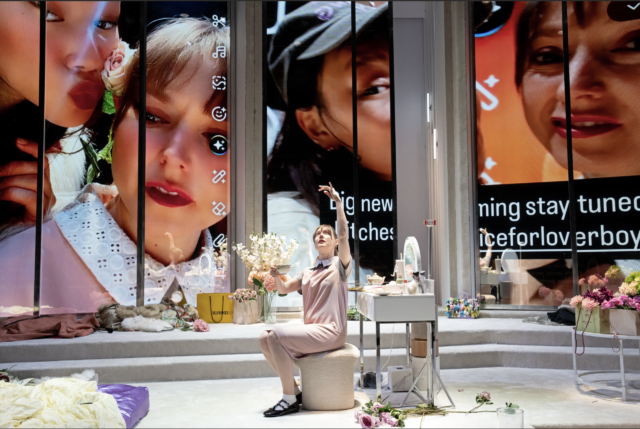
Kip Williams’s adaptation of Jean Genet’s The Maids skewers contemporary society (photo by Julieta Cervantes)
THE MAIDS
St. Ann’s Warehouse
45 Water St.
Tuesday – Sunday through June 14, $49-$149
stannswarehouse.org
“None of it is real,” two characters say in Kip Williams’s scathing adaptation of Jean Genet’s 1947 play The Maids, running through June 14 at St. Ann’s Warehouse.
In his lengthy introduction to the published edition of the play (paired with Deathwatch), Jean-Paul Sartre wrote, “It is the element of fake, of sham, of artificiality that attracts Genet in the theatre. He has turned dramatist because the falsehood of the stage is the most manifest and fascinating of all. Perhaps nowhere has he lied more brazenly than in The Maids.”
Williams has reimagined the work for today’s social-media-obsessed culture, with potent results that, despite the “lies,” ring only too true.
Sisters Solange (Phia Saban) and Claire (Lydia Wilson) are live-in maids toiling for Madame (Yerin Ha), a wealthy, famous influencer whose father is a billionaire. The siblings both hate and love Madame, wanting to be her while also dreaming of killing her. They rummage through her closets of expensive couture and luxuriate in her bedroom, which is filled with colorful flowers and floor-to-ceiling mirrors.
For the first part of the play, Rosanna Vize’s plush, elegant set is surrounded by a thin translucent curtain, as if the characters are trapped inside, but when it opens it merges the “falsehood of the stage” with a kind of realism that only enhances the fantasy world Genet and Williams have created and the three characters bask in.
Solange and Claire have deviously plotted to frame Madame’s boyfriend, who has been arrested for embezzlement, another example of fakery. “I needed it to be real,” Claire says when detailing how they pulled it off.
When Madame finally shows up, she is aghast at everything and everyone, from the flowers Kim Kardashian has sent her to the selfie a fan had asked for. “You can tell her assistant directly from me that he should either consider a career change or do some fucking research cos even fucking ChatGPT could tell you that nobody is doing pink fucking hydrangeas anymore. Fuck. Why is it so hard to get good help these days?” she complains to Solange. “Ok!? I feel like I’m going to die, but there’s like a massive difference between my metaphoric death and sending me this fucking disgusting death parade of flowers. Like I am in mourning for my literal life, but like not for actual real, ok?”
As insults fly and the tension mounts, the proceedings are projected on the mirrored closets as if being broadcast live on Instagram or TikTok, complete with filters that make the characters look like garish versions of Brad Pitt and Angelina Jolie, name-dropping such brands as Gianvito Rossi, Balenciaga, and Gucci by Ancora while Madame worries that her boyfriend will be sent to Guantanamo and that she’ll have to move to her father’s villa in France to get away from all the tumult. “It’s going to be really hard,” Madame says. “I will make such a fuss over you both. You’ll be like my little country dolls.”
But through it all, the three women make sure to capture nearly every minute online, which is the only thing that truly matters.
“I’m over. I’m dead. I’ve been cancelled, babes!” Madame opines. “Solange, film this. Film this. This is perfect. This is how it ends. This is perfection!”
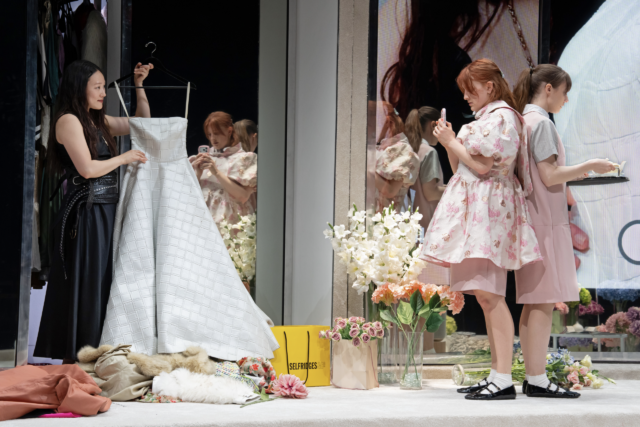
Madame (Yerin Ha) chooses just the right dress as sisters Solange (Phia Saban) and Claire (Lydia Wilson) stand back to back (photo by Julieta Cervantes)
Genet grew up in foster care and was arrested numerous times, including for vagrancy, theft, and using false identity papers. Identity is key to The Maids, as the characters occasionally take one another’s place and create fake identities online. Loosely inspired by the true story of sisters Christine and Léa Papin, two maids who killed their mistress and her daughter in France in 1933, Williams’s version is an unsparing satire about twenty-first-century Western culture mired in the desperate need of individuals to put their lives online, acquire likes, and expand their influence amid classism and capitalism run amok.
The Maids is tailor made for actors to hold nothing back and has boasted major trios in the past: Vivien Merchant, Glenda Jackson, and Susannah York in 1973, Cate Blanchett, Isabelle Huppert, and Elizabeth Debicki in 2013, and Uzo Aduba, Zawe Ashton, and Laura Carmichael in 2016. Saban (House of the Dragon, Oedipus) and Olivier nominee Wilson (King Charles III, Pains of Youth) appropriately devour the scenery as the virtually interchangeable sisters, while Ha (Bridgerton, Lord of the Flies) gets her fill as well, leading to a finale that reaches a devastating crescendo.
Williams, who also used live video in his Tony-nominated The Picture of Dorian Gray, Dracula, and Strange Case of Dr. Jekyll and Mr. Hyde, keeps the artifice front and center throughout. Zakk Hein’s projections are huge and grotesque, getting in the audience’s face, both enhancing and overwhelming the action unfolding onstage; should we be looking at the actors themselves or their giant images? Are we actually seeing ourselves and our desire for a fancy home, expensive clothing and accessories (the fanciful, and absurd, costumes are by Marg Horwell), and online fame assisted by botox and Ozempic? And how far are we willing to go to achieve any of that?
The stellar production also features sound by Dan Balfour, lighting by Jon Clark, and original music by DJ Walde that add to the “artificiality” of Genet’s vision. It’s often hard to watch, but you can’t turn away; as fantastical and outrageous as it all seems, it’s also all too real.
“Everything must be so false that it sets our teeth on edge,” Sartre adds in his introduction.
My teeth are still chattering.
[Mark Rifkin is a Brooklyn-born, Manhattan-based writer; you can follow him on Substack here.]