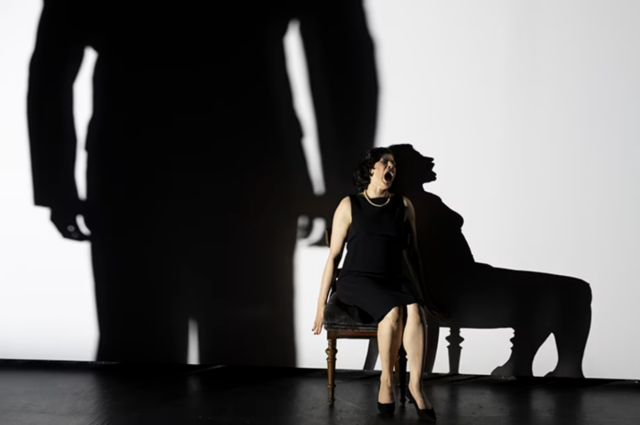
Heartbeat Opera’s Vanessa continues at Baruch Performing Arts Center through May 31 (photo by Russ Rowland)
VANESSA
Baruch Performing Arts Center
55 Lexington Ave. at 25th St.
Through May 31, $53 – $133
www.baruch.cuny.edu/bpac
www.heartbeatopera.org/vanessa
Heartbeat Opera’s Vanessa is a treat for opera lovers as well as opera newbies.
Adapted by company artistic director and conductor Jacob Ashworth with arrangements by music director Dan Schlosberg, the 1958 Pulitzer Prize winner by composer Samuel Barber and librettist Gian Carlo Menotti has been distilled down into its essence, a chilling one-hundred-minute Gothic romance with flashes of Douglas Sirk melodrama, film noir, and German expressionism. Sung in English, it is a taut tale of love both requited and unrequited, with a stark loneliness boiling at its center.
Vanessa (soprano Inna Dukach) has been pining away in her country mansion for twenty years, believing that her lost love will return to her. She lives with her niece, Erika (mezzo-soprano Kelsey Lauritano), who has sacrificed her youth to tend to her aunt, as well as her mother, the aging Baroness (mezzo-soprano Mary Phillips).
“Oh, I shall die if anything happens to him! / My heart, my heart, I can wait no longer,” Vanessa opines. Erika offers to calm her down by reading to her, choosing a rather relevant section from Sophocles’s Oedipus Rex, in which the protagonist declares, “Woe, woe is me, / Sorrowful, sorrowful that I am! / Where am I? Where am I going? / Where am I cast away?”
When someone approaches on a dark, stormy night, Vanessa is sure that it must be Anatol coming back to her, but it is actually his son, also named Anatol (tenor Freddie Ballentine), who shows affection for both Vanessa and Erika as the Baroness watches closely, suspicious of his intentions. Anatol explains, “All through my youth / I heard that name, ‘Vanessa.’ / Like a burning flame / it used to scorch my mother’s lips / and light my father’s eyes with longing. / Now that I am alone / I have been driven here / to meet at last the woman / who haunted so my house: Vanessa.”
When the Doctor (baritone Joshua Jeremiah) calls on Vanessa, he is at first overjoyed that she seems happy. “Ah, how good it is to see this house alive again!” the Doctor, who has loved Vanessa from afar, proclaims, but he is dumbfounded by the sudden appearance of Anatol and consumed by a jealousy that he does not know how to express. Meanwhile, both Vanessa and Erika have fallen for Anatol, but only the latter can face the reality of the situation. “It is a long winter here. Must the winter come so soon?” she wonders.
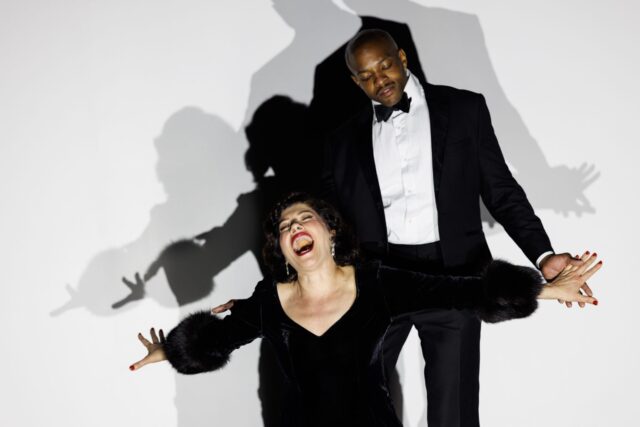
Vanessa (Inna Dukach) believes she has finally found love with Anatol (Freddie Ballentine) in Samuel Barber and Gian Carlo Menotti’s Pulitzer Prize winner (photo by Russ Rowland)
Vanessa unfolds on a spare, narrow, horizontal stage backed by a large white, angled screen onto which menacing shadows are cast by the performers, who are all dressed in black. Monochrome as the costumes are, the production’s one nod to excess, other than the emotional pitch, are the fabulous, diva-worthy retro ensembles. (The set is by Jiaying Zhang, with costumes by Terese Wadden and lighting by Yuki Nakase Link.) On one side is the seven-piece band, consisting of Sunny Sheu on violin, Thapelo Masita on cello, Louis Arques on clarinet and saxophone, Grace O’Connell on trumpet, Sam George on trombone, Deanna Cirielli on harp, and Eliot Goldmund on piano, playing the often ominous score.
Directed by R. B. Schlather (In the Penal Colony, The Mother of Us All), the opera drags a bit as it reaches its conclusion but is otherwise poignant and exciting, with superb performances by the ensemble amid striking visuals; the only props are chairs that are occasionally brought on and off, allowing the focus to be on the intense narrative.
It’s a heart-wrenching story that soars at the intimate Baruch Performing Arts Center, best encapsulated by the words of the Baroness, who says to Erika, “My poor child, love never bears / the image that we dream of; / when it seems to, / beware of the disguise!”
[Mark Rifkin is a Brooklyn-born, Manhattan-based writer; you can follow him on Substack here.]