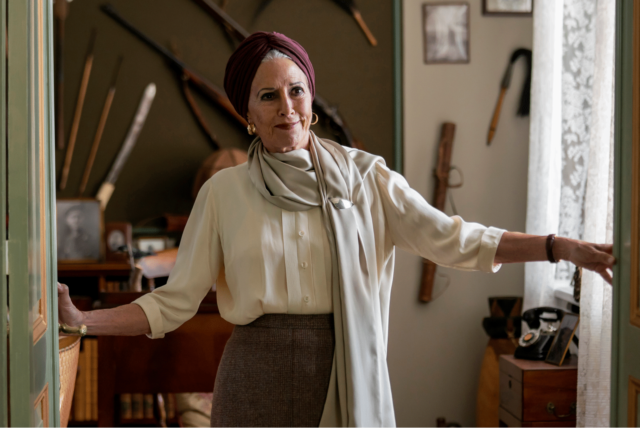
Birthe Neumann is radiant as socialite and author Karen Blixen in The Pact
THE PACT (PAGTEN) (Bille August, 2021)
Quad Cinema
34 West 13th St. between Fifth & Sixth Aves.
February 11-17 quadcinema.com pactmovie.com
Birthe Neumann is mesmerizing as Karen Blixen in Bille August’s The Pact, now playing at the Quad. Blixen is better known by her pen name, Isak Dinesen, author of such books as Out of Africa and such stories as Babette’s Feast and The Immortal Story, all of which became films. The Pact opens in 1948, and Blixen, referred to as Tanne or the baroness, holds court over the fanciful and the glitterati at her family estate, Rungstedlund. Now sixty-three, she is seriously ill but still able to revel in manipulating those around her. She forms an instant liking for young poet Thorkild Bjørnvig (Simon Bennebjerg), taking him under her wing and making a pact of spiritual faithfulness with him, built on mutual trust and protection; she compares it to a deal she claims to have made with the devil, trading her soul for the ability to tell stories.
The thirty-year-old Thorkild is reserved and inexperienced, but the baroness is determined to instill in him the courage to be fearless to make him a better writer. “All white people have a fear in them that I can’t stand. And that is the fear of displeasing. Instead of doing what they want, they try to flatter, hoping to be liked,” she advises him. “Do you know why so many people are unhappy nowadays? It’s because they are no longer raised to be brave. But in order to be happy, you need to risk being unhappy.”
As he spends more time at Rungstedlund, the baroness attempts to drive a wedge between him and his wife, Grete (Nanna Skaarup Voss), a shy librarian, and their young son, Bo (Mikkel Kjærsgaard Stubkjær); she also tries to make him grow closer to Benedicte Jensen (Asta Kamma August), the wife of socialite and arts philanthropist Knud W. Jensen (who would go on to found the Louisiana Museum of Modern Art in Humlebæk, Denmark, in 1958). Thorkild finds himself trapped in the middle: He wants to be a successful writer, husband, and father, but the baroness, who is divorced and asexual, living in a mansion with only her housekeeper and assistant, Mrs. Carlsen (Marie Mondrup), pining away for her lost love, Denys Finch Hatton, insists that he cannot be all three and must choose between them.
The baroness (Birthe Neumann) has very specific plans for poet Thorkild Bjørnvig (Simon Bennebjerg) in Bille August’s The Pact
The Pact is a compelling, beautifully photographed tale of unrequited love, heartbreaking loss, and the creative process. Adapted by Christian Torpe from Thorkild Bjørnvig’s 1974 memoir, the film, gorgeously directed by Bille August (Pelle the Conqueror,The Best Intentions) with a subtle simplicity, opens with a pair of fascinating shots: Cinematographer Manuel Alberto Claro first shoots Blixen from the side, her face hidden in shadow as she applies makeup in front of a mirror, followed by Thorkild shaving in bright light, his wife holding their baby beside him. One is facing the end, while the other is just starting, a visualization of the film’s epigraph, a quote from Blixen: “Not by your face but by your mask shall I know you.”
But as good as Neumann is, the film’s heart and soul is Bennebjerg (Borgen,A Report on the Party and the Guests), who has primarily appeared in shorts and television series before assuming this lead role. He walks a fine line as Thorkild navigates his different, deep attractions for the characters played by Neumann (The Celebration,The Kingdom), Voss (Klaphat), and Kamma August (Burn All My Letters,Sex), the daughter of Bille August and Danish superstar Pernilla August. Bennebjerg portrays Thorkild’s coming-of-age as he moves from innocence to experience under the strict tutelage of the baroness with a trepidatious unease that holds everything together; his performance grows more nuanced as the character learns more about what he has signed up for and is often not sure quite how to proceed. It’s a stage of growth we’ve all found ourselves in, even if it didn’t involve a world-famous Danish writer, but Bennebjerg makes it feel like it could happen to any of us, at any moment.
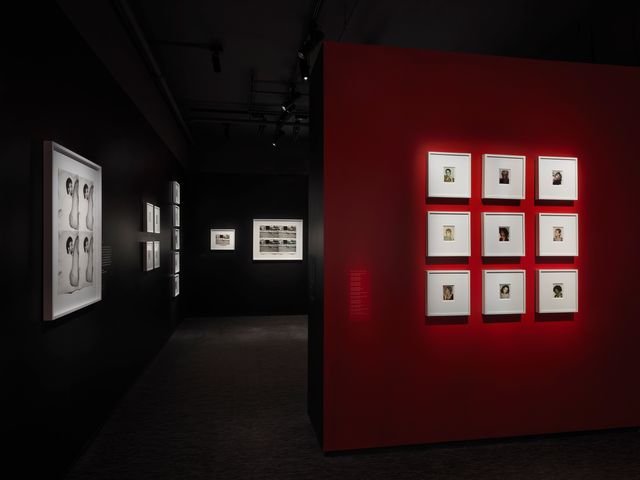
Andy Warhol exhibit has been extended at Fotografiska through February 20 (photo by Dario Lasagni)
ANDY WARHOL: PHOTO FACTORY / ANDERS PETERSEN: COLOR LEHMITZ
Fotografiska
281 Park Ave. South at Twenty-Second St.
Open daily, $16-$26, 9:00 am – 9:00 pm www.fotografiska.com/nyc
When I told a good friend of mine who teaches visual art that we were going to make our first visit to Fotografiska, she immediately asked, “Why?” The institution refers to itself as “a museum experience for the modern world,” with locations in Estonia, Sweden, Shanghai, and, soon, Berlin and Miami. It opened in the landmarked Church Missions House on Park Ave. South in December 2019, only a few months before the pandemic lockdown. It is not for everyone; seeing a show can feel like attending a gallery opening, with groups of people drinking cocktails, chatting away, and taking their time to get just the right picture of themselves in front of the photographs. Fotografiska’s motto is: “Have fun. Stay late. Get deep. Spill your drink.”
When we went, we saw a few disappointing, uninspiring exhibits; one relied on a slide show and reproductions of the work instead of original pieces, and two others were accompanied by poorly translated wall text. But across the six floors were two eye-opening presentations that make a trip to Fotografiska a must, even if you are not going to down martinis and snap away into the night.
Continuing through February 20, “Andy Warhol: Photo Factory” consists of more than 120 rarely or never-before seen works by Andy Warhol, from shots of familiar celebrities to photobooth strips to eight remarkable stitched photographs and studies from his 1974 Polaroid series “Ladies and Gentlemen,” of trans people and drag queens; he later turned some of these images into silkscreens. A pair of men in tuxedos serve food to a smiling Jean-Michel Basquiat. Keith Haring stands with his arm around Dolly Parton by a pond. Grace Jones is draped in white fur, black gloves, and a red scarf.
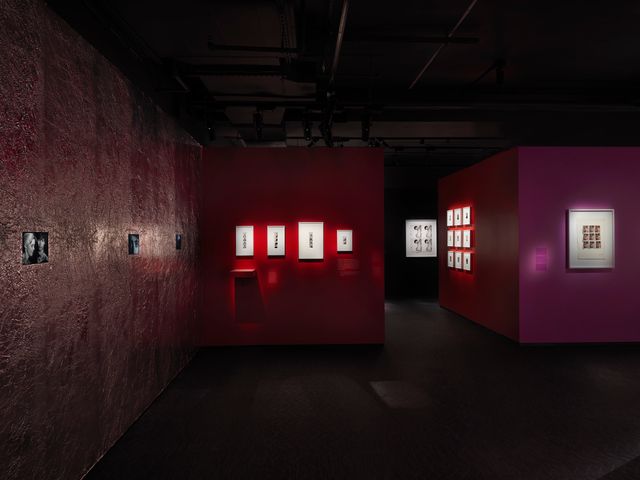
Andy Warhol exhibit at Fotografiska includes rarely seen images (photo by Dario Lasagni)
In one area, pictures are arranged on wallpaper depicting high-heeled shoes; several Screen Tests peek out from a wall covered in silver foil. Nine small nudes are arranged in three rows, primarily focusing on buttocks. Quotes from Warhol’s published diaries accompany some works.
The most impressive room contains Warhol’s little-seen stitched photos, in which he took one picture, made duplicates, then stitched them together with thread to create something wholly new, three-dimensional repeated images, loosely held together, of nudes, a beach landscape, and Steven Spielberg. The hand of the artist is key to Warhol’s success here; he went everywhere with his camera, becoming his own Instagram, taking photos that, essentially, anyone could have, in photo booths, with a Polaroid camera, threading some together himself. But, of course, nobody’s Instagram page will ever match his.
Even the introductory text is better, written by culture writer and curator Vince Aletti, who notes, “Andy Warhol’s art has been so thoroughly absorbed into the culture that it’s difficult to imagine the shock, consternation, and thrill it once provoked. He was a joke; he was a genius. His Pop was the purest, the shrewdest, the wittiest — both the most straightforward and the most confounding.” It is this dichotomy that keeps Warhol so popular, both among serious art lovers and people who just want to have some fun, stay late, and spill their drink.
The other must-see exhibit at Fotografiska is “Anders Petersen: Color Lehmitz,” through March 6. The show zeroes in on the Stockholm-born photographer’s pictures taken in Café Lehmitz in the late 1960s, shots of men and women having fun, staying late, and drowning themselves in drink. He invites the viewer into the seedy joint, where members of a motley crew play around, get into fights, smoke, and fall in love in a port neighborhood filled with sailors and brothels.
“The people at Lehmitz had a presence and a sincerity that I myself lacked,” Petersen, who goes everywhere with a camera on his belt, says about the series. “You were allowed to be desperate, tender, sit by yourself, or become part of the community. In the vulnerability, there was a lot of warmth and tolerance.” In a short documentary, Petersen explains that when he takes photos, he thinks of them as a book, not just individual images. In the wall text, curator Angie Åström writes, “The photos from Cafe Lehmitz become a kind of family album.”
In an accompanying slide show, Lehmitz, who is in his late seventies — he was twenty-three when he took these photos — talks about many of the photos, recounting each individual, sharing barroom stories about them. If you get the feeling that you’ve walked into a Tom Waits album, you’ve grasped the aesthetic: Petersen’s original photo of a shirtless man with tattoos snuggling into the neck of a laughing woman (“Lilly och Rose”) became the cover of the gravelly voiced singer and actor’s 1985 album, Rain Dogs,.
In other photos, four men argue over beers. A man stands alone against a pole, looking right into the camera, blowing out smoke from his cigarette. A woman seems surprised when a man puts his hand up her shirt, the jukebox and a door with broken glass in the background. A couple Petersen refers to as Bonnie and Clyde smoke while leaning on a pinball machine. A woman puts her hand to the face of an elderly man who blankly stares out at nothing, as if she is checking for signs of life.
The photos also come to life in a series of contact sheets Petersen processed in the late 1960s for the publication of his Café Lehmitz book. Seen in large-scale, the decaying sheets contain yellow and red dots, cross-outs in black, and yellow and green tints, featuring not only the images that he would use in the book and can be seen on their own in the exhibition but additional takes that were not used but form their own narrative on these sheets, as if stills from a film that was never made.
“It’s a place that I absolutely don’t want to romanticize, since the circumstances were anything but that,” Petersen explains. “But there was still that universal togetherness and presence that is often missing from fancy parlors or properly lit break rooms. That thing that many of us are longing for, but that our culture seldom gives us the tools for, to let us really connect with each other.”
Petersen’s photographs give voice to the marginalized, the disenfranchised, lonely people seeking solace in a life that might not have quite gone the way they expected. But Petersen makes no judgment about them, instead merely depicting them as they are, celebrating each and every one, and we are all the better for it.
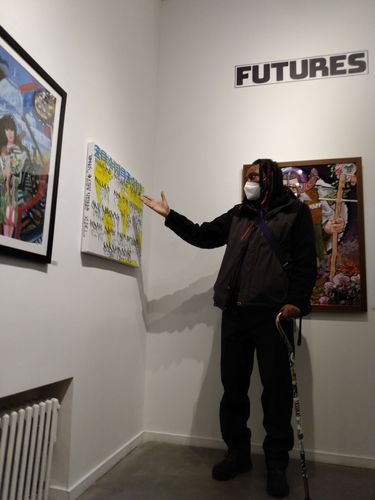
DubbleX discusses Future Fears at Fountain House Gallery opening (photo by twi-ny/mdr)
FUTURES
Fountain House Gallery
702 Ninth Ave. at Forty-Eighth St.
Tuesday – Saturday through March 2, free, 12:00 – 6:00
212-262-2756 www.fountainhousegallery.org www.artsy.net
In the nonprofit Art at a Time Like This, cofounders and independent curators Anne Verhallen and Barbara Pollack focus on twenty-first-century art that explores current events and the vast changes being experienced around the world every day. Pollack, author of Brand New Art from China: A Generation on the Rise and The Wild, Wild East: An American Art Critic’s Adventures in China, looks to what’s next in “Futures,” continuing at Fountain House Gallery through March 2. The show features painting, sculpture, and installation by more than twenty artists living with mental illness. The works range from bright and hopeful to dark and foreboding. Alyson Vega’s fabric collage Dear Future… contains such phrases as “Our bad” and “Left a bit of a mess.” In Spirit of 2076, Issa Ibrahim reimagines Archibald M. Willard’s iconic Yankee Doodle (Spirit of ’76) painting of two drummers and a fife player in front of the American flag during the Revolutionary War as Wonder Woman, Superman, and Batman marching for the United States of McDonald’s. Susan Spangenberg is represented by three pieces: Mister Doomsday, in which a strange creature is holding a coffee cup that says “Have a Nice Day” and a sign that declares “The End Is Near”; Octomission, a colorful octopus blasting off; and the large-scale map of the moon, Space Farce, a collaboration with Ibrahim that includes familiar quotes and logos placed on the moon.
Boo Lynn Walsh shares her thoughts on the future in collage Chaos: History Repeats (photo by twi-ny/mdr)
“Post-2020, predicting the future is perhaps an antiquated game, given how the sudden onset of the pandemic surprised all prognosticators,” Pollack said in a statement. “Combining boundless imagination with low-tech materials, the artists of ‘Futures’ create a new way of dealing with our hopes, fears, and anxieties, conjuring visions that cannot be seen through telescopes or crystal balls. From apocalyptic nightmares to over-the-rainbow fantasies, the artworks in this exhibition underscore the limits of politicians, scientists, and astrologers to find a new way of envisioning imminent change. Only artists, like these, seem capable of creating images that are dynamic and capture the diversity of the future, or, more accurately, ‘futures,’ since this holds a different meaning for each.”
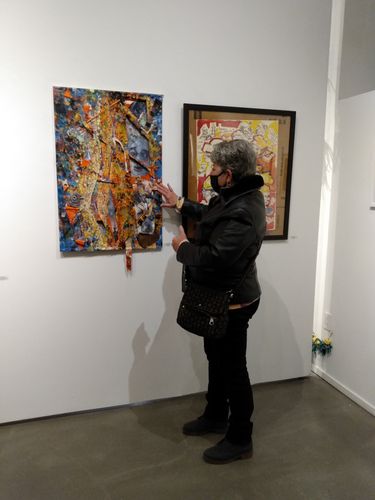
At the opening, several artists were on hand to discuss their work. Vermilion put on her blue Ceremonial Helmet, which gallery visitors cannot do, but you can spin her Compass, both of which are made of found materials; Boo Lynn Walsh offered everyone a chance to peer into her electronic wall sculpture Oracle of Artificial Enlightenment, and Ray Lopez talked about the sci-fi influences behind his watercolor Confessions into Another Porthole, in which a woman looks through a black hole in a blue circle, searching for something else. Most of the works are available for sale (some have already been sold), with prices ranging from $90 to $4,500.
Students occupy offices in documentary The Unmaking of a College
THE UNMAKING OF A COLLEGE: THE STORY OF A MOVEMENT (Amy Goldstein, 2021)
IFC Center
323 Sixth Ave. at West Third St.
Opens Friday, February 11 www.ifccenter.com
“One can worry that if Hampshire is failing, what does that mean for liberal arts education in general?” Sloan Foundation president Adam Falk asks in Amy Goldstein’s passionate documentary, The Unmaking of a College: The Story of a Movement. A graduate of the innovative, experimental independent Hampshire College, which opened its doors in 1970, Goldstein follows a months-long sit-in orchestrated by students upon learning that the institution was in danger of closing.
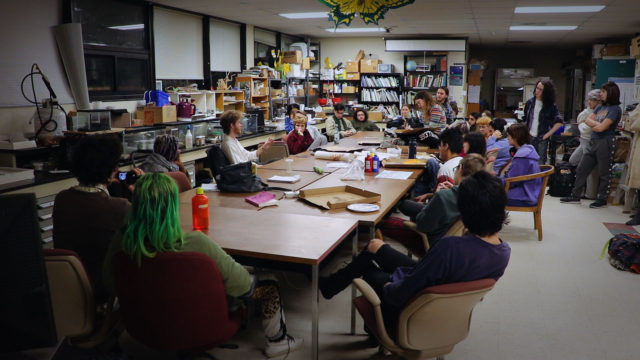
On January 15, 2019, new college president Miriam “Mim” Nelson sent out a letter advising of an important meeting being held in forty-nine minutes. At that meeting, which many people could not attend because of the late notice, she announced that the school was looking for a “strategic partner” and that there was likely going to be no incoming class in the fall. Students, teachers, and even members of the board of directors took action, demanding answers. When none came, the students occupied several offices, including Nelson’s, as they crusaded for their rights, attempting to save the liberal arts college, which had a relatively low endowment and relied primarily on tuition, which was high.
Columbia University professor Andrew Delbanco explains, “We are about to see a great shrinkage in the number of colleges and universities in this country because only the wealthiest will be able to survive. And it’s inevitable, I think, that fragile colleges are going to face the possibility of going out of business.”
Among the students Goldstein talks to are Marlon Becerra; Cheyenne Palacio-McCarthy; Andrew Gordon; Moon West; Annie Wood; Joshua Berman, who took extensive footage of various events and gatherings; and Rhys MacArthur, who works in the admissions office. They are often photographed in front of a large screen with campus footage projected over them, evoking how all-encompassing the situation is; they are not just battling for their education but for their future careers and life.
“Students have always been a huge part of how this college runs. I remember occupying the president’s office, but I don’t remember why. I mean, that’s just in our blood,” Hampshire alum and master documentarian Ken Burns notes. “At one point it seemed like the story is that Hampshire College is dead. I am happy to say that rumors of our death are greatly exaggerated.”
Nelson doesn’t back down even as the press gets hold of the story and some questionable behind-the-scenes negotiations are revealed. Sitting on the floor of her office, surrounded by students, Nelson tells them, “I just have to say, I feel like I’m in an alternative universe here. I am working so f’ing hard. I am fighting like you can’t even imagine to maintain our independence. It’s critical. So I’m looking at all of these things.”
Student Nya Johnson immediately responds, “You get paid to work f’ing hard. So work. Do your work. We pay you to do this. I don’t know; I’m just confused. What alternative universe are you living in?”
Hampshire has a history of activism and providing students with a nontraditional education. Fear of a merger with one of its sister schools, Amherst, Smith, Mount Holyoke, or UMass, worries students and faculty; professors are concerned with what would happen to them, particularly as potential layoffs loom. However, as Hampshire professor Salman Hameed declares about Nelson, “She picked the wrong college to mess with.”
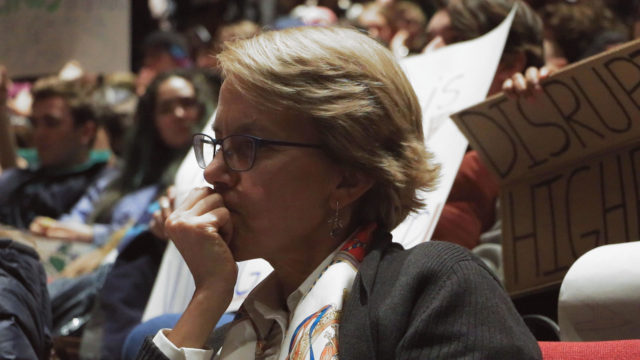
Hampshire College president Miriam “Mim” Nelson finds herself under fire in Amy Goldstein doc
Goldstein (Kate Nash: Underestimate the Girl,Self-Made Men) also speaks with Hampshire Gazette reporter Dusty Christensen, Science magazine editor in chief Holden Thorp, former college president Adele Simmons, lead fundraiser Cheri Butler, and Hampshire board of trustees member Mingda Zhao, who each offers a unique perspective on the conflict.
Hampshire professor Margaret Cerullo writes an article for The Nation detailing what is happening; she titles it “The Unmaking of a College: Notes from Inside the Hampshire Runaway Train,” a riff on the school’s original manifesto, The Making of a College. Yale School of Management associate dean Jeffrey Sonnenfeld announces, “This was very badly handled.” The only person who speaks up for Nelson is Hampshire alum and conservative Subject Matter PR firm CEO John Buckley, who was hired by Nelson to help handle the crisis. “I saw a woman who was trying to do the right thing who got caught and made some mistakes, and then everything unraveled really, really badly,” he says.
Hampshire’s motto is “Non satis scire” — “To know is not enough.” The students’ nonviolent campaign for transparency, involvement, and agency, to know the truth and be part of the solution, is inspiring; many of them are learning lessons that will help them on their life’s journey while also finding out there can be lies and betrayal on that road. In many ways, the film serves as a primer for the future as the next generation prepares to eventually take over a torn and tattered America — and it all begins with education.
The Unmaking of a College: The Story of a Movement opens February 11 at IFC Center; Goldstein will be on hand for a Q&A with some of the film’s subjects following the 7:50 show.
Rashomon helps kick off delayed monthlong centennial celebration of Toshirō Mifune at Film Forum
MIFUNE
Film Forum
209 West Houston St.
February 11 – March 10
212-727-8110 filmforum.org
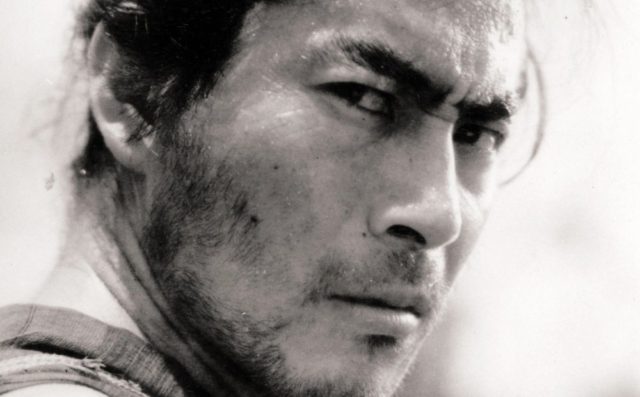
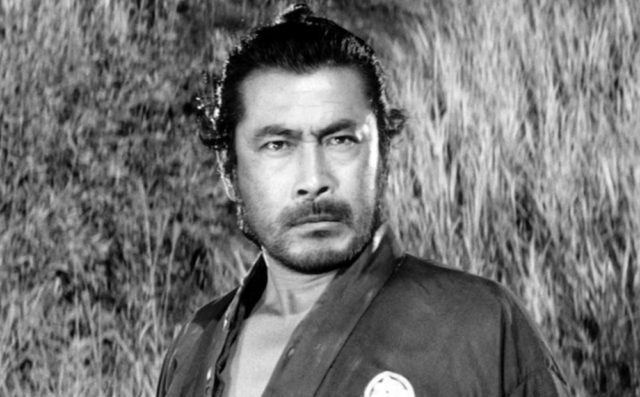
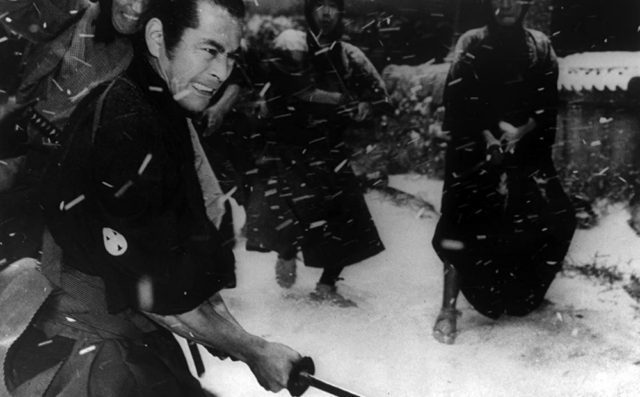
No other international actor stands out for his country as Japanese star Toshirō Mifune does for his. Quick: Name another big-time Japanese thespian. Born in Seitō on April Fools Day in 1920, Mifune made nearly two hundred appearances in films and on television, including a particularly fertile period between 1948 and 1966, when he made movies with Akira Kurosawa, Hiroshi Inagaki, Kihachi Okamoto, Masaki Kobayashi, and Mikio Naruse that would become classics. He worked in multiple genres, from Western Westerns and Eastern Westerns to noir detective thrillers, police procedurals, samurai epics — and, yes, romance.
Film Forum is celebrating Mifune’s fifty-year career and the hundredth anniversary of his birth — the series was scheduled for 2020 but was postponed because of the pandemic lockdown — with an exciting retrospective running February 11 to March 10, consisting of thirty-three films over four weeks, from his onscreen debut in 1947’s Snow Trail to all sixteen films he made with Kurosawa, from the little-seen A Wife’s Heart and All About Marriage to grandiose Shakespearean adaptations, from the Musashi Miyamoto trilogy to his fling with Hollywood. Mifune, who died on Christmas Eve, 1997, could out-Eastwood Eastwood, out-Bronson Bronson, and out-McQueen McQueen. “I’m not always great in pictures, but I’m always true to the Japanese spirit,” he once said. You can decide for yourself how great he was by heading over to Film Forum and catching a bunch of these flicks, several of which are not available for streaming; below are some recommendations.
RASHOMON (Akira Kurosawa, 1950)
Friday, February 11 at 2:55, 7:10
Wednesday, February 16, 5:35
Friday, March 4, 3:50
Saturday, March 5, 12:40
Wednesday, March 9, 6:00
Thursday, March 10, 12:40, 5:10 filmforum.org
One of the most influential films of all time, Akira Kurosawa’s 1950 masterpiece, adapted from Ryunosuke Akutagawa’s short story “In a Grove,” stars Toshirō Mifune as a bandit accused of the brutal rape of a samurai’s wife (Machiko Kyo) and the murder of her husband (Masayuki Mori). However, four eyewitnesses tell a tribunal four different stories, each told in flashback as if the truth, forcing the characters — and the audience — to question the reality of what they see and experience. Kurosawa veteran Takashi Shimura — the Japanese Ward Bond — plays a local woodcutter, with Minoru Chiaka as the priest. The mesmerizing work, which won an Oscar for Best Foreign Language Film, is beautifully shot by Kazuo Miyagawa; Rashomon is nothing short of unforgettable. (What is forgettable is the English-language remake, The Outrage, directed by Martin Ritt and starring Edward G. Robinson, Paul Newman, Laurence Harvey, Claire Bloom, and William Shatner.)
Nakajima (Toshirō Mifune) lives in fear in Akira Kurosawa’s I Live in Fear
I LIVE IN FEAR (Akira Kurosawa, 1955)
Friday, February 11, 12:40, 4:55, 9:10
Friday, February 18, 12:30
Saturday, February 19, 2:50 filmforum.org
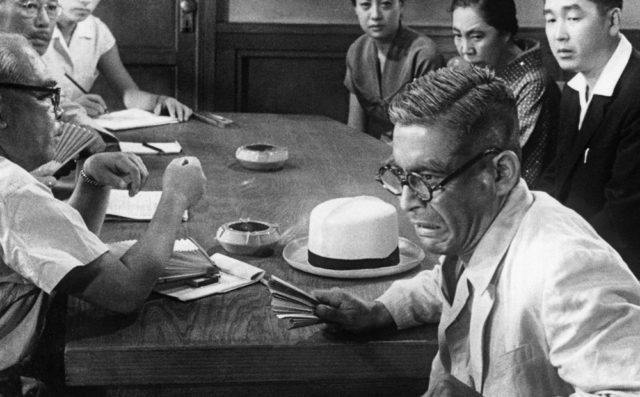
Akira Kurosawa’s powerful psychological drama I Live in Fear, also known as Record of a Living Being, begins with a jazzy score over shots of a bustling Japanese city, people anxiously hurrying through as a Theremin joins the fray. But this is no Hollywood film noir or low-budget frightfest; Kurosawa’s daring film is about the end of old Japanese society as the threat of nuclear destruction hovers over everyone. A completely unrecognizable Toshirō Mifune stars as Nakajima, an iron foundry owner who wants to move his large family — including his two mistresses — to Brazil, which he believes to be the only safe place on the planet where he can survive the H bomb. His immediate family, concerned more about the old man’s money than anything else, takes him to court to have him declared incompetent; there he meets a dentist (the always excellent Takashi Shimura) who also mediates such problems — and fears that Nakajima might be the sanest one of all.
Toshirō Mifune and Shirley Yamaguchi face unwarranted gossip in Akira Kurosawa’s Scandal
SCANDAL (Akira Kurosawa, 1950)
Sunday, February 13, 12:40
Monday, February 14, 3:00 filmforum.org
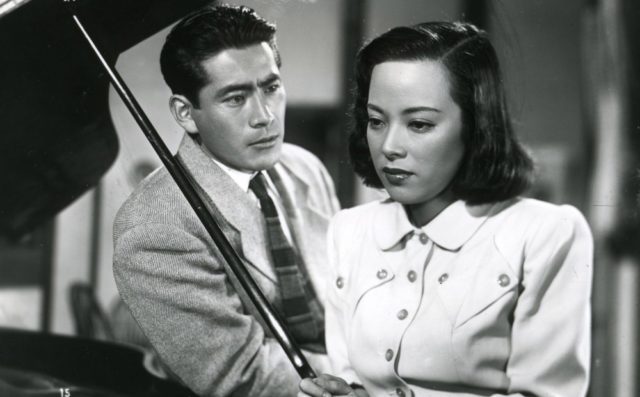
When two famous people are caught together at a hotel in the mountains, a scandal breaks out as a lurid gossip magazine prints their picture and makes up a sordid romance that is not true. With their reputations tainted, they consider suing the publication, but they run into problems with their ragtag lawyer, who has a bit of a gambling problem. Akira Kurosawa regular Toshirō Mifune stars as Ichiro Aoye, a well-known painter who likes smoking pipes and riding his flashy motorcycle. Yoshiko Yamaguchi is Miyaka Saijo, a timid pop singer who is terrified of the unwanted publicity. And Takashi Shimura is Hiruta, the struggling lawyer devoted to his young daughter, who is dying of TB. The first half of the movie is involving right from the roaring opening-titles sequence, with good characterization and an alluring story line. Unfortunately, the film bogs down in the second half, especially during the hard-to-believe courtroom scenes, the only ones of Kurosawa’s career. And the Christmas bit is tired and cliché-ridden, even if might have been unique at the time for a film made in postwar Japan. But Kurosawa’s attack on the media is still valid today, even if he did fill it with sappy melodrama.
Takashi Shimura and Toshirō Mifune team up as detectives tracking a stolen gun in Akira Kurosawa’s Stray Dog
STRAY DOG (Akira Kurosawa, 1949)
Monday, February 14, 8:10
Friday, February 18, 2:40
Sunday, February 20, 12:40
Thursday, February 24, 5:50
Wednesday, March 9, 8:10 filmforum.org
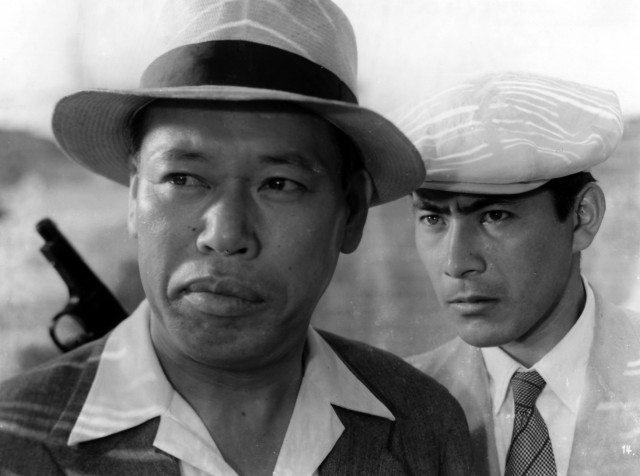
Akira Kurosawa’s thrilling police procedural Stray Dog is one of the all-time-great film noirs. When newbie detective Murakami (Toshirō Mifune) gets his Colt lifted on a trolley, he fears he’ll be fired if he does not get it back. But as he searches for the weapon, he discovers that it is being used in a series of robberies and murders — for which he feels responsible. Teamed with seasoned veteran Sato (Takashi Shimura), Murakami risks his career — and his life — as he tries desperately to track down his gun before it is used again. Kurosawa makes audiences sweat, showing postwar Japan in the midst of a brutal heat wave, with Murakami, Sato, dancer Harumi Namiki (Keiko Awaji), and others constantly mopping their brows — the heat is so palpable, you can practically see it dripping off the screen. (You’ll find yourself feeling relieved when Sato hits a button on a desk fan, causing it to turn toward his face.) In his third of sixteen films made with Kurosawa, Mifune plays Murakami with a stalwart vulnerability, working beautifully with Shimura’s cool, calm cop who has seen it all and knows how to handle just about every situation. (Shimura was another Kurosawa favorite, appearing in twenty-one of his films.)
Rookie detective Murakami (Toshirō Mifune) often finds himself in the shadows in Stray Dog
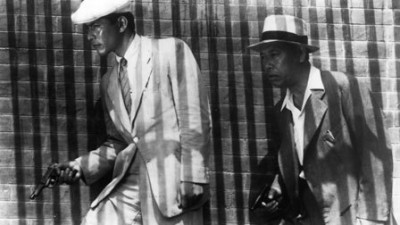
Mifune is often seen through horizontal or vertical gates, bars, curtains, shadows, window frames, and wire, as if he’s psychologically and physically caged in by his dilemma — and as time goes on, the similarities between him and the murderer grow until they’re almost one and the same person, dealing ever-so-slightly differently with the wake of the destruction wrought on Japan in WWII. Inspired by the novels of Georges Simenon and Jules Dassin’s The Naked City,Stray Dog is a dark, intense drama shot in creepy black and white by Asakazu Nakai and featuring a jazzy soundtrack by Fumio Hayasaka that unfortunately grows melodramatic in a few key moments — and oh, if only that final scene had been left on the cutting-room floor. It also includes an early look at Japanese professional baseball. Kurosawa would soon become the most famous Japanese auteur in the world, going on to make Rashomon, Ikiru, Seven Samurai, Throne of Blood, The Hidden Fortress, The Bad Sleep Well, The Lower Depths, and I Live in Fear in the next decade alone.
The Lower Depths is another masterful collaboration between Akira Kurosawa and Toshirō Mifune
THE LOWER DEPTHS (Akira Kurosawa, 1957)
Tuesday, February 15, 2:45, 8:00
Wednesday, February 16, 12:40
Tuesday, March 1, 5:40 filmforum.org
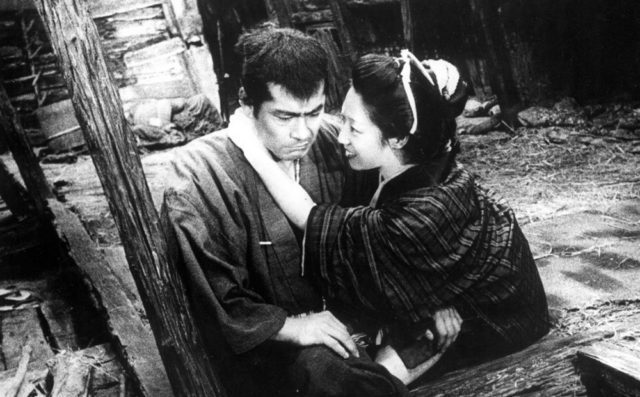
Loosely adapted from Maxim Gorky’s social realist play, The Lower Depths is yet another masterpiece from Japanese auteur Akira Kurosawa. Set in an immensely dark and dingy ramshackle skid-row tenement during the Edo period, the claustrophobic film examines the rich and the poor, gambling and prostitution, life and death, and everything in between through the eyes of impoverished characters who have nothing. The motley crew includes the suspicious landlord, Rokubei (Ganjiro Nakamura), and his much younger wife, Osugi (Isuzu Yamada); Osugi’s sister, Okayo (Kyôko Kagawa); the thief Sutekichi (Toshirō Mifune), who gets involved in a love triangle with a noir murder angle; and Kahei (Bokuzen Hidari), an elderly newcomer who might be more than just a grandfatherly observer. Despite the brutal conditions they live in, the inhabitants soldier on, some dreaming of their better past, others still hoping for a promising future. Kurosawa infuses the gripping film with a wry sense of humor, not allowing anyone to wallow away in self-pity. The play had previously been turned into a film in 1936 by Jean Renoir, starring Jean Gabin as the thief.
Toshirō Mifune and Akira Kurosawa take on Shakespeare in Throne of Blood
THRONE OF BLOOD (Akira Kurosawa, 1957)
Wednesday February 16, 3:15
Thursday, February 17, 12:40, 8:20
Sunday, February 27, 12:40, 8:10
Sunday, March 6, 9:05 filmforum.org/film/throne-of-blood-mifune
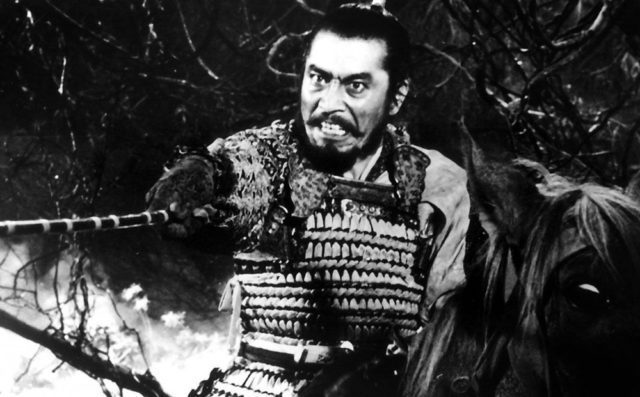
Akira Kurosawa’s marvelous reimagining of Macbeth is an intense psychological thriller that follows one man’s descent into madness. Following a stunning military victory led by Washizu (Toshirô Mifune) and Miki (Minoru Chiaki), the two men are rewarded with lofty new positions. As Washizu’s wife, Asaji (Isuzu Yamada, with spectacular eyebrows), fills her husband’s head with crazy paranoia, Washizu is haunted by predictions made by a ghostly evil spirit in the Cobweb Forest, leading to one of the all-time classic finales. Featuring exterior scenes bathed in mysterious fog, cinematographer Asakazu Nakai’s interior long shots of Washizu and Asaji in a large, sparse room carefully considering their next bold move, and composer Masaru Sato’s shrieking Japanese flutes, Throne of Blood is a chilling drama of corruptive power and blind ambition, one of the greatest adaptations of Shakespeare ever put on film.
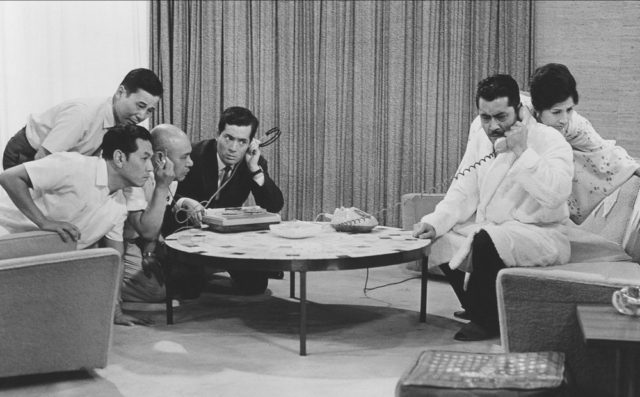
A group of men try to help Kingo Gondo (Toshirō Mifune) find kidnappers in Akira Kurosawa’s tense noir / police procedural
HIGH AND LOW (Akira Kurosawa, 1963)
Saturday, February 19, 8:00
Wednesday, March 2, 2:30
Tuesday, March 8, 12:40, 7:50 filmforum.org
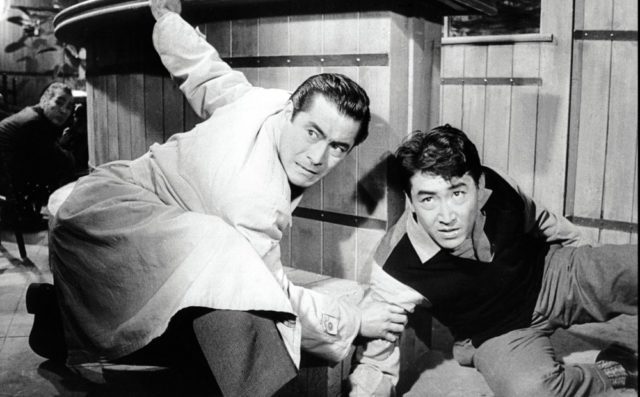
On the verge of being forced out of the company he has dedicated his life to, National Shoes executive Kingo Gondo’s (Toshirō Mifune) life is thrown into further disarray when kidnappers claim to have taken his son, Jun (Toshio Egi), and are demanding a huge ransom for his safe return. But when Gondo discovers that they have mistakenly grabbed Shinichi (Masahiko Shimazu), the son of his chauffeur, Aoki (Yutaka Sada), he at first refuses to pay. But at the insistence of his wife (Kyogo Kagawa), the begging of Aoki, and the advice of police inspector Taguchi (Kenjiro Ishiyama), he reconsiders his decision, setting in motion a riveting police procedural that is filled with tense emotion. Loosely based on Ed McBain’s 87th Precinct novel King’s Ransom, Akira Kurosawa’s High and Low, photographed by longtime Kurosawa cinematographer Asakazu Nakai, is divided into two primary sections: The first half takes place in Gondo’s luxury home, orchestrated like a stage play as the characters are developed and the plan takes hold. The second part of the film follows the police, under the leadership of Chief Detective Tokura (Tatsuya Nakadai), as they hit the streets of the seedier side of Yokohama in search of the kidnappers. Known in Japan as Tengoku to Jigoku, which translates as Heaven and Hell, High and Low is an expert noir, a subtle masterpiece that tackles numerous socioeconomic and cultural issues as Gondo weighs the fate of his business against the fate of a small child; it all manages to feel as fresh and relevant today as it probably did back in the ’60s.
Toshirō Mifune and Takashi Shimura made fifty-three movies together
DRUNKEN ANGEL (Akira Kurosawa, 1948)
Saturday, February 19, 12:40
Sunday, February 27, 6:00
Monday, February 28, 12:40
Tuesday, March 1, 8:20
Wednesday, March 2, 5:50
Thursday, March 10, 2:45 filmforum.org
The first film that Kurosawa had total control over, Drunken Angel tells the story of a young Yakuza member, Matsunaga (Toshiro Mifune), who shows up late one night at the office of the neighborhood doctor, Sanada (Takashi Shimura), to have a bullet removed from his hand. Sanada, an expert on tuberculosis, immediately diagnoses Matsunaga with the disease, but the gangster is too proud to admit there is anything wrong with him. Sanada sees a lot of himself in the young man, remembering a time when his life was full of choices — he could have been a gangster or a successful big-city doctor. When Okada (Reisaburo Yamamoto) returns from prison, searching for Sanada’s nurse, Miyo (Chieko Nakakita), the film turns into a classic noir, with marvelous touches of German expressionism thrown in. We deducted a quarter star for the terrible incidental music that lapses into melodramatic mush.
Nishi (Toshirô Mifune) is desperate for revenge in Akira Kurosawa’s dark Shakespearean noir, The Bad Sleep Well
THE BAD SLEEP WELL (Akira Kurosawa, 1960)
Thursday, February 24, 2:50
Sunday, February 27, 3:00
Friday, March 4, 8:20 filmforum.org
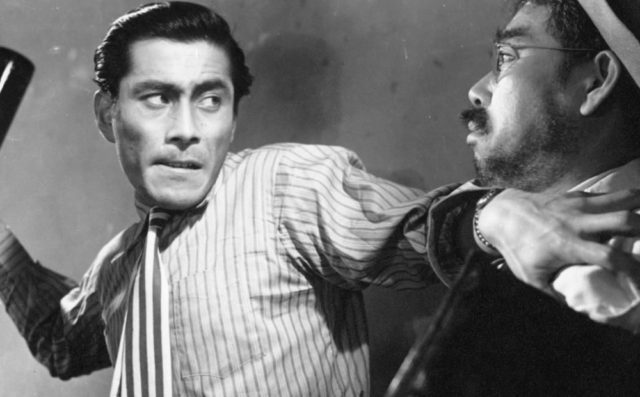
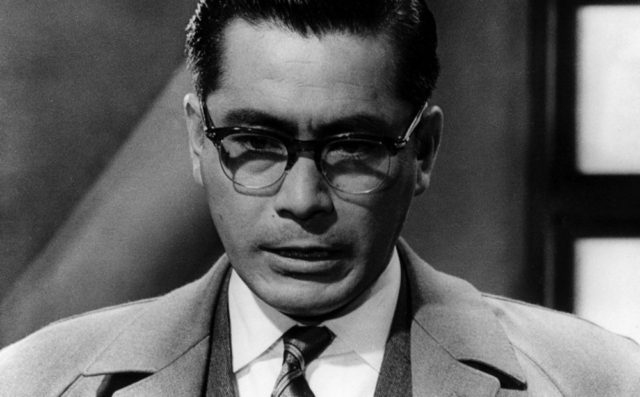
The twelfth of sixteen films director Akira Kurosawa and actor Toshirô Mifune made together between 1948 and 1965, the Shakespearean noir The Bad Sleep Well is a tense, gripping thriller in which Kurosawa takes on post-WWII Japanese corporate culture, incorporating elements of Hamlet into the complex narrative. The 1960 film begins with a long wedding scene in which everything is set in motion, from identifying characters (and their flaws) to developing the central storylines. Kōichi Nishi (Mifune) is marrying Yoshiko (Kyōko Kagawa), a young woman with a physical disability whose father is Iwabuchi (Masayuki Mori), the vice president of Public Corporation, a construction company immersed in financial scandal as related by one of the many cynical reporters (Kōji Mitsui) covering the party and anticipating possible arrests. Also at the affair are Iwabuchi’s cohorts in crime, Miura (Gen Shimizu), Moriyama (Takashi Shimura), Shirai (Kō Nishimura), and Wada (Kamatari Fujiwara), as well as Iwabuchi’s rogue son, Tatsuo (Tatsuya Mihashi), who threatens to kill Nishi if he does anything to hurt his sister. It soon becomes clear that Nishi in fact does have more on his mind than just marrying into the company. “Even now they sleep soundly, grins on their faces,” Nishi declares. “I won’t stand for it! I can never hate them enough!”
Photographed in an enveloping, almost 3-D black-and-white by Yuzuru Aizawa and with a propulsive, jazzy score by Masaru Sato, The Bad Sleep Well is a deeply psychological, eerie tale that finds inspiration in the story of Hamlet, Polonius, Ophelia, Claudius, Gertrude, Laertes, and Horatio. But whereas Kurosawa’s Throne of Blood and Ran were more direct interpretations of Macbeth and King Lear, respectively, Kurosawa, who edited the film and cowrote it with Hideo Oguni, Eijirô Hisaita, Ryûzô Kikushima, and Shinobu Hashimoto, uses the Shakespeare tragedy more subtly as he investigates greed, envy, revenge, betrayal, suicide, torture, ghosts, and murder; in fact, many critical plot points, including those involving violence, occur offscreen. The locations are spectacular, especially a volcano and an abandoned, decimated munitions factory that clearly references the destruction wrought by WWII. The actors wear their hearts on their sleeves, often emoting with silent-film tropes, especially Shimura, Fujiwara, and Nishimura as Iwabuchi’s nervous, perpetually worried underlings and Mihashi as the wild, unpredictable prodigal son. Mifune is stalwart throughout, wearing pristine suits and eyeglasses that mask what is bubbling inside him, threatening to explode, while Mori is a magnificently evil villain. At 150 minutes, it’s a long film, but it’s worth every minute; it could have actually been longer, but Kurosawa, in his first film made through his own independent production company, instead chose an abrupt yet fascinating ending with all kinds of future implications. Made between the period piece The Hidden Fortress and the samurai Western Yojimbo,The Bad Sleep Well was advertised as “a film that will violently jolt the paralyzed soul of modern man back to its senses,” and it still does just that, as corporate corruption seems to never end. Oh, and it also features one of the best wedding cakes ever put on celluloid.
Toshirō Mifune stars as a corrupt cop in The Last Gunfight
THE LAST GUNFIGHT (Kihachi Okamoto, 1960)
Friday, February 25, 3:50, 8:40 filmforum.org
In the little-known Kihachi Okamoto yakuza noir The Last Gunfight, Toshirō Mifune stars as corrupt detective Saburo Fujioka, who has been reassigned from Tokyo to Kojin City and instantly becomes caught in the middle of a mob war between rival gangs looking to pay him off so he will work for them. He befriends Tetsuo Maruyama (Kôji Tsuruta), whose wife might have been murdered, while alternately meeting with some bad people and angering his fellow cops, who are not happy to have a bad apple on their team. Director Kihachi Okamoto has fun with clichés — guns firing at the camera, as if aimed at the viewer; newspaper headlines forwarding the plot; barroom brawls; femmes fatales; nightclub scenes with live music, but in this case performed by three hitmen, singing, “Rub ’em Out”; evil baddies who think they’re untouchable; a loud, jazzy score by Masaru Satô with strange hints of other genres; and a bland color scheme that makes you wish it was made in black-and-white. And through it all, Fujioka never loses the tie and only takes off his trench coat twice. There’s also a poignant surprise twist at the end. Based on a story by Haruhiko Oyabu, it might not be a top-of-the-line thriller, but it’s worth it just to watch Mifune strut his stuff.
Toshiro Mifune can’t believe what he sees in Yojimbo
YOJIMBO (Akira Kurosawa, 1961)
Wednesday, February 23, 8:30
Saturday, February 26, 12:40, 5:10
Monday, February 28, 2:45
Thursday, March 3, 12:40
Tuesday, March 8, 3:30 filmforum.org
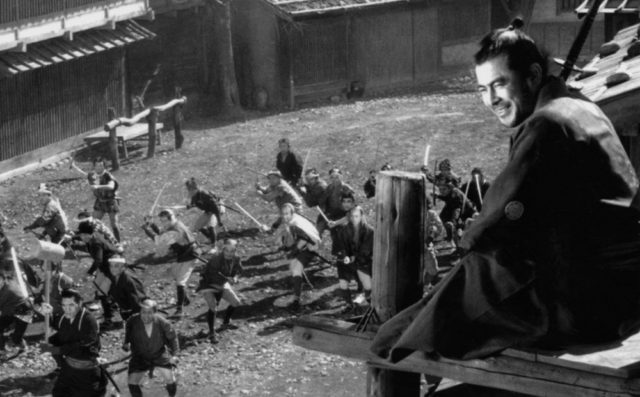
Kuwabatake Sanjuro (Toshirō Mifune) is a lone samurai on the road following the end of the Tokugawa dynasty in yet another of Akira Kurosawa’s unforgettable masterpieces. Sanjuro comes to a town with two warring factions and plays each one off the other as a hired hand. Neo’s battles with myriad Agent Smiths are nothing compared to Yojimbo’s magnificent swordfights against growing bands of warriors that include the evil Unosuke (Tatsuya Nakadai), who is in possession of a new weapon that shoots bullets. Try watching this film and not think of several Clint Eastwood Westerns (particularly Sergio Leone’s A Fistful of Dollars, since this is a direct remake of that 1964 Italian flick) as well as High Noon.
Toshirō Mifune can’t believe what he sees in Sanjuro
SANJURO (Akira Kurosawa, 1962)
Saturday, February 26, 3:00
Thursday, March 3, 3:00
Tuesday, March 8, 5:45 filmforum.org
In this Yojimbo-like tale, Toshirō Mifune shows up in a small town looking for food and fast money and takes up with a rag-tag group of wimps who don’t trust him when he says he will help them against the powerful ruling gang. Funnier than most Kurosawa samurai epics, Sanjuro is unfortunately brought down a notch by a bizarre soundtrack that ranges from melodramatic claptrap to a jazzy big-city score.
Toranosuke Shimada (Toshirō Mifune) shows rogue samurai Ryunosuke Tsukue (Tatsuya Nakadai) how its done in The Sword of Doom
THE SWORD OF DOOM (THE GREAT BODHISATTVA PATH) (Kihachi Okamoto, 1966)
Monday, February 21, 7:55
Wednesday, March 9, 3:10 filmforum.org
The Sword of Doom tells the story of one of the screen’s most brutal antiheroes, a samurai you can’t help but root for despite his coldhearted brutality, a heartless killer called “a man from hell.” Based on Kaizan Nakazato’s forty-one-volume serial novel Dai-bosatsu Tōge, Kihachi Okamoto’s The Sword of Doom, aka The Great Bodhisattva Pass, begins in 1860 with Ryunosuke Tsukue (Tatsuya Nakadai) slaying an elderly Buddhist pilgrim (Ko Nishimura) apparently for no reason as the man visits a far-off mountain grave. Shortly before Ryunosuke is to battle Bunnojo Utsuki (Ichiro Nakaya) in a competition using unsharpened wooden swords, the man’s wife, Ohama (Michiyo Aratama), comes to him, begging for Ryunosuke to lose the match on purpose to save her family’s future. A master swordsman with an unorthodox style, Ryunosuke takes advantage of the situation in more ways than one. As emotionless as he is fearless, Ryunosuke is soon ambushed on a forest road, but killing, to him, comes natural, whether facing one man or dozens — or even hundreds. The only person he shows even the slightest respect for is Toranosuke Shimada (Toshirō Mifune), the instructor at a sword-fighting school. “We have rules concerning strangers,” Toranosuke tells him, but Ryunosuke plays by no rules. “The sword is the soul. Study the soul to know the sword. Evil mind, evil sword,” Toranosuke adds, words that torment Ryunosuke, who tries to start a family in spite of his hard, detached demeanor. But regardless of circumstance, Ryunosuke continues on his bloody path, culminating in an unforgettable battle that is one of the finest of the jidaigeki genre.
The Sword of Doom boasts a memorable performance by Nakadai, the star of such other classics as Masaki Kobayashi’s Harakiri, Hiroshi Teshigara’s The Face of Another and Samurai Rebellion, and Okamoto’s Battle of Okinawa and Kill!, as well as many Akira Kurosawa films, including Yojimbo, Sanjuro, High and Low, and Ran. In The Sword of Doom he is reunited with Aratama, who played his wife in Okamoto’s masterpiece trilogy, The Human Condition. Nakadai is brilliant as Ryunosuke, able to win over the audience, riveting your attention even though he is portraying a horrible man who rejects all sympathy. Also contributing to the film’s relentless intensity are Hiroshi Murai’s gorgeous black-and-white cinematography, which features a beautiful sword fight in the snow and an exquisitely photographed scene in a claustrophobic mill, and Masaru Sato’s sparse but effective score. The Sword of Doom is a masterful tale of evil, of one man’s struggle with inner demons as he wanders through a changing world.
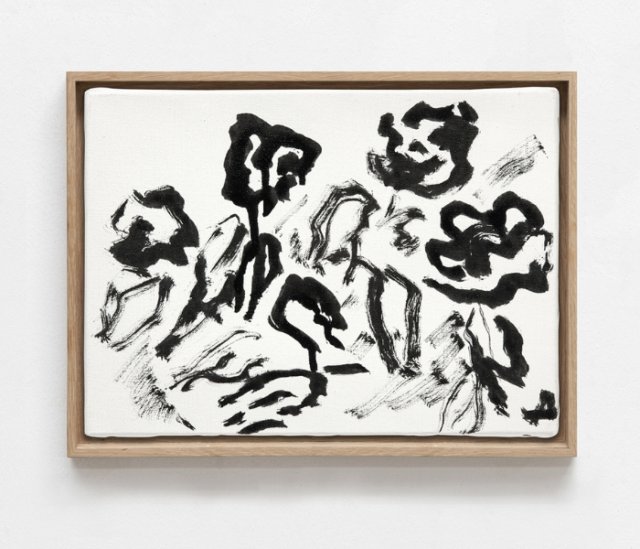
Etel Adnan, Découverte de l’immédiat 16, oil on canvas, 2021 (photo courtesy Galerie Lelong)
Who: Carla Chammas, Dawn Chan, Jina Khayyer, Mary Sabbatino What: Live, virtual discussion about artist Etel Adnan Where:Galerie Lelong & Co. online When: Saturday, February 12, free with advance RSVP, noon Why: In the summer of 2021, curator Hans Ulrich Obrist interviewed artists and longtime partners Etel Adnan and Simone Fattal at their summer home in Erquy, France, prior to their upcoming shows at Art Basel. At one point Adnan, who was born in 1925 in Beirut, said, “My last book [Shifting the Silence] is about realizing that I am going to die. It’s different to know and to feel it, and it’s as if life happens in silence. There is behind the noise of daily life a silence that we hear, another noise, a shifting silence. This silence has changed the focus of consciousness. That’s my last book.” Adnan, who had continued working through the pandemic and was a celebrated poet as well as a visual artist, passed away that November at the age of ninety-six. Her extraordinary career will be the focus of the latest free “Galerie Lelong: Dialogues” virtual discussion, taking place February 12 at 12:30; the talk features gallerist and curator Carla Chammas, art critic and writer Dawn Chan, and writer, poet, and journalist Jina Khayyer; Galerie Lelong vice president/partner Mary Sabbatino will moderate the conversation.
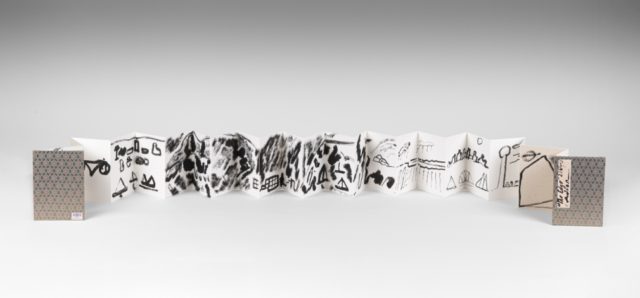
Etel Adnan, Erquy the Edge, India ink on booklet, 2021 (photo courtesy Galerie Lelong)
The gallery’s New York City and Paris locations are currently showing “Discovery of Immediacy,” on view in Chelsea through February 19. The exhibition consists of new black-and-white oil paintings and leporello, folded paper works. “The leporello is a journey,” Adnan told Obrist. “When you start a leporello, it’s like getting on a boat — you have a journey in front of you and that’s what’s beautiful. In the middle of a leporello you are afraid of making a mistake because you would have to throw everything away. You have to invest in the work and you have to keep a tension. It’s like composing music, [maintaining] a rhythm — that’s the work of the leporello, not to fall into a hole, to continue like when you are surfing, to hold the wave.” The colorful Guggenheim retrospective “Etel Adnan: Light’s New Measure,” which included color paintings and a bonus of several films, recently closed, but it is sure to come up as well as we all try to hold the wave.
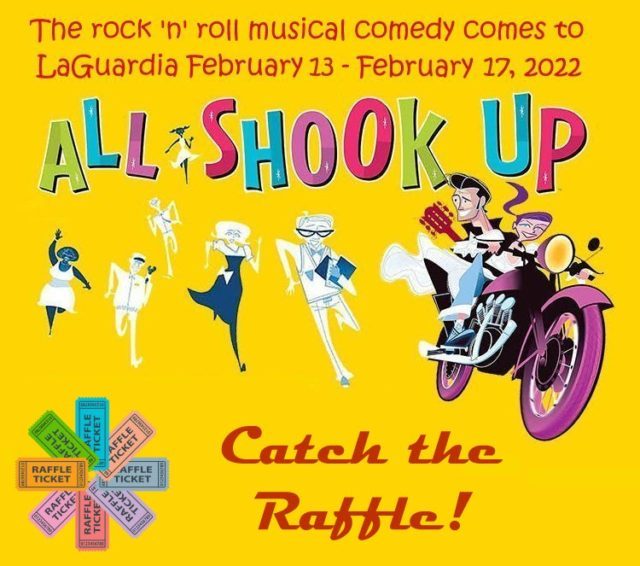
Who: Students of Fiorello H. LaGuardia High School of Music & Art and Performing Arts What: First-ever livestream of all-school production Where:LaGuardia High School online When: February 13, noon & 5:00, February 16-17, 7:00, free with RSVP Why: Instead of watching Fame next week, Alan Parker’s 1980 fiction film about teens auditioning for coveted spaces at the High School of Performing Arts in New York City, you can watch the read deal when the institution, now known as the Fiorello H. LaGuardia High School of Music & Art and Performing Arts, performs its all-school musical, streaming it live for the first time ever. Because of the pandemic, the show was canceled in 2020 and 2021; the 2022 production will take place at the school, which is located on Amsterdam Ave. at Sixty-Fifth St., in front of a limited audience of students, faculty, cast, crew, and family members. Four of the six performances will also be available as a free livestream.
The students will be presenting All Shook Up, the rousing musical that premiered at the Palace Theatre on Broadway in 2005; it features the music of Elvis Presley, with book by Tony winner Joe DiPietro, who has also written the book and lyrics for such shows as Memphis,The Toxic Avenger,Diana, and I Love You, You’re Perfect, Now Change and the book for Nice Work If You Can Get It and They All Laughed. The show will be performed by fifty-one students from across all five boroughs, with eleven students in the pit orchestra and another ninety-one working tech in addition to choreography by three 2016 graduates, Dharon Jones, Adriel Flete, and Victoria Fiore. Everyone onstage and off- will be wearing masks. “It’s so exciting to see these kids have this opportunity to revisit their passion for onstage performance and to watch them recapture the love and talent that’s so much a part of them,” LaGuardia drama teacher and show director Lee Lobenhofer said in a statement.
All Shook Up is set in the summer of 1955 in, according to the script, “a small you-never-heard-of-it town somewhere in the Midwest.” In the Shakespearean plot, parents and children, the sheriff and the mayor, and the rest of the townspeople confront segregation and racism and battle over the Mamie Eisenhower Decency Act while mechanic Natalie swoons for leather-jacketed parolee Chad, Dean has the hots for Lorraine, and Sylvia runs the local honky-tonk, but everyone faces obstacles that threaten their freedom in different ways. The first act is heavy with Presley hits, from “Jailhouse Rock,” “Love Me Tender,” and “Heartbreak Hotel” to “Follow That Dream,” “It’s Now or Never,” and “Don’t Be Cruel,” while the second act does a deeper dive into the Elvis songbook.
There will be two casts; “Rock” features Aaron Syi as Chad, Elena Salzberg as Natalie, Isaac Braunfeld as Dennis, Mairéad O’Neill as Sandra, Nolan Shaffer as Dean, Camille Henri as Lorraine, Eason Rytter as Jim, Cipa Frost as Matilda, Nigel Swinson as Earl, and Avery Palmer as Sylvia, while “Roll” has Michael Sanchez as Chad, Kahlea Hsu as Natalie, Jaxon Ackerman as Dennis, Charlotte Compo as Sandra, Carter Van Vliet as Dean, Bailey Emhoff as Lorraine, Otto Grimwood as Jim, Ani Kabillio as Matilda, Conor Picard as Earl, and Savannah Alvira as Sylvia. The livestreams are scheduled for February 13 at noon and 5:00 and February 16-17 at 7:00, free with advance RSVP here. You can also donate to support the musical by participating in a raffle starting at twenty dollars; among the prizes you can win are tickets to the Metropolitan Opera, Aladdin, or Come from Away, gift certificates to Charlie Palmer Steak or Ellen’s Stardust Diner, a ten-minute call with Mets world champion Dwight Gooden, and other items.