twi-ny recommended events

TWI-NY TALK: RICHARD TOPOL — PRAYER FOR THE FRENCH REPUBLIC

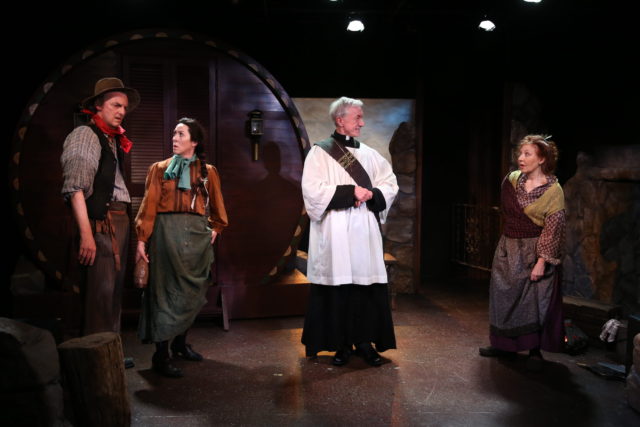
Rich Topol plays nonreligious narrator Patrick Salomon in Manhattan Theatre Club world premiere (photo by Matthew Murphy)

PRAYER FOR THE FRENCH REPUBLIC
Manhattan Theatre Club
MTC at New York City Center – Stage I
131 West 55th St. between Sixth & Seventh Aves.
Tuesday – Sunday through March 27, $99
212-581-1212
www.manhattantheatreclub.com

About seven years ago, I was sitting in the audience at a play when I recognized the man in front of me, actor Richard Topol. I tapped him on the shoulder during intermission and told him that I had just seen him at the Signature in A. R. Gurney’s The Wayside Motor Inn and had enjoyed his performance. He thanked me, saying that he was actually the understudy and that was the only time he had gone on. He was even more thankful when I told him that I had included him in my review.

Since then we’ve bumped into each other a few other times at the theater and discussed various shows we’d seen. He’s an extremely amiable mensch who clearly loves his chosen profession. Even if you don’t recognize his name, you’re likely to know his face; he has approximately fifty television and film credits, including portraying lawyer and politician James Speed in Steven Spielberg’s Lincoln, a recurring role on The Practice, and multiple parts on several Law & Order iterations.

But his true love is theater, which he also teaches. He has appeared extensively on and off Broadway, in such plays as The Merchant of Venice with Al Pacino, Julius Caesar with Denzel Washington, Alice Birch’s Anatomy of a Suicide with Carla Gugino, and Paula Vogel’s Tony-nominated Indecent with Katrina Lenk as well as Tony-winning revivals of Clifford Odets’s Awake & Sing! and Larry Kramer’s The Normal Heart. He is currently starring in Joshua Harmon’s Prayer for the French Republic, a scintillating three-hour exploration of anti-Semitism that travels between 1944 and 2016; Topol plays Patrick Salomon, a nonreligious Jew who has decided not to go into the family piano business.

Topol was raised in Mamaroneck and lost his father when he was twelve. He is married to actress Eliza Foss; they have one daughter, and Richard was close with his father-in-law, the late German-American composer, pianist, and conductor Lukas Foss.

During our wide-ranging Zoom conversation, Topol is thoughtful and generous, laughing and smiling a lot. Behind him in his living room is a landscape by his mother-in-law, the painter and teacher Cornelia (Brendel) Foss.

He admits that the most nervous he’s been in his life was when he hung out with Paul McCartney following a performance of Larry David’s Fish in the Dark, in which Topol played Dr. Stiles; after that, the Cute Beatle went from being his third favorite mop top — behind John and George — to his second.

A few days after Prayer for the French Republic opened at Manhattan Theater Club’s Stage I at City Center, we talked about one-person shows, getting Covid, baseball, and what it’s like being an actor in lockdown, including a detailed description of mounting a play as a pandemic continues.

Rich Topol starred as stage manager Lemml in Indecent (photo by Carol Rosegg)

twi-ny: During the pandemic, you appeared in several virtual and audio productions: You were in Melisa Annis’s Beginnings, Anne Washburn’s Shipwreck, Craig Lucas’s More Beautiful — and you played a chicken in Jimonn Cole’s Chickens.

richard topol: Oh my God! That was so much fun.

twi-ny: That was crazy.

rt: I loved Michael Potts in that.

twi-ny: You guys were great. Did you enjoy working on Zoom?

rt: No, no, no. I mean, I enjoyed working as opposed to not working. Shipwreck was the closest we got to working on a play because we rehearsed for a couple of weeks and it felt like, Okay, I’m going to rehearsal today. We did the kind of work that you do in a play before you get up on your feet. [Director] Saheem Ali was great and it was a great cast, obviously in a really interesting play. And we spent enough time with it to dig in the way you do in a play.

I mean, I also shot some TV shows over the course of the pandemic, so all of the Zoom stuff felt more like the way an actor like me connects to short-term work. You don’t develop a through-line, you don’t understand the arc of things. You’re not invested in a team, the whole idea of a team creating a thing and living together and becoming a version of a theater family, or whatever it is. Shipwreck was the closest to that.

twi-ny: As a listener, I felt it Shipwreck was one of the audio plays that worked the best during the lockdown. I got the feeling that this was a group of actors working in tandem.

rt: Right. I think because they had intended originally to produce it live, they had invested in it as fully and fulsomely as you do for a whole theater piece. There had been a lot of preparation. There was a sense of having more in the heads of the director and the producers, what we could imagine this great thing being, that infused the development and the rehearsal and experience of doing it. The Public took a lot of care in making it.

twi-ny: You finally returned to the stage in November in Portland with Searching for Mr. Moon, which is about fathers and sons, particularly about how you lost your father when you were very young and eventually found a father figure in Lukas Foss. This is your first one-man show, which you wrote with Willy Holtzman, a two-time Pulitzer nominee. What was the experience like sharing your life, in person, in front of people, back onstage? It’s a short question, right?

rt: The short answer is it was great. It was so satisfying. I remember at the time talking with people and saying, Oh my God, this is the longest period of time between . . . I was doing Anatomy of a Suicide at the Atlantic Theater Company.

twi-ny: Which was excellent. Loved it.

rt: Thank you. Yeah, I love that play. Intense. So that was the very last performance you could do in New York. And we were shut down. And so from March 12 of 2020 to November 3, 2021, was the longest period of time I hadn’t been onstage in my adult life. And I’ve been an actor for over three decades.

So it was thrilling to be back in a theater on a stage with a live audience, even though they were masked. So on the one hand, it was incredibly thrilling. And on the other hand, it was incredibly scary because it was the first play that I’d ever cowritten with anybody, and it was about my life. I felt more exposed than I’d ever felt before in my life. Willy and I had been talking about this play for a number of years. And then because the pandemic happened, we both had the time to really work on it. And that’s how it came to pass, and Anita Stewart, the artistic director of Portland Stage, was just a real cheerleader for the piece.

We did a developmental workshop in June up in Maine. That theater had stayed open through the pandemic because Maine had so few cases, because of the regulations, and because of their skill at keeping people safe. They produced a lot of one-person shows. They produced Lanford Wilson’s Talley’s Folly — they cast a married couple who played the two parts.

But even though they’re being Covid careful, they have diminished audiences because there are a lot of people who feel, I’m not going to see a play. I’m not going to risk that.

twi-ny: A lot of people still feel that way.

rt: But Willy and I had a lot of time over the pandemic because there wasn’t much else to do to finish the play. And then Anita gave us a shot. We did the workshop, we did a live reading in front of people. It went really well and they’re, like, We want to produce this and we have a slot.

But because it’s about one of the hardest things and most personal struggles that I’ve experienced for the last forty-six years of my life, since my father died, it was scary to share, but it felt worth sharing. Willy was like, I want to write a one-man show for you. I’m like, Okay, sure. First of all, I don’t like one-person shows, I don’t like seeing one-person shows; they’re not interesting to me. I love acting with other people, and it can’t be about me because I’m not interesting. So what could it be about.

twi-ny: Three strikes and you’re out.

rt: Right. It was a total strikeout. And then Willy’s like, Come on, come on. And so initially we decided it would be about Lukas Foss, who was my father-in-law, a really interesting man who had a really interesting life. He escaped the Nazis. Like in Josh’s play, he was one of those people, a German Jew in Berlin who got out. Even though he wasn’t Jewish; he didn’t think of himself as a Jew. He had a really interesting life and a really challenging death.

He had Parkinson’s disease. He had a mind that was brilliant and fingers that could play — I don’t know if you’ve ever heard him play or listened to something. It’s unbelievable. If you can listen to him playing on Lenny Bernstein’s “Age of Anxiety,” listen to the piano on that. It is unbelievable. And so the guy lost his physical abilities and his mental abilities. We thought, Okay, that’s an interesting idea for a play.

I’ve always had this obsession with searching for a father and he was my father-in-law, so let’s do that. And the play started to be about that. And the first two drafts of it were about that. It was this biodrama about Lukas and it was missing something.

Rich Topol debuted his intimate one-person show at Portland Stage in November (photo by No Umbrella Media LLC)

twi-ny: It needed more of you, probably.

rt: Yes, well, that’s what Willy said. And so, kicking and screaming, it became more and more about my relationship to Lukas and then my relationship to fatherhood. Then when my wife told the story to Willy about when she gave birth — the opening scene of the play is her giving birth to our daughter — and Eliza’s parents, in black tie, come in from a gala, bursting into the delivery room because they thought she was about to have a baby — she was about to have a baby — we’re like, What are you doing here? Get the fuck out of here. That seemed like a good starting-off point, discussing my becoming a father and my seeing the best potential father to me to help me learn how to be a father.

It was really satisfying to do. I was really glad to do it at Portland Stage, where most of the people who were watching knew nothing about me and I didn’t have to feel so exposed. I’m hoping to bring the show to New York, but I think doing it here, that’ll be scary.

Although my mother came and saw the show. My wife came and saw the show. People who know me and my life saw it. And I survived.

twi-ny: And they all want you to keep doing it. Since these are your lines and they’re about you, if a joke didn’t quite take or something emotional didn’t register with the audience, is it more or less upsetting than when you’re reciting somebody else’s words and something might not go as expected?

rt: Oh, less upsetting because I know I’m not a professional. I’m no Josh Harmon. Josh is a writer. I’m just some guy —

twi-ny: The third guy from the left.

rt: Exactly, the third guy from the left. At least in that experience I can cut myself some slack. It was the first production of the first play that I’ve ever cowritten. Willy did most of the writing. So that’s the sort of glib answer.

The truth is, most of the play, I play other people. I play my father-in-law. I play my mother, I play my wife, I play my mother-in-law. And in the scenes where I play myself, most of that writing is me, having written down my versions of stories that I’ve experienced. And so the ones that I was willing to share were the ones that couldn’t be avoided and, I guess, were the most important. Maybe I’m fooling myself. The play was well received, so I didn’t have the experience of Oh, that sucked. Right. Why am I doing this play?

twi-ny: Who talked you into this?!

rt: Who let me do this thing?

Let’s take that idea of writing and switch over to Prayer for the French Republic, which is exquisitely written. The language is so beautiful. What was the rehearsal process like?

rt: Well, it started actually in August of 2019, when Josh had been commissioned by Manhattan Theater Club to write a play. He came in with his finished draft and we did a reading of it, prepandemic and in-person. They hand delivered the scripts to everybody’s homes. They bicycled around Manhattan delivering the scripts because they didn’t want to email them. Josh was holding it close. I read it to myself and I thought, this is the best play I’ve read in ten years. And I mean, I haven’t read every play in the last ten years, but I’ve read a lot of plays and I’ve seen a lot of plays, and I thought, this is astoundingly amazing.

And so I was so excited to be part of the beginning of it. We did that reading and I think it confirmed for Manhattan Theatre Club and for Josh that he had latched on to something incredible. Then we did a couple of workshops that fall and then at the end of February of 2020. At that time I was reading Charles, actually.

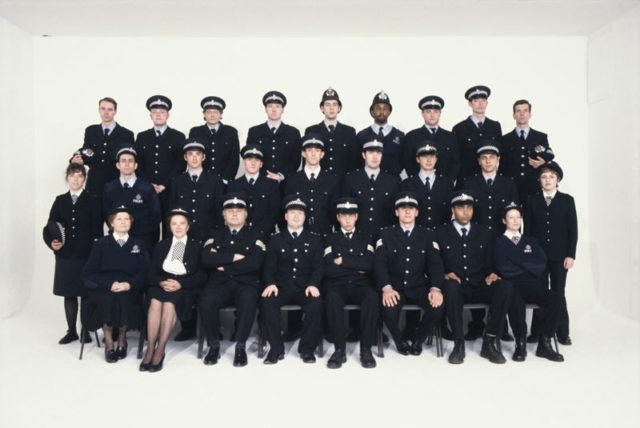
Rich Topol is third guy from the right in cast and crew photo from Prayer for the French Republic opening night (photo © 2022 by Daniel Rader)

twi-ny: That’s really interesting to me, because you fit so well as Patrick.

rt: Yeah, I know. I was like, No, no, no. When they said, Will you read Patrick? I was like, No, no, no, no, no. I love Charles. No, no, please don’t. They’re like, To be honest, Charles should be, if not actually North African, at least more Sephardic, more Middle Eastern. And so I was like, Okay, fine.

Now, of course, I’m totally madly in love with Patrick and I wouldn’t have it any other way. We did a workshop right before the pandemic hit in-person. And Josh had done some incredible things. And that’s when [director David] Cromer came on board. We’re already verklempt about it. So then the pandemic hit and immediately I got the virus.

The show closed on March 12. I had symptoms on the ides of March, on the 15th of March, and I was in bed for nineteen days with Covid-19.

twi-ny: So it was bad.

rt: It was miserable. I didn’t have it like Danny Burstein; I didn’t have to go to the hospital. Or Mark Blum, a lovely man who lost his life to it. And so it was the worst it could be without being bad. And then the symptoms were gone. We have a place upstate that we escaped too, and I got a call two days later from my agents. I’m like, Why is my agent calling me? The business is entirely shut down.

And she said, You just got an offer from Manhattan Theatre Club for Prayer for the French Republic. They want to do a workshop in July and then we’ll go into rehearsal in September and run till Christmas. And I thought, Oh, that’s perfect. This is the kind of play that should be running during the election. It felt to me that it was really important that this play be put up during the election. And then, of course, a month later, they’re, like, Yeah, we’re not going to do the workshop in July. But we’re still on track for the fall. And then a month later, it’s, Yeah, we’re not going to do the play in September. It’ll be sometime in 2021. We don’t know when but we’re still committed to doing the play.

And then we did a couple of Zoom workshops. We would do a weeklong workshop with the first act of the play, then the second act. And then another few months later we did the third. So we had a lot of time processing it with Josh and helping him wrangle this epic piece into what you saw. Then we got into the rehearsal space in December. And for those of us who’d been with it for two years, we’re like, Oh my God, we’re finally getting to do it. But still there was that sense of, Who’s producing a new eleven-person play, with nobody famous? It doesn’t have any songs —

twi-ny: And it’s about the Holocaust.

rt: Exactly. So kudos to them for sticking with it. And putting it up and investing in it, saying, I’m sorry, this is too important. We’re going to put this play up. We started first day of rehearsal learning about the Covid protocols, getting tested regularly.

twi-ny: Masked?

rt: We were wearing masks around the table. And then when we started up on our feet, we were unmasked, for those who were comfortable with that. And then one of our stage managers tested positive, and luckily she didn’t give it to anybody else. But at that point we’re like, Okay, we’re just wearing masks the whole time. We do not want to be shut down.

So this was the middle of December now, right before Christmas, and shows were going down left and right. We’re like, You know what, it’s not worth it. We do not want to shut this play down. Here we have been waiting for so long to do it. Let’s do what we can. And there were conversations among the cast about, Well, what do we do at home? Some of us have children and partners, but there was a real commitment to being safe so that we could get it up on our feet. And then Josh tested positive right before tech. And so actually the last few days of rehearsal and through tech, he watched the play like this.

twi-ny: On Zoom?

rt: There was a computer open and his computerized voice would come through. And again, he didn’t give it to anybody else. And then the testing protocols, we’re getting tested every day, and you can’t come into the room until you’ve tested negative, and, knock wood, that’s been it.

For the last six and a half weeks, we have been safe and we’ve been able to do it. And audiences have come. I am pleasantly surprised at how many hundreds of people are coming to see the show every day. I had seen a number of shows when I came back from Maine, and some had nobody in the audience and some were jam packed.

twi-ny: It’s been very strange. I went to a concert where everybody had to be masked and there were some empty seats, but it was pretty much sold out. But then I went to a hockey game and sixteen thousand people are screaming, no masks, lots of eating and drinking.

rt: Yeah. And I’m not going to any of that stuff. I did go see Hot Tuna and David Bromberg.

twi-ny: I love Bromberg.

rt: I looooove Bromberg.

twi-ny: How was he?

rt: He was great, for a seventy-year-old man. He was beautiful. He was really amazing. It was a really great time.

I’ve been to some plays where I’m sitting right next to total strangers and everybody has their mask on, and this was the same. Everybody did keep their masks on, but there were some drinking and eating. So we’ve been careful and thoughtful and fortunate, and I hope we continue to be so. Because it’s a great joy to do this play. It is a really challenging piece of theater and really satisfying to act in.

Rich Topol poses with a hot car on set of EPIX series Godfather of Harlem

twi-ny: Throughout your career, and especially more recently, you’ve played a lot of Jews: Sam Feinschreiber in Awake & Sing, Fritz Haber in Genius: Einstein, Lemml in Indecent, and now Patrick, who is a nonreligious Jew. Are you Jewish, or is it just a coincidence that you play a lot of Jews?

rt: I was born a Jew. I got bar mitzvahed. I think of myself as Jew-ish. I was in The Chosen a couple of times [There’s a knock at the door and Topol gets up to answer it, then returns.] That’s the exterminator, not exterminating Jews but exterminating bugs that Nazis would think are like Jews.

I’ve also actually played a lot of Jewish narrators who step into the play. I don’t think I’m as extreme as Patrick; Patrick is a Jew who doesn’t know anything about his Judaism and is happy to not know anything about his Judaism and is somebody who thinks of organized religion as what he says in the play, which is “bullshit.”

twi-ny: Which the character Molly agrees with.

rt: Right. I don’t subscribe there. But I’m also not religious. I think of myself as spiritual and, not to be too woo-woo, I believe in the earth. I’m a tree worshiper. I’m a tree hugger. Where I feel most soulful and spiritual is when I’ve climbed a mountain and I feel small in relation to a large, amazing thing. That’s the way I connect to religion. I think that most of the major religions are about feeling good to be small under the umbrella of something that’s bigger than our oneness, that connects us all.

twi-ny: I felt that that Josh really attacked the numerous angles of how to look at anti-Semitism and Israel and American Jewry. He covered everything. And without, I think, insulting anyone and without becoming didactic and preachy.

rt: He does a great job of giving everybody a valid argument. He’s really, really, really kind to all his characters. And thoughtful in allowing them to be really articulate people who have really strong opinions, and those opinions are different. And I think that’s one of the greatest things about the play, because it leaves the audience getting to consider those ideas that you’ve mentioned from a lot of perspectives. No, not from all perspectives, but certainly from a lot of perspectives within the Jewish community.

I’m always curious about what my non-Jewish friends who come and see the show think of it. I feel like the Jews, the Jews get it, the New York Jews get it, or they have really strong opinions about it.

twi-ny: Jon Stewart would ask, is it too Jewy?

rt: I have asked that of my non-Jewish friends. I’ve actually asked that of some of my Jewish friends too. Is this too Jewy? Is it just Jewy enough? Or is it not? The ones who are not Jews often say how the Jews in the play are just a specific example of the larger issue of otherness.

Look, we live in a world where the hate for other has been unleashed. And so what to do about that? If you’re a WASP from white privilege, maybe you look at this play and think, like Patrick, What’s the big deal, you know? Even those people understand, given what we’ve lived with, at least certainly for the last few years. But the larger questions that Josh asks in the play relate to almost everyone.

twi-ny: If Lukas were still around to see you in the show, would he be happy with your piano playing?

rt: I think he would be disappointed. And I’m slightly disappointed myself too, because I knew I was going to do this part for a long time and I knew that these songs were in the piece. But I feel like he shouldn’t be a better piano player than I am in this play. He doesn’t take over the family business. He shouldn’t be a lounge singer. I sing well, and maybe I’m justifying, but I feel like I play and sing just well enough but not too well for who he is. I love the progression of the piano in the play. It goes from Molly just clinking one note to me playing something schematic to Peyton [Lusk] playing that lovely Chopin piece to the end; the piano has a journey too. It’s a symbol, a metaphor for the journey of our family.

Rich Topol meets Yogi Berra on opening night of Bronx Bombers (photo © David Gordon)

twi-ny: Okay, for my last question, I have a sort of bone to pick with you. You were a Mets fan, then you switched over to the Yankees. I mean, come on.

rt: Did I say that out loud somewhere?

twi-ny: I have my sources.

rt: Actually, it sort of timed out pretty well, you know? Because when I became a Yankees fan, the Yankee sucked. It’s interesting because it connects to the father thing.

My father died in 1975; I don’t remember whether I jumped ship in ’74 or ’75. I know I was a Mets fan in ’73, and then we moved, and my next-door neighbor was a Yankees fan. And I wanted to be his friend.

twi-ny: Right before Reggie.

rt: Exactly. So you can’t pick a bone with me if it was because my father had just died and my next-door neighbor was a Yankees fan. The Mets had been to the World Series, right?

twi-ny: Yes they had, with Yogi Berra as manager. You played Yogi in Bronx Bombers. I think a lot of people forget that. I met him once at a Mickey Mantle Foundation dinner at Gracie Mansion. He was by himself and I went over to him and said, I’m going to ask you something that no one probably ever asks you about. And I asked him about managing the ’73 Mets. He looked up, put on a big smile, and said in that Yogi way, “No one’s asked me about that in years. So I’ll tell you.” And he told me about how much fun it was doing that.

rt: That’s when I was a Mets fan. That was Buddy Harrelson, Wayne Garrett, Tommie Agee, Jerry Grote. I’m a lefty, so Tug McGraw was my hero.

twi-ny: So you played Yogi, and then you met him on opening night of the show. What was that like?

rt: He was really sweet and really happy to be there and to be seeing this play with his wife, Carmen, having this stuff brought to life.

THE HARE WITH AMBER EYES — EDMUND de WAAL AND E. RANDOL SCHOENBERG IN CONVERSATION

Edmund de Waal will talk about his book and accompanying exhibition in free, virtual Jewish Museum program (photo by Iwan Baan)

Who: Edmund de Waal, E. Randol Schoenberg
What: Live virtual discussion about book and exhibit
Where: JewishGen Talks online
When: Wednesday, February 9, free with advance RSVP (donations accepted), 2:00
Why: “It is not just things that carry stories with them. Stories are a kind of thing, too. Stories and objects share something, a patina,” Edmund de Waal writes in his 2010 memoir, The Hare with Amber Eyes: A Hidden Inheritance. When ceramicist de Waal inherited his family’s netsuke collection, consisting of hundreds of miniature objects, he did a deep dive into the history of the Ephrussi clan, turning it into a bestselling book. Now the story behind his family and the netsuke is on view at the Jewish Museum through May 15. The fabulous show features paintings, letters, photographs, personal documents, keepsakes, and several vitrines containing hundreds of tiny items made of wood, ivory, or bronze, ranging from mice, monkeys, fish, rats, and nuts to spirits, demon catchers, gods, masks, and bottles. A woman takes a bath. A boy exposes himself. A snake wraps around a lotus leaf. A sea woman suckles an octopus. An eji stretches.

“The Hare with Amber Eyes” is on view at the Jewish Museum through May 15 (photo by Iwan Baan)

On the audio guide, de Waal quotes from the prologue, “I want to know what the relationship has been between this wooden object that I am rolling between my fingers — hard and tricky and Japanese — and where it has been. I want to be able to reach to the handle of the door and turn it and feel it open. I want to walk into each room where this object has lived, to feel the volume of the space, to know what pictures were on the walls, how the light fell from the windows. And I want to know whose hands it has been in, and what they felt about it and thought about it — if they thought about it at all. I want to know what it has witnessed.”

On February 9 at 2:00, de Waal will discuss the book, his family history, and the exhibit with attorney, philanthropist, and genealogist E. Randol Schoenberg; the free, virtual event is sponsored by the Museum of Jewish Heritage — A Living Memorial to the Holocaust, the Jewish Museum, and the Leo Baeck Institute. You can check out an earlier Jewish Museum conversation between de Waal and Adam Gopnik, about de Waal’s 2021 book, Letters to Camondo, here.

TAMBO & BONES

Tambo (W. Tré Davis) and Bones (Tyler Fauntleroy) channel Didi and Gogo from Waiting for Godot in new David Harris play (photo by Marc J. Franklin)

TAMBO & BONES
Playwrights Horizons, Mainstage Theater
416 West 42nd St. between Ninth & Tenth Aves.
Tuesday – Sunday through February 27, $30-$54
www.playwrightshorizons.org

In the past few years, several shows by Black playwrights have shattered the fourth wall in unique ways, challenging their majority white audiences by separating the line between fact and fiction, audience and performer. Two such examples are Jordan E. Cooper’s Ain’t No Mo’ and Jackie Sibblies Drury’s Pulitzer Prize–winning Fairview, both of which included participatory elements that placed systemic racism front and center while understanding precisely where their bread was buttered, balancing humor with recrimination.

David Harris’s new show, Tambo & Bones, which opened tonight at Playwrights Horizons, turns the tables on Black trauma porn in similar ways, incorporating Afrofuturism in its self-referential exploration of the past, present, and future of Black performers entertaining white audiences. Aggressively directed by Taylor Reynolds with a razor-sharp sense of wit and whimsy, the show, divided into three sections, expands on the concepts of minstrelsy — what Harris, who was a popular spoken word poet, refers to as “Black performative capitalism” — and freedom in different, not-always-obvious forms while scrutinizing what is real (life), what is fake (theater), and how they intertwine.

As Harris contends in his Playwright’s Perspective program note, “The most fun part about writing is that every writer I know is a fucking liar. Some think this is radical political work. Some think writing is to channel the ancestors and the woo-woos to put voice to page. But all of this is just tactic. This was the realization that made me stop doing poetry slams and start to focus on theater. I wasn’t growing as an artist; I was growing as someone who could perform identity. Spoken word capitalizes on an idea of the authentic identity. The real person. But here, in this theater, all of us know that every second of this experience is fake. And there is infinite possibility in that reality. And the pleasure is in the possibility.”

The play begins in a garden that looks like it was made for an elementary school musical. In his stage directions, Harris refers to it as “a fake ass pasture. Some fake ass trees and a fake ass bush. A fake ass sky with a fake ass sun. A lil bit of fake ass grass. Yo it’s fake ass pastoral out here.” Tambo (W. Tré Davis) is trying to grab a nap, moving a cardboard tree so he can relax in the shade. “It ain’t fake if I believe in it,” he says, getting to the heart of what theater is about, at least for a few hours.

But then Bones (Tyler Fauntleroy) arrives and ruins his friend’s rest by asking the audience for quarters so he can visit his son in the hospital for his birthday, all of which turn out to be lies. He also performs a lame trick with a knife to get more quarters. Tambo insists he is going about it all wrong.

“You gotta make em think. Stimulation, know what I mean?” Tambo explains. “And how do you do that?” Bones asks. Tambo replies, “You gotta deliver a treatise on race in America.” Bones: “Whaaaaaat?” Tambo: “Yup. Trendy intellectual shit.”

The scene is Harris’s reimagining of Samuel Beckett’s Waiting for Godot; both men wear old-fashioned hats and raise existential questions while waiting for something to happen. Bones is dressed in a raggedy costume that resembles Lin-Manuel Miranda’s military uniform in Hamilton, a show that used a Black and brown cast to entertain a predominantly white audience that patted themselves on the back for enjoying such a racially diverse musical about the Founding Fathers. But Tambo and Bones are not as passive as Vladimir and Estragon; instead of waiting for a mystery man to arrive, they go after the person responsible for their situation: the playwright.

“Why did this n—a write us into a minstrel show?” Tambo proclaims. “He could’ve written anything he wanted, and he chose to write this. You couldn’t give us no quarters in your show? You had to make us struggle n shit?” Bones replies, “Maybe he wanted all the quarters for himself.”

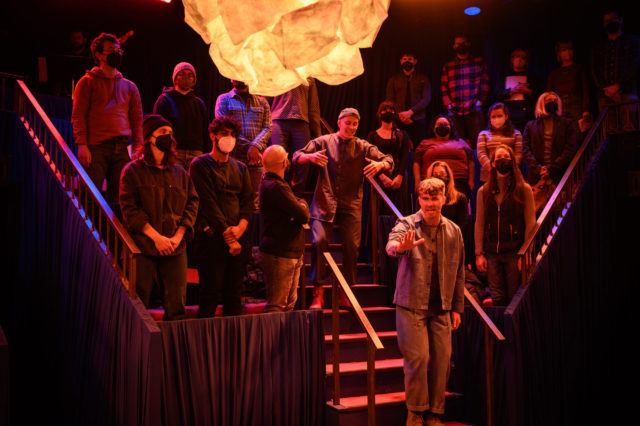
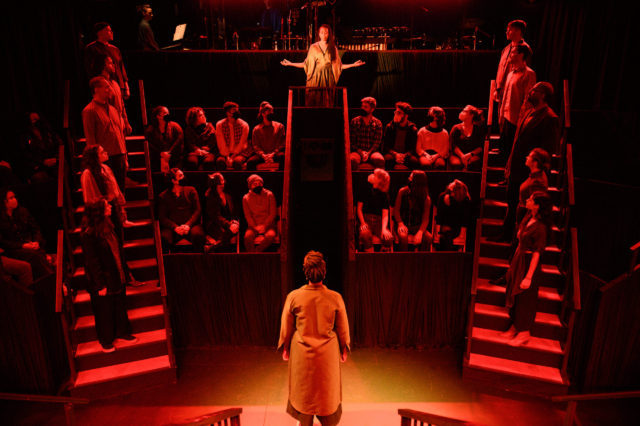
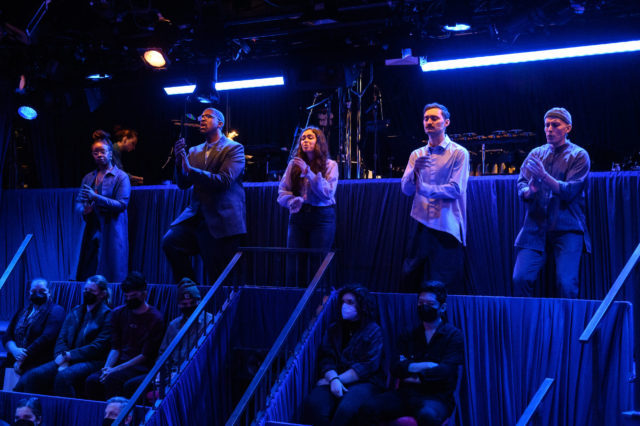
David Harris world premiere includes a hip-hop concert at Playwrights Horizons (photo by Marc J. Franklin)

In the second part, Tambo and Bones have become hip-hop superstars, covered in bling and rapping on a smoky stage with their names in lights. They blast such songs as “Started from the Cotton,” “Bootstrappin,” “Racism Is Bad,” and “Crack Rocks Crackin” as the audience, most of whom have probably never been to a live rap concert, dance in their seats, sing along, and wave their hands in the air like they just don’t care. But while Bones is reveling in their newfound wealth and success, Tambo still feels a responsibility to speak truth to power. “We here to have a mothafuckin party,” Bones shouts to the adoring crowd. Tambo adds more quietly, “And also provide commentary on some shit.”

The third section takes place four hundred years in the future — not a random number — as a seminar looks back at the legacy of Tambo and Bones and the history of race relations in America. It’s not an easy pill to swallow, reminding me of such other recent plays as Thomas Bradshaw’s 2019 revival of Southern Promises and Jeremy O. Harris’s Slave Play in how they relate to the audience.

Davis (Seared, Zooman and the Sign) and Fauntleroy (Tempest, Looking for Leroy) portray their carefully constructed stereotyped characters with a savvy appreciation of what they stand for in today’s world, paradigms of the Black experience in America, in theater and the rest of society, which tends to be not as forgiving as well-heeled off-Broadway audiences. “I’m just pondering my purpose n shit,” Bones says in the pasture. “You ain’t happy wit ya life as it is?” Tambo asks. “I read somewhere that happiness is just an illusion like sunlight,” Bones answers.

The first two sections feature stellar sets by Stephanie Osin Cohen, costumes by Dominique Fawn Hill, lighting by Amith Chandrashaker and Mextly Couzin, sound by Mikhail Fiksel, and music by Justin Ellington. The final scene is more ramshackle; it feels like Harris knew exactly what he wanted to say but is still working on how to accomplish it, resulting in a messy conclusion that still provides plenty of food for thought.

“It is not enough to demand insight and informative images of reality from the theater,” Bertolt Brecht wrote, describing what he called the alienation effect. “Our theater must stimulate a desire for understanding, a delight in changing reality. Our audience must experience not only the ways to free Prometheus, but be schooled in the very desire to free him. Theater must teach all the pleasures and joys of discovery, all the feelings of triumph associated with liberation.”

Tambo & Bones is a prime example of the alienation effect, but it comes with a fierce smackdown. By the end, you may simultaneously want to cheer wildly and cower in your seat. Harris (White History, Incendiary) and Reynolds (The Most Spectacularly Lamentable Trial of Miz Martha Washington, Plano) use form and genre to overturn expectations and confront an audience that is likely to revel in that challenge, then further contemplate what happened when they get home and think more about the show.

“Throughout my life, I’ve found myself continually in white spaces, and continually rebelling against white spaces, and continually finding that that rebellion has also led to me gaining in some way,” Harris admits in a Playwrights conversation with Reynolds. “I literally ask myself: what am I doing here besides trying to gain the currency of laughter, or the currency of someone thinking that I’m cool for writing this? Am I putting this up for an audience just because I want an audience?” Reynolds replies, “It’s awesome to hear you dig a little deeper into the play’s relationships with and to whiteness. And it’s not just that we are being held down by specific white people who have enslaved us — it’s also capitalism. The play puts capitalism on blast and I am so intrigued to see what the response will be from Playwrights Horizons audiences.”

Having now witnessed that response, I can say that it is, at the very least, intriguing. Harris’s next play, Exception to the Rule, will have its world premiere at Roundabout Underground in April. I already have my tickets.

COMPANY: KATRINA LENK, PATTI LuPONE & CHRIS HARPER

Who: Katrina Lenk, Patti LuPone, Chris Harper, Jessica Shaw
What: Virtual discussion about current Broadway revival of Company
Where: The Temple Emanu-El Streicker Center online
When: Thursday, February 10, free with advance RSVP, 12:30
Why: In my review of the current, controversial revival of Stephen Sondheim and George Furth’s beloved Company, I wrote, “Two-time Tony winner Marianne Elliott has reconceptualized Company in ways that go beyond mere gender switching and diverse casting; this Company emphasizes individuality, confinement, isolation, and fear through magnificent staging.” You can hear what some of the key participants have to say about the show when the Temple Emanu-El Streicker Center hosts a live, virtual discussion with Tony and Grammy winner Katrina Lenk (The Band’s Visit, Indecent), who plays Bobby, previously always portrayed as a man; two-time Tony and two-time Grammy winner Patti LuPone (Evita, Gypsy), who delivers the classic “Ladies Who Lunch”; and Olivier-winning producer Chris Harper (Elliott’s War Horse and The Curious Incident of the Dog in the Night-Time). SiriusXM’s Jessica Shaw will moderate the free talk.

DAVID BYRNE AND JOHN WILSON — HOW WE LEARNED ABOUT NON-RATIONAL LOGIC: A CONVERSATION ON HUMOR AND BOOKMAKING

John Wilson talks with David Byrne about his latest Pace show and new book on February 7

Who: David Byrne, John Wilson
What: Live virtual discussion
Where: Pace Gallery, 540 West Twenty-Fifth St., Pace Gallery YouTube
When: Monday, February 7, free (online), 7:00
Why: In his endlessly creative and fun HBO docuseries How To with John Wilson, Astoria native John Wilson uses footage shot all around New York City to delve into such issues as small talk, scaffolding, memory improvement, finding a parking spot, and making the perfect risotto. In his endlessly creative and fun career, British-born musician, singer, playwright, and visual artist David Byrne has made albums (solo and with Talking Heads), given concerts, directed films, and had gallery shows; currently, his brilliant American Utopia continues on Broadway at the St. James Theatre through April 3, and his latest exhibition, “How I Learned About Non-Rational Logic,” is running at Pace’s Twenty-Fifth St. space through March 19. The show consists of several series of drawings Byrne has done over the last twenty years, including his unusual depictions of dingbats sketched during the pandemic. (He describes his fascination with dingbats here.)

Byrne and Wilson have previously collaborated on the 2015 true crime concert documentary Temporary Color; they now will sit down together for a discussion at Pace in conjunction with the publication of Byrne’s new book, A History of the World (in Dingbats) (Phaidon, March 9, $39.95). “How We Learned About Non-Rational Logic: A Conversation on Humor and Bookmaking” takes place in person at Pace, where attendees will receive a signed copy of the book; the event will also be streamed for free over YouTube. “This idea of non-rational logic was not something I made up, but I realized that it kind of resonated with both the fact that I make music and the fact that these drawings follow a kind of logic that isn’t kind of based on logical or rational thinking,” Byrne notes in the above behind-the-scenes video. There should be plenty of such non-rational logic in what promises to be a very funny and illuminating talk.

FOUR QUARTETS

Pam Tanowitz Dance’s Four Quartets makes its New York City debut February 10–12 at BAM (photo by Maria Baranova)

FOUR QUARTETS
BAM Howard Gilman Opera House
Peter Jay Sharp Building
230 Lafayette Ave.
February 10–12, $25-$95, 7:30
718-636-4100
www.bam.org
pamtanowitzdance.org

T. S. Eliot’s 1936–42 epic Four Quartets poem begins with a two-part epigraph from Greek philosopher Heraclitus that warns, “Although logos is common to all, most people live as if they had a wisdom of their own. . . . The way upward and the way downward are the same.” Those words sound particularly relevant today as America battles through a pandemic and socioeconomic and racial inequality and injustice that are threatening the stability of our democracy. Heraclitus also wrote, “It is better to conceal ignorance than to expose it.” Meanwhile, Friedrich Nietzsche claimed, “Heraclitus was an opponent of all democratic parties.”

In 2018, Bronx-born, Westchester-raised choreographer Pam Tanowitz debuted her take on Eliot’s poem, as Four Quartets made its world premiere at Bard SummerScape; it is now coming to the BAM Howard Gilman Opera House for three performances, February 10–12. The seventy-five-minute piece features all-star collaborators, with music by Finnish composer Kaija Saariaho played by NYC orchestral collective the Knights, images by American abstract minimalist Brice Marden, costumes by Reid Bartelme and Harriet Jung, sets and lighting by Clifton Taylor, sound by Jean-Baptiste Barriére, and text performed live by Tony nominee and multiple Obie winner Kathleen Chalfant. (Bard’s recording of the audio was the first authorized version by a woman and an American.) The dancers are Kara Chan, Jason Collins, Dylan Crossman, Christine Flores, Zachary Gonder, Lindsey Jones, Victor Lozano, Maile Okamura, and Melissa Toogood.

“Making Four Quartets has changed me as an artist forever,” Tanowitz says in the above behind-the-scenes Bard documentary, There the Dance Is, which was filmed during the pandemic. “I’m not scared of failure. I’m not scared to imagine. And I’m not scared to take risks. I was before.”

“Burnt Norton,” the first section of Four Quarters, is an eerie reminder of what is happening in the United States and around the world today as we look toward a fraught future: “Time present and time past / Are both perhaps present in time future / And time future contained in time past. / If all time is eternally present / All time is unredeemable. / What might have been is an abstraction / Remaining a perpetual possibility / Only in a world of speculation. / What might have been and what has been / Point to one end, which is always present. / Footfalls echo in the memory / Down the passage which we did not take / Towards the door we never opened / Into the rose-garden. My words echo / Thus, in your mind. / But to what purpose / Disturbing the dust on a bowl of rose-leaves / I do not know. / Other echoes / Inhabit the garden. Shall we follow?”

Tickets are going fast for the show, which is part of BAM’s “New York Season,” consisting of works by local creators, so act now if you want to see this widely praised production. Up next at BAM are Kyle Abraham’s An Untitled Love at BAM Strong’s Harvey Theater, running February 23–26, and longtime favorite SITI Company’s final physical theater presentation, The Medium, at BAM Fisher March 15–20. You can also catch Tanowitz’s Bartók Ballet, her first commission for New York City Ballet, at Lincoln Center’s David H Koch Theater on February 22 and 23, a work for eleven dancers set to Béla Bartók’s String Quartet No. 5.

SKELETON CREW

Dominique Morisseau’s Skeleton Crew takes place in an auto stamping plant on the brink in 2008 (photo by Matthew Murphy)

SKELETON CREW
Samuel J. Friedman Theatre
261 West Forty-Seventh St. between Broadway & Eighth Ave.
Tuesday – Sunday through February 20, $59-$159 ($49-$99 with code FAFCREW)
www.manhattantheatreclub.com

When the audience enters MTC’s Samuel J. Friedman Theatre for the Broadway premiere of Dominique Morisseau’s Skeleton Crew, a sizzling tale of socioeconomic ills in 2008 Detroit, they see Michael Carnahan’s set, the dingy, dirty breakroom of an auto stamping plant, filled with handwritten and preprinted signs detailing various rules and regulations, advising employees that there is no smoking, when the next union meeting is, what their OSHA rights are, what they can and can’t do with the refrigerator, coffeemaker, and microwave. However, there are also multiple reminders, on paper and yellow caution floor signs, to wear a mask and turn off cellphones; those warnings are for the audience in 2022, of course, but the effect is an immediate feeling of equality between the performers and the characters they portray. We are them, and they are us, especially as we all continue to deal with a global pandemic.

The cast then heads onstage and removes all the contemporary signs with a resolute vigilance that, we soon find out, applies to the company admonitions that still remain. “I don’t abide by no rules but necessity. I do what I do til’ I figure out another thing and do that. And that’s all I got to say about it,” Faye (Phylicia Rashad) declares.

Rumors are swirling that the plant might be on the chopping block, which would wreak havoc in a city that we know is about to pay dearly during the coming subprime mortgage crisis. Faye, a divorced single mother, is the union leader with twenty-nine years on the job, intent on making it to thirty to receive more substantial retirement benefits. Despite having survived breast cancer, she smokes constantly; she also has a penchant for gambling with her much younger colleagues: Dez (Joshua Boone), a loose cannon hoping to start his own repair garage, and Shanita (Chanté Adams), a pregnant woman who is one of the line’s best workers. Both in their mid-to-late twenties, Dez ceaselessly flirts with Shanita, whose baby daddy is absent.

Their foreman, Reggie (Brandon J. Dirden), a close family friend of Faye’s since he was a child, used to be one of them before being promoted. He often finds himself in the middle, caught between the employees and his bosses upstairs, walking a tightrope that becomes even more tenuous when he admits to Faye that the plant will indeed be shutting down within a year.

Reggie (Brandon J. Dirden) and Faye (Phylicia Rashad) face a crisis in Broadway premiere of Skeleton Crew (photo by Matthew Murphy)

He tries to convince her to stay quiet about it, which she is hesitant to do. “It’s my job to protect these folks,” Faye says. Reggie responds, “Faye, I’m confiding in you. I’m putting myself on the line for you cuz I’m on your side. But I need you on mine. I need your guidance. Help me figure this out without sounding the alarm.” She agrees but feels guilty keeping the news from Dez and Shanita, who have their own issues with management.

“You youngins don’t have no respect for the blood been spilled so yo’ ass have some benefits,” Faye says to Dez, who she regularly calls “stupid.” Dez shoots back, “What benefits? I don’t hardly see no benefits.”

When materials start disappearing from the plant, Dez, who brings a gun to work and has been acting suspiciously, is a prime suspect. Meanwhile, Faye has hit some hard times and hides a secret from her colleagues. And Shanita shares her complex dreams with the others and plans on working as long as she can, piling on the overtime, before she gives birth. The tension is so thick that something has to eventually give, and when it does, everybody better stand back.

Skeleton Crew premiered at the Atlantic’s Stage 2 in January 2016, then moved to the bigger Linda Gross Theater in May of that year. It’s the first play of Morisseau’s to be produced on Broadway; she also wrote the book for Ain’t Too Proud to Beg: The Life and Times of the Temptations. The play completes her Detroit Projects trilogy, three works set in her hometown in the twentieth century, beginning with 2013’s Detroit ’67 and continuing with 2015’s Paradise Blue. Seen as a whole, the plays explore the Black experience in America in a way that evokes both August Wilson and Lynn Nottage; specific plays that immediately come to mind are Wilson’s Jitney and Nottage’s Sweat and Clyde’s as well as Erika Dickerson-Despenza’s recent Cullud Wattah, about the Flint water crisis.

Director Ruben Santiago-Hudson shows a firm confidence in Morisseau’s language and themes; he previously directed the world premiere of Paradise Blue at the Signature. He also was a close friend of Wilson’s and starred in and/or directed many of his plays, including Jitney and The Piano Lesson, both of which featured Dirden. In addition, Santiago-Hudson knows the Samuel J. Friedman well; his one-man show, Lackawanna Blues, was the previous production at the theater, completing its run in November.

Adesola Osakalumi dances between scenes in Dominique Morisseau’s Skeleton Crew (photo by Matthew Murphy)

Morisseau (Pipeline, Blood Rot) masterfully avoids any specific discussion about race, instead letting the story play out with that subtext hovering over everything like an ominous cloud. The audience knows that Detroit has had a history of race riots — from 1833 and 1849 to 1943 and 1967 — and in 2007-8, nearly twenty thousand Black men and women lost their jobs in car factories. “African Americans earn much higher wages in auto industry jobs than in other parts of the economy, and the loss of these solid, middle-class jobs would be a devastating blow,” the Economic Policy Institute reported at the time.

Tony winner and six-time Emmy nominee Rashad (A Raisin in the Sun, August: Osage County), who has directed three Wilson plays, is a powerhouse as Faye, a tired but strong-willed woman who is determined to not let a system she’s been fighting against her entire life beat her down. Rashad delivers her quips with an uncanny assuredness, her eyes revealing the wear and tear of years of battle, both personal and professional. Boone (Actually, All the Natalie Portmans) is a fireball as Dez, ready to explode at any moment but with a soft side underneath. Adams (Roxanne, Roxanne, Wilson’s Ma Rainey’s Black Bottom, directed by Santiago-Hudson) is charming as Shanita, who is wise beyond her years. And Dirden, who played Sly in the original New York production of Detroit ’67, gives a rousing performance as Reggie, a kindhearted man who has to make hard decisions that rip him up inside.

In between scenes, choreographer Adesola Osakalumi (Cullud Wattah, Fela!) dances at the front of the stage or behind the breakroom windows, moving robotically to hip-hop music that mimics the motion of the machines in the plant, which are seen almost abstractly in projections by Nicholas Hussong lit by Rui Rita. (The sound and music is by Robert Klapowitz, with original songs by J. Keys.) It equates humans with automation, as if people are interchangeable with machines. It might not be a new idea, but it is beautifully laid bare in Morisseau’s searing, intimate drama.

(MTC is currently hosting Detroit Week on Broadway, beginning February 4 at 8:00 with “Detroit Comes to Broadway,” celebrating the people and culture of the Motor City. On February 6 at 5:00, Morisseau, Dr. Michael Eric Dyson, and Michael Dinwiddie will take part in the free virtual discussion “Black Theatre: Radical Longevity.” And on February 7 at 6:00, “Morisseau Moment” fêtes the playwright with proclamations and presentations from her three latest shows, Skeleton Crew, Ain’t Too Proud to Beg, and Confederates, livestreaming from the Harlem School of the Arts.)