twi-ny recommended events

IN CONTENTION: MoMA’S BEST FILMS OF 2025

MoMA has deemed Kiyoshi Kurosawa’s revenge thriller Cloud one of the best films of 2025

THE CONTENDERS 2025
MoMA Film, Museum of Modern Art
11 West 53rd St. between Fifth & Sixth Aves.
Series runs through January 7
www.moma.org

Every year, MoMA screens what it considers the best films of the past twelve months from all over the world, in a series called “The Contenders.” Occasionally, directors are on hand for discussions after. Last month, MoMA showed such 2025 favorites as Ryan Coogler’s Sinners, Jafar Panahi’s It Was Just an Accident, Richard Linklater’s Nouvelle Vague and Blue Moon, and Yorgos Lanthimos’s Bugonia. Among December’s best are Noah Baumbach’s Jay Kelly, Luca Guadagnino’s After the Hunt, Kelly Reichardt’s The Mastermind, and Ira Sachs’s Peter Hujar’s Day.

Below is a look at some of the other upcoming class of 2025 contenders; keep watching this space for more reviews.

The United States is under a mysterious attack in Kathryn Bigelow’s A House of Dynamite

A HOUSE OF DYNAMITE (Kathryn Bigelow, 2025)
Tuesday, December 2, 7:00
www.ahouseofdynamitefilm.com
www.moma.org

In A House of Dynamite, director Kathryn Bigelow and screenwriter Noah Oppenheim meld John Badham’s 1983 War Games with Stanley Kubrick’s 1964 Dr. Strangelove and Sidney Lumet’s 1964 Fail Safe in a gripping thriller told from three perspectives as an unidentified ICBM makes its way to America. On the case are Captain Olivia Walker (Rebecca Ferguson), General Anthony Brady (Tracy Letts), and the president (Idris Elba), who are desperately trying to figure out who launched it — and, even more important, how to stop it. The cast also features Anthony Ramos as Major Daniel Gonzalez, Jason Clarke as Admiral Mark Miller, Gabriel Basso as Deputy National Security Advisor Jake Baerington, Renée Elise Goldsberry as the First Lady, Greta Lee as National Intelligence Officer for North Korea Ana Park, Jonah Hauer-King as Lieutenant Commander Robert Reeves, and, practically stealing the show, Jared Harris as Secretary of Defense Reid Baker. Bigelow pulls no punches as the film builds to a sensational finale. The screening will be followed by a conversation with Bigelow, whose previous movies include Zero Dark Thirty, The Hurt Locker, and the original Point Break.

SENTIMENTAL VALUE (Joachim Trier, 2025)
Wednesday, December 3, 7:00
www.neonrated.com
www.moma.org

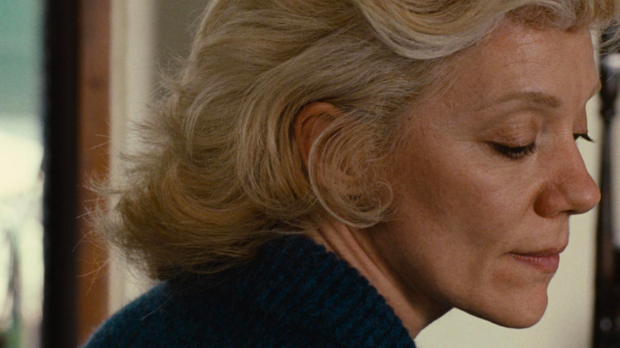
Danish-born Norwegian filmmaker Joachim Trier follows up one of the best films of 2022, two-time Oscar nominee The Worst Person in the World, which concluded his impressive Oslo Trilogy, with Sentimental Value, one of the best films of 2025 — and the decade, if not the century. Written by Trier and longtime collaborator Eskil Vogt, the intimate drama begins with a poetic house stating its raison d’être, establishing itself as a character all its own, then cutting to one of the most tense, uncomfortable, and stirring examples of stage fright ever put on celluloid. Renate Reinsve is spectacular as Nora Borg, an actress who, along with her sister, Agnes (Inga Ibsdotter Lilleaas), must confront their estranged father, Gustav (Stellan Skarsgård), who wants to come back into their lives upon the death of their mother, his ex-wife. Gustav is a famous filmmaker who has written a deeply personal script for Nora, who refuses to work with him. He instead courts popular American actress Rachel Kemp (Elle Fanning) for the role as Nora weighs her options. Sentimental Value is a heart-wrenching story of family dysfunction, patriarchal manipulation, trauma, and filmmaking that you won’t soon forget.

CLOUD (『クラウド』) (KURAUDO) (Kiyoshi Kurosawa, 2024)
Tuesday, December 9, 7:00
www.janusfilms.com
www.moma.org

Kobe-born suspense master Kiyoshi Kurosawa, who has made such horror faves as Cure, Pulse, and Creepy as well as such psychological dramas as Bright Future and Tokyo Sonata, is back with an intense revenge thriller that is not for the faint of heart, featuring torture and violence — and a ton of fun. In Cloud, Masaki Suda stars as Yoshii, a quiet, disengaged young man who works at a cleaning factory, supplementing his income as an online reseller, purchasing goods at cut rates — unethically taking advantage of people — and selling them online at exorbitant prices, with no care whether the items are actually legitimate or fakes. He is upset when the owner, Takimoto (Yoshiyoshi Arakawa), offers him a promotion; Takimoto sees promise in Yoshii, but Yoshii has no interest in taking on more responsibility. When one of his deals makes him a lot of money, he quits his job and dedicates all his time to reselling whatever products he can get his hands on, from designer handbags to anime figures. Yoshii alienates his business partner, Muraoka (Masataka Kubota), and moves with his girlfriend, Akiko (Kotone Furukawa), to a house in a small, faraway town, where a young local man, Sano (Daiken Okudaira), insists on being his assistant. As his deals get more and more lucrative and dangerous, Yoshii builds a well-deserved bad reputation as a ruthless operator, and soon a group of men, armed to the hilt, come after him, determined to get even.

Cloud is a fierce, propulsive trip down the internet rabbit hole, where anonymity might feel safe but reality threatens to blow it all up. Yoshii ruins every relationship he has, with clients, customers, Sano, Akiko, Takimoto, et al., seemingly without any care or regard; he spends hours staring at his computer screen, waiting for his items to start selling, with more concern and passion than he has for any human being. And when the posse finds him, he has no understanding why they want him dead. Suda (Kamen Rider, Cube) is terrific as Yoshii; we are initially offput by his herky-jerky movement and disengagement from society, but as everything closes in on him, we also feel compassion for his potential fate. The film is beautifully shot by Yasuyuki Sasaki and expertly directed by Kurosawa, who knows just how to make the audience squirm, especially at unexpected moments. “Grudges, revenge, they’ll only drag you down,” one member of the posse tells another. “Think of this as a game.” It’s a wry comment on how too many people look at the real world these days.

[Mark Rifkin is a Brooklyn-born, Manhattan-based writer and editor; you can follow him on Substack here.]
’TIS THE SEASON: ALICIA GRAF MACK’S AAADT AD DEBUT AT CITY CENTER

The Holy Blues is part of all-new evenings of Alvin Ailey American Dance Theater season at City Center (photo by Steven Pisano)

ALVIN AILEY AMERICAN DANCE THEATER
New York City Center
131 West 55th St. between Sixth & Seventh Aves.
December 3 – January 4, $45-$195
www.alvinailey.org
www.nycitycenter.org

It’s been a time of change for Alvin Ailey American Dance Theater. This has been the first year without the shining light of Judith Jamison, the beloved Ailey dancer and artistic director who passed away last November at the age of eighty-one. That month, her successor, Robert Battle, became a resident choreographer with the Paul Taylor Dance Company. And this past spring, longtime Ailey dancer and Juilliard Dance Division dean Alicia Graf Mack was named the fourth artistic director in the history of AAADT.

“This monumental season draws deeply on Alvin Ailey’s legacy rooted in celebrating the resilience of the human spirit while extending its truth and bold virtuosity to reflect this moment in time and our hopes for the future,” Graf Mack said in a statement about the company’s upcoming annual City Center residency. “Each new creation shares the utterly distinctive voice of its choreographer, testifying to the vitality of the tradition Mr. Ailey gave us and the gifts of spirit that Judith Jamison so lovingly nurtured. I am grateful and honored to be a caretaker of this ever-changing continuum of inspiration, along with Matthew Rushing and the company of brilliant dancers whose artistry will move us all as we take our next steps forward.”

Running December 3 through January 4, the 2025 City Center season features the company premiere of Medhi Walerski’s Blink of an Eye, set to J. S. Bach’s violin sonatas and partita, and a new production of Jamison’s duet A Case of You, originally a birthday tribute to Chairman Emerita Joan Weill, danced to Diana Krall’s version of the Joni Mitchell song.

There are five world premieres from a wide range of choreographers. Inspired by Geoffrey Holder’s book Black Gods, Green Islands, about Trinidad and Tobago, Cuban American theater director and arts educator and activist Maija García’s Jazz Island celebrates the Afro-Caribbean diaspora, with original music by jazz trumpeter Etienne Charles. Matthew Neenan’s Ailey debut, Difference Between, is set to music by MacArthur fellow and two-time Obie winner Heather Christian, who sings in “Tomorrow”: “Difference between. Deference, reverence, sever its shoots on the bean / Sanity, brevity, bravery, levity — these are the virtues / are any restored or recorded or / pored over once the romance of it leaves?”

Superstar Jamar Roberts, the company’s first resident choreographer, follows up such gems as Ode,A Jam Session for Troubling Times, and Holding Space with Song of the Anchorite, a reimagining of Alvin Ailey’s 1961 solo Hermit Songs, set to jazz trumpeter Avishai Cohen’s interpretation of a Ravel adagio. In Embrace, Fredrick Earl Mosley incorporates tunes by Stevie Wonder, Kate Bush, Etta James, Maxwell, Ed Sheeran, Des’ree, and P!nk in exploring the intimacy of human connection.

And Urban Bush Women founder and Ailey Artist in Residence Jawole Willa Jo Zollar, collaborating with current Ailey dancer Samantha Figgins and former company member Chalvar Monteiro, looks to the concepts of the Ring Shout and the Door of No Return in The Holy Blues, named after the title of Alvin Ailey’s journal. The twenty-five-minute piece debuted at BAM in June; in a company interview, Figgins explained, “Through life, we have these hills and valleys, our human suffering and our pleasure, our delight, our bliss, our joy, and The Holy Blues is a chance to watch that journey of a group of people — a community, of course, but all individuals — how they tackle the challenges of bringing themselves up out of whatever pain they may be in, out of whatever life throws at them, and how they are able to create something beautiful out of it.”

The thirty-two dancers will also perform the Ailey classics Memoria, Night Creature, Pas de Duke, Masekela Langage, A Song for You, Opus McShann, For Bird — with Love, Love Songs, Reflections in D, Hidden Rites, and Cry; Ronald K. Brown’s Grace; Lar Lubovitch’s Many Angels; Rushing’s Sacred Songs; Elisa Monte’s Treading; and Alonzo King’s Following the Subtle Current Upstream. Many of the programs will conclude with the one and only Revelations, six with live music. In addition, the Saturday family matinees will be followed by a Q&A.

“I join with the entire company in welcoming Alicia Graf Mack in her new role as our artistic director,” Rushing said in a statement. “Her great respect for and commitment to the Ailey mission, along with the perspective and integrity that informs her vision, will help elevate everything we do. We are excited to welcome audiences to New York City Center this holiday season to be uplifted by cherished classics and remarkable new works as the curtain goes up on the next chapter in Ailey’s extraordinary story.”

[Mark Rifkin is a Brooklyn-born, Manhattan-based writer; you can follow him on Substack here.]

TICKET GIVEAWAY: CANDACE BUSHNELL’S TRUE TALES OF SEX, SUCCESS, AND SEX AND THE CITY

Candace Bushnell is back for a special encore presentation of her one-woman show about her life and career (photo by Joan Marcus)

CANDACE BUSHNELL: TRUE TALES OF SEX, SUCCESS, AND SEX AND THE CITY
Adler Hall at the New York Society for Ethical Culture
2 West Sixty-Fourth St. & Central Park West
Friday, December 5, $34.45- $56.06 ($187.34 for VIP meet-and-greet), 8:00
ethical.nyc
candacebushnell.com

In December 2021, Candace Bushnell presented her one-woman show, Is There Still Sex in the City?, at the Daryl Roth Theatre, an endearing production in which Bushnell shared intimate details of her life and career, centering around the gargantuan success she has had with the creation of Carrie Bradshaw (Sarah Jessica Parker), Samantha Jones (Kim Cattrall), Charlotte York (Kristin Davis), and Miranda Hobbes (Cynthia Nixon), the fictional characters on the HBO smash Sex and the City, based on her series of columns and 1996 book of the same name. The run was unfortunately cut short after Bushnell contracted Covid.

I called the play “a fab treat, a funny and candid New York story that everyone can relate to in one way or another, whether you are a fan of Sex and the City or have never watched or read it.”

Bushnell, who has also written such novels as Killing Monica, Lipstick Jungle, and Rules for Being a Girl (with Katie Cotugno), is now touring the show, renamed True Tales of Sex, Success, and Sex and the City; in the spring, she’ll be taking it to Denmark, the Netherlands, Belgium, France, and California.

But first, the solo play is returning to New York City, where it all happened.

TICKET GIVEAWAY: Bushnell, who is celebrating a birthday today (December 1), will be at Adler Hall at the New York Society for Ethical Culture on December 5 at 8:00 for a special one-night-only performance of True Tales of Sex, Success, and Sex and the City, and she has gifted twi-ny with a pair of prime tickets to give away for free to see the “real life Carrie Bradshaw.” Just send your name, phone number, and favorite Sex and the City character to contest@twi-ny.com by Wednesday, December 3, at noon to be eligible. All entrants must be twenty-one years of age or older; one winner will be selected at random.

[Mark Rifkin is a Brooklyn-born, Manhattan-based writer and editor; you can follow him on Substack here.]

THE QUEENS OF QUEENS: IN SEARCH OF THE AMERICAN DREAM

Polish immigrant Renia (Marin Ireland) dreams of a better life in Martyna Majok’s reimagined Queens (photo by Valerie Terranova)

QUEENS
MTC at New York City Center – Stage I
131 West Fifty-Fifth St. between Sixth & Seventh Aves.
Tuesday – Sunday through December 7, $109-$139
www.manhattantheatreclub.com
www.nycitycenter.org

Polish-born American playwright Martyna Majok tells stories that challenge the audience, taking risks as she explores the lives of the disenfranchised, the disabled, the underrepresented, and undocumented immigrants in search of the unreachable American dream. In Cost of Living, which earned her the Pulitzer Prize, it all came together without compromise; I wrote of the Broadway version, “The separate storylines merge at the end in an uneasy finale that acknowledges that we all encounter tremendously painful issues in life, regardless of our physical or psychological situations, which is further established during the curtain call.”

Her three other plays were not quite as successful despite intriguing setups and intricate narratives. About Ironbound, I noted, “The rest of the cast play their roles well, but their characters and tales are nowhere near as interesting and compelling as Darja’s, and they become somewhat quaint and repetitive as the show goes on and overdoes the obvious distinctions between rich and poor.” And I wrote that Sanctuary City “takes a head-scratching turn as the ending approaches, detracting from everything that came before it, which was powerful and moving.”

Queens, which originally ran at LCT3 in 2018 and is now at MTC’s New York City Center – Stage I through December 7 in a newly reimagined version, displays too many of the same issues; the play features characters and situations that you want to embrace and understand, but Martok and director Trip Cullman (Cult of Love, Six Degrees of Separation) are unable to weave their way through a web of fascinating ideas that don’t quite mesh. As with Ironbound and Sanctuary City, there’s a strong play in there that refuses to emerge.

A group of women seek common ground in MTC production at City Center Stage I (photo by Valerie Terranova)

Over the course of sixteen years, seven immigrant women move in and out of a crowded basement apartment in Queens, desperate to find a better life in America: the Belarusian Pelagiya (Brooke Bloom), the Polish Agata (Anna Chlumsky), the Polish Renia (Marin Ireland), the Ukrainian Inna (Julia Lester), the Afghan Aamani (Nadine Malouf), the Ukrainian Lera (Andrea Syglowski), and the Honduran Isabela (Nicole Villamil).

“Any regrets? In your life? In this building?” Inna asks Renia. Although she doesn’t want to admit it, Renia has plenty, having made choices that did not necessarily work out the way she expected. Inna punches her in the face before going inside and renting a room.

The basement is cluttered with clothing, a guitar, and other objects that are memories of those who came before, haunting Renia. (The effective set is by Marsha Ginsberg.) “What is your reason?” the memory of Pelagiya asks her. Aamani adds, “The reason you are here. Looking to live someplace away from the rest of your kind of people. What happened.”

The narrative then shifts to December 2001, when Renia has arrived in New York with little money in her pocket. Pelagiya wants to know what brought her there. “It’s no story,” Renia says. “It’s always story,” Pelagiya insists. Renia responds, “I need place I can stay. I come here. End of story.” Of course, it’s only the beginning of what turns out to be a dark, painful story. Even a somewhat pathetic party the women hold is tinged with fear and sadness. The appearance of the Honduran American Glenys (Sharlene Cruz) injects a burst of youthful energy, but it’s not enough to sustain the play’s 135 minutes (with intermission).

Queens does serve as a fascinating counterpoint to Bess Wohl’s dazzling Liberation, the current Broadway transfer about six diverse women who meet regularly in a rec center basement in Ohio in the 1970s to discuss the role of women in society, how it impacts their lives individually and what they can do to help change the status quo publicly; both shows delve into the relationships among women as well as mothers and daughters. The Queens women, however, have a different kind of baggage — obviously, they lack the relative privilege of the characters in Liberation, and face colossal odds stacked against them, coming from countries where women are still in search of freedom, fifty years after the Liberation women began changing America. Still, women’s search for the most basic of freedoms is the motor that drives Queens, even if the ride is bumpy and the destination uncertain.

[Mark Rifkin is a Brooklyn-born, Manhattan-based writer and editor; you can follow him on Substack here.]

SEEING HELENE SCHJERFBECK: PANEL DISCUSSION AT SCANDINAVIA HOUSE

Helene Schjerfbeck, Self-Portrait, oil on canvas, 1912 (Finnish National Gallery Collection / Ateneum Art Museum; photo courtesy Finnish National Gallery / Yehia Eweis)

Who: Dr. Anna Maria von Bonsdorff, Dita Amory, Patricia Berman
What: Panel discussion on the life and career of Helene Schjerfbeck
Where: Scandinavia House, 58 Park Ave. between Thirty-Seventh & Thirty-Eighth Sts.
When: Wednesday, December 3, free with advance RSVP, 5:00
Why: On December 5, the Metropolitan Museum of Art is opening “Seeing Silence: The Paintings of Helene Schjerfbeck,” an exhibition featuring nearly sixty works by Finnish modernist painter Helene Schjerfbeck (1862–1946), from landscapes and portraits to still-lifes and self-portraits. You can get a behind-the-scenes preview of the show on December 3 at 5:00 when Scandinavia House hosts a panel discussion with Ateneum Art Museum Finnish National Gallery director Dr. Anna Maria von Bonsdorff, Met Museum Robert Lehman Collection curator in charge Dita Amory, and Wellesley College art professor Patricia Berman. The event, which is part of Scandinavia House’s twenty-fifth anniversary celebration, is free with advance RSVP.

Be sure to arrive early to check out the institution’s current exhibit, “A Time for Everything: 25 Years of Contemporary Art at Scandinavia House,” comprising works by such artists as Jesper Just, Louisa Matthíasdóttir, Shoplifter / Hrafnhildur Arnasdóttir, Pekka & Teija Isorättyä, Jeppe Hein, Olav Christopher Jenssen, Outi Pieski, and Olof Marsja.

[Mark Rifkin is a Brooklyn-born, Manhattan-based writer and editor; you can follow him on Substack here.]

BY THE SKIN OF OUR TEETH: THE SEAT OF OUR PANTS SETS WILDER TO MUSIC

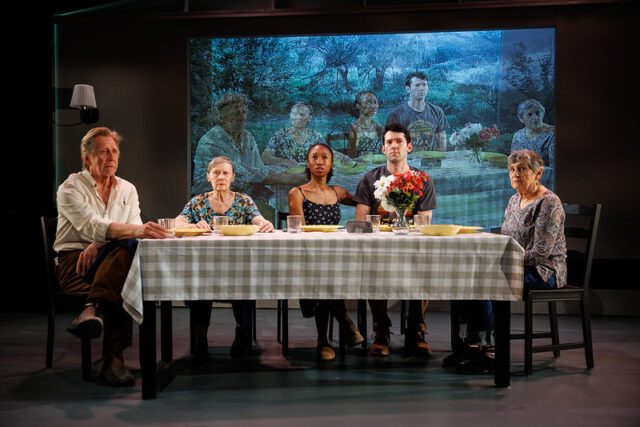
The Antrobus family faces the weight of the world in The Seat of Our Pants at the Public (photo by Joan Marcus)

THE SEAT OF OUR PANTS
Newman Theater, the Public Theater
425 Lafayette St. at Astor Pl.
Tuesday – Sunday through December 7, $125
publictheater.org

Just because The Skin of Our Teeth won Wisconsin native Thornton Wilder his third Pulitzer Prize doesn’t mean the 1942 work isn’t a slog, dense with metaphor, festooned with oddball characters and bizarre scenarios, and obsessed with strange time-shifting interventions. I’ve seen two recent productions, an overstuffed mess at Lincoln Center in 2022 and an exemplary revival from TFANA in 2017, but even the latter required significant attention from the audience to sift through Wilder’s complex storytelling as he essentially shares a tale that is nothing less than an encapsulation of the survival of living creatures on this planet.

The quartet of Leonard Bernstein, Jerome Robbins, Betty Comden, and Adolph Green attempted to turn The Skin of Our Teeth into a musical but eventually abandoned the project, as did the trio of John Kander, Fred Ebb, and Joseph Stein. But now Obie-winning composer, bandleader, playwright, and librettist Ethan Lipton has taken on the challenge and delivered an exciting and fun, if still problematic, musical adaptation called The Seat of Our Pants, continuing at the Public’s Newman Theater through December 7.

The 160-minute show (with intermission) is divided into The Skin of Our Teeth’s usual three acts, the first during the Ice Age in Excelsior, New Jersey, complete with dinosaurs and humans getting along well; the second on the boardwalk in Atlantic City at a convention of the Ancient and Honorable Order of Mammals, Subdivision Humans; and the third back in Excelsior following a devastating war. Each act is introduced by an announcer (Andy Grotelueschen), singing with a mic stand and asking the audience to join in. He advises at the very beginning, “I want to tell you that the news is good / I want to shout it out in every neighborhood / But I can’t lie to you — although I had assumed I would / The world is ending, the world is ending.”

At the center of everything is the Antrobus family: the father (Shuler Hensley), a successful and important businessman; his wife (Ruthie Ann Miles), a kind and practical woman; and their two children, the promising Gladys (Amina Faye) and the less-than-promising Henry (Damon Daunno). Holding it all together is their maid, Lily Sabina (Micaela Diamond), who often addresses the stage manager and the audience directly, complaining about the play itself. When someone apparently misses a cue, Sabina repeats a key line, “Don’t forget — we made it through the recession-pandemic-wildfire-oligarchy by the seat of our pants. One more crisis like that and then where will we be?” Fitz, the stage manager, tells her to stretch it out because of technical issues, but Sabina is having none of it.

“I will not invent words for this show,” she argues. “I hate this show and every line in it. I don’t understand a word of it anyway — all about the troubles of the human race? Now there’s a subject for you. Besides, the author hasn’t decided whether it’s set back in the caves or in New Jersey today. And now some other guy’s added songs. Songs! Because that’s what it was missing.”

Humans and animals interact in New Jersey in inventive musical based on Thornton Wilder play (photo by Joan Marcus)

But it turns out that many of the songs, including “The World Is Ending,” “Sabina’s Suite,” “Stuff It Down Inside,” and “Ordinary Girl,” inject life into the narrative, accompanied by clever staging by director Leigh Silverman (Yellow Face, Grand Horizons), boisterous choreography by Sunny Min-Sook Hitt, witty orchestrations and arrangements by Daniel Kluger, Lee Jellinek’s gleeful, open set with the audience on two sides facing each other and the band on the other two sides, and costumes (by Kaye Voyce) that range from suburban casual to convention uniforms to a talking mammoth (Geena Quintos) and turkey (Bill Buell) duo to band outfits that match the flowery yellow wallpaper. The attention to detail in the costumes and the set changes are hilarious.

But, as Sabina repeated, “Don’t forget —” that this is based on The Skin of Our Teeth, so not everything makes sense, scenes go on too long, and there are too many songs. But watching the cast, led by wonderful performances by Grotelueschen (Into the Woods, Pericles) and Diamond (Parade, The Cher Show), having so much fun — even band member Allison Ann Kelly gets in on the action — is infectious.

I’m thinking that The Skin of Our Teeth is back in favor because of the current state of the country and the world amid wars, the immigration crisis, economic instability, political dysfunction, climate change, polarization, and general havoc and maelstrom. So why not turn it into a charming musical? Obie winner and Guggenheim fellow Lipton (We Are Your Robots, The Outer Space) has done just that.

“I am skin and bones, and I have escaped only by the skin of my teeth,” Job says in the Old Testament. With The Seat of Our Pants, we escape with much more.

[Mark Rifkin is a Brooklyn-born, Manhattan-based writer and editor; you can follow him on Substack here.]

TAKING THE INTITIATIVE: A MORE-THAN-WORTHWHILE FIVE-HOUR THEATRICAL EXPERIENCE

Else Went’s Initiative unfolds over more than five hours at the Public Theater (photo by Joan Marcus)

INITIATIVE
LuEsther Hall, the Public Theater
425 Lafayette St. at Astor Pl.
Tuesday – Sunday through December 7, $109
publictheater.org

“Do you think we’ll do anything worthwhile with our lives? Is it even possible?” Clara (Olivia Rose Barresi) asks Riley (Greg Cuellar) about halfway through Else Went’s Initiative.

Experiencing the play is worthwhile, whether it’s the five-plus-hour performance, with three ninety-minute acts and two intermissions, or the six-and-a-half-hour one, with an added dinner break.

The show is set in “Coastal Podunk, California,” where a group of high school classmates explore first love, traumatic loss, and just about everything in between at the dawn of the new millennium as they begin to try to seek their place in an ever-more complex universe. In the early aughts, just after Y2K has not destroyed society, seven teenagers navigate adolescence, essentially without adults, on their own; we occasionally hear the garbled offstage shouting of two brothers’ unbalanced mother and the disembodied voices of Mr. Stone, a somewhat comforting English teacher, and Ms. May, a sensitive guidance counselor (both voiced by Brandon Burk). The tech age is upon the teens as they obsess over Super Nintendo and instant messaging on the internet — but only when they’re home at their computers. “The world is . . . tumultuous right now, and taking in too much information . . . can actually be dangerous,” Ms. May tells Clara, who responds, “It’s just that this is, like, the world, right? That I’m gonna inherit. Everyone’s always like ‘you’re the leaders of tomorrow,’ that sort of thing, but at the same time nobody wants to explain yesterday.”

Clara has returned to the classroom after several years of home-schooling by her religious parents. She is in love with Riley (Greg Cuellar), who admits to her he is gay but wants to remain her best friend. Clara seeks solace in Lo (Carson Higgins), a selfish, callous kid who is a star pitcher hiding something that happened between him and Riley at summer camp. Lo’s younger brother, Em (Christopher Dylan White), is a loner addicted to video games and unsure of how to return the affections of the sexy Kendall (Andrea Lopez Alvarez), the most progressive of the gang. Tony (Jamie Sanders), the least refined of them, has a crush on Kendall but becomes more of a bully after she doesn’t go for him and she becomes good friends with a shy, reserved new student, Ty (Harrison Densmore).

Over the course of four years, the teens discover things about themselves and each other as college approaches. Oh, and they spend a whole lotta time playing Dungeons and Dragons. Really. And it’s a blast to watch.

A continuing game of Dungeons and Dragons provides an exhilarating break during five-hour play (photo by Joan Marcus)

Initiative shouldn’t be compared to such other time behemoths as The Iceman Cometh, Strange Interlude, and the grandmaster of them all, Gatz. Written by Else Went and directed by Emma Rosa Went, who are married millennials who met in high school, the play, loosely inspired by their real lives, is performed by actors who are also millennials, which lends them an understanding of what their characters are going through; they might not look fourteen or fifteen, but they act it in a very empathetic, understanding way. In addition, several of them have been with the project since its start nearly ten years ago, giving them the opportunity to develop their portrayals.

Mikiko Suzuki MacAdams’s large, open set features a row of lockers, two swings, a glowing abstract orb that represents a popular local tree (as well as the end of innocence), a bridge in the back, and a series of arches that evoke Greek drama; desks, beds, chairs, tables, benches, and other furniture are wheeled on- and offstage, and a hot tub emerges from beneath. S. Katy Tucker’s projections focus on stars, the galaxy of opportunities awaiting the teenagers — as well as the challenges they will face. Noticing shooting stars out the window, Lo says to Riley early on, “You ever think about dying?”

The cast is extraordinary, holding our attention for five hours, making us care what happens to each character, even during the D&D scenes, which allow them, and the audience, to temporarily break free of their inner turmoil. Christopher Akerlind’s lighting and Angela Baughman’s sound further engage us in the proceedings, along with Kindall Almond’s period costumes.

The play is about fifteen minutes too long, and the Wents seem unsure how to end it; I noticed three times I thought it should conclude and was sorry to see it continue, and there’s a coda that feels unnecessary, explaining elements we are already aware of that were better left unsaid. But it all flows with a tender naturalism before that — and is sure to make you remember moments from your own high school years, the good ones and the bad.

Initiative is a warm and engaging coming-of-age epic filled with universal truths about then and now. In a script note, Else Went writes, “This play is the letter to my younger self that I cannot receive. . . . It is apology and forgiveness, to myself, to my first friends, my first loves.”

It’s a letter that the audience is happy she sent.

[Mark Rifkin is a Brooklyn-born, Manhattan-based writer and editor; you can follow him on Substack here.]