twi-ny recommended events

THE MEXICAN EXODUS: A HIP-HOP TALE OF SLAVERY AND FREEDOM

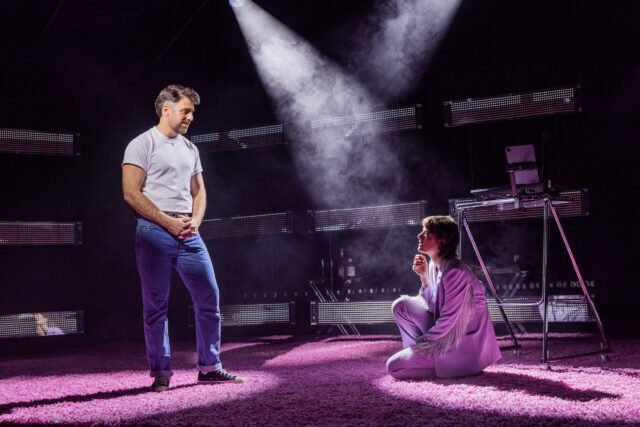
Nygel D. Robinson and Brian Quijada wrote and star in Mexodus (photo by Curtis Brown)

MEXODUS
Audible’s Minetta Lane Theatre
18 Minetta Lane between Sixth Ave. and MacDougal St.
Monday – Saturday through November 1, $56.50-$120.50
mexodusmusical.com
www.audible.com

Between 1829 and the end of the Civil War, several thousand American slaves escaped to Mexico, a kind of Underground Railroad that headed south instead of north, though without the same organized support system. Brian Quijada and Nygel D. Robinson have adapted that story into Mexodus, an exhilarating, funny, and passionate must-see two-person musical that has been extended through November 1 at Audible’s Minetta Lane Theatre.

“Did you know this shit? / We didn’t know this shit!” they declare early on. “In eighteen forty-eight it was America that won the war. / Ten territories from Mexico / Including the behemoth of Texas, yo! / And what would that land be used for? / Oh lord! To pick a bale of cotton / And what was slaves’ most common chore? / To jump down, turn around, and pick a bale a day. / Cotton: America’s original sin / And it’s then and there where our story begins.”

Quijada and Robinson switch between portraying versions of themselves, speaking directly to the audience in the present day, and two tough men from the pre–Civil War era. They also play all the instruments — guitars, keyboards, standup bass, harmonica, accordion, drums, percussion, triangle — creating live loops by recording snippets of music, then layering them electronically so it often sounds like there’s a full band in the theater while allowing them to act with their hands and feet free.

Henry (Robinson) is a Black man who has escaped from a brutal incident on the Texas plantation where he was enslaved, while Carlos (Quijada) is a former Mexican army medic and deserter overwhelmed by guilt, now working on a farm in la Frontera, which he describes as “la mitad — the middle. No laws, no lines, tierra descontrolada,” evoking a kind of middle passage.

Carlos found Henry washed up on the shore of the Rio Grande and is nursing him back to health. Henry is suspicious of Carlos; when Henry asks if it’s safe there, Carlos responds, “It’s not safe anywhere,” adding that he’s seen many “gringos” in the area hunting down runaways.

Both men are in vulnerable positions, alone and on their own, so they’ll need to help each other if they are going to survive while battling the elements and worrying about the slave hunters.

Brian Quijada and Nygel D. Robinson play all the instrument in historical loop musical (photo by Curtis Brown)

Quijada and Robinson met at a conference in February 2020 and decided to team up for the show, which was inspired by a Facebook post Quijada saw in 2017 and is named after this little-known Mexican exodus. The story of how the two strangers came to team up runs parallel to the relationship fostered between Carlos and Henry, who are composites of real figures, bonding through different aspects of looping. During the musical, Quijada and Robinson each share a tale from their childhood involving racism, love, and sacrifice. Robinson, honoring three generations of women in his family, says, “I don’t think I’m their wildest dreams because where we’re from, you don’t get to dream like this.” Quijada, describing a frightening instance of racial profiling at a gas station, explains, “We are taught to separate, we are taught to stick to our own, / Taught how to protect our homes. / We are given reasons to fight and start wars. / But what if / What if / What if we weren’t so quick to lock our doors.”

Director and costume designer David Mendizábal (Tell Hector I Miss Him, the bandaged place) expertly blends the multilayered narrative with Mextly Couzin’s lighting, Mikhail Fiksel’s looping and powerful sound, Johnny Moreno’s live projections, and Tony Thomas’s movement choreography on Riw Rakkulchon’s barn set, which includes multiple platforms, doors at either end, a DJ table at the top, and a rear wall of lights and speakers.

Robinson and Quijada, who wrote the book, music, and lyrics, are magnetic as they move across the stage and pause for emotional interludes. The score is influenced primarily by Hamilton, but in this case hip-hop interlaced with country and the blues. Their apprehension is palpable every step of the way — not just as Henry and Carlos but as themselves, Black and brown men in a nation that is rounding up nonwhite people ever more frequently and violently. When the law comes knocking at the barn door, it is hard not to think about what ICE is doing to legal and illegal immigrants — and citizens — in America.

“We’re all in this together,” Henry says. Echoing his words in Spanish, Carlos replies, “Todos estamos juntos en esto.” Henry responds, “Whoa, slow that down.”

The message of Mexodus is clear: We are all in this together — and this is no time to slow down.

[Mark Rifkin is a Brooklyn-born, Manhattan-based writer and editor; you can follow him on Substack here.]

SONIC SENSATION: 11,000 STRINGS AT PARK AVE. ARMORY

Georg Friedrich Haas’s 11,000 Strings envelops Park Avenue Armory’s Wade Thompson Drill Hall in sound and light (photo by Stephanie Berger)

11,000 STRINGS
Park Avenue Armory, Wade Thompson Drill Hall
643 Park Ave. at 67th St.
Through October 7
212-933-5812
www.armoryonpark.org

“The idea of this commission did not come from myself because of an easy reason. I never would have dared to make this suggestion. Nobody would have believed that this is possible,” composer Georg Friedrich Haas says about 11,000 Strings, his extraordinary concerto grosso continuing at Park Ave. Armory through October 7. The stirring production encircles the entire audience with fifty specially microtuned upright pianos that face the walls of the fifty-five-thousand-square-foot Wade Thompson Drill Hall, while the twenty-five members of the Klangforum Wien face the audience, playing the harp, saxophone, cello, violin, accordion, and more.

There is no conductor; instead, the pianists, from Juilliard, the Manhattan School of Music, the Mannes School of Music, NYU, and Columbia, play unique scores from individualized iPads while the Klangforum Wien perform with their own hard-copy scores and iPhones that track the time.

Under the music direction of Bas Wiegers and with lighting by Brian H. Scott, the sixty-six-minute piece unfolds in a series of sections that range from whispers to passionate explosions, from glorious cinematic moments to soft melodies evoking bees, birds, and the natural world. Close your eyes and you can get lost in the architecture of the space, as if the building itself is participating in the consonance.

Harpist Miriam Overlach performs with fellow members of Klangforum Wien and emerging and established pianists from New York City (photo by Stephanie Berger)

Since no two musicians are playing the exact same thing, it feels as if there is a wave of motion flowing through the hall and hovering over the audience, a compelling choreography as the pianists gently shift their bodies up and down or to the right and left and the Klangforum Wien members stand up and sit down. The unintended vagaries of live performance in physical space add visual surprises; near me, one of the pianos seemed to be the slightest bit loose, so as the pianist hit the keys, abstract images shook on the top panel, adding a touch of lovely mystery. Everyone is dressed in different all-black outfits; the reflections of each pianist’s face in their instrument’s panel have an otherworldly glow.

I focused on flutist Vera Fischer, violinist Gunde Jäch-Micko, violoncellist Benedikt Leitner, saxophonist Gerald Preinfalk, and percussionist Lukas Schiske, who were closest to where I was sitting, although I made sure to swivel my head around to catch harpist Miriam Overlach, violinist Sophie Schafleitner, trombonist Mikael Rudolfsson, and others. Several times the string musicians stood and dragged their bows against cymbals, offering brief flashes of dissonance that enhance the ritualistic feel of the piece.

11,000 Strings is yet another unusual and fascinating sonic environment that the armory is renowned for housing, following such previous works as Karlheinz Stockhausen’s Inside Light and Tyshawn Sorey’s Monochromatic Light (Afterlife).

You don’t have to understand the details of the music to be swept away by its magic. For example, Haas notes in the program, “When a violin tunes its strings in perfectly intoned fifths, this interval is a tiny fraction (almost exactly one-fiftieth of a semitone) higher than the piano’s fifth. If each of the 50 pianos is tuned higher by this very small interval, then an absolutely perfect fifth is created, for example, between the C of the first piano and the G of the second piano. The same applies between the C of the second and the G of the third piano (one-fiftieth of a semitone higher), between the C of the third and the G of the fourth piano, and so on. After 50 pianos, the circle closes, and the fifth has risen by a semitone.”

What is more important is what he writes later: “11,000 Strings is not an experiment. It is music for the people who play the piece and for the people who hear it. You don’t experiment with people.”

[Mark Rifkin is a Brooklyn-born, Manhattan-based writer and editor; you can follow him on Substack here.]
ROOFTOP MUSIC: JENNIE C. JONES AND ICE AT THE MET

Jennie C. Jones celebrates the opening of Ensemble on Met roof (photo by twi-ny/mdr)

Who: International Contemporary Ensemble, Jennie C. Jones, George Lewis
What: Live performance and discussion
Where: The Grace Rainey Rogers Auditorium, the Met Fifth Ave., 1000 Fifth Ave. at Eighty-Second St.
When: Sunday, October 5, $35-$70 (use discount code ENSEMBLE20 to save 20%), 2:00
Why: “What I hope for this work is that it ignites the sonic imagination. The pieces are not always singing, they’re not always performing, they’re not always activated. I think for me that’s also a tremendous part of the work, the way to hold space, and nuance, not always full of an outward expression but to hold a rich, interior imagination, and to hold a rich sonic imagination,” Jennie C. Jones said at the opening of Ensemble, her stunning installation on the Met’s Iris and B. Gerald Cantor Roof Garden. On view through October 19, Ensemble consists of three large-scale pieces inspired by a few of Jones’s previous works, the extraordinary skyline of the buildings surrounding the roof, and the Met’s musical instruments collection and use of travertine; one recalls a zither, another an Aeolian harp, and the third a one-string, in addition to a red path that expands in one corner.

The Roof Garden Commission rewards the viewer’s attention through close contemplation and intimate enjoyment; if you’re lucky, you might even hear the wind gently playing the strings.

On October 5 at 2:00, you’ll be able to hear the International Contemporary Ensemble (ICE) play their strings in the Met’s Grace Rainey Rogers Auditorium, as the Brooklyn-based collective performs Jones’s 2022 Oxide Score and 2024 Met Color Study, featuring Emmalie Tello on clarinet, Mike Lormand on trombone, Nuiko Wadden on harp, Clara Warnaar on percussion, Modney on violin, Kyle Armbrust on viola, and Brandon Lopez on bass. The Cincinnati-born, Hudson-based Jones will be on hand for a discussion with ICE artistic director George Lewis.

“This is one of Jennie’s things, right? The sculpture changes the sound. See, you stick your head in here, it kind of echoes,” composer, musicologist, and trombonist Lewis says in a video of him walking around Ensemble. “My first encounter with Jennie’s work was probably around 2015. She was finding all these incredible parallels between visual art and music. Jennie taught me a lot about graphic scores. You could say they’re open-ended, but she is definitely weighing in on what she feels could be a perspective. . . How do we transmit these energies to everyone around us, and how do we make these scores part of a larger listening and visual environment? Jennie engages sound as a medium and as a subject. . . . One of the great parts about this work is that it’s not telling you what or how to think or how to hear or how to feel or any of that. You have a lot of agency to decide that for yourself. And once you do, there’s discovery there.”

There’s lots to discover with Ensemble, but you’ll need to get to the Met fast, before the installation closes and the museum begins a five-year renovation of the roof.

[Mark Rifkin is a Brooklyn-born, Manhattan-based writer and editor; you can follow him on Substack here.]
HERE WE ARE: EISA DAVIS’S THE ESSENTIALISN’T

Eisa Davis immerses herself in a water tank in The Essentialisn’t (photo by Daniel J. Vasquez)

THE ESSENTIALISN’T
HERE Arts Center
145 Sixth Ave.
Tuesday – Sunday through September 28, $10-$120
here.org

“Can you be Black and not perform?” is the critical question at the center of Eisa Davis’s intimate and rewarding — and brilliantly titled — The Essentialisn’t.

During the pandemic, I saw Davis in Lynn Nottage’s What Are the Things I Need to Remember, a virtual microplay that was part of Theatre for One’s Here We Are, brief shows presented live for one person at a time, sitting at home in front of their computer, in which not only did the actors have their video and audio turned on but so did the audience member, allowing the performer to gauge the viewer’s reaction in real time — and in some cases even engage in very brief conversation. I wrote that What Are the Things I Need to Remember was “superbly directed by Tiffany Nichole Greene despite the clear limitations of physical space, in which Eisa Davis portrays a woman who brings up an old memory that still haunts her.”

I have the same feeling about The Essentialisn’t, which continues at HERE Arts Center through September 28.

In the lobby is a wall projection of black-and-white clips of legendary Black performers, including actress Dorothy Dandridge, dancer Jeni Legon, and jazz great Hazel Scott playing two pianos, one black, one white, simultaneously. To these, Davis intercuts footage of herself in a black skirt and high heels in a large vertical water tank.

The audience enters the theater itself and is greeted by an interactive art installation consisting of such books as Fred Moten’s Black and Blur, Saidiya Hartman’s Lose Your Mother: A Journey Along the Atlantic Slave Route, and Douglas Kearney’s Mess and Mess and as well as a pair of black Capezio tap-dancing shoes. In the far corner is a box of tags in a half-basketball filled with black dirt; audience members are asked to “write in your vote on essences of Black women” and put them in a clear acrylic box on a stool. The night I went, I saw such handwritten words as helper and light. There is plenty of time for everyone to interact with the books and tags while audio of Daniel Alexander Jones as W. E. B. Du Bois is piped in through a speaker.

After several minutes, the audience is led through a Mylar curtain to a small space with a few rows of seating perpendicular to the stage, which features a standing keyboard with a microphone, a water tank with a ladder, and two hair comforters on the floor. Davis is in the tank, barefoot, in a white dress. Her head emerges from the water and she begins singing over a Mende funeral dirge as video of the ocean and extreme close-ups of a Black woman’s hair, recalling Lorraine O’Grady’s Landscape (Western Hemisphere), are projected on two walls.

“I’m crossin, I’m crossin, I’m crossin the water / Darkness be my friend,” Davis begins. After she leaves the tank, two Sovereigns, Jamella Cross and Princess Jacob, dry her off, then wheel over a coat rack that has LED letters on it spelling out “Can you be Black and not perform?” Davis sings, “No, no, no, no.”

The Essentialisn’t is a magical multimedia mixtape at HERE (photo by Daniel J. Vasquez)

For more than an hour, Davis and the Sovereigns sing and talk about the slave narrative, logic, gender, ritual, Cat on a Hot Tin Roof, technologies of liberation, objectification, Afrofuturism, consent, and emancipation in such songs as “No Music,” “Tripping,” “Magical Negro,” and “Black Girl Bullet.” Davis explores Black diasporic culture and the Black feminine, making powerful pronouncements while placing white paper over a few of the words in the LED sign.

“Can you make sense of this nonsense? No,” she says. The Sovereigns declare, “This is not a performance. This is a performance.” Davis explains, “So I’m a act like I know. Even though . . . Let me be clear, performance isn’t the same as being enslaved. There’s just . . . a connection. I can perform, but when it’s forced? When it’s an obligation that can cost livelihood, life if you do or don’t do it? If you do or don’t do it well? When performance equals the illusion of success, an American dream I never even believed in because I knew it was a trick bag?”

The Essentialisn’t is a multimedia mixtape filled with both clear and subtle messages, which makes sense, as Davis, whose given first name is Angela, is the daughter of civil rights lawyer and social justice activist Fania Davis and the niece of educator and activist Angela Davis. Davis, who wrote and directed the piece, builds a genuine connection with the audience, encouraging participation and revealing the artistry, laying it all out in the open.

Her terrific team includes sound designer and live sound mixer Chris Payne, video designer Skye Mahaffie, lighting designer Cha See, soundscape artist Rucyl Mills, costumes by James Gibbel, movement consultant Okwui Okpokwasili, and scenic and costume consultant Peter Born, who add a magical feel to the show, incorporating Houdini-like elements. Cross and Jacob contribute humor and energy to the proceedings.

The Brooklyn-based Davis (The History of Light, The Secret Life of Bees), who won Obies for Passing Strange in 2006 and for Sustained Excellence in 2009 and was nominated for a Pulitzer Prize for Bulrusher in 2007, is a fearless multi-hyphenate, and much of that is on view in The Essentialisn’t, a provocative and affecting work that is as challenging as it is engaging.

The night I went, the audience was mostly white; that fact did not appear lost on Davis. In the scene “What Are You Working On?,” Davis’s grad school acting teacher (the Sovereigns) tells her, “Remember. We can’t train you in Blackness. We’re white. You’ll have to do that for yourself. . . . You’re gifted. You’ll work. But will you do the work?” Davis then covers the word “can” on the LED sign.

Can you be Black — and not perform?” she says.

It’s not a rhetorical question. Here we are, indeed.

[Mark Rifkin is a Brooklyn-born, Manhattan-based writer and editor; you can follow him on Substack here.]
EDWARD BURTYNSKY’S GREAT ACCELERATION AT ICP

Installation view, “Edward Burtynsky: The Great Acceleration,” 2025 (courtesy the artist and International Center of Photography)

EDWARD BURTYNSKY: THE GREAT ACCELERATION
ICP
84 Ludlow St. between Delancey & Broome Sts.
Through Sunday, September 28, $3-$18, 10:30 – 6:30
www.icp.org
www.edwardburtynsky.com

The eye-opening exhibition “Edward Burtynsky: The Great Acceleration” has been wowing ICP visitors since June 19, with two floors of wide-ranging photographs by the Canadian artist. While he is best known for large-scale pictures of natural landscapes and manufacturing settings, the show, which closes September 28, also features much smaller, intimate posed portraits of individual workers.

“ICP has long championed ‘concerned photography’ — imagery that informs and inspires action — which aligns deeply with my own practice,” Burtynsky said in a statement. “At such a critical moment in time, I hope this work sparks meaningful dialogue about our relationship with the planet and brings more people to this awareness.” The exhibit is named for the term given to the dramatic negative impact humanity is having on the environment.

Burtynsky’s concerned photography takes viewers around the world, from Talladega Speedway in Alabama, an Ivory burn in Nairobi, and a food processing plant in Ontario to oilfields in California, an industrial park in Ethiopia, and the Uralkali Potash Mine in
Berezniki, Russia. Using several different cameras — a revealing section takes visitors behind the scenes of his methods — Burtynsky captures glorious sites in remarkable detail and exploding with surprising shapes and colors. Be on the lookout for two nickel tailings photos from Sudbury, a gorgeous shot of downtown Breezewood, Pennsylvania, and a stunning picture of a rows of employees in the Cankun Factory in Xiamen City, China. Look closely at “Dry Tailings #1, Kolwezi, Democratic Republic of Congo” to see people nearly lost in the composition, and take your time delving into the details of the twenty-eight-foot-high “Pivot Irrigation #8, High Plains, Texas Panhandle, USA.”

Among the potent portraits are “Recycling Yard Worker, Fengjiang, Near Wenling, Zhejuang Province, 2004” and “China Recycling #22, Portrait of a Woman in Blue Zeguo, Zhejiang Province, China, 2004.”

“Conceived especially for our largest galleries, ‘The Great Acceleration’ presents suites of monumental images that draw attention to the severity of the impact we are having on the planet while also offering a contemplative space for reflecting upon photography’s role and potential today,” curator and ICP creative director David Campany said.

See it while we still have a planet to marvel at.

[Mark Rifkin is a Brooklyn-born, Manhattan-based writer and editor; you can follow him on Substack here.]
DEMONS, DOGS, AND DOSTOEVSKY: THE MUTT AT IATI THEATER

Kolya Krasotkin (Benjamin Nowak) and Zhutchka the dog (Alina Mihailevschi) fight for survival in The Mutt

THE MUTT
IATI Theater
64 East Fourth St. between Second & Third Aves.
Through September 21, $54.65
themuttplay.com

As the audience enters the tiny, downstairs black box space of the IATI Theater on East Fourth St. to see Anoushka Nesterova’s The Mutt, there is already a character there, a woman on all fours, panting lightly but desperately. Ticket holders fill in two perpendicular rows on two sides, looking through the program, talking to their friends, or taking photos of the human-dog, behind whom is an unpainted wooden construction that is part of a barn loft. The play begins with a video, projected on a horizontal white cloth in the loft, of snow and train tracks. In voiceover, a man says, “Once upon a time there was a woman, and she was wicked as wicked could be, and she died. And not one good deed was left behind her. The devils took her and threw her into the lake of fire. So her guardian angel stood and wondered what good deed of hers he could remember to tell to God.” The parable, which also refers to Paradise, ends, “And the woman fell into the lake and she is burning there to this day. So the angel wept and went away.”

The Mutt is an intimate retelling of “The Boys,” Book X of Fedor Dostoevsky’s 1880 Russian epic The Brothers Karamazov, a sprawling philosophical novel about faith, morality, and the human condition. It follows the exceedingly bright and cynical thirteen-year-old Kolya Krasotkin (Benjamin Nowak); his younger apostle, Smurov (Tommy Dougherty); the older, aristocratic Alyosha Karamazov (Fabio Bernardis), also known as Alexei, named after Dostoevsky’s son, who died at the age of three of epilepsy in 1878; and Zhutchka (Alina Mihailevschi or Nesterova), the dog, who is supposed to be dead, brutally killed by the ailing schoolboy Ilyusha Snegirev (Jaden Cavalleri) and renamed Perezvon. Ilyusha’s father, Captain Snegirev (Marcus Troy or Sasha Litovchenko), has been recently humiliated by one of Alyosha’s brothers and wants to leave town with his son, but they can’t afford to go.

An early exchange establishes some of the background, although many of the plot details are kept purposely vague and indeterminate:

Krasotkin: They won’t whip you for being with me?
Smurow: Lord, no, they never whip me! And you’ve got Perezvon with you?
Krasotkin: Yes, Perezvon.
Smurow: You’re taking her, too?
Krasotkin: Yes, him too.
Smurow: Ah! if it were only Zhutchka!
Krasotkin: Impossible. Zhutchka does not exist. Zhutchka has vanished in the darkness of the unknown.
Smurow: Ah! couldn’t we do this? You see, Ilusha says that Zhutchka was a shaggy, grayish, smoky-looking dog like Perezvon. Couldn’t you tell him this is Zhutchka, and he might believe you?
Krasotkin: Boy, shun a lie, that’s one thing; even for a good cause — that’s another. Above all, I hope you’ve not told them anything about my coming.
Smurow: Heaven forbid! I know what I am about. But you won’t comfort him with Perezvon. You know his father, the captain, told us that he was going to bring him a mastiff pup today. A real one, with a black nose. He thinks that would comfort Ilyusha, but I doubt it.
Krasotkin: And how is Ilyusha?
Smurow: Ah, he is bad, very bad! He is quite conscious, but his breathing! His breathing’s gone wrong. The other day he asked to be walked around the room, they put his boots on, he tried to walk, but he couldn’t stand. “Ah, I told you before, Papa,” he said, “that those boots were no good. I could never walk properly in them.” He fancied it was his boots that made him stagger. He won’t live another week. The doctor will come to them.
Krasotkin: Swindlers.
Smurow: Who are swindlers?
Krasotkin: Doctors, and all medical scum, generally speaking, and, naturally, in particular as well. I reject medicine. A useless institution. I mean to go into all that. But what’s that sentimentality you’ve got up there? The whole class seems to be there every day.
Smurow: Not the whole class. There’s nothing in that.
Krasotkin: What I don’t understand in all this is the part that Alexei Karamazov is taking in it. He has too much time to spend on sentimentality with boys.
Smurow: There’s no sentimentality about it. You are going yourself now to make it up with Ilyusha.
Krasotkin: Make it up with him? What an absurd expression! But I allow no one to analyze my actions.
Smurow: And how pleased Ilyusha will be to see you! He has no idea that you are coming. Why was it, why was it you wouldn’t come all this time?
Krasotkin: My dear boy, that’s my business, not yours. I am going of myself because I choose to, but you’ve all been hauled there by Karamazov — there’s a difference, you know. And how do you know? I may not be going to make it up at all. It’s a stupid expression.

Motives are questioned, the existence of a Supreme Being is debated, money is literally thrown around, socialism is defined, and a puppet show reaches to the heart of things as the characters get caught up in intellectual battles and physical altercations.

“What good is faith by force?” Zhutchka asks Krasotkin, who replies, “Never for one minute have I taken you for reality. You are a lie, you are my illness, you are a phantom.”

Presented by Streetcar Productions and Art Against Humanity, The Mutt is a kind of mutt itself, a mixed-breed of dance, theater, performance art, and music, poetically integrated by directors Nesterova and Elena Che and choreographer Gisela Quinteros, incorporating experimental movement with white ropes that bind and release the guilty and the innocent on Alyona Sotnikova’s minimalist set as the Jazz Pilgrim’s ominous score drones in the background. The video projections of a cold, lonely Russian winter are by Anastasia Slepchenkova, a blast of light in the dark.

The strong cast gives depth to the characters and add a modern feel to the proceedings, with Zhutchka nearly always front and center, stuck between fantasy and reality, life and death, being and nothingness.

“There was an old sinner in the eighteenth century who stated that, if there were no God, he would have to be invented. And man has, indeed, invented God. And the strange thing, the wonder would not be that God really exists, the wonder is that such an idea, the idea of the necessity of God, could enter the head of such a savage, vicious beast as man,” the narrator says over a second-act video. “As for me, I long ago decided not to think about whether man created God or God created man. And I won’t go through all the axioms laid down by Russian boys on that subject, and not only with the boys but with their professors too, since Russian professors today are quite often the same Russian boys. Yet, what must be noted above all else in relation to God is this: Does He exist, or does He not?”

That question has been asked through the ages, but don’t expect to find the answer in The Mutt, or in the eight-hundred-page novel, the four-hour 1969 Russian film, the seven-hour 2009 miniseries, or the forty-two-hour audiobook.

[Mark Rifkin is a Brooklyn-born, Manhattan-based writer and editor; you can follow him on Substack here.]
NOTHING BUT THE TRUTH: THE WILD DUCK FLAPS ITS WINGS IN BROOKLYN

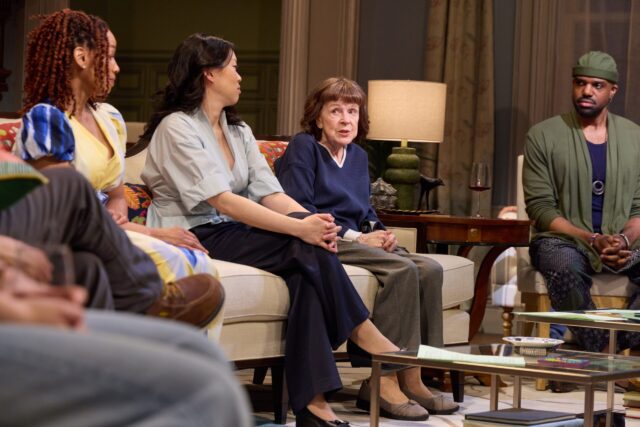
A family faces some hard truths in stellar revival of Henrik Ibsen’s The Wild Duck (photo by Gerry Goodstein)

THE WILD DUCK
Theatre for a New Audience, Polonsky Shakespeare Center
262 Ashland Pl. between Lafayette Ave. & Fulton St.
Tuesday – Sunday through September 28, $102-$132
www.tfana.org

“Men are the most peculiar creatures,” Gina (Melanie Field) says near the middle of Simon Godwin’s adaptation of David Eldridge’s 2005 translation of Henrik Ibsen’s The Wild Duck at the Polonsky Shakespeare Center.

That’s not the half of it.

Over the last fourteen years, Henrik Ibsen’s plays have been experiencing a renaissance, with productions of Ghosts at Lincoln Center, An Enemy of the People on Broadway and at Park Ave. Armory, The Master Builder and John Gabriel Borkman at BAM, and A Doll’s House and Lucas Hnath’s A Doll’s House, Part 2 on Broadway, along with Charles Busch’s Ibsen’s Ghost in midtown and Will Eno’s Peer Gynt reimagining, Gnit, at the Polonsky. It’s been a while since New York City has seen a major revival of Hedda Gabler and even longer of The Wild Duck, which is at last back in this exquisite rendering.

A dual presentation from Theatre for a New Audience and Shakespeare Theatre Company (STC), The Wild Duck is a complex tale of parents and children, money and power, truth-telling, and the ability to see what’s happening right in front of you. The story takes place in 1880s Norway, where wealthy mill owner Håkon Werle (Robert Stanton) is having a dinner party in honor of his son, Gregers (Alexander Hurt), who apparently would rather be anywhere else. Gregers has invited his old friend Hjalmar Ekdal (Nick Westrate), whom he has not seen in sixteen years; Hjalmar, who is not in the same class as the other guests, has reluctantly shown up and is embarrassed when his bedraggled father, Old Ekdal (David Patrick Kelly), a onetime war hero and partner of Håkon’s who spent several years in prison, walks through the party, muttering to himself, and accepts a bottle from Miss Pettersen (Katie Broad), the housekeeper.

Gregers and Hjalmar have a long conversation that leads to Gregers confronting his father, accusing Håkon of having had an affair and an ulterior motive in helping Hjalmar and his family. Håkon asks Gregers to become his partner, explaining, “I’m not as fit for work as I used to be. My eyes aren’t as good.” Gregers thinks his father, who is preparing to marry his current housekeeper, Mrs. Sørby (Mahira Kakkar), is up to something. “I know how you’re using me,” Gregers says. An angry Håkon replies, “I don’t think there’s a man in this world you could detest as much as you detest me.” A frightfully earnest Gregers retorts, “I’ve observed you too closely and for too long, Father.”

The narrative then switches to the Ekdals’ dusty, rustic studio, where Hjalmar and his wife, Gina, live with their bright, inquisitive fifteen-year-old daughter, Hedvig (Maaike Laanstra-Corn), and her grandfather, Old Ekdal, who was a well-regarded hunter. The old man now resigns himself to shooting animals in their loft, which is populated by birds, rabbits, chickens, and a wild duck that was winged by Håkon, was rescued in the sea by Håkon’s dog, and is now cared for by Hedvig, an avid reader who is losing her eyesight. (The impressive sets are by Andrew Boyce.) Hjalmar believes he will be able to lift up his family with an invention he is working on that will make them rich. For additional income, they have two boarders, Dr. Relling (Matthew Saldívar) and the unseen theologian Mr. Molvik. Gregers arrives to inquire if he can rent a vacant room; despite Gina’s misgivings, he moves in and almost immediately inserts himself into situations that drive wedges between just about everyone. Oh, and then there’s the Chekhovian gun. . . .

Hjalmar Ekdal (Nick Westrate) and his daughter, Hedvig (Maaike Laanstra-Corn), share a happy moment in The Wild Duck at TFANA’s Polonsky Shakespeare Center (photo by Gerry Goodstein)

The Wild Duck centers on the relationships between fathers and children: Håkon and Gregers, Old Ekdal and Hjalmar, and Hjalmar and Hedvig. Håkon blames Gregers’s distaste for him on his late wife; Hjalmar tells Gregers that he wants to save his aging, ailing father. And Hjalmar reevaluates his love for Hedvig after a secret is revealed.

It’s also focused on the concept of truth, particularly as it applies to Gregers, who believes in getting everything out into the open, no matter how much it might harm certain people. But he is not a master manipulator or self-righteous believer as much as he might be mad. “Damn it, can’t you see the man’s insane — He’s disturbed!” Dr. Relling shouts at one point. In addition, sight plays a major role, literally and figuratively, as some characters are losing their eyesight and others refuse to see the truth that’s staring them in the face.

Eldridge (Festen, Under the Blue Sky) and STC artistic director Godwin (Timon of Athens, Man and Superman) get right to the heart of Ibsen’s play with an exquisite rendering that grabs you and never lets go. It’s so on target, so alive and bursting with energy and intrigue, that you’ll wonder why you’ve never seen it before.

Westrate (Bernhardt/Hamlet, Casa Valentina) is a powder keg as Hjalmar, a tortured soul with pipe dreams who loves his family but seems powerless to take action; as a photographer, he takes pictures of others but never looks at himself. Field (The Phantom of the Opera, Uncle Vanya) is touching as Gina, a woman who is determined to move forward, intent on keeping the past behind her. Rising star Laanstra-Corn (Grief Camp, Homofermenters) steals every scene she’s in as Hedvig, an inelegant teenager who worships her father. Kelly (An Enemy of the People, Into the Woods) is affecting as Old Ekdal, a once proud man who has long lost his grip on reality. (He also wears a dazzling multi-patched coat; the fine period costumes are by Heather Freedman.) And Stanton (The Killer, Ink) is steely as the unyielding Håkon, who is unable to connect with his son.

Hurt (Continuity, Love, Love, Love) is an enigma as Gregers, a complex character whose motives are not always clear. The night I went, it was difficult to hear him; none of the actors use microphones, which is a special treat, but Hurt delivered his lines at a significantly lower decibel level. His body movement was also rather stiff and his eyes often distant, reminiscent of Jeremy Strong’s performance as Dr. Stockmann in Amy Herzog and Sam Gold’s recent adaptation of An Enemy of the People. Although the interpretation was generally successful, it called too much attention to itself in an otherwise stellar and memorable production.

And as far as the duck goes, it’s an extraordinarily salient metaphor not just for all the characters in the play but for the audience as well, a potent reminder of who we are, what we’ve done, and where we’re going.

[Mark Rifkin is a Brooklyn-born, Manhattan-based writer and editor; you can follow him on Substack here.]