twi-ny recommended events

TIME AND MEMORY: JEN TULLOCK DIGS DEEP IN SOLO SHOW

Jen Tullock cowrote and stars in one-person show at Playwrights Horizons (photo by Maria Baranova)

NOTHING CAN TAKE YOU FROM THE HAND OF GOD
Playwrights Horizons, the Peter Jay Sharp Theater
416 West 42nd St. between Ninth & Tenth Aves.
Tuesday-Sunday through November 16, $63.50 – $118.50
www.playwrightshorizons.org

“Do you remember the first time you saw her, or I mean, has writing about it changed your memory of her?” a voice asks author Kristin Frances Reinhardt in Jen Tullock and Frank Winters’s Nothing Can Take You from the Hand of God. Frances doesn’t answer the question in this intense solo show about first love, childhood trauma, forgiveness, and what and how we remember our past, filtered through family and religious dynamics and time.

Tullock performs all eleven roles in the seventy-minute multimedia production, from Frances’s brother, Eli, and mother, Raelynn, to her animated literary agent, Aubrey, and Kenny Weaver, the pastor of the Northeast Missions Church in her hometown. The play begins at a literary event launching Frances’s latest memoir, Never the Twain Shall Meet: Losing God and Finding Myself, the follow-up to Sorry I’m Late, about queer dating in Los Angeles. The new book explores Frances’s battles with her parents and the church over her sexual orientation as they go to extremes to try to force the gay out of her.

The action starts when agent Aubrey informs Frances that an organization discussed in the book, the Northeast Christian Church, got hold of an advance copy and is threatening to sue unless the author removes sections the church deems libelous for “wrongful likeness.” Frances decides to return home, believing she can straighten things out with the people she wrote about, primarily one specific young Polish woman with whom she fell in love, now a single mother who does not want to speak to her.

The narrative weaves in and out of the past and the present as the plot moves to Eli’s Backyard Bible Study class, a talent show audition, a coffee shop, a popular creek, a barbecue at Raelynn’s house, and the church, all the while intercutting discussions between Frances and Aubrey and readings and questions at the book event. For example, at one point the play switches back and forth between the book launch, with the host and audience heard in voiceover, and Pastor Jeremy Young at the church, with Tullock seamlessly shifting from Frances to Jeremy, making it feel like it’s all one conversation:

Jeremy: You know what my dream is? With this place? I want to make it so nobody has to write a book like you did. Not ever again. That’s the work that we’re trying to do.
Host: Wow.
Jeremy: Would you agree with that?
Host: Oh, gosh. That’s beautiful.
Jeremy: Well, I am so glad to hear you say that; I’m relieved, frankly. That means the world to me. Now let me ask you a question. Do you ever worry if you made any of it up?
Frances: Sorry, excuse me?
Host: Do you ever think about who your work is reaching?
Jeremy: Now, I’m not a lawyer — this may come as a shock to you, but I do know that even by the standards of Kentucky Common Law there is something called — let me see if I can get this right — Intentional Infliction of Emotional Distress. I know, it’s wordy.

Nothing Can Take You from the Hand of God is a technical whirlwind (photo by Maria Baranova)

Tullock gives a tour-de-force performance, quickly changing accents and body language while also adjusting several onstage looping stations and small cameras that record real-time visuals of her that are projected onto screens around her, as if each character contains their own multitudes, going beyond stereotypes. The claustrophobic set, featuring two chairs, a small table, and the tech equipment, is by Emmie Finckel, with almost dizzying projections by Stefania Bulbarella, sharp lighting by Amith Chandrashaker, and expertly rendered sound by Evdoxia Ragkou.

The play is furiously directed by Jared Mezzocchi (Russian Troll Farm, On the Beauty of Loss), who previously collaborated with Tullock (On the Head of a Pin, You Shall Inherit the Earth!) on the marvelous site-specific Red Hook show The Wind and the Rain; there is so much going on at any one time that it takes a while to pick up its unique structure, which can get overwhelming and confusing at certain moments.

Inspired by events from her own life and her family’s involvement in the evangelical church, Tullock and cowriter Winters (On the Head of a Pin, Student Body) don’t sugarcoat the story by creating heroes and villains; each character in the play is complicated and well developed, flaws and all. In the book and the show itself, Frances is an unreliable narrator, one who is able to make the audience take a long, hard look at their own past and wonder how many of their memories might have wandered from the truth over the years.

“Do you still believe in anything?” an audience member asks Frances at the book event.

It’s a question many of us should be asking ourselves in these dark, troubled times.

[Mark Rifkin is a Brooklyn-born, Manhattan-based writer and editor; you can follow him on Substack here.]

BODIES WITHOUT OUTLINES: EIKO AND WEN AT BAM

Wen Hui and Eiko Otake share personal moments involving war in moving piece at BAM (photo by Maria Baranova)

WHAT IS WAR
BAM Fisher, Fishman Space
321 Ashland Pl.
October 21-25, $55, 7:30
www.bam.org/whatiswar

“Why, eighty years after the end of the Second World War, do we still have wars?” Eiko Otake and Wen Hui’s What Is War posits.

It’s a potent question, one that the two interdisciplinary artists explore in the powerful seventy-minute presentation, continuing at BAM’s Fishman Space through October 25. There’s purposely no question mark after the title because the show does not intend to provide any answers; instead, it’s more about personal experience.

Eiko, who was born and raised in postwar Japan and has lived in New York City since 1976, and Wen, who grew up in China during the Cultural Revolution and is based in Frankfurt, Germany, have been friends for thirty years. During the pandemic, they made the award-winning video diary No Rule Is Our Rule, after Eiko’s visit to China to collaborate with Wen was cut short.

They are now out on the road touring What Is War, which combines text, movement, and film to tell each of their stories and how they overlap. The show begins with a video clip of the two talking, projected on the large back wall. After a few minutes, Eiko humorously checks with Wen to make sure she is recording their conversation, admitting that she sometimes forgets to flip the switch and ends up having to do it all over again. It’s the last laugh of the evening.

The two women then appear at opposite sides of the black box theater, Eiko in a long, dark dress, Wen in a light blouse and long black skirt. Both barefoot, they walk agonizingly slowly toward each other across a narrow strip of dirt, a kind of graveyard where they meet in the middle, digging up the past. In front of archival footage, Wen explains how her grandmother died during the Japanese bombing of Kunming in December 1941; Wen’s mother was only five at the time. “I never had a chance to meet my grandmother,” she says. “I did not even know her name.”

Eiko Otake and Wen Hui come together and break apart in What Is War (photo by Maria Baranova)

Eiko shows a photo of her parents’ wedding, projected onto an angled hanging cloth at stage right. “They married on August 10th, 1945, one day after the atomic bombing of Nagasaki and five days before Japan’s surrender,” she says, detailing how her father pretended to have tuberculosis to avoid military service. “Wen Hui, when I visited you in China and spent time with your mom, I felt really glad my father lied.”

Throughout the piece, which is dramatically lit by David A. Ferri, Eiko and Wen come together and drift apart, sometimes tenderly, sometimes with more force, as Eiko discusses the bombing of Tokyo by America, which killed one hundred thousand Japanese in six hours; Wen goes to a hospital to cheer up wounded soldiers during the Sino-Vietnamese War; Eiko points out the antiwar statements in Japan’s postwar constitution; and Eiko and Wen travel to the Lijixiang Comfort Station in Nanjing, where sex slaves were made available to the Japanese army. (Today the facade of one of the buildings is covered with contemporary photos of the women.)

At times, the performers push a horizontal mirror on wheels around the stage, which provides provocative reflections while also implicating the audience in the action.

In one of the most harrowing moments, Eiko recalls the late Japanese writer Kyoko Hayashi, who grew up in Shanghai, asking her, “Bodies I saw on August 9 had no outlines. Otake-san, when you perform, can you please think of such a body, a body without outlines?”

What Is War is a hard show to watch; Eiko and Wen pull no punches as they bare their souls and their bodies, using the past as a way to try to build a better, safer, more caring future, probably in vain if current events are any evidence. Any metaphors are in the movement itself; everything else unfolds as a bold, direct accusation of man’s seemingly never-ending thirst for battle, power, and domination.

Fortunately, each performance concludes with a catered gathering in the downstairs lounge, where Eiko and Wen are eager to speak with attendees and hear their thoughts on the work and on war, with plenty of smiles and hugs.

[Mark Rifkin is a Brooklyn-born, Manhattan-based writer and editor; you can follow him on Substack here.]
COOL ART CARS: STAYING FROSTY IN HARLEM

STAY FROSTY
BravinLee programs
458 West 128th St. between Amsterdam & Convent Aves.
October 24-26, free
www.bravinlee.com

For thirty years, the Drilling Company has presented Shakespeare in the Parking Lot, staging Bard plays in a Lower East Side municipal parking lot. Troupe founder Hamilton Clancy has referred to it as “an urban wrinkle” compared to traditional productions in theaters.

Now Karin Bravin and John Post Lee of BravinLee programs are providing an urban wrinkle alternative to art fairs with “Stay Frosty,” what they call “part tailgate, part trunk show, part festival, and part site-specific exhibition.”

Taking place October 24-26, “Stay Frosty” will feature approximately sixteen galleries displaying their wares in cars within marked parking spaces; among the participants are Willie Cole (H20, Harlem Coupe, made from recycled water bottles), Traci Johnson (a van repurposed into an intimate sanctuary), Field Projects (Kate Corroon Skakel’s sports-related Baller [For Ray]), Debra Simon Consulting (Amy Rose Khoshbin’s Allan Kaprow–inspired Altars to Agency), and Amy Ritter (Mobile Home Archive). Another ten artists will have freestanding works along fences around the perimeter, including Ellie Murphy (Door Arch Gate. Colonnade for a parking lot.), Kate Dodd (Shared Air), and Kumasi J. Barnett (The Question).

“Visitors can anticipate a combination of interactive works, monumental car installations, and a trove of artworks installed in glove compartments, trunks, and dashboards,” Bravin told twi-ny about the show, which will travel to other locations in 2026.

BALONEY (Z Behl and Kim Moloney), Piggies Undo the World (courtesy of the artist and BravinLee programs)

Three early renderings point to how unique and cool “Stay Frosty” can be: Guy Richards Smit depicts a large boulder on a green auto, Laurie De Chiara’s ArtPort Kingston promises a stuffed yellow station wagon from Jeila Gueramian, and Z Behl & Kim Moloney of BALONEY have transformed a pickup into Piggies Undo the World.

Admission is free — for the public and the galleries and artists — and all the art is for sale. There will be several special events on Friday, with Gracie Mansion’s Buster Would Have Loved This offering visitors candy from a limo from 3:00 to 6:00, followed by a performance by Khoshbin, who will also be leading a participatory release ritual each day at noon.

“Let’s spit-the-bit and restore our mental health,” BravinLee advises.

Everyone is invited to come along for the ride for what should be a bevy of very cool cars.

[Mark Rifkin is a Brooklyn-born, Manhattan-based writer and editor; you can follow him on Substack here.]
DISPELLING MISTRESSES: ENDING A LOVE TRIANGLE THROUGH DIGNITY AND RESPECT

Elizabeth Lo is given remarkable access to a love triangle in award-winning documentary Mistress Dispeller

MISTRESS DISPELLER (Elizabeth Lo, 2024)
IFC Center
323 Sixth Ave. at West Third St.
Opens Wednesday, October 22
www.ifccenter.com

In her debut feature-length documentary, 2020’s Stray, Elizabeth Lo tracked a remarkable homeless canine named Keytin as the golden mutt lived a dog’s life on the streets of Istanbul, allowing Lo to capture his every move, telling the dog’s story from his perspective.

Lo has followed that up with Mistress Dispeller, in which the participants in a love triangle allow Lo to capture their every move, telling their story from each of their unique perspectives.

Taking inspiration from Chantal Akerman’s Jeanne Dielman, 23 Quai due Commerce, 1080 Bruxelles and Akira Kurosawa’s Rashomon, Lo’s film explores a relatively new “love industry” in China, mistress dispellers, who, for fees of tens of thousands of dollars and more, are hired by women who believe their husbands are having an affair; over the course of two or three months, the dispeller, using a false identity, ultimately convinces the mistress to end the illicit romance through a structured technique. They do so in a calm, unobtrusive way, treating all three parties with dignity and respect.

It took three years for Lo to find mistress dispeller Wang Zhenxi, then get permission to document one of her cases, in which Mrs. Li wants to end her husband’s affair with the younger Fei Fei. Wang poses as a cousin of Mr. Li’s who is interested in learning the married couple’s favorite pastime, badminton. Wang carefully orchestrates various meetings in which she spends time alone with the mistress, studies her motivations and emotions, and comes up with a plan. Lo’s mounted, still camera is in every room, every car — but not necessarily Lo, who sometimes leaves the camera recording as she exits the space, permitting her subjects to talk more openly without her watching. “I am just a vessel in their lives,” Wang says, and so is Lo. (Lo had previously interviewed Mrs. Li’s younger brother, who was a dispelled male mistress and recommends Wang in the film.)

Although it is made clear from the start that this is not some kind of game, there are winners and losers. “It’s just like a war. You either win or lose everything,” Wang explains. Fei Fei admits, “Winning or losing isn’t the question. Actually, neither is important to me anymore. Because there are many more important things than winning.” But later she states, “I can’t keep losing though, right? Everyone wants to win. Why can’t the winner be me?”

Lo directed, produced, and photographed the film in addition to writing and editing it with Charlotte Munch Bengtsen. She gives equal weight to Mr. Li, Mrs. Li, and Fei Fei while delving into Wang’s methods. Time and money is never discussed; instead, Lo focuses on the care Wang employs in her business, determined to achieve a satisfying result for all involved. The access Lo is supplied is astounding; of course, only Mrs. Li knows what’s happening at first, but soon Mr. Li understands as well, while Fei Fei discovers the deception only at the conclusion.

Lo does not seek to elicit any judgments, but she includes several scenes in which Mrs. Li and Fei Fei carefully tend to their personal style, taking care to dress well and get their hair done, while Mr. Li, the object of each woman’s affection, is not exactly a fashion plate or a great conversationalist. However, the film does not ask us to question the love — and we know from the start that Wang’s goal is to restore the marriage, with the mistress out of the picture.

In a program note, Fei Fei says, “I am willing to participate in filming because, considering the long river of life, this is a small part of it. But it’s also something that’s significant to me right now. I see this as a documentary of my life. It is also a portrait of love. From the beginning of our encounter, to the middle of the relationship, and the end, it’s all part of this process of love. . . . Love doesn’t disappear, it just diverts. It’s just a process of love moving around. It’s quite meaningful to make time to recall and witness the process for yourself — whether the path you take is right or not. . . . When others see this film, they might gain some insights from it.”

Meanwhile, Mrs. Li explains, “Teacher Wang taught me a lot. About love, and other things. She said, ‘Look, you are going through this, this difficulty, and we should film it, so more women, more people, can face their families and learn how to handle a situation like this. . . .’ I want more people to know that love doesn’t come easy, especially for people at our age. Don’t give up so easily.”

The film also touches on aspects of contemporary Chinese dating, from matchmaking seminars and fairs to online channels. Lo occasionally cuts away for drone shots of cities and mountainous landscapes, incorporating all of China into the narrative, merging the inner and outer worlds of the people and the country.

Mistress Dispeller opens October 22 at IFC Center, with Lo on hand for Q&As at the 6:35 screenings on Wednesday with Penny Lane and Thursday with Constance Wu; Lo and Wu will also deliver an extended introduction before the 9:00 show on Saturday.

[Mark Rifkin is a Brooklyn-born, Manhattan-based writer and editor; you can follow him on Substack here.]
SEEING TRIPLE: TALKING BAND’S LATEST IS ANOTHER AVANT-GARDE MASTERWORK

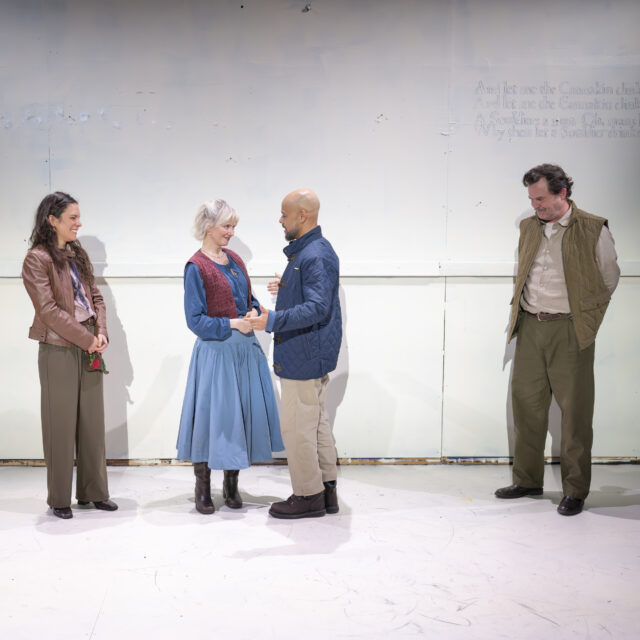
Steven Rattazzi, Amara Granderson, and Lizzie Olesker star as three accidentally interconnected New Yorkers in Triplicity (photo by Maria Baranova)

TRIPLICITY
Mabou Mines@122CC
150 1st Ave. at Ninth St.
Wednesday – Monday through October 26, $30-$40
talkingband.org

I got so mad watching Triplicity, Talking Band’s latest fantastic foray into the experimental and the avant-garde. The legendary downtown troupe was founded in 1974 by Paul Zimet, Ellen Maddow, and Tina Shepard and has presented approximately sixty shows over the years. Embarrassingly, I discovered them only a few years ago and have been blown away by their last five productions but, oh, what I have missed over the decades.

In a program note, director Zimet writes, “I feel Triplicity is a quintessential Talking Band work: It uses music, the music of speech, and choreography to heighten the ordinary and allow us to appreciate it in a new way.” If you’ve never experienced a Talking Band work, then Triplicity is a great place to start. And if you have been to previous TB shows, well, what are you waiting for? Triplicity runs at Mabou Mines@122CC only through October 26.

Triplicity is a truly New York City tale, following the interconnected, overlapping lives of four strangers as they go about their regular, mostly mundane existence in the big metropolis.

Frankie Shuffleton (Lizzie Olesker) is a seventy-something widowed bookkeeper who walks around her Christopher Street block every day at noon, sits on a park bench, and picks up a salad in a plastic container on her way home, where she listens to the news on the radio at seven, catches a police procedural at ten, then goes to bed. In true Beckett fashion, her first words are “There’s nothing to say,” which sharply contrasts with her accidental acquisition of a “talk to me” phone in which people call seeking advice.

Danny Dardoni (Steven Rattazzi) is a fifty-something exterminator who lives in a large Italian household in Bay Ridge, reads the poems of Virgil, and is shocked to learn that there is an enormous beehive in the attic. Danny, who has an innate sense for details, specializes in killing mice and rats and, not necessarily happily, tells us that he “is responsible for the safety and well-being of my family, to provide a home, this house, that is a safe place in a dangerous world.”

Norma Linda Box (Amara Granderson) is a twentysomething wannabe writer with five roommates, four jobs, and a hatred of people saying her name. When she sees a snake on the sidewalk, she takes him home because his blue stripes match a tattoo on her left ankle. “No one has witnessed the event,” she says. “I own it. I can define it. It’s mine to define.”

And Calliope (El Beh) is a street singer who is kind of a Greek chorus in funky, wild clothing, singing songs related to the words and actions of Frankie, Danny, and Norma, picking up on their sound and movement. “Whatever the weather / Calliope sings to whoever will listen / That’s it / That’s it,” she warbles.

As they share their stories, they break out into formalistic dances and roll around on their chairs; the playful choreography by Sean Donovan and Brandon Washington evokes the independence, and loneliness, of so many New Yorkers.

Talking Band’s Triplicity features unique choreography by Sean Donovan and Brandon Washington (photo by Maria Baranova)

In astrology, triplicity is an essential dignity involving a group of three Zodiac signs belonging to one element. That definition fits the show well, as the worlds of three people intersect and become one through the participation of a fourth.

The play begins with Frankie telling her story three different ways, moving her chair and adding more detail each time, a dazzling introduction to how we talk about our lives and share them with others. The concept of numbers is key throughout the seventy minutes, a poetic leitmotif. “Suddenly everything is in two’s!” Frankie declares. Three girls ride scooters. At four, Frankie goes out for coffee. Norma has five roommates and writes six essays. There are seven shards of glass on a blue tile floor. They get ten inches of rain over three days. The barrage of numbers suggests the passage of time, in minutes, hours, days, weeks, months, and years on the journey from birth to death.

Anna Kiraly’s set consists of rolling chairs, doorways with windows on which she projects different color schemes, a mazelike path on the floor, and a corner with special props for Calliope. Olivera Gajic’s costumes feature Frankie in a quaint sweater and skirt, Danny in a white T-shirt and sneakers, Norma in blue-jean overalls and wearing a red bandanna, and Calliope in a series of wildly adorned outfits.

Triplicity is written and composed by Ellen Maddow and directed by Paul Zimet, the incomparable married team who have been collaborating as writer, director, composer, and/or actors for half a century, including on Talking Band’s recent surge of endlessly compelling and engaging works, which have made me nearly weep with joy as the company continues to push the limits of what theater can be: Shimmer and Herringbone at Mabou Mines, Existentialism and Lemon Girls or Art for the Artless at La MaMa, and The Following Evening at PAC NYC.

In Triplicity, they capture the essence of New York City, the heart and soul of everyday people, the music and energy, divided into such chapters as “Adagio,” “Allegretto,” and “Scherzo,” resulting in a beautiful mini-symphony performed by a magical quartet.

[Mark Rifkin is a Brooklyn-born, Manhattan-based writer and editor; you can follow him on Substack here.]
NOTHING TO SAY OR DO? A SAMUEL BECKETT HAT TRICK IN NEW YORK

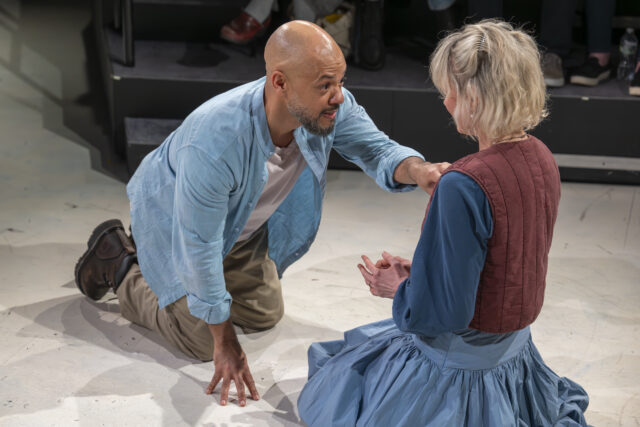
Keanu Reeves and Alex Winter star in Broadway smash version of Samuel Beckett’s Waiting for Godot (photo by Andy Henderson)

WAITING FOR GODOT
Hudson Theatre
141 West Forty-Fourth St. between Sixth & Seventh Aves.
Tuesday – Sunday through January 4, $98.56-$558.88
godotbroadway.com
www.thehudsonbroadway.com

“There’s nothing to do,” Vladimir tells Estragon in Samuel Beckett’s 1953 masterpiece Waiting for Godot.

There’s plenty to do for Beckett fans in New York City right now, much but not all of it a most excellent adventure.

The talk of the town is Keanu Reeves and Alex Winter reprising — well, channeling? — their roles from 1989’s Bill & Ted’s Excellent Adventure and the 1991 and 2020 sequels in Godot at the Hudson Theatre. Action star Reeves is making his Broadway debut as Estragon (Gogo) in Jamie Lloyd’s bumpy adaptation, while Winter returns to the Great White Way for the first time in forty-four years as Vladimir (Didi).

Reeves and Winter follow in the formidable footsteps of such duos as Michael Shannon and Paul Sparks, Ian McKellen and Patrick Stewart, and Robin Williams and Steve Martin and, for the most part, hold the audience’s attention. Gogo and Didi usually find themselves in a strange, dark wasteland, with only a single bare tree, a country road, and a solitary stone as they contemplate life and death, heaven and hell, and existence and humanity, but Lloyd and set designer Soutra Gilmour locate them inside a giant tube that is part tunnel, part circular skateboard ramp, part existential void in space. Resembling abandoned vaudevillians in all black, sporting impressive bowlers (the costumes are also by Gilmour), they sit at the edge of the tube, feet dangling, waiting for the mysterious Godot to arrive and, perhaps, bring meaning to their sad, pathetic lives.

They are visited instead by the loud, blustery Pozzo (Brandon J. Dirden) and his menial, an apparent servant named Lucky (Michael Patrick Thornton). Pozzo usually leads Lucky around by a rope around his neck — evoking master and slave, circus ringleader and animal performer while referencing the rope Gogo had mentioned earlier when he and Didi considered hanging themselves — but here Lloyd has the verbally abusive Pozzo pushing Lucky, who is in a wheelchair, altering their dynamic. Curiously, Lucky breaks the fourth wall several times, acknowledging the audience and encouraging them to clap after he does his dance (with his head and hands). In addition, a young boy (Eric Williams or Zaynn Arora) shares important information with Gogo and Didi.

Lloyd (A Doll’s House, Sunset Blvd.) has slimmed down the show to just over two hours including intermission, so the pacing works well. Lloyd’s decision to get rid of nearly all the usual props, including a key carrot that Gogo chews in an annoying manner, seems like overkill. There’s a perpetual droning hum of doom hovering over the proceedings (the sound is by Ben and Max Ringham), contrasting Jon Clark’s subtle lighting shifts, highlighted by dazzling surprises at the end of each act.

Reeves and Winter may not display a wide range of emotions, but they avail themselves well enough to keep the audience engaged. At one point Didi says, “This is not boring you I hope,” looking out at us, and we essentially answer no.

Bill and Ted enthusiasts may whoop when Gogo says, “Back to back like in the good old days,” and the two actors stand back to back and play air guitar, echoing what they do in the film series, but the reference feels out of place in a show that exists in a barren emptiness and is about nothing (and everything).

“The only true wisdom consists in knowing that you know nothing,” Bill says in the first movie, quoting Socrates. Ted responds, “That’s us, dude.”

Party on, dudes!

Stephen Rea is mesmerizing as a man listening to his past in Krapp’s Last Tape (photo courtesy Patricio Cassinoni)

KRAPP’S LAST TAPE
NYU Skirball Center for the Performing Arts
566 La Guardia Pl.
Through October 19, $83-$130
nyuskirball.org

“Nothing to say,” an old man declares in Samuel Beckett’s 1958 autobiographical classic, Krapp’s Last Tape, a fascinating kind of companion piece to Waiting for Godot.

In 2012, Irish actor Stephen Rea decided to go into a studio and perform the prerecorded sections of Krapp’s Last Tape, in case he was ever asked to do the one-man show, in which a dissatisfied man listens to tapes his younger self made thirty years before. Rea is now touring the play, which continues at the NYU Skirball Center through October 19.

Jamie Vartan’s spare set features a desk in the center, an overhead hanging light, and a door at the back, stage right. Paul Keogan’s shadowy lighting maintains an old-fashioned vaudeville black-and-white feel. The past is present in both Vicky Featherstone’s taut staging and the theme of the play.

The show begins with Krapp slowly opening a hilariously long drawer and removing a banana. He eats the fruit — the yellow of the banana stands out from the otherwise colorless gloom — and tosses the peel onto the floor, where, of course, he soon slips on it. He does not make the same mistake twice.

To celebrate his birthday, he is going to listen to one of his old reel-to-reel tapes, the one he made when he turned thirty-nine, discussing his life. He brings in the machine and a stack of tapes, carefully searching for box three, spool five, taking great delight in saying the word “spool” over and over again. “Thirty-nine today, sound as a bell, apart from my old weakness, and intellectually I have now every reason to suspect at the . . . crest of the wave — or thereabouts,” he listens to his old self explain. “Good to be back in my den, in my old rags. Have just eaten I regret to say three bananas and only with difficulty refrained from a fourth. Fatal things for a man with my condition. Cut ’em out! The new light above my table is a great improvement. With all this darkness round me I feel less alone. In a way. I love to get up and move about in it, then back here to . . . me. Krapp.”

Not much has changed in those thirty years; his loneliness in the darkness is palpable. He looks up the meaning of “viduity,” sings, and recalls a romantic evening on a lake. But the tape does not provide him with happiness; he barks out, “Just been listening to that stupid bastard I took myself for thirty years ago, hard to believe I was ever as bad as that. Thank God that’s all done with anyway.”

What’s next? Well, the play’s French title is La Dernière Bande, or “The Last Tape.”

Krapp’s Last Tape has previously been performed by such actors as Patrick Magee, Harold Pinter, Brian Dennehy, and Michael Gambon; I’ve seen it with John Hurt at BAM and, earlier this year, F. Murray Abraham at the Irish Rep. The play, a haunting examination of time, memory, and the futility of language, works best in more intimate quarters; it gets a bit lost at the Skirball, even at only about fifty minutes.

Rea (A Particle of Dread, Cyprus Avenue) inhabits the character with a graceful elegance despite Krapp’s pathetic, sad-sack circumstances, at times recalling Buster Keaton, one of Beckett’s favorites. It’s a bravura performance that I would have loved to see in a significantly smaller venue.

Druid production of Samuel Beckett’s Endgame comes to Irish Arts Center for monthlong run (photo by Ros Kavanagh)

ENDGAME
Irish Arts Center, JL Greene Theatre
726 Eleventh Ave. between Fifty-First & Fifty-Second Sts.
October 22 – November 23, $25-$86
irishartscenter.org

“Nothing is funnier than unhappiness,” Nell tells Nagg in Samuel Beckett’s 1957 chess-inspired Endgame, which takes place during some kind of apocalypse as four characters contemplate their fate in a dingy basement dungeon, two of them living in garbage cans.

In a conversation in the Skirball program for Krapp’s Last Tape, Stephen Rea tells director Vicky Featherstone and Dr. Tanya Dean, “Endgame is a tough thing. I remember Beckett saying he loved Endgame, and he didn’t like Waiting for Godot. And I said, ‘Well, it’s been absorbed.’”

Rea played Clov in the 1976 Royal Court production of Endgame; I’ve seen the show twice, in 2008 at BAM with Max Casella, Alvin Epstein, Elaine Stritch, and John Turturro, and in 2023 at the Irish Rep with John Douglas Thompson, Bill Irwin, Joe Grifasi, and Patrice Johnson Chevannes. From October 22 through November 23, Galway’s Druid theater company will be presenting Endgame at the Irish Arts Center, with Tony winner Marie Mullen, Bosco Hogan, Aaron Monaghan, and Rory Nolan, directed by Tony winner Garry Hynes. As with Soutra Gilmour’s set for Waiting for Godot on Broadway, Francis O’Connor’s scenic design for Endgame also emphasizes the circularity of life.

Monaghan, who plays Clov, previously starred as Estragon opposite Marty Rea (no relation to Stephen) in Druid and Hynes’s Waiting for Godot at Lincoln Center’s 2018 White Light Festival. Hynes also helmed a stunning Richard III starring Monaghan in 2019 as well as The Beauty Queen of Leenane at BAM in 2017, with Marty Rea and Mullen.

Endgame is part of Druid’s fiftieth anniversary celebration. In the play, Clov shouts, “The end is terrific!” But luckily for theatregoers, the end appears to be nowhere in sight for Druid, or for seeing Beckett in New York.

[Mark Rifkin is a Brooklyn-born, Manhattan-based writer and editor; you can follow him on Substack here.]

LIFE AS IMPROV: VERA BRANDES, KEITH JARRETT, AND KÖLN 75

Mala Emde is hypnotic as teenage concert promoter Vera Brandes in Ido Fluk’s Köln 75

KÖLN 75 (Ido Fluk, 2025)
IFC Center
323 Sixth Ave. at West Third St.
Opens Friday, October 17
www.ifccenter.com

In Ido Fluk’s exciting, propulsive Köln 75, if teenage concert promoter Vera Brandes (Mala Emde) is going to make the impossible happen and first book master pianist Keith Jarrett (John Magaro) for the first-ever jazz show at the Cologne Opera House in Germany, sell tickets, and then convince Jarrett to actually take the stage and perform, she’ll need to improvise like, well, a jazz legend.

Inspired by a true story, the film begins at Vera’s (Susanne Wolff) fiftieth birthday party, where her father (Ulrich Tukur) makes a surprise, unwelcome appearance. “When she was young, she had a lot of potential,” he says in what is supposed to be a celebratory toast. “She is, without a doubt, my greatest disappointment.”

Vera turns to look into the camera and confidently declares, “Let’s do this again!” The action then shifts to the 1970s, with Jazzworld magazine critic-at-large Michael “Mick” Watts (Michael Chernus) discussing some of the most famous recorded false starts in music history. We then meet Vera when she’s sixteen, a freewheeling, free-loving jazz fan into John Coltrane, Miles Davis, Charles Mingus, and Dexter Gordon. One night she goes to a club to see British saxophonist Ronnie Scott (Daniel Betts), who, after hanging out with Vera, asks her to book a German tour for him even though she has zero experience. (She tells him she’s twenty-five.) When she asks why her, he answers, “Because I can’t imagine anyone turning you down.”

Soon Vera, her older boyfriend, Jan (Enno Trebs), her best friend, Isa (Shirin Eissa), and a young man she’s just met, Oliver (Leon Blohm), are putting together shows and living life in the fast lane, much to the chagrin of Vera’s stodgy and humorless conservative dentist father and mother (Jördis Triebel).

After watching Jarrett perform a solo concert, Vera decides that she must book the pianist into the Cologne Opera House, staking her entire music future on it even as she faces roadblock upon roadblock, from the opera house’s total lack of support to Jarrett’s unpredictability, neuroses, and nearly debilitating back pain. As Jarrett and his producer, Manfred Eicher (Alexander Scheer), set out on an eight-hour drive with Watts to get to Germany, Vera is determined to not let multiple problems stop her from staging the show and forging her career.

Emde (And Tomorrow the Whole World, 303) is hypnotic as Vera, who is always thinking, always planning, never sitting still; like Scott said, you can’t imagine anyone turning her down. Emde imbues Vera with endless bursts of energy, emotion, and an infectious joie de vivre even when everything is falling apart. Magaro (Past Lives, September 5) offers a terrific counterpoint as Jarrett, who is overwhelmed by a bundle of nerves and a lack of confidence despite his success. As Watts, Chernus (Severance, Devil in Disguise: John Wayne Gacy) serves as a calming force somewhere in between them, speaking directly to the audience as a concerned observer, a journalist who keeps being told that he cannot use anything he witnesses in his story. (Although there was a real jazz writer with the same name, the character is a composite of several people.)

In making the film, writer-director Fluk (The Ticket, Never Too Late) ran into numerous problems of his own, so he and his crew had to improvise as well; for example, the Cologne Opera was not available, so they had to find an alternate space in Poland, and Jarrett and his record company chose not to cooperate, so Fluk could not use Jarrett’s actual music. However, Fluk did have an eight-hour conversation with the real Vera Brandes, who had been waiting fifty years to tell her story to someone. Köln 75 works because it’s not primarily about music, or the 1970s, or Keith Jarrett; instead, it’s told from the perspective of an unsung hero, an intoxicating young woman who refuses to let her dreams die.

Köln 75 opens October 17 at IFC Center, with Brandes, Emde, Chernus, and Fluk on hand for Q&As at the 6:45 screenings on Friday and Saturday night.

[Mark Rifkin is a Brooklyn-born, Manhattan-based writer and editor; you can follow him on Substack here.]