twi-ny recommended events

LEMON GIRLS OR ART FOR THE ARTLESS

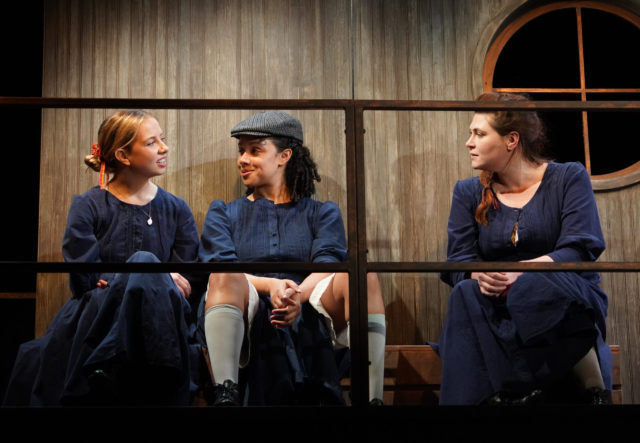
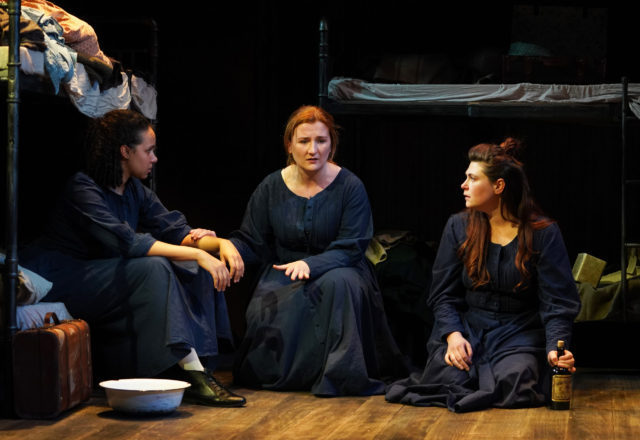
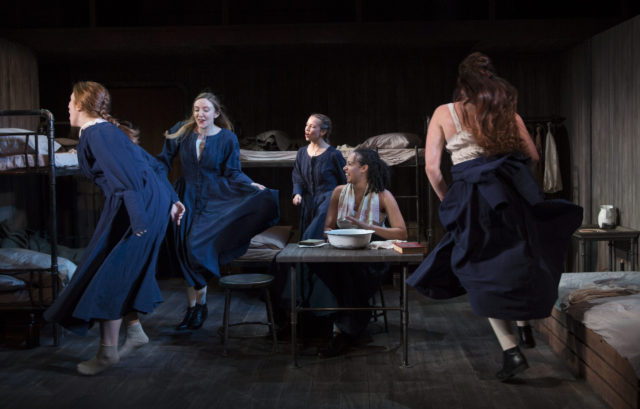
A quartet of senior women gets more than they bargained for in Lemon Girls or Art for Artless (photo by Andrew Bisdale)

LEMON GIRLS OR ART FOR THE ARTLESS
La MaMa Experimental Theatre Club, the Downstairs
66 East Fourth St. between Second Ave. & Bowery
Thursday – Sunday through March 27, $25-$30
212-475-7710
www.lamama.org
talkingband.org

Lemon Girls or Art for the Artless is a small show in a small space, but it’s one of the most exhilarating and inspiring shows I’ve seen since the pandemic interrupted in-person entertainment in March 2020. It’s an uproarious and touching celebration of aging and coming to terms with who you are and what you’ve accomplished, a kind of alternative to the wickedly fun Six on Broadway, where the six wives of Henry VIII battle it out to see who had it worst with the monarch.

Continuing in the Downstairs theater at La MaMa through March 27, Lemon Girls is about four senior women whose connection to life changes when they meet a stranger in their local café, appropriately called Solo, where the quartet, friends since attending the progressive Lemon Elementary school together, meet for coffee every Tuesday at 3:30. They sit at the same table each week, but they are surprised one afternoon to not only find a line to get in — the new pencil latte has become a thing — but also see that a stranger has taken their spot.

Urban historian Nivea (Patrena Murray), social worker Topo (Lizzie Olesker), retired civil servant Pinny (Louise Smith), and cookbook writer Lorca (Ellen Maddow) assume that the man, Sid Spitz (Jack Wetherall), will cede them the table, but instead he cheekily asks them to join him, in some ways becoming their fifth friend, painter Fran (Tina Shepard), who is not there. They recognize instantly that he’s not like the other males they know, who call themselves the Romeos: Retired Old Men Eating Out. (“They enjoy the turkey chili. It gives them gas,” Pinny points out.) An FIT librarian and performance artist, Sid invites the women to become part of a music theater workshop he leads in the basement of a rec center.

After some waffling, they do actually show up. Their skepticism of Sid’s earnest direction gives the rehearsal scenes brilliant, low-key comedy. “Keep on walking, fill in the spaces, curve through the people, use your arms. And STOP. And float. And STOP and float,” he advises, adding, “The floor is sand, your feet are hands, they squeeze the sand. They caress, they sink, they caress, they squeeze.”

Lorca says to Nivea, “What does he mean our feet are hands? Like monkeys? Does he mean monkeys? Is this the beach? Are we supposed to be at the beach, or the zoo?”

When Sid tells them to move underwater and “fill the empty spaces,” Lorca wonders, “Underwater? How do we breathe? People can’t breathe underwater.” And when he prompts them to glide like their hands are knives and the air is bread, slicing away, Lorca argues, “Suddenly it’s the kitchen?”

Sid Spitz (Jack Wetherall) leads rehearsals for upcoming show in charmer at La MaMa (photo by Andrew Bisdale)

But the four women are superb actors, able to play their characters, older women who are learning to perform, with skill and nuance as the quartet eventually enjoys adapting to Sid’s unique choreographic methods and come up with songs that share intimate details of their lives. As they prepare to put on a public show for an organization called Art for the Artless, there’s conflict: In order to keep the workshop funded, they need a fifth participant, and Nivea promises to bring Fran.

In addition, Sid needs to get paid so he can afford his rent to his landlord and best friend, Marvin; the unseen Marvin is about to turn ninety and is close with artist David Hockney, which excites the group, who rave about how Hockney’s recent show at the Met changed their lives.

At one point, Topo opines, “What I think I look like and what I look like don’t match. That gives me the creeps,” to which Lorca replies, “But it doesn’t matter. It doesn’t matter anymore.” Before the rehearsals, the women had resigned themselves to a plain existence, exemplified by some of Lorca’s bitter songs. Sitting outside the café, Lorca and Pinny remember one of Lorca’s schoolgirl ditties: “I sit on a bee because I am dumb / I scream at my teacher cuz she isn’t fair / I kick the doctor because he hurt me / I drown in the river because it is there.” But hope is on the way.

Lemon Girls or Art for the Artless is the latest from avant-garde mainstays Talking Band, which has staged more than fifty new works since 1974. The show is directed by four-time Obie winner Paul Zimet (The City of No Illusions, The Walk Across America for Mother Earth), who cofounded the troupe with Maddow (Fusiform Gyrus — A Septet for Two Scientists and Five Horns, Fat Skirt Big Nozzle), who wrote Lemon Girls and composed the wonderful songs, and Shepard. Sean Donovan (Cabin, The Reception) did the marvelous, often hysterical choreography, which is a character unto itself, helping define the four women and how they view the world. The fab costumes are by Kiki Smith.

Anna Kiraly’s set is anchored by the slightly raised Café Solo at the corner of stage right, covered by a blue curtain when the action is taking place in the central makeshift workshop space, where a door leads beyond. The characters open and close the curtain as scenes there begin and end; on the back wall of the café, Kiraly projects pixelated, abstracted black-and-white footage of younger people hanging out in the shop, which the four women ignore.

As we emerge from the coronavirus crisis, which hit senior citizens particularly hard, it is an absolute joy to watch Nivea, Topo, Pinny, Lorca, and Sid, portrayed by a supremely talented cast, meeting new people, trying new things, and finding renewed meaning in their everyday existence.

“That’s what’s changed!” Nivea suddenly declares. “That’s what I’ve gone back to, I mean. I’ve stopped watching myself. I used to always be watching myself watching myself. Did you ever do that?”

Lorca replies, “Oh yeah. Everything was such a ridiculous complication of layers. And finally I just got tired of it, really, really tired of it. I would watch myself reflected in store windows looking like a hobbling old hag. It was so sad and exhausting! So I just stopped looking. It’s like I went back to when I was eight or something. Whatever I feel like doing, I do it.”

Talking Band has been around for nearly a half century; if you haven’t seen them before, you’ll be thrilled that you’ve met them now and have finally been introduced to their intoxicating philosophy.

UPLOAD

UPLOAD
Park Ave. Armory, Wade Thompson Drill Hall
643 Park Ave. at Sixty-Seventh St.
March 22-30, $45-$150, 7:30 / 8:00
www.armoryonpark.org
www.vanderaa.net

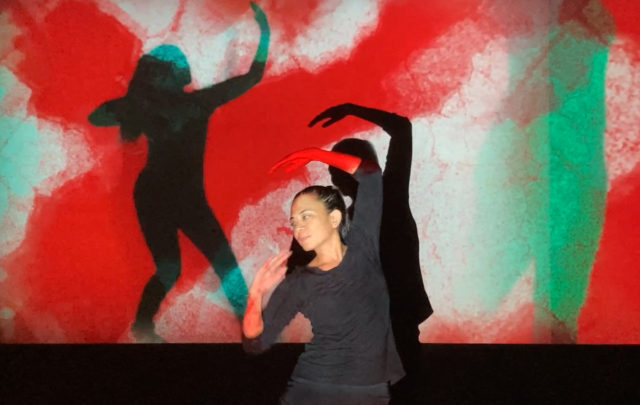
Dutch composer Michel van der Aa returns to Park Ave. Armory this month with the North American premiere of Upload, a multimedia opera running March 22-30 in the Wade Thompson Drill Hall. The hybrid work uses film and motion capture technology to tell the story of a father and daughter seeking digital consciousness, an exciting follow-up to Rashaad Newsome’s recently concluded Assembly installation at the armory, which was hosted by the AI known as Being the Digital Griot.

Previously presented at the Dutch National Opera and the Bregenz Festival in Austria, the eighty-five-minute Upload features soprano Julia Bullock as the daughter and baritone Roderick Williams as the father in person, with Katja Herbers as a psychiatrist and Ashley Zukerman as a CEO in prerecorded flashbacks shot by cinematographer Joost Rietdijk. The score is performed by the Cologne-based Ensemble Musikfabrik under the direction of Otto Tausk; the set and lighting are by Theun Mosk, with motion capture and graphics by Darien Brito and special effects by Julius Horsthuis.

Composer, director, and librettist van der Aa was last at the armory with 2017’s Blank Out, in which Williams appeared onscreen in a story loosely based on the life and career of bilingual South African poet Ingrid Jonker. “Park Ave. Armory is one of my favorite performance spaces in the world,” van der Aa said in a statement. “When it presented Blank Out, I was inspired by the response from the armory’s open-minded and diverse audiences. Upload was developed with the Armory in mind.” There will be an artist talk with van der Aa, moderated by performance artist Marina Abramović, on March 22 at 6:00 ($15).

JANE BY CHARLOTTE

Jane Birkin is seen through the eyes of her daughter in Jane by Charlotte

JANE BY CHARLOTTE (Charlotte Gainsbourg, 2021)
Quad Cinema
34 West 13th St.
Opens Thursday, March 17
212-255-2243
quadcinema.com

Jane by Charlotte is a documentary that only a daughter could make about her mother, a movie about two women who are always being looked at looking at each other.

In 1988, French New Wave auteur Agnès Varda made Jane B. par Agnès V., in which the director herself was a character in the film, showing London-born French singer, actress, and fashion icon Jane Birkin galivanting through imaginative and playful set pieces as Varda photographed her, with Varda sometimes revealing herself in front of and behind the camera. She had just finished Kung Fu Master, a family affair starring Birkin, her daughters Charlotte Gainsbourg (who also appeared in the documentary) and Lou Doillon, and Varda’s son Mathieu Demy.

Charlotte, the actress and singer who is the daughter of Birkin and French pop star and heartthrob Serge Gainsbourgh, now picks up the camera to delve into her complicated relationship with her mother in another family affair, Jane by Charlotte, opening March 17 at the Quad. Charlotte will be at the theater for Q&As after the 7:00 and 7:30 screenings Thursday night. It’s a deeply personal film in which mother and daughter share intimate details of their lives together, the good and the bad, while also avoiding certain topics as they head toward milestones, with Jane approaching seventy-five and Charlotte fifty.

Daughter and mother take a break in bed by Jane by Charlotte

“Filming you with a camera is basically an excuse to just look at you. That’s a brief explanation of the process, OK?” Charlotte tells her mother, who has been looked at most of her life. Birkin has been a public figure since she was a teenager as an international model in the 1960s, her name immortalized in the treasured Hermés Birkin bag. She’s released some twenty albums and appeared in such films as Blowup, Je t’aime moi non plus, La Belle Noiseuse, and Death on the Nile. Charlotte is no stranger to the limelight either, starring in such films as Lars von Trier’s Antichrist, Melancholia, and Nymphomaniac, Franco Zeffirelli’s Jane Eyre, Alejandro González Iñárritu’s 21 Grams, and Michel Gondry’s The Science of Sleep and releasing five records of her own.

Cinematographer Adrien Bertolle follows Jane, Charlotte, and, occasionally, Charlotte’s young daughter, Jo, as they roam from Paris and New York City to Brittany, visiting the beach, a Manhattan rooftop, and, for the first time in many years, the home Jane and Charlotte lived in with Serge, who passed away in 1991 at the age of sixty-two. They are shown rehearsing a duet at the Beacon for the touring concert “Birkin Gainsbourg: Le Symphonique,” performing Serge’s song “Ballade de Johnny-Jane.” [ed. note: Birkin will be performing at the Town Hall on June 22 in support of her December 2020 record, Oh! Pardon tu dormais. . . .] The soundtrack also features snippets of Birkin’s “F.R.U.I.T.,” “Max,” and “Je voulais être une telle perfection pour toi!” and Charlotte’s “Lying with You” and “Kate.”

Jane often poses for her daughter, who takes still shots and movies of her mother, who speaks openly about her aging as Charlotte snaps close-ups of her mother’s wrinkled face, arms, and hands. They lie together in bed, all in a heavenly white, as Jane talks about her insomnia and her longstanding near-addiction to sleeping pills.

Jane had one child with each of her major relationships: She had Kate with her husband, conductor and film composer John Barry, in 1967; Charlotte with Serge, who she never married, in 1971; and singer, actress, and model Lou with director Jacques Doillon in 1982. But mother and daughter carefully avoid several details. They discuss Jane’s recent illness without ever naming it as leukemia. And although they often mention Kate, they never speak of her as being dead; a fashion photographer, Kate died in 2013 at the age of forty-six, perhaps by suicide. Both Jane and Charlotte divide their lives into two segments, before and after Kate, a haunting presence who hovers over them.

Charlotte Gainsbourgh and Jane Birkin stroll through Paris in intimate documentary

Jane, who suffered a minor stroke in September, has come to terms with getting older. “We don’t have much of a choice, you know,” she says. “I’m very lucky.” She also admits to making mistakes with Charlotte and in other parts of her life. “I never wanted to do wrong in regards to you,” she tells her. “You were so private, and so . . . secretive. I didn’t have any clues.” Later, sitting in front of projections of home movies, Jane confesses, “I think I’m always tormented by guilt. I often wonder if it was all my fault, if I should have done differently, in regards to everything.”

Ultimately, in her directorial debut, Charlotte makes some confessions of her own, revealing what she still needs from her mother. It’s a poignant and emotional, wholly French finale, evoking Truffaut as we watch Jane on a beach, her hair blowing in the wind. The two of them then hug as if they never want to let go, Charlotte’s Bolex camera dangling over her shoulder.

FIRST LOOK 2022: ZERO FUCKS GIVEN

Adèle Exarchopoulos stars as a flight attendant going nowhere in Zero Fucks Given

FIRST LOOK 2022: ZERO FUCKS GIVEN (RIEN À FOUTRE) (Julie Lecoustre & Emmanuel Marre, 2021)
Museum of the Moving Image
35th Ave. at 36th St., Astoria
Friday, March 18, 7:00
Festival runs March 16-20; weekend pass $60; festival pass $120
718-777-6800
movingimage.us

Adèle Exarchopoulos is magnetic as a flight attendant with a loose grip on her life in Zero Fucks Given, the debut directorial collaboration between Paris- and Brussels-based cowriters and producers Emmanuel Marre and Julie Lecoustre. The film makes its New York premiere as part of the Museum of the Moving Image’s eleventh “First Look” festival, consisting of more than three dozen international shorts and features in addition to a gallery presentation and a live virtual reality performance.

Exarchopoulos (Blue Is the Warmest Color, Mandibles) stars as Cassandre, a twentysomething woman who’s unable to commit to anything, but it doesn’t seem to bother her. She considers herself a free spirit, but she doesn’t do much with that freedom. She is based at an airport in Lanzarote in the Canary Islands and wants to get a better airline job in Dubai; she might travel the world, but she spends most of her time in airport hotels and nightclubs, swiping right and left on her cellphone for company. “I like people for two hours and then it’s goodbye,” she tells friends.

As a flight attendant for Wing, she downs vodka before takeoff, usually does the bare minimum at work, and regularly breaks the rules, which she thinks don’t apply to her; when she is offered a promotion, she asserts that she doesn’t want any more responsibilities. After partying, she often wakes up in a blackout about the night before. She might claim to not care, but she is clearly haunted by the death of her mother, who died in a horrific car crash. She has trouble communicating with her father, Jean (Alexandre Perrier), who was devastated by the loss and is trying to sue someone, anyone. When Cassandre — whose name references the Greek mythological figure who was cursed with the ability to prophesize doom that no one listens to — eventually has to return home, suppressed emotions bubble to the surface.

Zero Fucks Given has an infectious, freewheeling atmosphere; the cast includes nonprofessional actors and actual airline personnel, and Perrier, who plays Cassandre’s distraught dad, is one of the associate producers. Marre and Lecoustre (Castle to Castle) eschew rehearsals and encourage significant improvisation while shooting on location with extended breaks in between filming scenes. Exarchopoulos even does her own hair and makeup and wears her own clothing to give the film a more realistic feeling.

Cinematographer Olivier Boonjing zooms in on Cassandre’s face and body as she pretends not to care about what she’s doing, but there’s more to her than she’s allowing herself to acknowledge. “I’m rather lucky,” she says, but she’s going nowhere. She rarely has time to experience the ritzy cities she flies to, traveling back and forth in the enclosed space of airplanes, breathing recycled air. Her mother died in a roundabout, unable to get out of a traffic circle, a stark metaphor for how Cassandre is stuck in life. You might not give a fuck about Cassandre at the beginning, but by the end you’ll be giving more than a few.

Zero Fucks Given is screening at MoMI on March 18 at 7:00. “First Look 2022” runs March 16-20, kicking off with Antoneta Alamat Kusijanović’s Croatia-set Murina, preceded by Tsai Ming-liang’s Hong Kong short The Night. The closing night selection is Pawel Lozinski’s documentary The Balcony Movie. Among the other films are Kirill Serebrennikov’s Petrov’s Flu, Sergei Loznitza Babi Yar. Context, Valentyn Vasyanovych’s Reflection, Qiu Jiongjiong’s A New Old Play, Edwin’s Vengeance Is Mine, All Others Pay Cash, Omar El Zohairy’s Feathers, and Radu Jude’s Semiotic Plastic. There will also be daily “Working on It” lab sessions with live presentations, panel discussions, and screenings, followed by receptions with festival guests

WAVES ACROSS TIME: TRADITIONAL DANCE AND MUSIC OF OKINAWA

“Waves Across Time: Traditional Dance and Music of Okinawa” comes to Japan Society March 18-19 (photo © Yohei Oshiro)

Who: Okinawan dancers and musicians
What: Performance honoring the golden anniversary of Okinawa being returned to Japan following US WWII occupation
Where: Japan Society, 333 East 47th St. at First Ave.
When: Friday, March 18, and Saturday, March 19, $42, 7:30
Why: On June 17, 1971, the last of the Ryukyu Islands was returned to Japanese control. “Waves Across Time: Traditional Dance and Music of Okinawa” is touring the United States, paying tribute to the fiftieth anniversary of that event with an evening of traditional music and dance that comes to Japan Society on March 18 and 19. Michihiko Kakazu, the artistic director of the National Theatre Okinawa, has curated a diverse program that includes several types of traditional storytelling featuring a select group of performers wearing lavish, colorful bingata costumes, created using a unique Okinawan dyeing process.

“Waves Across Time” begins with excerpts from the noh-inspired kumiodori masterpiece Manzai Techiuchi; “Sakamoto-bushi” features two women using castanets called yotsudake, followed by a dance between brothers disguised as buskers, and concluding with “Shinobi no ba,” a secret rendezvous that includes solos for the thirteen-stringed koto and the fue. The program continues with several zo odori works, folk dances that originated in the nineteenth century and grew in popularity in the late 1920s after the Meiji era, consisting of solos, duets, and ensemble pieces about traditional village life (Murasakae), true love, and martial arts. The music will be performed live on the snakeskin-covered three-stringed sanshin and other traditional instruments. Each performance will be preceded by a lecture on Okinawa by ethnomusicologist Dr. James Rhys Edwards at 6:30; Japan Society will also host the workshop “Introduction to Okinawan Dance,” led by Kakazu and members of the troupe, on March 19 at 11:00 ($50) and “Okinawan Dance Workshop for Families” on March 20 at 10:30 ($40 per family).

ARMITAGE GONE! DANCE: A PANDEMIC NOTEBOOK

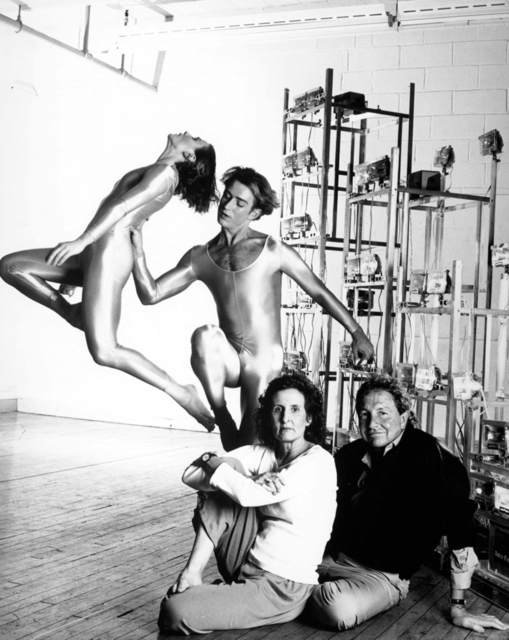
Jock Soto and Karole Armitage will dance onscreen and in person at New York Live Arts (photo courtesy AG!D)

ARMITAGE GONE! DANCE: A PANDEMIC NOTEBOOK
New York Live Arts
219 West 19th St.
March 16-19, $15-$35, 7:30
newyorklivearts.org
www.armitagegonedance.org

Armitage Gone! Dance will be at New York Live Arts this week with a program of world premieres that mix live performance with film, fashion, visual art, science, and more that promises to be a grand finale before the company is reimagined for the future. As a special treat, Karole Armitage, who founded AG!D in 1981, will take the stage for the first time since 1989.

“A Pandemic Notebook” begins with the diptych Beautiful Monster and Louis. The first part was inspired by Le streghe bruciata viva (The Witch Burned Alive), Luchino Visconti’s contribution to the 1967 omnibus Le streghe, with Silvana Mangano and Annie Girardot, and Roberto Rossellini’s 1966 television film La prise de pouvoir par Louix XIV (The Taking of Power by Louis XIV), along with references to former president Donald Trump and celebrity culture; the music is by Michael Gordon, Jean-Baptiste Lully, Thomas Adès, and David T. Little.

The second part combines two short films from Armitage’s “Under the Dancer” series, Head to Heel and Andy, made during the pandemic, with live performance, followed by Time/Times, an homage to slow cinema in which Armitage, currently an MIT Media Lab Directors Fellow, will dance with former New York City Ballet principal Jock Soto in front of footage taken in White Sand Dunes National Park, Valley of Fires lava fields, and Plaza Blanca in New Mexico and in the snow of Crested Butte, Colorado, set to Bach’s Chaconne.

The next piece, 6 Ft. Apart, debuted online last May in “WOMEN / CREATE! A Virtual Festival of Dance” and will now be performed in person; the work involves Alonso Guzman tracking dancers Sierra French and Cristian Laverde-Koenig using an iPhone attached to his baseball cap that triggers engineer Agnes Fury Cameron’s abstract percussive sounds.

The seventy-five-minute show concludes with Marc Jacobs, adapted from the fall 2021 runway show Armitage choreographed for the designer, who supplies the daring costumes for this performance, set to the Jim Pepper Remembrance Band and Gunther Schuller’s “Goin’ Down to Muskogee.”

The full company consists of Armitage, Guzman, Laverde-Koenig, French, Isaac Kerr, and Kali Marie Oliver, with lighting by Tsubasa Kamei and Clifton Taylor. It should be quite a farewell for the popular, cutting-edge company; it will be fascinating to see what Armitage does next.

ON SUGARLAND

Aleshea Harris’s On Sugarland takes place in a southern cul-de-sac amid wartime (photo by Joan Marcus)

ON SUGARLAND
New York Theatre Workshop
79 East Fourth St. between Second & Third Aves.
Tuesday – Sunday through March 20, $55-$75
www.nytw.org

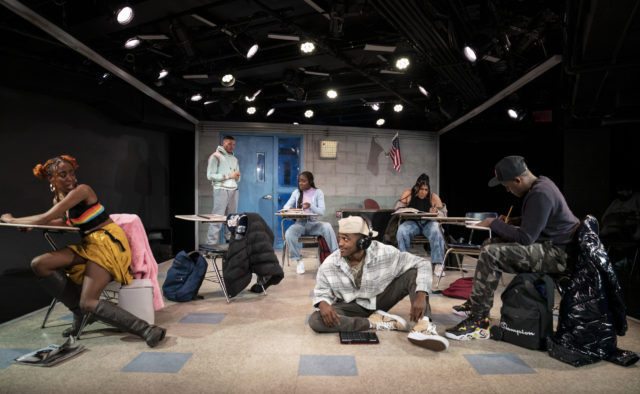
“We got to holler,” Staff Sergeant Saul Greenwood (Billy Eugene Jones) declares in Aleshea Harris’s electrifying On Sugarland, continuing at New York Theatre Workshop through March 20. He and the Sugarland cul-de-sac of mobile homes, a poor neighborhood trapped inside circular train tracks that promise to take them nowhere, holler in unison to mourn lost members of their community and to honor their ancestors, but the screams resound against generations of socioeconomic injustice and systemic racism emanating from the military industrial complex and its reliance on a fervent nationalism above all else.

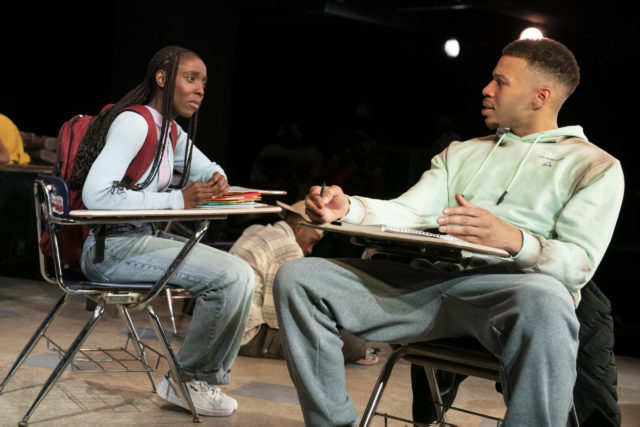
Brilliantly filtering Sophocles’s Philoctetes through a bit of Tennessee Williams, Harris tells the vivid, haunting story of the four-hundred-year war fought by Blacks in America for their humanity. The play opens as the people of Sugarland gather to holler for Sergeant Iola Marie Eagle Eye, who the army has finally declared Presumed Killed in Action after her body had gone missing for years. Her fourteen-year-old daughter, Sadie (Kiki Layne), hasn’t spoken in all that time, her voice as well as her mother taken from her, but the narrative is punctuated with her long, poignant monologues to the audience about the matriarchs of her family, generation by generation, back to her great-great-great-grandmother, a freed slave who carried messages to Union soldiers during the Civil War. Each of her stories ends with bloodshed.

Evelyn (Stephanie Berry) and Tisha (Lizan Mitchell) are elderly sisters who can’t stop squawking at each other. Evelyn is like Blanche DuBois, living in a fantasy world; she takes her time overdressing for Iola Marie’s funeral, hoping to attract a suitor. Tisha tends to an outdoor shrine where she collects items from the men, women, and children who have died, paying special attention to her late son’s belongings, which she talks to as if he were there. “It’s time. You’re gonna make us late,” Tisha complains. “The only ‘late’ a lady ever needs to worry about is when her monthly hasn’t shown itself. And since your basement is sealed shut, you good,” Evelyn responds. “When they send you to hell, Ima be in Heaven waiting,” Tisha says.

Saul leads the service in honor of Iola Marie, proclaiming, “We got to holler / They ain’t sent her body home / ’Cause there ain’t nothin left to send / The War has taken the flesh of our dear sister / but the soul is intact / And we are gathered here to reach into / the next world / the world that now holds Iola / We are gathered here to knock on that world’s door / with a singing and a praise / We are gathered here to holler so she can hear us from where she’s at and know that she was loved.” It’s a powerful memorial for all fallen Black people, not just one lost soldier.

Addis (Caleb Eberhardt) and his father, Saul (Billy Eugene Jones), face different kinds of battles in searing new play (photo by Joan Marcus)

But Evelyn is having none of it. “That War can kiss the black off my ass. Fuck that War. Fuck burying boxes. Fuck hollering,” she tells her sister. “I am not cursing the doing of things. I am cursing their necessity. I am cursing the conditions which have led to what have become our customs. Little girls burying boxes for their dead mothers. Our front yard looking like some kind of horrifying carnival graveyard. Calling it Sugarland don’t make it sweet.”

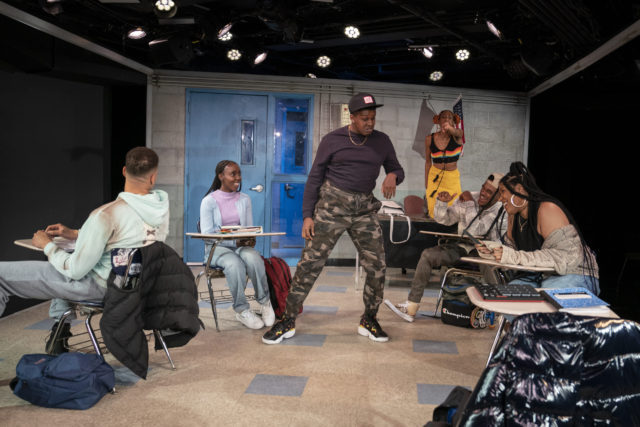
Saul’s seventeen-year-old son, Addis (Caleb Eberhardt), wants to be a warrior like his father; too young and addled for the military, he guards Sugarland as if he were a soldier. He’s in love with Iola Marie’s sister, Odella (Adeola Role), a woman his father’s age. He tells Sadie, “Uh huh Busy being a soldier if you must know I’m already in Junior Cadets Almost Cadet First Sergeant If The War come to this cul-de-sac Ima show out Gon be the last one standing Ima carry the flag and plant that mug on a hilltop They gon make a statue of ya boy Ima be a hero They gon call my name.” Addis regularly shaves his father with a straight razor and helps tend to Saul’s damaged, foul-smelling foot, which oozes blood. Addis wants to join the army, while Saul wants to return to duty, despite his mental and physical injuries.

Meanwhile, the Rowdy (Thomas Walter Booker, Xavier Scott Evans, Mister Fitzgerald, Josh Fulton, Charisma Glasper, Kai Heath, Shemar Yanick Jonas, and Mariyea), a group of eight male, female, and nonbinary teenagers, serve as the Greek chorus, wandering around on the periphery, parading through the space, blasting music, harassing Addis, and commenting on what they’re seeing and occasionally interacting with the others as the biggest holler of all is to come.

On Sugarland is a brilliant, Pulitzer-worthy play deserving of a Broadway transfer and a wide audience. Harris (Is God Is, What to Send Up When It Goes Down), a former spoken-word performer whose mother is a Trinidadian immigrant who spent twenty years in the army, captures the heart and soul of a community too long unheard and unseen. Sadie talks often in her monologues of how her female ancestors were invisible. “White men ain’t in the business of seeing little black girls / you know / we invisible,” she says. Saul says a similar thing about Iola Marie. Their hollers echo through the theater until you can feel it in your bones. Harris makes it clear that a reckoning is coming, so everyone better start opening their eyes and ears. “It was a goddamn beautiful massacre,” Sadie says of an ancestor’s act of vengeance.

Obie-winning director Whitney White (Our Dear Dead Drug Lord, Semblance), who previously collaborated with Harris on the ritualistic healing production What to Send Up When It Goes Down, maintains a furious pace, a relentless assault on the senses that is superbly choreographed by Raja Feather Kelly (Hurricane Diane, The House That Will Not Stand); there is nary a wasted word or movement during the play’s intense and passionate 160 minutes (with intermission).

Evelyn (Stephanie Berry) remembers the past as Sadie (Kiki Layne) listens intently (photo by Joan Marcus)

The play is set in what the German-born, Kentucky-raised Harris describes as “a time of war. yesterday, today, and, unfortunately, tomorrow.” Adam Rigg’s confining set tempts the characters with a potential freedom that seems to always be just out of reach. Qween Jean’s costumes run from elegant to street-savvy, while Mikaal Sulaiman’s sound design and his and Starr Busby’s original music pound and pulsate.

At several points, the recording of a bugle can be heard. The onstage characters stop what they’re doing and salute a nonexistent flag. Despite how this country has treated them and their ancestors over the last four centuries, they still believe in what it has to offer. “Iss all kinda massacres, ain’t it?” Sadie says after a bugle plays the anthem. “All kinds. They got all kinds.”