twi-ny recommended events

BIRTHDAY CANDLES

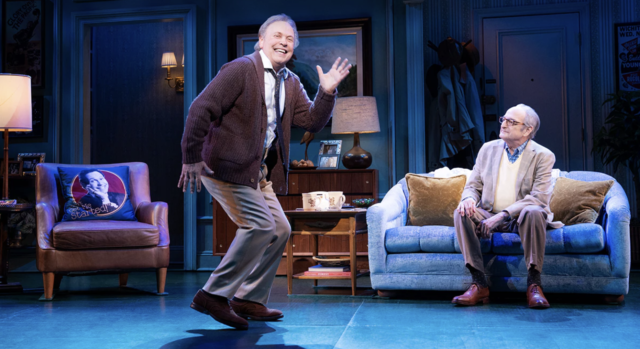
Ernestine (Debra Messing) lives a relatively simple life in Noah Haidle’s Birthday Candles (photo by Joan Marcus)

BIRTHDAY CANDLES
American Airlines Theatre
227 West 42nd St. between Broadway & Eighth Ave.
Tuesday – Sunday through May 29, $39-$250
212-719-1300
www.roundabouttheatre.org

“Have I wasted my life?” Ernestine (Debra Messing) asks her mother, Alice (Susannah Flood), at the beginning of Noah Haidle’s Birthday Candles, continuing through May 29 at the Roundabout’s American Airlines Theatre.

Haidle’s Broadway debut is a touching and bittersweet, if at times Hallmark-y, look at ninety years in the life of an average American woman in Grand Rapids, Michigan. The play is built around her annual preparation of her birthday cake, a recipe handed down from mother to daughter in their family. Each scene takes place in the same kitchen, which never changes. Ernestine wears essentially the same costume (by Toni-Leslie James) in every scene as she ages, the time shifts indicated only by a sharp chime that arrives in the middle of the action and contextual clues given by the dialogue and the outfits of the other characters, which range from her boyfriend and future husband, Matt (Tony nominee John Earl Jelks), to her numbers-obsessed neighbor, Kenneth (Enrico Colantoni), who has a serious crush on her, to a parade of children, their spouses, their children, etc. (Jelks, Crystal Finn, Susannah Flood, and Christopher Livingston play multiple roles, their character not always immediately apparent as the next generation arrives. I saw understudy Brandon J. Pierce stepping in for Livingston.)

Ernestine serves as a witness to birth and death, illness and infidelity, success and failure, devoid of any references to the outside world. Whereas Jack Crabb, portrayed by Dustin Hoffman in Arthur Penn’s 1970 epic revisionist Western Little Big Man, spends his 121-year life on the road, meeting famous people (General Custer, Wild Bill Hickok), encountering a diverse series of events (battles with Native Americans, saloon shootouts, getting married and operating a small store), and watching everything change around him, Ernestine lives in a self-contained bubble, with no inkling of what is happening in society at large; there are no references to politics, sports, entertainment, anything that can put us in a specific time and place, only what is occurring within the family at any given moment, and always on her birthday. Another signifier is Ernestine’s annual measurements penciled on a doorframe; she grows taller until she begins shrinking as an old woman. Birthday Candles also recalls Thornton Wilder’s 1931 The Long Christmas Dinner, a one-act play that covers ninety years of the Bayard clan without ever leaving the dining room.

The show opens as Ernestine is turning seventeen, filled with the excitement of all that life offers. “I am a rebel against the universe. I will wage war with the everyday. I am going to surprise God!” she announces to her mother, who is more concerned with teaching her daughter the basic but cherished recipe for the cake.

Ninety years pass by in ninety minutes in Birthday Candles (photo by Joan Marcus)

“Eggs, butter, sugar, salt. The humblest ingredients,” Alice tells Ernestine. “But when you turn back and look far enough, you see atoms left over from creation,” implying that the history of the family — perhaps of humanity itself — is embodied in the cake.

Ernestine responds, “Stardust. The machinery of the cosmos is all here, I get it. Will you help me with my audition?”

Ernestine is practicing for the lead in her high school’s gender-switching production of Queen Lear, signaling that Birthday Candles is going to be a matriarchal tale about mothers and children; the men play second fiddle. “Madam, do you know me?” Alice reads as Cordelia. Ernestine, as the queen, answers, “You are a spirit, I know. When did you die?” In King Lear, the elderly monarch starts losing his mind as he deals with his three daughters, the calculating Regan and Goneril and the youngest, Cordelia, the only one who truly loves him. By having Alice reading the part of Cordelia and Ernestine portraying Lear, Haidle is alerting us to the casting choices and plot that follow.

As time marches on, new characters enter and old characters depart, the future replacing the past. Jelks portrays Ernestine’s husband, Matt, and their son, Billy; Finn is Billy’s wife, Joan, and their daughter, Alex; and Flood is Ernestine’s mother, Ernestine’s daughter, Madeline, and Alex’s daughter, Ernie. Finn and Livingston also appear as a surprise couple. People discuss their jobs, their relationships, and their personal identities in a vacuum. At one point, Madeline tells her parents and brother, “I don’t have a definition anymore. There aren’t any. In me. Or in the world.”

The actors make only small adjustments as their characters age, except for Messing once she passes her real-life age of fifty-three. Her slow decline as she survives so many of the others is heartbreaking, but she’s not about to stop making that cake on her birthday, no matter how old she is or who is around to enjoy it with her.

Ernestine’s (Debra Messing) life flashes before our eyes in Noah Haidle’s Broadway debut (photo by Joan Marcus)

One who is always there with her is her pet goldfish, given to her by Kenneth when they were seventeen and named Atman, the Sanskrit word for an individual’s essence, or soul. Kenneth explains, “The Katha Upanishad is the first to use the concept of Atman as a beginning argument of achieving liberation from human suffering. I quote, and please forgive my basic translation. ‘Like fire spreads itself throughout the world and takes the shape of that which it burns, the internal Atman of all living beings, while remaining one fire, takes the form of what He enters and is at the same time outside all forms.’” He points out that goldfish have only three-second memories and “then the world begins anew.” That’s one way to forget the pain, although the pleasurable moments vanish as well; Ernestine’s life is filled with plenty of both.

Haidle (Vigils, Smokefall) has created an emotional, gripping tale that is haunted by the fear of death as it explores various concepts of love, between married couples, parents and children, siblings, owners and pets, and a devoted neighbor. Director Vivienne Benesch, who helmed the play’s world premiere at the Detroit Public in 2017, manages the time shifts with aplomb as characters come and go through several open doorways on Christine Jones’s welcoming kitchen set, over which hangs dozens of household objects — remnants of a long life — in addition to the phases of the moon, a reminder of time itself.

Emmy winner Messing (Will & Grace,Outside Mullingar) is enthralling as Ernestine, who could be any of us. The different paths her life takes, each twist and turn, lead to familiar small dramas that are fully relatable; as she ages, it is hard not to consider what your own future holds. I am not a crier, but I have to admit that I was wiping away tears in the final scenes, and I was not the only one.

Colantoni (The Distance from Here, Fear) is utterly charming in his Broadway debut as Kenneth, an oddball who spends more than half a century pining for Ernestine, a regular reminder of the things in life we want that are so close but can so often be just out of reach. The rest of the cast is excellent as well, with a memorable comic turn by Finn as Joan, who has no filter and talks to herself out loud.

At a 1974 press conference, Muhammad Ali said, “If a man looks at the world when he is fifty the same way he looked at it when he was twenty and it hasn’t changed, then he has wasted thirty years of his life.” Did Ernestine waste her life? It’s a question we all ask ourselves as our birthdays come and go.

TWO BY SYNGE: IN THE SHADOW OF THE GLEN / THE TINKER’S WEDDING

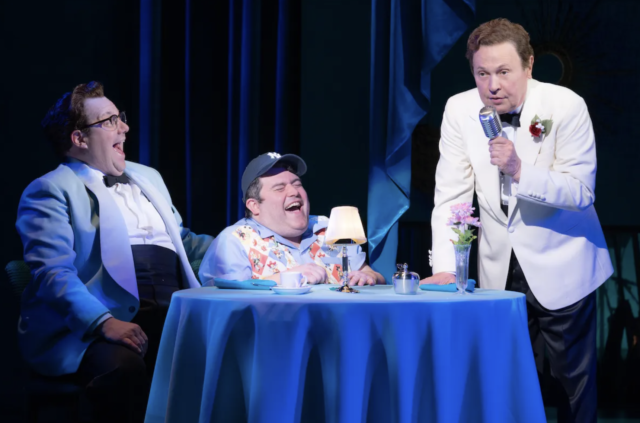
The Irish Rep’s Two by Synge features several musical interludes (photo by Carol Rosegg)

TWO BY SYNGE: IN THE SHADOW OF THE GLEN / THE TINKER’S WEDDING
Irish Repertory Theatre, W. Scott McLucas Studio Theatre
132 West 22nd St. between Sixth & Seventh Aves.
Wednesday – Sunday through May 22, $50
212-727-2737
irishrep.org

I am here to sing — pun intended — the praises of the great John Keating, currently starring in the theatrical twinbill Two by Synge: In the Shadow of the Glen & The Tinker’s Wedding at the Irish Rep. It’s a rave long in coming. If you don’t know the name, you must not have visited the Irish Rep much in the last quarter century, during which time the Tipperary native has appeared in more than a dozen productions (as well as numerous Shakespeare adaptations at TFANA).

Keating, a wiry fellow who stands six-foot-three with wildly curly hair and an immediately recognizable face, portrayed the fearful, deeply religious Shawn Keogh in John Millington Synge’s Playboy of the Western World at the Irish Rep in 2002; he is not the same John Keating who illustrated a 1927 edition of the work.

Directed by Irish Rep founding artistic director Charlotte Moore, Two by Synge consists of a pair of early short works about Irish peasantry, which the Dublin-born Synge based on stories he heard and saw, then wrote about at the urging of his friend and colleague W. B. Yeats. They take place in the company’s downstairs W. Scott McLucas Studio Theatre, a tiny, intimate black box where you can practically reach out and touch the actors — while getting the sensational opportunity to revel in Keating’s extraordinary talent.

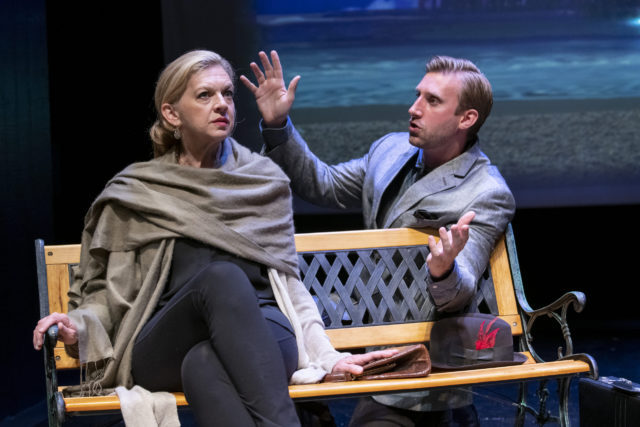
It begins with The Tinker’s Wedding, Synge’s bawdy tale of a poor couple, Sarah Casey (Jo Kinsella), the onetime Beauty of Ballinacree, and Michael Byrne (Keating), a tinker, who want to get married. Their relationship is more out of necessity than true love.

A couple of peasants want the local priest to marry them in The Tinker’s Wedding (photo by Carol Rosegg)

Sarah harasses Michael, arguing, “It’ll be small joy for yourself if you aren’t ready with my wedding ring. Is it near done this time, or what way is it at all?” He replies, “A poor way only, Sarah Casey, for it’s the divil’s job making a ring, and you’ll be having my hands destroyed in a short while the way I’ll not be able to make a tin can at all maybe at the dawn of day.” Sarah says, “If it’s the divil’s job, let you mind it, and leave your speeches that would choke a fool.” Michael retorts, “And it’s you’ll go talking of fools, Sarah Casey, when no man did ever hear a lying story even of your like unto this mortal day. You to be going beside me a great while, and rearing a lot of them, and then to be setting off with your talk of getting married, and your driving me to it, and I not asking it at all.”

Sarah tries to force the local priest (Sean Gormley) to perform the ceremony, but he is not about to do so without getting some form of payment, as Sarah and Michael are not church regulars and she does not live the life of a model Christian. “A holy pair, surely! Let you get out of my way,” the harried priest declares, attempting to leave them, but Sarah is adamant. Soon arriving is Michael’s mother, Mary (Terry Donnelly), a well-known drunk who has a way of ruining everything. She tells the priest, “Isn’t it a grand thing to see you sitting down, with no pride in you, and drinking a sup with the like of us, and we the poorest, wretched, starving creatures you’d see any place on the earth?” When the priest threatens again to not marry the couple, Sarah and Michael come up with a bizarre plan to ensure their union.

The Tinker’s Wedding — which Synge never got to see performed, as he died of Hodgkin’s lymphoma at the age of thirty-seven, more than seven months before its 1909 debut — is a bit too jumbled at first but eventually finds its legs. Daniel Geggatt’s set features stone walls, a fireplace, a small gate, and the facade of a house that resembles a huge Native American drum. Keating is a joy to watch, whether he is front and center or drifting off into the background, tinkering with the ring or a tin can. In full character, he follows the action with intricate gestures, from smiles and nods of agreement to frowns and head shakes. His eyes gape open in wonder and shudder in fear. While that might be what good acting is about, he takes it to another level, in the simplest moments as well as the turning points.

Keating (The Naturalists, The Winter’s Tale) is even better in the second play, the significantly superior In the Shadow of the Glen, the first of Synge’s works to be staged (in 1903). Keating plays a tramp in a shoddy coat (courtesy of costume designer David Toser) who has wandered in from a storm to seek temporary shelter in the home of Nora Burke (Kinsella) and her husband, Dan (Gormley), who is lying lifeless in the bed. (The set is essentially the same save for the “drum,” which has been rotated to reveal the bedroom.) She seems relatively nonplussed by the corpse, and the tramp is taken aback.

“It’s a queer look is on him for a man that’s dead,” the tramp points out. Nora responds, “He was always queer, stranger, and I suppose them that’s queer and they living men will be queer bodies after.” The tramp adds, “Isn’t it a great wonder you’re letting him lie there, and he is not tidied, or laid out itself?” She answers, “I was afeard, stranger, for he put a black curse on me this morning if I’d touch his body the time he’d die sudden, or let any one touch it except his sister only, and it’s ten miles away she lives in the big glen over the hill.” Tramp: “It’s a queer story he wouldn’t let his own wife touch him, and he dying quiet in his bed.” Nora: “I’m thinking many would be afeard, but I never knew what way I’d be afeard of beggar or bishop or any man of you at all. It’s other things than the like of you, stranger, would make a person afeard.”

The tropes of a classic ghost story turn on a fabulous plot twist and the arrival of the Burkes’ neighbor, young farmer Micheal Dara (Ciaran Bowling) — the character Keating played in his first professional performance in 1994 — in whom Nora sees a rescuer from her sudden predicament. “What way would I live and I an old woman if I didn’t marry a man with a bit of a farm, and cows on it, and sheep on the back hills?” she asks.

A tramp finds himself caught between a young farmer (Ciaran Bowling) and a woman (Jo Kinsella) mourning her husband in J. M. Synge’s In the Shadow of the Glen (photo by Carol Rosegg)

Keating (Autumn Royal, The O’Casey Cycle) is again magnificent in Glen, his body movements and shifting of his eyes utterly hypnotizing. He is an actor’s actor, making everyone around him better; watching him watching the other characters also offers another way into the play for the audience, no matter how successful it already is, and In the Shadow of the Glen is just that, a short but satisfying foray into the fear of death that hovers over Irish stories. Moore (The Streets of New York, The Playboy of the Western World) and lighting designer Michael O’Connor makes sure to never have Keating fade too far into the background as members of the rest of the fine cast take center stage.

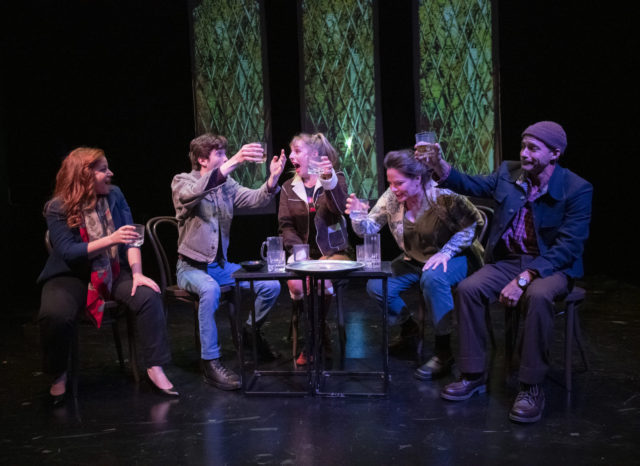
The two shows, which total seventy-five minutes, also include six songs, two by Synge, three traditionals, and one original by Gormley, “A Smile upon My Face,” which comes between the two comedies. Yes, despite such lines as “It’s a cruel and a wicked thing to be bred poor,” said by Sarah Casey, Two by Synge is very funny.

In his preface to The Tinker’s Wedding, the playwright explained, “The drama is made serious — in the French sense of the word — not by the degree in which it is taken up with problems that are serious in themselves, but by the degree in which it gives the nourishment, not very easy to define, on which our imaginations live. We should not go to the theatre as we go to a chemist’s, or a dram-shop, but as we go to a dinner, where the food we need is taken with pleasure and excitement. . . . Of the things which nourish the imagination humour is one of the most needful, and it is dangerous to limit or destroy it. Baudelaire calls laughter the greatest sign of the Satanic element in man; and where a country loses its humor, as some towns in Ireland are doing, there will be morbidity of mind, as Baudelaire’s mind was morbid. In the greater part of Ireland, however, the whole people, from the tinkers to the clergy, have still a life, and view of life, that are rich and genial and humorous. I do not think that these country people, who have so much humor themselves, will mind being laughed at without malice, as the people in every country have been laughed at in their own comedies.”

Whenever you’re not sure if something is funny or not, just follow Keating’s lead and he’ll make sure you’re on the right path.

GALERIE LELONG: DIALOGUES — ANDY GOLDSWORTHY WITH BRETT LITTMAN

Who: Andy Goldsworthy, Brett Littman
What: Live and livestreamed discussion about new Andy Goldsworthy exhibition, “Red Flags”
Where: Galerie Lelong, 528 West Twenty-Sixth St. between Tenth & Eleventh Aves., and Zoom
When: Saturday, April 23, free, 11:00 am (exhibition continues through May 7)
Why: In September 2020, Cheshire-born, Scotland-based environmental artist Andy Goldsworthy installed 109 hand-painted “Red Flags” in Rockefeller Center, replacing state flags and now featuring the color of the earth from each state. “Collectively I hope they will transcend borders,” he said when he started the project. “The closeness of one flagpole to another means that in certain winds the flags might overlap in a continuous flowing line. My hope is that these flags will be raised to mark a different kind of defense of the land. A work that talks of connection and not division.” He also compared the red earth to the blood running through our veins.

Installation view, Andy Goldsworthy, Red Flags, 2020 (courtesy Galerie Lelong & Co., New York)

The installation has now been reconfigured as an indoor exhibit at Galerie Lelong in Chelsea — whittled down to fifty flags and accompanied by two related videos — where it will be on view through May 7. Goldsworthy’s work with natural materials is well documented, in such films as Thomas Riedelsheimer’s 2001 Rivers and Tides and 2016 Leaning into the Wind as well as Goldsworthy’s permanent Garden of Stones at the Museum of Jewish Heritage. “Red Flags may not have been conceived as a response to recent events, but it is now bound up with the pandemic, lockdown, division, and unrest,” Goldsworthy added back in September 2020. “However, I hope that the flags will be received in the same spirit with which all the red earths were collected — as a gesture of solidarity and support.”

In conjunction with Earth Day, the gallery is hosting a free conversation with Goldsworthy and Isamu Noguchi Foundation and Garden Museum director Brett Littman, taking place in Chelsea and Zoom on April 23 at 11:00; admission is free in person and online. You can also check out a September 2020 virtual interview Goldsworthy did with the Brooklyn Rail about his flags project and career here.

BETTER THINGS: ADVANCE SCREENING / PAMELA ADLON IN CONVERSATION WITH ISAAC MIZRAHI

Who: Pamela Adlon, Isaac Mizrahi
What: Advance screening and discussion of Better Things (92Y Recanati-Kaplan Talks)
Where: 92nd St. Y, Buttenwieser Hall, 1395 Lexington Ave. between 91st & 92nd Sts., and online
When: Saturday, April 23, $25 in person, $20 online (talk only), 7:00
Why: One of the best virtual talks during the pandemic was 92Y’s conversation between Better Things cocreator, producer, director, cowriter, and star Pamela Adlon and actor and comedian Mario Cantone. Emmy winner Adlon, who plays Sam Fox, a single mother of three girls and a former child star still working in the business, and Cantone, who plays her agent, Mal Martone, cracked up each other, and the online audience, as they talked about the hit comedy and dealt with Zoom issues. After five seasons that began in 2016, Better Things is concluding its run on April 25 with its final, fifty-second episode, entitled, “We Are Not Alone.”

But on April 23 at 7:00, you can say goodbye to Sam; her daughters, Max (Mikey Madison), Frankie (Hannah Riley), and Duke (Olivia Edward); Sam’s expat mother, Phil (Celia Imrie); Rich (Diedrich Bader), Sam’s best friend; Mal; and other characters when the 92nd St. Y presents an advance, in-person-only screening of the finale, followed by a live discussion between Adlon (King of the Hill, Louie), herself a single mother of three daughters, and Brooklyn-born fashion designer and television presenter Isaac Mizrahi, that can also be accessed online. Better Things is an extraordinarily funny and moving show that is, first and foremost, about family, dealing with familiar issues in unique ways as three generations of women face the challenges of daily existence with charm and humor. If you haven’t been watching, start bingeing now.

JANE LEE HOOKER: ROLLIN’ RECORD RELEASE PARTY

Who: Jane Lee Hooker, Tom Clark and the High Action Boys
What: Record release party
Where: Hill Country, 30 West Twenty-Sixth St. between Fifth & Sixth Aves.
When: Friday, April 22, free with RSVP, 8:00
Why: At they show in the fun video for “Drive” from their brand-new album, Rollin’, fab New York blues rockers Jane Lee Hooker will not be arriving at Hill Country for their record release party in a snazzy Mercedes convertible. But on April 22, singer Dana Danger Athens, guitarists Tracy Hightop and Tina T-Bone Gorin, bassist Mary Z, and drummer Lightnin’ Ron Salvo will still find their way to the barbecue joint for some tasty tunes from the band, which formed in 2015 and has previously released Spiritus and No B! The new record, made during the pandemic, features such songs as “Drive,” “Jericho,” and “All Good Things,” in which Athens promises “all good things comin’ your way.”

Athens explained in a statement, “Somehow, amidst the chaos of a global pandemic, we were able to write and record what I feel is our best work as a band yet.” Gorin added, “Astounding that some things, like writing music with each other, will always be a beautiful and safe world, even during a worldwide health disaster like Covid-19.” And Hightop said, “We were really able to take our time and do these amazing songs justice. This album is just next level in so many respects. I can’t wait to get out there and play these songs in front of an audience!” Opening up for JLH is longtime city faves Tom Clark and the High Action Boys (Cross-Eyed and Bow-Legged). Expect “all good things comin’ your way.”

GILLIAN WEARING: WEARING MASKS / DIANE ARBUS BY GILLIAN WEARING

Gillian Wearing, Self-Portrait, framed chromogenic print, 2000 (collection of Sherry and Joel Mallin, New York)

GILLIAN WEARING: WEARING MASKS
Solomon R. Guggenheim Museum
1071 Fifth Ave. at 89th St.
Panel discussion: Thursday, April 21, free with RSVP, 2:00
Thursday – Monday through June 13, $18-$25, 11:00 am – 6:00 pm
212-423-3500
www.guggenheim.org

In her five-minute 2018 short film Wearing, Gillian, British artist Gillian Wearing repeats, “I’m Gillian Wearing.”

But who is Gillian Wearing? In the revealing exhibition “Gillian Wearing: Wearing Masks,” continuing at the Guggenheim through June 13, the fifty-eight-year-old Turner Prize winner explores the idea of “Gillian Wearing” through film, sculpture, photography, painting, and installation, putting viewers in the position of asking themselves who they are as well.

Part of the Young British Artists movement of the late 1980s and early ’90s, Wearing focuses on self-portraiture very differently from such near-contemporaries as Cindy Sherman, who disguises herself as real and fictional characters in cinematic and art-historical tableaux as she explores gender and identity, and Lucas Samaras, whose vast output includes an endless array of self-imagery in multiple formats.

Wearing often uses masks — the show was conceived well before the Covid-19 pandemic — on herself and others to challenge who we are and how we are seen. “I do not like to be on this side of the camera. I’d much rather be on the other side of the camera,” she says in Wearing, Gillian. “Watching me being me alienates me from me, and I don’t recognize myself.” In the film, performers, and Wearing herself, wear AI digital masks of her face. “It’s really about putting myself on the line, and that comes from the risk of being judged and laying myself bare to people’s judgments, but . . . such is life.” Those kinds of feelings are not unique to Wearing, particularly in the social media age, when so many people can engage in sophisticated self-display, creating whatever image they want and hiding behind it for myriad reasons.

Gillian Wearing, 60 Minutes Silence, color video projection, with sound, 1996 (Arts Council Collection, Southbank Centre, London)

Spread across four galleries, the exhibition welcomes you into Wearing’s intriguing world, where nothing is quite what it seems. For Signs that Say What You Want Them to Say and Not Signs that Say What Someone Else Wants You to Say, Wearing asked strangers on London streets to write down something about themselves on sheets of paper and then photographed them holding up the signs, which now evoke early Facebook posts. “Everything is connected in life,” one man writes. “The point is to know it and to understand it.”

At first, 60 Minutes Silence might appear to be a photograph of twenty-six uniformed police officers arranged in three rows, but it is actually an hourlong video in which the cops try to maintain their position, moving as little as possible. It’s a kind of reversal, since part of a police officer’s job is to keep a close eye on the public, but now we’re watching them. In addition, seeing the 1996 piece in 2022 makes us think not only of the raging controversy over police brutality but also of diversity: We also can’t help but notice that there are only five women and two people of color. In Confess All on Video. Don’t Worry, You Will Be in Disguise. Intrigued? Call Gillian . . . , people in masks and wigs share extremely personal stories on a split screen in a large booth, again presaging social media.

But Wearing most often is looking at herself. Me and My Ideal Self features photographs of Wearing placed under glass in a custom frame; on the front panel is an elongated photo of Wearing standing in heels on a wooden box, as if not wanting anyone to see what’s inside. She takes self-portraits of herself as her grandparents, her brother, and other family members, of herself at three, seventeen, and twenty-seven (portraits from fifty to seventy appear on the wallpaper), and of herself as seminal photographers Andy Warhol, Diane Arbus, Robert Mapplethorpe, Weegee, Claude Cahun, Henry Fox Talbot, and August Sander, the photographer who set out to document German society in People of the Twentieth Century.

There are also video portraits, a collection of masks, a pair of busts of Wearing nearly kissing each other, a prosthetic Wearing head dangling on an immense charm bracelet with other body parts, and Polaroids she took of herself in the 1990s, sans masks. Throughout it all, her eyes, or the eyes of others in masks of her face, are always visible, looking right at the viewer, a performative take on personal identity, memory, and connection.

On April 21 at 2:00, the Guggenheim will host the free, livestreamed panel discussion “Wearing Masks: The Performance of Identity in Contemporary Art,” with senior curator Jennifer Blessing, photographer and musician Farah Al Qasimi, visual artist Malik Gaines, and multimedia artist Colette Lumiere, moderated by Dr. Ksenia M. Soboleva.

Given the coronavirus crisis and the ongoing debate over mask mandates as variants keep emerging, Wearing has revisited her 2013 Me as Mask, now taking that wax mask of her face, placing a black-bordered blue mask over it, and having it held up on a stick by a disembodied hand, hollow eye holes staring back at us.

“We all wear masks. We’re all actors,” she says in Wearing, Gillian. “Do you feel that you know me a bit now?” The answer is a rousing yes and no.

DIANE ARBUS
Scholars’ Gate, Doris C. Freedman Plaza
Central Park entrance, 60th St. & Fifth Ave.
Through August 14, free
www.publicartfund.org
online slideshow

In conjunction with the Guggenheim retrospective, Gillian Wearing has gone one step beyond her 2008 self-portrait as photographer Diane Arbus, using the existing photo of Arbus that inspired her picture and transforming it into a life-size statue for the Public Art Fund. The work stands at the Scholars’ Gate entrance to Central Park, in Doris C. Freedman Plaza, on the pavement, not a plinth; she is one of us. The photo of Arbus is part of what Wearing refers to as her “spiritual family,” comprising artists that she has photographed herself in digital masks. As in the photo, the statue depicts Arbus with her medium-format Rolleiflex hanging from around her neck, looking for subjects; she is wearing a dark jacket and white shoes. “A photograph is a secret about a secret. The more it tells you the less you know,” Arbus said in 1971. Wearing now asks what kind of secrets a statue of a photo might hold.

In “An Interview with Myself,” Wearing’s catalog contribution to the Guggenheim show — which includes a thirteen-inch model of the statue and the Arbus quote “If you scrutinize reality closely enough, if in some way you really, really get to it, it becomes fantastic” — she writes about portraying herself as others, “The whole process takes several months, and I liken it to how an actor gets into character. By the time I am in full costume, I lose my actual self a bit. It can be disappointing when the mask comes off and it’s my face again.”

In this case, the mask comes off and it is Arbus, a New York City native who specialized in capturing the daily reality of ordinary folk as well as sideshow performers, strippers, female impersonators, freaks, and others on the fringe. “For me the subject of the picture is always more important than the picture. And more complicated,” Arbus said. That statement relates to Wearing’s work, and specifically her portrayals of Arbus, in beautifully complex ways.

THEATER OF WAR: THE NURSE ANTIGONE

Who: Tracie Thoms, Taylor Schilling, John Turturro, Ato Blankson-Wood, Keith David, Craig Manbauman, Sandy Cayo, Elizabeth Hazlewood, Jumaane Williams, Bryan Doerries
What: Dramatic reading and community discussion
Where: Theater of War Zoom
When: Thursday, April 21, free with RSVP, 6:00
Why: Theater of War Productions teams up with the Greater NYC Black Nurses Association for its latest live, interactive presentation, exploring caregiving and death. On April 21 at 6:00, an all-star cast will deliver a dramatic reading of Sophocles’s Antigone, about one of the daughters of Oedipus and Jocasta who is determined to give a proper burial to her brother Polynices, who has been branded a traitor, his body left to rot.

The fifth-century play will be performed by actors Tracie Thoms, Taylor Schilling, John Turturro, Ato Blankson-Wood, and Keith David, joined by frontline nurses Craig Manbauman, Sandy Cayo, and Elizabeth Hazlewood and New York City public advocate Jumaane Williams; the discussion, which explores the themes of the play as they relate today to the coronavirus crisis and other health issues, will be facilitated by Theater of War artistic director Bryan Doerries and held in conjunction with the Johns Hopkins School of Nursing, the Johns Hopkins Berman Institute of Bioethics, and the Resilient Nurses Initiative — Maryland.