twi-ny recommended events

FIDDLER’S JOURNEY TO THE BIG SCREEN

Star Chaim Topol and director-producer Norman Jewison kid around on the set of Fiddler on the Roof

FIDDLER’S JOURNEY TO THE BIG SCREEN (Daniel Raim, 2022)
Angelika Film Center
18 West Houston St.
Opens Friday, April 29
www.angelikafilmcenter.com
zeitgeistfilms.com

Daniel Raim takes viewers behind the scenes of the making of one of the most beloved musicals of all time in Fiddler’s Journey to the Big Screen, opening April 29 at the Angelika. Raim follows the development of the 1964 Broadway smash Fiddler on the Roof, which ran for 3,242 performances and won nine of the ten Tonys it was nominated for, into the classic 1971 film that was up for eight Oscars and won three.

The documentary is anchored by a series of talks with Fiddler’s director and producer, Canadian filmmaker Norman Jewison, who had previously made The Cincinnati Kid, In the Heat of the Night, and The Russians Are Coming, the Russians Are Coming and would go on to direct and produce Jesus Christ Superstar, A Soldier’s Story, and Mooonstruck. One of the first things we learn about Jewison is that he isn’t Jewish.

Recalling the initial meeting he had with United Artists executives, Jewison recalls, “[Studio head] Arthur Krim looked at me and he says, ‘What would you say if we were to say we want you to produce and direct Fiddler on the Roof?’ And my heart came up into my mouth and I thought, Oh my G-d. And I looked over, waited, and they waited, and they all kind of leaned forward. They thought, What is he waiting for? And then I said, ‘What would you say if I told you I’m a goy?’” He got the job because, as Krim explained, “We want a film for everybody.”

Documentary goes behind the scenes of the making of Fiddler on the Roof

Raim incorporates old and/or new interviews with vibrant lyricist Sheldon Harnick, who turns ninety-eight on April 30 (the score was composed by Jerry Bock, who passed away in 2010); musical director and conductor John Williams, who is featured extensively; production designer Robert F. Boyle, who was Raim’s professor at AFI; cinematographer Oswald Morris; American film critic Kenneth Turan; and Israeli star Chaim Topol, who nabbed the role of Tevye from Zero Mostel, who played the anguished, deeply religious father on Broadway. The film is worth seeing just for the lovely interviews with the three actresses who portrayed the three oldest daughters, none of whom marry the men their parents prefer: Rosalind Harris (Tzeitel), Michele Marsh (Hodel), and Neva Small (Chava). “What a gift I was given,” Marsh, nearly in tears, remembers.

Discussing his approach to the cross-cultural nature of the story, which was based on the 1894 Yiddish tales of Tevye the dairyman by Sholem Aleichem, Jewison points out, “Themes of family is universal; everybody has a family — good or bad, right or wrong, we all have a family, and we all have our little problems. But we all end up sitting around the table. And I thought, this is so common, this is something people can understand. They can understand a family. They can understand Golde. They can understand Tevye; they can understand his problems with life and his relationship to G-d. I think all of these things, all put together, make the story of Fiddler on the Roof so compelling.”

More than a dozen years in the making, Fiddler’s Journey can be a bit scattershot and is supplemented with occasional narration by Jeff Goldblum that feels like filler, consisting primarily of excerpts from Jewison’s This Terrible Business Has Been Good to Me, Alisa Solomon’s Wonder of Wonders: A Cultural History of Fiddler on the Roof, and Morris’s Huston, We Have a Problem: A Kaleidoscope of Filmmaking Memories. Unfortuntely, these distract from the main narrative, which is packed with fabulous details about everything from the construction of the synagogue, Frank Sinatra’s desire to play Tevye, and the stocking Boyle placed over the lens of the camera to the influence of Marc Chagall’s paintings, Harris understudying Bette Midler onstage, and the involvement of Isaac Stern.

The wealth of material includes archival stills and film footage, Mentor Huebner’s storyboards, and photos by Roman Vishniac that inspired the look of the movie, which was shot in Lekenik in what was then Yugoslavia. There are also in-depth looks at such treasured songs as “Matchmaker, Matchmaker,” “If I Were a Rich Man,” “Sunrise, Sunset,” and “Do You Love Me?”

The Fiddler on the Roof movie might be fifty years old now, but its impact is as powerful and, sadly, as relevant as ever. “One of the things that Fiddler is about: Nothing is permanent,” Turan says. Long before the Russian invasion of Ukraine — Aleichem was born and raised in Kyiv — the show (most recently revived in Yiddish by the National Yiddish Theatre Folksbiene at the Museum of Jewish Heritage) and the film captured the pain of refugees forced to leave their home. Raim’s (Harold and Lillian: A Hollywood Love Story, The Man on Lincoln’s Nose about Boyle) documentary was completed prior to the invasion, but it’s impossible to watch it without thinking about all the Anatevkas we see on the news every day, in Ukraine and around the world.

(Raim will be at the Angelika on April 29 and 30 for Q&As following the 7:25 screenings, joined by Small and Harris.)

THE YES MEN CLOSING RECEPTION / CATALOG LAUNCH

Gilda, Dow’s Golden Skeleton, is part of Yes Men retrospective at carriage trade (photo by twi-ny/mdr)

Who: The Yes Men
What: Exhibition closing reception and catalog launch
Where: carriage trade, 277 Grand St.
When: Friday, April 29, free, 6:00
Why: For a quarter-century, the Yes Men — Jacques Servin and Igor Vamos (or Andy Bichlbaum and Mike Bonanno) — have been confronting corporate greed and environmental neglect through “identity-correcting” hijinks in which they portray fake entrepreneurs and spokespeople at actual press conferences, conventions, and television news programs. They build realistic sham websites and use forged IDs to gain entrance to locations they have no business being at as they take on George W. Bush, Dow Chemical, the World Trade Organization, ExxonMobil, the New York Times and the New York Post, HUD in New Orleans, the US Chamber of Commerce, Shell Oil, VW, and, most recently, the United Nations COP26 summit. They pull off the pranks with ingenuity, bold daring, and a wild sense of humor, as evidenced by their hysterical “SurvivaBall,” which is on view at carriage trade’s small but terrific Yes Men retrospective.

The show, which has been extended several times because of popular demand, features Dow’s Golden Skeleton, named Gilda, a gold skeleton wearing a beauty contest sash that declares her an “acceptable risk”; a wall of fake Chevron street ads, riffing on the company’s “We Agree” campaign, making such claims as “I can see sludge & dead birds from my window” with a photo of Sarah Palin, “I’m living like there’s no tomorrow because there isn’t one” with a photo of Don Draper from Mad Men, “We lie and we don’t care — we love money — fuck the world!” with a photo of Jim Carrey from Liar Liar, and “To prove us likes you us will smash your planet” with a picture of Bizarro Superman; a vitrine of ExxonMobil Vivoleum phallus candles made from the skin of the “late” climate change victim Reggie Watts; and copies of a fake New York Times edition that proclaims, “Iraq War Ends,” “Maximum Wage Law Succeeds,” and “Ex-Secretary Apologizes for W.M.D. Scare,” which you can take home and read to your heart’s delight. There is also a case of newspaper and magazine articles and legal cease and desist orders sent to the Yes Men, a collection of fake IDs they’ve used, a pictorial history of the Golden Phallus stunt, and a room where twenty of their short and full-length films are on continuous rotation, from 1996’s Bringing IT to YOU! to 2021’s “Total Disaster” excerpt from The Fixers.

On April 29 at 6:00, carriage trade will be hosting the closing reception of the exhibition, along with the launch of the seventy-two-page catalog ($25; $20 at the reception). There’s no telling who might be there and in what capacity, so be ready for anything. (For more on the show, check out Montez Press Radio’s interview with Jacques Servin and carriage trade’s Peter Scott here.)

HARKNESS MAIN STAGE SERIES: AMOC’S WITH CARE

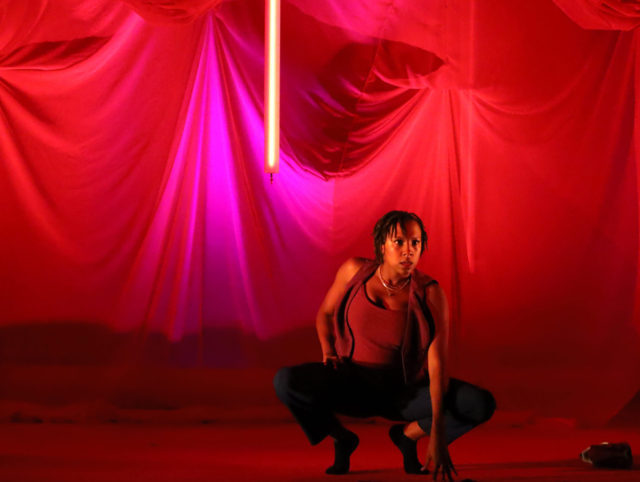
AMOC’s With Care comes to the 92nd St. Y this week (photo by Natalia Perez)

Who: Bobbi Jene Smith, Or Schraiber, Keir GoGwilt, Miranda Cuckson
What: New York City premiere of work by AMOC (American Modern Opera Company)
Where: Kaufmann Concert Hall, 92nd St. Y Harkness Dance Center, 1395 Lexington Ave. at Ninety-Second St., and online
When: In person Thursday, April 28, $30, 8:00; online April 29, noon, to May 1, midnight, $15
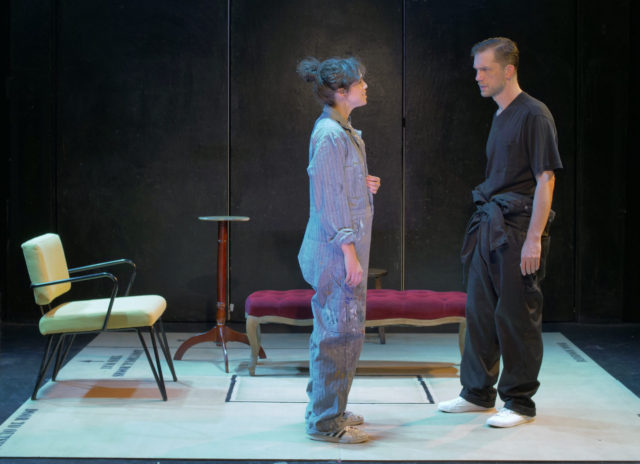
Why: In November 2018, married former Batsheva dancers Bobbi Jene Smith and Or Schraiber debuted With Care at ODC Theater in San Francisco, a co-commission with AMOC (American Modern Opera Company). The piece, which explores caregiving, carelessness, and loss — as perceived prior to the pandemic, when those issues took center stage — was created by Smith in collaboration with violinist Keir GoGwilt; the latter performs with violinist Miranda Cuckson as current L.A. Dance Project artists-in-residence Smith and Schraiber, portraying a caregiver and a wounded spirit, move around them.

Directed by Smith and featuring music by AMOC cofounder Matthew Aucoin, the work includes chairs, small wooden slats, and sand with dance, music, and spoken word that should take on new meaning in the wake of the Covid-19 crisis. “The original impetus for With Care came out of the last section of my previous work with Keir, A Study on Effort,” Smith said in a statement. “This piece consists of seven efforts, the last of which is the effort of taking care. We thought to expand this study of emotional and physical labor into a theatrical context, investigating the dynamics of caregiving and taking between four characters. Adding Or and Miranda opened a world in which the dynamics of care spiral from empathy to apathy. The more our characters attempt to break free from this cycle, the more they become lost in the maze of their commitments to each other. Yet ultimately the only solace they find is in each other. Never stop caring.”

With Care will be performed live at the 92nd St. Y’s Kaufmann Concert Hall on April 28 at 8:00; a recording will be available online from April 29 at noon to May 1 at midnight. For more on Smith and Schraiber, check out Boaz Yakin’s 2019 film, Aviva, and Elvira Lind’s 2017 documentary, Bobbi Jene. The Harkness Main Stage Series continues in May with the Future Dance Festival and in June with Jonathan Fredrickson of Tanztheater Wuppertal.

CREDO: THE DESSOFF CHOIRS PERFORMS MARGARET BONDS

The Dessoff Choirs presents a cantata by Margaret Bonds made in collaboration with Langston Hughes and inspired by the words of W E B. Du Bois

Who: The Dessoff Choirs
What: New York premieres of cantatas by Margaret Bonds
Where: Church of the Heavenly Rest, 1085 Fifth Ave. at Ninetieth St.
When: Thursday, April 28, $20-$40, 6:45 talk, 7:30 concert
Why: “I believe in God who made of one blood all races that dwell.” So begins W. E. B. Du Bois’s 1904 prose poem Credo, which served as inspiration for African American composer, pianist, teacher, and Chicago native Margaret Bonds’s piano/vocal score that is part of the Dessoff Choirs’ presentation of a pair of New York premieres of cantatas by Bonds, taking place April 28 at the Church of the Heavenly Rest. The company, which was founded in 1924 by Margarete Dessoff, previously released the recording The Ballad of the Brown King & Selected Songs, centered around Bonds’s 1954 collaboration with Langston Hughes about Balthazar, one of the three kings who visited the baby Jesus. At the Heavenly Rest, the Dessoff Choirs, joined by a full orchestra, Grammy-winning bass-baritone Dashon Burton, soprano soloist Janinah Burnett, and the Carter Legacy Singers, will perform I Believe: Credo and Simon Bore the Cross, the latter also a collaboration with Hughes.

“Dessoff is dedicated to performing rarely heard choral masterpieces,” Dessoff music director Malcolm J. Merriweather said in a statement. “We are thrilled to cast a spotlight on Margaret Bonds’s neglected but important contribution to the American music canon. She is a forgotten voice for civil rights that must be remembered, appreciated, and cherished. It seems the time has come for Bonds’s voice to be heard.” The program begins with a preconcert talk at 6:45, followed at 7:30 by Dr. Rollo Dilworth’s seven-movement choral symphony version of Credo and Bonds’s Easter cantata, about Simon of Cyrene, who carried Jesus’ cross; the work was found in a dumpster at a book fair, along with other scores of hers.

I LOVE THIS POEM: AN ONLINE READING

An all-star cast celebrates the power of poetry in online benefit for Literacy Partners

Who: Common, Julianne Moore, Liev Scheiber, Danai Gurira, Ethan Hawke, John Leguizamo, Tayari Jones, Cleo Wade, Kiese Laymon, Tommy Orange, Dinaw Mengestu, Kevin Kline, John Lithgow, Megha Majumdar, Zibby Owens, Mira Jacob, more
What: Online poetry reading benefiting Literacy Partners
Where: Literacy Partners online
When: Thursday, April 28, free with RSVP (donations accepted), 8:00
Why: On April 28 at 8:00, Literacy Partners will stream an encore presentation of “I Love This Poem: An Online Reading,” consisting of short works read by such actors as Common, Julianne Moore, Liev Scheiber, Danai Gurira, Ethan Hawke, John Leguizamo, Kevin Kline, and John Lithgow, hosted by Zibby Owens and Mira Jacob. Part of the organization’s literary and social justice series, the event, which was held on May 20, 2021, also features favorite poems read by two students, Angie and Monica. “We present this public reading in celebration of the power of poetry to heal, connect, and inspire us to advocate for a more just and equitable world,” Literacy Partners explains.

The evening includes poems by Fion Lim, Langston Hughes, Natalie Diaz, Billy Collins, Rabindranath Tagore, Lucille Clifton, John Keats, Alice Walker, William Shakespeare, Kim Addonizio, Pablo Neruda, Adrienne Rich, Rodolfo Gonzalez, and Maya Angelou. Literacy Partners was founded in 1973 to “emphasize support for individuals excluded from education because of racial or ethnic segregation and discrimination, economic challenges, sexism, or immigration status.”

DU YUN’S A COCKROACH’S TARANTELLA and ZOLLE

Who: Du Yun, International Contemporary Ensemble, Satomi Matsuzaki
What: New stagings of Du Yun’s A Cockroach’s Tarantella and Zolle
Where: NYU Skirball, 566 La Guardia Pl.
When: Friday, April 29, and Saturday, April 30, $35, 7:30
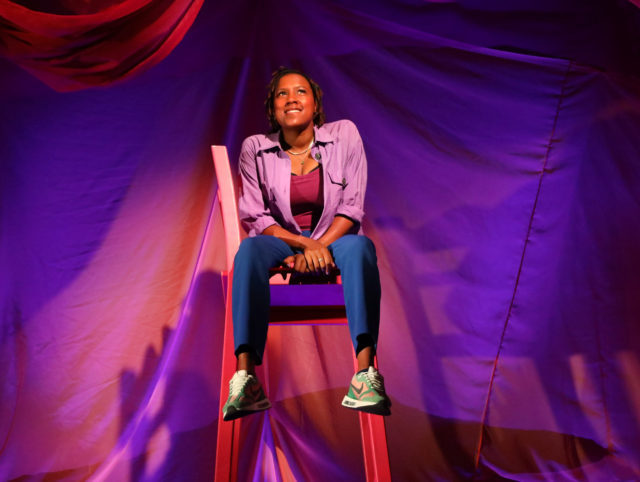
Why: Shanghai-born, NYC-based composer, performer, Grammy nominee, Pulitzer Prize winner, Guggenheim fellow, and advocator Du Yun is teaming up with the International Contemporary Ensemble and Deerhoof singer Satomi Matsuzaki, in her operatic debut, for new stagings of two earlier works dealing with issues of home and migration, memory and reality. A founding member of ICE, Du Yun will present 2010’s A Cockroach’s Tarantella and 2005’s Zolle, both reconfigured for NYU Skirball; the former features Matsuzaki and Du Yun, the composer, librettist, and sound designer, as the narrators, with violinists Josh Modney and Pauline Harris, violist Hannah Levinson, and cellist Mariel Roberts, while in the latter Du Yun is the Wander Woman Ghost, Matsuzaki is the Same Wander Woman Ghost, assistant director eddy kwon is the Land-Watcher, and Ziad Nehme is the recorded tenor Land-Watcher, with Alice Teyssier on flute, Ryan Muncy on saxophone, Nathan Davis on percussion, Modney on violin, Levinson on viola, and Roberts on cello. The direction, costumes, and video are by Roscha A. Säidow, with lighting by Nicholas Houfek; Kamna Gupta conducts.

Zolle “was scored for the female voice and a narration — two voices of the same character which both embody who she is,” Du Yun, who was an international student when she wrote the work, said in a statement. “When I’m creating, it feels that the ideas and emotions are very heightened but then the words fail at that total expression. A character that has both narration and singing embodies what I think most immigrants are experiencing — ‘How can you manifest these complex emotional subtleties with both entities, with words and with music?’ . . . This piece is about belonging and also questioning about belonging. That was what propelled me to write this story and it really holds a very dear place in my heart.” Kicking off ICE’s twentieth anniversary season, the shows will lead to “Sound Is an Opening,” a series of community events curated by kwon.

HIT THE ROAD

Panah Panahi’s Hit the Road tells the story of a clandestine family journey

HIT THE ROAD (Panah Panahi, 2021)
Film Forum
209 West Houston St.
Opened Friday, April 22
212-727-8110
filmforum.org

Panah Panahi’s debut feature, Hit the Road, is a gorgeously told tale about a family’s secret journey across the vast hinterlands of Iran. Writer-director Panahi lets the details filter out in dribs and drabs, like air whistling through a barely opened window on their drive down deserted paths through brown and gray mountainous, past arid landscapes toward lush green vistas with flowing rivers. Every shot is magisterial in scope, from the confines of their crowded car to the seemingly endless countryside that threatens danger as much as it offers freedom.

Fear hovers over the family as their trip continues, as they worry about being followed or that they can be discovered through a forbidden smartphone. Names are seldom used, except for their ailing rescue dog, Jessy; all the other characters are relatively anonymous, as if our knowing too much about them would increase the threat level. The father, Khosro (Hassan Majnooni), sits in the back, his itchy, broken left leg in a long cast; his ridiculously adorable and extremely smart six-year-old boy (Rayan Sarlak) is almost always by his side or on top of him, chattering away, understanding more about the world than six-year-old boys should. In the front, the concerned mother (Pantea Panahiha) anguishes over their every move while their grown son (Amin Simiar) drives on in virtual silence. They cheerily sing to old Iranian pop tunes on the radio while avoiding mentioning the specifics of their odyssey as they get closer to their destination.

“I think I’m losing it. What next?” the mother tells her husband, asking, “Do you ever think about the future?” He replies, “This is my future.”

They make several stops on the way, which cinematographer Amin Jafari often photographs from a far distance, with little or no camera movement, as if a landscape painting with people in the background has come to life. A handful of scenes last between three and six minutes without any cuts, especially later in the film, lending it a feeling of reality that transcends mere artifice. (The seamless editing is by Ashkan Mehri and Amir Etminan.) A long talk between the father and the older son is beautifully touching, as is a fantastical moment between Khosro and the younger child that evokes a previous mention of Stanley Kubrick’s 2001: A Space Odyssey. The temporary break from the tense reality was signaled from the very beginning, when the boy touches piano keys drawn on his father’s cast and we can hear the music, which also introduces us to Payman Yazdanian’s lovely, evocative score.

Beautiful landscapes appear throughout Panah Panahi’s Hit the Road

Panahi is the son of Iranian auteur Jafar Panahi (Offside This Is Not a Film), who apprenticed under Iranian master Abbas Kiarostami (Close-Up, Taste of Cherry), both of whom have made films that take place primarily in cars, including his father’s Taxi and 3 Faces, on which Panah served as coeditor with Mastaneh Mohajer, and Kiarostami’s Ten. But with Hit the Road, which Panah produced with Mohajer, the younger Panahi finds his own path, balancing high comedy with the hard choices his characters have to make, taking viewers on a memorable cinematic adventure that doesn’t have to spell everything out to hold us firmly in its poetic grasp.