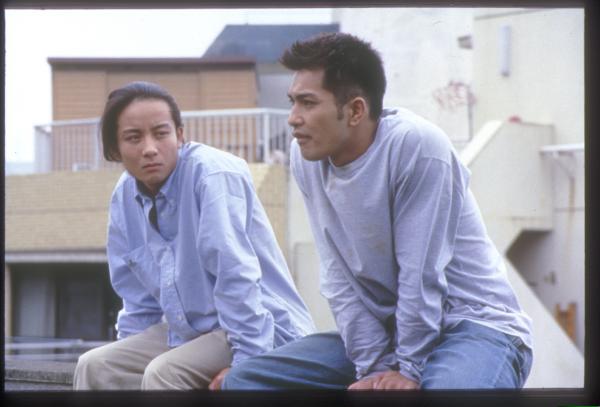
Brothers Shun (Michisuke Kashiwaya) and Ryuchi (Kazuki Kitamura) discuss finding a better life in Takashi Miike’s LEY LINES
13 FROM TAKASHI MIIKE: LEY LINES (NIHON KURO SHAKAI) (Takashi Miike, 1999)
Film Society of Lincoln Center
Walter Reade Theater
165 West 65th St.
Friday, March 18, 1:00, and Sunday, March 20, 6:45
Series runs March 16-20
212-875-5610
www.filmlinc.com
www.subwaycinema.com
 Takashi Miike complete his thematic Black Society Trilogy with one of his best crime dramas, 1999’s Ley Lines. Following 1995’s Shinjuku Triad Society: Chinese Mafia War and 1997’s Rainy Dog, the third film focuses on Godardian-like ennui of disenchanted youth as Ryuchi (Kazuki Kitamura), his younger brother, Shun (Michisuke Kashiwaya), and their friend Tan (Tomorowo Taguchi), Japanese children of Chinese immigrants, leave their rural home to find a more exciting life in Shinjuku, and they get their wish pretty quickly, immediately getting hustled by tough-talking prostitute Anita (Dan Li). To make money, they start selling toluene on the street and end up on mob boss Wong’s (Naoto Takanaka) bad side, which is never a good idea. Ley Lines is beautifully shot by Naosuke Imaizumi, with intense colors and dramatic shots of the city. Although the film contains plenty of sex and violence, it is also one of Miike’s deepest, most emotional works, especially when the main characters gather on a rooftop and talk about life. Ley Lines, which also features Miike regulars Ren Osugi and Shô Aikawa, is screening twice at the Film Society of Lincoln Center series “Shinjuku Outlaw: 13 from Takashi Miike,” being held March 16-20 in conjunction with Subway Cinema and also including such Miike films as Fudoh: The New Generation (1996), Agitator (2001), Crows Zero II (2009), and the awesome new 13 Assassins (2010). [Ed. note: Miike was originally scheduled to appear at the Walter Reade Theater to introduce several screenings but has had to cancel because of the catastrophic events occurring in Japan.]
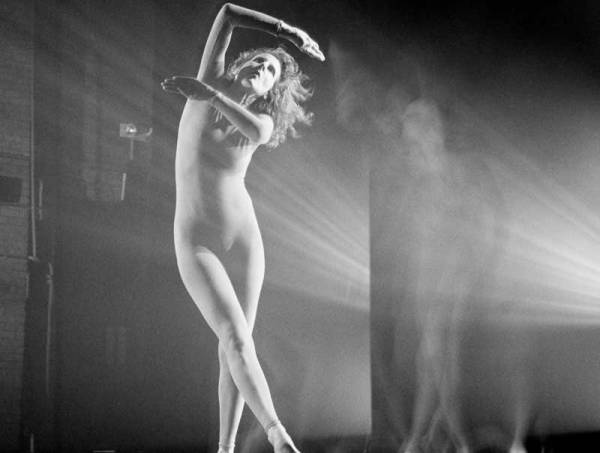

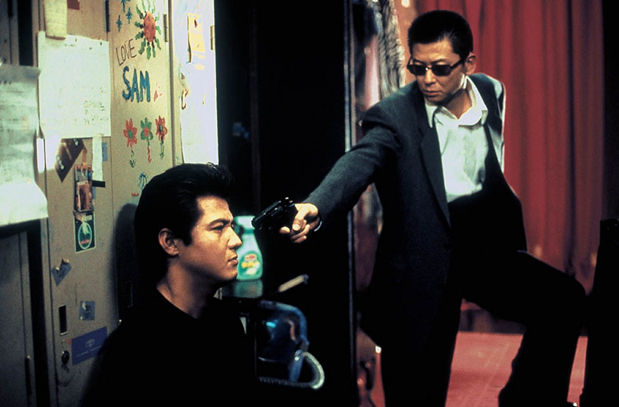
 In Takashi Miike’s Dead or Alive, the ultracool beginning and unforgettably bizarre ending are awesome; unfortunately, the long middle section lacks the excitement and originality of many of his other crime films, from Ley Lines (1999) and City of Lost Souls (2000) to Ichi the Killer (2001) and Izo (2004). The DVD comes with the following warning: “This motion picture contains explicit portrayals of violence; sex; violent sex; sexual violence; clowns and violent scenes of violent excess, which are definitely not suitable for all audiences…. Enjoy at your own risk.” Dead or Alive lives up to its billing with plenty of drugs, sex, violence, blood, gluttony, stabbings, shootings, chopsticks, strippers, sunglasses, sin, sloth, Russian roulette, betrayal, Yakuza battles, explosions, revenge, feces, vomit, communism, cops and robbers, and, yes, clowns. Miike also explores complex relationships among fathers and sons, fathers and daughters, and siblings while delving into one of his most common cross-cultural themes, as Chinese triad boss Ryūichi (Riki Takeuchi) and Japanese detective Jojima (Show Aikawa) prepare for the ultimate showdown. The first of a conceptual trilogy that continues with Dead or Alive 2: Birds (2000) and Dead or Alive: Final (2002), Dead or Alive is screening March 15 at Japan Society as part of the Globus Film Series “Hardest Men in Town: Yakuza Chronicles of Sin, Sex & Violence” and will be introduced by Miike, who is in town for the Film Society of Lincoln Center’s awesome retrospective “Shinjuku Outlaw: 13 from Takashi Miike.” [Ed. note: Takashi Miike has had to cancel all upcoming New York City appearances because of the catastrophic events occurring in Japan.]
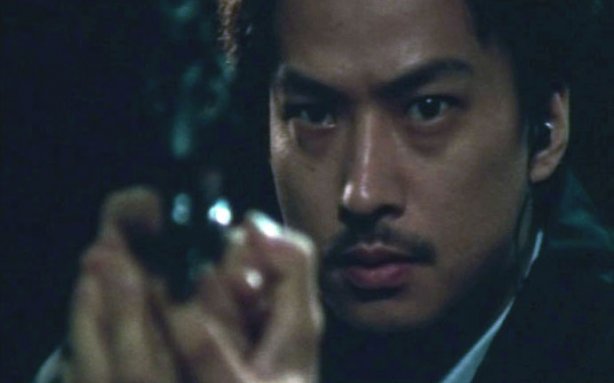
 “Shinjuku is not the best post,” detective Tatsuhito Kiriya says in Shinjuku Triad Society: Chinese Mafia War. Boy, is he not kidding. Takashi Miike’s first major theatrical release after a series of television and straight-to-video projects, 1995’s Shinjuku Triad Society serves as an excellent introduction to the controversial auteur, who is prone to a bit of the old ultra-violence in his films. The fifty-year-old Miike grew up in various parts of Japan but with direct ties to Korean and China, influencing the race battles that drive the Black Society Trilogy, which begins with Shinjuku Triad Society and continues with 1997’s Rainy Dog and 1999’s Ley Lines. In Shinjuku Triad Society, Kippei Shiina stars as Tatsuhito, a cop-on-the-edge desperate to bring down Taiwanese gang leader Wang’s (Tomorowo Taguchi) Dragon’s Claw crime syndicate, turning personal when Tatsuhito’s brother, Yoshihito (Kyosuke Izutsu), starts working for the brutal warlord. The dark, lurid film showcases Miike’s penchant for the extreme, including a ripped-out eyeball, organ selling, slashed bodies, rape, and beheadings. Miike also flips the genre on its head by featuring a lot of gay sex, as Wang has a decided preference for pretty boys. Shinjuku Triad Society, which also features Ren Osugi as Yakuza boss Uchida and Airie Yanagi as sly, dangerous prostitute Ritsuko, is screening March 27 at 4:30 as part of the Film Society of Lincoln Center series “Shinjuku Outlaw: 13 from Takashi Miike,” being held in conjunction with the fine folk over at Subway Cinema. [Ed. note: Miike was originally going to be at the Walter Reade Theater to introduce several screenings but has had to cancel because of the catastrophic events occurring in Japan.]