Yvonne Rainer’s ASSISTED LIVING will get its New York premiere March 16-19 at the Baryshnikov Arts Center
Baryshnikov Arts Center
450 West 37th St. between Ninth & Tenth Aves.
March 16-19, $25, 8:00
212-366-5700
www.performa-arts.org
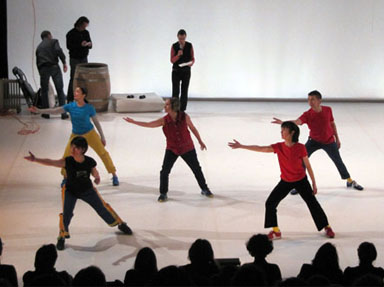
Legendary choreographer and experimental filmmaker Yvonne Rainer looks back while moving ahead at the Baryshnikov Arts Center next week, reprising 2009’s Spiraling Down and presenting the New York premiere of Assisted Living: Good Sports 2. Drawing on principles developed in her seminal work, Trio A, and other pieces from the 1960s, Rainer’s most recent dances incorporate sports, primarily soccer, as well as old and new pop-culture references. For Assisted Living, Pat Catterson, Emily Coates, Patricia Hoffbauer, Emmanuelle Phuon, Keith Sabado, and Sally Silvers were each given photos from the New York Times sports section to inspire their movement; lighting designer Les Dickert, set designer Joel Reynolds, and Rainer herself also appear onstage, involved in set changes and various cues. The work is sponsored by Performa; since 2007, Rainer has been working with the nonprofit arts organization, which “is dedicated to exploring the critical role of live performance in the history of twentieth century art and to encouraging new directions in performance for the twenty-first century.” Rainer, who will turn seventy-seven in November, has been choreographing dances for more than fifty years, having trained with such giants as Martha Graham, Merce Cunningham, and Anna Halprin, in addition to making such influential films as The Man Who Envied Women and Privilege, earning the right to choreograph the questions in our latest, albeit brief, twi-ny talk.
twi-ny: Both works you are presenting at BAC deal with sports and sports photography, among other things. Are you a big sports fan, and what was it from those images that inspired you?
Yvonne Rainer: I am a tennis fan, but do not play myself. As a kid I loved street games, and in high school played softball. But as a choreographer it is not competitive sports that interest me so much as all the incidental movements that do not contribute directly to the rules and organization of play. For example, the languid movements of soccer players when they are waiting to be engaged and the stillness of photos that record the interactions of individual bodies.
twi-ny: How is it different performing at Judson Church back in the 1960s versus performing today in New York City?
Yvonne Rainer: At Judson Church we were a community with shared interests and enthusiasms and objectives. Today in NYC the choreographer is on her own, an autonomous molecule struggling to find a place.
twi-ny: What has it been like collaborating with Performa over the years?
Yvonne Rainer: Performa has been my life saver, a buffer in the cultural maelstrom. Their support has been essential to the continuity of my work.
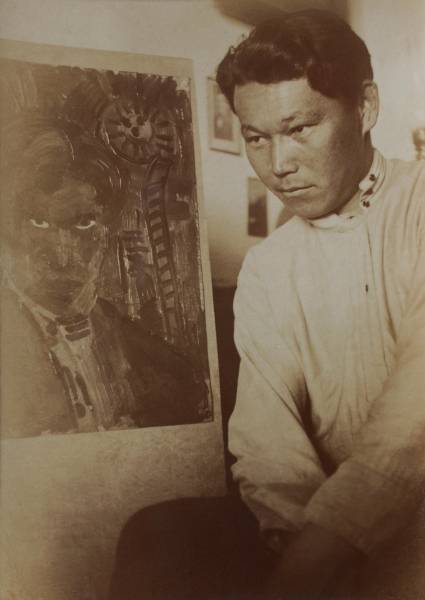
 While making a documentary about grass-roots political activism in the former Soviet Union, Amanda Pope and Tchavdar Georgiev learned of a remarkable museum in the middle of nowhere. Tucked away in the desert border town of Nukus in Uzbekistan is a monument built by one man’s fierce vision and refusal to give up, risking his freedom and security in the name of art. Winner of awards in Beijing, Palm Beach, and Russia and selected for festivals all around the world, The Desert of Forbidden Art tells the compelling story of archaeologist and wannabe painter Igor Savitsky, who devoted his life to amassing a stunning collection of forbidden Soviet avant-garde art, primarily by little-known artists who were challenging the Fascist leadership on beautiful canvases loaded with social and historical relevance. Through interviews with surviving members of some of the artists’ families and friends of Savitsky’s, former New York Times Central Asia bureau chief Stephen Kinzer (the first Western journalist to write about the institution), art historians, longtime Savitsky Museum director Marinika Babanazarova, and others, supplemented by readings from Savitsky’s letters, Pope and Georgiev explore the power art can have in a repressed society as Savitsky, often getting funds from the very government that was banning the art he was collecting, put on public display works by such painters as Alexander Volkov, Kliment Redko, Victor Ufimtsev, Lyubov Popova, and Ivan Koudriachov from among the forty thousand pieces in the museum’s holdings (which now have passed the eighty-thousand mark). One of the most fascinating characters is Ural Tansykbaev, who was believed to have been collaborating with the Fascist government but is revealed to have had a subversive side as well. “I like to think of our museum as a keeper of the artists’ souls,” Savitsky is quoted as saying in the film. “Their works are the physical expression of a collective vision that could not be destroyed.” Sir Ben Kingsley supplies the voice of Savitsky, with Sally Field, Ed Asner, and Igor Paramonov providing voice-overs for various artists. As Pope and Georgiev note, the future of the Savitsky Collection is in jeopardy as it becomes more well known, more people look to profit from it, and Islamic fundamentalists seek to destroy it.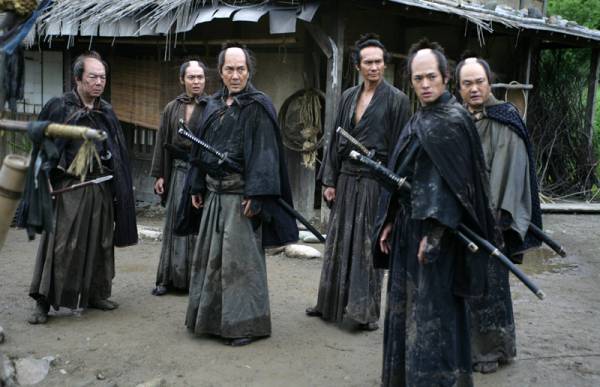
 Japanese director Takashi Miike’s first foray into the samurai epic is a nearly flawless film, perhaps his most accomplished work. Evoking such classics as Kurosawa’s Seven Samurai, Mizoguchi’s 47 Ronin, Aldrich’s The Dirty Dozen, and Eastwood’s High Plains Drifter, 13 Assassins is a thrilling tale of honor and revenge, inspired by a true story. In mid-nineteenth-century feudal Japan, during a time of peace just prior to the Meiji Restoration, Lord Naritsugu (Gorô Inagaki), the son of the former shogun and half-brother to the current one, is abusing his power, raping and killing at will, even using his servants and their families as target practice with a bow and arrow. Because of his connections, he is officially untouchable, but Sir Doi (Mikijiro Hira) secretly hires Shinzaemon Shimada (Kôji Yakusho) to gather a small team and put an end to Naritsugu’s brutal tyranny. But the lord’s protector, Hanbei (Masachika Ichimura), a former nemesis of Shinzaemon’s, has vowed to defend his master to the death, even though he despises Naritsugu’s actions. As the thirteen samurai make a plan to get to Naritsugu, they are eager to finally break out their long-unused swords and do what they were born to do. “He who values his life dies a dog’s death,” Shinzaemon proclaims, knowing that the task is virtually impossible but willing to die for a just cause. Although there are occasional flashes of extreme gore in the first part of the film, Miike keeps the audience waiting until he unleashes the gripping battle, an extended scene of blood and violence that highlights death before dishonor. Selected for the 2009 Cannes Film Festival and nominated for the Silver Lion at the 2010 Venice Film Festival, 13 Assassins is one of Miike’s best-crafted tales; nominated for ten Japanese Academy Prizes, including Best Picture, Best Director, Best Screenplay (Daisuke Tengan), Best Editing (Kenji Yamashita), Best Original Score (Koji Endo), and Best Actor (Yakusho), it won awards for cinematography (Nobuyasu Kita), lighting direction (Yoshiya Watanabe), art direction (Yuji Hayashida), and sound recording (Jun Nakamura). 13 Assassins is the centerpiece of the Film Society of Lincoln Center’s “Shinjuku Outlaw: 13 from Takashi Miike” series, running March 16–20 at the Walter Reade Theater and held in conjunction with Subway Cinema; Miike will be at the March 17 screening, which will be followed by a reception. [Ed. note: Miike was originally scheduled to appear at the Walter Reade Theater to introduce this and several other screenings but has had to cancel because of the catastrophic events occurring in Japan.]