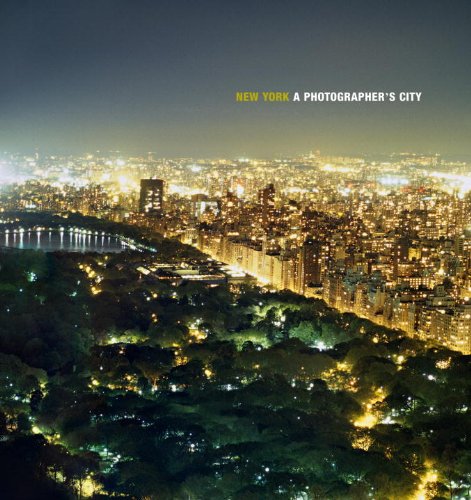
New York is the most photogenic city in the world, serving as the subject of many of the greatest photographs ever taken since the advent of the art form in the mid-to-late nineteenth century. From its rising skyscrapers to its fast-moving denizens, New York offers picture takers an ever-changing, always engaging canvas. “Through all the ways it articulates itself, through its incomparable density of feeling and meaning, New York City remains a singularly vibrant place — and subject — that continues to captivate the eye, the mind, and the soul,” Steve Hamburg writes in the introduction to the new book New York: A Photographer’s City (Rizzoli, March 2011, $45). Collecting more than two hundred images from more than one hundred artists, the book features contemporary photos taken in a post-9/11 world, examining “New York’s shift from the centralized and vertical to the outward and horizontal,” Hamburg notes.

Larry Racioppo, “Sunbather and Giglio,” chromogenic color print, 1998) (courtesy the artist / © Larry Racioppo)
Meanwhile, in the foreword, Elisabeth Sussman looks at another development that makes these photos different from the iconic images of the past: color. “Previously, New York’s image had always seemed tethered to the beauties of black and white, to the chiaroscuro of the grayscale, as if lack of color was the equivalent of the grim, the dour, the tough, the architectural, the contrasts between night and day that became trademarks of the city’s psychology and geography,” Sussman explains. “The images collected here are a revelation of a very special sort because they force the viewer to register the hues of light, weather, night, day, streets, and stone, and the cacophony of products, signs, and building surfaces that constitute the kaleidoscope of urban experience.” Edited by Marla Hamburg Kennedy, the deluxe hardcover features photographs by a who’s who of the contemporary art world, including Jenny Holzer, Roe Ethridge, Hiroshi Sugimoto, Vik Muniz, Tony Oursler, Jeff Mermelstein, James Welling, Andreas Gursky, Wolfgang Tillmans, Catherine Opie, Lucas Samaras, Doug Aitken, Thomas Struth, William Wegman, Abelardo Morell, Ryan McGinley, Joel Sternfeld, and many others. The book is organized thematically, grouped into series of photos depicting bicycles, hands, masses of people seen from above, architectural structures, solitary figures, yellow panoramas, and “for rent” signs.
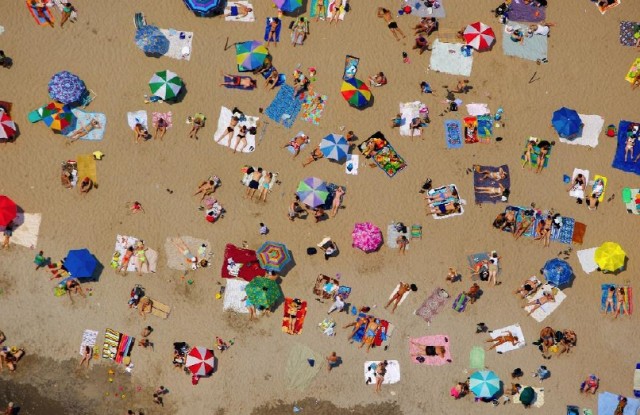
Vincent Laforet, “Coney Island, June 18th,” inkjet print, 2006 (courtesy the artist and Rizzoli / © 2006 Vincent Laforet)
Among our favorites are Pascal Perich’s “Seungling on the Manhattan Bridge,” a portrait of a young woman looking out over a barely visible city; Spencer Tunick’s untitled print of the top half of a man sticking out of a pothole in the middle of the street; Vincent Laforet’s “Coney Island, June 18th” and “Bryant Park, May 31st,” overhead shots of people relaxing on the beach and the grass, respectively; Andy Freeberg’s “Pace Wildenstein,” a shot of the nearly all-white front desk of the gallery, the top of an employee’s head just peeking out from behind a computer; Timo Stammberger’s “Underground #11 (New York City),” taken deep in the subway; and Richard Galpin’s trio of illustrative peeled photographs. One of the best things about New York: A Photographer’s Eye is that it eschews the obvious, instead compiling unusual and unexpected works that will appeal to native and adopted New Yorkers as well as tourists and other visitors.

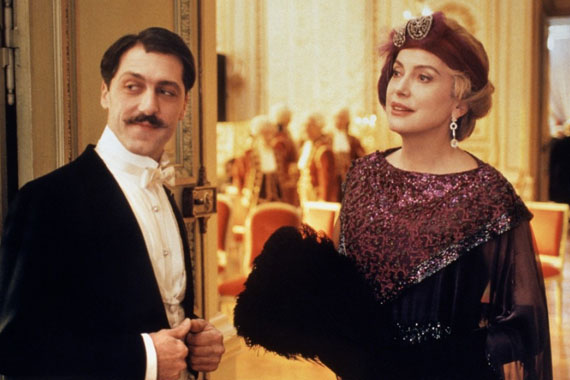
 Raoul Ruiz’s overly long dramatization of Marcel Proust on his deathbed, thinking back on his own life as well as the fictional life of his characters, has charm and wit and a whole lot of bizarrely entertaining set movements. Despite a cast that includes Catherine Deneuve, Emmanuelle Béart, Marie-France Pisier, Chiara Mastroianni (Deneuve’s real-life daughter), and John Malkovich, the acting is only so-so, and it helps if you know a little Proust, but Ruiz is a director always worth watching, so give it a chance—if you have the time. Time Regained is screening March 23 as part of BAMcinématek’s “Deneuve” series, which continues through March 31 with such films as Scene of the Crime (Le lieu du crime) (André Téchiné, 1986), Donkey Skin (Peau d’âne) (Jacques Demy, 1970) , and A Christmas Tale (Arnaud Desplechin, 2008).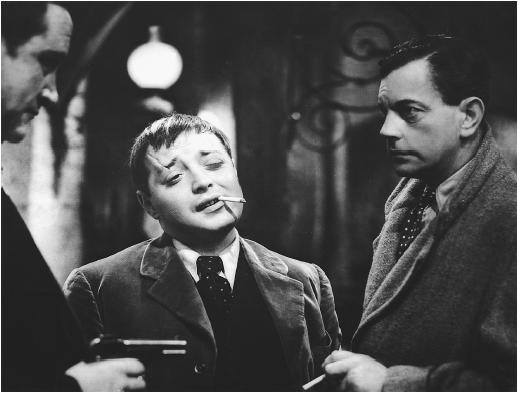
 Alfred Hitchcock’s first version of The Man Who Knew Too Much set off a flurry of successes (The 39 Steps, Secret Agent, Sabotage, Young and Innocent, and The Lady Vanishes) that led to his move to Hollywood. In St. Moritz during a winter sports competition, Louis Bernard (Pierre Fresnay) is participating in the ski jump, while his friend Jill Lawrence (Edna Best) is battling Ramon (Frank Vosper) in a shooting contest. At a dance party that night, Louis is murdered, but not before giving secret information to Jill’s husband, Bob (Leslie Banks). It turns out that Louis was a spy, and Ramon and his associates, including the villainous Abbott (Peter Lorre, displaying terrific two-toned hair), need to make sure that no one else finds out about their nefarious plot, so they kidnap the Lawrence’s precocious young daughter, Betty (Nova Pilbeam), to prevent Bob from talking to the police or the British government. Bob decides to play secret agent himself, enlisting family friend Clive (Hugh Wakefield) to follow the trail to reveal the evil plans while also trying to save Betty. Written by Charles Bennett, who scripted many of Hitchcock’s early British films, and D. B. Wyndham-Lewis, The Man Who Knew Too Much is an exciting thriller filled with light humor and an overabundance of charm; for example, when Betty ruins both Louis’s and her mother’s chances at victory, they shake it off as if it were funny, which it actually isn’t. But the suspense scenes work well, including one set in a dentist’s office in addition to the final shoot-out. Lorre is particularly effective in his first English-language role, which he performed phonetically. The Man Who Knew Too Much is screening March 22 at 7:15 at Anthology Film Archives as part of its “Auto-Remakes” series, comprising works that were remade by the original filmmakers, and will be followed at 9:00 by Hitchcock’s 1956 version, which stars James Stewart and Doris Day as the unsuspecting couple suddenly caught up in international intrigue. (Hitchcock had told François Truffaut that he felt the original was the work of a talented amateur, thus the remake.) The series also features such “auto-remakes” as Yasujiro Ozu’s I Was Born, But… (1932) and Good Morning (1959), Raoul Walsh’s High Sierra (1941) and Colorado Territory (1949), John Ford’s Judge Priest (1934) and The Sun Shines Bright (1953), Leo McCarey’s An Affair to Remember (1939 and 1957), and other reworkings by Ken Jacobs, Ernst Lubitsch, Howard Hawks, and Marcelo Gomes and Karim Aïnouz.
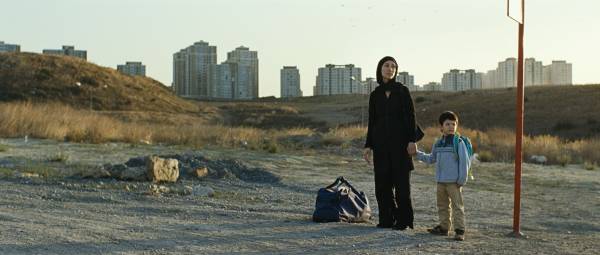
 Viennese actress Feo Aladag makes a powerful directorial debut with her heartbreaking melodrama, When We Leave. Inspired by her work with Amnesty International’s Stop Violence Against Women campaign, Aladag tells the story of a young mother, Umay (Head-On’s Sibel Kekilli), who leaves her abusive husband, Kemal (Ufuk Bayraktar), in Istanbul and returns with her son, Cem (Nizam Schiller), to her family in Germany. But her father, Kader (Settar Tanriogen), her mother, Halime (Derya Alabora), and especially her older brother, Mehmet (Tamer Yigit), insist she return to Kemal despite his mistreatment of her, since she has now brought shame to her family among the tight-knit Turkish community in Berlin. But as Umay refuses their demands and tries to put her life back together, Kader and Mehmet steadfastly turn away from her pleas to be accepted by them and instead conspire to return her and Cem to Kemal, no matter the cost. Winner of the Best Narrative Feature and Best Actress Award (for Kekilli) at the 2010 Tribeca Film Festival and Germany’s official entry for the 2011 Academy Awards for Best Foreign Language Film, When We Leave is a heart-tugging tale of misguided tradition, familial obligation, and the basic need to be loved. The film falters a bit as Umay continues going back to her parents time and time again, risking her life and that of her son, but it’s still a poignant, moving tale reminiscent of Abdullah Oguz’s 2007 film Mutluluk (Bliss), which brilliantly dealt with the theme of honor killings in Turkey. One of the most frightening aspects of the film is that the crimes of honor it deals with are all too real in numerous societies around the world, although Aladag wisely avoids getting overly preachy and pedantic. When We Leave is screening at Symphony Space as part of the weekly Thalia Film Sundays program on March 20, March 27, and April 3.