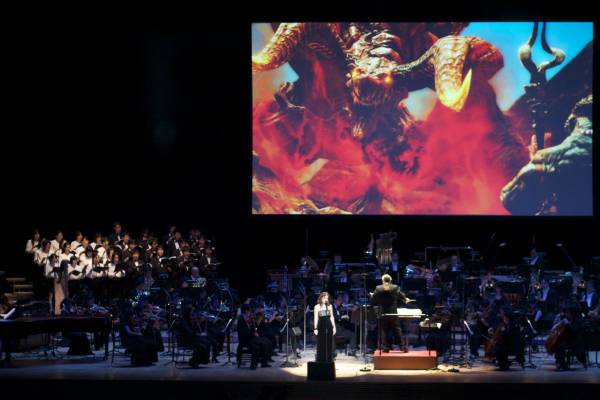
Final Fantasy multimedia concert experience comes to BAM April 1-2 (Final Fantasy XIV © 2010 Square Enix Co., Ltd. Final Fantasy is a registered trademark of Square Enix Holdings Co., Ltd. All material used under license.)
BAM Howard Gilman Opera House
Peter Jay Sharp Building
230 Lafayette Ave.
Friday, April 1, and Saturday April 2, $65-$175, 8:00
718-636-4100
www.ffdistantworlds.com
www.bam.org
Final Fantasy began as a role-playing video game in 1987 and has since expanded into manga, movies, television, and much more, emerging as an international phenomemon with a legion of dedicated fans. In addition to its amazing imagery using cutting-edge technology, Final Fantasy features symphonic scores composed by Nobuo Uematsu, who began making the music for the series shortly after accidentally bumping into creator Hironobu Sakaguchi. On April 1-2, Uematsu and conductor Arnie Roth will present “Distant Worlds: Music from Final Fantasy” at BAM’s Howard Gilman Opera House, performed by the Distant Worlds Philharmonic Orchestra, the Riverside Choral Society, and various soloists, accompanied by a screen showing memorable images and videos from the games. The April 1 program includes FF VII: Prelude, FFVIII: Liberi Fatali, FFXI: Memoro de la Stono — Distant Worlds, FF VII: J-E-N-O-V-A, FF VIII: Fisherman’s Horizon, the American premiere of FF XIV: Answers, FFX: To Zanarkand, FFVI: Terra’s Theme, FFXII: Kiss Me Goodbye, FFV: Clash on the Big Bridge, FFVII: Opening — Bombing Mission, and FFVIII: Don’t Be Afraid, while April 2 consists of FF VII: Aerith’s Theme, FF V: Dear Friends, FF IX: Vamo’ alla Flamenco, FF VI: Opera “Maria and Draco,” FF IX: A Place to Call Home — Melodies of Life, FFX: To Zanarkand, FFVI: Terra’s Theme, FFXII: Kiss Me Goodbye, FFV: Clash on the Big Bridge, FFVII: Opening — Bombing Mission, and FFVIII: Don’t Be Afraid. “Distant Worlds” has been touring the world, delivering its multimedia concert experience to fans who can’t get enough of Final Fantasy and its depiction of the ultimate battle between good and evil. Tickets start at $65, but if you splurge for the $175 package you get to meet Uematsu and Roth and attend an autograph and photo session. (If you use code 13999, you’ll save $10 on all tickets.)
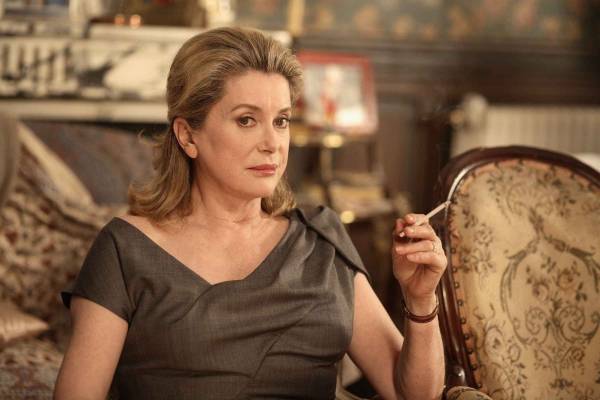
 One of the best films of 2008, A Christmas Tale (Un Conte de Noël) is yet another extraordinary work from French filmmaker Arnaud Desplechin (La Sentinelle, Esther Kahn). Desplechin, who examined family dysfunction in the masterful Kings and Queen (one of the best films of 2006), brings back much of that film’s cast in A Christmas Tale. Catherine Deneuve stars as Junon, the family matriarch who has just discovered she has leukemia and is in need of a bone-marrow transplant. Although it is rare for children to donate bone marrow to their mother (or grandmother), Junon insists that they all take the test to see if they are compatible. Soon they gather at Junon and Abel’s (Jean-Paul Roussilon) house for the holidays: oldest daughter Elizabeth (Anne Consigny), a dark and depressed woman whose teenage son, Paul (Emile Berling), has been institutionalized with mental problems and whose husband, Claude (Hippolyte Girardot), is rarely home; Ivan (Melvil Poupaud), the youngest son, a carefree sort married to Sylvia (Chiara Mastroianni, Deneuve’s real-life daughter), whom Junon strongly distrusts; and black sheep Henri (Mathieu Almaric), the middle child who was initially conceived primarily to save Abel and Junon’s first son, Joseph, who ended up dying of the same leukemia that Junon has contracted. Henri, who shows up with a new girlfriend, the very direct Faunia (Emmanuelle Devos), is a philandering ne’er-do-well who is deeply estranged from Elizabeth and not close with his mother, leading to much strife as Christmas — and a possible transplant — nears. Desplechin, who wrote the script with Emmanuel Bourdieu, once again has created powerful, realistic characters portrayed marvelously by his extremely talented cast; despite the family’s massive dysfunction, you’ll feel that even spending more than two and a half hours with them is not enough. A Christmas Tale concludes BAMcinématek’s month-long “Deneuve” series in high style.




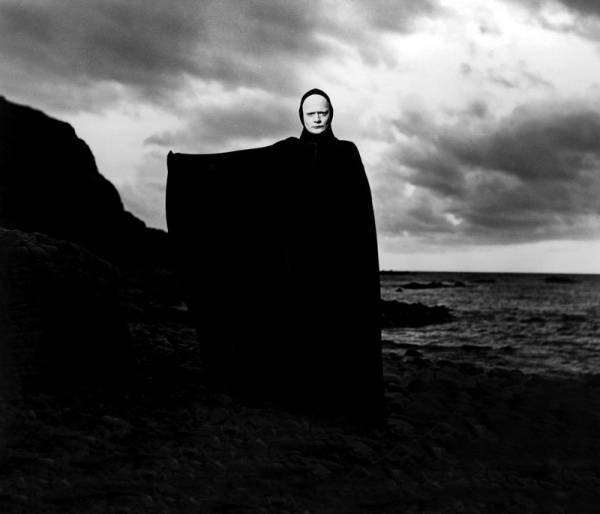
 It’s almost impossible to watch Ingmar Bergman’s The Seventh Seal without being aware of the meta surrounding the film, which has influenced so many other works and been paid homage to and playfully mocked. Over the years, it has gained a reputation as a deep, philosophical paean to death. However, amid all the talk about emptiness, doomsday, the Black Plague, and the devil, The Seventh Seal is a very funny movie. In fourteenth-century Sweden, knight Antonius Block (Max von Sydow) is returning home from the Crusades with his trusty squire, Jöns (Gunnar Björnstrand). Block soon meets Death (Bengt Ekerot) and, to prolong his life, challenges him to a game of chess. While the on-again, off-again battle of wits continues, Death seeks alternate victims while Block meets a young family and a small troupe of actors putting on a show. Rape, infidelity, murder, and other forms of evil rise to the surface as Block proclaims “To believe is to suffer,” questioning God and faith, and Jöns opines that “love is the blackest plague of all.” Based on Bergman’s own play inspired by a painting of Death playing chess by Albertus Pictor (played in the film by Gunnar Olsson), The Seventh Seal, winner of a Special Jury Prize at Cannes, is one of the most entertaining films ever made. (Bergman fans will get an extra treat out of the knight being offered some wild strawberries at one point.) The film is screening on March 29 at 1:00 as part of the Film Society of Lincoln Center’s Janus Films Classics series and will be followed at 3:00 by Bergman’s Cries and Whispers (1972).