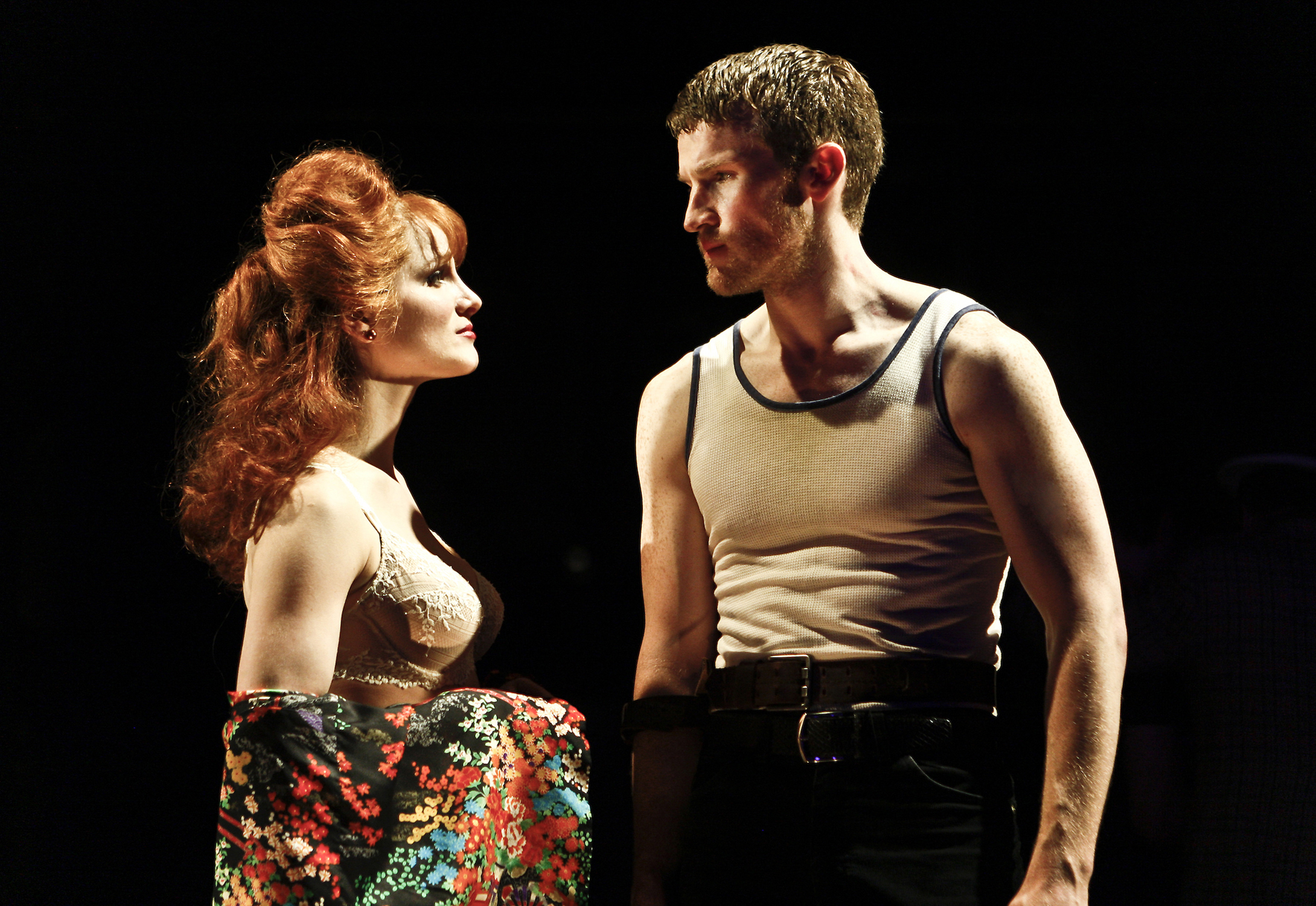
Larisa Polonsky and Claybourne Edler offer a different take on the kindness of strangers in Tennessee Williams’s ONE ARM (photo by Monique Carboni)
The Acorn Theater at Theatre Row
410 West 42nd St. between Ninth & Tenth Aves.
Through July 2, $61
www.thenewgroup.org
www.tectonictheaterproject.org
www.theatrerow.org/theacorn.htm
Early on in One Arm, Moisés Kaufman’s adaptation of a 1940s short story and unproduced 1960s screenplay by Tennessee Williams, the main character, Ollie Olsen (Claybourne Elder), says, “Somebody tole me that if you stand in one place long enough near the sea or the Gulf, a sea gull will fly over and shit a pot of gold on you. Is that a fact or a fiction?” It’s a fact that there’s no pot of gold waiting for Ollie, a one-armed street hustler facing the electric chair. A onetime lightweight boxing champion of the Pacific fleet, Ollie gave up on life immediately after losing his limb. “Oliver couldn’t have put into words the psychic change which came with his mutilation,” Williams writes in the short story. “He knew that he had lost his right arm, but didn’t consciously know that with it had gone the center of his being. But the self that doesn’t form words nor even thoughts had come to a realization that whirled darkly up from its hidden laboratory and changed him altogether in less time than it took new skin to cover the stump of the arm he had lost. He never said to himself, I’m lost. But the speechless self knew it and in submission to its unthinking control the youth had begun as soon as he left the hospital to look about for destruction.” Elder plays Ollie as a matter-of-fact loser awaiting his ultimate fate, resigned that life has nothing left to offer, a far cry from his contemporary, Midnight Cowboy’s Joe Buck. Ollie has chosen not to care about what goes on in his new life, letting things happen to him instead of taking action as he moves from Los Angeles to New York and New Orleans; when he finally does react, it lands him on death row. Kaufman (The Laramie Project, Bengal Tiger at the Baghdad Zoo) keeps things appropriately low-tech, dank, and dark. Instead of trying to come up with a way to hide Ollie’s right arm, Kaufman has chosen to keep it always visible, tied to the former boxer’s taut body with a black belt. “Think of it as an arm that doesn’t exist,” the onstage narrator (Noah Bean) explains. Derek McLane’s set and David Lander’s lighting offer excitements galore, as Ollie’s bed serves multiple purposes, including getting turned around and used as a car, while Lander employs a dangling lamp as an inventive spotlight. The ensemble changes costumes and roles in a flash; particularly impressive are Larisa Polonsky as Lila, a girl in the French Quarter, and a nurse interested in Ollie, and Greg Pierotti as Cherry the pimp, a man in the park, and a middle-aged homosexual. Unlike so much of Williams’s work, there are no passionately melodramatic scenes, no Stanley Kowalski screams, no Big Daddy speeches. Kaufman maintains a calm, relatively subdued atmosphere, although the inclusion of the narrator is a major flaw. For the most part, the narrator is either telling the audiences things they can figure out for themselves or filling in gaps in the story that would have been better acted out; it sometimes feels as if the narrator is being used as an excuse not to have to stage a specific scene. Since the play runs only eighty minutes, this gives it a rushed, at times unfinished feel. A production of the New Group in collaboration with Kaufman’s Tectonic Theater Project, One Arm might be minor Tennessee Williams, but even minor Tennessee Williams still packs a punch.

 Iranian-American documentarian Tanaz Eshaghian (I Call Myself Persian, Be Like Others) and cinematographer Kat Patterson gained remarkable access to Afghanistan’s Badam Bagh women’s prison for their fascinating HBO film, Love Crimes of Kabul. Having its U.S. premiere at the twenty-second Human Rights Watch Film Festival, Love Crimes focuses on the intriguing stories of three imprisoned women. Eighteen-year-old Sabereh was arrested after her father turned her in for allegedly having sex with her seventeen-year-old neighbor, Abbas, even though lab reports show she is still a virgin. The twenty-year-old and pregnant Kareema turned in herself and her fiancé, Firuz, in the hopes of forcing him to marry her. And twenty-three-year-old Aleema is in jail because she ran away from her abusive husband and took shelter with Zia and her son, both of whom were arrested as well for attempting to sell her; meanwhile, Zia is trying to convince Aleema to marry her son in order to save them all from shame. Approximately half of the 125 female inmates at Badam Bagh have been incarcerated for either having premarital sex, running away from home, or committing adultery, many of them facing upwards of fifteen to twenty years for their actions. The women are remarkably open and honest, making their own cases to the camera while condemning those of their fellow inmates. Eshaghian captures Kareema speaking to her mother through the prison gates as they discuss the possibility of her father making a financial deal with Firuz and his family. Forty-five-year-old Naseema, the elder spokesperson of the group, proudly talks about having killer her husband, whom she claims deserved it because of his penchant for adultery, including with a seven-year-old girl. And the prison guards regularly defend the laws that essentially make certain kinds of love a crime in Afghanistan. Although she is not allowed into a wedding ceremony or two of the trials, Eshaghian does film one of the trials; she also photographs Firuz’s parents talking to her very directly while in bed, and Aleema holds nothing back when discussing her divorce and her unwillingness to marry Zia’s son, primarily because she claims he couldn’t afford to keep her in the lifestyle she wants. Eshaghian presents the facts and the myriad opinions without embellishment, letting these deeply personal and inherently infuriating stories speak for themselves, revealing a frighteningly old-fashioned society that is doing everything it can to prevent the freedom of women to make their own choices. Part of the “Migrants’ and Women’s Rights” section of the Human Rights Watch Festival, which also includes “Times of Conflict and Responses to Terrorism,” “Human Dignity, Discrimination, and Resources,” and “Truth, Justice, and Accountability,” Love Crimes of Kabul will be shown June 20-22, with all three screenings followed by a discussion with Eshaghian. The festival, which runs through June 30, features nineteen films from twelve countries that deal with human rights issues around the world.