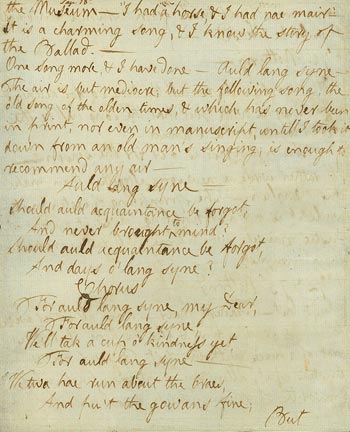
Robert Burns, “Auld Lang Syne” (detail), autograph manuscript written within a letter, dated (September 1793), to George Thomson
Morgan Library & Museum
225 Madison Ave. at 36th St.
Tuesday – Sunday through February 5, $15 (free Fridays 7:00 – 9:00)
212-685-0008
www.themorgan.org
Tonight at midnight, people around the world will break out into the same song, “Auld Lang Syne,” welcoming in 2012, but how many of those revelers know the true story about the famous tune? The Morgan Library is currently hosting a splendid little exhibition that examines the details behind the music and lyrics of the popular ditty, whose three-word title translates to “old,” “long,” “since.” It was Scottish poet Robert Burns who combined the familiar music and lyrics for publisher James Johnson in 1796, although there were different versions both before and after, from a 1667 lover’s lament and a 1760s Caledonian country dance to William Shield’s 1782 opera, Rosina, and Rudyard Kipling’s 1900 Boer War revision. The show, which comprises original letters, manuscripts, portraits, rare books, and even an arrangement by Beethoven, also features a strong online component where you can read and listen to snippets of the evolution of the complete song, so you’ll be able to surprise your fellow partyers tonight by breaking out into all four Burns stanzas, including “We twa hae run about the braes, / And pu’t the gowans fine; / But we’ve wander’d mony a weary foot, / Sin auld lang syne.” In addition, the Morgan will be celebrating the eve of Burns Day on January 24 with the special concert “Days of Auld Lang Syne: Euan Morton Sings Songs of Scotland,” in which the singer and actor will perform Scottish works, accompanied by composer Bryan Reeder on piano. (Also currently on view at the Morgan are “Charles Dickens at 200,” “Treasures of Islamic Manuscript Painting from the Morgan,” and “David, Delacroix, and Revolutionary France: Drawings from the Louvre.”

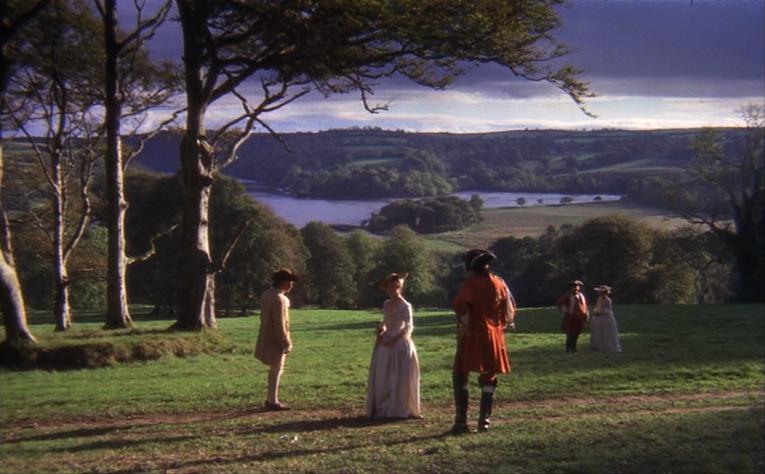
 The Museum of the Moving Image concludes its “See It Big!” series, in which major motion pictures that deserve to be seen on the big screen are shown in the museum’s recently renovated and expanded theater, with one of the most elegantly visual pictures ever made, Stanley Kubrick’s lush, romantic epic, Barry Lyndon. Based on William Makepeace Thackeray’s 1844 serialized picaresque novel The Luck of Barry Lyndon, Kubrick’s extravagant three-hour tale follows the shenanigans of one Redmond Barry, played with endless charm by Ryan O’Neal. The man soon to be known as Barry Lyndon has a remarkable knack for survival — or maybe it’s just plain old Irish luck — as he rises in English society via a series of duels (with epees, guns, and bare knuckles), military battles (the Seven Years’ War), and, most prominently, sexual conquests. Consisting of two sections, “By What Means Redmond Barry Acquired the Style and Title of Barry Lyndon” and “Containing an Account of the Misfortunes and Disasters Which Befell Barry Lyndon,” the film features glorious music by Bach, Vivaldi, Handel, Mozart, Schubert, and the Chieftains in addition to absolutely divine locations and costumes that lay the groundwork for the sumptuous Oscar-winning art direction by Ken Adam, Vernon Dixon, and Roy Walker and cinematography by John Alcott; virtually every scene contains beautiful shots based on famous paintings, a treat for the eyes and the ears. (Leonard Rosenman took home an Academy Award as well for his adapted score.) The overly long story does drag at times, but it flows better once you get used to O’Neal in the title role. The underappreciated film also has a great supporting cast, with Marisa Berenson as Lady Lyndon, Patrick Magee as the Chevalier de Balibari, Hardy Krüger as Captain Potzdorf, Steven Berkoff as Lord Ludd, Leonard Rossiter as Captain John Quin, and Gay Hamilton as Nora Brady. The Museum of the Moving Image is screening a restored 35mm print of Barry Lyndon on December 30 at 7:00 and January 1 at 6:00.
 Canadian-born director James Cameron (The Terminator, Aliens, The Abyss, and some movie about a big sinking ship) crafts an expensive, high-tech apology to native people the world over in the futuristic adventure thriller Avatar. Borrowing elements from such films as The Matrix, Alien, the Lord of the Rings trilogy, the Star Wars saga, Disney’s animated Pocohantas, Reign of Fire, and many a cowboy-and-Indian tale, Cameron propels audiences into 2154, where a team of scientists join up with military troops on Pandora, home to the invaluable mineral unobtainium as well as a native race known alternately as the na’vi, or the People. In the middle of it all is Jake Sully (Sam Worthington), a wheelchair-bound former Marine who takes the place of his brilliant brother, who was recently murdered. While head researcher Dr. Grace Augustine (Sigourney Weaver) thinks bringing Jake on board is a mistake, Col. Miles Quaritch (Stephen Lang) sees it as an opportunity to make use of Jake’s expert reconnaissance skills, so Jake takes over what would have been his brother’s avatar — a giant creation modeled after the na’vi that humans can operate from a pod while asleep and that gives Jake the opportunity to walk again through this tall blue being. Quaritch secretly promises Jake that he will get him the costly procedure that will give him back the use of his real legs if he infiltrates the na’vi and sends intel back to the colonel as the military prepares an all-out assault on the People, but when Jake falls for the beautiful Neytiri (Zoë Saldaña), he undergoes a change of heart. As with most Cameron films, the visual splendor is thwarted by a tired, clichéd script that devolves into complete silliness in the last half hour, spurred on by James Horner’s treacly score and plenty of poorly delivered lines. But Avatar is still lots of stupid fun, especially if you see it in 3D, as it is being shown December 29 at the Museum of the Moving Image as part of the “See It Big!” series, which concludes December 30 and January 1 with Stanley Kubrick’s lush and elegant Barry Lyndon.
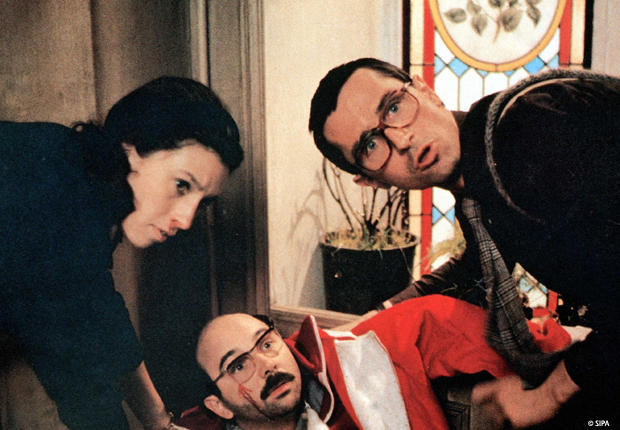
 While here in America, Christmas movie traditions tend to be on the more sappy side, like the treacly It’s a Wonderful Life, Miracle on 34th St., or any one of a number of updated versions of A Christmas Carol, France has a very different idea of what qualifies as a holiday favorite. Le père Noël est une ordure, also known as Santa Stinks (or the closer translation Father Christmas Is a Bastard), has been a cult classic going on thirty years now. The no-holds-barred seasonal slapstick satire is the creation of Jean-Marie Poiré and the members of the popular Le Splendid café-théâtre company, who spend a New Year’s Eve together like you’ve never seen before. Thérèse (Anémone) and Pierre (Thierry Lhermitte) work at a suicide-prevention hotline, but they are not very good at helping lonely, depressed people, as shown early on when a man calls from a phone booth and quickly puts a bullet in his head when no one at the SOS Detresse Amitié really listens to him. Meanwhile, their cranky coworker, Madame Musquin (Josiane Balasko), gets trapped in an elevator, desperate to get to her Christmas Eve dinner; young transvestite Katia (Christian Clavier) stops by looking for a little love; neighbor Preskovic (Bruno Moynot) keeps bringing over the most disgusting homemade treats imaginable; and low-level crook Félix (Gérard Jugnot) wanders around in a Santa suit, chasing rabbits and wielding a gun while his pregnant wife, the obnoxiously chatty Josette (Marie-Anne Chazel), does everything she can to get away from him while also commenting on all the fun. Le père Noël est une ordure has no sympathy for the holiday season, instead reveling in low-grade humor, over-the-top violence, and surprising plot twists that are not at all what you’d expect from a Christmas movie. With that in mind, MoMA has chosen to present the U.S. theatrical premiere of this French farce with a one-week run beginning December 28 so as not to ruin your Christmas celebration. (And to further save you from potential ruination, be sure to pay no attention whatsoever to Nora Ephron’s all-star 1994 dud, Mixed Nuts, which was loosely based on Le père Noël est une ordure.)